When I tested a 35-foot non-resonant wire with my KH1 last week, I was pleased with the results. Continuing with that theme, I thought I’d try a 29-foot wire, another popular non-resonant length.
I drove back to Valley Forge National Historical Park (US-0761, KFF-0761) and re-created the setup I used last time. To support the wire, I again used my homebrew drive-on mount to support a partially extended 31-foot Jackite pole. I’m guessing the pole was up about 27 feet, give or take. I set up my camp chair nearby and ran the wire over to the KH1. Starting off, I used a 17-foot counterpoise wire.
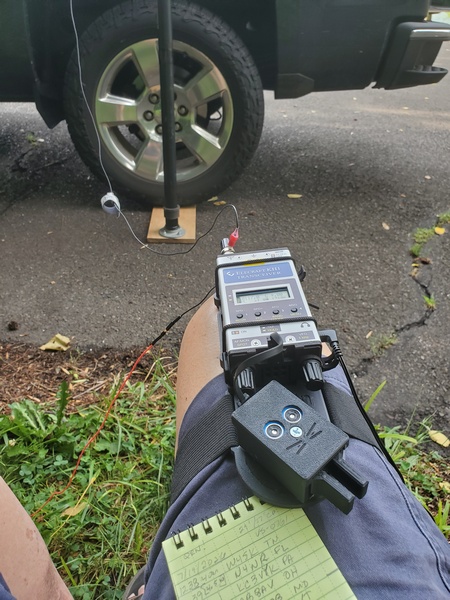
First, I checked to see what kind of match the KH1 would find on its five bands. The SWR was very low on all bands except for 20M, where the best the KH1 would do was around 2.4:1.
I started my activation on 40M, and the wire seemed to get out pretty well. Although the band was noisy with static crashes, I made my first ten contacts in about 11 minutes. I eventually moved up to 30M, but I only had one hunter there.
At that point, I took a break to experiment with counterpoise wires. I tried both 29-foot and 13-foot counterpoise wires, but neither of them improved the match on 20M. I also tried repositioning the counterpoise with no luck.
I left the 13-foot counterpoise wire attached and went back to 40M. I made an additional handful of contacts on 40M before trying 17M. On 17M, I picked up three more before calling it quits.
Admittedly, I had high hopes for the 29-foot wire. I’ve used that length a bunch of times, although usually with a 9:1 unun and rigs with more robust tuners. In any event, it worked well on bands other than 20M. I managed 26 contacts in a little more than an hour.
On the drive home, I thought about some ways to improve the match on 20M. I’m not sure any of them are really worth the effort, though. For now, I’ll just stick with 35-ft when I use a random wire with the KH1.
72, Craig WB3GCK


I really enjoy reading your posts
73, Ken KG4BIG
LikeLike
Thanks, Ken!
LikeLike