I headed back to Valley Forge National Historical Park (US-0761, KFF-0761) to try out an antenna configuration I didn’t get to during my last visit. I was eager to see how well my Elecraft KH1’s internal ATU would match it.
The antenna in question is just a 35-foot wire with a 17-foot counterpoise. There’s nothing novel about this configuration, as it’s a popular choice for the Elecraft KH1. Since I bought the KH1 last summer, I had never tried directly feeding a random wire. Since I already had the 35-foot wire I used in North Carolina last year, I gave it a go this morning.
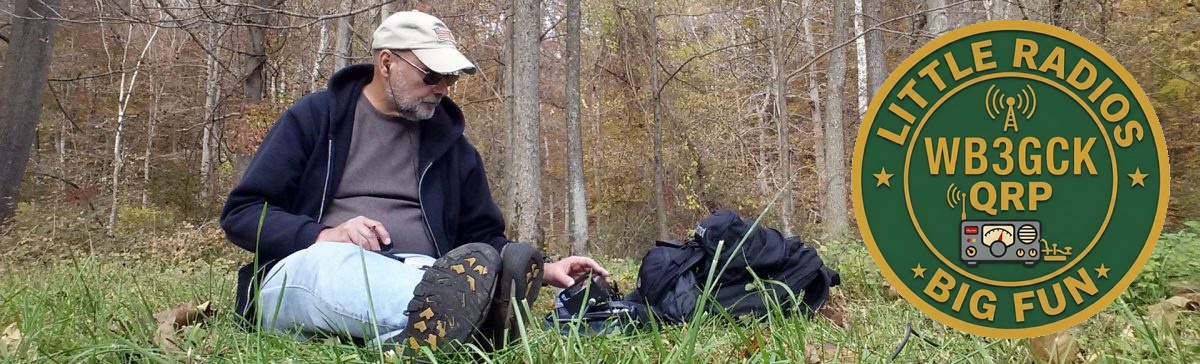
To support the 35-foot wire, I used a 31-foot Jackite pole on my homebrew drive-on mount. I sloped the wire down to my camp chair. I laid out the counterpoise wire in the grass and used a binding post to a BNC adapter to connect both wires to the KH1. To hold the KH1, I used a kneeboard from Tufteln strapped to my leg. I used my CWMouse paddles for sending.

Before starting my activation, I tried the KH1 on each of its five bands. The KH1 found a 1:1 match on both 40M and 30M. The 20M band gave the highest SWR at 1.6:1; however, the KH1 was putting out a full five watts on that band. On both 17M and 15M, the SWR was a respectable 1.3:1.

Satisfied that the KH1 was happy with this antenna configuration, I got underway on 40M. The wire seemed to get ust fine, but it’s hard to judge an antenna’s performance on the air. There are just too many variables in play. Anyway, I made contacts all up and down the East Coast and out to the mid-west. I ended up making contacts on 40M, 30M, and 20M. It was a bit too early in the morning for 17M and 15M.
After an hour and 10 minutes, I wrapped up with 25 contacts in my log with nine park-to-park contacts. Not too bad for early on a Monday morning, I suppose.
Overall, I was very happy with the 35-foot wire with the KH1. I think it might be a permanent addition to my backpack. It certainly doesn’t take up much room. I’ll probably be using it for the upcoming Flight of the Bumblebees contest.
72, Craig WB3GCK

