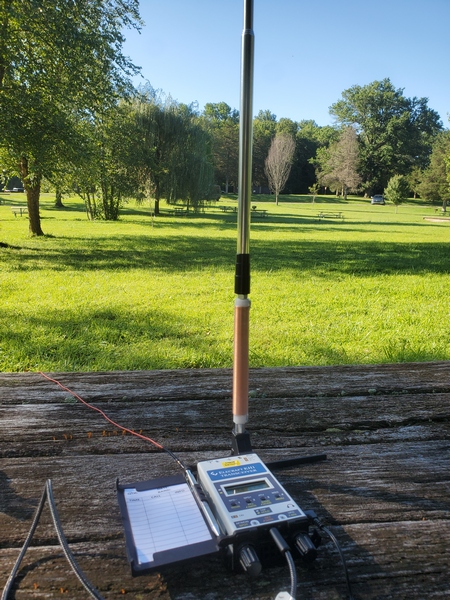
I made an early-morning run up to Evansburg State Park (US-1351, KFF-1351) for a quick activation. My plan for this activation was to try out my Gabil GRA-CFP2600 carbon fiber whip in the “Gabil-on-a-Table” configuration I have been using lately.
The weather forecast was showing a chance of late morning rain, so I headed out a little earlier than I normally do. On arrival, I grabbed my gear and headed for a picnic table in a wooded area that I’ve used many times over the years. It only took a few minutes to get the antenna set up with two 16.5-foot radials laid out on the ground. I easily found a good match on 40M and got started.
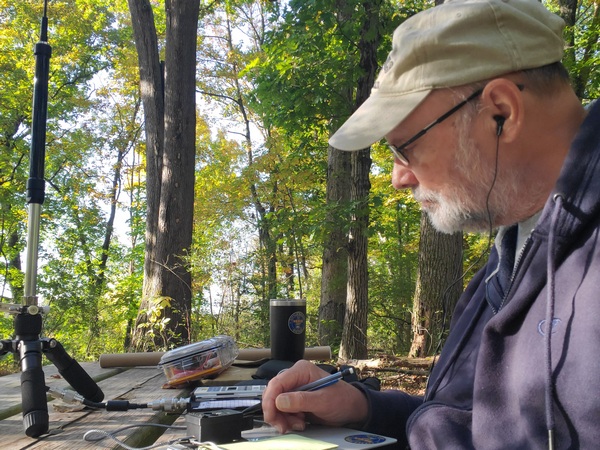
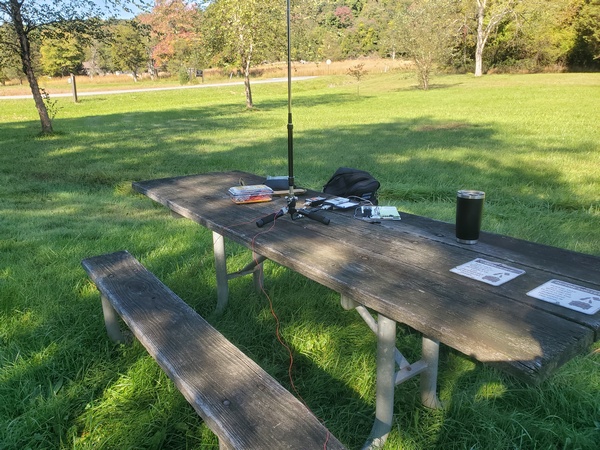
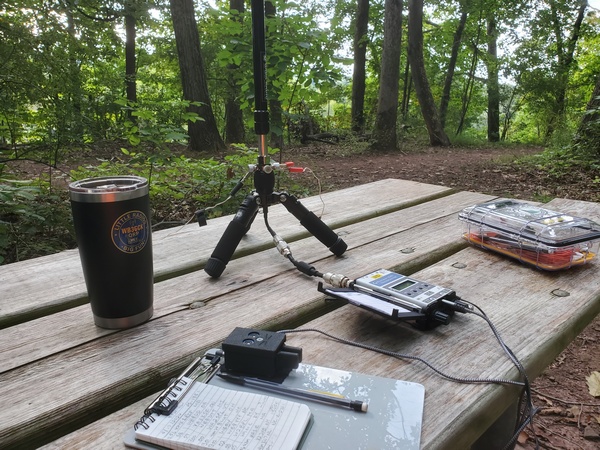
Operating at Evansburg State Park with the KH1 and Gabil antenna
My first 15 contacts came fairly easily, so I checked 30M and 20M. I picked up one contact on each of those bands. I could tell from the POTA spots that most of the activity was on 40M. That’s usually a good indicator of which bands are working. So, back to 40M I went. I picked up eight more contacts, bringing my total to 25. Subtracting out my time playing around with the antenna, I was on the air for about 40 minutes.
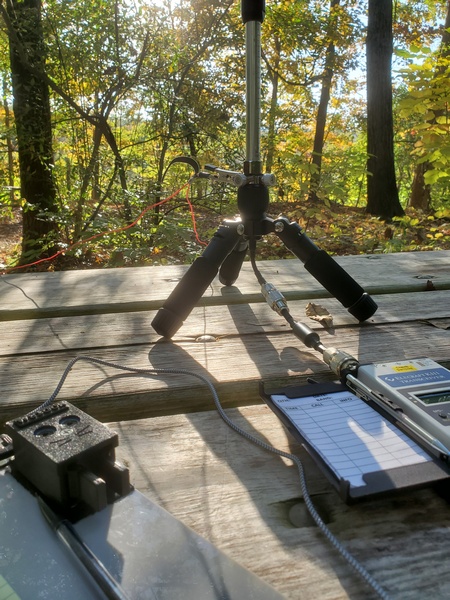
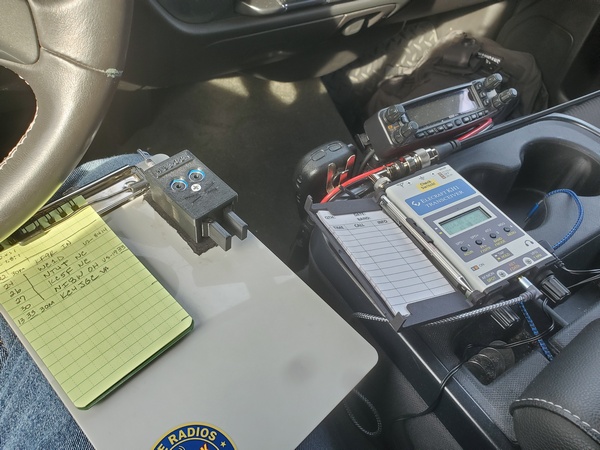
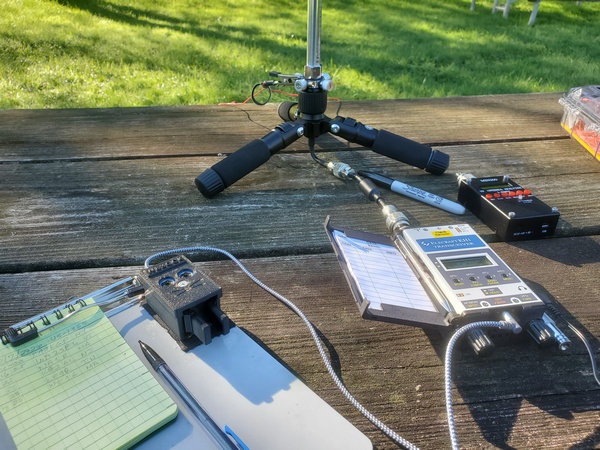
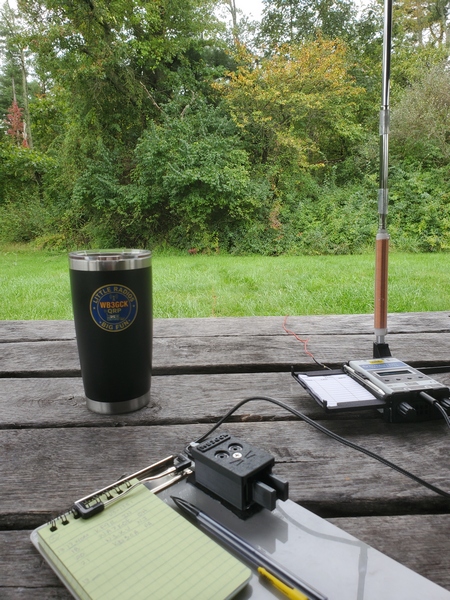
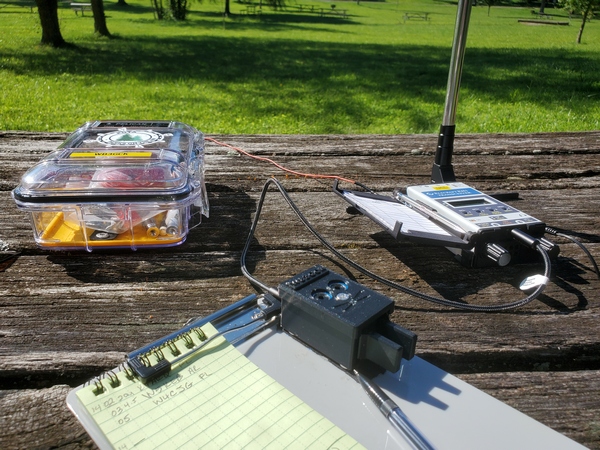
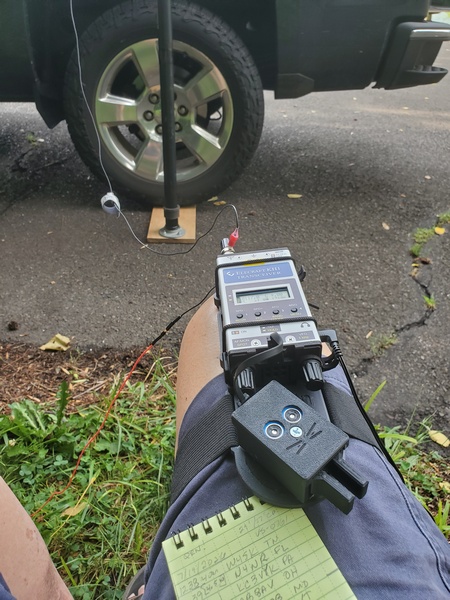
Gabil antenna, KH1, and CWMouse paddles. Once again, I neglected to take a picture of the carbon fiber whip in use.
One thing I noticed was that 20M was a little touchy to tune up. That’s something I’ve experienced a time or two in the past. This morning, the best I could do was an SWR of 2.0:1. The KH1’s ATU handled that easily. I’m sure I could have gotten the SWR lower by adding more radials—which I didn’t have with me. I’ll have to remember to pack a couple more radials next time.
In any event, it was a beautiful morning to be out in the park. Plus, I got home before the rain started. Timing is everything.
In my last post, I mentioned how I damaged the telescopic whip, which is part of my Gabil GRA-7350TC antenna. The replacement telescopic whip has a long lead time, so I ordered a carbon fiber whip from Gabil in the meantime. Less than 24 hours after Amazon delivered it, I put the new whip to the test.
The new whip is the Gabil GRA-CFP2600 carbon fiber whip. Weighing in at just 78 grams (2.75 ounces), it’s a lightweight whip that breaks down into five separate sections. Fully assembled, it measures 248.4 cm (8 feet, 1.8 inches). That’s a tad longer than the stock whip. The sections are thin, but rigid. They slide together with a friction fit and make a distinctive “pop” when separated.
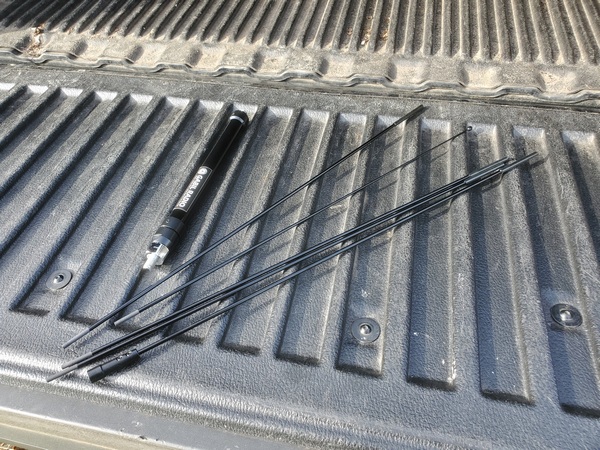
The five sections of the GRA-CFP2600 whip. The GRA-7350TC loading coil is on the left. Unfortunately, I neglected to take a picture of the antenna assembled for use.
To try it out, I headed over to Marsh Creek State Park (US-1380, KFF-1380) near one of the boat launches. Being a sunny and brisk October day, the parking lot was jam-packed with folks taking advantage of the weather. My original plan was to operate from a picnic table next to the lake. Since someone was already using the table, I operated from the truck.
To try out the new whip, I used a mag mount on the roof of the truck and ran the coax to my KH1 inside the truck. Using an antenna analyzer, I easily tuned up the antenna on 40M and got started. The band was as busy as the park. There were a couple of contests going on besides the large number of POTA stations I heard.
After finding an open frequency, I started calling CQ. The carbon fiber whip seemed to work well. I logged my first 10 contacts in just 10 minutes. After about 15 minutes, I was getting a headache from hearing stations on adjacent frequencies. I opted to seek refuge in the calmer waters of 30M. I picked up several more contacts before shutting down. After 40 minutes I had 22 contacts with four park-to-park contacts. I had P2P contacts on two bands from both WC1D and NI8W. Thanks, guys!
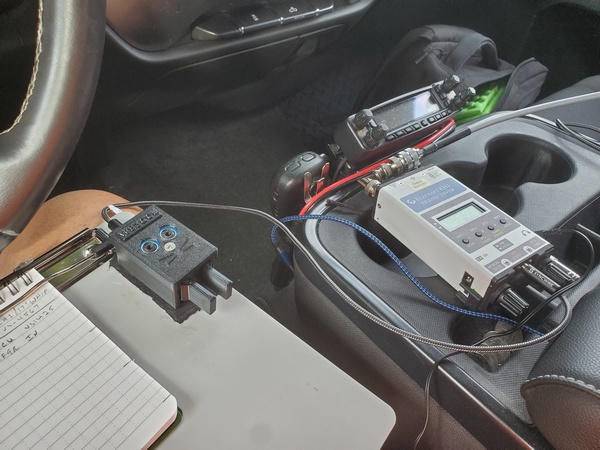
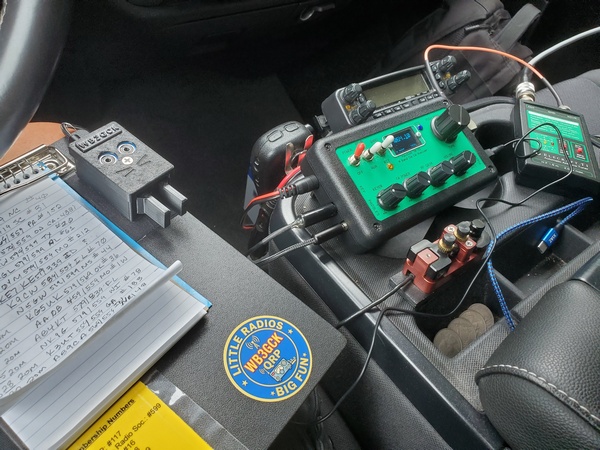
My usual KH1 setup in the truck
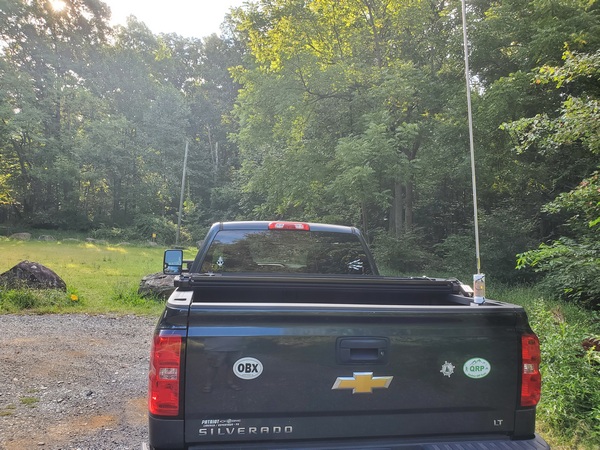
Before packing up the antenna, I did a quick check of the SWR on 20M and 17M. No issues tuning up on those bands. In my haste to pack up, however, I neglected to take a picture of the antenna installation. So, you’ll just have to use your imagination to picture a thin, black, eight-foot whip on a magnetic mount.
This carbon fiber whip has been on the market for a while, so I won’t bore you with a detailed review. YouTube has several reviews, and the Gabil website features two of them. However, there are a couple of pros and cons from my first outing with it.
Pros:
It’s super lightweight
Goes together quickly
Seems more rugged than the original telescopic whip
On the air, it seems to work as well as other short whips I have used. Certainly, as well as the original telescopic whip.
Cons:
Broken down, the pieces are significantly longer than the rest of the GRA-7350TC components. I have to pack them separately from the rest of the Gabil GRA-7350TC components.
Speaking of packing… Other than the cardboard tube it ships in, there is nothing provided to store the pieces in. I’m still thinking about how I will pack and transport this whip in the field. I’m thinking about buying a tent pole bag to carry it in. If any GRA-CFP2600 owners have suggestions, I’m all ears.
The GRA-CFP2600 whip is a novel design from the good folks at Gabil. It certainly has the high quality that is typical of their other products.
As always, this blog has no advertisers or sponsors. I bought the GRA-CFP2600 with my own funds.
I made a run up to French Creek State Park (US-1355, KFF-1355) for a quick, early-morning activation. While my activation was successful, it was not without a self-inflicted issue or two.
It was a beautiful, brisk fall morning here in southeastern Pennsylvania, so I set up at a picnic table. I used my Gabil GRA-7350TC antenna on top of the table, like I did a few weeks ago. As in the earlier activation, I used two 17-foot radials and no additional coax besides the Gabil RF choke. Using an antenna analyzer, I quickly found a good match on 40M.
My picnic table setup
I connected the KH1 and started calling CQ. When I picked up my phone to spot myself, I had no cell service. My cellphone carrier’s coverage is hit or miss in this park. The hotspot in my truck uses a different carrier, so I usually spot myself from the truck—something I neglected to do. Doh! Despite my oversight, I worked two stations that just happened to hear my CQs. After that…nothing. So, I headed back to the truck to post spots for POTA and WWFF.
My KH1 and Gabil antenna
Having overcome the spotting issue, things quickly picked up. I worked 16 stations before the activity on 40M slowed down. While tuning the antenna for 20M, I had some trouble getting a good match for some reason. Eventually, I got it down to about 2.3:1 and let the KH1’s ATU do its magic. I logged four more contacts on 20M before the QSOs dried up. I called it quits after an hour with 20 QSOs in my log.
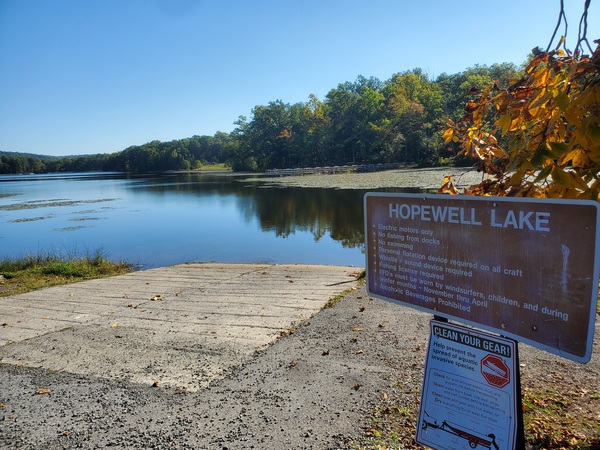
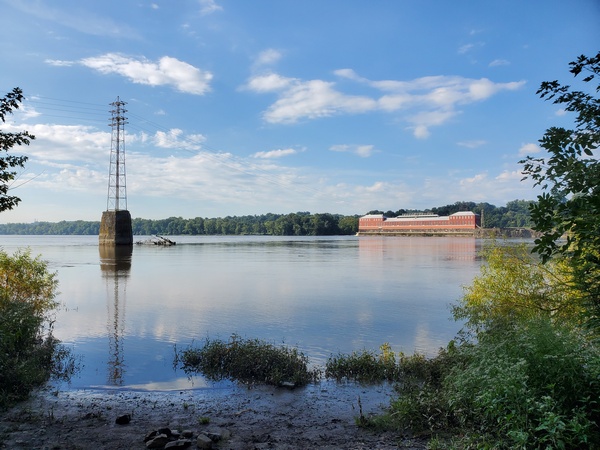
The Hopewill Lake boat launch at French Creek State Park
But the fun didn’t end there. As I was taking the antenna down, I inadvertently manhandled the skinny top section of the Gabil whip and bent it over. Doh! I carefully straightened it out as best I could and managed to collapse it. At home, I checked it out, and the whip seems usable—albeit an inch or two shorter. I decided to order a Gabil GRA-CFP2600 carbon fiber whip and save the slightly damaged telescopic whip as a backup. Hopefully, that will be a bit more rugged.
While I was at it, I also ordered an exact replacement for the damaged telescopic whip. It wasn’t very expensive, and the smaller form factor when it’s collapsed is handy sometimes. I’ll just need to be more careful with it in the future.
Sometimes things just don’t go according to plan. I have proven that many times over the years. My activation this morning was another example.
I drove up to Evansburg State Park (US-1351, KFF-1351) this morning for an early morning activation. My original plan was to operate from a picnic table in a wooded area, but heavily overcast skies prompted my decision to operate under a picnic pavilion.
My antenna of choice was going to be the “Gabil on a Table” configuration I used recently. I looked up at the ceiling of the pavilion and assumed there was enough headroom for the Gabil vertical on a table. Well, it did—until I slid the coil up to tune up on 40M. Doh! I probably could have used the vertical on 20M if I collapsed the radiator a little. Given the early hour, however, I really wanted to get on 40M. So, I took down the Gabil and packed it away.
Fortunately, with the KH1, there are always other options. I opted to operate the KH1 in tabletop mode with the whip, a right-angle adapter, and AXE extender coil. I had everything I needed in my KH1 box. No need to walk back to the truck to get stuff. Within minutes, I was up and running on 40M.
My KH1 set up for 40M at US-1351
This configuration on 40M never ceases to amaze me. Within 10 minutes, I had my first 10 contacts. Not too shabby for a 45-inch whip and a huge loading coil. After making 20 contacts, the action slowed considerably. I logged a few more contacts on 40M before changing bands.
I could have moved up to 20M, but I didn’t feel like changing the antenna and counterpoise wire. Instead, I went to 30M. That band always works fine with the same configuration I use for 40M. Unfortunately, there wasn’t much activity on 30M (except for a station that started calling CQ on top of me). After spending some time fruitlessly calling CQ with no takers, I called it quits.
After about 45 minutes on the air, I had logged 25 contacts—all of them on 40M. I also picked up three park-to-park QSOs. My best “DX” this morning was out to Missouri.
One of my favorite ways to use my Gabil GRA-7350TC antenna is on a picnic table within arm’s reach for easy adjustment. It’s a configuration I wrote about in a previous post. I wanted to try something similar using my Elecraft KH1, but with a minor twist.
What I had in mind was using the Gabil antenna on its tripod with most of the coax eliminated. To do this, I used a Gabil common-mode choke between the antenna and the KH1. Besides helping to keep RF off the shield, it also provided a little extra coax length. This makes it a little easier to connect to the radio.
I had most of what I needed, except for an adapter to go from the choke to the radio’s antenna input. After scouring through my collection of connectors and adapters, I found what I needed: a PL-259 to BNC-M adapter. These aren’t very common, but I had acquired one somewhere along the way.
Now, I just needed a picnic table. For that, I headed to Evansburg State Park (US-1351, KFF-1351). I set up my Gabil antenna at a picnic table I’ve used several times before. I attached two 17-foot radials, which I laid on the ground. Using an SWR meter, I quickly tuned the antenna for an SWR of 1.3:1 on 40M. I swapped out the SWR meter for my KH1 and got on the air.
The Gabil vertical connected to the KH1 via a common-mode choke
After spotting myself, I logged my first 10 contacts in about nine minutes. Not bad for 3.5 watts to an eight-foot vertical. I hunted a couple of park-to-park contacts before moving up to 20M. I tuned around the band, and it seemed somewhat quiet. I called CQ a few times before getting a call from a very loud F4WBN. Right after that, I worked a station in Texas. Then the activity came to a screeching halt. My guess is that it was a little too early in the morning for 20M.
After spending more time on 20M than I should have, I went back down to 40M and picked up a couple more park-to-park contacts. I logged several more contacts after that before packing up. My one-hour effort netted 24 contacts, including five that were park-to-park.
My Gabil is an early version with scale markings applied with a sticker, rather than the engraved markings on the newer ones. I’ve already experienced a little peeling, so I wanted to add some band markings of my own. My plan was to use a Sharpie to mark the coil settings. I figured if I forgot to pack an SWR meter, I could at least get the antenna close enough for the KH1’s internal ATU to handle. It was a brilliant plan, except that I forgot to bring the pen. Doh! (Note to self: Add a Sharpie to the backpack.)
All-in-all, the Gabil proved its worth once again. It’s quick to setup, gets the job done, and it packs down small.
My (far) better half and I spent most of the week in central Pennsylvania helping a family member recovering from surgery. Although the mornings focused on getting the grandkids off to school and making sure the grand-dog got walked, I squeezed in a couple of short activations.
Not sure how much radio time (if any) I would have this week, I packed light. I only brought my Elecraft KH1 and some antennas that I usually keep in the truck.
Capt. John Smith Chesapeake National Historic Trail (US-4567)
On our second day in central PA, I had to drop my granddaughter off at her friend’s house to catch the school bus. Since I was only about five miles away from a boat launch on the Susquehanna River in northern Lancaster County, I drove over there for a short activation of US-4567.
Early morning view of the Susquehanna River
Except for a few early morning cyclists, the place was empty. I parked my truck in a spot that’s within 100 feet of the river and got set up. I didn’t have much time, so I stayed in the truck and used a 17-foot whip and my homebrew loading coil. Up in the cab, I used the KH1 and my CWMouse paddles.
KH1 and CWMouse paddles. This was the same setup I used for both activations this week.
The A Index was a whopping 29, so I wasn’t expecting great results. As is often the case, Mother Nature fooled me. The 40M band seemed really hot; I made my first ten contacts in about nine minutes. The KH1 was putting out a whopping 3.5 watts.
Towards the end of my activation, I noticed that the Reverse Beacon Network and other POTA spotters were showing my frequency 500 kHz higher than my dial frequency. Although I had the KH1’s filter on the narrowest setting, it sounded very broad to me. Doing some poking around the menus, I found the problem. Somehow the mode had changed to USB. Most likely, it resulted from some fat-fingering on my part. Doh! A quick button press or two and all was right with the world. Actually, I made most of my contacts with the mode set to USB instead of CW, so it wasn’t the worst mistake I could have made.
I wrapped things up after 30 minutes on the air, with 20 QSOs in the log (including two dupes). All of my contacts were on 40M. Although 40M seemed long (with several Michigan and Missouri stations), I had a park-to-park contact with my friend N3CU. Ken was activating a park towards the southern end of the county. A park-to-park QSO with KB1SF in Michigan turned out to be park number 1,000 for me as a hunter. It was a fun activation, but I needed to get back to the house.
PA State Game Lands 246 (US-8941, KFF-5862)
The next morning was pretty much the same situation, but this time I activated some nearby state game lands. Although this location is only about 10 minutes away from where I was staying, it had been more than a year since my last activation there. I was long-overdue for a visit.
I used the same setup as the day before, but this time making sure the KH1 was actually in CW mode. Like the previous day, the 40M band was very active early in the morning. This time it only took about seven minutes to log my first 10 contacts, and they rolled in steadily after that.
I finished up with 31 contacts—one was a dupe—in just over 30 minutes of operating. Again, all of my contacts were on 40M. I would have tried other bands, but the hunters kept me busy on 40M. Satisfied with the contacts I made, I headed back to the house for breakfast with the rest of the family.
Stationary-mobile at PA State Game Lands 246
I’ve come to the conclusion that the KH1 really plays well with the 17-foot base-loaded vertical mounted on the back of the truck. Putting out around 3.5 to 4 watts, the little KH1 was really getting out. Thanks to all the early-rising hunters out there for a couple of fun activations this week.
A while back, I came across a video by Aaron W4ARB in which he showed how to adapt the whip from a Gabil GRA-7350TC antenna for use with the Elecraft KH1. The Gabil whip is just over seven feet long, providing some height advantage over the KH1’s 45-inch whip. Since I had both the KH1 and a Gabil antenna, I gave it a try.
Aaron’s video gives you all the details you need, so be sure to go check it out. Since the Gabil and the KH1 whip use different thread sizes, Aaron found an inexpensive adapter to make it work. It reduces the M10 thread the Gabil whip requires to the M4 thread mount on the KH1. The longer whip weighs a bit more than the KH1’s whip, so Aaron used the KH1 on a picnic table with a Tufteln Right Angle Adapter. I just happened to have one of those in my KH1 kit.
To test this out, I drove out to French Creek State Park (US-1355, KFF-1355) and set up at a secluded picnic table. Using the adapter, the Gabil whip attached perfectly to the KH1 angle mount. I set up for 40M, using the Elecraft AXE1 coil and a 33-foot counterpoise wire. Aaron elevated his counterpoise wire for improved efficiency. Being lazy by nature, I just laid mine on the ground.
I set the KH1’s antenna switch to the 17M/15M position to use less loading inductance. In order for the KH1’s ATU to achieve a decent match, I needed to partially collapse the Gabil whip by two sections. In this configuration, the antenna is only slightly longer than the KH1’s whip, but it seemed to get out OK. I easily made the requisite 10 contacts, including a two-way QRP park-to-park contact with a station in Michigan.
Given that I had to partially collapse the Gabil whip on 40M, I’m not sure it provides a significant improvement over the KH1 whip. It certainly works, though. A smaller loading coil would be great.
The Gabil whip antenna mounted on the Elecraft AXE1 coil
At this point, I did a little antenna experimentation. Using the fully extended Gabil whip, a 13-ft counterpoise wire, no AXE1 extender, and the switch in the 17M/15M position, the KH1 easily found a match on 20M. I also got it to load on 30M, but I neglected to make a note of the exact configuration I used. I’ll have to try that again another time.
My setup. The Gabil whip is mounted directly on the right angle adapter for 20M
The longer whip really seemed to work well on 20M. In short order, I worked nine stations, including five in Florida. I packed up after an hour on the air, with 20 contacts in the log.
This was hardly a scientific evaluation, but the KH1 and Gabil whip is a combination I will definitely use again. Thanks to W4ARB for the idea and the great video.
I arrived home the night before from a week-long vacation in North Carolina and still had some unpacking to do and things to catch up on. Still, I wanted to take part in the Skeeter Hunt QRP contest, which is something I look forward to each year. Despite the weather forecast for heavy rain, I got on the air for the first one and a half hours of the contest.
I drove over to Valley Forge National Historical Park (US-0761, KFF-0761), hoping to make enough Skeeter Hunt contacts to complete a POTA activation at the same time. Since I was focusing on contest contacts, I didn’t bother to spot myself on the POTA and WWFF sites.
It was drizzling when I got to the park, so I operated from the truck. Equipment-wise, I used my trusty Penntek TR-35 transceiver, along with a 17-foot whip and my homebrew loading coil. I started out on 40M, and it sure was rough going, producing only three contest contacts. I probably spent too much time on that band. Eventually, I gave up on 40M and moved up to 20M. The skeeters were more plentiful up there.
My rig inside the truck
The rain was starting to come down heavier, and I still had some errands to run, so I packed it in. After about 90 minutes, I ended up with 13 skeeters and a couple of non-skeeters in the log.
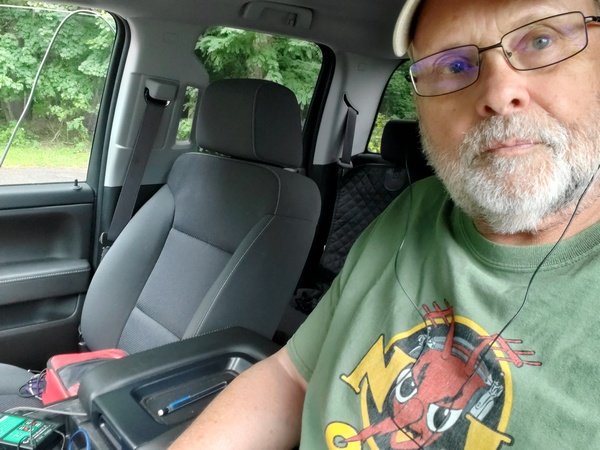
Hunkered down in the truck, wearing my official Skeeter Hunt t-shirt
As I was leaving the park, the skies opened up, and a torrential rain ensued. My timing couldn’t have been better. Despite all the rain, it was a good time. I would have liked to stay longer, but I had things to do and places to be.
Many thanks to Larry W2LJ and the NJQRP club for organizing this fun event. I’m already looking forward to next year.
Angry-looking clouds. Unsettled geomagnetic conditions. That sounds like a good time to go activate a park with a compromised antenna. So that’s what I did. When you get the opportunity to go play radio in a park, you just have to go for it.
Early on a Monday morning, I made a trip up to Evansburg State Park (US-1351, KFF-1351). We had some storms overnight, and there were some lingering dark clouds around. So, I hunkered down under a picnic pavilion. I didn’t have much time, so I went with the Elecraft KH1 and its internal whip. Along with the whip, I used a Tufteln 90-degree adapter. For keying, I used my trusty CWMouse paddles on my clipboard.
Picnic Table-portable with the KH1 at Evansburg State Park
I installed the AXE1 extender coil for 40M and got started. The noise floor was very low, but I had to endure the occasional loud static crashes from storms in the area. Despite the unsettled geomagnetic field, the first five QSOs came quickly. After working a couple more, I gave 30M a try and logged three more.
With 10 contacts in the log, I removed the AXE1 and moved up to 20M. There was a bit more activity up there, and I made nine more contacts in short order. I shut down after an hour on the air with 19 contacts. That included four park-to-park contacts.
There are far better antennas than the KH1’s 45-inch whip, but probably none faster to deploy. Not to mention the huge fun factor in making contacts with such a diminutive antenna.
When I tested a 35-foot non-resonant wire with my KH1 last week, I was pleased with the results. Continuing with that theme, I thought I’d try a 29-foot wire, another popular non-resonant length.
I drove back to Valley Forge National Historical Park (US-0761, KFF-0761) and re-created the setup I used last time. To support the wire, I again used my homebrew drive-on mount to support a partially extended 31-foot Jackite pole. I’m guessing the pole was up about 27 feet, give or take. I set up my camp chair nearby and ran the wire over to the KH1. Starting off, I used a 17-foot counterpoise wire.
First, I checked to see what kind of match the KH1 would find on its five bands. The SWR was very low on all bands except for 20M, where the best the KH1 would do was around 2.4:1.
I started my activation on 40M, and the wire seemed to get out pretty well. Although the band was noisy with static crashes, I made my first ten contacts in about 11 minutes. I eventually moved up to 30M, but I only had one hunter there.
At that point, I took a break to experiment with counterpoise wires. I tried both 29-foot and 13-foot counterpoise wires, but neither of them improved the match on 20M. I also tried repositioning the counterpoise with no luck.
I left the 13-foot counterpoise wire attached and went back to 40M. I made an additional handful of contacts on 40M before trying 17M. On 17M, I picked up three more before calling it quits.
Admittedly, I had high hopes for the 29-foot wire. I’ve used that length a bunch of times, although usually with a 9:1 unun and rigs with more robust tuners. In any event, it worked well on bands other than 20M. I managed 26 contacts in a little more than an hour.
On the drive home, I thought about some ways to improve the match on 20M. I’m not sure any of them are really worth the effort, though. For now, I’ll just stick with 35-ft when I use a random wire with the KH1.