POTA at Alapocas Run State Park

I haven’t been on HF much lately, so I made another trip down to Delaware for a Parks on the Air activation. My destination today was Alapocas Run State Park, just north of Wilmington.

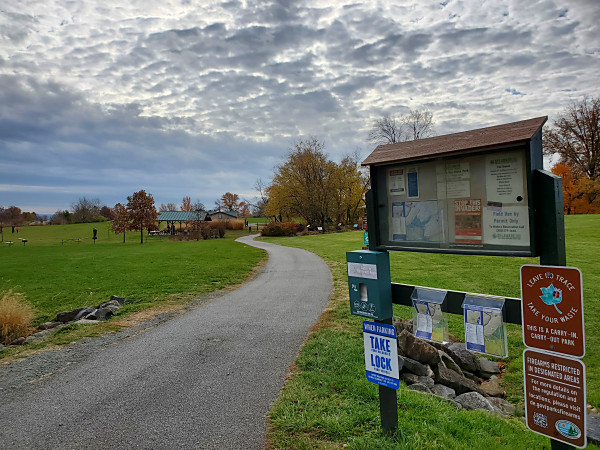
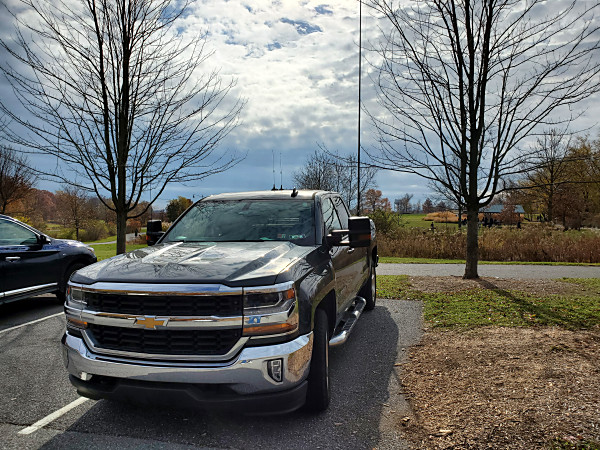
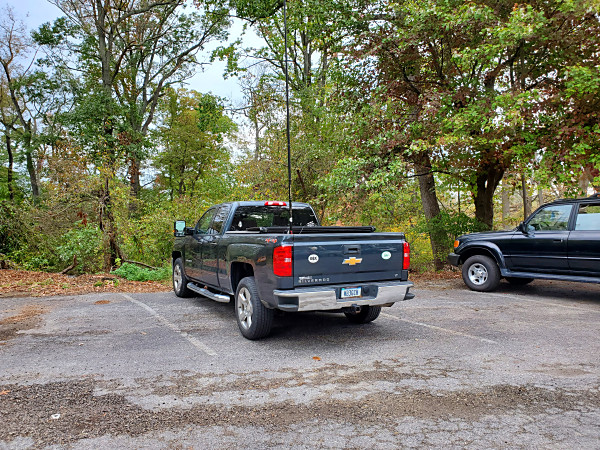
I parked in a section of the park that has some multi-use trails, a picnic area, a large playground, and a couple of athletic fields. I chose a parking spot between some trees to avoid problems with my antenna. More on that later. 

The trail and picnic area at Alapocas Run State Park

After paying the $8.00 parking fee for an out-of-state vehicle, I set up my KX3 (5 watts) and 19-foot vertical. I started on 40M and logged 31 contacts with one park-to-park QSO. Needless to say, the band was in good shape. 

The 20M band wasn’t bad either. I logged 20 contacts there, including CU3BL and G3WPF. I also made it out to the West Coast, working a station in Oregon. Finishing up on 30M, I made five more contacts there, bringing my total to fifty-six.

On the drive down to the park this morning, I talked to my friend Frank N3FLL on the local repeater and told him where I was going. Frank was listening for me and worked me on all three bands. 

Although I had a successful activation, there was some drama as I was taking down my antenna. Remember when I said I parked to avoid the trees? Well, somehow I got my antenna wire caught in one of those trees. I pulled and pulled until my wire finally came loose. I thought for sure that I had broken the wire. The wire is #26 stealth wire, which is made of copper-clad steel. Fortunately, the branch gave way before the wire, and the wire came down intact. That sure is some tough wire.

My parking spot at Alapocas Run State Park. The tree on the right is the one that tried to eat my antenna.

Delaware parks have always been good to me, radio-wise. I have a few more parks in the First State that I want to activate in the near future.

I wish all those who celebrate a happy and safe Thanksgiving holiday.

73, Craig WB3GCK

POTA at Auburn Valley State Park

I made a trip down to Delaware to activate a new—for me—park. My Parks on the Air (POTA) destination this morning was Auburn Valley State Park. Despite needing to leave early to attend to something at home, it was a successful activation.

Before heading down there, I did my usual online reconnaissance. The Yorklyn Bridge Trail trailhead looked like a suitable spot. It’s away from the main part of the park and, best of all, it has a portable toilet. 

The Yorklyn Bridge Trail trailhead at Auburn Valley State Park, Delaware.

Out-of-state vehicles have to pay $8 to get into the park. So, I spent the first fifteen minutes trying to figure out the payment system. There is a kiosk there that accepts credit cards, but it was out of order. I found some payment envelopes, so I fill it out and enclosed my money. It took me a while to figure out where to put the envelope. Once I resolved all of that, it was time to get on the air.

I set up in my truck and used my usual setup: my KX3 at 5 watts and my 19-foot vertical. I started on 40M. There was just enough of a cell signal to get a spot on the POTA website, and the hunters soon started calling. I stayed on 40M for about 45 minutes, logging 31 CW contacts.

After a quick break, I moved up to 30M. I had eight contacts logged when my cell phone rang. There was a situation at home that needed my attention. At that point, I had 39 QSOs, including 3 park-to-park contacts. So, after an hour on that air, I packed up for the drive back to Pennsylvania. 

I spent more time on the road today than I did operating. Even short POTA activations are fun.

73, Craig WB3GCK

Zombie Shuffle 2021

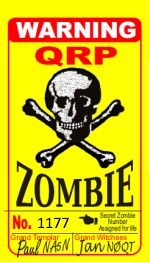
WB3GCK QRP Zombie credentials

Last night was the annual running—or shuffling, I should say—of the Zombie Shuffle QRP contest. Organized by Paul NA5N, it’s a silly little sprint that I look forward to each year. 

As in recent years, I had to take part in the contest from home. This puts me at a distinct disadvantage; running 5 watts into my rainspout with S5 noise levels can be challenging. Undeterred, I jumped right into the fray. This year’s rules allowed you to use any spooky name of your choosing. I went with Bones.

The 40M band was very productive, netting me seven zombies before I had to take a break for dinner. I never heard much on 20M, but that isn’t the strongest band for my makeshift antenna. 

When I got back on after dark, activity was sparse on 40M, producing only three more contacts. I dropped down to 80M and picked up four more before calling it quits.

I ended up with 14 contacts, none of which were bonus stations. Thanks to those who hung in there as I asked for multiple repeats. My apologies to the one or two stations I couldn’t pull out of the noise. 

If you’re looking for a fun, low-key contest, give the Zombie Shuffle a try next year.

72, Craig WB3GCK

POTA at Fort Washington State Park

I made an early morning visit to a nearby state park for a Parks on the Air (POTA) activation. Although Fort Washington State Park (K-1352) is only 30 or 40 minutes away, this was my first time there. I obviously need to get out more.

I did some online reconnaissance before leaving and headed for the Militia Hill Day Use Area in the park. After all, any location with “hill” in its name has to be good for radio, right? 

I arrived at the park around 9:30am (local). As it turns out, the elevation is great from this location. Although it was busy for a Sunday morning, I found a parking spot away from the rest of the visitors. I set up my usual 19-ft vertical and operated my KX3 from inside the truck. The cell coverage was excellent, so I could spot myself easily. Initially, I fat-fingered the park designator and my frequency, but I quickly corrected that. 

My parking spot in Fort Washington State Park (POTA K-1352)

Almost immediately, I began receiving calls on 40M. I made my required ten contacts in the first eight minutes. I worked eighteen stations before things slowed down.

I moved up to 20M and had mixed results there. Right off the bat, I got a call from G0DJF in England. HB9BQB in Switzerland followed him and gave my 5-watt signal a 559. I worked one local station after that, then the band dried up for me. 

Down on 30M, I worked 7 more chasers. I went back to 40M before closing down and logged 8 more stations there, including two park-to-park QSOs.

The Militia Hill Observation Deck in Fort Washington State Park. Bird watching seems to be popular at this location.
The Militia Hill Observation Deck in Fort Washington State Park. Bird watching seems to be popular here.

I ended up with 35 stations in my log. For a Sunday morning, the number of chasers on the air was amazing. The Parks on the Air program sure has gotten popular. 

73, Craig WB3GCK

Putting the QRP Camper to Bed

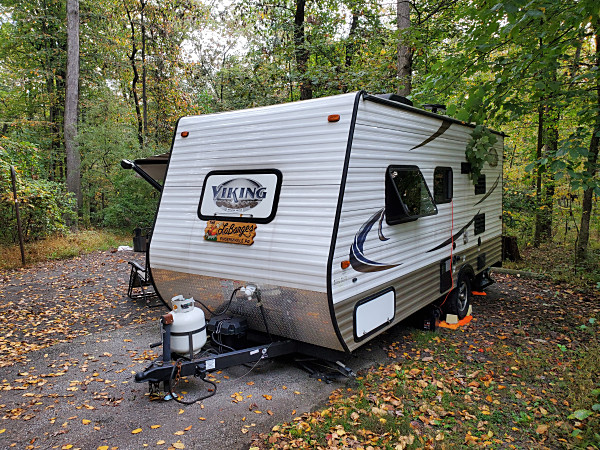
It’s been a rough year for camping. With my physical issues, our camper has seen little action this year. Since we need to winterize the camper soon, my (far) better half and I took the camper up to nearby French Creek State Park for the weekend. We planned to use this last trip to clean out the trailer and get it ready for storage. Of course, I got on the radio over the weekend, too.

I set up my 29.5-foot vertical and KX3 after we arrived on Friday, but I didn’t get on the air until later that evening (around 0100Z). I started calling CQ POTA on 80M and soon had some chasers. Since the cell coverage is spotty in this campground, I entered my planned activation on the POTA website. The POTA system automatically spotted me, and seven chasers came calling. 

The WB3GCK "QRP Camper" in French Creek State Park near Elverson, Pennsylvania
The WB3GCK “QRP Camper” in French Creek State Park near Elverson, Pennsylvania

I jumped on 40M the next morning, while the coffee was perking. In less than an hour, I had ten more in the log. That qualified me for a late-shift activation. Thanks to all the nightowls and early risers for calling. I spent most of the day relaxing and doing some work on the camper.

By late Saturday afternoon, some heavy rain moved in, forcing us to hunker down in the camper for the rest of the day. I got on the radio again and worked some more POTA chasers and picked off a few New York QSO Party stations. I shut down around 7:30 P.M. (2330Z) with 35 QSOs in my log.

Back on the air Sunday morning (0800 local, 1200Z), I intended to make a few casual Straight Key Century Club (SKCC) contacts. I called CQ SKCC a few times and soon had a mini pileup. I had forgotten that the POTA spotting website would automatically spot me. So I quickly switched out my straight key for my paddles and proceeded with an impromptu POTA activation. After eleven quick POTA contacts, things slowed down, and I shut down to pack up. 

I ended the weekend with 46 QSOs, including two park-to-park contacts. Not too shabby for five watts, I guess.

So, that wraps up another camping season, albeit a short one. Now it’s time to finish winterizing the trailer and putting it to bed for the next five months. Hopefully, the QRP Camper will see more action next year.

73, Craig WB3GCK

POTA at Nolde Forest

I activated a new (for me) park this morning. Although Nolde Forest State Park (K/KFF-4362) is only a 45 minute drive for me, I had never been there.

The Nolde Forest Environmental Education Center is located south of Reading, Pennsylvania. It’s a 725 acre park with numerous trails and diverse habitats.

I first pulled into the Sawmill parking area, which is a trailhead for some of the hiking trails. The parking lot was small and crowded, so I drove down the road to the main entrance. There, I found the gate partially closed with a sign that said parking was only for an event. Back to the Sawmill area I went.

Bulletin board in the Sawmill parking area at Nolde Forest Evironment State Park

I found a parking spot and got the KX3 and homebrew vertical set up. The area is in a low spot, so I wasn’t expecting much. Not long after I spotted myself, 40M came alive with callers. I made my first ten contacts in about 9 minutes. I stayed on 40M about 30 minutes until the hunters thinned out.

My parking spot in Nolde Forest State Park. The parking lot was crowded, but I managed to get a spot on the end.

The 20M band was a different story, though. I only made two contacts up there, but one of them gave me a 559 from Nevada. Not too shabby for 5 watts in a gully, I guess. I tried 30M, but I only found one taker there. I went back to 40M and picked up a few more before wrapping up.

At one point, a young man walked up to my passenger-side window and asked what I was doing. I gave him my elevator speech about Amateur Radio and Parks on the Air (POTA). He gave me two thumbs up and said that was “rad.” I assume I suitably impressed him.

After an hour and fifteen minutes, I had 25 contacts in my log. No park-to-park QSOs this time, though.

Sadly, I didn’t get to see much of the park beyond the parking lot. My doctor hasn’t cleared me for hiking (or biking) just yet. I need to go back again sometime when I can do some exploring. Maybe some operating on top of the hill that was behind me.

73, Craig WB3GCK

POTA at William Penn State Forest

We had some beautiful Fall weather here in southeastern Pennsylvania today. It was a great day for a Parks on the Air (POTA) activation. This time I drove up to William Penn State Forest’s Hopewell Tract near Elverson, PA.

I have operated here many times over the years. However, this was my first POTA activation from here. The area around the Hopewell Fire Tower has good elevation, and I have always had good luck there.

The Hopewell Fire Tower in William Penn State Forest, Hopewell Tract (POTA K-5481)

The parking lot was empty when I arrived. Except for some occasional hikers passing through, I had the place to myself. I mounted my 19-foot vertical on the back of my truck and set up my KX3 in the cab. I ran my usual 5 watts.

I spotted myself and started calling CQ. It took me about 20 minutes on 40M to make the required ten contacts. I logged 19 contacts on 40M, including three park-to-park QSOs.

I had mixed results on 20M. I got very few Reverse Beacon Network spots, but I worked two Oregon stations and one in Nevada. I had no more takers after that. I moved down to 30M and picked up five more there.

I packed up after an hour and a half. In all, I made 27 contacts in about 13 states and two Canadian provinces.

Before heading out, I walked back to the Fire Tower to get a picture. Years ago, you could climb the tower, but it’s been closed now for some time. I’m not big on heights, so it’s not a big loss for me.

73, Craig WB3GCK

Outer Banks Round 2

I was back down in the Outer Banks of North Carolina for a few days this week. Since I was there for a family function, there wasn’t much time for ham radio. I did, however, get on the air for a bit one morning with a haphazard antenna.

We were staying with family in a rental house just down the road from the one we were in last month. Like the previous house, it had a beautiful view of Currituck Sound.

One morning, everyone went over to the beach for some surf fishing. Since I’m still dealing with my knee issues, I stayed behind and broke out the radio.

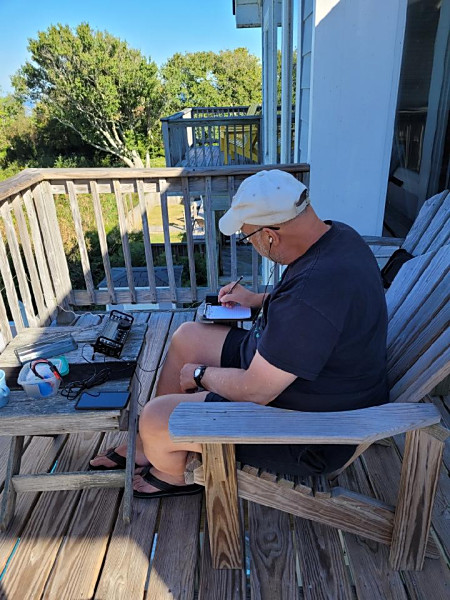
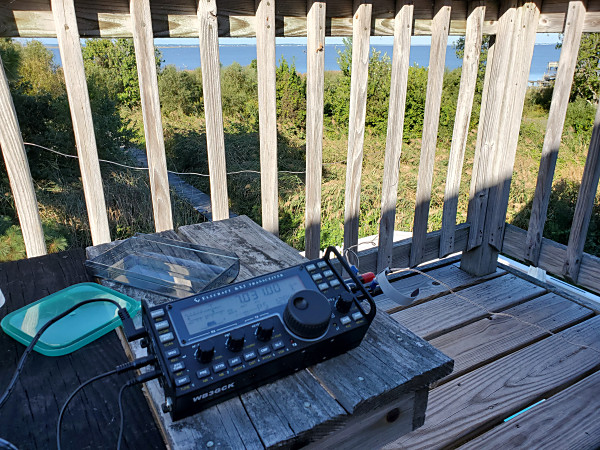
I took my KX3 out to a small, 3rd story deck and broke out two 25-foot pieces of speaker wire for an antenna. I wrapped one around the deck railing for the radiator. For a counterpose, I tossed the other wire off the deck. I used a BNC-to-binding post adapter to connect up to the KX3.

Operating from the deck in Corolla, North Carolina, on the Outer Banks

Frankly, I wasn’t expecting much from this antenna with 5 watts. When I turned on the rig, though, I heard some very loud signals on the 40M band. After calling CQ a few times, I saw a dozen spots on the Reverse Beacon Network (RBN).

Over the next forty-five minutes, I had a couple of rag chews with stations in New York and New Jersey. I also logged a Parks of the Air (POTA) station in Connecticut.

My KX3 out on the deck. You can see the two pieces of speaker I used for an antenna.
My KX3 out on the deck. You can see the two pieces of speaker wire I used for an antenna.

Before packing up, I moved up to 20M and heard a French station calling CQ. I threw out my call and heard, “WB3?.” My 5 watts and the thrown-together antenna made it to France. Unfortunately, a loud, low-pitched version of my CW was coming from somewhere down below. As it turns out, the wire hanging off the deck was right next to an outdoor speaker. I didn’t complete the contact for fear of creating too much of a racket.

By this time, I was losing my shade anyway, and it was getting hot out there. So, I took down my makeshift antenna and packed up the radio. This brief—but fun—session was the only opportunity I had on this trip for ham radio.

It never ceases to amaze me what you can do with 5 watts and a couple of pieces of wire.

72, Craig WB3GCK

September Weekend Sprintathon

I haven’t made too many Straight Key Century Club (SKCC) contacts lately, so I took some time today to participate in the Weekend Sprintathon (WES). I drove up to my daughter’s property and operated from one of the fields.

To keep things simple, I used my usual 19-ft vertical mounted on the truck. I took advantage of the beautiful weather and set up a table and chair under a shady tree. I used my KX3 at 5 watts, along with my little MS2 straight key.

My operating location for the September 2021 Weekend Sprintathon (WES)

I started on 40M and only heard a few WES stations to work. I called CQ for a while and bagged a few more contacts. Based on my Reverse Beacon Network (RBN) spots, the band was in good shape. Before changing bands, I found two Parks on the Air (POTA) activators and worked them. 

I switched to 20M and found that the two loudest stations were from France. I had back-to-back WES contacts with Bob F6EJN and Bert F6HKA. Bob and Bert gave me RSTs of 559 and 569, respectively. I tried a few stateside stations, but I wasn’t getting through—go figure. I did log two more POTA stations, though. 

My KX3 and MS2 straight key

I gave 40M another try and found WA3GM doing a POTA activation in the next county over. Greg gave me a 339, but he was able to pull me out. After working three more WES stations, I started packing up.

I ended up with a dozen WES contacts and five POTA stations. Regardless of the number of QSOs, it was a great day to take the radio outside.

73, Craig WB3GCK

POTA at PA State Game Lands 234

I did another brief Parks on the Air (POTA) activation today. My target this time was PA State Game Lands 234 (K-8931). This one was close by, as a section of it is only 15 minutes from home. It was certainly quieter than my last activation.

The parking area is right across the street from a residential area. Also, there were powerlines directly across from me. There was a steady stream of hunters coming and going, so the parking area was crowded. It’s dove season here in Pennsylvania.

Entrance to PA State Game Lands 234 near Royersford, PA.

With all the hunting going on, I didn’t venture into the gated area. Instead, I operated from the parking area. I used my usual setup—my 19-foot vertical on the back of the truck and my KX3 (5 watts) inside.

I started off on 40M with a park-to-park (P2P) contact with VE2VIA in Quebec. After spotting myself, things picked up. I soon had my required ten contacts. After 30 minutes, the 40M activity began to slow down. I moved up to 20M and had 4 QSOs, including a P2P contact with KØBWR in Idaho. Despite some powerline noise, the 30M band produced another ten QSOs.

On four occasions, I stopped to answer questions from curious hunters. They were fascinated with my antenna and the fact that I was using Morse Code to communicate. I’m always happy to stop and give ham radio a plug.

I packed up after an hour and fifteen minutes. I ended with 29 QSOs, including the two P2P contacts. Thanks to WD9IGY, who worked me on both 20M and 30M.

This outing was a fitting wrap-up for a long holiday weekend here in the U.S. I hope my fellow U.S. hams had a safe and happy Labor Day.

73, Craig WB3GCK