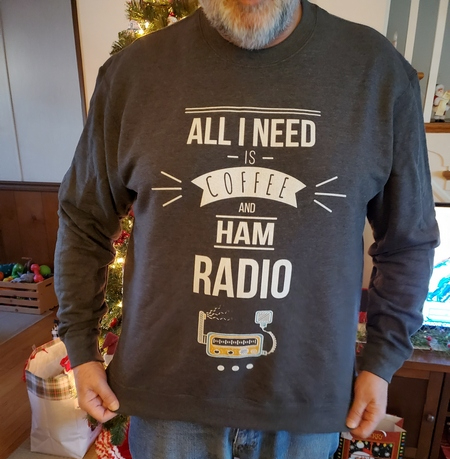
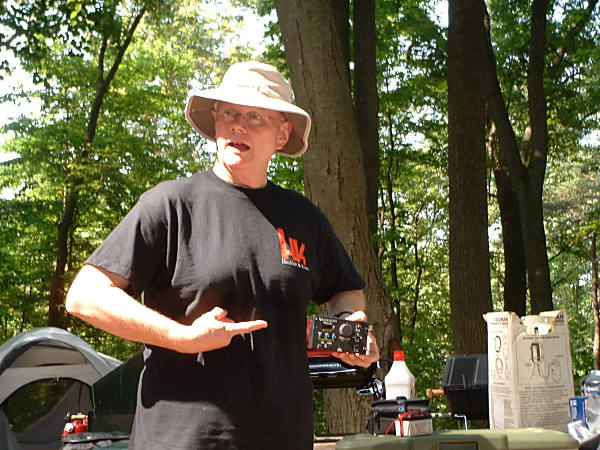
Among the Christmas gifts my XYL gave me was one that sums me up perfectly. She understands my love of coffee, and she is very supportive of my ham radio hobby. With this sweatshirt, I can proudly display both of my addictions.
One of the Christmas gifts I received from my XYL. It suits me perfectly!
I don’t have a link to the source, but my XYL says she found it on Amazon.
I finally had my knee replacement surgery a couple of weeks ago. Since then, I’ve been singularly focused on recovery and physical therapy. As a result, I haven’t been on HF since before my surgery. This weekend, however, I finally ventured down into the basement where my HF gear resides.
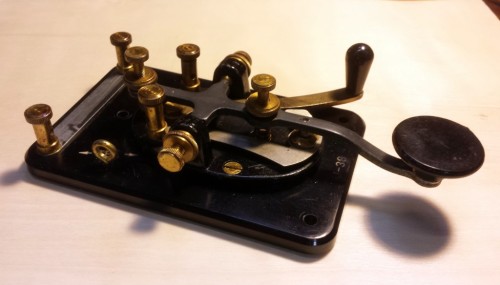
The Straight Key Century Club (SKCC) Weekend Sprintathon (WES) was running this weekend, so I grabbed hold of my trusty J-38 key and got on the air. Band conditions weren’t all that great, but I made a handful of contacts during a few brief sessions on the radio.
My trusty J-38 straight key
For those who have inquired, the new knee is getting a little better each day. I still have a month of physical therapy ahead of me, and it’ll probably be a few weeks before I’m able to drive again.
I miss going out portable, but in the near-term, I’ll be on the air from home from time to time.
My (overly) fastidious approach to logging my ham radio contacts has been well-documented. Since I upload all of my contacts to the Logbook of the World (LoTW), I like to reflect my locations accurately in the TQSL software. When you do most of your operating while portable, that can add up to a lot of locations to deal with. I’ll show you my approach to dealing with locations in TQSL.
How It Started
As best I can recall, I started using LoTW about six or seven years ago. I started creating new locations in TQSL for every place I operated away from home. So, there were lots of campgrounds that my (far) better half and I frequented, along with an assortment of parks and other places my radio has been to. Then, along came National Parks on the Air, followed by Parks on the Air. Before I knew it, I was scrolling through a long list of locations to find the one I wanted for an upload to LoTW.
One approach to paring down the list, I suppose, would be to go in and delete the one-off locations I’m not likely to visit again. That, however, conflicts with my inherent packrat nature. (That also explains the boxes of assorted leftover screws I have in the basement.)
One thing I noticed is that many locations in my list shared the same attributes, e.g.: state, county, grid square, etc. For example, all the parks in northern Delaware I activated recently are all in the same county and grid square. (Fun fact: Delaware only has three counties.) Based on this observation, I came up with an approach to tame my locations list and make it easier to scan the list to find a particular location.
My Location Naming Convention
I ended up deleting most of my locations is TQSL and created some new ones using the following naming convention:
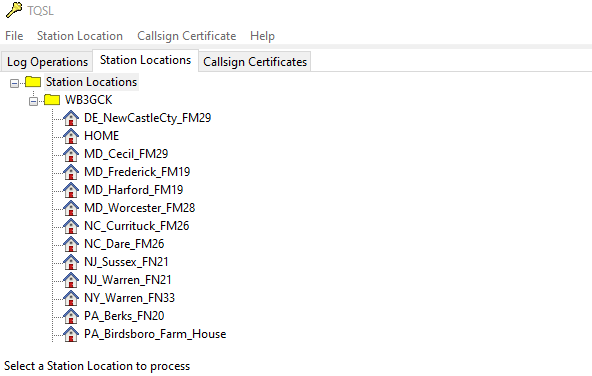
STATE_COUNTY_GRID
The STATE is just the standard two-character abbreviation. The GRID is the four-character grid square. Here are some examples from my locations list:
TQSL automatically stores the locations alphabetically, so it’s easy to scroll through the list to find the location I’m looking for. I kept one or two of specifically named locations for frequently used places like “Home.”
My “Station Locations” pane in TQSL showing some of the locations I have stored
While this works for my situation here in the States, operations in other countries would likely need some tailoring. I’ll cross that bridge when I get to it. Also, if you have certificates for more than one callsign, you’ll need to account for that.
Where Am I, Anyway?
To use this approach, I need to know what county and grid square I’m in. There are a couple of resources I use to do that. Before I get on the air from a portable location, I use these resources on my Android phone:
What County am I In. When I access this website from my cell phone, it shows the county I’m in, along with the zip code, address, and coordinates.
Easy QTH Locator. When you launch this app, it uses your phone’s location services to show your grid square, along with your coordinates and elevation.
Once I have determined the county and grid square I’m in, I jot this information down in my notebook or take screenshots from the apps on my phone.
These are the resources I use, but a web search will yield lots of similar tools you can use. I should also note that I have no financial interest in these apps.
Wrapping Up
This could very well be another case of over-thinking on my part. Regardless, I’ve been using this approach for a while now, and it has been working out for me. I’d be interested in hearing your method of managing portable locations for LoTW.
Oh, and before I forget… Remember to make regular backups of your TQSL locations, certificates, and preferences. Someday you’ll be glad you did.
It saddened me to learn over the weekend of the recent passing of Rich Arland K7SZ. Rich was an avid QRPer and author of several books and many articles on the subject. Years back, he was the author of the QRP Power column in QST Magazine. Rich was a 2002 inductee in the QRP Hall of Fame, a well-deserved honor.
I first met Rich when we were both members of the (now defunct) Eastern Pennsylvania QRP Club. He and his wife, Patty, attended a Field Day or two with the club in French Creek State Park. His keen sense of humor always made for a fun weekend.
Rich Arland K7SZ at the Eastern Pennsylvania QRP Club (EPA-QRP) Field Day in 2005.
During one of our club gatherings, he admired an alkaline battery pack I built into a small military surplus container. I had an extra container, which I mailed to him along with a small circuit breaker/switch. Rich wrote about his completed battery pack in the March 2002 edition of QST (pages 82-83). He gave me a little shout-out, too.
When I bought my Yaesu FT-817, Rich sent me a nice little 12 volt power supply to go with it. That was about 18 years ago, and that power supply is still in regular use today.
Rest in peace, Rich. I’ll think of you every time I power up my old FT-817.
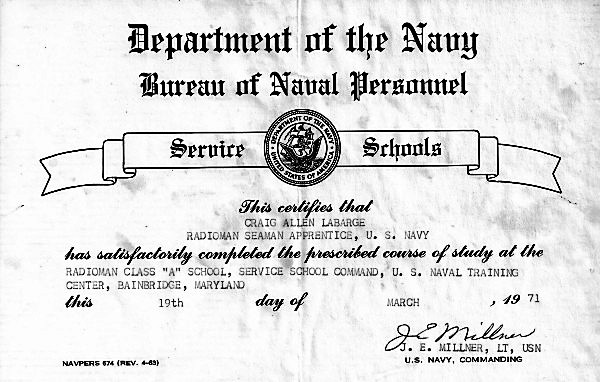
It’s hard to believe, but a half-century has gone by since I graduated from Navy Radioman School. The Navy decided that the 18-year-old kid was ready to do this radio stuff for real.
Following three months of boot camp, the Navy transferred me to the U.S. Navy Training Center in Bainbridge, Maryland. USNTC Bainbridge was not the most glamorous place. The barracks were run-down, World War II-vintage wooden structures with a cockroach problem.
I still remember my first day in Radioman school. The instructor gave us a sheet of paper and told us to memorize it. It was the Morse alphabet with the sound of each character. (A = DID-DAH, B = DAH-DI-DI-DIT, and so on). I also took a typing test. Fortunately, I had a typing course in high school and was able to test out of the typing training. The non-typers had to attend an after-hours crash course in touch typing.
Early on, our training focused on CW. As I recall, the requirement back then was 10 WPM, sending and receiving. The CW training also covered messaging handling, logging, and net procedures. Looking back, I think focusing on CW 8 hours a day for a few weeks was a great way to learn it. Plus, I was getting paid to do it!
We did all of our CW copying on a mill. A mill was a manual typewriter will all caps. After I got out of the Navy, I had to re-train myself to copy with a pencil since I had never done that before.
Over time, we moved on to a variety of other topics. We learned about the radio equipment we would likely be using. Radio-teletype was the primary communications mode for the fleet back then, so we also had to learn that equipment.
My diploma from Navy Radioman A School in March of 1971.
We spent the last week of school standing radio watches in a simulated shipboard radio room. This part of the course was called the PRAC-DECK. We set up radio circuits and sent and received message traffic. To make things interesting, the instructor would inject some equipment issues for us to troubleshoot.
On my first mid-watch (night shift), the instructor said I had to learn the most important skill I would need out in the fleet. That skill turned out to be making coffee in one in one of those 25-cup percolators. I ran into that instructor a few years later. He laughed when I reminded him about that lesson. I told him he was right about a pot of coffee being necessary for communications.
All in all, it was an interesting four months. Fifty years later, I’m still using the CW I learned back then.
All too often, I hear about some unfortunate ham who lost their computer-based log files due to some hardware or software failure. I don’t know about you, but just the thought of losing a decade or more of QSO data gives me the chills.
Back in my working days as a Systems Engineer, I was called upon a few times to develop contingency plans for large computer systems and networks. While working on those projects, I would continually ask myself, “What would we do if…”
As a result of all that, I still think about backup plans and backups for those backups. One customer once told me I was a belt and suspenders kind of guy; one method of holding up my pants just wasn’t enough.
The Problem in a Nut Shell
Storing your log files—or any data that’s important to you—in one place is a recipe for disaster. Hard drives can and do fail. (Been there, done that.) If your log file only exists on that failed hard drive, you’re out of luck.
The obvious solution is to keep a copy of your log somewhere other than your hard drive. I’ve had computers fail on me a few times over the years, and I was thankful I had backup copies of my important files.
External Storage Media
The easiest way to backup your log files is to create copies of them on removable storage media, such as an external hard drive, USB flash drive, or SD memory card.
The cost of storage devices has dropped significantly over the years. You can get a 1TB external hard drive these days for less than $50. I have a 1T USB-connected drive that I use to backup all of my data, including my log files.
If you’re just concerned with backing up your log files, a USB flash drive or an SD memory card is an inexpensive way to go. I often see 32GB flash drives for less than $10. I also use a thumb drive for an extra nightly backup of my logs. (Remember the belt and suspenders thing?)
If you’re an N3FJP ACLog user, you have an easy way to back up your logs. You can configure ACLog to save a backup each time you close the program. So, if you attach an external storage device (flash drive, SD memory card, etc.) to your computer, your backups will happen automatically. I do this with SD memory cards on each of my laptops. So, when I’m logging in the field with no Internet access, I’m still backing up my logs. More belts and suspenders.
Off-Site Storage
Back in the day, the computer systems I worked with regularly transported copies of their backups to another location across town. These off-site backups ensured that copies of data would survive a catastrophic event in the computer room. Hopefully, none of us ever face that situation.
For off-site storage, you could make a copy of your log data on removable media and take it to another location for safe-keeping. I’m too lazy for that. Thanks to the magic of the Internet, however, there are ways to do this electronically—and for free.
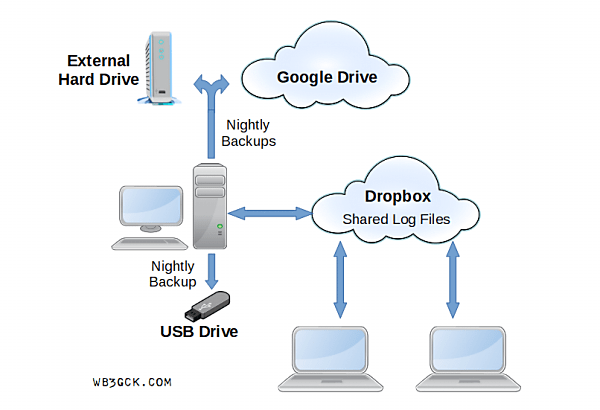
An easier way is to use cloud-based storage. There are several cloud storage providers, and most of them offer a no-cost option. I use Dropbox and Google Drive for my ham radio logs.
I keep my main log files (N3FJP ACLog and SKCC Logger) in a Dropbox folder that gets replicated to all of my computers. This approach allows me to run those logging programs on any of my computers using the same database. It also keeps a copy on Dropbox’s server. For good measure, I also backup my logs to Google Drive. (There are the belt and suspenders again.)
I would be remiss if I didn’t mention Logbook of the World as an off-site backup method. If you routinely upload to LoTW, you have a backup of at least the rudimentary information about your QSOs (callsign, date, time, band, mode, etc.). In my case, there is information in my logs that isn’t captured by LoTW. So, restoring from LoTW would be the last resort for me.
My approach to backing up my logs might be overkill, but I can always restore my logs in the event of a computer failure.
Making It All Happen
I make nightly backups of all my logs to an external hard drive, a thumb drive, and Google Drive. If I was disciplined enough, I could manually copy the necessary files to all three locations. Knowing me, though, that probably wouldn’t be a very reliable option.
So, I use backup software to automate all that. I use a paid version of SyncBakSE, but there are lots of other options available. I know Windows has a built-in backup capability, for example, but I have no experience using it.
Wrap-Up
Admittedly, my approach is somewhat overkill, bordering on paranoia. I’m not suggesting that you should do the same; I’m just offering up some possibilities for your consideration.
Regardless of how you do it, please make regular backup copies of your logs or any other data that’s important to you. Someday, if your computer goes belly-up, you’ll be awful glad you did.
On one of the several ham radio mailing lists I subscribe to, there was some recent discussion about unusual antennas. You know—bed springs, light bulbs, and the like. It brought to mind a memorable QSO I had 27 years ago.
In the July 1993 issue of QST, Rod Newkirk W9BRD (later VA3ZBB, now SK) wrote an article about building small, multi-turn loop antennas[1]. If his name doesn’t ring a bell for you, Rod wrote the “How’s DX?” column in QST from 1947 to 1978 and coined the term, “Elmer.”
Although I never actually built one of Rod’s loops, I found the article fascinating. At the end of the article, Rod noted that he conducted his loop antenna experiments in the partially-underground cellar of his Chicago home. Remarkable!
Fast-forward to September 1993. I went downstairs to my basement shack one evening and fired up my old MFJ-9030 on 30M CW. I had three QSOs that night; one of them was with—you guessed it—W9BRD.
During our QSO, Rod mentioned that he was using one of his experimental mini-loops indoors in his shack. When I told him I was running 5 watts into my rainspout, he sent back, “Hey, if it’s metal, load it up.” According to my log, we chatted for about 12 minutes before signing.
Needless to say, that contact put a smile on my face. It was the kind of QSO I really enjoy—one with a station using an unusual set-up or operating in a unique location. I guess you could say this QSO checked both of those boxes. Not to mention that I had just worked a very well-known figure in Amateur Radio.
QSL card from W9BRD documenting our unusual QSO in 1993.
I fired off a QSL card to Rod to acknowledge our QSO and to let him know that I enjoyed his loop article. Before too long, I received a card back from Rod. His typewritten note on the back of the card continued the theme of our QSO. It read, in part: “Hey, if your XYL uses gold or silver thread for that needlepoint, let’s try loading it up, Craig.” He also wrote about his experiences with rainspout antennas, including his attempt to feed a particularly stubborn one.
Rear of W9BRD’s QSL card
From articles I have read, it’s clear that Rod had a penchant for assembling and experimenting with unusual antennas. His daughter, Amanda, once wrote: “He especially loved discovering how much of a signal he could achieve with his various objects: the coffee cans, cookie tins, piles of wire and boxes and tidbits—out of which he wrung quite magical things.”[2]
When it comes to unusual antennas, Rod was a man after my own heart. Over the past 27 years, his words from our QSO have been my mantra: “If it’s metal, load it up!”
Thanks for the inspiration, Rod.
73, Craig WB3GCK
References: [1] Newkirk (W9BRD), Rod. “Honey, I Shrunk the Antenna.” QST, July 1993, pp. 34-35, 39. [2] Newkirk (WN9PMC), Amanda. “On Being W9BRD’s Daughter.” K9YA Telegraph, Vol 11, Issue 9, September 2014, pp. 2-3. (K9YA Telegraph website)
I haven’t been posting much here lately. The COVID-19 pandemic and other family obligations have been cutting into my ham radio activities. Nevertheless, I do have a few projects in the works.
A few weeks ago, I started another project in my ongoing series of speaker wire antennas. This one will be a variant of the bi-square antenna. This antenna has the potential to be a little more field-friendly than the delta loop I tested last month. It’s all built; I just need to get out somewhere to set it up and see how it works.
I’ll file my next project under the category of Old Dogs/New Tricks. Back in December, I bought a Kenwood TH-D74a HT. That gave me the ability to reach a nearby D-Star repeater. This week, I purchased an MMDVM hotspot to go along with it. I plan to spend some time in the coming days getting it set up. I’m hoping to be able to eventually connect to the DMR talk groups used by my ARRL section and local ARES-RACES groups. Fortunately, my local group has some experienced hotspot users I can consult if I run into any snags. Wish me luck.
Sadly, our camping season with our little QRP Camper is off to a late start. State park campgrounds in our area have been closed due to pandemic. We have reservations at a state park in Maryland next month, however, and it looks that might be our first trip of the year. I’m looking forward to a little QRP-portable operating from the camper.
My local QRP club has started making plans for Field Day. We have a set of social-distancing guidelines we’ll be following this year. We’ll be limiting the number of participants, keeping our tents at least 10 feet apart, and eliminating common eating areas. Also, we won’t be sharing stations and equipment. This year’s Field Day will be different, for sure.
Other than that, I’ve been active on our local ARES-RACES nets, and I have been checking into the Pennsylvania NBEMS Net on Sunday mornings.
You can also find me on 40M or 80M CW in the evening. I usually hang out around the SKCC watering holes.
I’ll be posting more on all of this stuff in the coming weeks. Until then, stay safe, and I’ll see you on the air.
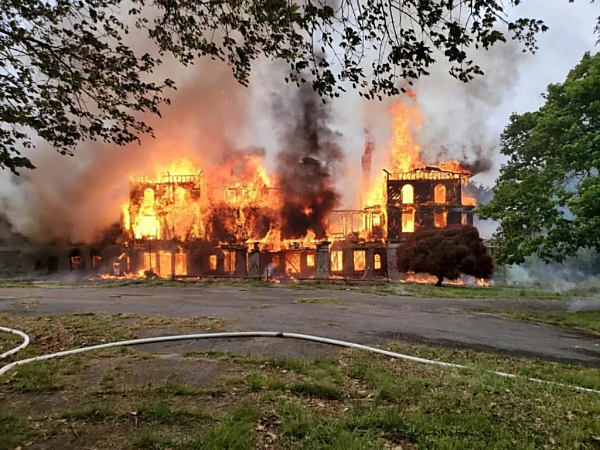
I came across a news item posted in one of the U.S. Navy Facebook groups I follow. There was a fire at what is left of one of my duty stations from back in the early 1970s. It was where I went through Navy Radioman School and learned the Morse Code.
The fire at the former Bainbridge U.S. Naval Training Center in Port Deposit, Maryland. I don’t recognize the building in this picture. (Photo: Maryland State Fire Marshal/ Facebook)
I was stationed at the U.S. Naval Training Center, Bainbridge, in Port Deposit, Maryland, from November of 1970 through April of 1971. The base was very old then, but there was some history to it. Bainbridge first served as a Navy training center for new recruits (aka boot camp) during World War II. After that, it was home to a variety of Navy schools, including the Radioman School that I attended.
The old wooden barracks were pretty decrepit, by the time I got there. While the accommodations at Bainbridge weren’t the best, I still have some good memories of the short time I spent there.
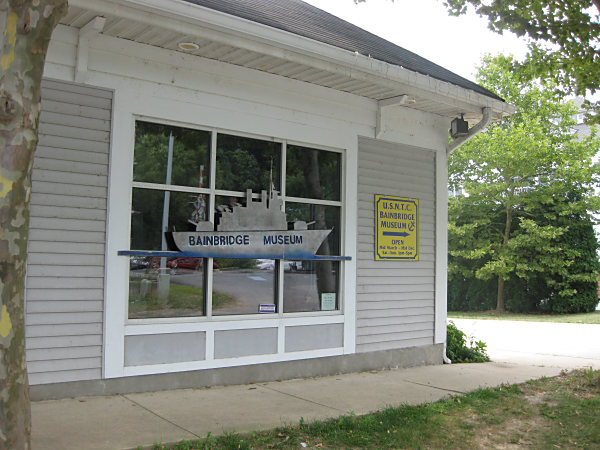
The Navy deactivated the base in 1976, and the expansive property has been mostly vacant and over-grown since then. Fortunately, the Bainbridge Museum is just down the road in Port Deposit, Maryland. They have captured a lot of old photographs and items from the old base. I paid a visit to the museum back in 2009. It was a walk down Memory Lane for sure.
The Bainbridge Museum in Port Deposit, Maryland
So, thanks to Bainbridge Naval Training Center for getting me formally trained in radio and CW. Almost 50 years later, I’m still using much of what I learned there.
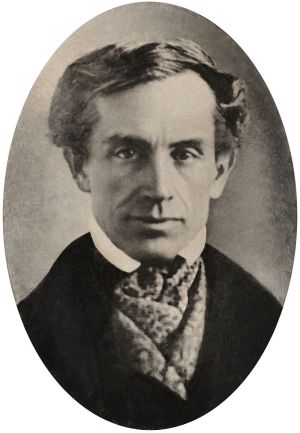
It’s that time of year again. Today is Morse Code Day. Celebrated each year on April 27th, Morse Code Day coincides with the birth of Samual F.B. Morse (1791-1872).
Samuel F.B. Morse (circa 1840)
Morse contributed to the development of the single-wire telegraph and developed the encoding method, which bears his name. But, of course, you probably already knew that.
I’m always amazed that I still use a means of communication that was first used in 1844. CW has been my favorite mode since I learned the code in Navy Radioman school nearly 50 years ago.
So, have a happy Morse Code Day. I hope to hear you on the air today!