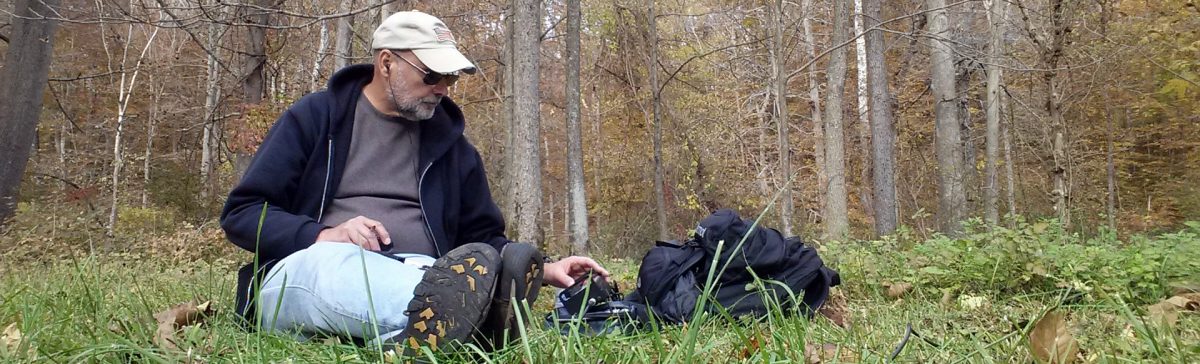
I did a modest Winter Field Day (WFD) operation this year, doing a little operating each day from a POTA/WWFF park. My aim was to make at least enough WFD contacts to complete a couple activations in the process.
Logging
Except for ARRL Field Day, I’ve always been a diehard paper logger. For this year’s WFD, I wanted to try using my tablet for logging. Since I planned to operate mostly “search & pounce,” I figured I’d be able to adapt easily.
I’m using an Amazon Fire tablet these days. It was inexpensive and has good battery life, but ham radio applications—and applications in general—are limited in the Amazon Appstore. To get around Amazon’s limitations, I installed the Google Play application. Following some instructions I found on the Internet, it was a fairly simple process to find and install the four apps required to do that. Now I can install just about any app available through Google Play, and they run fine under Fire OS.
Using my new capabilities, I installed both the HamRS and Ham2K PoLo logging apps and did some testing. I like that the ADIF produced by HamRS uses separate fields for “Category” and “Section.” This is compatible with the N3FJP WFD logger, should I ever want to import it there. In the end, however, I opted to go with PoLo. The user interface is less busy on my tablet.
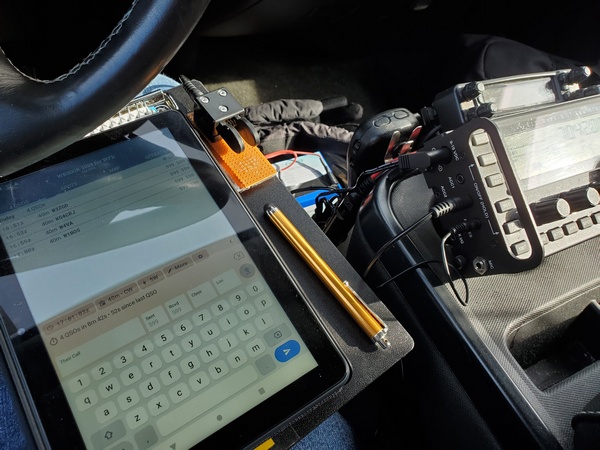
I’m very fastidious about backing up my data in the field. Since neither PoLo nor HamRS have an automatic backup function (like the N3FJP loggers have), my strategy was to periodically export the ADIF and Cabrillo files to my Dropbox account.
Day 1
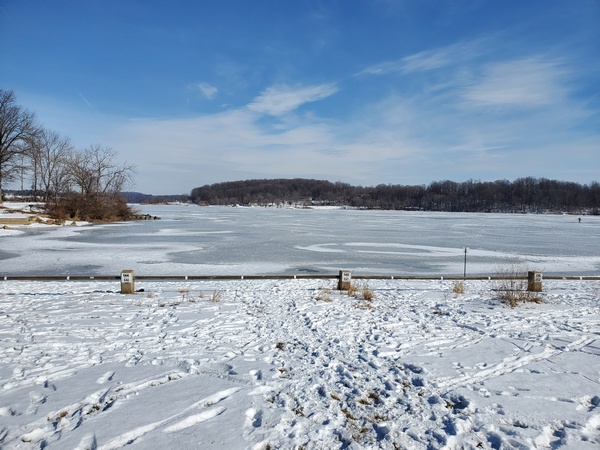
On Saturday afternoon, I headed out to Marsh Creek State Park (US-1380, KFF-1380) and operated from the truck in my usual spot close to the lake. The park was busy with folks ice fishing, skating, or just walking around on the frozen lake, so the parking lot was pretty full.

I used my KX3 (5 watts) so I could access 15M and 10M. For my antenna, I used my 12-foot loaded whip fed through a 1:1 coaxial choke. (More on that setup in another post.)
This year I operated as 1M EPA, searching and pouncing for contacts. There was a ton of CW activity on 40M and 20M, so I had plenty of stations to pounce on. The 20M band, in particular, was jam-packed with CW signals. There was QRM galore. The 15M and 10M bands had less activity, so I didn’t have to fight with pile-ups to work stations.
Once again, my QU-21C paddles gave me problems. (The poor operator on the other end probably thought I was having a medical emergency.) I switched to my Palm Mini paddles and kept going.
Paddle problems notwithstanding, two hours of operation produced 29 Winter Field Contacts and two POTA park-to-park contacts in the log.
Day 2
On Sunday morning, I went back up to Marsh Creek to make a few more contacts. Activity was not as brisk as the day before, and it was harder finding stations I hadn’t already worked. Despite that, I worked 21 WFD stations in a little more than an hour. Most of my contacts were on 40M and 20M, with only one on 15M.
After cleaning the contacts the night before, the QU-21C paddles worked flawlessly this time out. I might need to take them apart to see what’s going on with the contacts on the DIT side.
Wrap-up
I finished up with a grand total of 50 CW WFD contacts this year. This wasn’t my best showing, but it was far from my worst. Considering the limited time spent on it, I did OK—by my standards.
Logging on the tablet worked out fine, for the most part. Operating in the “search and pounce” mode, I could easily keep up poking away with a stylus. If I was running stations in a pile-up, it would have been more difficult. I’m a pretty good touch typist, so I would probably do better using my Bluetooth keyboard with the tablet.
It was nice to actually have some winter weather here in southeastern Pennsylvania for this year’s Winter Field Day. I hope everyone who participated had a successful Winter Field Day.
72, Craig WB3GCK
 WB3GCK QRP Amateur Radio
Good results Craig. I use pencil and Rite-in-the-rain paper logging in the field. For backup I take a picture of my log with my phone before packing up. The picture gets automatically backed up to Google Photos. I then transfer the log entries to HAMRS when I get home and export the ADIF to Dropbox.
LikeLike
Thanks, John. That’s similar to my usual logging process. It boggles my mind that these “portable” logging apps don’t provide some kind of automatic backup function. I’ve heard some horror stories of logs disappearing. 73, Craig WB3GCK
LikeLike
Good evening Craig very nice results and I kept it as 1H at this end. Thanks for the contact on Sunday on 20m.
73,
Mike
VE9KK
LikeLike
Thanks, Mike. You had a great signal down here. 73, Craig
LikeLike