My AliExpress Whip on the Air

I had a chance to use the inexpensive whip I bought through AliExpress recently. While it performed well enough, I encountered a couple of minor quality issues. That’s certainly not surprising, given its $18 USD price tag. 

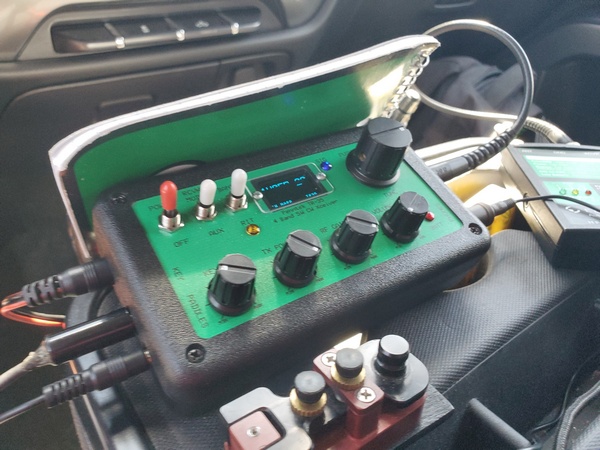
I made an early morning trip to Ridley Creek State Park (US-1414, KFF-1414). I coupled the AliExpress whip with my homebrew loading coil. My rig today was my Penntek TR-35 (5 watts, CW). 

Extending the whip, I noticed that two of the sections were pretty tight and took some effort to pull them out. Better tight than loose, I guess. Another issue is that the crimp that holds the mounting stud in the bottom section of the antenna was a little loose. When the antenna was fully seated in the mount, I could still rotate the antenna. 

My $18 (USD) whip from AliExpress mounted on my homebrew loading coil

Because this whip is longer than a quarter wave on 20M, I didn’t extend the first section from the bottom. Using an antenna analyzer, I was seeing SWR readings similar to my MFJ-1979 whip. The SWR readings seemed stable. So, I guess the suspect crimp is making a good enough connection. 

Band conditions seemed so-so this morning. Despite that, I logged 25 contacts on 40M and 20M in an hour, including three park-to-park contacts. I didn’t work any DX stations today, but I worked a station on the west coast in Washington on 20M. 

Even with its issues, the whip did a pretty decent job this morning. It won’t replace my MFJ whip, but it will have a place in my antenna arsenal.

72, Craig WB3GCK

Quick Two-Fer

As is my practice of late, I did an early morning activation to beat the heat. On Sunday morning, I drove up to Hopewell Fire Tower, which is part of William Penn State Forest (US-5481, KFF-4914). This small tract is located within French Creek State Park (US-1355, KFF-1355).

There was only one other vehicle in the parking lot when I rolled in. My plan was to operate from an old, stone picnic shelter, but I was swarmed by bugs as soon as I got out of my truck. So, I stayed in the truck to keep the annoying flying critters at bay. My equipment today included my Penntek TR-35 (5 watts, CW) and my 12-foot loaded whip. 

Based on my Reverse Beacon Network (RBN) spots, the 40M band seemed in pretty good shape. I quickly logged 15 contacts before moving to 20M. I logged a few more on that band before shutting down. 

My 40 minute activation yielded 19 QSOs, including four park-to-park contacts. One of those P2P contacts was with fellow QRP Polar Bear, VE3WMB. It’s always a pleasure to work Michael.

Stay cool out there!

72, Craig WB3GCK

Another Reluctant Activation

As I have gotten older, the heat and I don’t get along very well anymore. So, with the heat and humidity forecasted for today, I was just going to stay home and get caught up on some things around the house. My (far) better half intervened and encouraged me to go out early before it got too hot. She’s always right, so off I went.

I drove down to Ridley Creek State Park (US-1414, KFF-1414) and found a parking spot with some shade. Along with my Penntek TR-35 (5 watts, CW), I used an MFJ-1979 17-foot whip with my homebrew loading coil. 

My MFJ-1976 17-ft whip on my homebrew loading coil.
My MFJ-1979 17-ft whip on my homebrew loading coil.

I started out on 40M and wound up staying there for my whole activation. The band was in pretty good shape, as it only took about eight minutes to log my first 10 contacts. 

About 40 minutes into my activation, I got a call from my (far) better half. There was an issue at home, so I packed up and headed out.

I ended up with 20 contacts this morning, with four known park-to-park contacts. One contact was with fellow QRP enthusiast, Jim W1PID. It’s been a while, so it was nice to hear him again. One of my park-to-park contacts was with QRPer Thomas K4SWL. We had a very light copy on each other, but he persevered and eventually pulled me out of the noise. Thanks for your patience, Thomas!

On an unrelated note, it’s great to have Logbook of the World (LoTW) back up and running, after a serious cybersecurity incident. The system also seems to run much faster now, so it’s nice to see the backlog steadily declining. I’m guessing things should be back to normal in the next week or so.

Finally, I’d like to wish my fellow Americans a very happy and safe Independence Day!

72, Craig WB3GCK

A Brief Activation at PA SGL 246

I mentioned in a previous post that I’m out in central Pennsylvania, doing some house sitting for my daughter’s family and taking care of my grand-dog. I wanted to get in at least one park activation while I’m here, but I didn’t want to leave the pup alone for too long. Fortunately, Pennsylvania State Game Lands 246 (US-8941, KFF-5862) is just minutes away.

I last activated PA SGL 246 back in 2022 and had 34 contacts. So, 10 contacts this time would not only qualify another activation for Parks on the Air (POTA), but it would also give me the 44 contacts needed for World Wide Flora and Fauna (WWFF). 

I rolled into the empty parking lot and quickly set up my 12-foot loaded whip on the back of the truck. My rig today was my trusty KX3 today (5W, CW).

There really wasn't much to photograph where I was at US-8941/KFF-5862. Just a gravel parking lot.
There really wasn’t much to photograph where I was at US-8941/KFF-5862. Just a gravel parking lot and some big boulders.

I started out on 40M and was greeted with about S2 worth of noise. I’m guessing it was coming from a power line that runs over the parking lot. Despite the noise, I made 10 contacts in about 13 minutes. Then things seemed to dry up.

I moved up to 30M for a while, but there were no takers. Determined to add at least one more contact, I went back down to 40M. It took a few minutes, but I finally got one more call.

Around that time, it was starting to get hot in the truck. I also neglected to grab my water bottle as I headed out the door. Doh! So, having narrowly exceeded my goal of 10 contacts, I packed up before I got too dehydrated. Besides, I had an errand to run before heading back to the house.   

After about 30 minutes of operating, the grand total today was 11 contacts. I don’t think I had any park-to-park contacts. 

I think this might have been the shortest activation I have ever done.

72, Craig WB3GCK

20M Activation at Ridley Creek

Today I did something I don’t think I have done before: a single-band activation. Normally, I spend time on several bands. Today, however, I wanted to see how my 17-ft whip would perform mounted directly to the antenna mount on my truck (sans loading coil). 

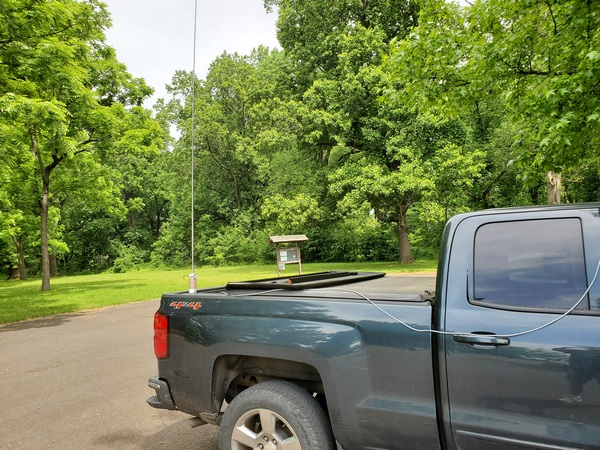
I drove down to Ridley Creek State Park (US-1414, KFF-1414) this morning and set up in one of the picnic areas. After mounting the antenna, I broke out my antenna analyzer. Since the fully extended whip is approximately a quarter-wave on 20M, I wasn’t surprised by the SWR readings. With 15 feet of RG-8X coax attached, the SWR was a flat 1.45 across the band. So I fired up my Penntek TR-35 (5 watts, CW) and hung out on 20M for the next hour.

My 17-foot whip mounted on my truck at Ridley Creek State Park (US-1414, KFF-1414)

When I checked the band conditions, I saw the geomagnetic field was “unsettled.” Solar wackiness notwithstanding, I logged my first 10 contacts in about 12 minutes. European signals weren’t very strong this morning, but I still managed three DX contacts: two from Italy and one from France. An hour’s effort produced 26 contacts, including four park-to-park contacts. 

I’m planning to dust off a 25 year old 20M QRP rig and use it for a future activation. This antenna configuration might come into play for that. Stay tuned…

72, Craig WB3GCK

(Antenna) Size Matters

I went back to Marsh Creek State Park (US-1380, KFF-1380) for a quick activation this morning, and things got off to an interesting start. After setting up my trusty Penntek TR-35 (5 watts, CW) and 12-foot loaded whip, things just didn’t seem right. My SWR on 40M was high, and even my Elecraft T1 antenna tuner couldn’t get it lower than 3:1. 

I started checking cables and connections, but everything looked OK. Heck, it’s not a very complicated antenna, so there isn’t much that can go wrong. When I got out of the truck to change to another antenna, I noticed my 12-foot whip looked a little shorter than usual. I took the whip off and immediately found the problem. In my haste to get set up this morning, I neglected to extend the top section of the telescoping whip. Doh! Once I pulled the top section out and re-installed the whip, all was right with the world again. 

Using a notepad as an impromptu sun shield for my Penntek TR-35

Despite getting off to a slow start, my results weren’t too bad (by my standards). I finished with 36 contacts, including one known park-to-park contact. I had one DX contact with IW2NXI.

I finished my activation just in the nick of time. An hour after I got home, there was a major geomagnetic storm in progress. Timing is everything.

73, Craig WB3GCK

Back to Valley Forge

I almost talked myself out of this activation today. We had a long day yesterday at a family function with about four hours of driving, so my initial inclination was to take it easy today. In the end, the POTA urge was too great to deny, and I’m glad I went.

I drove over to Valley Forge National Historical Park (US-0761, KFF-0761), which is just a couple of miles down the road. It had been about five months since my last visit, so I was overdue for an activation here. 

Using my Penntek TR-35 (5 watts, CW) and 12-foot loaded whip, I started out on 40M. The signals were surprisingly strong this morning. My activation kicked off with a park-to-park contact with N1BS up in Rhode Island.

My location in Valley Forge NHP (US-0761, KFF-0761)

Forty and 20M produced most of my contacts this morning. I ended up with 39 contacts with 6 park-to-park QSOs. I had four DX QSOs: two with Italian stations, and two with SM4BNZ in Sweden on 20M and 17M. 

I also had a nice park-to-park contact with fellow QRPer, AA4XX. It had been a while since our last QSO, so it was good to hear Paul on the air this morning. 

After about 90 minutes of operating, the bands seemed to dry up, so I packed up and made the short drive back home. 

In the end, it was a fun morning, so I’m glad I went. 

73, Craig WB3GCK

Hanging with the Heron

Since I’m slowly sneaking up on POTA “Repeater Offender” status (20 activations) at Marsh Creek State Park (US-1380, KFF-1380), I made a quick trip back there this morning. Unlike the rainy weather I encountered last time, it was a beautiful, clear morning. 

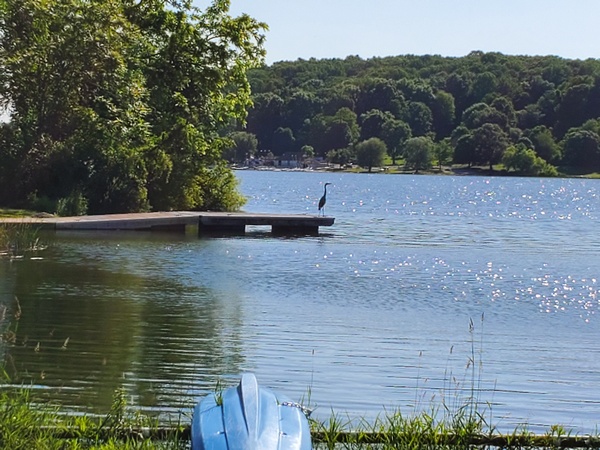
Since it was a weekday, the parking lot at the Western Launch area was pretty empty. When I got out of the truck to set up my antenna, I noticed a large heron. Last time, he was patrolling the shallow, marshy area near my parking spot. Today, he was proudly standing on the dock, surveying his domain. I snapped a couple of pictures of him and continued setting up.

The resident heron surveying his domain at Marsh Creek State Park (US-1380, KFF-1380)

I went with my usual setup: my Penntek TR-35 (5 watts, CW) and my 12-foot loaded whip. Starting on 40M, it took all of 12 minutes to make my first 10 contacts.

I had some errands to run, so I kept it short. In a little more than an hour, I logged 22 contacts. There weren’t any park-to-park contacts, but I did log four European stations (Italy, Sweden, Czech Republic, and Slovak Republic) on 17M. 

The heron eventually flew off. Like the heron, I took off, too—for home, that is.

Have a great weekend!

73, Craig WB3GCK

Holiday Weekend Activations

Over the course of the long Memorial Day weekend, I got in two short activations. As expected, there was a lot of activity going on at the parks. Parks in this area get a little busy on holiday weekends. 

Ridley Creek State Park (US-1414, KFF-1414)

I rolled into Ridley Creek State Park early on Saturday morning. Even at 0900 local time, the park was fairly crowded. I was going to operate from a picnic table, but given the number of people there, I decided against that. Between the hikers, dog walkers, mountain bikers, and folks setting up for picnics, it was a busy place. 

Using my Penntek TR-35 (5 watts, CW) and 12-foot base-loaded whip, I logged 27 contacts. Most of the contacts were on 40M and 30M, with just one on 17M. No DX today, but I had three park-to-park contacts. After about 90 minutes, I packed up and headed home.

Norristown Farm State Park (US-4363, KFF-4363)

On Monday, I had another early activation, this time at Norristown Farm State Park. As I expected, there were quite a few people at this park taking advantage of the holiday. 

This activation was almost a carbon copy of Saturday’s. I used my TR-35 and 12-foot loaded whip, and once again, I made 27 contacts with three park-to-park QSOs. Like the last activation, 40M and 30M were the most productive bands for me. 

This time, though, I worked two European stations (Italy and Sweden) on 17M. These were my first DX contacts in more than a month, so I was glad to be out of my slump. 

I hope everyone had a happy and safe holiday weekend. Be sure to take time to honor those who paid the ultimate price for the freedoms we enjoy.

73, Craig WB3GCK

A Tool for Dual Activators

I was first bitten by the parks bug, taking part in ARRL’s National Parks on the Air (NPOTA) program in 2016. When NPOTA ended, I started activating parks under the World Wide Flora & Fauna (WWFF) program. When Parks on the Air (POTA) came along, I started submitting my logs to both programs—and still do. 

Since POTA and WWFF are separately administered, there are some significant differences between the two programs. One notable difference involves the park designators. In some cases the park numbers are the same, but often they’re different. For example, the designator for PA 246 State Game Land is KFF-5862 in WWFF and US-8941 in POTA. Sometimes a park will be in one program but not the other. 

Fortunately, Al Zelna N3KAE has provided an online tool that makes it easy for “dual activators” to cross-reference the WWFF and POTA park designators in the U.S. and Canada. Visit the CQ Parks.net website to check it out. 

Dual Parks North America

If you aren’t familiar with WWFF, it’s the original Amateur Radio parks program. In its current form, WWFF dates back to 2012, but it has roots going back to about 2008. While POTA has seen tremendous growth since its inception, WWFF is still very popular in Europe and other parts of the world. When band conditions are good, a spot on the WWFF site or a DX cluster will often generate a European pile-up. It sure is fun having a bunch of DX stations chasing my little QRP station.

Have fun out in the parks, however you activate!

73 & 44, Craig WB3GCK