Over the years I have accumulated a stash of the bags that Crown Royal whiskey comes in. I don’t drink much hard liquor myself, but I have a relative who enjoys a nip now and then. She knows I have a thing for bags and containers, so she passes them along to me. I graciously accept them, figuring someday I’ll find a good use for them.
When I take my Penntek TR-35 on the road, I use a repurposed insulated lunch box to carry the radio, an Elecraft T1 tuner, along with a variety of accessories. Pending a better solution to protect the TR-35 from bouncing around, I wrap some bubble wrap around it before placing it in the box. Decidedly low-tech, but effective.
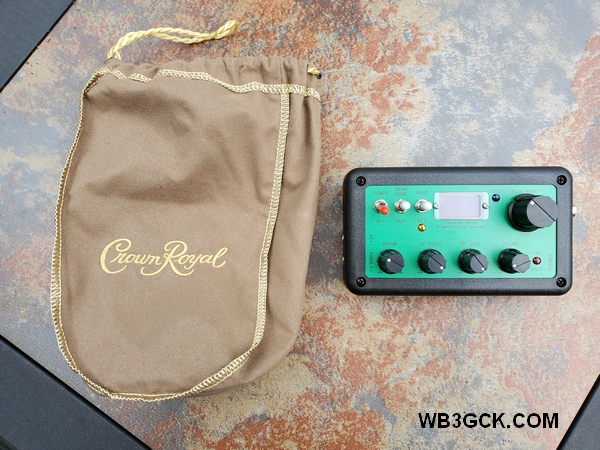
The Crown Royal bag, along with my TR-35 transceiver
The lunch box works great, but it’s a little bulky for my sling pack. So, for hiking, I usually pack the TR-35 loose in the pack, with a rubber band around the bubble wrap.
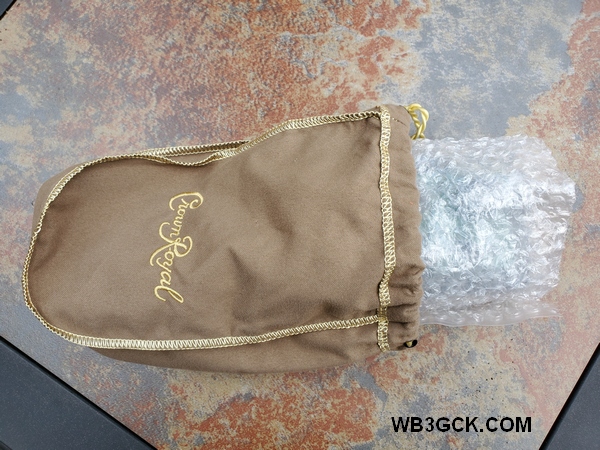
The bubble-wrapped TR-35 going in the bag
I found that a Crown Royal bag provides a more elegant solution for packing the TR-35 (or other small QRP rig). I just wrap the bubble wrap around the radio and place it in the bag. There’s no longer a need for the rubber band. Plus, there’s enough room in the bag to accommodate the T1 tuner.
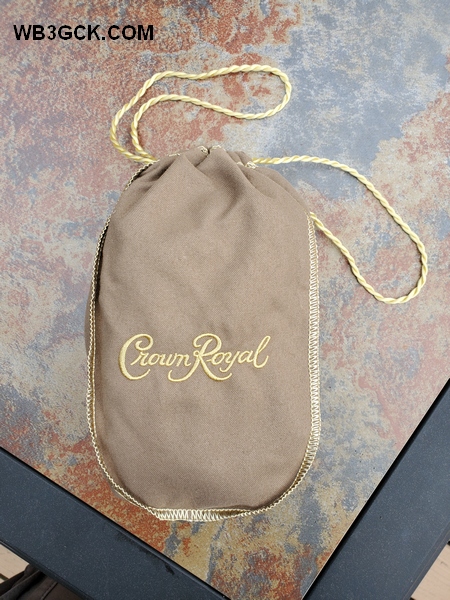
The Crown Royal bag with my TR-35 tucked away inside
These bags don’t offer any real protection from the weather, but they look cool. My collection of bags includes a variety of colors, so I can change them to match my mood (just kidding—let’s not get carried away here).
So, there’s a crazy little hack for you to ponder. If you’re a Crown Royal drinker, save the bags. Your radio just might fit in there.
This weekend was a Parks on the Air (POTA) Support Your Parks weekend. There are four seasonal events with the chance for activators and hunters to earn plaques. Even though I stand little to no chance of getting a plaque, I figured this would be a good weekend to activate a couple of parks.
Marsh Creek State Park (K-1380)
On Saturday, I headed over to the western boat launch area in Marsh Creek State Park. I’ve operated from this spot twice in the past year, and it’s not usually busy. Not today, though. The parking lots were jam-packed, with a steady stream of boaters coming in. I drove around to the other side of the lake to check out the picnic area.
When I arrived mid-morning, the picnic area parking lot was fairly empty. I figured the place would get pretty busy towards lunchtime, so I found a shady parking spot and operated from the truck. I used my Penntek TR-35 (5 watts) and my usual 19-foot vertical.
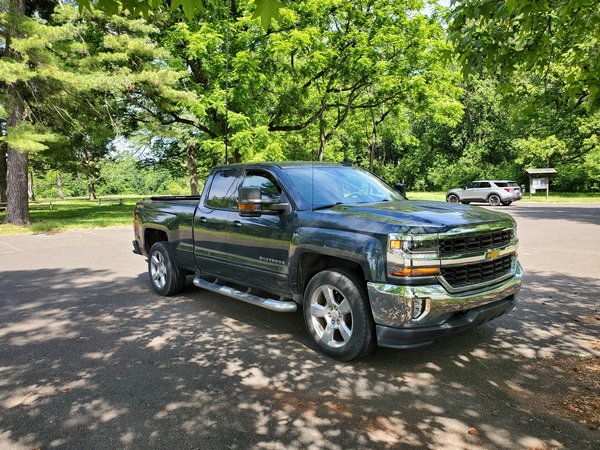
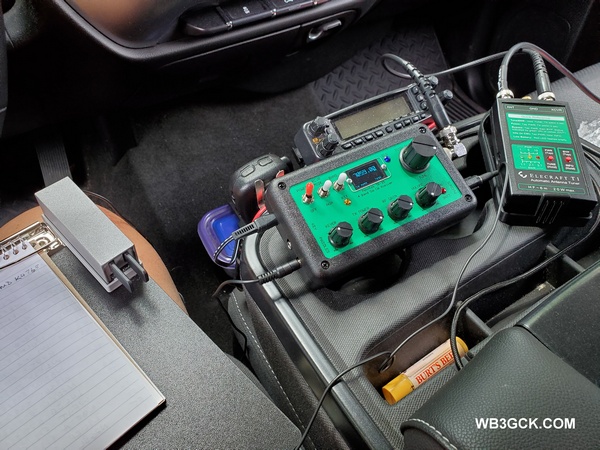
I forgot to take pictures of Marsh Creek State Park (K-1380), but I did take this picture in the cab of my truck.
My first contact was with my friend and fellow ARES-RACES member, N3FLL. Frank said he was doing some POTA hunting today, so I was happy to give him a park.
After I had logged 26 CW contacts (with three park-to-park QSOs), the inside of the truck was getting pretty warm. Plus the great smells from all the surrounding barbeques reminded me it was lunchtime. By the time I left, the park was getting crowded with folks taking advantage of the summer weather, so my timing was perfect.
Valley Forge National Historical Park (K-0761)
I wanted to get a bike ride in, so Sunday morning I rode from the Pawlings Road trailhead into Valley Forge Park. It was a little over two miles to the Betzwood Picnic Area. I operated from this location once before six years ago. The elevation isn’t very good, but I gave it a shot, anyway.
I found a picnic table in a shady spot back along some trees. I had a hill right behind me, but the shade was more important today. On this trip, my rig was the TR-35 and my Alexloop.
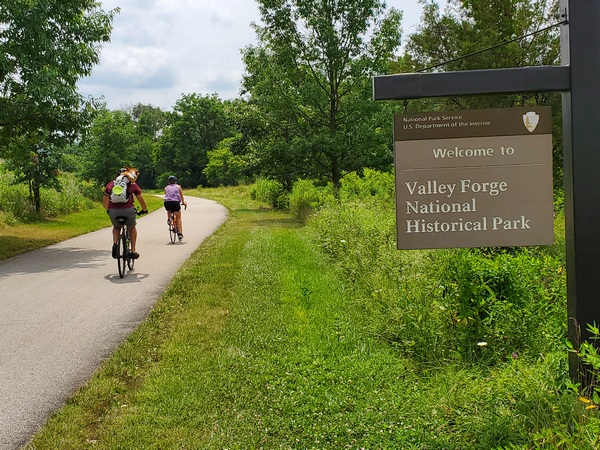
The Schuylkill River Trail entering Valley Forge National Historical Park from the west.
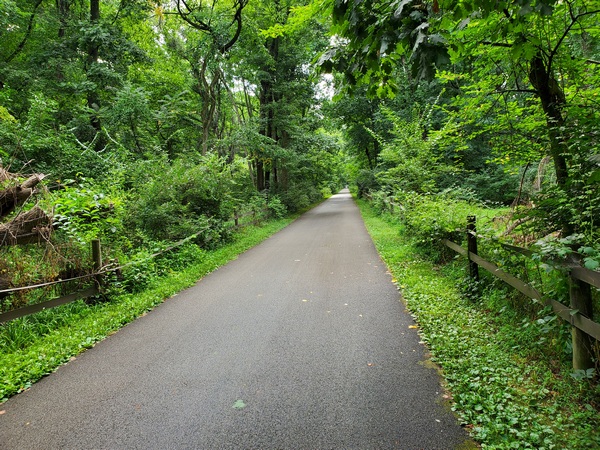
One of my favorite stretches along the Schuylkill River Trail. This section is in Valley Forge National Historical Park.
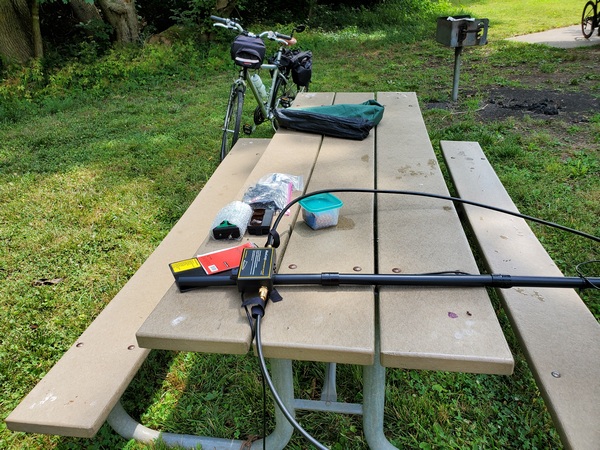
Once again, I neglected to take pictures of my setup, but here’s a picture I took while packing up to head back.
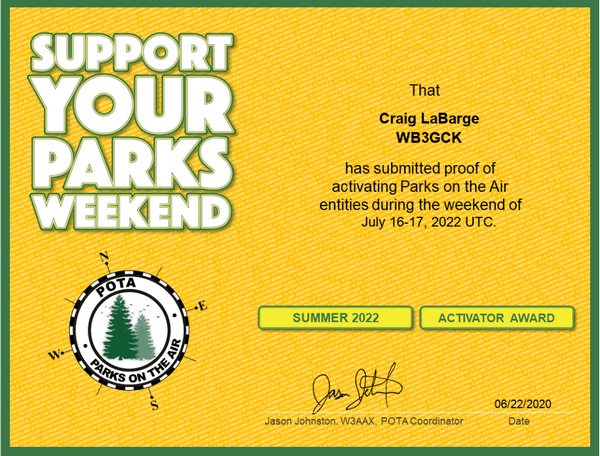
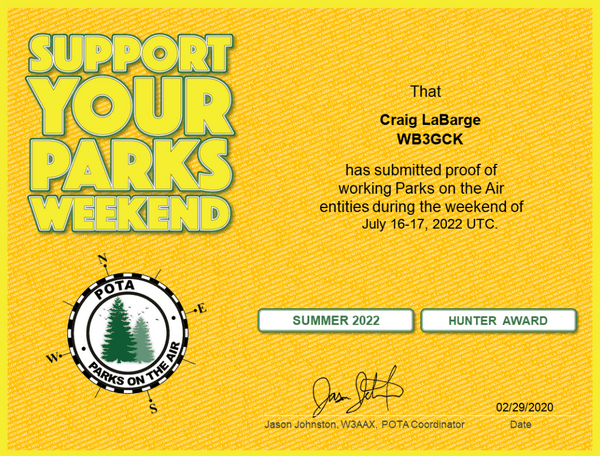
Even if you don’t qualify for a plaque, activitors and hunters participating in the Support Your Parks event get a certificate.
Hunters also received certificates for working parks during the Support Your Parks Weekend. My park-to-park contacts earned me this one.
My first contact was with W3DET on 30M. This was my first QSO with Dave in a while, so it was good to hear him again. I made four more contacts before giving 20M a try. I picked up one contact on 20M, so I moved down to 40M, which is the least efficient band for the Alexloop. However, the 40M band produced four park-to-park contacts.
Since it was so hot and humid, I packed up after making the required ten contacts and headed back to the trailhead. There was nothing extraordinary today, radio-wise, but I had an enjoyable bike ride.
When I got home and logged into the POTA website, I found I had received a certificate for activating during the Support Your Parks weekend. There sure were a ton of stations on the air this weekend, so I hope all the activators and hunters had fun.
I had a couple of hours this morning, so I loaded up the bike and headed out for another ride. Since the SKCC’s Weekend Sprintathon is running this weekend, I took the radio gear along for the ride.
I rode the new section of the Schuylkill River Trail that I mentioned in my last post. I headed west from the new trailhead and rode out to Towpath Park. Towpath Park is a small community park that I have operated from many times over the years. Today was the first time I got there by bike.
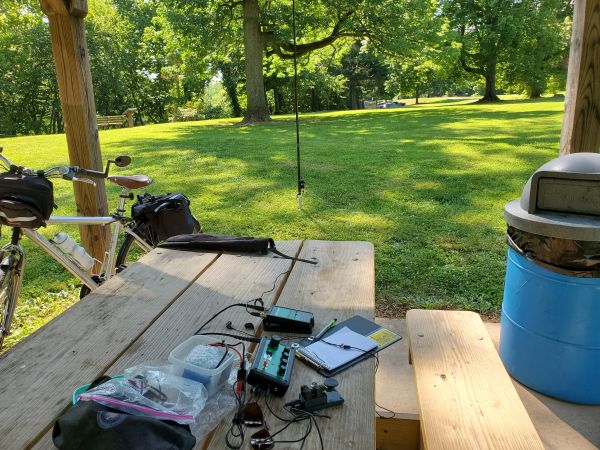
After a nice three-mile ride, I arrived at the park. I headed to a small pavilion and set up the radio. I used my TR-35 and my homebrew 19-foot vertical. I have to say that I have really been enjoying my little TR-35. It’s a great rig for portable operations like this.
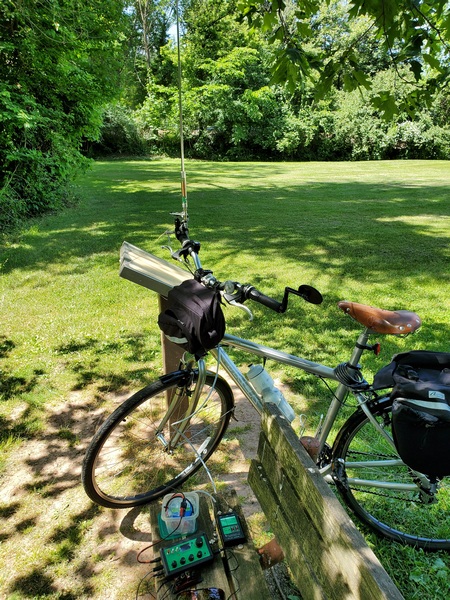
My bike-portable setup at Towpath Park along the Schuylkill River.
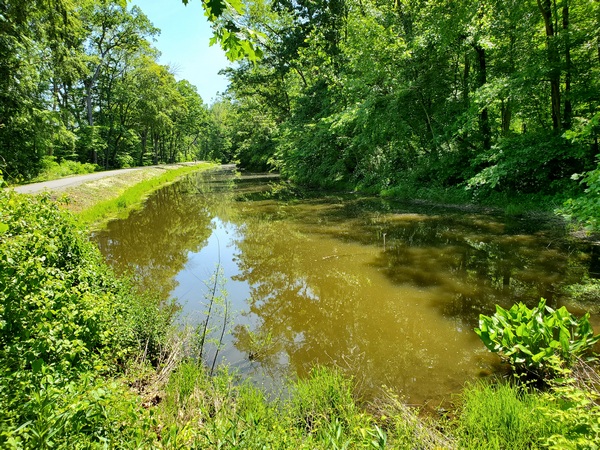
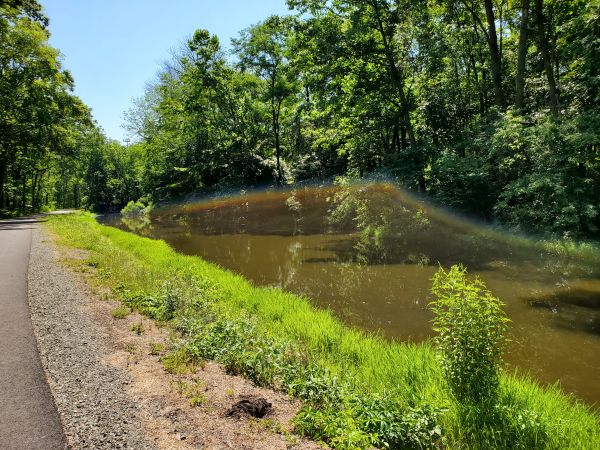
I didn’t hear much contest activity, but I still managed to log four contacts in short order on 40M (NH, MI, OH, MA) and one on 20M (WI). After my radio-based pit stop, I loaded up the bike and started back down the trail. On the way back, I stopped to snap a picture of what’s left of the canal from which Towpath Park derives its name.
A short stretch of the canal from which Towpath Park derives its name. The bright sunlight caused a strange rainbow effect in the picture.
This is a great ride for bike-portable operation. I’ll definitely be doing this again in the future.
I needed another rig like I needed a hole in the head, but I couldn’t resist. I’ve had my eye on the Penntek TR-35 for a while now, so I finally pulled the trigger and ordered one. I considered it a Father’s Day present to myself. Two days later, I had the TR-35 in my hands.
Lacking the patience and the close-up vision for serious kit building these days, I ordered a factory-built radio with the rotary encoder tuning option. Now, I have seen plenty of pictures and videos of the TR-35, but the small size of this rig really struck me when I opened the box. Its footprint is not much larger than a QSL card. It’s a perfect size for portable operating.
Here are some features that drew me to the TR-35:
It covers the bands I use most in the field (40/30/20/17)
Built-in iambic mode B keyer (my mode of choice)
Two CW memories. Perfect for POTA activations, QRP contests, etc.
Separate inputs for paddle and straight key. I sometimes get calls from fellow SKCC members, so it’s convenient to switch instantly to a straight key for those QSOs.
No complicated menu structures to navigate to get things set up. The TR-35 is super-simple to operate, and that’s just how I like it.
The TR-35 doesn’t include a built-in tuner. No worries; I’m going to dust off my little Elecraft T1 ATU and show it some love. An SWR indicator would have been a nice feature to have, but I can get along fine without it.
Taking It For a Spin
I didn’t have a chance to put my new TR-35 on the air until today. I drove over to Valley Forge National Historical Park (K-0761 and KFF-0761) to try the new rig on a POTA activation. Doing an activation with a radio you’ve never used is a little like going camping with a tent you’ve never set up before. But, what the heck, I was a risk-taker today. Actually, I brought a backup rig along, but I never needed it.
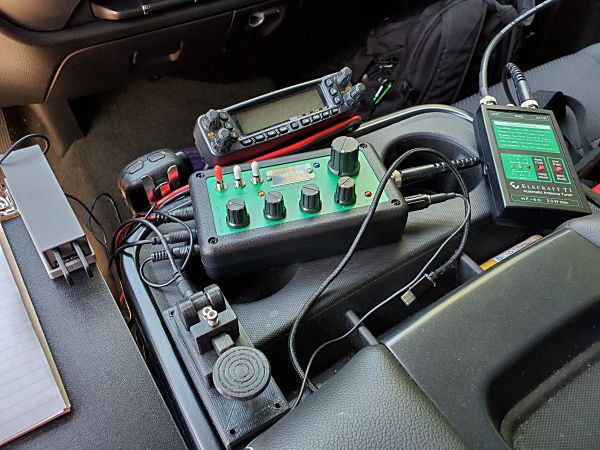
I set up the TR-35 in the cab of my truck, along with my T1 tuner. The antenna was my homebrew 19-foot vertical on the back of the truck. As soon as I powered up, I was greeted by lots of loud CW signals. That’s a good sign. I quickly programmed a “CQ POTA” message into one of the two CW memories and got on the air.
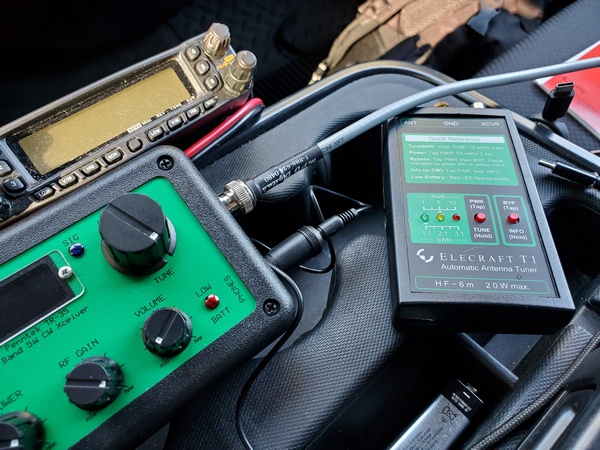
My TR-35 on its first POTA activation at Valley Forge National Historical Park. My Elecraft T1 tuner is on the right. It was nice to have paddles and a straight key connected simultaneously.
One of the first things I noticed is how loud the audio is. I was using earbuds, and I had to turn the volume almost all the way down. The sidetone seemed a bit loud for my liking, but not really much of a problem for me.
Once I got going, I had a lot of fun with this little rig. I easily made contacts on each of the four bands (40/30/20/17). The TR-35 is a joy to operate, and I really appreciate its simplicity. Tuning with the optional rotary encoder is smooth as silk.
After about an hour and a half, I had 24 contacts in the log, with five park-to-park QSOs. My stomach reminded me it was lunchtime, so I packed up and headed home. I left the park feeling very happy about my recent purchase. The TR-35 is going to see a lot of use in the field.