A while back I purchased one of AD8HK’s end-fed random wire (EFRW) antennas. I tried it for the first time during my ill-fated Flight of the Bumblebees (FOBB) outing. With everything that went wrong that day, the AD8HK antenna certainly deserved a better evaluation—at least one where I wasn’t in a panic over problems with my newly acquired Elecraft KH1.
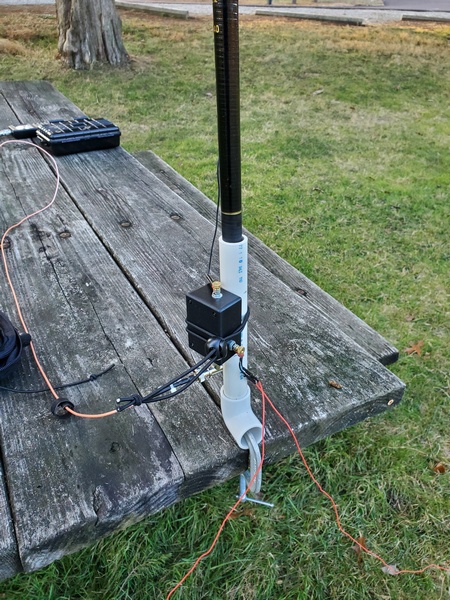
The AD8HK EFRW is a really slick little antenna. It consists of a 15-foot radiator and a 7.5-foot counterpoise wire. It has a neat 3-D printed winder for the wires that also incorporates a 4:1 unun and BNC connector. It’s compact and well-built. AD8HK Antenna Systems sells this antenna (and other offerings) through eBay.
During my infamous FOBB outing, I fed the antenna with 6 feet of RG-316 coax. It loaded up on 30M through 15M, but neither my KH1 nor my Elecraft T1 tuner could find a match on 40M. I’m not sure what the issue was, but I didn’t have much time to look into it.
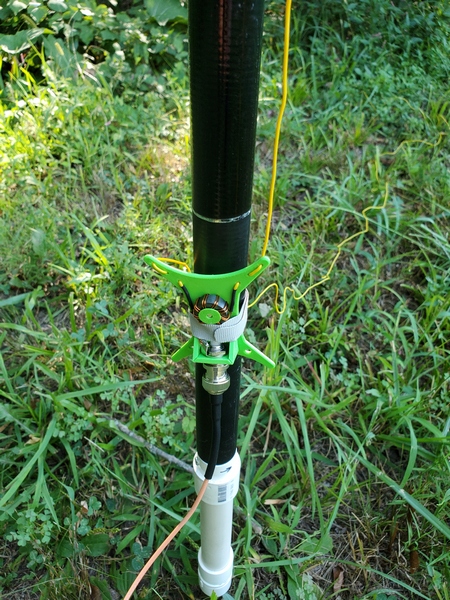
The AD8HK winder/unun secured to the pole with a Velcro strap.
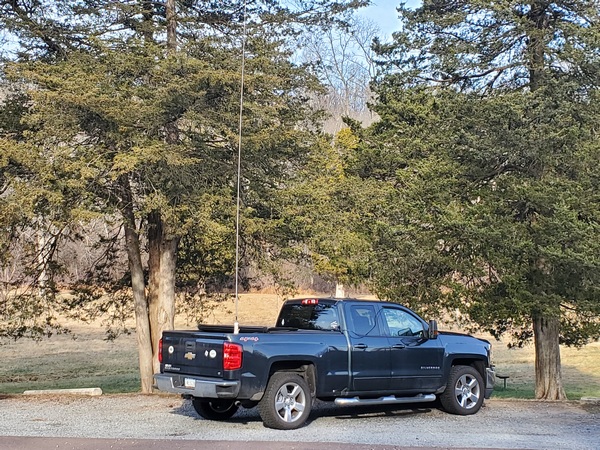
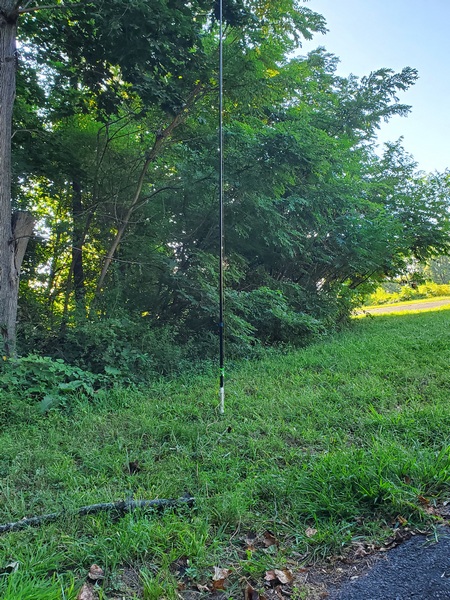
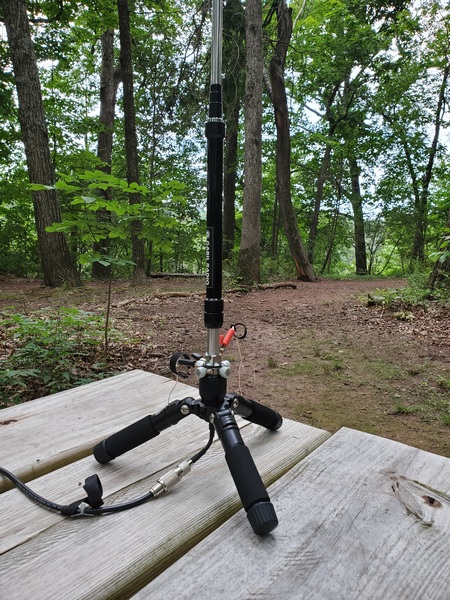
This morning I took the AD8HK EFRW over to Valley Forge National Historical Park (US-0761, KFF-0761) for an activation. I supported the antenna with a 20-foot pole and my homebrew ground mount. I fed the antenna with 20 feet of RG-316, and this time my T1 ATU easily found a match on 40M. It also loaded up fine on 30M through 17M.
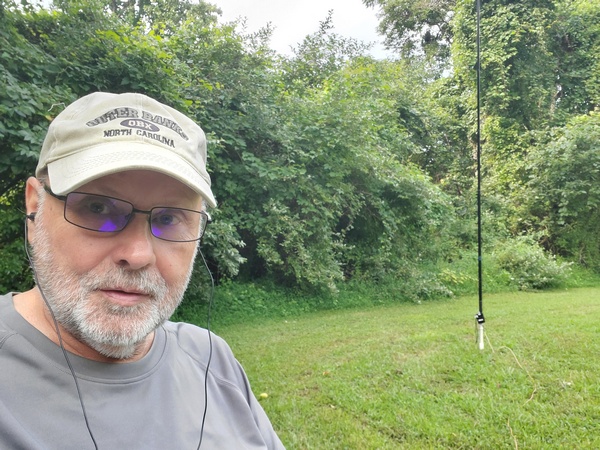
My antenna pole
A 15-foot radiator isn’t going to be a barn burner on 40M; however, this little antenna certainly held its own today. I easily logged 13 contacts on 40M before moving on to try other bands. When I wrapped up after a little over an hour, I had twenty contacts in the log, with four park-to-park contacts. I made contacts on all four bands covered by my Penntek TR-35 (40M-17M), and I was pleased to work W6LEN out in California on 20M.
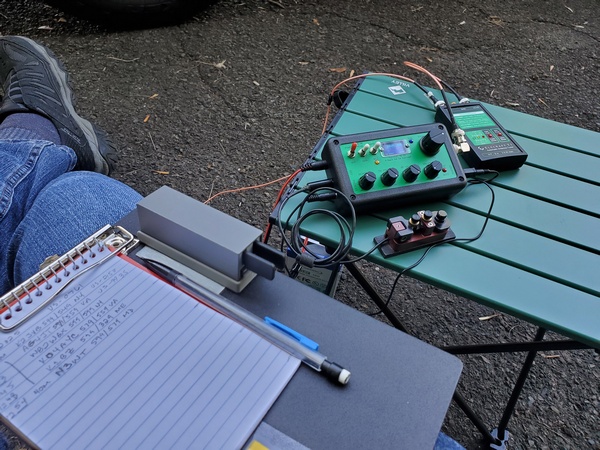
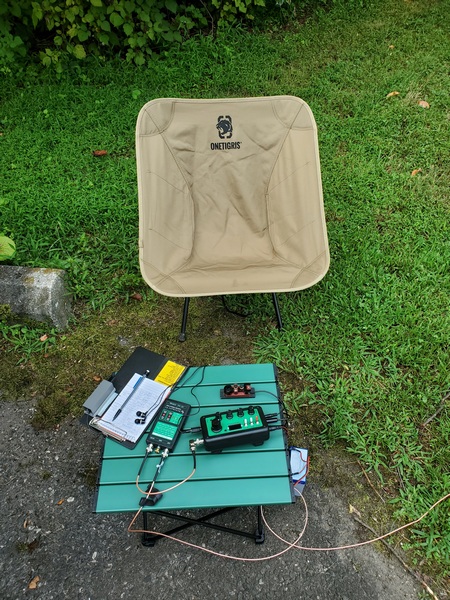
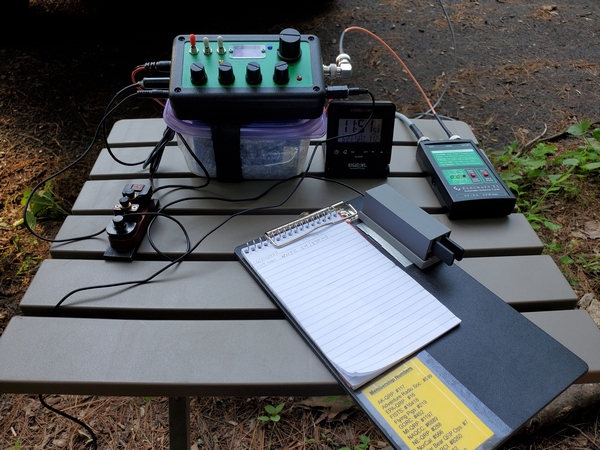
My usual set up: Penntek TR-35 and Elecraft T1 ATU
After today, the AD8HK EFRW has definitely earned a spot in the KH1 kit I’m putting together. It’s easy to deploy and has a relatively small footprint.
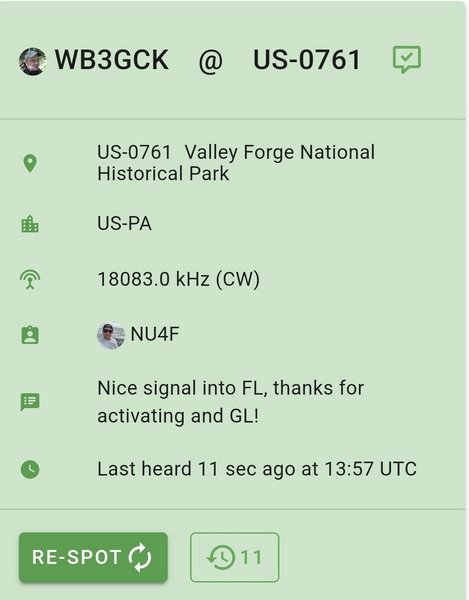
Thanks to NU4F for the nice spot from Florida
Speaking of my KH1… I heard from Elecraft a few days ago. They replaced the FET in the final amplifier, and now the rig is on its way home. I can’t wait to get it back on the air.
On Wednesday, August 7th, I set out to do some antenna experimentation. So, why not get in a POTA/WWFF activation at the same time? To kill those two birds with one stone, I drove down to Ridley Creek State Park (US-1414, KFF-1414). (Disclaimer: No birds were actually harmed during this activation.)
I saw some discussion on the Internet about an antenna configuration I found intriguing. It’s just a 15-foot radiator and a 7.5-foot counterpoise wire fed through a 4:1 unun. Folks claim they work on 40M through 15M—with a tuner, of course. I’m a sucker for simple, field-expedient antennas, so I gave it a try during the recent Flight of the Bumblebees contest.
With the unun I used, I had mixed results. I couldn’t get the antenna to load on 40M, but it seemed to do fine on 30M through 15M. I wanted to try the same configuration, but with a larger 4:1 unun I built a several years ago. After cutting another set of 15-foot and 7.5-foot wires, I was ready to go.
My antenna feedpoint
When I got to the park, I headed to a spot I had been using a lot lately. It’s off the beaten path and well away from the other park visitors. Using my homebrew ground mount, I set up the antenna on a lightweight 19-ft telescoping pole I bought years ago on eBay. I ran 20 feet of RG-316 coax over to my Penntek TR-35 and Elecraft T1 tuner.
My operating position
Before I started my activation, I gave the antenna a quick check. The antenna was an easy match on 30M through 17M, but it took two tries before the T1 found a good match on 40M.
Despite the slightly fussy tuning on 40M, the antenna didn’t do too badly on that band. I logged 12 contacts before the activity slowed down. I next tried 30M, but there were no takers. Moving up to 20M, I logged three more stations. Up on 17M, I worked one last station in Alabama. After an hour on the air, I had 16 stations in the log, including five park-to-park contacts.
Something in the woods behind me was not happy with my presence. Fortunately, I never came face-to-face with whatever it was.
I had better luck with this antenna configuration this time around. The unun I used for this outing uses a larger iron powder toroid (T130-2, as I recall) compared to the smaller ferrite core used in the other unun. Also, the longer run of coax I used this time was probably a contributing factor.
In any event, this configuration can definitely work. Granted, it’s a compromise antenna, but it’s super simple to deploy for casual operating in the field. Still, I think a slightly longer radiator would make for an easier match on 40M.
I have another configuration in mind that I plan to try soon.
Actually, this bumblebee barely got off the ground at all this year. It started off with a heartbreaking rig failure and ended with some horrendous local noise.
I had a late-breaking change of plans this week. I originally planned to operate in the Flight of the Bumblebees (FOBB) contest from a nearby POTA entity. Instead, I ended up in central Pennsylvania helping a family member recovering from a recent surgery.
So, I activated Plan B: take my new KH1 along and make a few contacts from the backyard. What could go wrong with that? A lot, as it turns out.
Using my homebrew ground mount, I set up a new antenna on my lightweight telescopic pole. The antenna comprises a 15-foot radiator and a 7.5-ft counterpoise fed through a 4:1 unun. (More about that antenna in another post.) I ran a 6-foot length of RG-316 coax over to the KH1.
I easily got a 1:1 match on 20M and up, but it wouldn’t load up at all on 40M. Going back to 20M, I started operating. Something on the display didn’t look right. It turned out that I wasn’t getting any power output. When I pressed the ATU button, I heard some relay clicking, but there was no power or SWR displayed after tuning. When I keyed up, the display showed zero bars of power and one bar for SWR.
I checked to make sure I wasn’t in “Test” mode (I wasn’t). Next, I started pouring through the settings to make sure I hadn’t messed something up. Nothing looked out of the ordinary to me. I tried the built-in whip on 20M, but still no power out.
After spending an inordinate amount of time playing around with the KH1, I packed it up and brought out my Penntek TR-35. My trusty Elecraft T1 ATU also refused to load up on 40M.
So, 20M was the only band working for me, given the rig I was using. I could have set up a different antenna, but I didn’t have that much time.
The 20M band had some horrendous local noise, so it was rough going. I worked one bumblebee in Missouri, and that was it. Frustrated with my inability to hear any other FOBB activity through the noise, I called it quits. I needed to get back inside to take care of a few things, anyway.
Having owned my KH1 for less than a week, you can imagine my disappointment. I shot off a message to the support folks at Elecraft, so hopefully, they can help get this issue resolved before I head down to North Carolina on vacation next month. (Fingers crossed)
Wanting to take advantage of the excellent weather today, I drove up to Evansburg State Park (US-1351, KFF-1351) for a quick morning activation. I wanted to give my Gabil GRA-7350TC vertical some air time, so I tossed it into the truck and headed out to the park.
The picnic table I planned to use had been moved from its usual spot. Not wanting to drag the heavy table back to where it belongs, I set up at a table I have used previously. It’s close to a hiking trail, so I needed to make sure my radials wouldn’t be a trip hazard for passersby.
I set up the Gabil antenna on its tripod at one end of the table. To facilitate tuning, I set up my Penntek TR-35 (5 watts, CW) and Elecraft T1 ATU within arm’s reach of the antenna. I meant to bring a 3-foot coax along, but it didn’t make it into my backpack. A 10-foot cable was the best I could do, so I just coiled up the excess. (Note to self: Keep a 3-foot cable in the backpack.)
I started out on 40M, so I laid out a 33-foot counterpoise wire on the ground. I reached for my little SWR meter, but it wouldn’t power on. It had been a while since I had last charged it, so the battery appeared to be dead. I ended up adjusting the antenna for maximum noise in the receiver and used the T1 to do the final matching.
After I had a few contacts in the log, I changed over to 20M. I built my 33-foot counterpoise wire so I could split it into two 16.5-foot wires. After laying out the two counterpoise wires, I tried to peak the noise. No joy. I just couldn’t find a discernible peak.
Just then, I remembered I had a 12-volt power cable for the SWR meter. Duh! Why didn’t I think of that sooner? After temporarily disconnecting the TR-35, I used the battery to power the SWR meter. I quickly got the antenna adjusted to a 1.3:1 SWR. I reconnected the TR-35 and got started. (Note to self: Throw a Powerpole splitter in the backpack.)
The action was relatively slow-going this morning, but there were a fair number of activators on the air. After a little over an hour, I had 14 contacts, nine of which were park-to-park.
Despite some minor glitches, it was an enjoyable morning operating in the park.
Today was shaping up to be the first day of a five-day heatwave here in southeastern Pennsylvania. Since there are excessive heat warnings in place for the next few days (and I don’t hold up too well in the heat these days), I went out for an early morning activation to beat the heat.
I drove up to Evansburg State Park (US-1351, KFF-1351), since my last visit was back in March. Because of a medical condition, I need to be careful with sun exposure. So, I looked around until I found a shady spot where I could set up my radio and use an antenna on my truck. My rig today was my Penntek TR-35 (5 watts, CW) and my 12-foot loaded whip mounted on my truck.
I started on 40M, and it didn’t take long to make my first 10 contacts. The Reverse Beacon Network (RBN) was reporting some strong hits from my 5-watt signal. After logging 15 contacts, I did some hunting and logged a few park-to-park contacts.
The 30M band was pretty quiet, yielding only 2 contacts. I had a little better luck on 20M, but the band conditions there weren’t all that great. I shut down after about an hour and a half, with 26 contacts in the log. Considering the early hour, I was satisfied with that.
In the end, it wasn’t the heat that was the problem today; it was the bugs. I was the target of both air and ground assaults by tiny mosquitos and huge ants. That was to be expected, I guess, since I was sitting in a wooded area on a warm day.
I hope the weather is better for Field Day next weekend. The extended forecast shows lower temperatures here, but a chance of rain on Saturday. Oh well, at least the heatwave will be over by then.
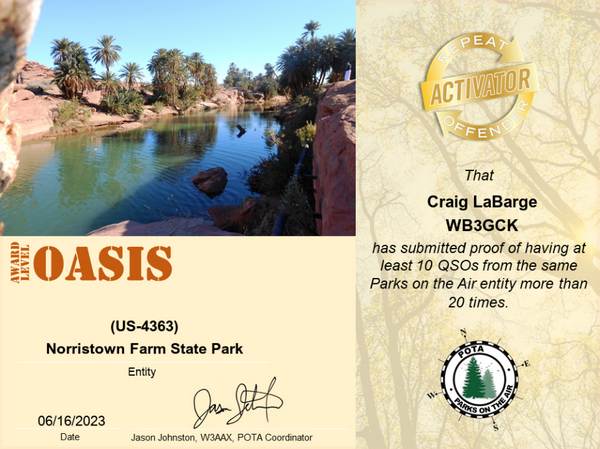
I was one activation away from the 20 needed for a POTA “Repeat Offender” award at Norristown Farm Park (US-4363, KFF-4363). After coming away empty-handed in my last attempt, I tried again this morning. This time I had a much better outcome.
Given the dismal weather forecast, I left my bike at home and operated instead from the shelter of my truck. I went with my go-to setup: Penntek TR-35 (5 watts, CW) and 12-foot whip with my homebrew loading coil.
The bands weren’t great, but I have seen worse conditions. There was a fair amount of fading with some static crashes from storms in the area. Despite those challenges, I made my first 10 contacts in about 15 minutes on 40M.
While I was on 40M, I heard Greg WA3GM activating US-1351 about 5 miles away. Greg was operating with the Pottstown Area Amateur Radio Club’s annual PAARC in the Park POTA event. Our park-to-park contact this morning was a repeat of one we made last year.
After operating for an hour, it started to drizzle, so I called it quits. My time on 40M, 30M, and 20M, produced 26 contacts, with two park-to-park contacts.
My timing was excellent, as I ran into a heavy downpour on my way home. In any event, I was happy to close the books on activation #20 at US-4363.
“Mama said there’d be days like this.” — The Shirelles
My week got off to a good start. I activated parks three days in a row with good success. With some nice Spring weather today, I thought I’d get the bike out for an activation. I drove out to Norristown Farm Park (US-4363, KFF-4363), since I’m one activation away from a Repeat Offender award there. My plan was to get in a bike ride, while completing my 20th activation.
Things didn’t go as well as I had hoped.
I last rode my bike there about eight years ago. A friend and I were doing some communications testing to prepare for a March of Dimes event. I rode all over the park with an HT, while my friend listened for me at the proposed Net Control location. I remembered seeing a picnic table just off the road, so I headed out in that direction. About a mile out, I found a covered picnic table. It wasn’t the one I remembered, but it seemed to be a better location.
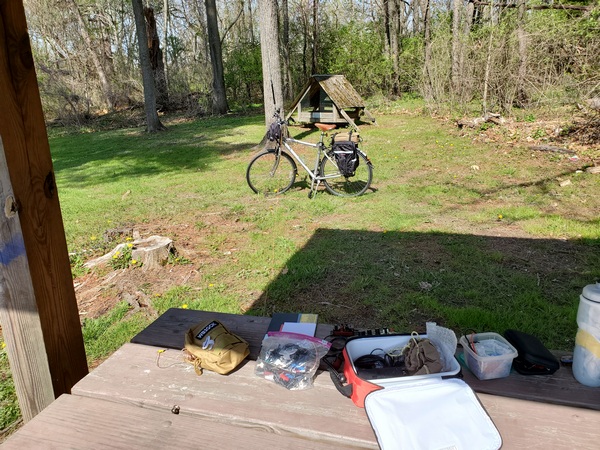
The view from the covered picnic table I was using.
My setup was similar to the last time I used the bike. I mounted a Gabil GRA-7350TC vertical on my handlebars and used a 33-ft elevated radial. I easily adjusted the antenna for a 1.3:1 SWR on 40M. Then, I ran 20-ft of RG-316 over to the picnic table where I set up my Penntek TR-35 (5 watts, CW) and Elecraft T1 tuner.
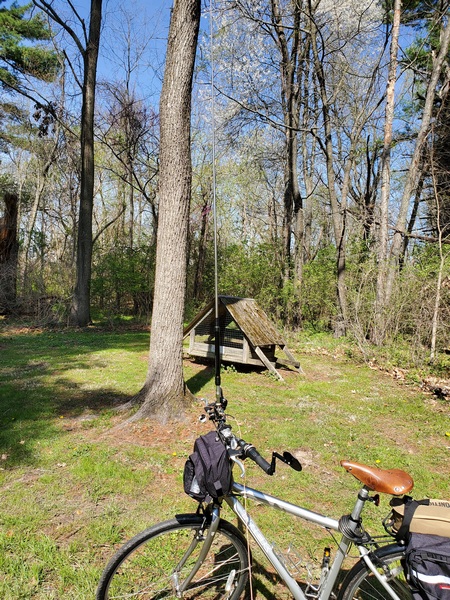
You have to look closely to see the Gabil GRA-7350TC on my handlebars.
The 40M band seemed a little weak. I heard very little activity, and my hits on the Reverse Beacon Network (RBN) weren’t all that strong. After 10 minutes or or so of futile CQing, I reconfigured the radials and tuned up the antenna for 20M. This time I used three 17-ft radials.
Despite getting double-digit Signal-to-Noise readings on RBN, 20M wasn’t producing any takers. I tried calling a couple of activators, but I wasn’t getting through the pile-ups. I didn’t have much time this morning, so I gave up after 30 minutes with an empty log. After packing up my gear, I rode back to the parking lot.
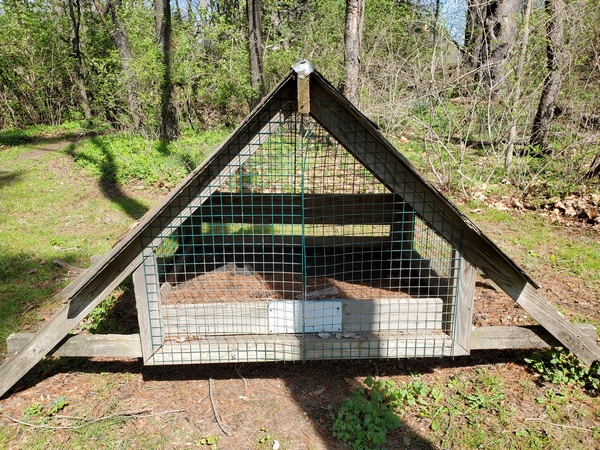
This empty cage was located in the back of the clearing I was in. I have no idea why it was there or what kind of critter it might have been used for.
On the ride back, I tried to figure out what the problem was today. Was it propagation, my location, or was it just one of those days? Who knows?
Radio-wise, today was a bust. I did, however, get in a pleasant bike ride and a little exercise.
My original plan was to do a bicycle-portable activation in Valley Forge National Historical Park (US-0761, KFF-0761). Lousy weather and another commitment put those plans on hold. Instead, I did a short stationary-mobile activation there instead.
The two main picnic areas in Valley Forge opened for the season on April 1st, so I rolled into one of my favorite spots. Not surprisingly, I was the only one there. I don’t think that too many folks want to have a picnic at 0830 (local time) in the rain.
I set up my usual Penntek TR-35 (5 watts, CW) and 12-foot loaded whip and started out on 40M. The bands were recovering from some geomagnetic storming yesterday, but were still a little flakey. Contrary to propagation predictions, 40M turned out to be the most productive band for me today. The 20M band only produced two contacts, while 17M was a total bust today.
One of my hunters on 40M sent me his SKCC number. I always keep a straight key connected to the TR-35, so I easily completed an SKCC contact with him.
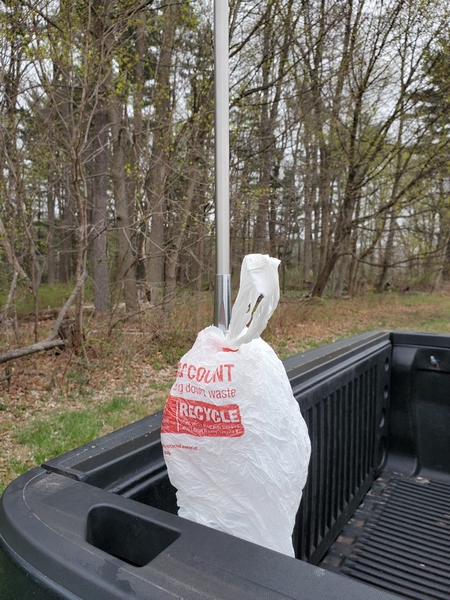
Part way through my activation, the rain started picking up. I headed around to the back of the truck to put a plastic bag on my homebrew loading coil.
I had to break out the foul weather gear for my loading coil.
After 20 minutes of futile CQing on 17M, I decided to call it quits. I ended up with 18 contacts. No DX today, but there were two known park-to-park contacts.
Hopefully, I’ll be able to get the bike out sometime next week.
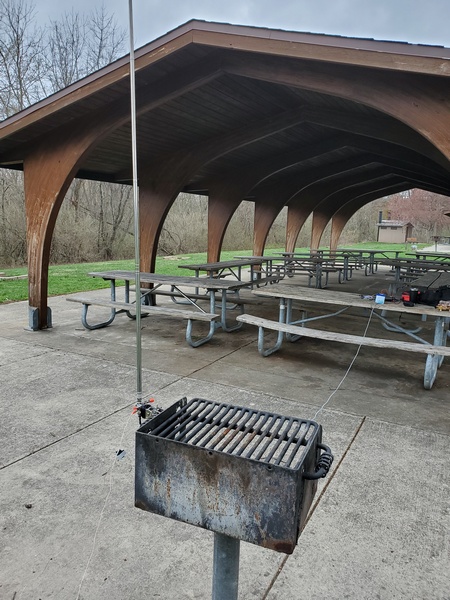
With rain in the forecast, I headed out to Norristown Farm Park (US-4363, KFF-4363) early on March 31st and conducted my activation under the shelter of a picnic pavilion. I used a jaw clamp to mount a 17-ft whip antenna to one of the picnic grills. So, I guess you could call this another “Grills on the Air” activation. With the lousy forecast and being a weekday to boot, I had the entire picnic area to myself.
My 17-foot whip clamped to a grill
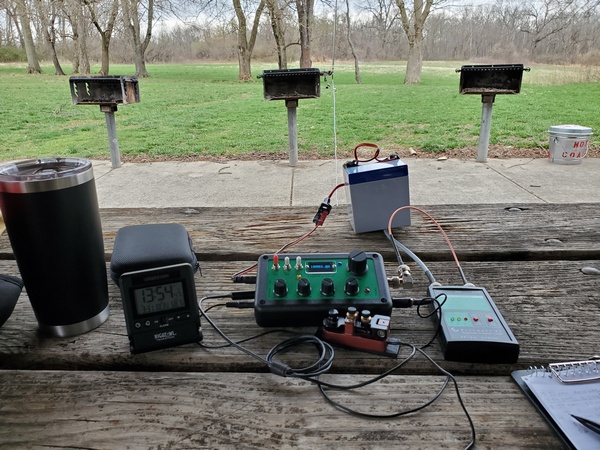
After installing the antenna on the grill, I laid out three 17-foot radials. With this setup, I easily obtained a 1.4:1 SWR. I set up my Penntek TR-35 (5 watts, CW) at the closest picnic table. The 18-foot length of RG-8x I brought along was a tad short, so I had to suspend it off the ground. I placed my LiFePO4 battery on top of the coax to prevent my little Elecraft T1 tuner from being dragged off the table.
My setup at Norristown Farm Park (US-4363, KFF-4363). My coax was a bit short, so I used my battery to keep my Elecraft T1 tuner from being dragged off the table.
There was a bit of static from the storm moving in, but the signals on 20M were strong enough to overcome it. Despite being early on a weekday, I made my first 10 contacts in about 13 minutes. I continued on 20M until the pool of hunters dried up.
After about 30 minutes, I shortened the whip for 17M. I only got the SWR down to about 1.9:1, so I let the T1 do the heavy lifting. The 17M band was less productive, but I made eight more contacts before calling it quits. My last QSO of the morning was with the Slovak Republic on 17M.
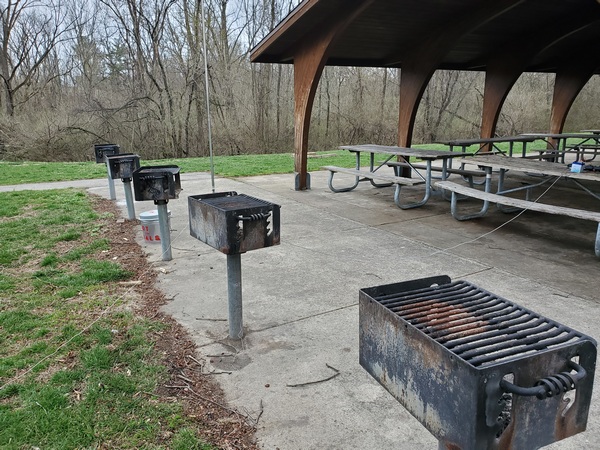
There were five grills next to the pavilion I was using. Hmmm… Maybe some sort of vertical array in the future?
After an hour on the air, I had logged 30 contacts with two park-to-park contacts. A few stations worked me on both bands. I also had three DX contacts: F1BLL, DL8NDG, and OM3CND.
It never rained during my activation, but that was fine with me. I had a nice dry outing to wrap up the month of March.
It has been quite a while since I’ve done any bike-portable operating. Over the past couple of years, I’ve dealt with medical issues of one sort or another. This year, I’ve avoided any serious issues, so I dusted off the bike and went out for a ride. While I was out, I tested some new gear for the bike. (I purchased all of the products mentioned with my own money.)
Antenna Mount
I make no claims of originality for this setup. I first saw this antenna mount in a YouTube video by VA7BIX. So, I found one on eBay and fired off an order to give it a try.
The antenna mount in question is a Nagoya RB-46. I had been looking for a way to mount my Gabil GRA-7350TC antenna (or any antenna with a ⅜-24 mount) on my bike. Originally intended for mounting on a car’s roof rack, the RB-46 can be clamped to the handlebars on bikes. With the kickstand down, my bike leans a bit. Fortunately, I can the adjust the RB-46 in two directions, so the antenna stays vertical. It accommodates a standard SO-239 to ⅜-24 antenna stud mount, which I had on hand.
Installing the RB-46 is quick and easy—for normal people. My installation, however, required extra time for searching the garage floor for dropped nuts and washers. Hardware mishandling aside, I installed the mount on my handlebars and adjusted it so the antenna would be vertical with the bike’s kickstand down.
Nagoya RB-46 antenna mount attached to my handlebars with my Gabil GRA-7350TC installed.
I also had a protective cap for the SO-239 in my junk box, so I put it to use here. Just in case it rains while I’m riding, I carry a ⅜-24 bolt in my handlebar bag. I figure I could put that in the antenna mount to keep the rain out. That’s probably overkill, but that’s how I roll. (No pun intended.)
New Panniers
I really like the cheap set of pannier bags I have been using for more than a decade. Sadly, they were really showing their age and were being held together with liberal applications of duct tape. Figuring I had gotten my money’s worth out of the old bags, I ordered a set of Bushwhacker Moab pannier bags.
The new bags are slightly larger than my old ones, so there’s more than enough room to carry my radio gear. My Bushwhacker handlebar bag has been going strong for about 12 years, so I’m hoping my new panniers also have a long life.
Schuylkill River Trail
I’m fortunate to live near the Schuylkill River Trail, a beautiful multi-use trail that runs along—you guessed it—the Schuylkill River. Since I haven’t been on the bike in a while, I chose a section of the trail for a three-mile ride that leads to a quiet local park.
Before loading up my bike, I always check the tire pressure. This morning, the front tire had gone flat, despite having fully inflating it a couple days earlier. After installing a new tube, I was finally on my way. Then, as I was driving to the trailhead, it started raining. Geez, what else!? Thankfully, the rain stopped by the time I reached the trailhead.
Bike loaded up and ready to roll
I rode about three miles to Towpath park, a ride I’ve done many times in recent years. The ride was uneventful, and I was soon setting up the GRA-7350TC on my new antenna mount. I used two 17-foot radials laid out on the ground and 25 feet of RG-316 coax. It was easy to get a 1.3:1 SWR on 20M.
Set up and on the air in the park
To see how it works, I set up my Penntek TR-35 on a nearby park bench. Tuning around I found some POTA activators to call. I ended up working three of them. It was fitting that one of my contacts was with Jim N4JAW. Jim is a bicycle/ham radio enthusiast I wrote about in a recent post. (Jim told me later that he was also bike-portable. You can read about his POTA activation operation and our QSO on his Ham on a Bike blog.)
My Penntek TR-35 set up on a park bench
Before tearing down, I checked the other bands with an antenna analyzer. I was able to get good matches on 30M through 12M. The 10M band was a little finicky. I didn’t use my longer radials, so I knew 40M would be tough.
Happy with the results, I loaded up the bike for the ride back to my truck.
Wrapping Up
I have a few takeaways from today’s ride:
The antenna mount worked great. However, using a PL-259 to BNC-F adapter on the antenna mount caused some clearance issues. It was a little tricky connecting the coax. I need to try using a right angle adapter next time.
The new panniers were easy to put on and take off the bike. Having a little extra room is a plus.
My short ride today was no Tour de France, but it reminded me how much I enjoy riding my bike. Yep. I definitely need to do more bike-portable outings this year.