On Wednesday, August 7th, I set out to do some antenna experimentation. So, why not get in a POTA/WWFF activation at the same time? To kill those two birds with one stone, I drove down to Ridley Creek State Park (US-1414, KFF-1414). (Disclaimer: No birds were actually harmed during this activation.)
I saw some discussion on the Internet about an antenna configuration I found intriguing. It’s just a 15-foot radiator and a 7.5-foot counterpoise wire fed through a 4:1 unun. Folks claim they work on 40M through 15M—with a tuner, of course. I’m a sucker for simple, field-expedient antennas, so I gave it a try during the recent Flight of the Bumblebees contest.
With the unun I used, I had mixed results. I couldn’t get the antenna to load on 40M, but it seemed to do fine on 30M through 15M. I wanted to try the same configuration, but with a larger 4:1 unun I built a several years ago. After cutting another set of 15-foot and 7.5-foot wires, I was ready to go.

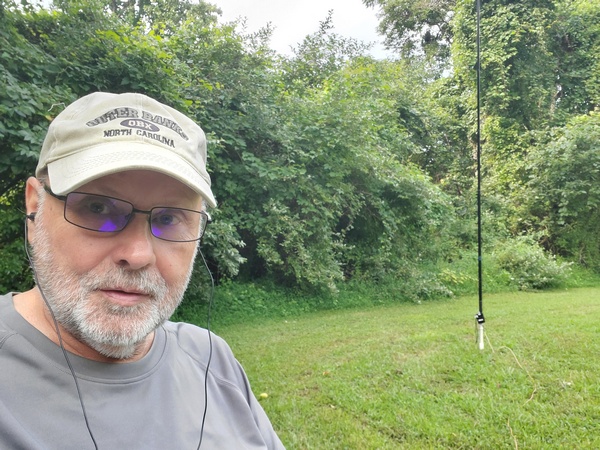
When I got to the park, I headed to a spot I had been using a lot lately. It’s off the beaten path and well away from the other park visitors. Using my homebrew ground mount, I set up the antenna on a lightweight 19-ft telescoping pole I bought years ago on eBay. I ran 20 feet of RG-316 coax over to my Penntek TR-35 and Elecraft T1 tuner.
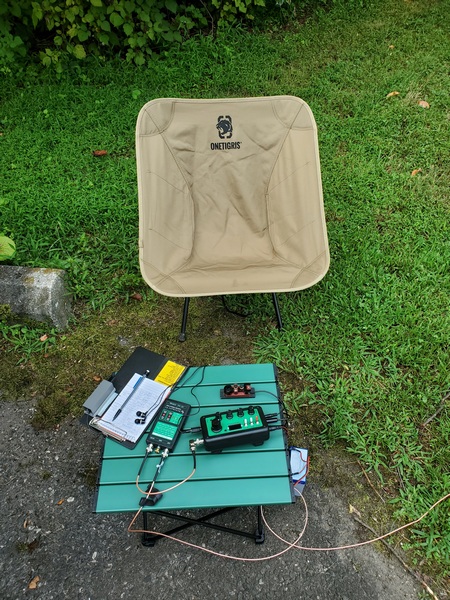
Before I started my activation, I gave the antenna a quick check. The antenna was an easy match on 30M through 17M, but it took two tries before the T1 found a good match on 40M.
Despite the slightly fussy tuning on 40M, the antenna didn’t do too badly on that band. I logged 12 contacts before the activity slowed down. I next tried 30M, but there were no takers. Moving up to 20M, I logged three more stations. Up on 17M, I worked one last station in Alabama. After an hour on the air, I had 16 stations in the log, including five park-to-park contacts.
I had better luck with this antenna configuration this time around. The unun I used for this outing uses a larger iron powder toroid (T130-2, as I recall) compared to the smaller ferrite core used in the other unun. Also, the longer run of coax I used this time was probably a contributing factor.
In any event, this configuration can definitely work. Granted, it’s a compromise antenna, but it’s super simple to deploy for casual operating in the field. Still, I think a slightly longer radiator would make for an easier match on 40M.
I have another configuration in mind that I plan to try soon.
72, Craig WB3GCK


Craig, that antenna sounds very interesting. I wonder if it might work better as a vertical 22.5ft Off-Center Fed Dipole, i.e.with the counterpoise hanging vertically above ground and below the radiator?
LikeLiked by 1 person
One of my favorite POTA antennas is a 28.5′ random wire vertical with a 17′ counterpoise. This is connected to a 9:1 UnUn with a 1:1 choke. I works very well 80 through 6 meters and gets a little squirrelly on 160. I have made 1,000’s of contacts with this antenna form the world over. For details check the post on my website https://kk4z.com/2024/01/16/k4swl-antenna/ I named it after my friend Thomas who inspired me to build one.
LikeLiked by 1 person
Yep, that’s a great antenna. For years, my go-to antenna when camping is a 29-foot wire with a 9:1 unun. With 25 feet if coax, the shield serves as the counterpoise. I typically use a choke at the radio end, but it isn’t usually necessary at QRP power levels. 73, Craig
LikeLike
Lack of activity could be a propogation issue rather than the antenna. If it doesnt lose all of its umph in the core of the balun it will put out. I can usually see my signal on the WEBsdrs in utah and cailfornia during the day but today there is nothing using both of my dipoles. It seems to come and go these days suddenly.
LikeLike
Absolutely. The bands have been up and down lately. I wasn’t really concerned with the number of contacts; I was more concerned whether my ATU could load it up or not. My base-loaded 12-foot whip plays pretty well on 40M, so I figured 15 feet would also do well, provided my ATU could provide a match. I spend a lot of time on 40M, so I was happy the T1 could match it, and the antenna seemed to get out surprisingly well. 73, Craig
LikeLike