I’ve been a little under the weather this week, but I managed to get out and make a some Winter Field Day contacts. I was on the air for a couple of hours each day, operating in the new “Mobile” category.
My location this year was on some land owned by my daughter and her husband. I operated from my truck on top of a hill, which has always been an excellent location for me. (Thanks to my son-in-law for clearing out the area for me.)
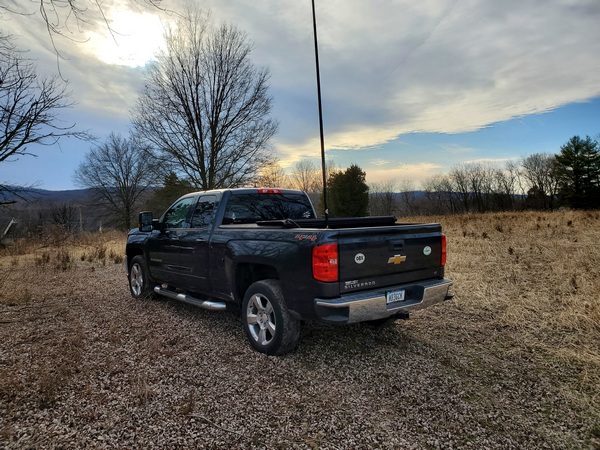
My Winter Field Day set up on Saturday
On Saturday, I operated during the first hour or so of the contest, using my KX3 and homebrew vertical. I spent all of my time on 40M, and the band was in great shape. I logged 23 CW contacts. Among those, were three SSB contacts I made for the extra multiplier. Winter Field Day is usually the only time I use a microphone on HF, so it always feels awkward for me.
I went back out there on Sunday morning, but this time things got off to a rough start. After I set up my antenna, I got in the truck to set up my KX3 only to find I left it at home. Fortunately, I had my TR-35 in the truck as a backup. (I guess I need to go back and read my old post on checklists.) There was also a protracted search for an adapter I dropped. Eventually, I got my act together and got on the air.
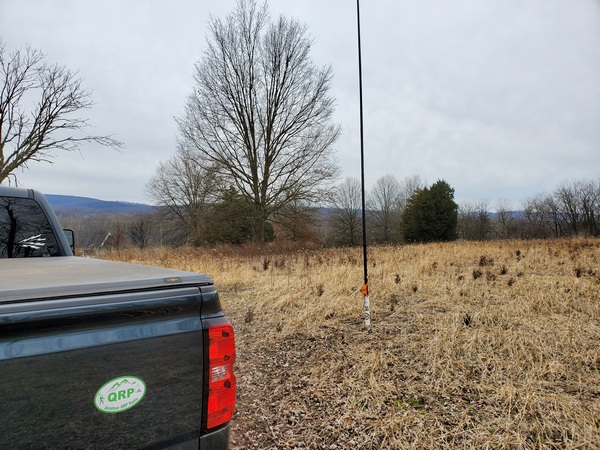
The Rybakov vertical I used on Sunday
The setup this time out was my TR-35, Elecraft T1 ATU, and a Rybakov vertical. The antenna was simply a 25-foot (7.6M) vertical wire fed through a 4:1 unun that I built recently. I used another 25-foot (7.6M) wire on the ground for a radial. Since I only worked 40M the day before, I planned to concentrate on 20M, 15M, and 10M. With the TR-35, however, 20M was as high as I could go for Winter Field Day.
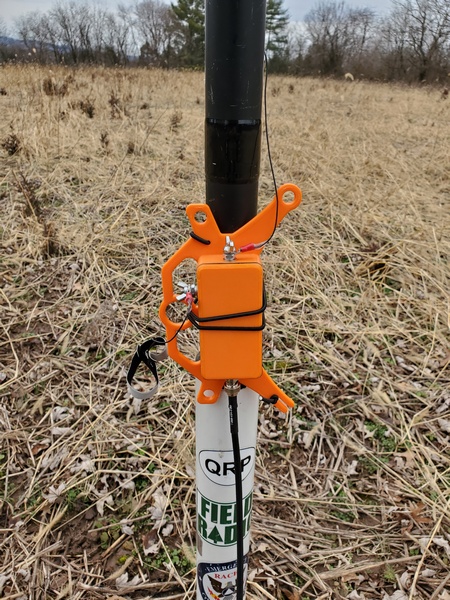
The 4:1 unun used with the Rybakov vertical
Most of my contacts this time around were on 20M. The band was in good shape, and the Rybakov vertical performed well for me. I was able to work just about every station I could hear including a couple of west coast stations.
I ended the weekend with a total of 46 WFD contacts in 25 sections. While I never set any records, WFD is always one of my favorite events.
We arrived on Saturday, after a long drive from southeastern Pennsylvania. After unloading and getting organized in the house we rented in Corolla for the week, I went outside and set up an antenna.
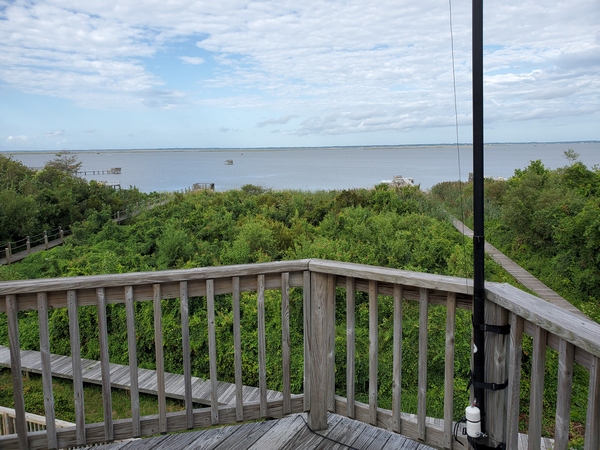
Currituck Sound, as seen from my antenna.
For the past two years at this house, I used a 29-foot vertical fed through a 9:1 unun. During both trips, I struggled with noise issues. I had a couple of antenna options I wanted to try this year.
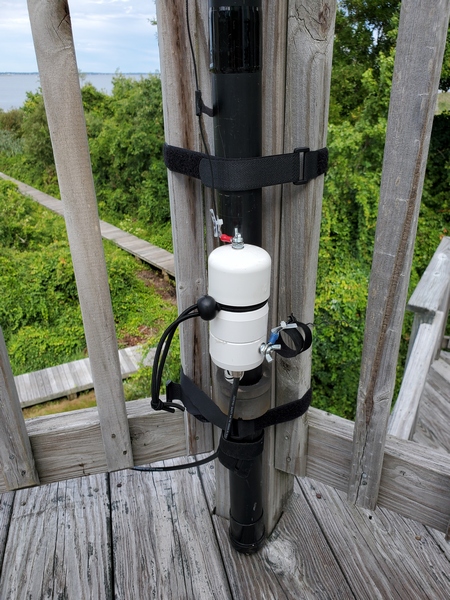
This time around, I went with a Rybakov-type antenna. I strapped a 28-foot Jackite pole to the railing of the 3rd floor deck. I used a 26-foot vertical wire fed through my recently built weather-resistant 4:1 unun. My 26-foot counterpoise wire ran out to the side of the antenna and down the side of the deck stairs. It was a weird configuration, for sure. I ran 25 feet of RG-8X coax down to the second floor, where I could operate in the shade—in the morning, at least.
My Rybakov vertical configuration. The red line shows how I ran the counterpoise wire. Despite this weird-looking setup, it worked pretty well.
I didn’t test the antenna until early Sunday morning, and my KX3’s tuner matched it on every band from 40M through 10M. The noise levels on 40M and 20M were down around S2, a dramatic improvement over previous years and completely workable. The higher bands were dead quiet.
My antenna feedpoint. I used my weather-resistant 4:1 to create a Rybakov-type vertical.
My first contact was an interesting one. Fellow Boschveldt members, Glen NK1N and Rob KE3TI, were on an overnight backpacking trip on the Appalachian Trail in Pennsylvania. I sent Glen NK1N a text message to let him know I was on the air, and we connected on 40M. We chatted for a bit and exchanged SKCC numbers. Conditions were rough in the beginning but, towards the end of our contact, our signals improved.
Before quitting, I logged 10 SKCC Weekend Sprintathon (WES) contacts. There were bonus points for using a homebrew key, so I used a straight key I cobbled together a few years ago. I also worked Greg WA3GM, who was doing a POTA activation at a park near to my home in Pennsylvania. So, my jury-rigged Rybakov seemed to get out OK.
The homebrew straight key I used during the SKCC Weekend Sprintathon (WES).
Monday morning, I got set up on the deck to make a few contacts. I noticed the antenna was acting up a bit on the 40M band. The KX3’s tuner showed it found a 1:1 match, but the SWR went up when I transmitted. I had no issues with the other bands, just 40M. It seemed like I was getting some RF on the coax shield, so I added a common mode choke at the transceiver and changed to a shorter length of coax. That cleared up the issue. I’m guessing there was some interaction between the antenna’s counterpoise and the coax on 40M. Even before I resolved the antenna issue, I logged a half-dozen contacts.
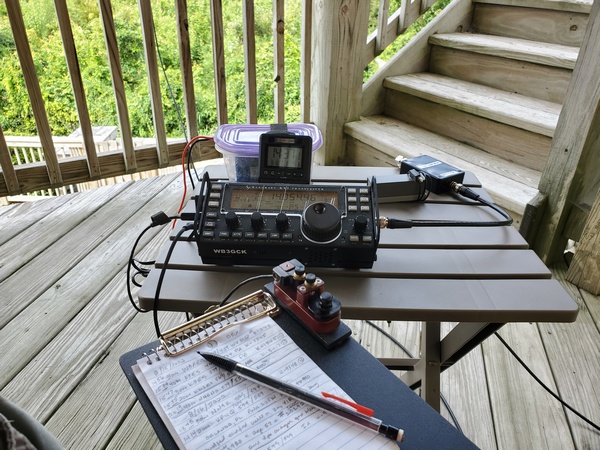
My radio setup on the 2nd story deck of the rental house.
With six adults, four grand-kids, and two grand-dogs, there was always something going on in the house. However, I managed to get on the air for about an hour each morning after breakfast to make a few contacts.
Thursday evening was busy. I kept track of Winlink check-ins for an ARES-RACES net back home. Using DMR, I checked into another ARES-RACES net in Pennsylvania. When I’m down here, I always like to check into the Outer Banks Area Wide Net. Then, it was out to the dock to join my grand-kids for some crabbing.
As I was finishing up breakfast on Friday, I got a text message from my friend, Frank N3FLL, asking if I was on the air. I quickly moved my radio out to the deck and had a nice QSO with him. I also worked a few POTA activators including Greg WA3GM. I worked Greg on the first day, so it was only fitting that I work him on the last day, too. After that, it was time to take down the antenna and pack up the radios.
I didn’t spend as much time on the air as in previous years, but I worked some fellow SKCC members, chased a few POTA activators, and had a couple of nice ragchews. All in all, it was a great vacation with excellent weather. I’m already looking forward to next year.
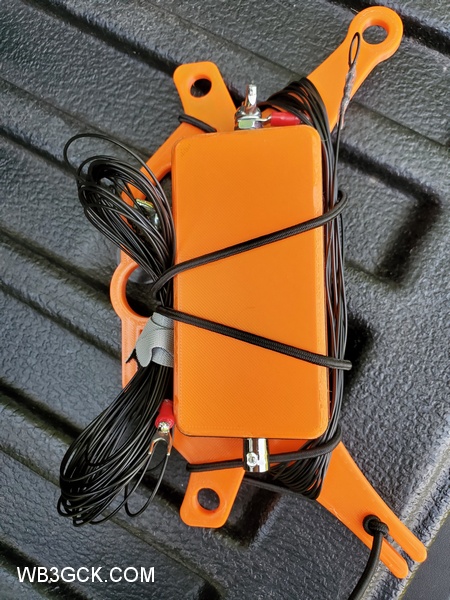
I recently came across a product on Etsy that caught my eye. It’s a 3D printed project box with an integrated antenna wire winder. I couldn’t resist, so I ordered one.
The box will accommodate a T-130 toroid, and the snap-on lid comes with a gasket. There is a pre-drilled hole for a BNC-F panel mount connector, and there are marks to guide drilling for the output and ground connectors of your choice. You can choose from two colors: orange or green. The vendor states that it is “UV and weather resistant.”
I like the idea of having a box to enclose the balun or transformer. My preference for portable antennas is to avoid exposed components or circuit boards.
I used mine to build a 4:1 unun for portable use in a Rybakov configuration. The unun consists of 19 bifilar turns of #24 solid hookup wire on a T130-2 toroid. You can find plans for winding the unun here and other places on the Internet. For the output and ground connections, I used #10-24×3/4″ stainless steel machine screws, along with some nuts, flat washers, and lock washers.
Inside view of the 4:1 unun. I used double-sided foam mounting tape to secure the toroid. I also use a small piece of packing foam (not shown) between the lid and the toroid for added stability.
To go along with the completed unun, I prepared two 26-foot wires; one for the radiator and one for a counterpoise. I finished up by attaching a length of 2.5mm bungee cord. This cord keeps everything together for travel. I have also used it to secure the box to a vertical support, e.g., fiberglass mast, fence post, etc.
The 4:1 unun deployed in a Rybakov vertical configuration with a 26-foot radiator and a 26-foot counterpoise
In the field, this Rybakov antenna worked as well as others I have built over the years. I tested it using my Penntek TR-35 and Elecraft T1 tuner with 18 feet of coax. It tuned up easily on 40, 30, 20, and 17 meters, and I made a couple of QSOs while testing. The integrated winder made it easy to deploy and take down.
The 4:1 unun packed up for travel
I have a feeling another one of these boxes is in my future. Maybe a 9:1 unun next time?
One antenna I plan to try during my annual Outer Banks, North Carolina, vacation this summer requires a 4:1 unun. If the antenna works as hoped, it’ll be in place for the entire week. So, I need an unun that can stand up to the elements.
About a year ago, I built a 9:1 unun in a weather-resistant housing made from PVC pipe parts. I had some parts left over from that project, so I built a 4:1 unun version. The construction of this unun is like the last one, however, this one has a ground terminal.
Weather-resistant 4:1 unun components
I wouldn’t want to take this unun on a backpacking trip; it weighs in at a substantial 8.6 ounces. When I’m going to be operating from a location for an extended period, however, this should do the trick.
Parts
The parts for the housing are similar to the last one, but there are some additions for the ground connection.
About 2.5 inches of 1.5-inch PVC pipe
(1) 1.5-inch PVC end cap (slightly rounded top)
(2) 1.5-inch PVC end caps with flat tops
(1) SO-239 panel-mount connector (along with some #4 hardware for mounting)
A 4:1 unun wound on a T130-2 toroid
(2) #10-24×3/4″ stainless steel machine screw (along with some #10 flat washers, nuts, wing nuts, and lock washer)
The PVC end-caps with flat tops can be hard to find. If you search online for furniture-grade end caps, you might find some.
Construction
You can find plans for winding the unun here and other places on the Internet. The one I built for this project uses 19 bifilar windings of #24 solid hookup wire on the T130-2 toroid.
To start, you need to glue the two flat top end caps together. When dry, drill the holes to mount an SO-239 connector in the center.
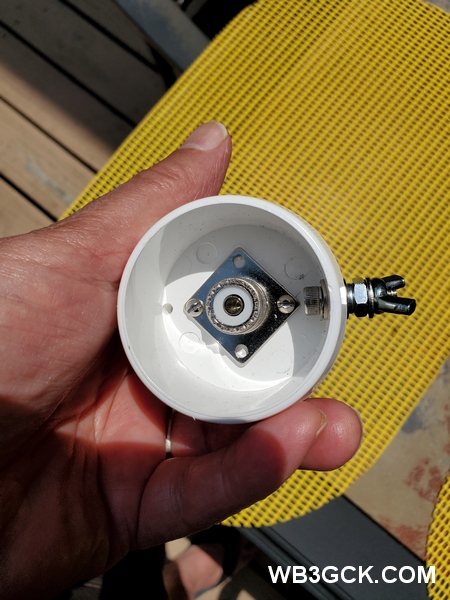
The underside of the 4:1 unun. The SO-239 is recessed to provide some protection from the elements.
For mechanical reasons, I added the #10-24 stainless steel screw for a ground terminal in the lower half of the connector housing. A short length of wire runs from the ground screw through a small hole and connects to one of the SO-239’s mounting screws. I installed another #10-24 screw in the slightly rounded end cap for the antenna connection.
The final assembly was straight forward. I soldered the toroid’s input wires to the center pin of the SO-239 connector. Then, I attached the toroid’s ground wire to one of the SO-239’s mounting screws.
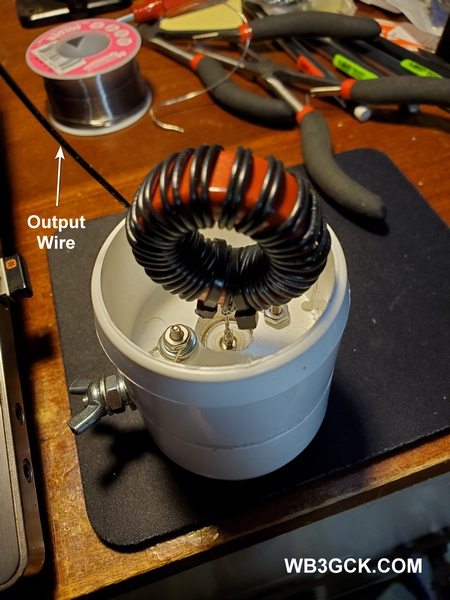
This is how the toroid is installed in the Weather-Resistant 4:1 UNUN.
Next, I inserted the PVC pipe section into the connector housing. I then installed a ring lug on the output wire. I left the output wire just long enough to make the connection to the output bolt in the rounded end cap. Before mounting the end cap to the PVC pipe, I added some pieces of foam around the toroid core to hold it in place. Then I press-fitted all the PVC parts together.
Testing in the Field
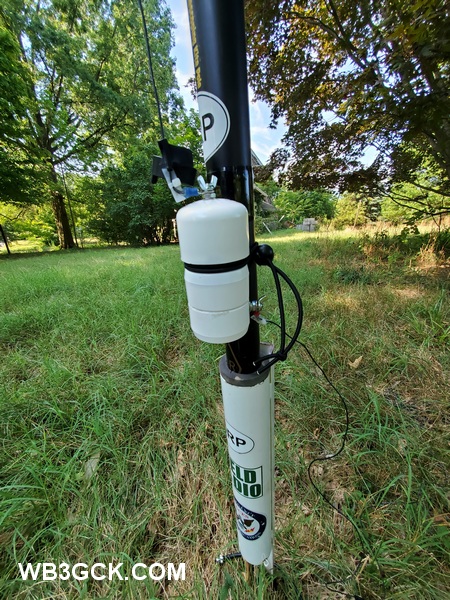
I tested the 4:1 unun in the field recently, and it performed as expected. I used it as part of a Rybakov vertical, with a 26-foot radiator supported by a Jackite pole, another 26-foot wire on the ground for a counterpoise, and 18 feet of RG-8x coax. My little Elecraft T1 tuner matched it with no problems on 40M, 30M, 20M and 17M, the bands covered by the rig I was using. Similar 4:1 ununs I have built worked well from 40M through 6M, so I’m confident this one will, too. While I was testing, I had a couple of nice CW rag chews on 40M and 30M.
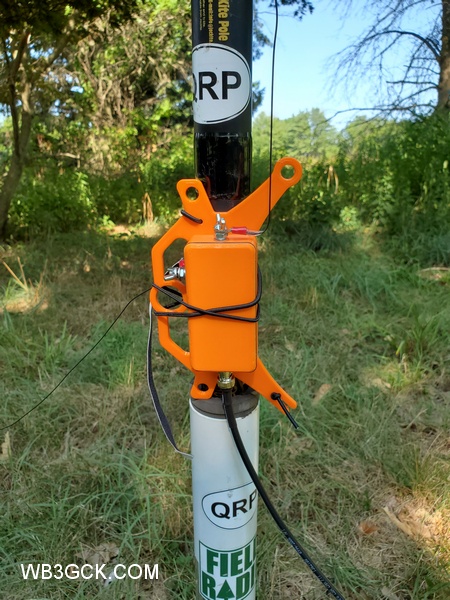
The weather-resistant 4:1 unun in use. In this configuration, there’s a 26-foot radiator and a 26-foot counterpoise wire.
Wrap-up
Like its 9:1 counterpart, this unun is probably a bit over-engineered. My weather-resistant 9:1 has served me well through several camping trips and two Field Days, so I expect this 4:1 version will do likewise. So, bring on that beach weather!
I celebrated the first day of spring with a QRP-portable outing today. I headed out to my daughter’s property and set up on top of the hill to test a new antenna and make a few contacts in the process.
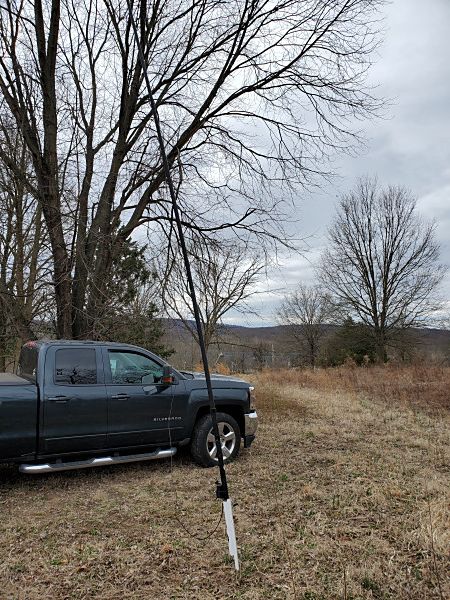
Spring notwithstanding, it wasn’t a great day to be up there. Strong thunderstorms last night left the ground soft and ushered in a cold front. Along with overcast skies, there were some strong wind gusts. So, I set up the KX3 in the shelter of the truck.
Mother Nature was trying her best to knock down my antenna
I set up the antenna I planned to test—the subject of a future post—and ran it through its paces. The results were less than satisfactory. It needs a little tweaking, and I found a mechanical issue that will need some attention. Add that to the to-do list.
As a backup antenna, I went with a Rybakov-style vertical, with a pair of 26.5-foot wires, one vertical and the other on the ground for a counterpoise. I grabbed a small 4:1 unun that I built a few years ago and mounted it at the feedpoint. The male BNC on the coax cable refused to go onto the BNC jack on the unun. It looks to me like the center connection in the BNC jack has some corrosion or something in it and needs to be replaced. Another task for the to-do list.
Fortunately, I had another 4:1 unun in the truck, and I quickly got that set up. This particular unun is about 10 years old and has never let me down. It got me on the air, so I could at least make a few contacts.
I tuned around 40M and made a couple of contacts with Virginia QSO Party stations. Later on, I checked the Parks on the Air spotting page to see what parks were being activated. I worked a couple of parks on the 40M band and moved up to 20M to work N4CD at a park in Texas.
Although I spent most of the time fiddling with antennas, I’m glad I could get out and play radio for a while. If all goes according to plan, I’ll be having knee replacement surgery this week. The recovery and rehab process will probably put me out of commission for a few weeks.
In a previous post, I mentioned an antenna of mine that went missing. The antenna in question was a variation of my old Dollar Store Special. After I built a replacement, I found the original in my truck. No problem; as the name suggests, it wasn’t a huge monetary investment. This antenna is just another example of what can happen with some extra speaker and too much time on my hands.
The original Dollar Store Special (circa 2005) was the first of several projects to see if I could build a usable antenna from a 50-foot length of inexpensive speaker wire. The resulting antenna was a 50-foot radiator and some counterpoise wires configurable for 40M, 30M, and 20M. I used one of these for years as a backup antenna. As with all random wire antennas, it requires a tuner and, of course, some way to get one end up in the air.
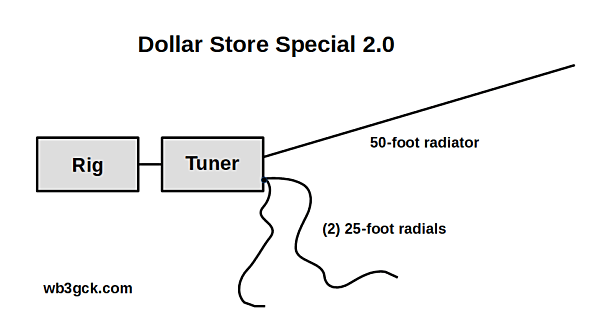
For this version, I went with a 50-foot radiator and two 25-foot radials. Besides being more simple to construct, it adds a little more flexibility. Space permitting, I can use the 50-foot wire in an inverted L, inverted V, or sloper configuration. When I need a quick way to get on the air, I can use a 25-foot radiator with a 25-foot counterpoise. (Elecraft documentation often recommends the 25-foot wires as a simple field antenna. [1][2])
My updated Dollar Store Special. In addition to this configuration, I sometimes use one of the 25-foot wires as the radiator and the other as a counterpoise.
I refer to this antenna—with tongue firmly planted in cheek—as the Dollar Store Special 2.0. That makes it sound like a bigger deal than it actually is. I should also note that I can no longer get speaker wire at my local dollar store. I have to spend a few dollars more now, but I kept the name anyway.
Construction is as easy as it gets:
Get a 50-foot length of two-conductor speaker wire. I use some inexpensive 24 gauge wire.
Separate the two conductors.
Cut one of the 50-foot wires in half.
I added a spade lug on one end of each wire and made a small loop in the other end.
I also added some Goop® sealant/adhesive to hold the end loops together and provide some strain relief to the spade lugs.
The 50-foot radiator and two 25-foot radials cover 60M through 10M using my KX3’s internal tuner. Feeding it through a 4:1 unun, I can cover 80M through 10M. A 9:1 unun works well with this length also.
With a 25-foot radiator and a single 25-foot radial, my KX3 covers 40M through 10M with no problems. Adding in a 4:1 unun makes this a Rybakov 806 antenna that covers 60M through 10M. If you’re so inclined, you could partially unroll the 50-foot wire and use it as a second radial.
These results, of course, are highly dependent on the tuner you’re using. There’s nothing special about the 50-ft length. You can trim the radiator back to a length that provides an easier match. I stayed with the 50-foot length since I wanted to make use of the entire pool of speaker wire for these projects. Go with whatever works for you.
I’ve had good results with both configurations, and I have been impressed with the 25-foot radiator and 25-foot radial configuration. Although it’s slightly compromised on 40M, it seems to get out pretty well.
There’s nothing at all magical about this antenna; after all, it’s just three pieces of cheap wire. However, it makes a decent backup—or even a primary—antenna kit for portable use.
As I was writing this, I jotted down two more ideas for speaker wire antennas. Somebody stop me!
Some recent Internet discussion got me thinking about the Rybakov 806 Vertical antenna. This easy-to-build antenna has served me well over the years. So, I went back and revisited some of the ways I’ve used it.
What the heck is a Rybakov anyway?
The Rybakov 806 Vertical appears to be the brainchild of Enrico IV3SBE from Italy (now 5Z4ES in Kenya). The term, Rybakov, is Russian for “fisherman.” That’s right… It’s an antenna with a Russian name designed by an Italian who lives in Africa — truly an international creation. From what I could glean from exhaustive Internet searches, this design dates back to the mid to late 2000s. I found numerous references to it from 2009.
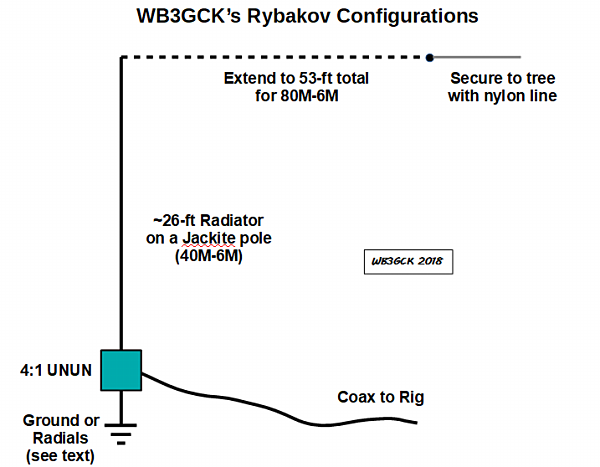
The classic Rybakov configuration is a 7.6m or 8m (~25 or 26 feet) wire fed through a 4:1 UNUN. The length isn’t critical, as long as you avoid resonance on the bands of interest. It’s often supported by a telescopic fishing pole (hence, the name, “Rybakov”). Being a non-resonant antenna, you need to use an antenna tuner to make it work. You also need to use radials or some other type of ground.
The antenna can cover 80M through 6M (the “806” part of its name, I suppose). The band coverage depends on the wire length used and the capabilities of your tuner. With a 7.6M wire, you can cover 40M and up without problems. For 80M coverage, plan on using a longer radiator.
The only thing you need to build is the 4:1 UNUN. The IW7EHC website provides detailed instructions for building one. Beyond that, you just need to cut some wire to length for the radiator and radials. Easy peasy!
My experience with the Rybakov
I had been using this type of antenna before I even knew it had a name. Rick KC8AON had a version of this type of antenna he called, “The Untenna.” That’s where I found it.
My first experiment with it was in a “stationary mobile” setup. I rigged up a 26-foot vertical wire and grounded the UNUN to the body of my truck. My Z-817 tuner was able to load it up with no difficulty. I had no problem making contacts and I liked the multi-band coverage.
I next used the Rybakov at a Boschveldt QRP Club Field Day. I set up a 26-foot ground-mounted vertical and used about six 16-foot radials with it. Again, the performance seemed decent and I remember doing well on 10M that year. The only shortcoming was that it wouldn’t load up on 80M.
The next year, I solved the 80M problem by using a 50-foot wire in an inverted L configuration. For the ground, I used six 16-foot radials and two 33-foot radials. This configuration gave me full coverage from 80M to 10M and it worked great. This antenna configuration became my “go to” Field Day for several years. In later years, I used a 53-foot radiator re-purposed from another antenna project.
My typical implementation of the Rybakov 806 antenna. A length of 25 to 27 feet does well from 40M and up. I go with a 50 or 53-foot radiator for 80M coverage.
I used another version of the Rybakov with the pop-up camper that I used to own. I strapped a 31-foot Jackite pole to the camper and used it to support a 27-foot wire. I grounded the UNUN to the body of the camper. This antenna worked great on 40M to 6M and, best of all, I didn’t need to go outside at night to change bands. I used this antenna with good results for several years until I sold the camper.
I also built a Rybakov that I use as a backup antenna in the field. I built a small 4:1 UNUN that I use with a 25-foot radiator and a 25-foot radial. The antenna, along with a short length of coax, is easy to carry in my pack.
The bottom line (for me, at least)
I’ve had good luck with the Rybakov Vertical over the years. Is it the best antenna? Nope. Purists will argue about UNUN, ground, and coax mismatch losses. Yep, there are those. Yet, its simplicity and “no gap” band coverage are hard to beat. It’s easy to deploy in the field and it really does work.
If you’re in the market for a simple portable antenna project, the Rybakov 806 is an easy one.
[Update 4/3/2019: I’ve always wondered about the rationale behind the 25-foot radiator often used with the Rybakov antenna. An article in QST [1] by Joe Reisert W1JR shed some light on that for me. Joe’s article discusses the 3/8-wave vertical antenna. According to the article, the 3/8-wave antenna has a low take-off angle and its 200-ohm feedpoint is easily matched with a 4:1 transformer. Its higher radiation impedance provides good performance with just four 1/4-wave radials. For 20M, a 3/8-wave radiator is about 25-ft. Similarly, for 40M, it would be 50-feet. So, my guess is that’s the concept behind the Rybakov design.]
I headed out this morning with the dual purposes of getting in a bike ride and doing a little portable QRP operating. My destination was a 3-mile section of the historic Horse-Shoe Trail that runs through Warwick County Park.
I had never been on this section of the trail before, so I didn’t know exactly what to expect. It’s a beautiful trail and very well maintained. The stone and sometimes rocky surface was better suited for a mountain bike. My old hybrid bike was able to handle it with no problems, though. At the bottom of a rocky hill, I came across an open field and decided to set up the radio there.
Operating from the Horse-Shoe Trail Field North.
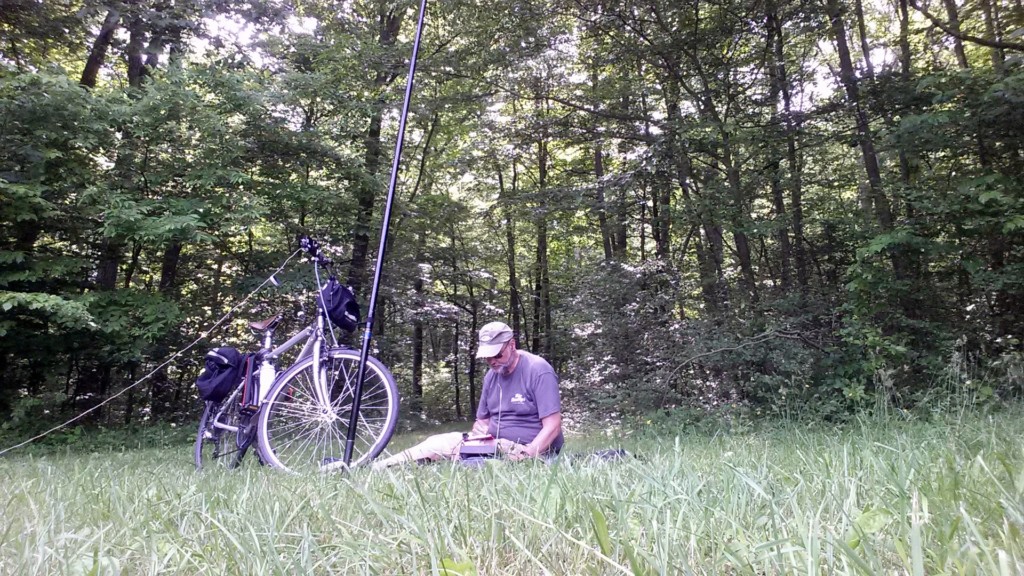
I set up an experimental antenna that uses a compact 20-foot telescopic pole I picked up recently on eBay. It’s basically a variation of the Rybakov Vertical with a 25-foot wire fed through a 4:1 unun. I laid out one 25-foot radial on the ground. I mounted the pole by simply placing it over a screwdriver shoved into the ground. Since the wire is longer than the pole, I attached the unun to the bike’s handlebar and ran a short coax down to my KX3. The KX3’s ATU matched it easily from 40 through 10 meters.
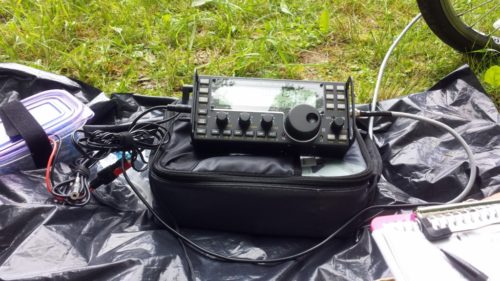
My operating position
I called CQ on 20 meters and had a nice chat with Lynn, NG9D, near Chicago. I think he thought I was crazy using an untested antenna out on a trail. (I had a backup!)
Moving down to 30 meters, I worked Mike, W9KY, in Indianapolis. I finished up on 40 meters with a short 2-way QRP QSO with Jack, WD4E, in North Carolina and a nice QSO with NY2MC aboard the USS Ticonderoga in Whitehall, NY. I did a little more experimenting with the antenna before packing up the bike for the ride back.
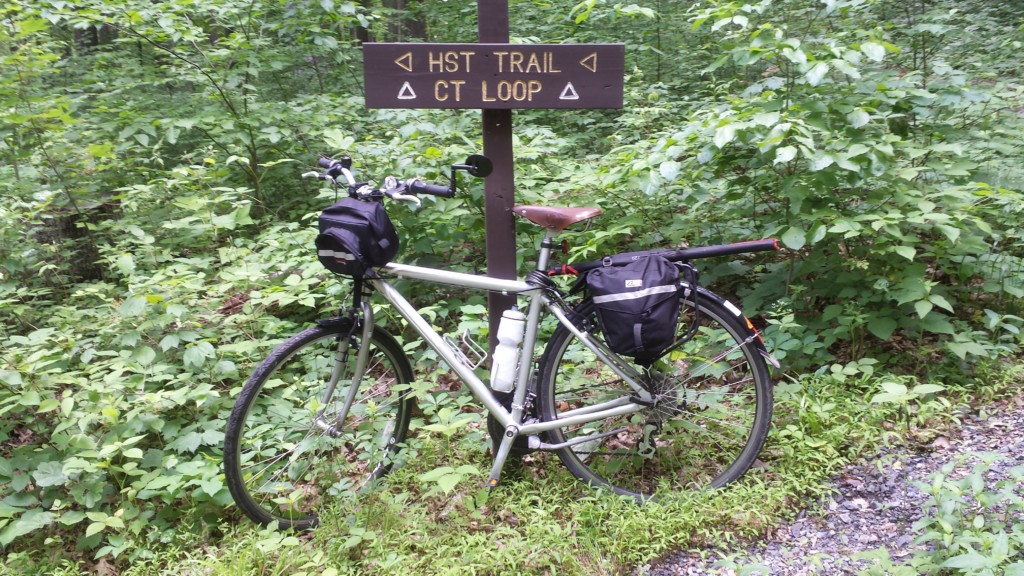
My trusty bike loaded up on the ride back to the trailhead
As I expected, this antenna isn’t a real barn burner on 40 meters but it seems to work well enough for casual operating. The pole weighs about 12 ounces and collapses down to about 26 inches, making it easy to transport via bike or backpack. I definitely need to make some refinements to the antenna, though. If it works out, it will be the subject of a future post.
It was a nice morning in a beautiful park. I’m looking forward to exploring some of the other trails.




 WB3GCK QRP Amateur Radio