I set off this morning to activate Norristown Farm State Park (US-4363, KFF-4363) with a specific plan in mind. We’re talking about me, of course; so things don’t always go as planned. Today was a good example of that.
If a specific parking space was available, I planned to use a loaded whip on my truck and operate from a nearby park bench. Failing that, I figured I would set up at one of the picnic pavilions with a vertical of some sort. When I rolled in, however, the parking lot was crowded and people were setting up for an event under the pavilions. So, I was off to come up with a Plan C.
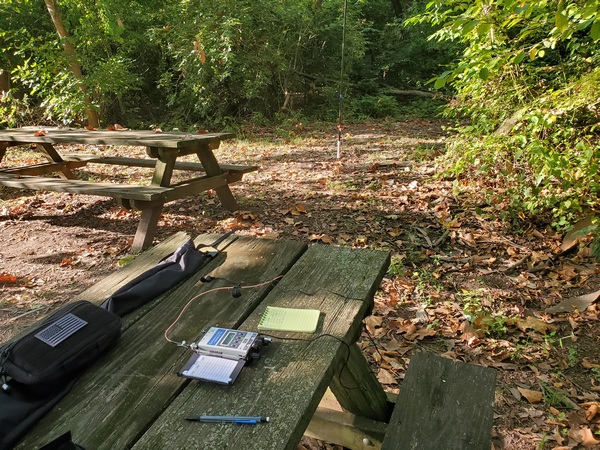
I drove back up the road a bit and pulled into a mostly empty trailhead parking lot. Off to one side, I found a secluded picnic table tucked away in a wooded area. About five minutes later, I was on the air.
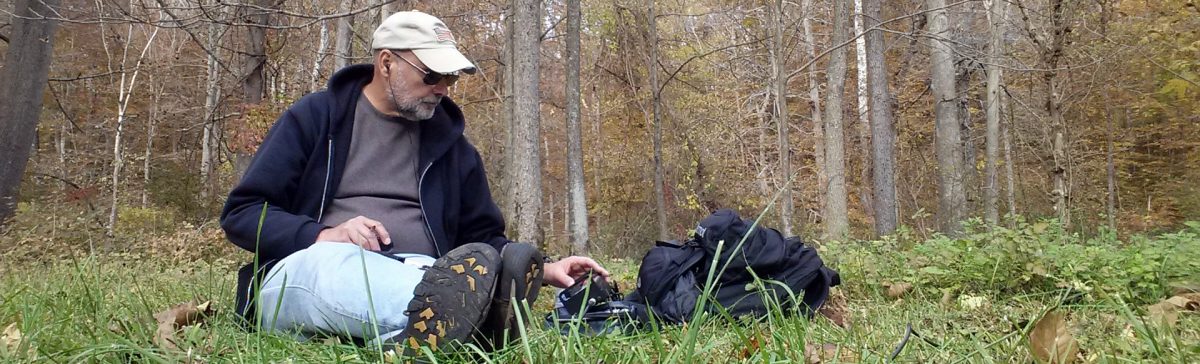
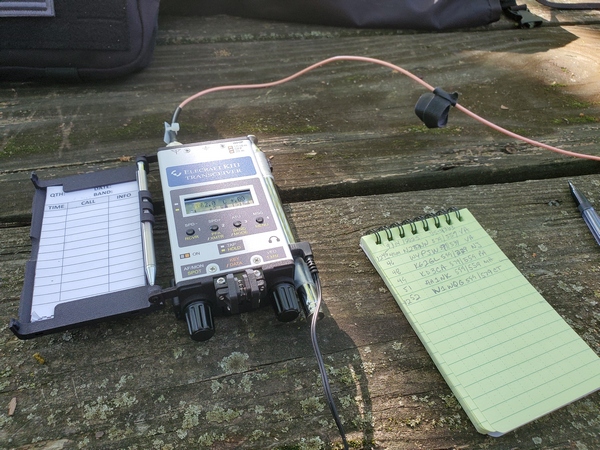
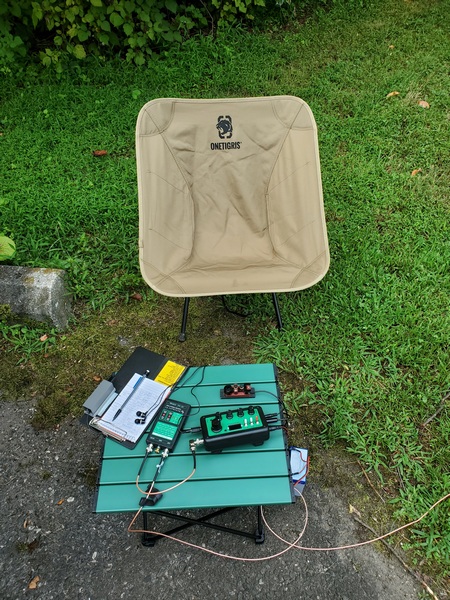
I sometimes think that my 50+ years of ham radio have been an ongoing quest to simplify my operations. My recently acquired KH1 is definitely a giant step in that direction. Everything I need (except for my earbuds) is attached to the radio.
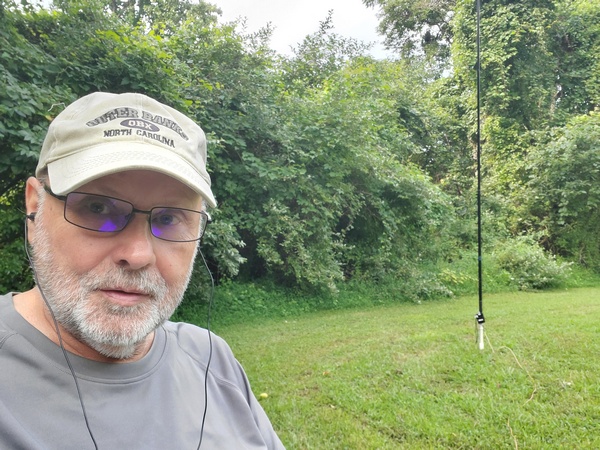
Looking at the propagation forecast, I opted to forego the KH1’s whip antenna and go with something larger. So, I went with the 9:1 end-fed random wire from AD8HK Antenna Systems mounted on a cheap 19-foot telescopic pole. The ground was a little soft, so it took me a few tries with my homebrew ground mount to get the antenna reasonably vertical.
Even with a vertical just under 18 feet, the 40M band was productive today. After eight quick contacts, things slowed down, and I changed bands. The 30M band produced one contact, while 20M was good for a half-dozen more. I went back down to 40M to pick up a few more before calling it quits. After about an hour, I ended up with 18 contacts, five of which were park-to-park.
I have to say I’m really having fun with the KH1. It’s ideal for the short activations I tend to do. The battery life is nothing short of exceptional. This was the second activation since I last charged it, and I could probably do four or five more.
A little over a month ago, the finals in my brand new Elecraft KH1 gave up the ghost during my second outing with it. After a trip back to the factory for some TLC from the Elecraft folks, the rig safely arrived back in Pennsylvania this week. I anxiously took the little rig out to the field this morning to get re-acquainted with it.
My destination today was Evansburg State Park (US-1351, KFF-1351). With an active geomagnetic field, I knew band conditions could make for a tough outing.
Along with my KH1, I used a new antenna I bought from AD8HK Antenna Systems and received just yesterday. This antenna features a 9:1 unun with 17’9.5″ radiator and a 8’10.5″ counterpoise wire. The unun assembly has an integrated wire winder, making for a neat, compact little antenna. I mounted the antenna on a 19-foot pole and ran 20 feet of RG-316 back to the KH1.
The AD8HK 9:1 Random Wire Antenna strapped to a telescoping pole
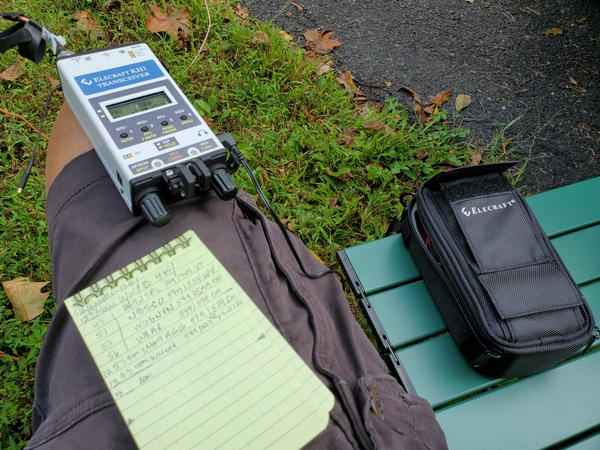
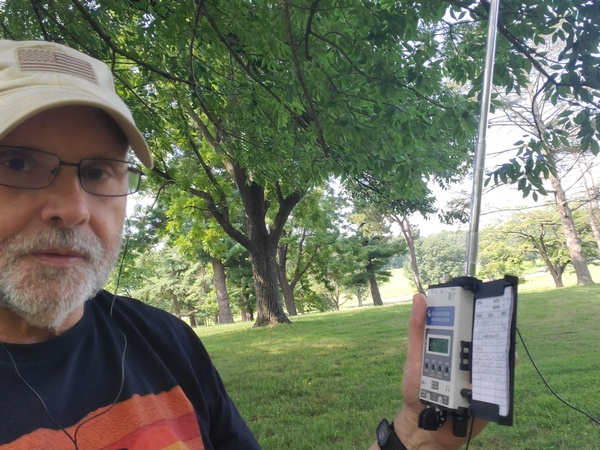
With the KH1 resting on my knee, I did a quick check of the bands from 40M through 15M. The KH1’s internal tuner easily found a decent match on all five bands. I went back to 40M and got started.
My newly-repaired Elecraft KH1 balanced on my knee
Despite the questionable band conditions, I logged seven contacts in about 15 minutes. I made another five contacts on 20M and 17M before calling it quits. The nice shady spot where I started out was quickly becoming a toaster oven.
I ended my brief outing with twelve contacts, including four park-to-park contacts. My KH1 has been out of commission for the past month, so I spent a good portion of my time refreshing my memory on the KH1’s menus and functions. The KH1 is thoughtfully laid out, so it all came back quickly.
Today wasn’t the best day for evaluating a new antenna, but the AD8HK EFRW did a decent job. Plus, it was great to have the KH1 back on the air. Both will see more use in the field in the future.
[Update 9/9/2025: During this activation, the KH1’s output power seemed low. As it turned out, the KH1 had been inadvertently set for low power. So, I was only running about two watts. Doh! I guess I need some more re-familiarization with this rig!]
Wait… It’s September already? Where did the summer go? Anyway, I observed the (unofficial) end of summer with a POTA/WWFF activation—and it was a fun one.
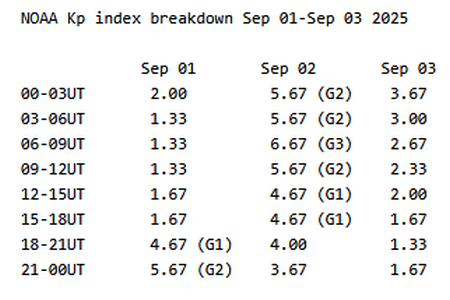
I drove up to Norristown Farm State Park (US-4363, KFF-4363) for an early morning activation. I tend to do early activations to avoid the crowds. There was another reason to get out early this morning: NOAA was predicting some geomagnetic storms starting later in the day.
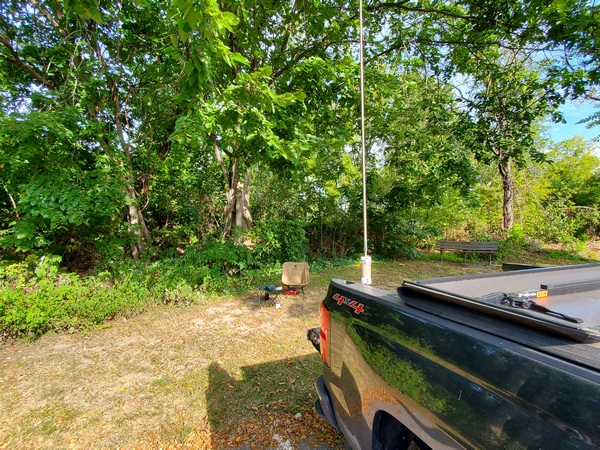
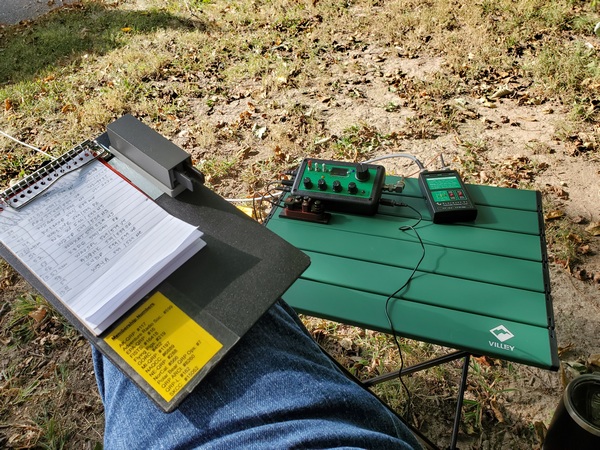
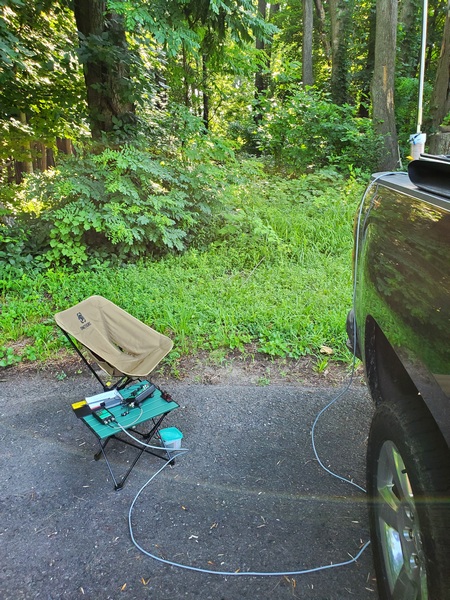
I parked my truck near a nice shady spot. For today’s activation, I used a 12-foot whip and my homebrew loading coil mounted on the truck. I ran a coax cable over to my table back under the trees. My rig today was my trusty Penntek TR-35 (5 watts, CW) with my Elecraft T1 tuner.
Even though the bands would probably be rough later on, they were in great shape this morning. I logged 25 contacts on 40M, and most of the signals were very strong. After things slowed down on 40M, I made some more contacts on 30M, 20M, and 17M.
After about an hour and 20 minutes, I pulled the plug with 43 contacts in the log, including 7 that were park-to-park. I worked a few of the stations on multiple bands:
Three bands: W9GTA
Two bands: KJ4R, K4NYX (P2P), and KI5GTR
One advantage of participating in both the Parks on the Air (POTA) and World-Wide Flora and Fauna (WWFF) parks programs is that you broaden the pool of hunters. Spots on the WWFF website often bring out the European hunters. That was the case today on 17M, with calls from DK9HN, F4ILH, and DM5WW. (Check out this website for more information on “dual activating.”)
So, that wraps up the summer of 2025. It was a fun morning; the bands were busy, and the weather was perfect.
I hope my U.S. and Canadian friends had a great Labor Day weekend.
Once again, the NJQRP Skeeter Hunt contest coincided with our annual family vacation to the Outer Banks of North Carolina. I’m certainly not a hardcore contester, but I wanted to set aside some time to make a few contacts from North Carolina. Although our rental house was beautiful, it presented some challenges for ham radio.
Operating in the NJQRP Skeeter Hunt contest
After a long drive down and all the unloading/unpacking the day before, I didn’t feel like getting too crazy putting up an antenna. Although this was our first time in this rental house, I had a good feel for the layout from online research.
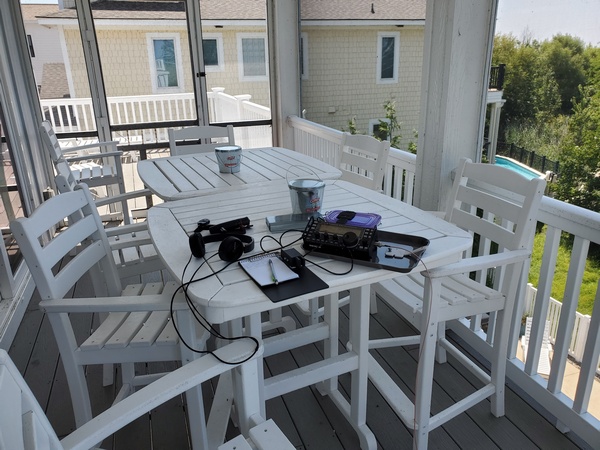
My “shack” for the week
My previous experience has shown that these rental properties come with a lot of RF noise, both from within the house and from neighboring houses. The house this year was no exception. So, I stayed away from vertical antennas near the house and went with an end-fed random wire sloper.
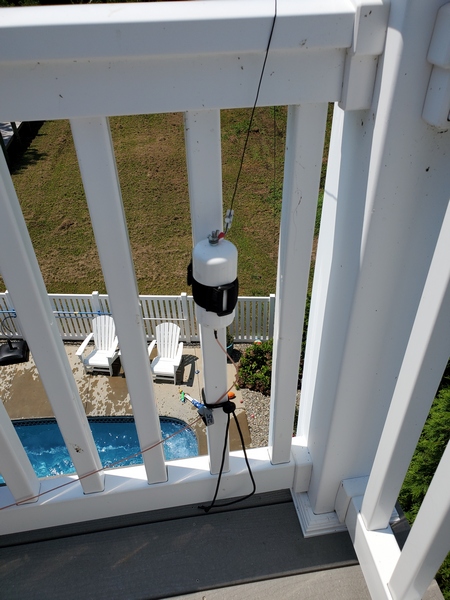
The antenna this year was a 35-foot wire, sloping down from the 3rd-story deck. I fed it through my homebrew weather-resistant 9:1 unun and ran 25 feet of coax into a screened-in porch on the same level. I attached the end of the wire to a fence around the pool area, making sure it wouldn’t get in anyone’s way. The wire was a bit long, so I ran the last two feet horizontally along the top of the fence.
My antenna feedpoint. The far end of my random wire sloped down to the fence by the pool.
I fired up my KX3 and checked the bands. A quick contact with a POTA activator on 40M confirmed it was putting out some sort of signal. The noise on 40M, however, was horrendous in places. The higher bands were better but still somewhat noisy. I hunted four POTA activators while experimenting with the antenna. Two of the contacts were easy, while the other two were tough going.
I also had to contend with some audio interference from my grandkids having fun in the pool down below. Anticipating this, I brought along a pair of over-the-ear headphones this year. Unfortunately, the headphones were no match for four exuberant kids.
Once the contest started, the noise level on 40M was about S3 in parts of the band, and S5-S7 in other parts. There was also a loud noise signal that would slowly sweep across the band from time to time. Despite the noise, I worked four skeeters and one very confused QRO station who wasn’t in the contest. He probably thought I was a POTA activator and couldn’t figure out why I needed to know his power output.
Up on 20M, the noise was lower but still present. I didn’t hear much Skeeter Hunt activity, despite getting some respectable hits on the Reverse Beacon Network. I ended up with a pair of Missouri skeeters in the log. I tried calling CQ on 15M with no luck.
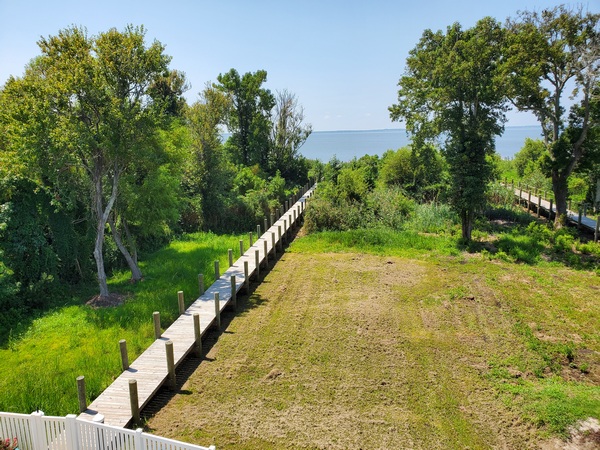
After a little over an hour, I threw in the towel. My operating position was facing west across Currituck Sound, so my nice shady spot was giving way to the afternoon sun. Before I pulled the plug, I had one last contact on 40M with a friend back in Pennsylvania.
The view from the antenna
So, my 2025 Skeeter Hunt results were less than stellar. Although it was frustrating working through the noise, I still had fun. Plus, the scenery from my temporary “shack” was outstanding.
On Wednesday, August 7th, I set out to do some antenna experimentation. So, why not get in a POTA/WWFF activation at the same time? To kill those two birds with one stone, I drove down to Ridley Creek State Park (US-1414, KFF-1414). (Disclaimer: No birds were actually harmed during this activation.)
I saw some discussion on the Internet about an antenna configuration I found intriguing. It’s just a 15-foot radiator and a 7.5-foot counterpoise wire fed through a 4:1 unun. Folks claim they work on 40M through 15M—with a tuner, of course. I’m a sucker for simple, field-expedient antennas, so I gave it a try during the recent Flight of the Bumblebees contest.
With the unun I used, I had mixed results. I couldn’t get the antenna to load on 40M, but it seemed to do fine on 30M through 15M. I wanted to try the same configuration, but with a larger 4:1 unun I built a several years ago. After cutting another set of 15-foot and 7.5-foot wires, I was ready to go.
My antenna feedpoint
When I got to the park, I headed to a spot I had been using a lot lately. It’s off the beaten path and well away from the other park visitors. Using my homebrew ground mount, I set up the antenna on a lightweight 19-ft telescoping pole I bought years ago on eBay. I ran 20 feet of RG-316 coax over to my Penntek TR-35 and Elecraft T1 tuner.
My operating position
Before I started my activation, I gave the antenna a quick check. The antenna was an easy match on 30M through 17M, but it took two tries before the T1 found a good match on 40M.
Despite the slightly fussy tuning on 40M, the antenna didn’t do too badly on that band. I logged 12 contacts before the activity slowed down. I next tried 30M, but there were no takers. Moving up to 20M, I logged three more stations. Up on 17M, I worked one last station in Alabama. After an hour on the air, I had 16 stations in the log, including five park-to-park contacts.
Something in the woods behind me was not happy with my presence. Fortunately, I never came face-to-face with whatever it was.
I had better luck with this antenna configuration this time around. The unun I used for this outing uses a larger iron powder toroid (T130-2, as I recall) compared to the smaller ferrite core used in the other unun. Also, the longer run of coax I used this time was probably a contributing factor.
In any event, this configuration can definitely work. Granted, it’s a compromise antenna, but it’s super simple to deploy for casual operating in the field. Still, I think a slightly longer radiator would make for an easier match on 40M.
I have another configuration in mind that I plan to try soon.
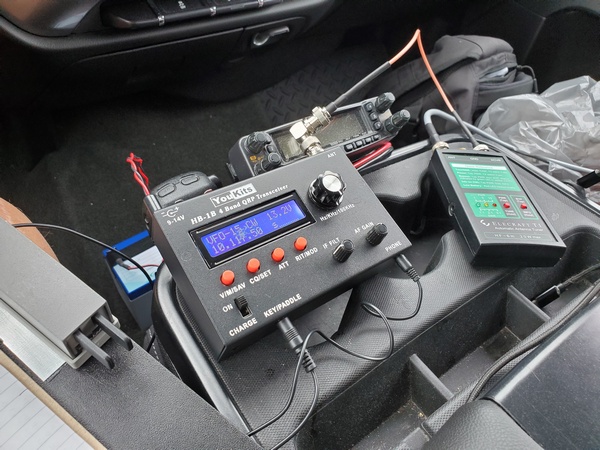
I normally have my old YouKits HB-1B nearby as a backup radio. In that role, it spends a fair amount of time tucked away under the backseat of my truck. I hadn’t used it in a few months, so I fired it up for a POTA/WWFF activation at Marsh Creek State Park (US-1380, KFF-1380).
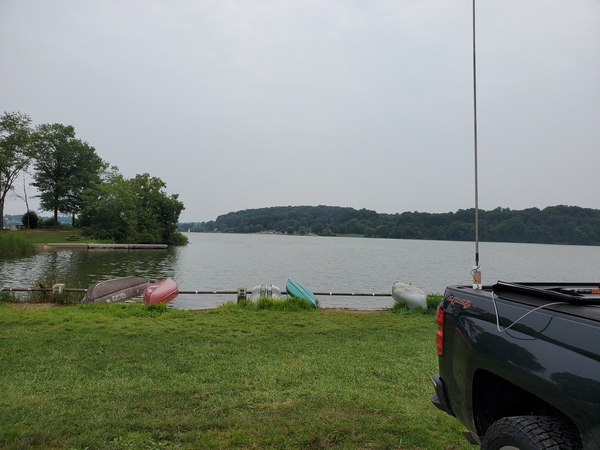
I rolled into one of my favorite spots on the western shore of Marsh Creek Lake. Being a weekday, the boat launch parking lot wasn’t nearly as crowded as it gets on weekends during the summer months. It was very hazy this morning from the smoke from Canadian wildfires.
Hazy morning at Marsh Creek Lake
Besides the HB-1B, I used my Elecraft T1 tuner, a 17-foot whip, and my homebrew loading coil. I started out on 40M, and that band did not disappoint. It only took about 10 minutes to make my first 10 contacts. I stayed on 40M for about 30 minutes until the activity dwindled.
My trusty HB-1B getting some air time
I set the loading coil tap for 20M, but things were much slower there. I logged just two contacts on 20M, but one of them was F1BLL in France. After that, I switched to 30M and picked up three final contacts.
After a little more than an hour, I had logged 28 contacts. Among those contacts, I had three (known) park-to-parks and one DX contact.
The HB-1B really doesn’t like my cell phone. To prevent getting noise in the receiver, I had to keep my phone several feet away. Despite its quirks, the HB-1B still got the job done.
I’m at the stage in my life when I should be “thinning the herd” when it comes to radios. So, what do I do? Instead of getting rid of some stuff, I fire off an order to Elecraft for a KH1 Edgewood package. I need another QRP rig like a hole in the head, but after considering it for the past year, I gave in and ordered one.
I have a couple of use cases in mind for the KH1. This rig should be ideal for bicycle-portable outings and hopefully get me out on some hiking trails—within the limits of my arthritic knee, of course.
I have to admit that after I placed the rig in my online shopping cart, it took me several minutes to convince myself to press the “Submit” button. Less than 24 hours later, I received a shipping notice from Elecraft.
While waiting for the KH1 to arrive, I watched a bunch of YouTube videosread serveral blogs, and downloaded the manual. With those resources, I was thoroughly prepared when the Post Office delivered it.
What I wasn’t prepared for was exactly how tiny this thing is. Even with the research I had done, I didn’t fully appreciate its diminutive size until I had it in my hand. It’s amazing how much functionality Elecraft was able to cram into this little rig.
My new rig at US-0761/KFF-0761
Some Initial Impressions
Menus. I prefer radios that are simple to operate without a bunch of complicated menus. That’s one reason I love my Penntek TR-35 so much. There are a lot of menu options provided through the four pushbuttons on the KH1’s front panel. Elecraft, however, has come up with a scheme that makes navigating the menus very intuitive.
Paddles. The Elecraft KHPD1 paddles included with the Edgewood package will take some getting used to. I typically prefer paddles with a light touch, like my trusty Palm Mini paddles. I played around with the Elecraft paddles with the rig in the “Test” mode. It didn’t take too long before I could send coherent code with them. We’ll see how I do in the field. Fortunately, there are several after-market paddles for the KH1 if I decide to go that route.
Overall Ergonomics. It’s clear that a lot of thought has gone into the clever design of the KH1. Everything from the logging tray to the self-contained pen is nothing short of genius. I’ve never used a handheld HF rig before, so using the logging tray will take some getting used to.
Maiden Outing
The day after I received the KH1, my (far) better half suggested I go out and give the new radio a try. Of course, I took her suggestion, but I had some reservations. There was some geomagnetic craziness going on, plus the higher bands could be tough early in the morning. Nevertheless, I packed up the KH1 and headed off to Valley Forge National Historical Park (US-0761, KFF-0761).
I started off using the KH1 handheld with the telescopic whip while sitting on top of a picnic table. Using the stock counterpoise wire on the ground, the KH1’s internal ATU easily found a 1:1 match. The bands were really rough, but I made seven contacts that way. It took the better part of an hour to make those contacts, however. Six were on 20M and one was on 17M.
A Boy and His Toy
I wanted to try the lower bands—and my rear end was sore from sitting on the table—so I walked back to the parking lot and set up a 12-foot loaded whip on my truck. Sitting on a camp chair next to the truck, I bounced around the bands. I ended up with one contact on 40M and three more on 20M. Out of my 11 contacts, four were park-to-park.
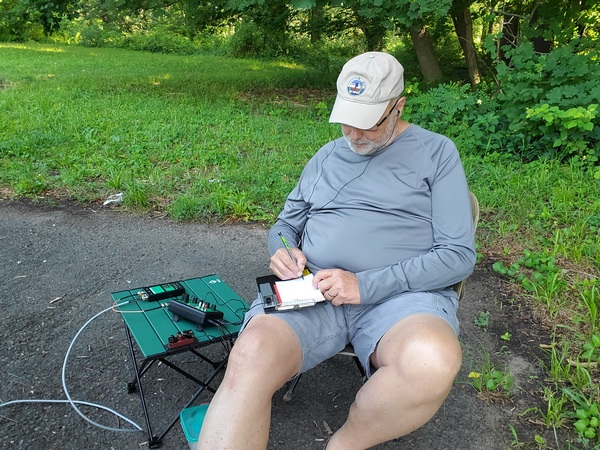
Using the logging tray was a challenge. Writing while holding the rig in my hand was tough. Sitting in a chair with the radio resting on my knee was a little easier. My handwriting was pretty sloppy but still readable.
With enough contacts for the activation, I declared victory and went home.
Wrap-Up
I’m definitely not an early adopter with new gear. The KH1 is no exception. Elecraft announced the KH1 in the fall of 2023. Since that time, they have made improvements to the paddle and added new features via the firmware. Plus, by waiting to buy one, I got to learn from the users who jumped on the KH1 bandwagon early on. Thanks to the legions of YouTubers and bloggers for sharing their experiences with this rig. You made it easy for me to get up and running with it.
After the intial outing, I am thoroughly impressed with the KH1. With earbuds, the receiver sounds great, and the rig was super easy to use.
This little rig is going to see a lot of future use in the field.
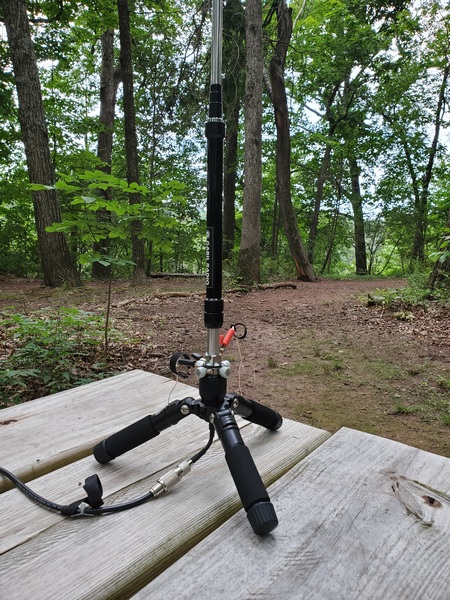
Wanting to take advantage of the excellent weather today, I drove up to Evansburg State Park (US-1351, KFF-1351) for a quick morning activation. I wanted to give my Gabil GRA-7350TC vertical some air time, so I tossed it into the truck and headed out to the park.
The picnic table I planned to use had been moved from its usual spot. Not wanting to drag the heavy table back to where it belongs, I set up at a table I have used previously. It’s close to a hiking trail, so I needed to make sure my radials wouldn’t be a trip hazard for passersby.
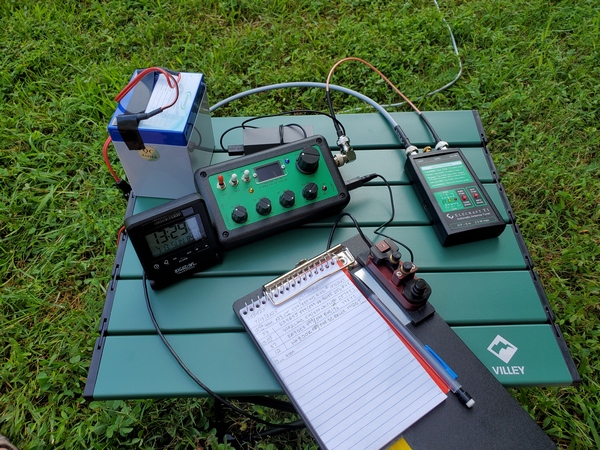
I set up the Gabil antenna on its tripod at one end of the table. To facilitate tuning, I set up my Penntek TR-35 (5 watts, CW) and Elecraft T1 ATU within arm’s reach of the antenna. I meant to bring a 3-foot coax along, but it didn’t make it into my backpack. A 10-foot cable was the best I could do, so I just coiled up the excess. (Note to self: Keep a 3-foot cable in the backpack.)
I started out on 40M, so I laid out a 33-foot counterpoise wire on the ground. I reached for my little SWR meter, but it wouldn’t power on. It had been a while since I had last charged it, so the battery appeared to be dead. I ended up adjusting the antenna for maximum noise in the receiver and used the T1 to do the final matching.
After I had a few contacts in the log, I changed over to 20M. I built my 33-foot counterpoise wire so I could split it into two 16.5-foot wires. After laying out the two counterpoise wires, I tried to peak the noise. No joy. I just couldn’t find a discernible peak.
Just then, I remembered I had a 12-volt power cable for the SWR meter. Duh! Why didn’t I think of that sooner? After temporarily disconnecting the TR-35, I used the battery to power the SWR meter. I quickly got the antenna adjusted to a 1.3:1 SWR. I reconnected the TR-35 and got started. (Note to self: Throw a Powerpole splitter in the backpack.)
The action was relatively slow-going this morning, but there were a fair number of activators on the air. After a little over an hour, I had 14 contacts, nine of which were park-to-park.
Despite some minor glitches, it was an enjoyable morning operating in the park.
I rolled into one of my favorite spots and set up my table and chair in the grass behind my truck. From previous activations, I knew this spot always has lots of shade. Of course, with the heavily overcast skies this morning, sun exposure wasn’t much of an issue.
I mounted a 17-foot whip and my homebrew loading coil on my truck and ran some coax back to my operating position. Rig-wise, I used my Penntek TR-35 (5 watts, CW), Elecraft T1 tuner and my little American Morse MS2 straight key.
My strategy today was to operate in the WES for an hour. If I hadn’t reached 10 contacts by then, I planned to break out the paddles and finish up as a POTA activator.
It was a good thing I had a “Plan B.” After an hour, I had only scratched together six WES contacts. I don’t know if it was the unsettled geomagnetic conditions or just a lack of early morning participants, but I didn’t hear much WES activity on 40M and 20M.
After spotting myself on the POTA and WWFF websites, I easily made the requisite 10 contacts on 20M plus three more for good measure. One of those contacts was a park-to-park.
It wasn’t my best outing, but far from my worst. Even with the humid weather and the occasional mosquito, it was nice to do a little outdoor operating and log some familiar SKCC and POTA callsigns.
Operating from Valley Forge National Historical Park (US-0761, KFF-0761) on the 4th of July has become something of a tradition for me over the years. I expected the park to be busy today, so my plan was to get out early before the picnic-goers arrived en masse. Then, get home to spend the rest of the day with my (far) better half.
I headed to a spot in one of the picnic areas that has some shade in the morning. Today, I used a 17-foot telescopic whip on my homebrew loading coil on the truck, along with my little Penntek TR-35 (5 watts, CW). An 18-foot length of coax was more than enough to reach my operating position.
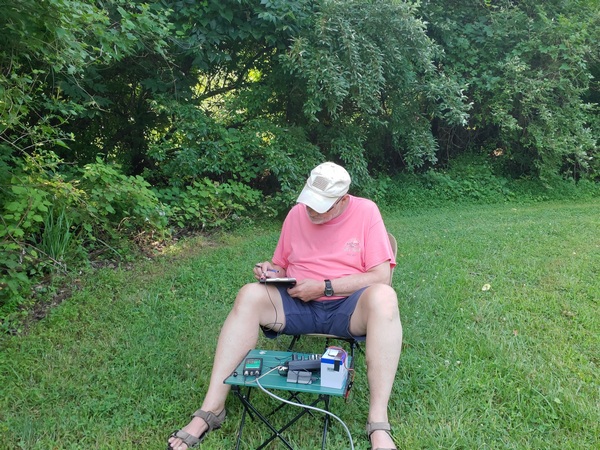
Speaking of my operating position… I set up my camping chair and table on a paved area next to my truck. Normally, I would set up in the grass behind the truck, but the grass was a little high and the ticks have been bad this year. In fact, I found one strolling across my notepad at one point.
I started off on 40M, and things got off to a fast start. It was probably a combination of decent band conditions and it being a holiday. Regardless, the hunters pounced on me within a minute of posting my spot. It didn’t take long to make my first 10 contacts.
After things slowed down on 40M, I gave 30M a try. That band produced just a single contact. I moved up to 20M and found a little more action up there. After an hour and 10 minutes, I started losing my shade, so it was time to wrap things up. I finished up with 31 contacts, including five park-to-park contacts.
Around that time, I saw a teenager casually throw some trash on the ground before getting in their car to leave. This was only about 10 feet away from where I was sitting. Unbelievable, since they had to drive past the trash cans on their way out of the parking lot. After I loaded up the truck, I grabbed a plastic bag and cleaned up the mess that was carelessly left behind. Apparently, my parents taught me better.
Littering incident notwithstanding, it was a fun little activation this morning. I hope my fellow citizens have an enjoyable and safe 4th of July holiday.






 WB3GCK QRP Amateur Radio