Covering More Bands with My 12-ft Whip

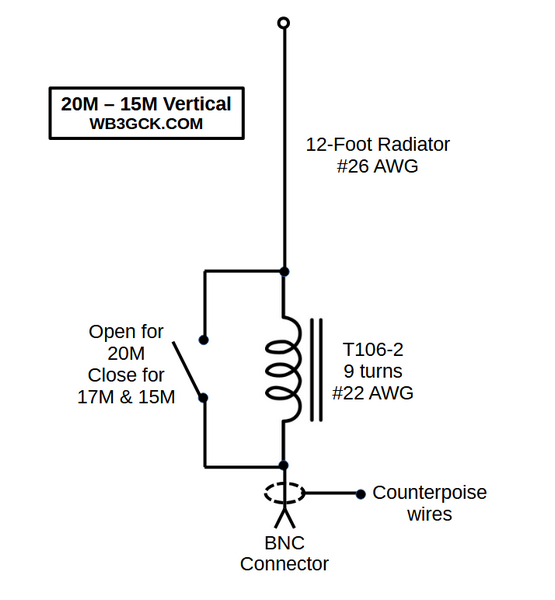
Back in 2017 I built my 19-foot wire vertical, which was my go-to portable antenna for about 4 or 5 years. The concept was simple: It functions as a base-loaded resonant vertical on 40M & 30M and as a random wire on 20M and up. The matching unit contains a tapped toroid for 40M & 30M and is fed through a built-in 1:1 choke. It occurred to me I could do something similar with the 12-foot telescopic whip and homebrew loading coil I’ve been using on my truck of late. 

My 12-foot whip setup is resonant on 40M through 17M. You’re probably thinking: “Why not just bypass the loading coil and adjust the length of the whip for 15M through 10M?” Well, being as lazy as I am, that would make band changes a little more involved than I want to deal with. I like having some “frequency agility,” and I’m not above using an ATU to achieve that.

To emulate the scheme I used for the 19-foot vertical, I just needed a choke at the input to my homebrew loading coil. (I could probably go without the choke, but I wanted to keep the coax from becoming part of the antenna.) So, I use the 12-foot whip as a base-loaded resonant vertical on 40M through 17M. For 15M through 10M, I would bypass the coil and use an ATU. 

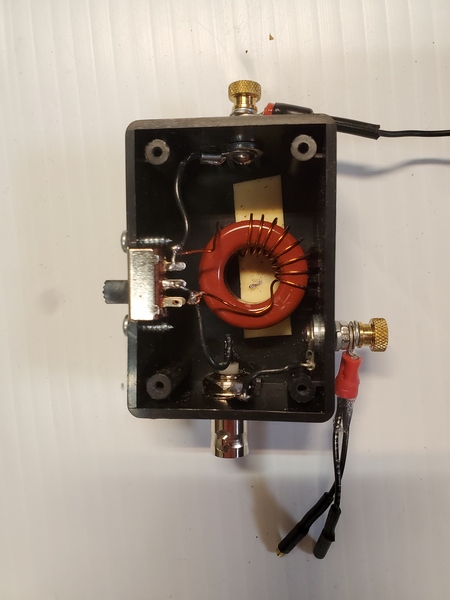
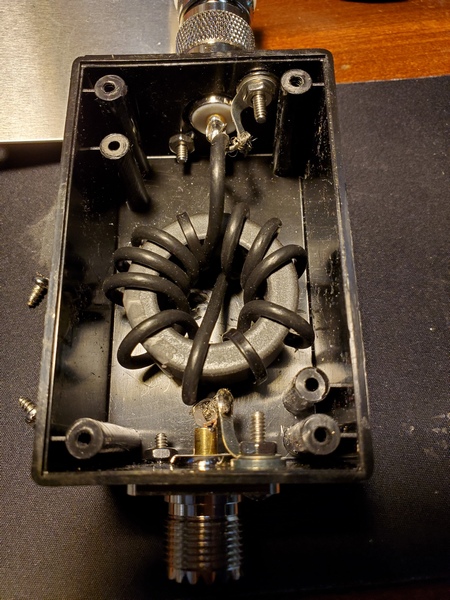
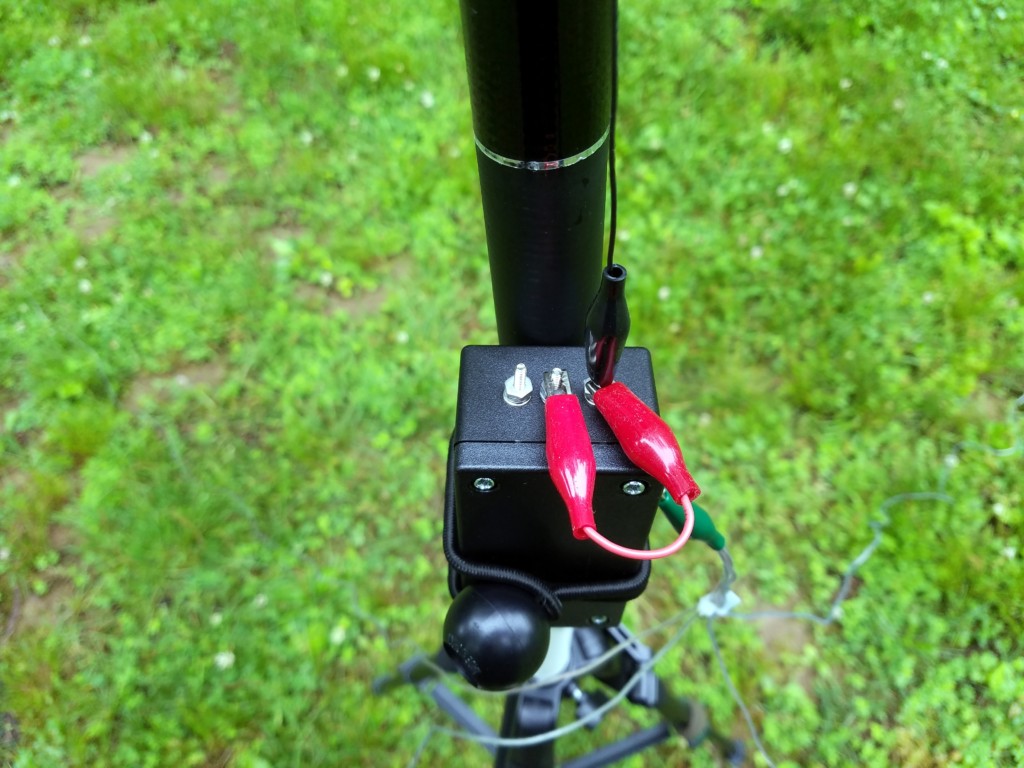
To test this out, I threw together a choke using parts I had on hand. I wound 10 turns of RG-174 on an FT-140-43 toroid. A Radio Shack project box I had in my stash of parts was the perfect size to house the toroid. (I bought it a decade or two ago, and it was still unopened in the original Radio Shack packaging.) Since I installed SO-239 connectors on each end, I had to use an adapter to connect the choke to the SO-239 on the antenna. To hold the coil in place, I wedged a piece of foam packing material between the lid and the core. The completed choke is functional, albeit a little cheesy-looking. 

The choke is 10 turns of RG-174 coax on an FT140-43 toroid.

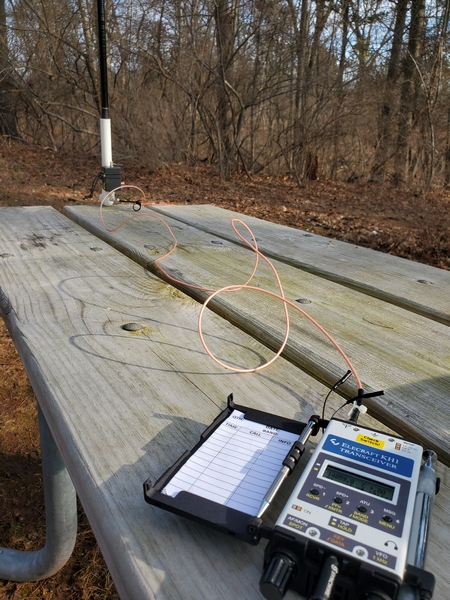
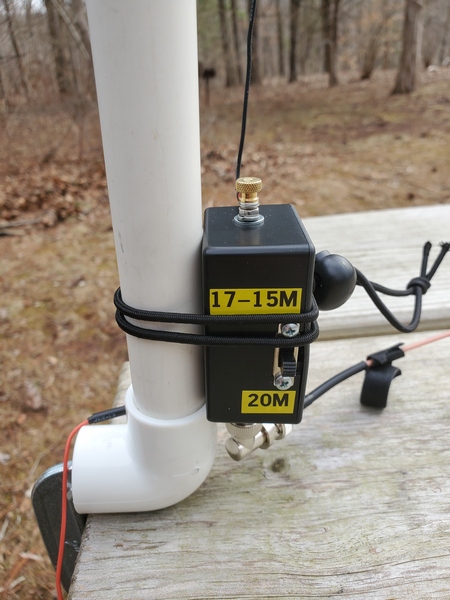
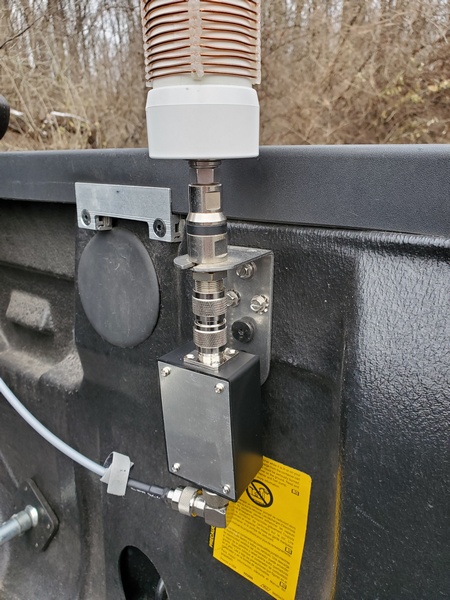
My first test using the 12-ft whip on the higher bands was a success. While activating Ridley Creek State Park (US-1414, KFF-1414), I used my KX3 (5 watts, CW) and installed the choke at the antenna feedpoint. On 40M through 17M, the loading coil functioned as it normally does. On 15M, 12M, and 10M, I bypassed the coil entirely and relied on the KX3’s internal ATU to load up the whip. 

The choke installed at the antenna's feedpoint
The choke installed at the antenna’s feedpoint

The KX3 easily found matches on all three bands, and my results on the air were encouraging. On 15M, I worked stations in Poland, Belgium, France, Ukraine, Germany (3), and the Slovak Republic. I made two stateside contacts on 12M. Up on 10M, I worked some more DX: Germany (2), Italy, and Czech Republic. One of the German contacts was park-to-park. 

I’ve used this arrangement on a few more activations since then, including Winter Field Day. My results have been consistently good.

I haven’t done any modeling, but the 12-foot whip seems to be a pretty good length for operating like this. It’s just a little longer than a ¼-wave on 15M and a little shy of ⅜-wave on 10M. On 12M, it’s somewhere between ¼ and ½-wave; so it isn’t resonant on any of the bands of interest. 

Although I was pleased with these initial results, I might do a little more tinkering with this setup. I’m toying with repackaging the choke to make it a little more weather resistant. I encountered some rain during the first activation using it. There was no damage to the choke at all, but I always have a tendency to over-engineer things—it keeps me occupied and out of trouble, I suppose. 

No scientific breakthrough here. Just a lazy guy “force feeding” a fixed length whip to squeeze a few more bands out of it. 

72, Craig WB3GCK

Drive-on Antenna Mount Article

Drive-on Antenna Mast Mount

Back in December, Becky Schoenfeld W1BXY, Editorial Director for ARRL’s On the Air magazine, asked me if I would be interested in writing a detailed set of step-by-step instructions for my Drive-on Portable Antenna Support. Naturally, I said I would.

I submitted my manuscript, along with an all-new set of pictures. The article was published in the current issue (May/June 2024) of On the Air (pages 20-22).

If you’re interested, have a look. ARRL members have access On the Air as part of their membership.

73, Craig WB3GCK

Junk Box Loading Coil

Whenever I buy parts for a project, I always buy one or two extras. Over the years, I’ve amassed a sizable collection of random parts. Some of it will never be used, but sometimes my collection of parts has just what I need for something I want to build. I like when that happens.

A while back I wrote about an old homebrew coil I resurrected and paired with a 12-foot telescopic antenna. The coil, while effective, was built to use with a much shorter whip and is larger than what I need. I scoured my junk box and came up with most of the parts I needed to build a scaled-down version. 

I should note that I built this coil specifically to use with my old MFJ-1956 12-foot telescopic whip. In this configuration, this coil covers 40M through 17M. So, if you have a different whip or want to cover different bands, you’ll need to modify the design accordingly. 

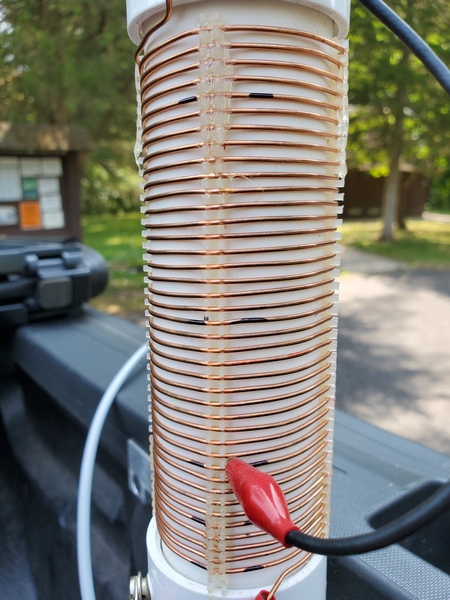
Completed loading coil. Used with a 12-foot telescopic whip, it tunes from 40M through 17M.

I used the old coil as a guide to determine the number of turns I needed to cover the bands of interest, adding two turns for good measure. Using an online shortened vertical calculator, I figured I would need about 13.4μH to load the 12-foot whip on the 40M band. Using an online coil inductance calculator, I estimated the total inductance of my coil to be 14.8μH. So, it covers 40M with a turn or two to spare.

The new coil assembly measures 8.25 inches end-to-end, making it 2.25 inches shorter than the old coil. While it’s about 3.3 ounces lighter than the old coil, this new coil still weighs in at a hefty 10.8 ounces. 

Parts List

With a few exceptions, my junk box provided the parts I needed to build the coil.

  • 5-3/8 inches of 1.5 inch PVC pipe
  • (2) PVC end caps for 1.5 inch PVC pipe
  • (4) pieces of nylon grommet edging, 3.25 inches each. (The material I used has about 8 notches per inch)
  • 16 gauge bare copper wire, approx. 12.5 feet
  • (1) 3/8-24 coupling nut, 1-1/8 inches long
  • (1) 3/8-24 x 1-1/4 inch stainless steel bolt (bottom mounting stud)
  • (1) 3/8-24 x 1 inch stainless steel bolt (top bolt)
  • 3/8 inch flat washers & lock washers
  • (2)  #10 x 3/4-inch self-tapping screws
  • Approx. 6 inches of RG-174 coax
  • Small alligator clip
  • Misc: ring lugs for ⅜-inch & #10 screws

Construction Notes

As shown in the accompanying photo, I drilled the end caps to accommodate the ⅜-24 bolts. The 1-1/4 inch bolt was used for the bottom of the coil, along with a flat washer and a lock washer. The 1-inch bolt was used for the top, along with flat washer, lock washer, and the coupling nut. 

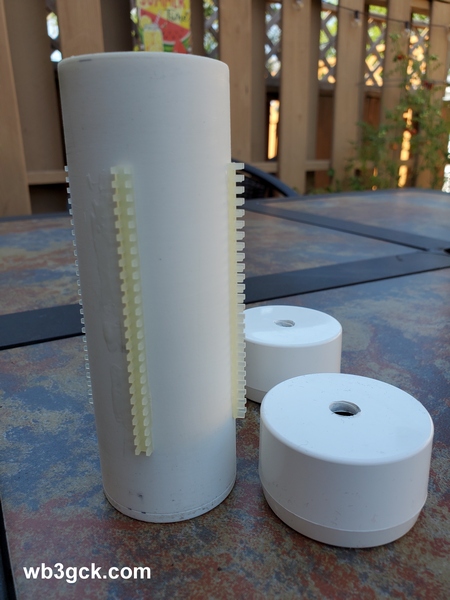
This is the coil form with the four strips of grommet edging glued on. The ends were drilled to accommodate the 3/8-24 bolts.

The coupling nut was one item I didn’t have in my junk box. My local hardware store is well-stocked, but they didn’t have them with the ⅜-24 thread. I eventually found what I needed on Amazon. It was a little pricey, but I didn’t have any better options at the time. 

After cutting the PVC pipe to length, I temporarily installed the end caps. Then, I cut four pieces of the grommet edging to length and glued them on, using Goop® adhesive. Unfortunately, I can’t provide a part number and source for the edging. A local QRPer, Ron Polityka WB3AAL (SK), gave me several pieces many years ago. I’m pretty sure Panduit was the manufacturer. My stash was nearly depleted, but I had enough left for this project. 

Before assembling the end caps, I made two short jumpers, each with a ⅜-inch ring lug on one end, and a smaller ring lug on the other. Then I tightened everything up. I left about a ½ inch of thread on the top bolt to go into the coupling nut. I was careful to ensure that my whip antenna would fully thread into the coupling nut. 

Before winding the bare wire on the coil form, I installed a ring lug on one end. I drilled a pilot hole in the side of the lower end cap and used a self-tapping screw as a connection point. When you wind the wire on the coil form, try to get the turns as tight as you can. (I didn’t do as good a job winding the coil as I would have liked.) Once I finished winding the coil, I cut the wire to length and installed a ring lug. I used some more Goop adhesive on the grommet edging to hold the turns in place. 

The last step was to build the clip lead. For this, I used a piece of RG-174 coax. There’s nothing magical about the RG-174; stranded hookup wire would be fine. I used RG-174 primarily because of its flexibility, plus the shield would be a good RF conductor. (The center conductor was unused.) I crimped and soldered a ring lug to the braid on one end, and soldered an alligator clip to the braid on the other end. Then I used another self-tapping screw on the top end cap to connect everything together. 

On the Air

I wrote about my initial tests of the coil in a previous post. Using an antenna analyzer, I determined where to place the tap for each of the four bands. I then used a permanent marker to mark these locations on the coil, so I can quickly change bands without resorting to the antenna analyzer. 

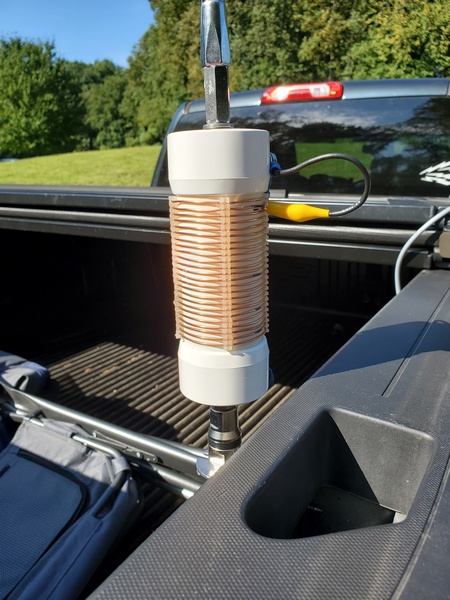
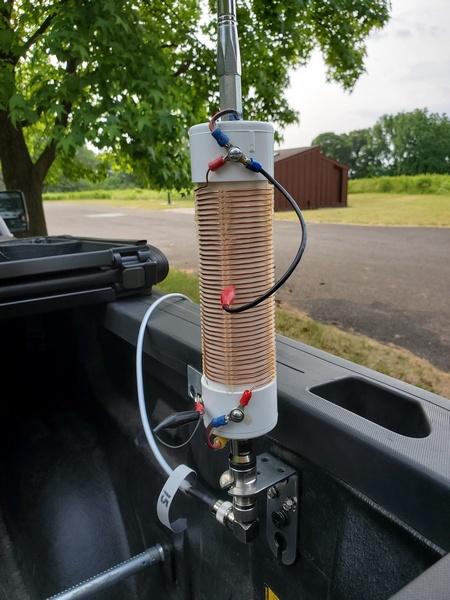
This is the completed loading coil installed on my truck for a POTA activation.

With the antenna mounted on my truck, the SWR is higher than I would like on 40M and 30M. This is not unlike other shortened, base-loaded verticals I’ve used in this configuration. An additional counterpoise wire or two might help. Also, grounding the bottom of the coil and feeding it a couple turns up from the bottom would provide a precise match on the lower bands. I’ve used that technique in the past. That configuration , however, is a bit more complicated to implement, given the way I plan to use this coil. So, I just use a tuner to keep the radio happy, and the antenna seems to work fine.

Wrap-up

My older, larger coil worked fine; so technically, this project was unnecessary. But, since I had most of the parts on hand, what the heck. It was a fun project, and I’m sure it will see a lot of use in the future.

73, Craig WB3GCK

Repurposed Antenna Parts – Round 2

In a recent post, I wrote about a vertical antenna I put together with an old homebrew loading coil and a 12-foot telescopic whip. I intended to add some marks on the coil for each band, so I could eliminate the need for an antenna analyzer during band changes. This time, I actually remembered to bring a permanent marker and got it done.

I drove up to Evansburg State Park (K-1351/KFF-1351) this morning for a quick POTA activation. Before I got going, I used my antenna analyzer to determine the tap points for each band. I used a Sharpie® marker to mark the coil for 40M, 30M, 20M, and 17M. Since the coil has sufficient inductance to load the 12-foot whip on 60M, I also marked that band (the top-most mark on the coil). Before I started operating, I went back and checked each tap location to confirm repeatable results. Using a Sharpie marker is a decidedly low-tech approach, but it serves the purpose. 

My homebrew loading coil. If you look closely, you can see the marks I added. As shown, the coil is tapped for the 30M band.

To change bands now, I just move the tap to the appropriate mark. I still use an antenna tuner to deal with any minor variations I might encounter. Now I can change bands in the time it takes to move the coil tap and hit the “tune” button on the tuner.

Despite the so-so band conditions this morning, the 12-foot whip performed well. In less than an hour of operating, I made 18 contacts. Most of my contacts were on 40 and 30. There were two park-to-park contacts I’m aware of. 

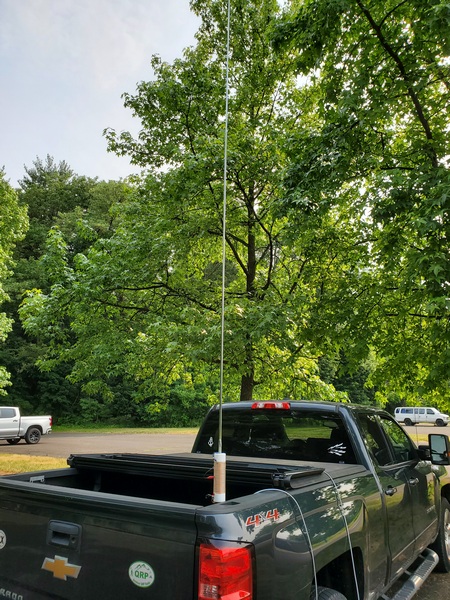
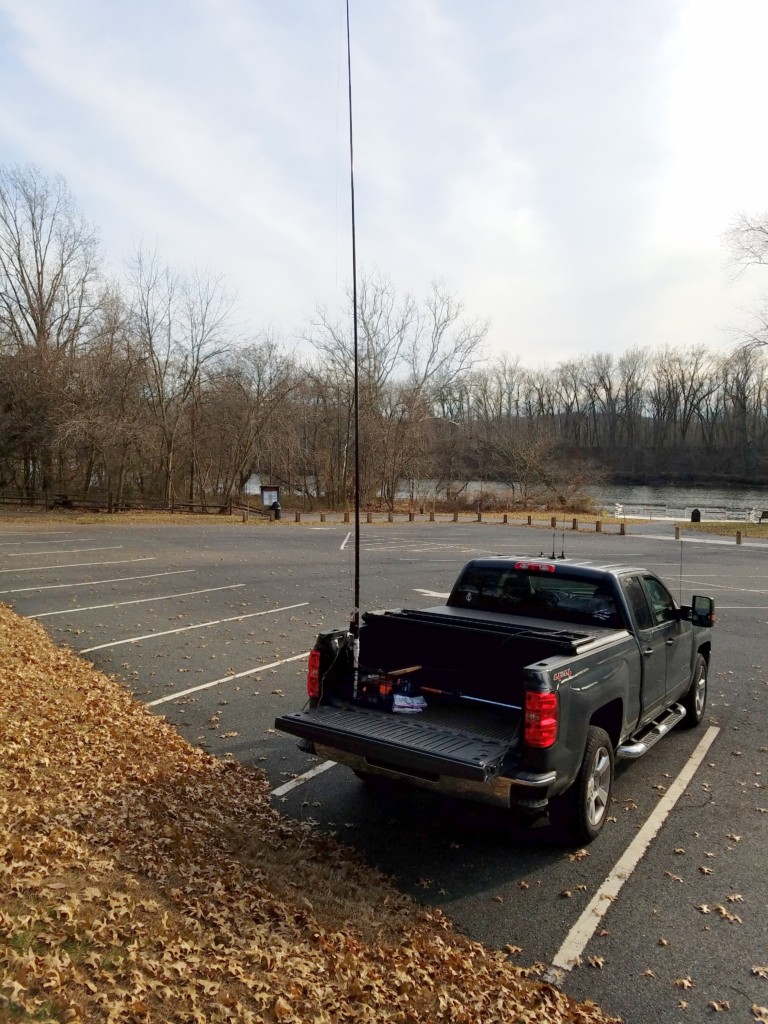
The 12-foot base-loaded whip in use at K-1351

My operations were interrupted for a chat with a curious park ranger. I gave him my standard Parks on the Air spiel. He had encountered POTA activators in another state park, so he had some familiarity with the activity. After a few minutes, he left to look into a reported issue on one of the hiking trails. 

So, I’m pretty satisfied with this antenna. It has a length advantage over my Gabil GRA-7350TC antenna. Comparing coil dimensions, I suspect it also has an efficiency advantage over the Gabil antenna. 

Regardless, I now have another useful option in my antenna arsenal.

73, Craig WB3GCK

POTA with Repurposed Antenna Parts

While going through my stash of old parts, I came across a coil assembly I built over 20 years ago. Originally, it was part of a homebrew antenna inspired by the MFJ-1622 Apartment Antenna; but I used it over the years with a variety of whip antennas while “stationary-mobile.” As I moved on to other antennas for my portable operations, the coil was relegated to the junk box and forgotten—until now.

I also had an old MFJ-1956 12-foot telescopic whip that I haven’t used in years. It was stashed away in the basement waiting to become part of a new antenna project. Having just installed a ⅜-24 antenna mount in the bed of my pickup truck, I thought the coil and whip might work well with it. 

The coil is a beast. It’s made from 1.5-inch PVC pipes and wound with bare copper wire—16 awg, I think. I used four strips of nylon grommet edging material to keep the turns evenly spaced. (I don’t remember where I got the grommet material, but it’s similar to this Panduit product.) The coil is about 5.4 inches long and 2 inches in diameter with 40 turns. Using an online calculator, I figured the coil is approximately 25.4 μH. 

The homebrew coil I built more than 20 years ago.

The coil assembly weighs in at a hefty 14.1 ounces, and the overall length is 10.5 inches. The whip is 24 inches collapsed and weighs 9.6 ounces, so it wouldn’t be my choice for a backpacking antenna. However, on my truck, it should do fine.

Using another online calculator, I reckoned the coil should be more than enough to resonate the 12-foot whip on the 40M band and possibly the 60M band. Since the whip, coil, and mounting bracket all use ⅜-24 hardware; it was just a matter of slapping it all on the truck to see what how it would perform. 

To test it out, I made a trip to Valley Forge National Historical Park (K-0761, KFF-0761) this morning. With a minor geomagnetic storm underway, the forecasted band conditions looked pretty dismal. I also got an early start, since we were expecting some severe storms around mid-day. So, I wasn’t expecting much, in the way of contacts. 

I mounted the antenna on the back of the truck and broke out the antenna analyzer. It took a bit of fiddling to find resonance on 40M. The lowest SWR was around 3.8:1. That’s not great, but my little Elecraft T1 tuner handled it with no difficulties. On the air, I was getting some decent spots from the Reverse Beacon Network, and I made about 8 contacts before moving to 30M.

My homebrew coil and 12-foot whip mounted on the back of my truck.

The SWR on 30M was down to about 2:1. Again, the T1 made sure my TR-35’s finals stayed happy. I made one park-to-park contact on 30M before moving up to 20M

The SWR on 20M was about 1.3:1 across the band. I made another seven contacts here, before stopping to do some experimenting with the antenna. 

I checked 17M and measured an SWR of about 1.2:1 across the band. I didn’t try to make contacts on 17M. Instead, I went back to 40M to pick up a few more contacts before shutting down. 

I intended to bring a Sharpie® pen along to mark the coil for each band to speed up band changes. Of course, I forgot to bring one along. Oh well, I’ll do that next time. For 15M and above, I’ll need to bypass the entire coil and shorten the length of the whip accordingly. 

The static crashes were getting louder, and I heard thunder off in the distance. So, I called it quits. Just as I shut the rig off, the heavy rains started. I quickly took down the antenna and packed up to leave. 

Despite the lousy band conditions and heavy QRN, I ended up with 18 contacts. I had three park-to-park contacts today. And, as it turns out, this was my 20th POTA activation at Valley Forge, earning me a “Repeat Offender” award for this park. 

It looks like this mash-up of antenna parts works pretty well. I’ll give it another shot in a few days. Hopefully, the weather and band conditions will be better. 

72, Craig WB3GCK

A Homebrew Z-Match Transmatch

[This is an updated version of an article that originally appeared on my QSL.NET website. Although it’s twenty years old, I still occasionally hear from people who have built similar tuners.]

Antenna tuners (more accurately referred to as “transmatches”) make great homebrew projects; they are reasonably simple to build and, when finished, provide a useful piece of equipment. Every shack should have (at least) one. I built this one a couple of decades ago, and it’s still in use.

WB3GCK Z-Match Tuner - front panel
WB3GCK Z-Match Tuner – front panel

For this project, I decided to try my hand at building a Z-Match tuner from scratch. This type of tuner has been around for a while. While the Z-match can take on several variations, what distinguishes it from other circuits is that it is a resonant circuit that uses a fixed inductor. 

WB3GCK Z-Match Tuner - rear panel
WB3GCK Z-Match Tuner – rear panel

Z-Match tuners became very popular within the QRP community years back, thanks primarily to articles in QRP journals by Charlie Lofgren W6JJZ and the emergence of Z-Match tuners in kit form. Emtech sold its wildly popular ZM-2 kit commercially and the NorCal QRP Club began selling their BLT tuner kit (a W6JJZ design) like hotcakes.

Some Pros and Cons

Why the popularity? Here are some advantages that the Z-match design offers:

  • Matches balanced loads without the use of lossy baluns.
  • Being a parallel resonant circuit, the Z-match can provide some band-pass filtering for your receiver and harmonic attenuation for your transmitter.
  • A well-designed Z-match tuner has a high Q and is more efficient (less lossy) than other types of tuners.
  • The fixed inductor simplifies construction (no taps or rollers needed).
  • Using a toroid inductor and some small poly-film variable capacitors, the Z-match can be built into a very compact package. This sort of thing usually appeals to QRPers.

There is, of course, no free lunch here. Here are some disadvantages of the Z-match design:

  • Tuning is usually very narrow and can be a bit touchy sometimes
  • The range of impedances that can be matched is not as great as in other designs, such as the “T” configuration.

Design and Construction

I make no claims of originality for anything in my version of the Z-match. I based it on a classic design which was first appeared in SPRAT #84 (see the G3YCC web site for a schematic of the original design). This design, by the way, is similar to the one used in the Emtech ZM-2.

I incorporated a few modifications in my version, based on an article by W6JJZ (“The Z-Match: An Update”, QRP Quarterly, July 1995, pp 10-11). First, instead of the T-200-2 toroid specified in the SPRAT article, I used a T-200-6 core. W6JJZ recommends the Type-6 core over the Type-2 because it provides a higher Q over most of the HF range. The number of turns has to be adjusted for the Type-6 core, due to differences in permeability. Here again, I went with W6JJZ’s suggested turns count. Another reason for choosing the T-200-6 core was that I happened to have one in my junk box. How convenient!

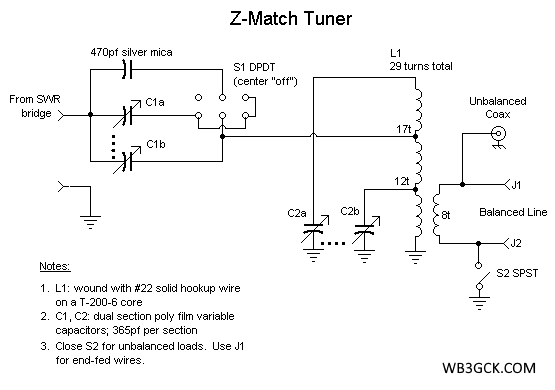
Z-Match Tuner Schematic

The coil was wound using some #22 solid hookup wire (from Radio Shack) which I had laying around. The secondary winding is wound between the turns of the primary to ensure tight coupling. I added a toggle switch to ground one side of the secondary winding to accommodate single-ended loads (like a random wire). A piece of styrofoam was glued to the bottom of the enclosure to provide some support for the toroid and to keep it away from metal surfaces.

WB3GCK Z-Match Tuner - Inside view
WB3GCK Z-Match Tuner – Inside view

Another W6JJZ modification I used was the inclusion of a DPDT (center off) toggle switch to provide some flexibility with the input capacitor. Using this switching arrangement, I can select between one section of the capacitor, both sections in parallel, or both sections in parallel with a fixed 470pF mica capacitor. The extra input capacitance can sometimes be helpful on the lower frequencies.

The capacitors are poly film variable capacitors (2 sections @ 365pF each), which were originally purchased from Mouser Electronics. Unfortunately, Mouser no longer carries them, and I don’t know of another commercial source. I should have purchased a truckload of them when they were available! Similar capacitors with smaller values are still available if you look around.

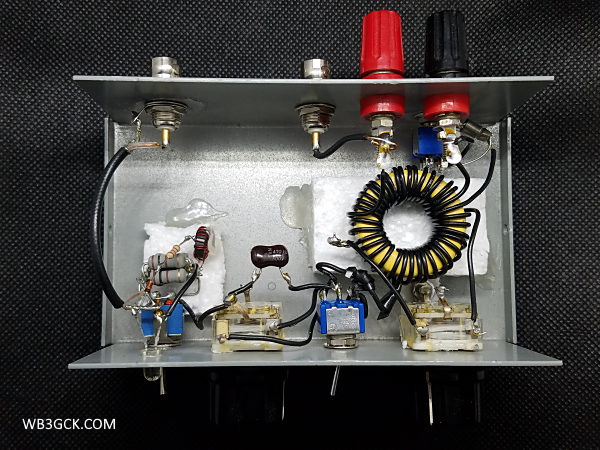
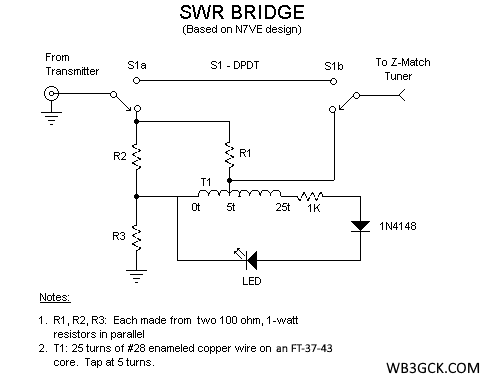
The SWR bridge I used is a Dan Tayloe LED SWR indicator from a kit that was offered years ago by the Arizona scQRPions. It uses a resistive bridge circuit with a single LED to indicate a null when the bridge is balanced. For the 50-ohm resistors in the bridge, I substituted 2 100-ohm, 1-watt resistors. The bridge will handle a typical 5-watt QRP rig without flinching and could probably handle a bit more than that.

SWR Bridge Schematic

The whole thing was packaged in an enclosure which measures 3 x 5 x 2 inches. It certainly could have been built into a smaller package, but I had this enclosure on hand and decided to put it to use.

On the Air

To use the Z-Match, adjust the capacitors for a null in the background noise in your transceiver. That will get you close to a match. Then, switch in the SWR bridge, apply some RF, and tweak the capacitors for minimum brightness on the LED. There may be some interaction between the two capacitors, so you might have to go back and forth between them a time or two.

For an initial test, I hooked it up to the famous—in my mind, at least—WB3GCK Downspout Antenna. The little Z-match loaded up the downspout on 40 through 10 meters with no problems. On most bands, I could get the LED indicator to go completely out. On one or two bands, I couldn’t get it completely extinguished, but it did give a definite null. Double-checking with a second SWR bridge indicated that the SWR was 1.5:1 or less in this condition. While tuned up on 40 meters, I had a quick QSO with a station near Chicago from here in southeastern Pennsylvania with 3 watts.

Wrap-Up

This little Z-Match tuner was one of my favorite—and most useful—projects. It’s a great accessory for QRP rigs that lack an internal tuner or SWR meter.

73, Craig WB3GCK

©2000-2020 Craig A. LaBarge

“Stationary-Mobile” with My 19-foot Vertical

Earlier this year, I built a lightweight, 19-foot vertical. Intended for tripod or ground mounting, I did the initial tuning and pruning of the vertical in that configuration. Today, I thought I’d see if it would work mounted on my pickup truck.

I have this plastic crate that I keep in the bed of the pickup truck. I use it to hold parts for my drive-on antenna mount, along with some tools and miscellaneous “stuff.” I hold the crate in place using bungee cords attached to a cargo bar that spans the width of the bed. I decided to make use of the crate as a quick and dirty antenna mount.

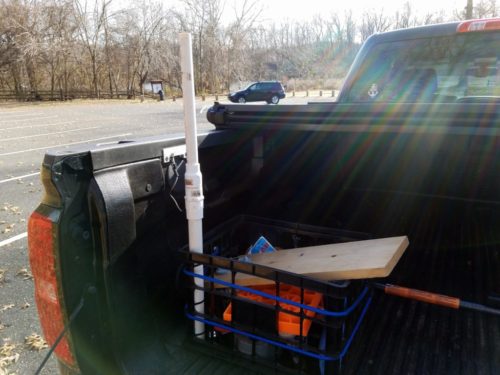
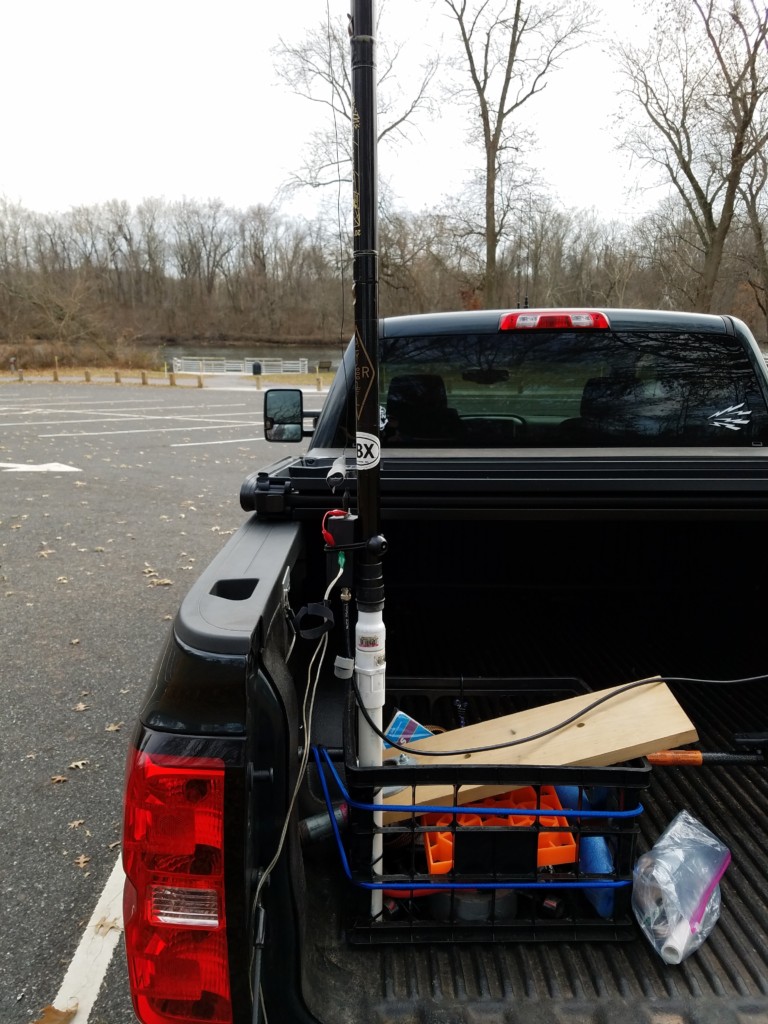
I took some 1-inch PVC pipe with a female threaded coupler from a previous antenna project and attached it to an inside corner of the crate with heavy-duty zip ties. I kept this part short enough to fit underneath the tonneau cover when traveling. To mount my 20-foot Black Widow pole, I used a 1-inch PVC male coupler and a reducer to go down to a 3/4-inch PVC pipe. The 3/4-inch PVC pipe fits nicely up inside the Black Widow pole. I went with the Black Widow pole rather than the lighter weight pole I normally use with this antenna since I already had all the PVC parts I needed to mount it.

My makeshift mount. The PVC mount is attached to the plastic crate, while the crate is attached to a cargo bar using bungee cords. The random junk I store in the crate keeps things stable.

I headed out to a local park today to give it a try. It only took a few minutes to get it set up. From the antenna, I ran some RG-8x coax through a window and into the cab of the truck. I connected the antenna ground to the body of the truck using a short piece of braid to a metal plate used to latch the tonneau cover closed.

The Black Widow pole installed on my makeshift mount.

I fired up my antenna analyzer and the SWR was off the charts. On closer inspection, I found the plate I was using for my ground wasn’t actually attached to the body of the truck. Instead, I connected two radials and ran them off the back of the truck. This time the SWR on 40 and 30 was much better. The resonant frequencies in this configuration were higher than when ground-mounted but my KX3’s internal tuner easily handled the minor mismatches.

I started out on 20 meters where this antenna operates as a random wire. I heard N5PHT doing a Parks on the Air (POTA) activation (KFF-3023) down in Texas. I gave him a call and exchanged reports. Moving down the band, I worked XE1XR in Mexico. So, the antenna seemed to be working fine. I checked 30 meters but it was devoid of activity.

The 19-ft vertical in operation.

Down on 40 meters, I had a nice ragchew with Bernard VE9BEL. Bernard was operating a club station (VE9CRM) in New Brunswick, Canada. He gave me a 599 and said I was “booming” into New Brunswick. Not bad for 5 watts into a 19-foot loaded vertical. I last worked Bernard a few years ago from Mt. Misery in Valley Forge National Park. We had strong signals both ways on that day, too.

So, it looks like this antenna is usable from the truck. I still need to find a way to connect the ground to the body of the truck. If possible, I’d like to avoid drilling holes in my new truck. This antenna is a little easier to deploy than my usual “Bike Rack Vertical.” The downside is I have to exit the truck to change bands. Life is a series of trade-offs, I guess.

73, Craig WB3GCK

Memorial Day Antenna Testing

Some time ago, I bought a small, lightweight telescopic fishing pole from a Chinese vendor on eBay.  It’s about 19.5 feet tall and collapses down to about 26 inches.  It’s a great size for backpacking or transporting on my bike.  It weighs practically nothing.  In fact, it’s too light for supporting anything but a lightweight vertical wire.  Although I have used it a few times to support various antenna configurations, I never really found one that was a “keeper.”

Since I had some time over the long holiday weekend, I scratched out a quick design for yet another vertical antenna and cobbled it together with parts I had on hand in my junk box.  I designed it to operate as a base-loaded resonant vertical on both 40 and 30 meters.  On 20 meters and higher, it operates as a non-resonant wire; thus, an antenna tuner is required on those bands.  Along with the loading coil, the matching unit contains a 1:1 choke balun to isolate the feedline.    Both the choke balun and tapped loading coil are wound on toroids and mounted in a small, plastic enclosure.  The radiator is a 19-foot piece of #28 wire.  I could have shortened the radiator to make it resonant on 20 meters also, however, I went with the longer radiator for better performance on 40 meters.  I used four 12.5-foot radials that I made from a 25-foot roll of cheap speaker wire.

The antenna I was testing. The white piece between the telescopic pole and the tripod is an adapter I made from PVC pipe.

Normally, I like to use the “build a little, test a little” approach.  Since I don’t have the luxury of space at home for antenna testing, I just took my chances and built the whole thing.  I headed out to a local park yesterday to give it the “smoke test” and see how close I came with my loading coil design.

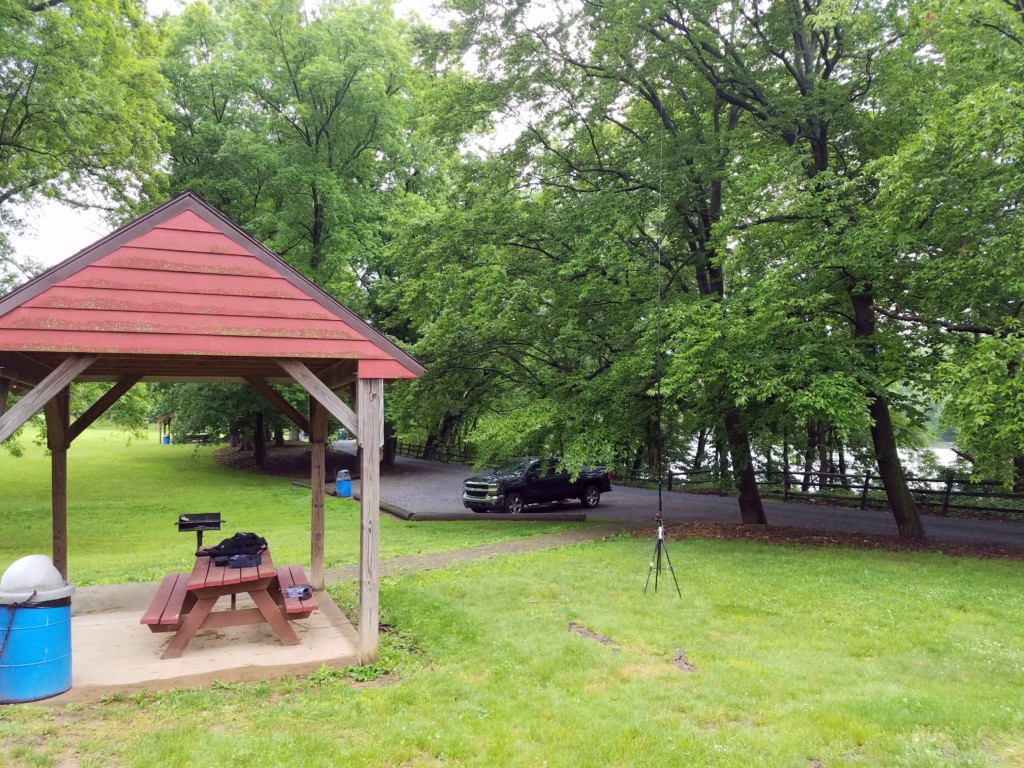
My operating location on a cloudy and rainy morning

It took less than 5 minutes to set it up.  I used an antenna analyzer to take some initial measurements.  On both 20 and 30 meters, the resonant frequencies were low and fell outside the band.  I still have some work to do there.  On 20 meters and up, the KX3’s tuner loaded it up easily.

The antenna matching unit. The red jumper is used to change bands.

Next, I wanted to put it on the air.  I started on 40 meters and used the KX3’s tuner to tweak the SWR.  I called CQ a few times and eventually got a call from K4ALE in Virginia.  Bevin said I was 559 with QSB.  Despite the poor band conditions, we had a nice chat.

After I signed with Bevin, I set the antenna for 30 meters and kicked in the KX3’s tuner.  I called CQ and was quickly answered by NN4NC in North Carolina.  Jim gave me a 569.  At times, the band would fade to just about nothing.  As I was chatting with Jim, some drizzle started blowing in under the pavilion where I was sitting.  So I signed with Jim and quickly packed up.

I’ll be doing some adjustments to the antenna over the coming weeks.  It looks, though, that this could be a useful portable antenna, once I get the loading coil straightened out.

Since this is a work in progress, I left out the details for now.  After I get the antenna working as intended, I’ll provide a detailed description, schematic and parts list in a future post.

72, Craig WB3GCK
Drive-on Portable Antenna Support

[This is an updated description of the drive-on antenna support that I have been using for many years.  This version originally appeared in the July 2016 edition of QRP Quarterly in the “Idea Exchange” column and most-recently  in the October 2024 edition of Radio ZS, The Journal of the South African Radio League.  You can still find the older article here.  A revised, “step-by-step” version appeared in ARRL’s On the Air Magazine (May/June 2024 edition). ]

Here’s a simple, inexpensive drive-on mast support that I have been using for more than ten years now.  It’s been particularly handy for quick trips to the field, such as National Parks on the Air (NPOTA) activations.

Over the years, telescopic fiberglass poles have become popular as portable supports for lightweight antennas.  Two popular suppliers of these collapsible poles are Jackite (http://www.jackite.com/) and SOTABeams (http://www.sotabeams.co.uk/).  I typically use my 31-foot Jackite pole to support a vertical wire along the outside of the pole.  I have also used them to support lightweight dipoles and a variety of end-fed wire antennas.

One trip to your local hardware store will get you everything you need for this project.  To support a 31-foot Jackite pole, here’s what you’ll want to buy:

  • 1-1/4 inch floor flange
  • 18-inch length of 1-1/4 inch threaded steel pipe
  • (4) 1/4-20 x 1-1/2-inch flathead bolts
  • (4) 1/4-20 nuts
  • (4) 1/4-inch flat washers
  • (4) 1/4-inch lock washers
  • 18 to 24-inch length of 1×8 lumber (I used a piece of maple.  A piece of 1×6 lumber would also work)

[NOTE: I’ve heard that the dimensions of newer Jackite poles may be different. Use the dimensions given here as a general guide, and be sure to double-check the dimensions of your particular pole before buying materials.]

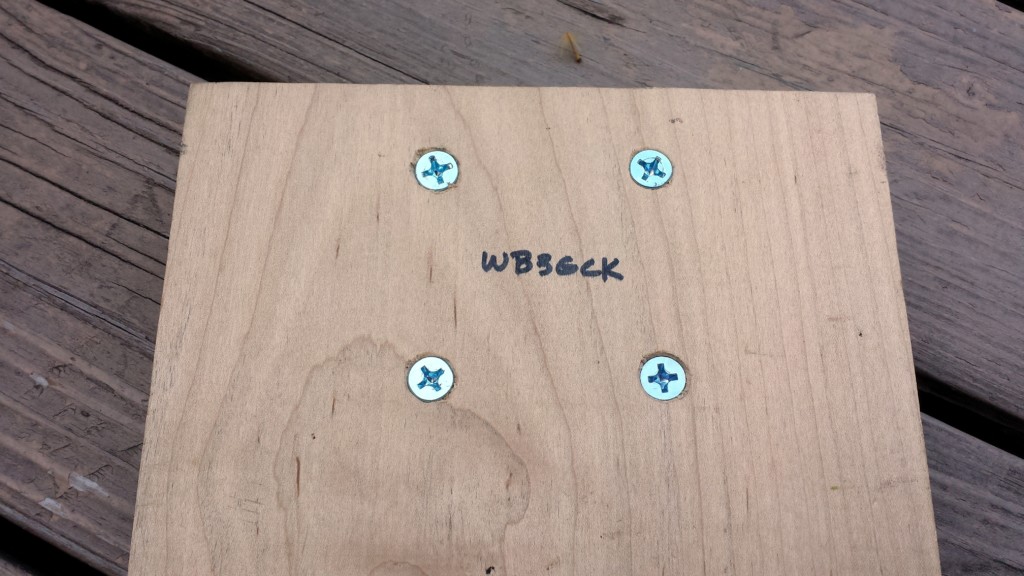
Figure 1. Drill 4 countersunk holes for the floor flange at the end of the board.

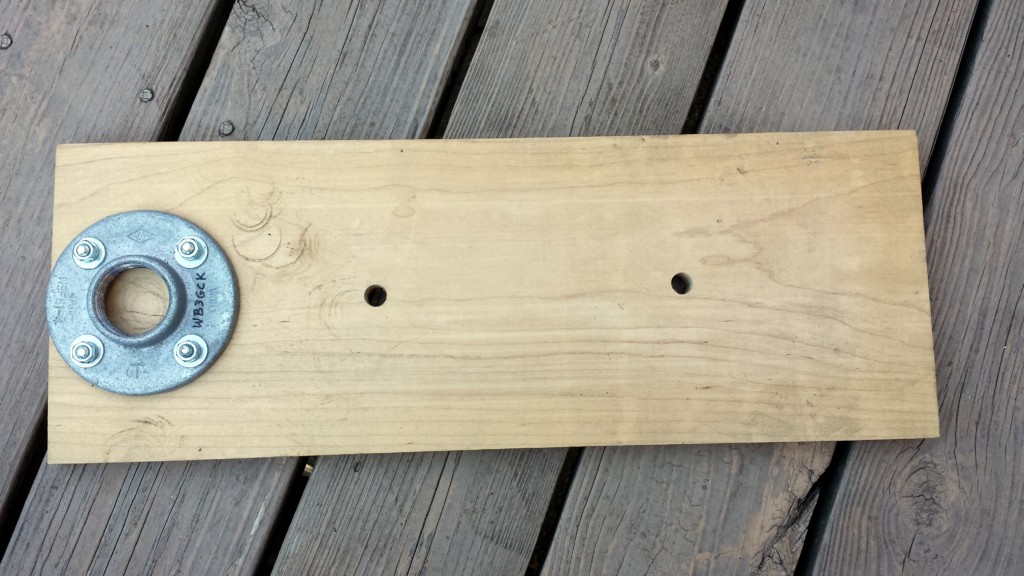
Assembly is pretty straightforward.  Drill four holes to mount the flange to the board.  The flathead bolts go in from the bottom.  You need to countersink the bolts so they will flush with the bottom of the board.  Attach the flange with the flat washers, lock washers and nuts.  That’s about it.

Figure 2. Here is the floor flange mounted on the board.

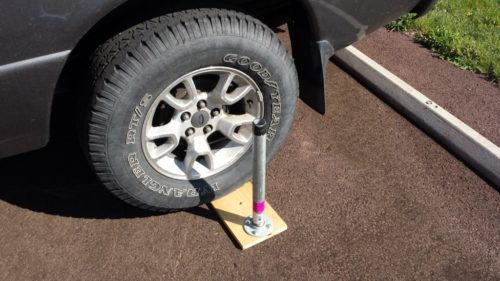
To use the mount, I just set it on the ground and run one of my vehicle’s tires up on it.  Next, I screw the threaded pipe into the flange.  Once the pole is fully extended and the bottom cap removed, I just slide the pole over the pipe.  For my 31-foot Jackite pole, I use a little electrical tape on the pipe to give a snug fit.

Figure 3. Drive onto the mount and screw in the pipe.
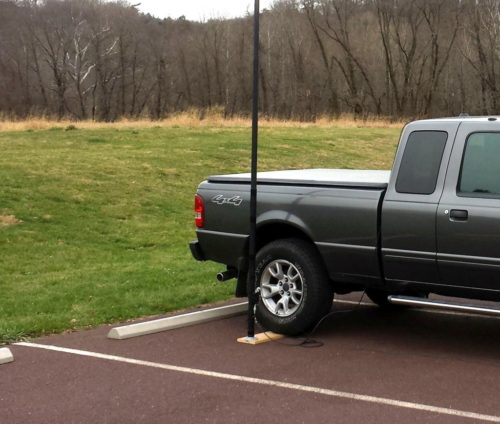
Figure 4. Drive-on mast in use supporting a vertical wire.

You can also adapt this for other size poles.  For my 28-foot Jackite pole, for example, I use a 1-inch pipe.  For my 20-foot Black Widow pole (https://www.bnmpoles.com/), I use a 3/4-inch pipe.  You can buy reducers (adapters) in the plumbing department that will allow you to use the smaller diameter pipes with the 1-1/4 inch flange.  If you only use one particular pole, you can always buy a smaller flange and build your mount with that.

This design is more than sufficient for a lightweight, telescopic fiberglass mast. If you need to support something heavier, like a steel mast, you’ll need a more robust support than this.

DE WB3GCK

MS2 Straight Key Magnetic Mount

As I mentioned in an earlier post, I bought the little American Morse MS2 straight key intending to somehow magnetically attach it to the clipboard I use for portable operating.  It took some thinking but I came up with a workable solution.  I might come up with a better solution in the future but, for now, it should suffice.

What I set out to do was build a wooden mount that could attach the MS2 that held two magnets that lined up with the steel washers on the clipboard.  I had a couple of “super magnets” that I planned to use.  The problem I ran into is that the magnets are almost too strong to attach directly to the washers.  My solution was to enclose the magnets within the wood base.

Super magnets used for the MS2 straight key magnetic mount. Boy, these things are powerful!
Super magnets. Boy, these things are powerful!

I cut a 1×3.25-inch piece of 1/8-inch plywood.  Then I drilled two 3/4-inch holes just deep enough to fit the magnets.  After placing the magnets in the holes, I glued on a thin wood veneer.  This puts some extra spacing between the magnets and the washers on the clipboard.  After drilling a mounting hole for the MS2, I sprayed on a couple of coats of paint.

MS2 straight key magnet mount wood pieces prior to assembly
Wood pieces prior to assembly

After letting the paint dry, I went to attach the key to the base.  Oops!  I drilled the mounting hole from the wrong side of the mount.  My first inclination was to putty it in and repaint.  However, I decided to leave it there as a constant reminder to always measure twice and drill once!

MS2 straight key attached to the magnetic base
MS2 attached to the magnetic base. Don’t look too closely or you might see the drilling mistake I made.

The mount actually works well.  The concealed super magnets hold the key firmly to the clipboard without the need for excessive force to remove it.  Once I free up some time, I’ll give it a thorough test out in the field.

MS2 straight key mount attached to the clipboard
The finished product

72, Craig WB3GCK