Flight of the Bumblebees (FOBB) has always been one of my favorite QRP contests. Although I didn’t think I was going to be able to participate this year, I managed to get in on the first hour or so of the contest.
My (far) better half and I took our “QRP camper” up to French Creek State Park (PA) for the weekend. I figured we would be packing up and heading home about the time FOBB started, so I never signed up for a Bumblebee number. We ended up packing up most of our stuff in the morning, leaving my ham radio equipment for last. So, I was able to get in a little operating time before we had to vacate our campsite.
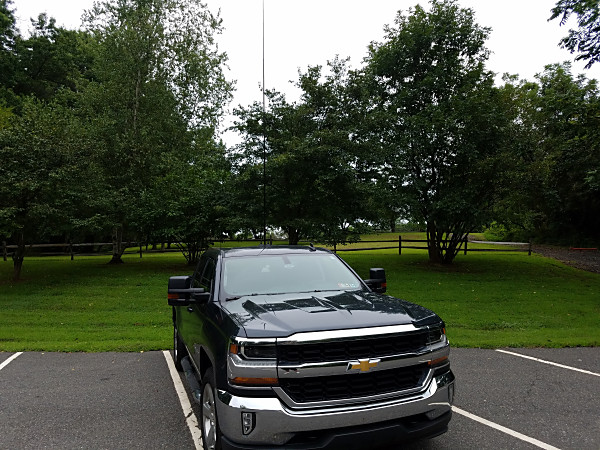
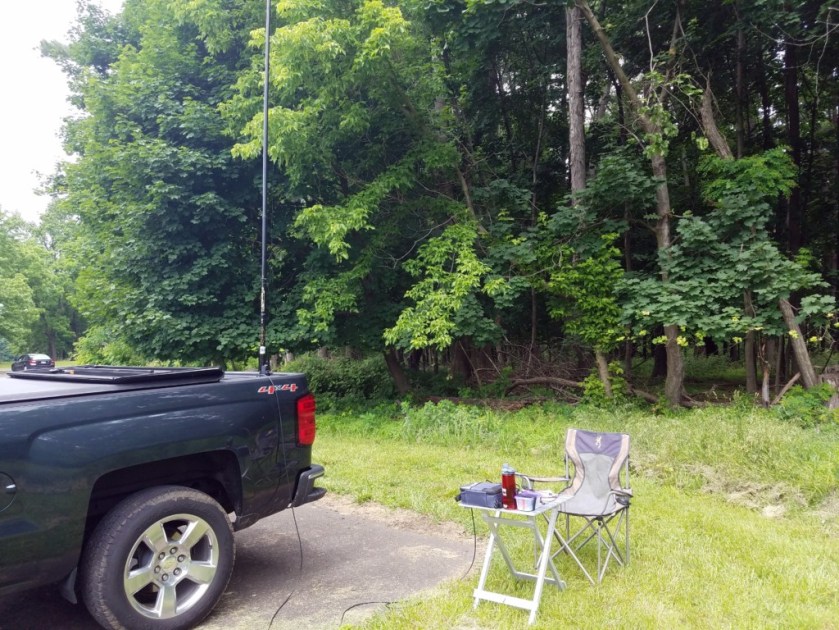
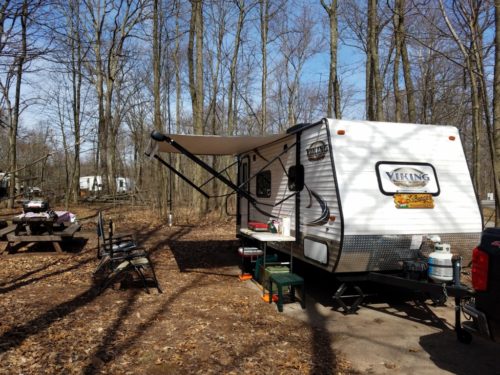
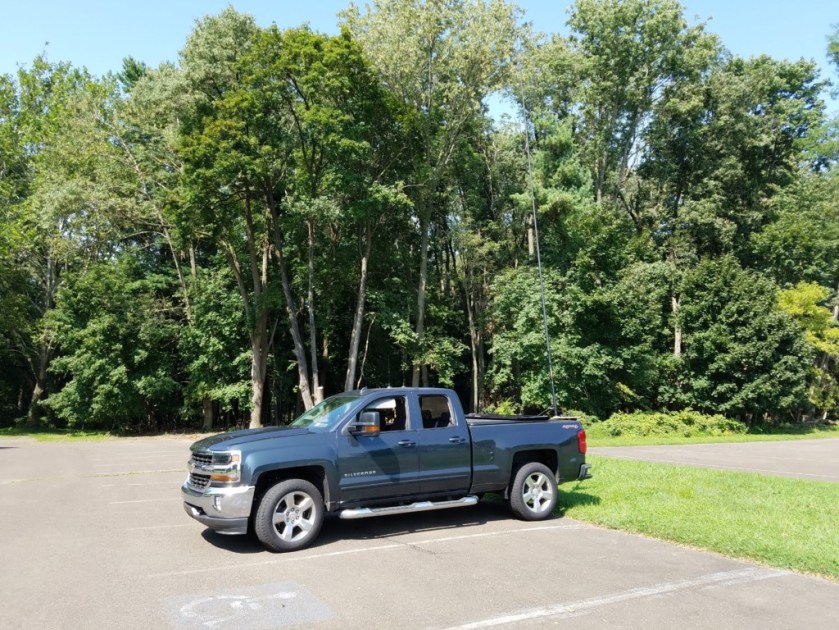
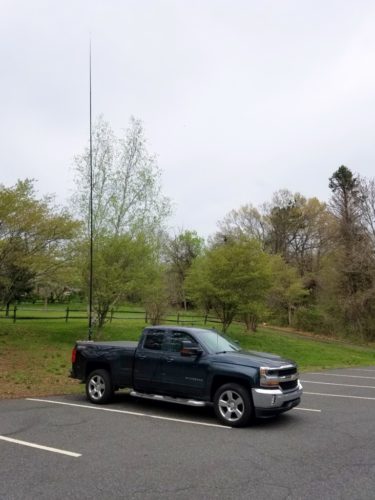
The WB3GCK “QRP Camper” at French Creek State Park near Elverson, Pennsylvania. The Jackite pole supporting my 29-foot vertical wire can be seen on the right in the photo.
Without a Bumblebee number, I operated as a “Home” station, despite being portable. Although the bands seemed a little weak, my hour of work yielded 8 contacts, including 6 bumblebees. One of the highlights was working Ed WA3WSJ who was using the Boschveldt QRP Club callsign, W3BQC. Ed hiked up to Pulpit Rock on the Appalachian Trail for the event. Having operated as W3BQC during Field Day several times over the years, it was fun to be on the other end for a change.
Hopefully next year I’ll have more time to spend in the contest.
My setup in Valley Forge National Historical Park. I lasted about an hour before I had to seek some shade.
I alternated between making SKCC contacts and checking the IFRE calling frequencies. Most of my contacts were with SKCC stations on 40M. I didn’t hear much activity on 20M but I did make a 2-way QRP SKCC contact with Bobby AK4JA. Bobby was running a crystal-controlled tube rig and had a nice signal into Valley Forge.
After about an hour, the heat was starting to get to me and the static crashes from nearby storms were deafening. I moved my rig into the truck to get out of the direct sun and checked around 7.035 for IFRE stations and heard Dave W3DET calling CQ. I had previously worked Dave in the last IFRE and, as luck would have it, he is also an SKCC member. Two for the price of one.
After two hours or so, the static crashes were giving me a headache, so I packed up and headed home. I needed to get a few things together for a public service event the next day. I ended up with 10 SKCC contacts and the IFRE contact with W3DET.
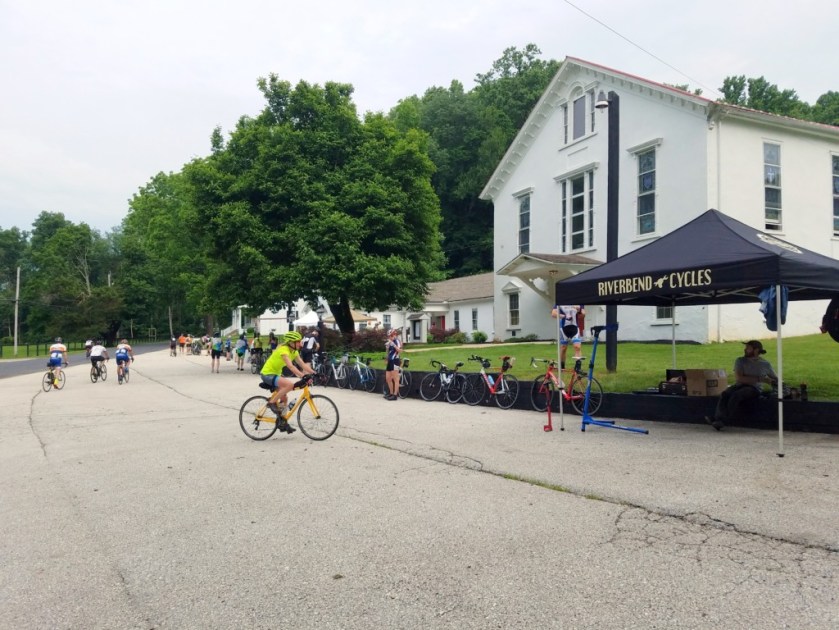
On Sunday, I wrapped up my weekend supporting the French Creek Iron Tour with my local ARES-RACES group. The Iron Tour is a charity bike event benefiting the French & Pickering Creeks Conservation Trust. This year, I provided communications for a rest stop in historic Yellow Springs, Pennsylvania. Fortunately, the rain held off until I finished up and there were no major issues to deal with.
The French Creek Iron Tour rest stop in Yellow Springs, Pennsylvania.
Unfortunately, I was once again unable to participate in was the annual Cookie Crumble Contest due to a conflict with the bike event. Hopefully, I’ll be able to participate in this fun QRP contest next year.
There’s an old saying that goes: “Even a blind squirrel finds a nut once in a while.” I think that was the case for me 23 years ago.
As I was submitting my meager entry for last week’s QRP to the Field (QTTF) Contest, it made me think back to the very first QTTF contest in April of 1995. I’ve never considered myself a serious contester; not by a long stretch. Somehow, though, I actually placed 1st overall in the NorCal QRP Club’s inaugural QTTF. I actually did it with a most unlikely setup, too.
My 1st place certificate from the first-ever running of the QRP to the Field Contest in 1995
A local ham, Rolf N3LA (SK), graciously allowed me to operate my modest QRP station from his rural property. I operated from my truck with my antenna supported by one of Rolf’s trees.
My antenna was simply a 40M inverted vee that I made from #22 stranded hook-up wire. I fed it with about 30-feet of RG-174 coax. The center of the antenna was only about 12 to 15 feet high. One end was tied off to a bush about 4 feet off the ground. The other end ran into a fenced-in area that was home to a ram with a bad attitude. I had to wait until the ram was otherwise pre-occupied to tie-off that end of the antenna. That end was only a foot or two off the ground.
My rig was a Small Wonder Labs SW-40 running 950mW. This was from the first batch of kits offered by Dave Benson’s (K3SWL) former company. I was also using a keyer built from an old NorCal kit, which used the classic Curtis keyer chip. I used a set of paddles that I had cobbled together from stuff in my junk box. The whole station was powered by a 7 A-H gel cell battery that was almost as big as the rest of the equipment combined.
Some of the equipment I used for the QTTF Contest in 1995. The SW-40 and NorCal Keyer are packaged in LMB enclosures. My “Junkbox Paddles” are on the right. I made a lot of QSOs with this setup in years past.
Over the course the afternoon, I worked a steady stream of QRPers. I was in QRP heaven. Even Rolf, who was monitoring from inside his house, was amazed at the number of contacts I was producing with less than a watt.
QRP to the Field 1995 - WB3GCK (950mW)
40M CW
-----
1615 K4XY VA
1641 WA9MTO MD
1646 KG8FL OH
1653 KI2L MA
1655 VE3VAW ONT
1659 W2RPH NJ 1W
1701 K2SJB NY
1706 VY2MP PEI
1710 N1OZL MA
1715 VY2MP PEI (DUPE)
1723 WQ1T NH
1728 VE3FRF ONT
1740 KC1FB CT
1743 W3TS PA 1W
1745 AC4WC VA 4W
1749 K1PUG CT 1W
1807 WK8S MI
1810 WA8IBT OH
1827 N7ANT VA
1836 W3EEK PA
1840 W2TFL NY
1841 VE3UWL ONT
1844 KB8GAE OH
1848 AA3GN PA
1851 K2MV NJ
1855 WA0JTL MI
1858 WB8EEL MA
1903 N4JEO VA
1905 NO1E NH
1913 AA2PF NY
1915 K4XY VA (DUPE)
1917 N2CX NJ
1929 AA2NL NJ
1930 AA4YZ/8 OH
2038 W2QUV NY 5W
2048 KD4PUP VA
2050 KT3A PA <1W
2054 KA4GVA VA
2056 W03B MD 250mW
2101 W8MVN OH 4W
2117 AA2WJ NY
2129 KZ4D VA 2W
2137 WA8LCZ MI
2139 AA1EX NH
2141 WQ1F VT 4W
2144 KC1FB CT (DUPE)
2146 K2JT NJ
2204 K0JPL MO
2209 KA3WTF PA 5W
I specifically remember a couple of the contacts. I worked Joe N2CX, who was testing a new antenna over in New Jersey. Joe later mentioned that QSO in an article about his antenna in QRP Quarterly. I also remember working Ernie W8MVN (SK) in Ohio. Back in the day, Ernie ran a pair of phased, full-wave 40M delta loops on top of a 60-foot tower. He called me with an ear-splitting QRP signal that had me scrambling for the RF gain control on my rig. I think my ears are still ringing from his incredibly loud signal.
Even though I only operated on one band with my 950mW rig, I managed to log 46 contacts (plus a few dupes) that day. With my QRPp multiplier, I ended up in first place out of a field of 50 stations.
I haven’t done that well in a QRP field contest since. (I did, however, place 2nd in the New England QRP Club’s QRP Afield contest using the same equipment later that year.) Rather than skill or prowess as a contester, I have always attributed my win to a combination of great propagation and lots of plain old dumb luck.
If your callsign is in the log above, thank you for helping this blind squirrel find a nut!
Boy, if I thought last year’s QRP to the Field (QTTF) contest was rough, this year was even worse. Solar wackiness and high local noise levels teamed up and made for a miserable day.
My (far) better half and I spent our first camping trip of the year at nearby French Creek State Park here in southeastern Pennsylvania. We were in a campsite that we have used many times over the years. Radio-wise, I used my 29.5-foot vertical and 9:1 unun. Since we were having an unusually chilly and windy April day, I wimped out and operated from inside our little travel trailer.
My mobile QRP shack at French Creek State Park. My antenna is in the background near the trees.
In between some beginning-of-the-season maintenance tasks on the trailer, I planned to get on the radio for some QTTF fun. Sadly, there wasn’t much fun to be had. Reportedly, there was a G2-level geomagnetic storm on Friday with effects that appeared to last through the weekend. I haven’t seen the bands that bad in a while. To make matters worse, our little trailer had some larger RVs for neighbors this weekend and all of their electrical doo-dads were causing some horrendous noise levels on the bands. The 40M band was the worst with near-constant S9 noise levels.
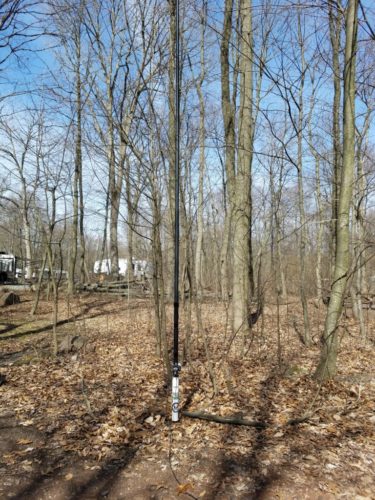
My vertical antenna out behind the trailer
My high noise levels and weak signals on the bands made for a frustrating day. My contacts were few and far between. A few times, I just had to walk away from the rig and do something else. At the end of the day, I had worked only 2 other QTTF stations and 2 International Marconi Day (IMD) special event stations.
My apologies to those who tried to work me and to those who suffered through my requests for repeats. I hope things go better next year.
I braved the chilly temperatures yesterday to operate in the annual Freeze Your B— Off (FYBO) contest. It’s always fun to get out for some QRP-portable but the contest itself left me cold (pun intended).
I went back to the same spot I used for my impromptu outing a few days ago. (Truth be told, I like this spot in the Winter primarily because it’s one of the few local parks that has a year-round Porta-Pottie.) I used my usual setup with the KX3 at 5 watts into my 19-foot vertical on the back of the truck. It was about 30° F outside with a steady breeze. Inside the truck, it was a balmy 35° F or so.
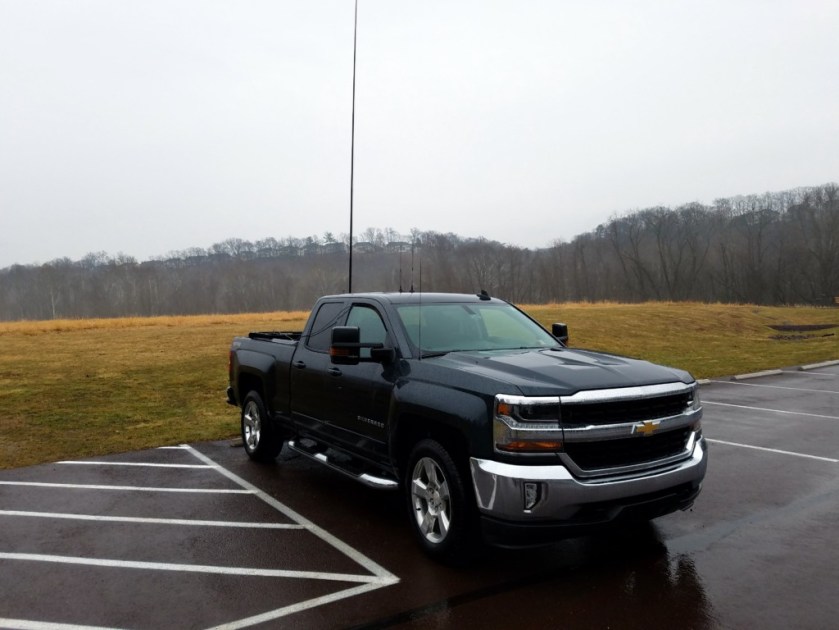
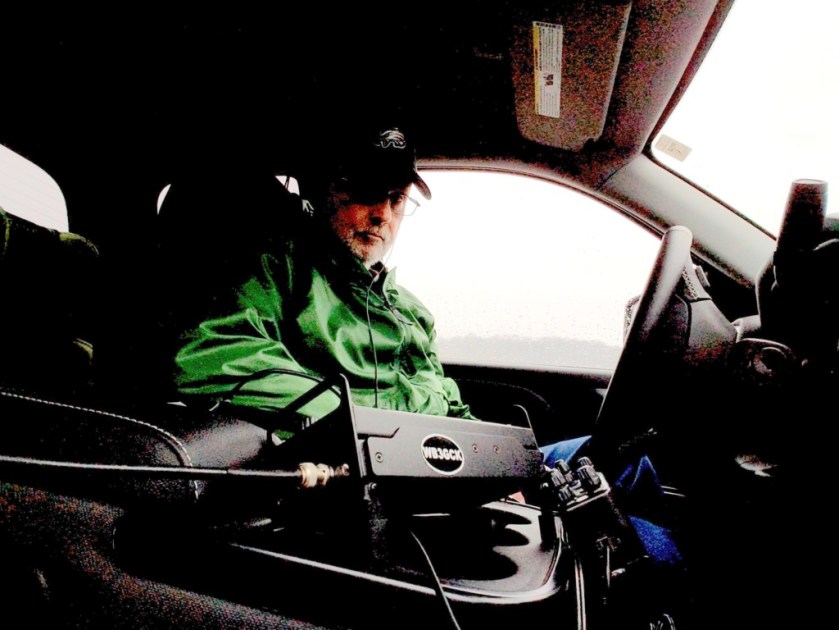
The WB3GCK QRP cockpit. (This picture was actually taken during Winter Field Day.)
There was a lot of contest activity going on but no specific FYBO activity that I could find. I worked several QSO party stations from Minnesota and Vermont. I was pleased with how well I was getting into Minnesota on 40M. I also received a very nice signal report on 20M from K5C, a Space Shuttle Columbia special event station in Texas. I ended up with 10 contacts in the log before my toes started going numb.
But where were the FYBO stations?
Ever since 2016, the FYBO rules include a “Work Anyone” rule. Since you can work other contests or participate in activities such as POTA and SOTA and submit those contacts as FYBO contacts, there’s no real incentive for anyone to actually call “CQ FYBO.” As a result, I didn’t hear a single FYBO station yesterday. For me, this rule takes the fun out of operating in a QRP contest.
Don’t get me wrong; I appreciate that the Arizona ScQRPions take the time and effort to run the contest. It’s just that, for me, part of the fun of a QRP field contest is working other QRPers. In this contest, that’s less likely to happen. In any event, it still gives you a reason to shake off that cabin fever and get out for some portable operating.
I had every intention of doing something special for Winter Field Day (WFD) this year but Life-in-General got in the way. I hadn’t made any particular plans, so I decided to do a little operating from some local parks.
Day One
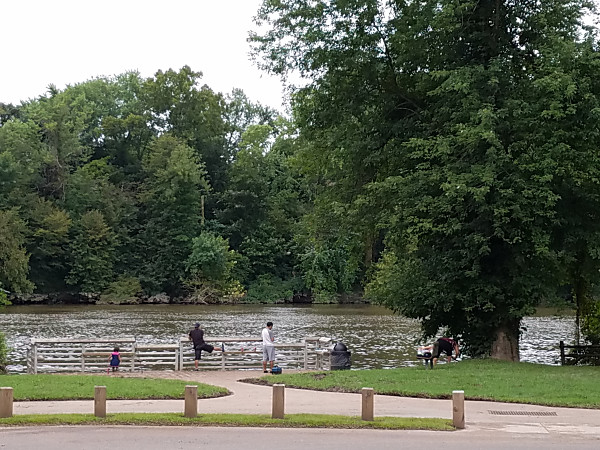
I drove out to nearby Upper Schuylkill Valley Park for a few hours on Saturday afternoon and parked in a spot with a nice view of the Schuylkill River. We were experiencing some above average temperatures this weekend (it was 55° F today), so I actually had my window rolled down.
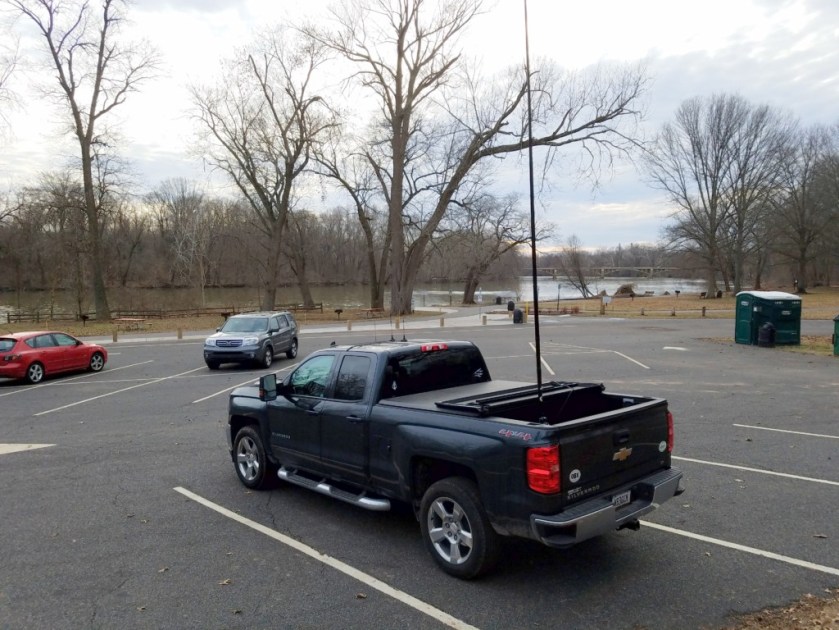
My location at Upper Schuylkill Valley Park for Winter Field Day 2018
I set up my 19-foot vertical in the back of the truck and my KX3 in the cab of the truck just in time for the start of the contest. I operated in the Outdoor category (1O), running QRP CW only.
In just under 2 hours, I logged 21 stations on 40 and 20 meters. Part of that time was spent chatting with a curious passerby. I spent about 10 minutes talking about ham radio with him. After he left, I made a few more contacts before heading home for the evening.
Day Two
What a difference a day makes. On Sunday morning, I operated from Black Rock Sanctuary, just outside Phoenixville. While the temperature was still fairly moderate (47° F), it rained steadily all morning. I had to cover up my antenna components with plastic to keep everything dry.
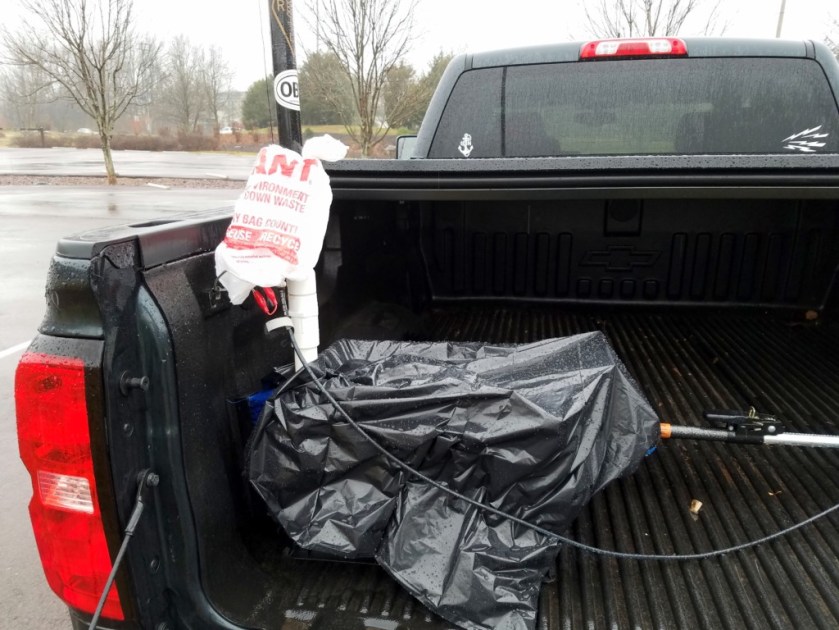
My vertical antenna wearing its raincoat
The 40M band was in pretty good shape, so I spent most of my time there. I checked 20M once or twice but there was another contest going on and I didn’t hear any Winter Field Day CW activity.
Winter Field Day at Black Rock Sanctuary
After about 1.5 hours, I matched yesterday’s effort with another 21 contacts. I even dragged out the microphone (gasp!) and made 4 SSB contacts. One of the SSB contacts was with WW1USA from the World War I museum in Missouri. He was also giving out WFD exchanges.
WB3GCK hunkered down for Winter Field Day on a rainy Sunday morning
Overall, I worked 42 stations in 24 sections and 21 states. I’m certainly not a threat to win but I’m happy with the results of my meager effort. It was great to hear all the CW activity this year.
I didn’t spend a lot of time on WFD this year but it certainly was fun. Maybe next year I’ll do something more adventurous like Winter camping. We’ll see.
This year’s QRP Zombie Shuffle coincided with our last camping trip of the season with our little travel trailer. We wrapped up our camping season in French Creek State Park in southeastern Pennsylvania.
After setting up camp and eating dinner, I spent some time on the radio in search of my fellow zombies. It’s customary to complain about contest band conditions but this year the complaints were justified. I never really heard any strong signals and there was severe fading on the bands.
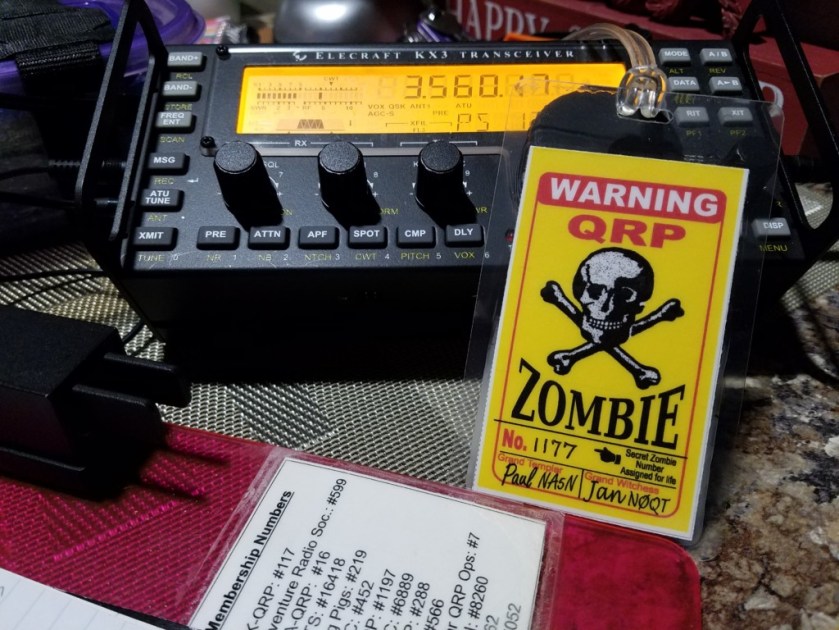
My official QRP Zombie credentials.
Despite the frightful conditions, I managed to log 8 zombies this year. Six of my eight contacts were on 80M. I was using a 29.5-foot wire vertical and 9:1. I’m always amazed at how well this relatively short antenna gets out on 80M.
One of the highlights was working Ed WA3WSJ while he was operating from a shelter on the Appalachian Trail. He was also using the Boschveldt QRP Club call, W3BQC. I’ve made hundreds of Field Day QSOs as W3BQC but this was the first time I have been on the receiving end.
So, another Zombie Shuffle is in the books and it’s time to crawl back into the crypt. I can’t wait to shuffle again next year.
Another NJQRP Skeeter Hunt is in the books. This year, stations operating from Parks on the Air (POTA) entities earned bonus points. So, I did a repeat of last year’s contest and operated from Valley Forge National Historical Park (POTA designator KFF-0761).
I operated from my truck in the Varnum’s Picnic Area of the park. I like this spot because it’s quiet, RF-wise, and has decent elevation. Most importantly, it has a restroom, which is important for us old guys.
In my haste to get set up and on the air, I made a huge mistake by parking in an area without shade. (More on that later.) As I was mounting my 31-foot Jackite pole on the back of my truck, an elderly gentleman approached and inquired about my antenna. He was very curious about ham radio, so after I got set up, I let him listen to some signals on my KX3. After about 10 minutes, he wished me luck and moved on.
My unshaded site at Valley Forge. It’s hard to see, but my 31-foot Jackite pole if mounted is mounted on a bike rack on the back of my truck.
Propagation was weird today. At times, 40M seemed to be very long. I worked stations in Michigan and Wisconsin while struggling to work my friend Carter N3AO down in Virginia. The bands seemed to be up and down all afternoon.
In the course of nearly 3 hours of operating, the sun was baking me and my radio inside the cab of my truck. At one point, the KX3 rolled its power back to 3 watts. I never had that happen before. After rearranging some things, I got the KX3 out of the direct sunlight and things eventually went back to normal.
Towards the end of my operating session, I was struggling to find stations I hadn’t already worked. Since the heat was taking its toll on me and the radio, I decided to pack up and head home.
My lucky Skeeter Hunt t-shirt.
Even though I was wearing my lucky Skeeter Hunt t-shirt, I only ended up with 19 QSOs in the log. Four of those were park-to-park QSOs, though. I didn’t do as well as last year but it was still a fun event. Thanks for Larry W2LJ and the NJQRP Club for putting the Skeeter Hunt together.
I missed the QRP to the Field (QTTF) contest last year due to family obligations. I almost missed it again this year for the same reason. I had some family coming in this weekend but I managed to sneak out for a few hours to make a few contacts.
The theme this year was, “A River Runs Through It.” Stations operating near a river get a higher multiplier for their score. Living near the Schuylkill River, I have a lot of options. I decided to head over to Upper Schuylkill Valley Park, which is one of my regular operating spots.
A view of the Schuylkill River from Upper Schuylkill Valley Park.
The weather forecast was calling for periods of rain throughout the day, so I opted to operate from inside the truck. As it turns out, that was a wise decision. It rained most of the time I was operating.
My “stationary-mobile” set up for QRP to the Field
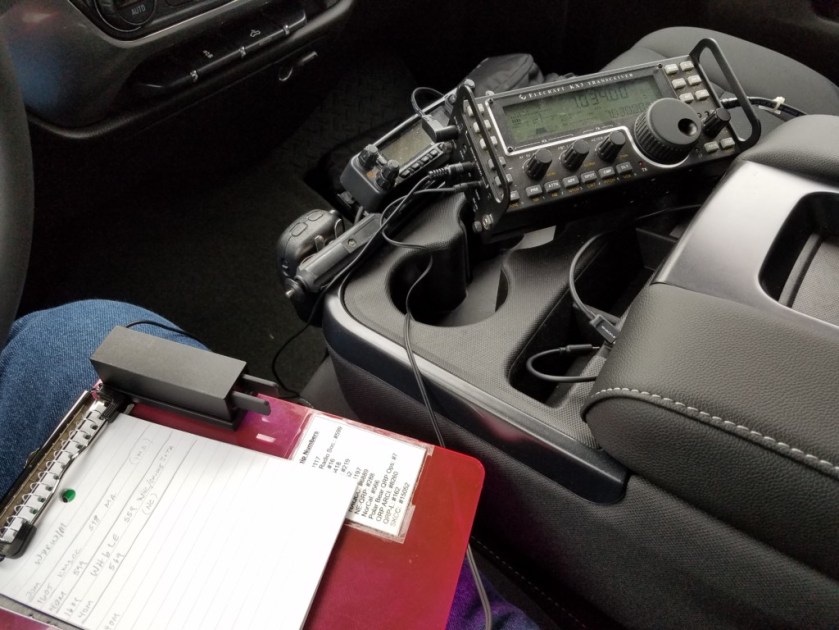
I set up my trusty 30-foot vertical on the back of my truck and set up my KX3 on the center console. I was quickly on the air but I wasn’t hearing much. Between some solar storms and static from the rain, band conditions were pretty lousy.
My operating position in the truck.
After a while, 40 meters opened up a bit. I had a brief run of stations there. Twenty meters remained pretty dismal. I heard W0RW/M out in Colorado early on but could connect with him. I eventually worked Tom K4AKC in Alabama. Besides that, I didn’t hear much of anything on 20 meters.
After about two hours, I had to leave. The rain started picking up, so I quickly took down the antenna and headed home. I ended the day with 10 contacts on 40 meters and just 1 on 20 meters.
As I was packing up, a large group of kayaks traveled down the river.
I sure could have used some better band conditions and weather but, all things considered, I was happy with the 11 stations I managed to work.
Well, there wasn’t much “field” in Winter Field Day (WFD) for me. My XYL and I traveled out to central Pennsylvania for the weekend to babysit our 2-year old grandson. My plan was to sneak out into the backyard for a few hours each day to operate in WFD as category 1O (outdoor). Before the weekend, however, I came down with a wicked cold (courtesy of my other grandson). I decided that operating out in the cold probably wasn’t a good idea.
I strapped my 31-foot Jackite pole to the fence in the backyard and used it to support the far end of my LNR EFT-10/20/40 end-fed halfwave antenna. The feed point was just inside a second story window. I set up my KX3 and operated under battery power. I read over the rules and concluded that I was a “1H” (home) station.
My temporary indoor station for Winter Field Day
After setting up, I had a warm-up QSO on 20M with K0WEW in Kansas. Everything appeared to be working. I operated mostly during nap time (my grandson’s, not mine). With just a couple of hours of actual operating, I ended up with 20 CW Winter Field Day stations in the log. I’m sure I could have logged more if I had plugged in the microphone. I just couldn’t bring myself to do that.
Outside of the contest, I worked TM1A (France) in the REF Contest (on 40 meters, no less). I also had a nice two-way QRP QSO with W4MQC. Alan was operating portable from New Hampshire.
Even though it wasn’t much of a Field Day for me, it wasn’t without some excitement. At one point, all the signals on 40 meters suddenly dropped way down. I looked out the window and saw that the wind caused my Jackite pole to collapse putting half of my antenna on the ground. My halyard line got caught between two sections of the pole when it collapsed. It took me about 30 minutes to get that mess straightened out.
My hat goes off to all the hardy hams who braved the cold for Winter Field Day. Hopefully, next year I’ll get out there, too.