POTA/WWFF & WES at Marsh Creek

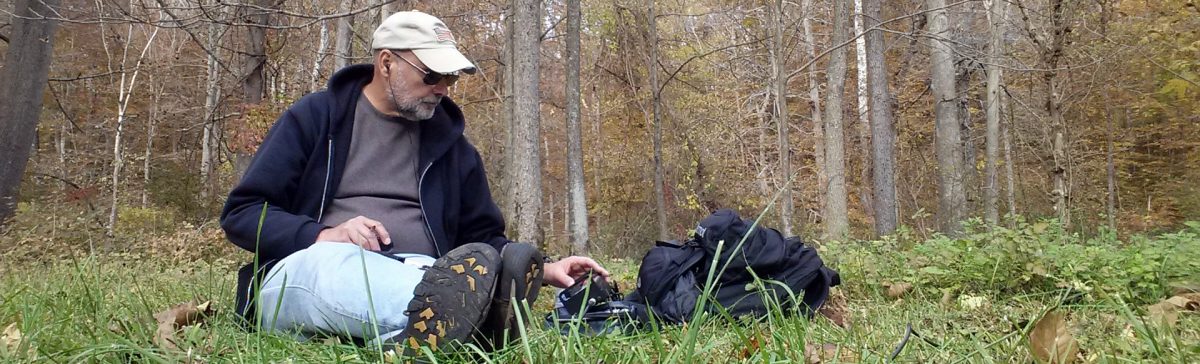
I was out of town this past week puppy-sitting my grand-dog recovering from surgery. Although I brought my KH1 along, I didn’t have an opportunity to use it. Today was the first day I could get in some radio time. Since I hadn’t been there in a while, Marsh Creek State Park (US-1380, KFF-1380) seemed like an appropriate destination. 

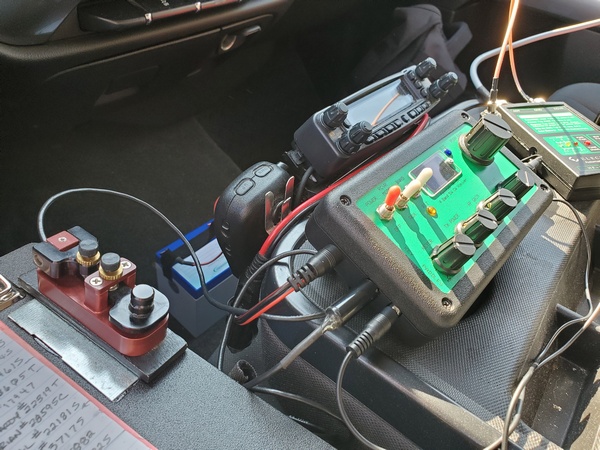
My (far) better half and I had plans for the afternoon, so I got an early start. The weather was somewhat dreary with some occasional drizzle, so the park wasn’t very crowded. I hunkered down in the truck with my usual Penntek TR-35 and 12-foot loaded whip.
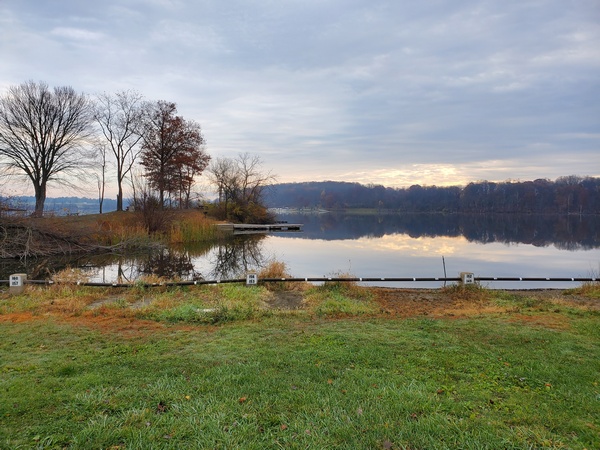
Marsh Creek Lake on a hazy morning

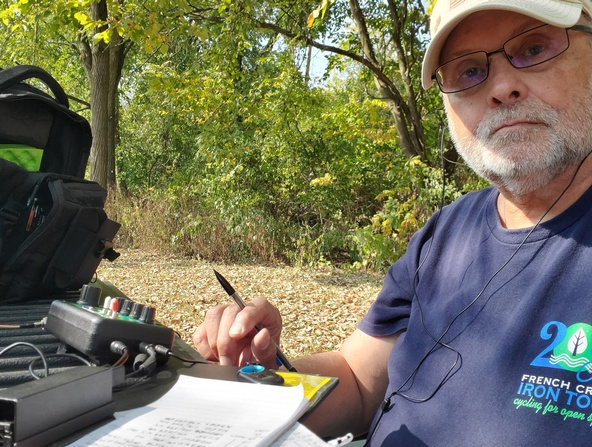
As is my custom, I started on 40M. Since the Straight Key Century Club’s (SKCC) monthly Weekend Sprintathon (WES) was in progress, I grabbed my straight key and worked a half-dozen SKCCers. One thing I love about the TR-35 is that it has separate inputs for paddles and straight key, and you can switch between the two at will. That’s perfect for mixing SKCC and POTA/WWFF.

I started calling CQ on 40M and worked 13 POTA/WWFF hunters before a digital station started transmitting on top of me. Right about then, it started raining, so I grabbed a plastic bag to protect my loading coil. From that point on, I stayed on the WARC bands, picking up some more contacts on 30M and 17M. 
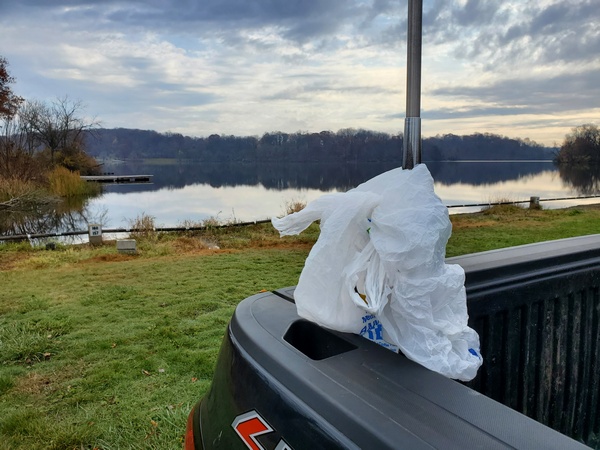
My loading coil protected rom the rain

After an hour and 10 minutes, I had logged 35 contacts. The bands seemed to be in decent shape, although there was some static from storms along the east coast. Despite the occasional noise, I had contacts with both California and Poland on 17M. 

Although it was another of my typical short-duration activations, it was great to get back on the air. And I’m happy to report that my grand-dog is recovering nicely and doing great.

72, Craig WB3GCK

Skeeter Hunt 2025

Once again, the NJQRP Skeeter Hunt contest coincided with our annual family vacation to the Outer Banks of North Carolina. I’m certainly not a hardcore contester, but I wanted to set aside some time to make a few contacts from North Carolina. Although our rental house was beautiful, it presented some challenges for ham radio.

WB3GCK operating in the NJQRP Skeeter Hunt contest
Operating in the NJQRP Skeeter Hunt contest

After a long drive down and all the unloading/unpacking the day before, I didn’t feel like getting too crazy putting up an antenna. Although this was our first time in this rental house, I had a good feel for the layout from online research. 

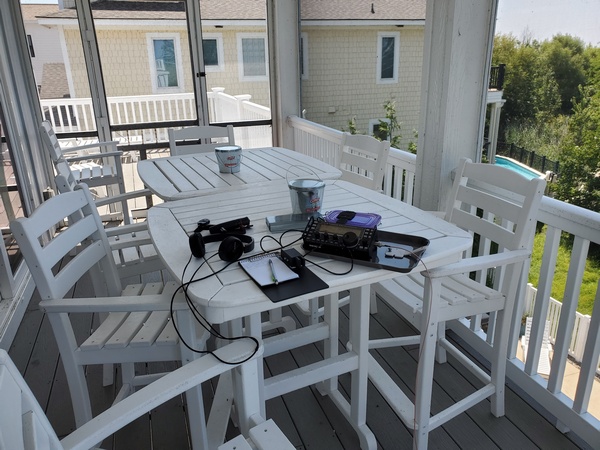
My "shack" for the week
My “shack” for the week

My previous experience has shown that these rental properties come with a lot of RF noise, both from within the house and from neighboring houses. The house this year was no exception. So, I stayed away from vertical antennas near the house and went with an end-fed random wire sloper.

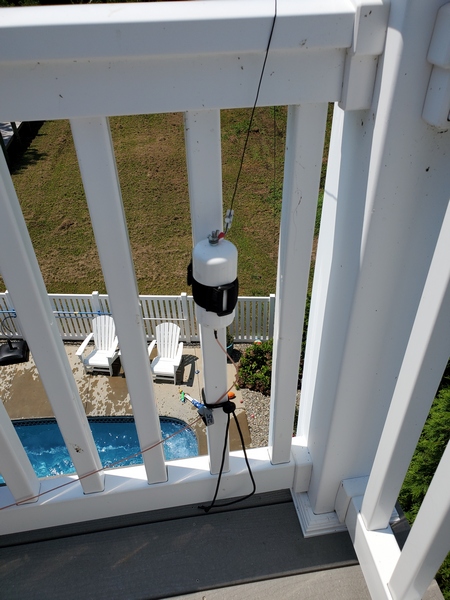
The antenna this year was a 35-foot wire, sloping down from the 3rd-story deck. I fed it through my homebrew weather-resistant 9:1 unun and ran 25 feet of coax into a screened-in porch on the same level. I attached the end of the wire to a fence around the pool area, making sure it wouldn’t get in anyone’s way. The wire was a bit long, so I ran the last two feet horizontally along the top of the fence. 

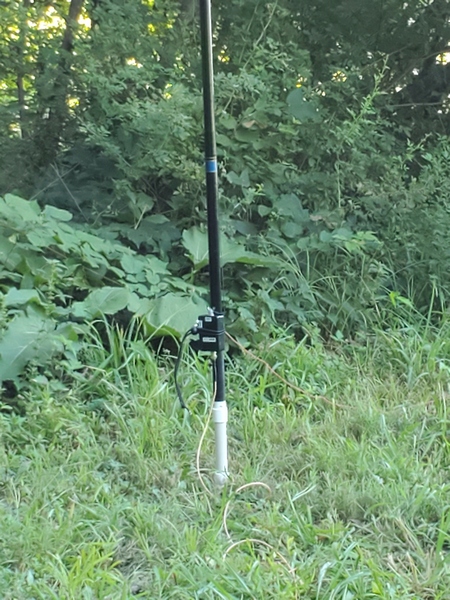
My antenna feedpoint. The far end of my random wire sloped down to the fence by the pool.

I fired up my KX3 and checked the bands. A quick contact with a POTA activator on 40M confirmed it was putting out some sort of signal. The noise on 40M, however, was horrendous in places. The higher bands were better but still somewhat noisy. I hunted four POTA activators while experimenting with the antenna. Two of the contacts were easy, while the other two were tough going. 

I also had to contend with some audio interference from my grandkids having fun in the pool down below. Anticipating this, I brought along a pair of over-the-ear headphones this year. Unfortunately, the headphones were no match for four exuberant kids. 

Once the contest started, the noise level on 40M was about S3 in parts of the band, and S5-S7 in other parts. There was also a loud noise signal that would slowly sweep across the band from time to time. Despite the noise, I worked four skeeters and one very confused QRO station who wasn’t in the contest. He probably thought I was a POTA activator and couldn’t figure out why I needed to know his power output.

Up on 20M, the noise was lower but still present. I didn’t hear much Skeeter Hunt activity, despite getting some respectable hits on the Reverse Beacon Network. I ended up with a pair of Missouri skeeters in the log. I tried calling CQ on 15M with no luck.

After a little over an hour, I threw in the towel. My operating position was facing west across Currituck Sound, so my nice shady spot was giving way to the afternoon sun. Before I pulled the plug, I had one last contact on 40M with a friend back in Pennsylvania.

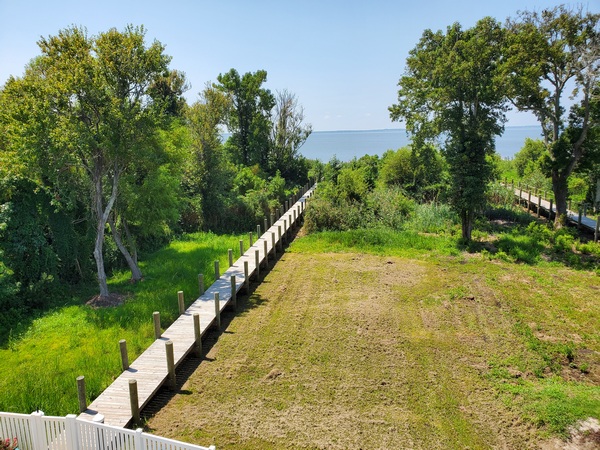
The view from the antenna

So, my 2025 Skeeter Hunt results were less than stellar. Although it was frustrating working through the noise, I still had fun. Plus, the scenery from my temporary “shack” was outstanding.

72, Craig WB3GCK

More Antenna Testing in Valley Forge

In my last post, I talked about using a simple antenna comprising a 15-foot radiator, a 7.5-foot counterpoise, and a 4:1 unun. It worked well, but I found it a little touchy to tune on 40M. Today, I tried the same configuration, but with a slightly longer radiator and counterpoise.

I wanted to add a little length to the radiator, but limit it to 19 feet, so I could still use my lightweight 19.5-foot telescoping pole to support it. Looking at a table of random wire antenna lengths to avoid, it seemed like 18 feet might be a good choice for 40M through 15M, my primary bands of interest. Scaling the counterpoise wire proportionately, I went with a length of 9 feet. 

Just as I was getting ready to cut a set of wires to try out, I stumbled on a video by Thomas K4SWL. In the video, he was using an antenna built by AD8HK that used a radiator length of 17’9” and a counterpoise length of 8’10.5”. I went with those dimensions, since they were very close to what I was considering and seemed to work with Thomas’s KH1.  

On the Air

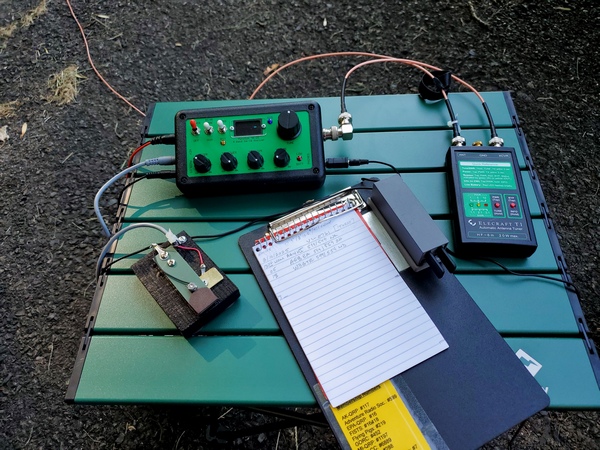
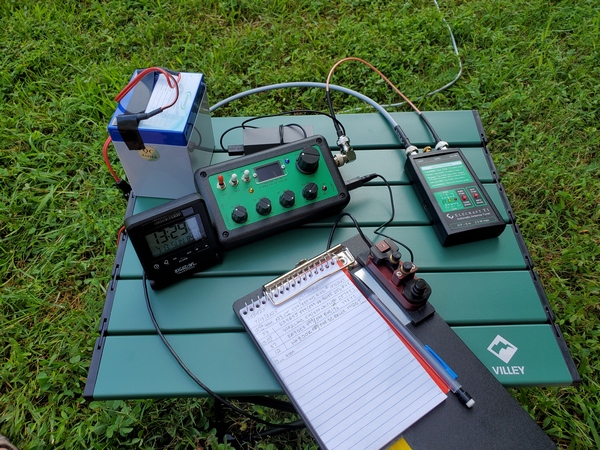
To try it out, I made a quick trip over to Valley Forge National Historical Park (US-0761, KFF-0761). Using the same 4:1 unun and coax as the last time, I made a quick check to see how my Elecraft T1 loaded up on the bands. The tuner quickly found a match on 40M, 30M, 20M. On 17M, however, it seemed to struggle. I went back to 40M and got started with my activation. 

My radio equipment at Valley Forge NHP

This wasn’t the best day to be doing this. The geomagnetic field was unsettled with a K index of 4 and the A index sitting at 47. Nevertheless, the callers showed up, although at a somewhat slower pace than usual. 

After I had 14 contacts in the log, I decided to spend the rest of my limited time playing around with the antenna. When I went back and checked 17M, the T1 tuned it up without flinching. I also rearranged the counterpoise wire so it ran 180 degrees opposite of my coax. Checking the bands again, the T1 reliably matched 40M through 17M. 

My antenna at Valley Forge NHP

Convinced that the new wire lengths work, I went back to the 15-foot radiator and 7.5-foot counterpoise I used a few days earlier. This time, the T1 had no issues loading up on 40M. Go figure! 

I really wanted to give the unun with the smaller ferrite core another shot. When I last tried it with the 15-foot & 7.5-foot wires, neither my KH1 nor my T1 could find a match on 40M. Unfortunately, I neglected to put it in my backpack before I left. I’ll have to save that for another time. 

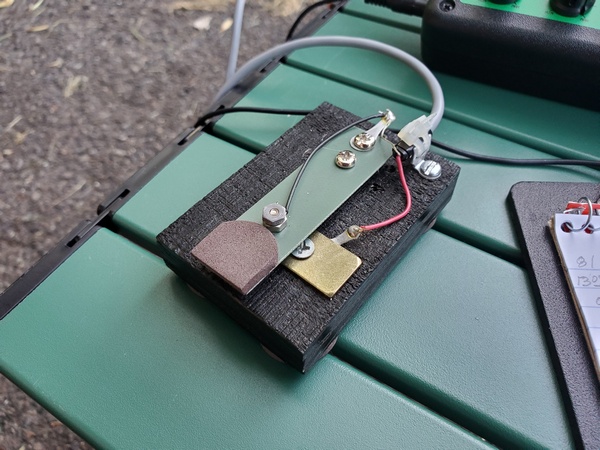
The Straight Key Century Club (SKCC) Weekend Sprintathon contest was going on this weekend, and I worked one SKCC station while tuning around the bands. This month, the WES theme was homebrew keys. In the spirit of the contest, I made the contact using a straight key I built a few years ago from junk box parts. 

My homebrew straight key constructed from odds and ends in my junk box
My homebrew straight key constructed from odds and ends from my junk box

Conclusions

So it looks like both the 15’/7.5’ and 17’9”/8’10.5” configurations are usable with my homebrew 4:1 unun. Given a choice, though, I would probably stick with the longer wires. 

One other thing is clear: short random wires can sometimes be finicky little critters.  When in doubt, rearrange the counterpoise wire.

72, Craig WB3GCK

The Disastrous Flight of Bumblebee 24

Actually, this bumblebee ‌barely got off the ground at all this year. It started off with a heartbreaking rig failure and ended with some horrendous local noise.

I had a late-breaking change of plans this week. I originally planned to operate in the Flight of the Bumblebees (FOBB) contest from a nearby POTA entity. Instead, I ended up in central Pennsylvania helping a family member recovering from a recent surgery.

So, I activated Plan B: take my new KH1 along and make a few contacts from the backyard. What could go wrong with that? A lot, as it turns out.

Using my homebrew ground mount, I set up a new antenna on my lightweight telescopic pole. The antenna comprises a 15-foot radiator and a 7.5-ft counterpoise fed through a 4:1 unun. (More about that antenna in another post.) I ran a 6-foot length of RG-316 coax over to the KH1. 

I easily got a 1:1 match on 20M and up, but it wouldn’t load up at all on 40M. Going back to 20M, I started operating. Something on the display didn’t look right. It turned out that I wasn’t getting any power output. When I pressed the ATU button, I heard some relay clicking, but there was no power or SWR displayed after tuning. When I keyed up, the display showed zero bars of power and one bar for SWR.

I checked to make sure I wasn’t in “Test” mode (I wasn’t). Next, I started pouring through the settings to make sure I hadn’t messed something up. Nothing looked out of the ordinary to me. I tried the built-in whip on 20M, but still no power out.

After spending an inordinate amount of time playing around with the KH1, I packed it up and brought out my Penntek TR-35. My trusty Elecraft T1 ATU also refused to load up on 40M.

WB3GCK equipment set up for the 2025 Flight of the Bumblebees contest

So, 20M was the only band working for me, given the rig I was using. I could have set up a different antenna, but I didn’t have that much time. 

The 20M band had some horrendous local noise, so it was rough going. I worked one bumblebee in Missouri, and that was it. Frustrated with my inability to hear any other FOBB activity through the noise, I called it quits. I needed to get back inside to take care of a few things, anyway.

Having owned my KH1 for less than a week, you can imagine my disappointment. I shot off a message to the support folks at Elecraft, so hopefully, they can help get this issue resolved before I head down to North Carolina on vacation next month. (Fingers crossed)

I hope you all did better in the contest than me.

72, Craig WB3GCK

WES & POTA at Ridley Creek

I made some contacts in the monthly Straight Key Century Club (SKCC) Weekend Sprintathon (WES) this morning and completed a POTA activation while I was at it. My operating site today was Ridley Creek State Park (US-1414, KFF-1414).

I rolled into one of my favorite spots and set up my table and chair in the grass behind my truck. From previous activations, I knew this spot always has lots of shade. Of course, with the heavily overcast skies this morning, sun exposure wasn’t much of an issue. 

I mounted a 17-foot whip and my homebrew loading coil on my truck and ran some coax back to my operating position. Rig-wise, I used my Penntek TR-35 (5 watts, CW), Elecraft T1 tuner and my little American Morse MS2 straight key

WB3GCK's radio setup at Ridley Creek State Park (US-1414, KFF-1414)

My strategy today was to operate in the WES for an hour. If I hadn’t reached 10 contacts by then, I planned to break out the paddles and finish up as a POTA activator. 

It was a good thing I had a “Plan B.” After an hour, I had only scratched together six WES contacts. I don’t know if it was the unsettled geomagnetic conditions or just a lack of early morning participants, but I didn’t hear much WES activity on 40M and 20M. 

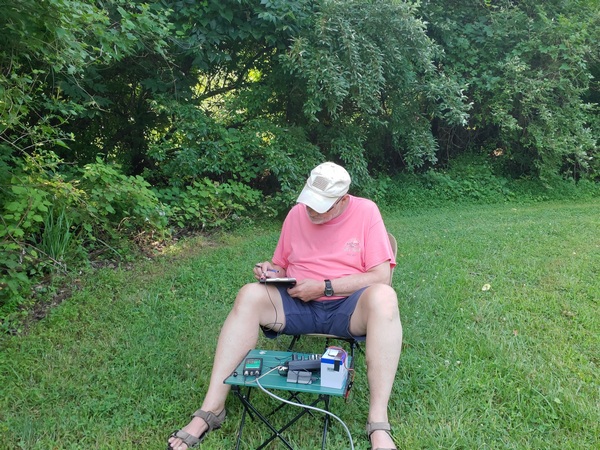
WB3GCK operating in the SKCC WES contest at Ridley Creek State Park (US-1414, KFF-1414)

After spotting myself on the POTA and WWFF websites, I easily made the requisite 10 contacts on 20M plus three more for good measure. One of those contacts was a park-to-park. 

It wasn’t my best outing, but far from my worst. Even with the humid weather and the occasional mosquito, it was nice to do a little outdoor operating and log some familiar SKCC and POTA callsigns.

72, Craig WB3GCK

Zombie Shuffle 2024

The QRP zombies were out and about on the bands last night. I got on the air for some of the annual Zombie Shuffle. This year was a little different experience for me from past years, but it was still fun. 

WB3GCK QRP Zombie credentials

This contest is called a “shuffle” because zombies don’t sprint. It kicks off at 1500 local time, but I usually don’t work too many fellow zombies in the first hour. The 40M band is usually my bread and butter band, however, I made most of my contacts in the first hour on 20M. I kicked things off by working a bonus station and worked about eight total in the first hour before taking an extended break.

I checked the bands again twice after dark, and it was slim pickings for me. There was a constant S3-S4 local noise level on 40M, which made things tough. I managed five more zombies on 40M, but it was rough going at times. From my RBN spots, I was obviously getting out better than I was receiving.

I usually pick up a few zombies on 80M, but not this year. Anyway, I wrapped things up early and submitted my entry to Paul NA5N in time to watch Game 1 of the World Series.

This year I was again running 5 watts from my KX3 into my rain gutter antenna. During exchanges, I used my zombie name, Bones. 

My 13 contacts were a few off from last year’s shuffle, but it certainly wasn’t my worst year either. It’s a silly contest, but I look forward to it every year.

72, Craig WB3GCK

Sprinting in the Park

No, I wasn’t running through the park. I was operating in the Straight Key Century Club’s Weekend Sprintathon contest from a POTA/WWFF entity. I ended up with two POTA/WWFF activations as a result. 

On Saturday morning, I drove over to Norristown Farm Park (US-4363, KFF-4363), which has become one of my favorites. It was pretty chilly when I started, so I set up in the truck. (That turned out to be a poor decision.) I used my Penntek TR-35 (5 watts) and my trusty 12-foot loaded whip. I used my little MS2 straight key for the SKCC contacts.

My setup in the truck on Saturday. My little American Morse MS2 straight key looks unusual but has a great feel.
My setup in the truck on Saturday. My little red American Morse MS2 straight key looks unusual but has a great feel.

My plan was to operate in the WES and only spot myself on the POTA and WWFF websites if I had trouble making my 10 contacts. The band conditions had improved significantly from the severe geomagnetic storms over the previous couple of days, so I was optimistic. 

Starting out on 40M, I was pleasantly surprised to find a bunch of SKCC stations. I worked 13 WES stations on 40M before moving up to 20M to work a few more. SKCC WES contacts come at a slower pace than POTA contacts, so after an hour and 20 minutes, I only had 16 contacts. I was happy with that, though. 

By that time, the temperature had gone up, and the sun was beating down on the windshield. It was really getting hot in the truck, so I pulled the plug and packed up for the day. 

On Sunday morning, I went back to Norristown Farm Park for more of the SKCC WES. This time, I operated from the tailgate of my truck. I rarely do that, because the tailgate is too high off the ground. I had backed the truck up to a slight slope, so my chair was a bit higher than if I had been on flat ground. Still, it wasn’t all that comfortable for keying. I ended using my clipboard on my lap. My equipment was the same as the day before.

Operating from the tailgate on Sunday morning.

This time there was much less SKCC activity on 40M. Despite numerous CQ calls, I only logged four WES contacts. So, I made the command decision to spot myself on the POTA website and switch over to the paddles. The activity picked up dramatically after that.

This time I ended up with 21 contacts, which included three park-to-park QSOs. All together, I made 20 SKCC WES contacts over the weekend, which is not too bad for me. 

I’ll have to try this again for next month’s Weekend Sprintathon. 

72, Craig WB3GCK

POTA Repeat Offender and SKCC WES

The monthly running of the Straight Key Century Club’s Weekend Sprintathon (WES) contest was this weekend. I needed two more activations at Marsh Creek State Park for a POTA “Repeat Offender” award, so I headed out both Saturday and Sunday for POTA/WWFF activations and to make a few WES contacts.

We had some outstanding weather here in southeastern Pennsylvania, so I knew Marsh Creek (US-1380, KFF-1380) was going to be pretty busy. Given that, I headed out early on Saturday morning. I found a parking spot in the boat launch area, but the parking lot was filling up fast. 

My location in Marsh Creek State Park (US-1380, KFF-1380) for a POTA activation and the SKCC WES
My location in Marsh Creek State Park (US-1380, KFF-1380) for a POTA/WWFF activation and the SKCC WES

My trusty Penntek TR-35 was the perfect rig for this weekend. The TR-35’s separate straight key and paddle inputs let me instantly switch between the two without having to make configuration changes in the radio. I also went with my usual 12-foot whip and homebrew loading coil

The separate straight key and paddle inputs on the TR-35 lets me instantly switch between the two. (Note to Self: Clean out your truck!)

The 40M band was alive and well, so I spent most of my time there. I alternated between calling “CQ POTA” with the paddles and searching and pouncing SKCC WES stations with my little MS2 straight key. In about an hour of operating, I logged 26 contacts. Among those were three park-to-park QSOs and six SKCC WES QSOs. 

As great as the weather was on Saturday, it was even better on Sunday. I wanted to attend my grandson’s hockey game, so I went out even earlier this time and kept it even shorter. Even though I got an earlier start than the day before, the parking lot was even more crowded this time around. 

Once again, 40M was in excellent shape, and I ended up staying there for the duration. I logged 19 contacts in about 45 minutes, with three park-to-park and three more WES contacts. Then it was time to head home to take care of a few things before going to the soccer game.

In the end, I didn’t set any records in the WES contest, but I got in the two activations needed for my Repeat Offender award. 

72, Craig WB3GCK

Flight of the Bumblebees 2024

Yesterday was the annual Flight of the Bumblebees (FOBB) QRP contest, a four-hour sprint sponsored by The Adventure Radio Society. It’s been a couple of years since I last took part, so I was glad to get out for a couple of hours this afternoon. Prior to the contest, I signed up to be a bumblebee station and was assigned bumblebee number 82. 

I operated from a picnic area in nearby Valley Forge National Historical Park (US-0761, KFF-0761). There were several picnics in progress, so I headed to an area well away from them. I found a nice shady spot under the trees, where I set up my table and chair. Except for having to swat the occasional bug, it was a comfortable spot.

My operating position under some nice shady trees

My rig was an Elecraft KX3, running 5 watts. I dusted off my trusty homebrew 19-foot vertical and put it to use for this event.

In general, the bands weren’t all that great. Most of the signals I heard were weak, and there was considerable fading on the bands. A few contacts were a real struggle. 

The FOBB activity was surprisingly brisk when I first started, but slowed dramatically as the contest wore on. In about two hours and a half hours of operating, I ended up with 22 contest QSOs. Fourteen of those were with fellow bumblebees. Before I shut down, I came across a POTA station and had a quick park-to-park contact outside of the contest.

Although I was in a POTA entity, I didn’t spot myself or call “CQ POTA.” However, my FOBB contacts were more than enough to complete an activation.

Given the conditions, I did better than I expected. Thanks to those stations that hung in there to pull me out of the noise.

72, Craig WB3GCK

Gone Before the Wind

The weather prognosticators said we’re under a Wind Advisory from midday today through tomorrow. In the best interest of my antenna, I got an early start this morning to avoid confronting the forecasted 45 MPH wind gusts. 

Instead of doing a normal POTA or WWFF activation, I headed down to Ridley Creek State Park (K-1414, KFF-1414) to take part in the Straight Key Century Club (SKCC) Weekend Sprintathon (WES) contest. I haven’t been very active in the WES contests of late, so I focused my attention on that. 

I used my usual Penntek TR-35 transceiver (5 watts CW) and my 12-foot loaded whip antenna. I also used my little American Morse MS2 straight key. The MS2 is an unusual-looking key, but I’ve really grown to love it over the years. I did some earlier posts on the MS2 and the magnetic base I built for it.

My little MS-2 straight key attached to my clipboard with a homebrew magnetic base I made for it
My little MS2 straight key attached to my clipboard with a homebrew magnetic base I made for it

Most of my operation today was on 40M. I split my time between calling CQ and search-and-pounce. The WES contests are rather laid back, compared to a typical POTA activation. The WES QSOs come at a much slower pace. I didn’t log my 10th contact until about 45 minutes in. 

As I was making my tenth contact, it started raining. So, I grabbed a plastic bag and went back to wrap up my loading coil. It was only a passing shower, so I removed the antenna’s “raincoat” a short while later. 

The "raincoat" I fashioned to protect my loading coil from the rain
The “raincoat” I fashioned to protect my loading coil from the rain

I ended up this morning with 15 contacts in my log. Thirteen were with SKCC stations, and two were POTA park-to-park contacts. I also worked KS1KCC, the SKCC club station in Michigan, on both 40M and 20M. 

This was a fun change of pace today, and I added a few new SKCC numbers to my log. 

72, Craig WB3GCK