Sometimes, you just have to be flexible. Originally, I had planned to do some bike riding today and experiment with a bike mount I cobbled together for my Elecraft AX1 antenna. However, Mother Nature decided to throw some freezing temperatures at me today. Instead of a cold bike ride, I opted for a more comfortable “stationary-mobile” POTA activation.
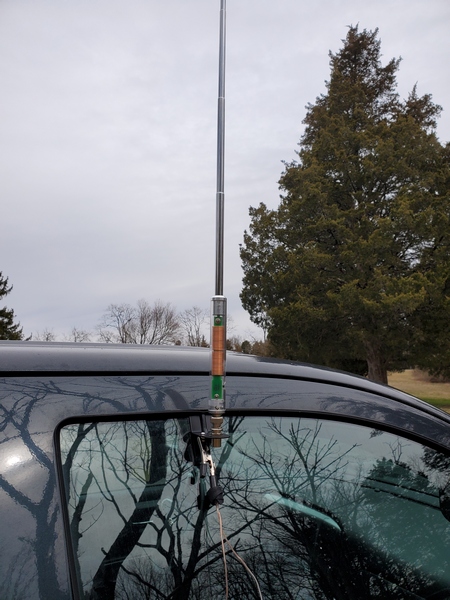
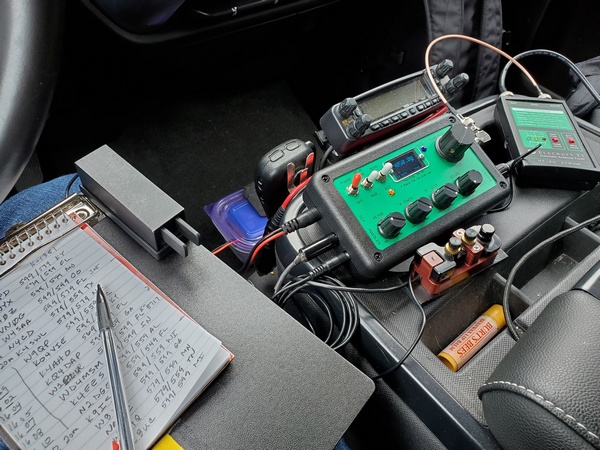
I loaded up my gear and made the quick trip to nearby Evansburg State Park (K-1351). My setup today was similar to the one I used a couple weeks ago. I used my AX1 antenna on a window mount. The rig today was my PennTek TR-35 (5 watts), coupled with an Elecraft T1 tuner. The TR-35 limited my operation to the 20M and 17M bands. With this simple setup, I was on the air within a couple of minutes of arriving.
My window-mounted AX1 antenna
Contacts on 20M came as easily today as my last activation with the window mounted AX1. I had my first 10 contacts in about 15 minutes. I was pleased to get a call from K4SWL down in North Carolina. Thomas has a bunch of recent posts on the AX1 over at qrper.com. Of course, I had to let him know I was using an AX1 today.
The organized chaos in the cab of my truck, which includes my PennTek TR-35 and Elecraft T1 ATU.
After logging 20 contacts on 20M, I changed over to 17M. I didn’t have as much luck, but I made four contacts there. After that, I went back to 20M to make a couple of park-to-park contacts. My last contact was with WA3GM. Greg is a local ham who is spending some time in Florida and was activating a park down there.
I shut down after an hour of operating with 26 contacts in the log including 3 park-to-park contacts.That exactly matched the results from my last activation with the AX1. This little antenna never ceases to amaze me.
Hopefully, we’ll get some more moderate temperatures this week, so I can finally get that bike ride in.
Recently, Thomas K4SWL over at QRPer.com featured an excellent guest post from W2AEW describing a car window mount Alan built for his Elecraft AX1 antenna. Inspired by Alan’s post, William KR8L, did some experimenting and came up with his own window mount. These folks got me thinking—a dangerous thing, sometimes.
I remembered a commercially made window mount I bought 25+ years ago. (I think it came from RadioShack, but I’m uncertain of that.) Back then, I was traveling for work a lot, and I usually took my old RadioShack HTX-202 HT along with me. When I was using a rental car, I used the window mount with a rubber duck antenna. When parked, I used a 2M half wave telescopic antenna on it. I hadn’t used it—or seen it—in years. It was somewhere amongst the miscellaneous stuff acquired over my 48 years in ham radio.
It took a little searching, but after rummaging through some old parts, I found the old window mount. The mount is made of steel with a female BNC connector on it. It also has six feet of RG-58 coax attached. The coax is more than enough to reach the center console of my truck from the passenger side window.
The old window mount I resurrected from the junk box. The bolt next to the BNC connector is something I added.
The next task at hand was to figure out a way to connect a counterpoise wire to the mount. The steel mount has a black coating on it, which electrically isolated the BNC connector from the mount. To resolve that, I removed the BNC connector and used a rotary tool to remove some of the coating around the mounting hole. Then, I drilled a hole for a small bolt that I could use as a place to attach an alligator clip for the radials.
I already had an Elecraft AX1 antenna that I bought years ago when they first came out. I usually carry it in my backpack as a backup antenna, but I really haven’t used it very much. So, I guess it’s time to put it to use.
To see how this setup worked, I drove over to nearby Valley Forge National Historical Park (POTA K-0761) for a brief activation. Along with the AX1 on the window mount, I used two 12.5-foot radials. I have to admit it was nice being able to deploy an antenna in less than a minute.
My AX1 deployed on the window mount with two radial wires clipped on.
Back in the truck, I fired up my KX3 running five watts. I was prepared to crank the power up to 10 watts, if need be, but that proved unnecessary. Within a minute of spotting myself, the calls started coming in. The signal reports were decent, and I was seeing some strong hits on the Reverse Beacon Network. It took all of 12 minutes to make my prerequisite ten contacts.
In less than an hour, I had 14 contacts on 20M, nine on 17M, and three on 15M. Among those 26 QSOs, I had one park-to-park contact with a station in Quebec. At one point on 17M, I had a DX station calling. I believe it might have been Italy, but I just couldn’t pull out the entire callsign. My apologies to that station, wherever they were.
The AX1’s performance was a pleasant surprise. Although it has been in my antenna arsenal for a few years now, I really haven’t given it a serious test. Well, that changed today. It has proven itself to be a worthy antenna choice, when a larger antenna is impractical.
Thanks to W2AEW and KR8L for inspiring me to dust off my old window mount and put it to good use.
During my last POTA activation, the eyelet at the top of my trusty 20-foot Black Widow telescopic pole snapped off. This pole has served me well for over 25 years, so I can’t blame the pole. The Black Widow poles are still available from the manufacturer, so I could have just bought a new one. But hey, what fun would that be?
After staring blankly at the broken pole for a while, I rummaged through my stash of parts and came up with an easy fix. I found a small ring terminal that fit snugly over the top of the pole, so I just glued it on using some Loctite outdoor adhesive. In keeping with my usual practice, I added a small key ring (split ring) to the eyelet replacement. (For more on the rationale for the split ring, check out this post.)
My quick and dirty replacement for the broken eyelet on my Black Widow telescopic pole. I simply glued a ring terminal to the top section of the pole.
Well, that was easy enough. Hopefully, this silly little hack will squeeze 25 more years of use left in this old pole. It probably won’t, but a guy can dream, right?
We arrived on Saturday, after a long drive from southeastern Pennsylvania. After unloading and getting organized in the house we rented in Corolla for the week, I went outside and set up an antenna.
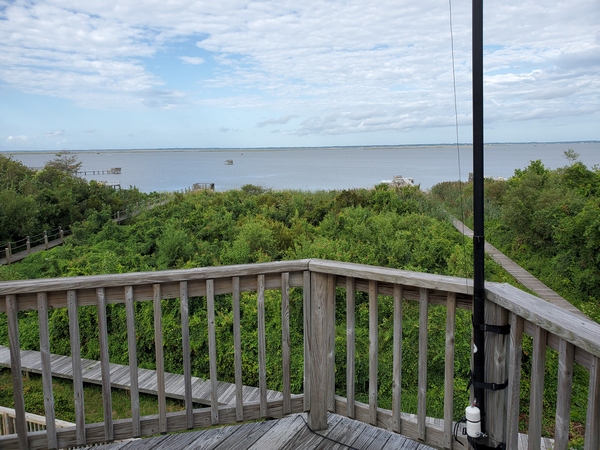
Currituck Sound, as seen from my antenna.
For the past two years at this house, I used a 29-foot vertical fed through a 9:1 unun. During both trips, I struggled with noise issues. I had a couple of antenna options I wanted to try this year.
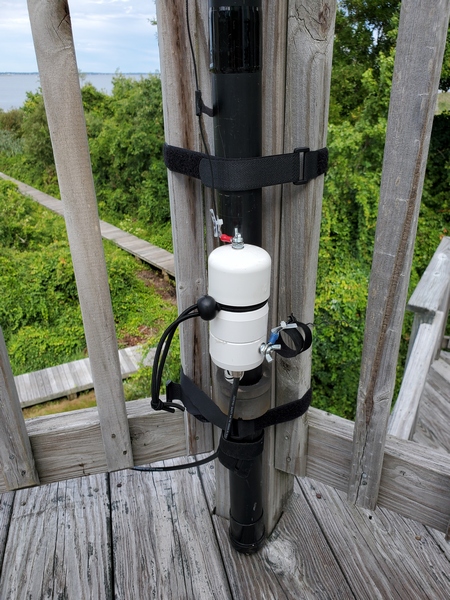
This time around, I went with a Rybakov-type antenna. I strapped a 28-foot Jackite pole to the railing of the 3rd floor deck. I used a 26-foot vertical wire fed through my recently built weather-resistant 4:1 unun. My 26-foot counterpoise wire ran out to the side of the antenna and down the side of the deck stairs. It was a weird configuration, for sure. I ran 25 feet of RG-8X coax down to the second floor, where I could operate in the shade—in the morning, at least.
My Rybakov vertical configuration. The red line shows how I ran the counterpoise wire. Despite this weird-looking setup, it worked pretty well.
I didn’t test the antenna until early Sunday morning, and my KX3’s tuner matched it on every band from 40M through 10M. The noise levels on 40M and 20M were down around S2, a dramatic improvement over previous years and completely workable. The higher bands were dead quiet.
My antenna feedpoint. I used my weather-resistant 4:1 to create a Rybakov-type vertical.
My first contact was an interesting one. Fellow Boschveldt members, Glen NK1N and Rob KE3TI, were on an overnight backpacking trip on the Appalachian Trail in Pennsylvania. I sent Glen NK1N a text message to let him know I was on the air, and we connected on 40M. We chatted for a bit and exchanged SKCC numbers. Conditions were rough in the beginning but, towards the end of our contact, our signals improved.
Before quitting, I logged 10 SKCC Weekend Sprintathon (WES) contacts. There were bonus points for using a homebrew key, so I used a straight key I cobbled together a few years ago. I also worked Greg WA3GM, who was doing a POTA activation at a park near to my home in Pennsylvania. So, my jury-rigged Rybakov seemed to get out OK.
The homebrew straight key I used during the SKCC Weekend Sprintathon (WES).
Monday morning, I got set up on the deck to make a few contacts. I noticed the antenna was acting up a bit on the 40M band. The KX3’s tuner showed it found a 1:1 match, but the SWR went up when I transmitted. I had no issues with the other bands, just 40M. It seemed like I was getting some RF on the coax shield, so I added a common mode choke at the transceiver and changed to a shorter length of coax. That cleared up the issue. I’m guessing there was some interaction between the antenna’s counterpoise and the coax on 40M. Even before I resolved the antenna issue, I logged a half-dozen contacts.
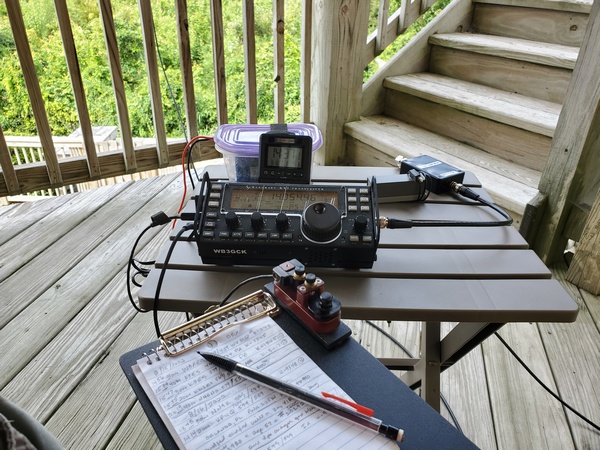
My radio setup on the 2nd story deck of the rental house.
With six adults, four grand-kids, and two grand-dogs, there was always something going on in the house. However, I managed to get on the air for about an hour each morning after breakfast to make a few contacts.
Thursday evening was busy. I kept track of Winlink check-ins for an ARES-RACES net back home. Using DMR, I checked into another ARES-RACES net in Pennsylvania. When I’m down here, I always like to check into the Outer Banks Area Wide Net. Then, it was out to the dock to join my grand-kids for some crabbing.
As I was finishing up breakfast on Friday, I got a text message from my friend, Frank N3FLL, asking if I was on the air. I quickly moved my radio out to the deck and had a nice QSO with him. I also worked a few POTA activators including Greg WA3GM. I worked Greg on the first day, so it was only fitting that I work him on the last day, too. After that, it was time to take down the antenna and pack up the radios.
I didn’t spend as much time on the air as in previous years, but I worked some fellow SKCC members, chased a few POTA activators, and had a couple of nice ragchews. All in all, it was a great vacation with excellent weather. I’m already looking forward to next year.
I recently came across a product on Etsy that caught my eye. It’s a 3D printed project box with an integrated antenna wire winder. I couldn’t resist, so I ordered one.
The box will accommodate a T-130 toroid, and the snap-on lid comes with a gasket. There is a pre-drilled hole for a BNC-F panel mount connector, and there are marks to guide drilling for the output and ground connectors of your choice. You can choose from two colors: orange or green. The vendor states that it is “UV and weather resistant.”
I like the idea of having a box to enclose the balun or transformer. My preference for portable antennas is to avoid exposed components or circuit boards.
I used mine to build a 4:1 unun for portable use in a Rybakov configuration. The unun consists of 19 bifilar turns of #24 solid hookup wire on a T130-2 toroid. You can find plans for winding the unun here and other places on the Internet. For the output and ground connections, I used #10-24×3/4″ stainless steel machine screws, along with some nuts, flat washers, and lock washers.
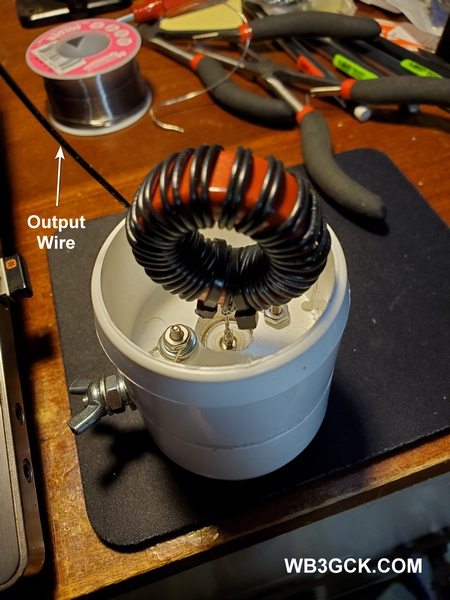
Inside view of the 4:1 unun. I used double-sided foam mounting tape to secure the toroid. I also use a small piece of packing foam (not shown) between the lid and the toroid for added stability.
To go along with the completed unun, I prepared two 26-foot wires; one for the radiator and one for a counterpoise. I finished up by attaching a length of 2.5mm bungee cord. This cord keeps everything together for travel. I have also used it to secure the box to a vertical support, e.g., fiberglass mast, fence post, etc.
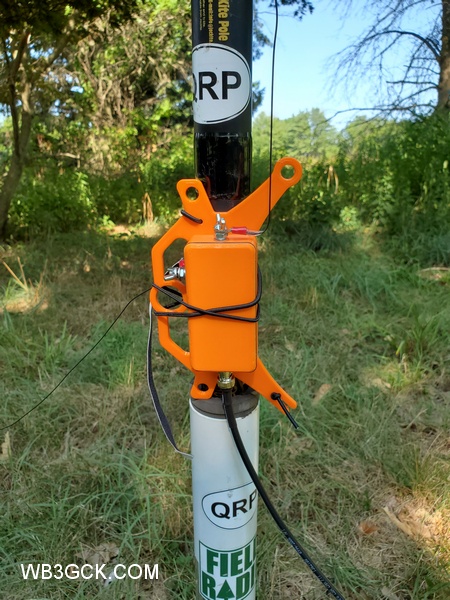
The 4:1 unun deployed in a Rybakov vertical configuration with a 26-foot radiator and a 26-foot counterpoise
In the field, this Rybakov antenna worked as well as others I have built over the years. I tested it using my Penntek TR-35 and Elecraft T1 tuner with 18 feet of coax. It tuned up easily on 40, 30, 20, and 17 meters, and I made a couple of QSOs while testing. The integrated winder made it easy to deploy and take down.
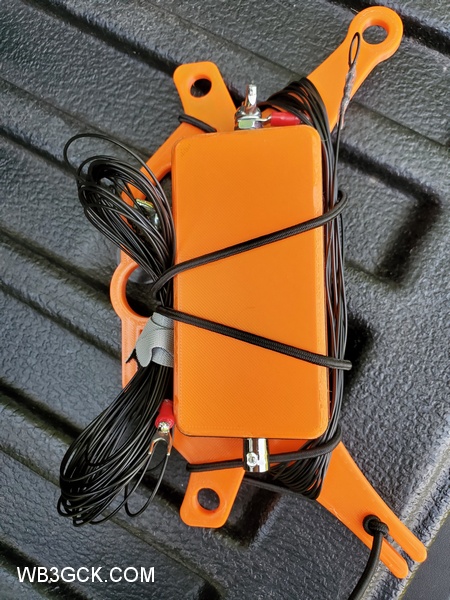
The 4:1 unun packed up for travel
I have a feeling another one of these boxes is in my future. Maybe a 9:1 unun next time?
One antenna I plan to try during my annual Outer Banks, North Carolina, vacation this summer requires a 4:1 unun. If the antenna works as hoped, it’ll be in place for the entire week. So, I need an unun that can stand up to the elements.
About a year ago, I built a 9:1 unun in a weather-resistant housing made from PVC pipe parts. I had some parts left over from that project, so I built a 4:1 unun version. The construction of this unun is like the last one, however, this one has a ground terminal.
Weather-resistant 4:1 unun components
I wouldn’t want to take this unun on a backpacking trip; it weighs in at a substantial 8.6 ounces. When I’m going to be operating from a location for an extended period, however, this should do the trick.
Parts
The parts for the housing are similar to the last one, but there are some additions for the ground connection.
About 2.5 inches of 1.5-inch PVC pipe
(1) 1.5-inch PVC end cap (slightly rounded top)
(2) 1.5-inch PVC end caps with flat tops
(1) SO-239 panel-mount connector (along with some #4 hardware for mounting)
A 4:1 unun wound on a T130-2 toroid
(2) #10-24×3/4″ stainless steel machine screw (along with some #10 flat washers, nuts, wing nuts, and lock washer)
The PVC end-caps with flat tops can be hard to find. If you search online for furniture-grade end caps, you might find some.
Construction
You can find plans for winding the unun here and other places on the Internet. The one I built for this project uses 19 bifilar windings of #24 solid hookup wire on the T130-2 toroid.
To start, you need to glue the two flat top end caps together. When dry, drill the holes to mount an SO-239 connector in the center.
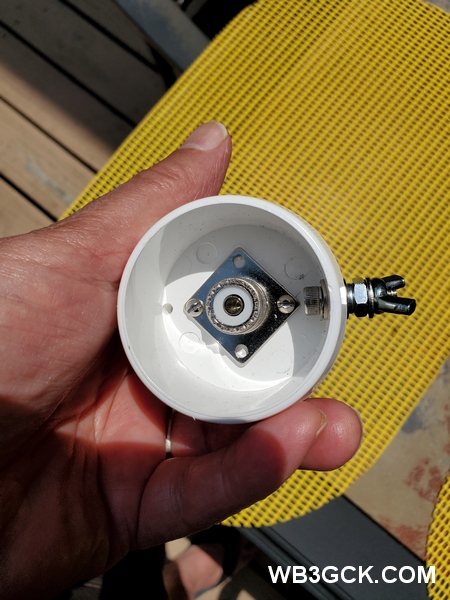
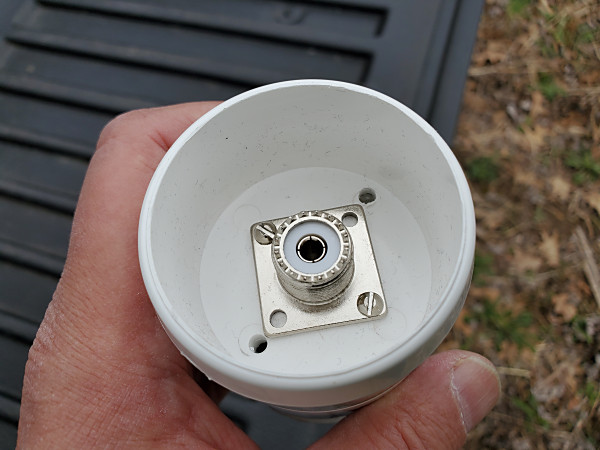
The underside of the 4:1 unun. The SO-239 is recessed to provide some protection from the elements.
For mechanical reasons, I added the #10-24 stainless steel screw for a ground terminal in the lower half of the connector housing. A short length of wire runs from the ground screw through a small hole and connects to one of the SO-239’s mounting screws. I installed another #10-24 screw in the slightly rounded end cap for the antenna connection.
The final assembly was straight forward. I soldered the toroid’s input wires to the center pin of the SO-239 connector. Then, I attached the toroid’s ground wire to one of the SO-239’s mounting screws.
This is how the toroid is installed in the Weather-Resistant 4:1 UNUN.
Next, I inserted the PVC pipe section into the connector housing. I then installed a ring lug on the output wire. I left the output wire just long enough to make the connection to the output bolt in the rounded end cap. Before mounting the end cap to the PVC pipe, I added some pieces of foam around the toroid core to hold it in place. Then I press-fitted all the PVC parts together.
Testing in the Field
I tested the 4:1 unun in the field recently, and it performed as expected. I used it as part of a Rybakov vertical, with a 26-foot radiator supported by a Jackite pole, another 26-foot wire on the ground for a counterpoise, and 18 feet of RG-8x coax. My little Elecraft T1 tuner matched it with no problems on 40M, 30M, 20M and 17M, the bands covered by the rig I was using. Similar 4:1 ununs I have built worked well from 40M through 6M, so I’m confident this one will, too. While I was testing, I had a couple of nice CW rag chews on 40M and 30M.
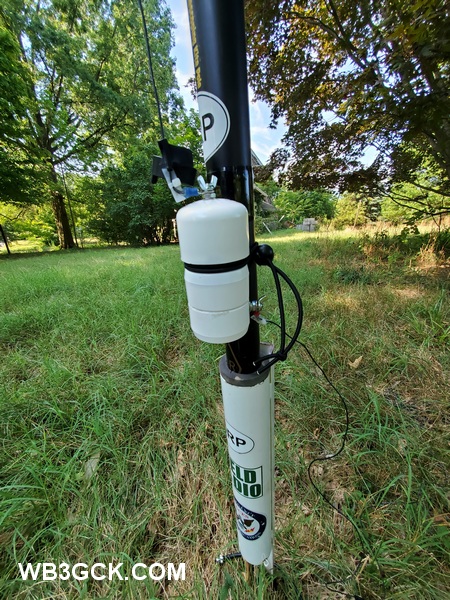
The weather-resistant 4:1 unun in use. In this configuration, there’s a 26-foot radiator and a 26-foot counterpoise wire.
Wrap-up
Like its 9:1 counterpart, this unun is probably a bit over-engineered. My weather-resistant 9:1 has served me well through several camping trips and two Field Days, so I expect this 4:1 version will do likewise. So, bring on that beach weather!
In a recent post, I wrote about an old antenna tuner I built about 25 years ago. Although a description of it has been online for decades, I never posted pictures of it. So, here it is.
I originally posted an article about this tuner on my QSL.net website under the title: A Simple and Flexible Tuner for QRP. Once my go-to transmatch for portable use, it had been on the shelf for quite a while. I hadn’t opened the case in 20 years, so it was a nostalgic walk down Memory Lane for me.
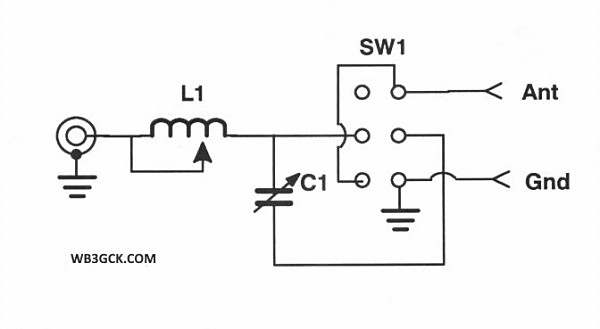
Schematic of the “Simple and Flexible Tuner for QRP.”
All of the parts used for this project came from my junk box or were re-purposed from other projects. This is the second tuner to inhabit this enclosure, so the variable capacitor and rotary switch were already in place.
The coil is consists of 40 turns of enameled copper wire on a plastic 35mm canister. The wire appears to be 22 AWG. I wasn’t shooting for any particular inductance value; I just started winding turns. Based on the dimensions of the coil, the total inductance appears to be approximately 31 uH. I tapped it in 8 places and wired it to a rotary switch. I used two-sided foam tape to secure it to the bottom of the enclosure. I left the cap on the film canister so that the lid would press down slightly on it. This helps to securely hold the coil in place.
Inside view of the tuner
The variable capacitor was salvaged from an old radio by a friend of mine. It’s a two-section capacitor, totaling about 365 pf, according to my notes. I added a switch to select between one or both of the sections. Because the capacitor is sometimes in series with the coil, I used some thin fiberglass material to insulate it from the chassis.
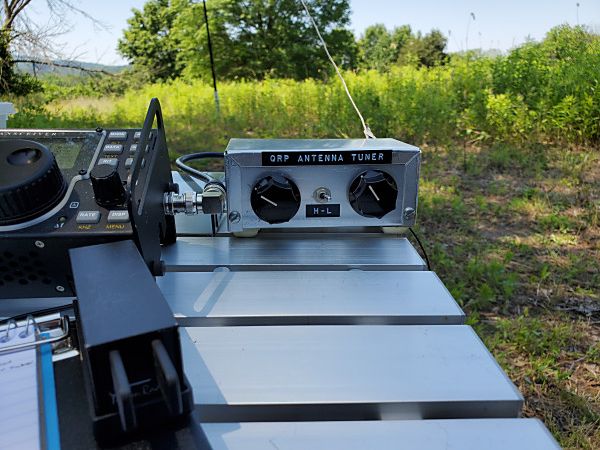
Front panel of my old antenna tuner. The switch selects one or both sections of the variable capacitor.
To the best of my recollection, I purchased the aluminum box at Radio Shack back in the day. I finished off the project with some embossed labels made on an old Dymo label maker. They look tacky, but they’re still holding up after all these years.
Rear view of my old tuner. The slide switch on the left selects the configuration. In the “LO” position, the coil and capacitor are in series. In the “HI” position, the tuner is configured as an L-match tuner.
After spending 15 or more years on the shelf, this funky-looking tuner has been seeing a lot more use lately. I mostly use it as an L-Match for end-fed wires. (I’ve only used the low impedance, series connection a few times over the years.) It’s a great portable tuner for QRP when weight isn’t a consideration.
I have the parts on hand to build a lighter L-match when I need to carry a tuner in my backpack. Until I find the time to put it together, I’ll keep using this funky old tuner.
According to the weather prognosticators, today is the start of a 4- or 5-day heatwave here in southeastern Pennsylvania. So, I wanted to get out early for some antenna testing before things heated up too much.
I planned to play around with the speaker wire end-fed halfwave antenna I built recently. To do this, I went back to my favorite antenna test range—my daughter and son-in-law’s property.
I set up the formerly 66-foot wire (now about 63 feet) in an inverted-V configuration. Since the last time I used this antenna, I trimmed off a couple of feet to see if I could get my little Hendricks SOTA tuner to load it on 20M.
I started with the SOTA tuner on the 40M band and worked a POTA activator in Indiana. I moved up to 20M, but the SOTA tuner wouldn’t tune below a 2.2:1 SWR.
Before I left the house today, I had the forethought to pack an old antenna tuner I built about 25 years ago. I used it extensively years ago, but I relegated it to the shelf when fancier equipment came along. I switched to the old tuner, which I configured as an L-match. It loaded up nicely on 40, 20, and 15 meters. As a bonus, the old-school tuner gave a good match on 30 and 17 meters.
My 25-year-old homebrew antenna tuner. It doesn’t look like much, but it did a nice job with my end-fed halfwave antenna cut for 40M.
After I finished experimenting with the antenna, I set out to make a few contacts. It was a busy day for Parks-on-the-Air (POTA) activators. I worked 10 of them in 8 states plus Puerto Rico. Three of the QSOs were on 17 meters. It was nice to hear POTA activity up there.
All in all, I was pleased with how my old homebrew antenna tuner performed. I don’t think it will be spending as much time on the shelf in the future.
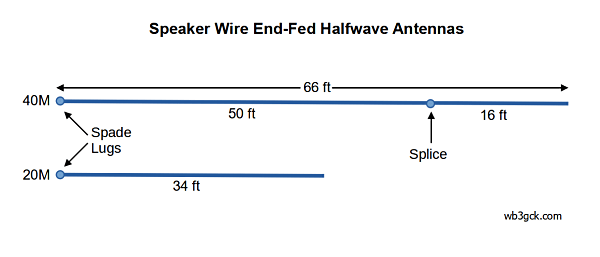
A while back, I challenged myself to see what kind of antennas I could make from a cheap 50-foot roll of two-conductor speaker wire. This time I made a couple of end-fed halfwave wires for the 40M and 20M bands.
My aim with these projects is to make (nearly) full use of the 50 feet of speaker wire. I figured that would be enough for 66-foot and 34-foot radiators for the 40M and 20M bands, respectively. These dimensions work with the Hendricks SOTA Tuner (now sold by Pacific Antenna) I planned to use with them.
Construction couldn’t be more simple:
Starting with 50 feet of speaker wire, separate the conductors.
Cut one of the wires into two lengths, 34 and 16 feet.
Splice the 16-foot wire onto the 50-foot wire. Now you have wires that are approximately a halfwave on 40M (66 feet) and 20M (34 feet).
I added spade lugs to one end of each wire.
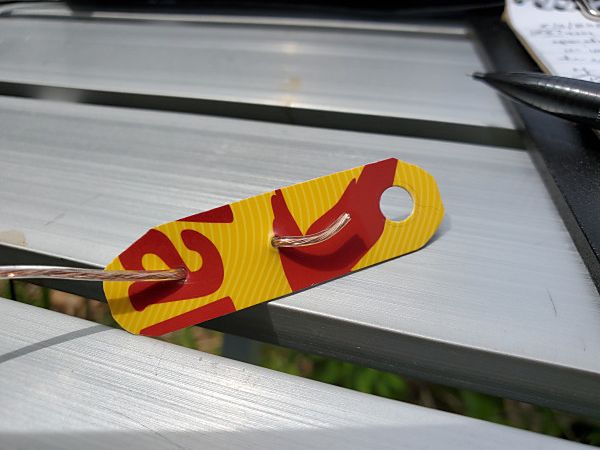
I used pieces of a used gift card to make end insulators that would allow for adjustments if needed. (See photo)
Speaker Wire EFHW Antenna diagram
Of course, you’ll need an antenna coupler to match these wires to your rig. The SOTA Tuner I used worked fine, but each wire operated only on a single band. I cheated a bit and used some other scrap wire to make two short counterpoise wires, 5 feet for 40M and 3 feet for 20M. Of course, you could always use the 34-foot wire as a counterpoise for the 66-foot wire if you’d like.
An improvised end insulator made from an old gift card. I used this so I could shorten the wire, if needed, by folding it back on itself.
I haven’t tried it yet, but an L-network transmatch should allow the 66-foot wire to work on 40M, 20M, and 10M. A 49:1 transformer might also give you multiple bands with the 66-foot wire. You’ll likely need to adjust the length to obtain a match. You’re on your own here.
In the field, the SOTA Tuner provided a good match on both wires. I used the 66-foot wire as an inverted vee and the 34-foot wire as a sloper. I had no trouble making contacts on both bands with 5 watts.
Of course, you could build these antennas with any old wire. After all, it’s just wire. But, I enjoy the challenge of being constrained by the 50 feet of speaker wire.
I have more speaker wire and more antenna ideas, so you’re going to be subjected to more of these crazy projects in the future.
When camping or on vacation, one of my go-to antennas is a simple 29.5-foot wire and 9:1 unun. In these situations, the antenna is usually up for days, and I have to use plastic shopping bags to protect the unun from the elements. For this project, I attempted to build an unun that can withstand the elements.
I had been thinking about this for a while. I wanted something that would protect the internal parts and provide some protection for the coax connection. Eventually, my stash of PVC pipe odds and ends caught my attention. I figured if this stuff could keep water in, it should be able to keep water out. What I came up with is somewhat weird-looking, but it should do the job
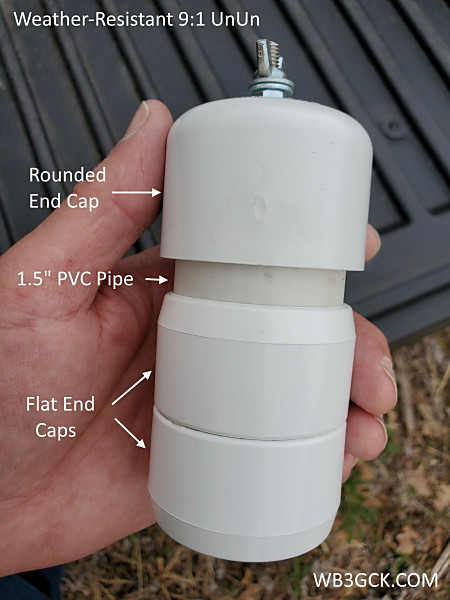
This is the completed 9:1 UnUn.
Parts
Here are the major parts I used:
About 2.5 inches of 1.5-inch PVC pipe
(1) 1.5-inch PVC end cap (slightly rounded top)
(2) 1.5-inch PVC end caps with flat tops
(1) SO-239 panel-mount connector (along with some #4 hardware for mounting)
A 9:1 unun wound on a T130-2 toroid
(1) 10-24×3/4″ stainless steel screw (along with some #10 flat washers, nuts, wingnut, and lock washer)
I have to mention a few things about the parts. The PVC end-caps with flat tops are hard to find. If you search online for furniture-grade end caps, you might find some. For winding the toroid, the Emergency Amateur Radio Club in Hawaii (EARCHI) has excellent instructions you can download.
Construction
I wasn’t sure how I was going to put this together until I started building it. So, these won’t be detailed, step-by-step instructions. They should, however, give you a general idea of how I ended up assembling it.
First, I glued the two flat end caps together, end-to-end.
While the glue was drying, I wound the unun. I left the leads a little longer than the EARCHI instructions, but I cut them back as needed during assembly. I used some #22 gauge solid hookup wire for the windings.
I drilled a 5/8-inch hole through the two attached end caps and installed the SO-239 connector. To keep things simple, I only used two screws to mount it. So, I only drilled two holes for the #4 machine screws for mounting. I also created a couple of weep holes to allow any condensation to drain out. I don’t know if these are needed or not, but they won’t hurt.
I drilled a hole in the rounded end cap for the #10 screw. I made this hole a snug fit for the screw.
Next, I soldered the toroid input and ground connections to the SO-239. I left the toroid leads about 1.5 inches long. I used a small lug to attach the gound lead to one of the SO-239 mounting screws.
I then soldered a ring lug onto the end of the output wire (antenna connection) and attached it to the stainless steel bolt. I made sure that this output lead was just long enough to make the connection to the bolt. (You probably noticed a splice in this wire. I cut it by mistake, while installing the toroid. Stuff happens!)
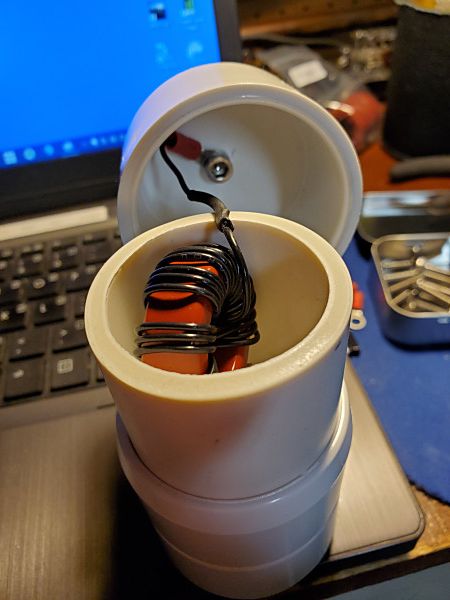
I squeezed in some foam packing material on both sides of the toroid to hold it in place.
Finally, I press-fitted the top end cap. The end caps are on pretty tight, so I decided not to glue the parts together. With a little effort, I can still get inside of it if needed.
This is a view of the toroid. Before I closed it up, I wedged pieces of packing foam on either side of the toroid to hold it in place.
I don’t typically use radials with this setup, so I didn’t provide for an external ground connection. I rely on the coax shield for the necessary counterpoise. Should I ever need to, I can easily add a ground stud.
This is a view of the bottom of the UnUn. I added two “weep holes,” in case there’s ever any condensation inside. These probably aren’t necessary.
Field Testing
I took the unun out for a test drive, and it performed as expected. With a 29.5-foot radiator and 25 feet of RG-8x coax, the internal tuner in my KX3 was able to load it up from 80M through 6M. (This type of antenna is certainly compromised on 80M and 60M, but I have made lots of contacts with them.)
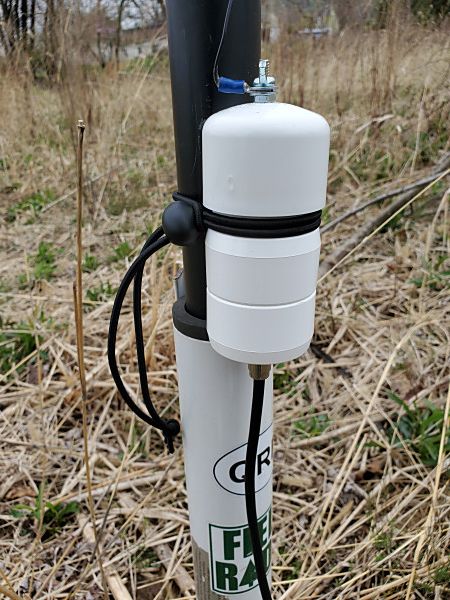
This is the weather-resistant unun in use. I used an adjustable bungee cord to strap it to the Jackite pole. The recessed connector helps to protect the coax connection from the elements.
The Straight Key Century Club (SKCC) Weekend Sprintathon (WES) was in progress while I was out, so I made a few contest contacts. Running my usual 5 watts, I worked two French stations on 20M. I was also pleasantly surprised to have a station in Hawaii come back to my 5-watt CQ on 15M. So, it looks like it’s working.
I also inadvertently tested the unun’s mechanical integrity. I accidentally dropped it twice before using it for the first time. No problems.
Conclusion
I admit I might have over-engineered this thing, but it was a fun project, nonetheless. Our first camping trip of the season is two weeks away. Hopefully, we won’t have any rain. But, if we do, my antenna will be ready for it.









 WB3GCK QRP Amateur Radio