We have some family coming in, and I had some errands to run to get ready for them. Before I got started with all that, I drove to Evansburg State Park (US-1351, KFF-1351) to squeeze in a short activation.
I went with a usual setup: my TR-35 (5 watts, CW) and 12-foot loaded whip. Although I was off to an early start, it didn’t take long to make my first 10 contacts on the 40M band. The 30M band was less productive, but it produced a handful of contacts.
WB3GCK at Evansburg State Park (US-1351, KFF-1351)
I spent the rest of my time up on 17M. I spotted myself on the WWFF spotting page, and the European WWFF hunters did not disappoint. They contributed seven DX QSOs to my log:
Poland
Belgium (2)
Finland (2)
Germany
Italy
There were a few other notable highlights. I worked NL7V in Alaska (17M), and I also received a call from Thomas K4SWL from QRPer.com (30M). Right before I pulled the plug, I saw on the POTA spotting page that fellow Polar Bear QRPer, Michael VE3WMB was on 40M. I ended my activation with a Polar Bear park-to-park QSO with Michael. My activation wrapped up with 37 contacts, including six park-to-park QSOs.
And now it’s back to the holiday preparations, I’d like to wish all those who celebrate a very happy Easter.
My (far) better half and I spent the weekend puppy sitting at my daughter’s house in central Pennsylvania. There are some POTA entities in the area, so I planned to get in an activation while we were there. We drove out in my (far) better half’s car, so I couldn’t use my usual setup.
Thanks to the work I did before I retired, I have a tendency to plan for every contingency. I started thinking about antennas for every scenario I might encounter. Since I have a lot of antenna options, my packing list quickly grew to ridiculous proportions. In the end, I resisted the urge to over-plan and kept things simple.
For this trip, I took my Elecraft AX1 antenna. With this antenna, I could go “picnic table portable” or use a window mount on the (far) better half’s car. For the rig, I went with my KX3, so I could use 20M, 17M, and 15M.
Early Saturday morning, I threw my backpack into my (far) better half’s car and drove up to Boyd Big Tree State Preserve (K-4356, KFF-4356). My last activation at this park was back in 2022. Coincidently, I was puppy sitting on that trip, too.
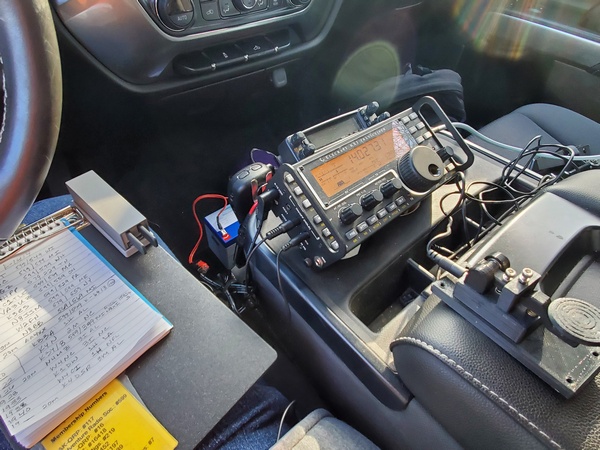
The parking lot was pretty crowded when I rolled in, but I found a spot with a little room around it. It only took a minute or two to set up the AX1 on the window mount. The car is pretty small, so I had to experiment a little to find a spot on the center console to accommodate the KX3.
It was a little cramped inside my (far) better half’s car, but certainly workable.
My goal for the day was to make at least 14 contacts to reach the required 44 contacts at this park for World Wide Flora and Fauna (WWFF). (I had 30 contacts on my previous activation.) Of course, I would have been happy just to make the 10 contacts required for POTA. But, once again, I underestimated the effectiveness of the AX1.
My AX1 and window mount on my (far) better half’s car
Running five watts of CW on 20M and 17M, a steady stream of hunters kept me busy. It only took about 20 minutes to make the 14 contacts I was looking for. The last time someone activated this park was back in November, and there have been very few CW activations. So, this was probably a new one for a lot of hunters.
DX-wise, I had one of my better outings. I had 14 DX contacts with the following countries:
Sweden (2)
Finland (4)
Italy (3)
France
Poland
Germany
Slovak Republic (2)
I worked OH2LIO on both 20M and 17M. Although not DX, I was pleased to log a contact with a California hunter. My little QRP signal really seemed to be getting around.
After slightly over an hour, I had 37 contacts, including four park-to-park contacts. Not too bad for five watts and a 45-inch whip.
I’m glad I went with this simple setup. That little AX1 never ceases to amaze me.
The weather prognosticators said we’re under a Wind Advisory from midday today through tomorrow. In the best interest of my antenna, I got an early start this morning to avoid confronting the forecasted 45 MPH wind gusts.
Instead of doing a normal POTA or WWFF activation, I headed down to Ridley Creek State Park (K-1414, KFF-1414) to take part in the Straight Key Century Club (SKCC) Weekend Sprintathon (WES) contest. I haven’t been very active in the WES contests of late, so I focused my attention on that.
I used my usual Penntek TR-35 transceiver (5 watts CW) and my 12-foot loaded whip antenna. I also used my little American Morse MS2 straight key. The MS2 is an unusual-looking key, but I’ve really grown to love it over the years. I did some earlier posts on the MS2 and the magnetic base I built for it.
My little MS2 straight key attached to my clipboard with a homebrew magnetic base I made for it
Most of my operation today was on 40M. I split my time between calling CQ and search-and-pounce. The WES contests are rather laid back, compared to a typical POTA activation. The WES QSOs come at a much slower pace. I didn’t log my 10th contact until about 45 minutes in.
As I was making my tenth contact, it started raining. So, I grabbed a plastic bag and went back to wrap up my loading coil. It was only a passing shower, so I removed the antenna’s “raincoat” a short while later.
The “raincoat” I fashioned to protect my loading coil from the rain
I ended up this morning with 15 contacts in my log. Thirteen were with SKCC stations, and two were POTA park-to-park contacts. I also worked KS1KCC, the SKCC club station in Michigan, on both 40M and 20M.
This was a fun change of pace today, and I added a few new SKCC numbers to my log.
Today was a day of sunny weather sandwiched between a rainy day yesterday and a week of mostly rainy days coming up. So, I took advantage of it and headed over the Norristown Farm State Park (K-4363, KFF-4363) for an early morning activation.
I operated today from a parking lot near the picnic pavilions. This area is a little lower in elevation than some other parts of the park, but I always seem to do well there. This spot also has the advantages of being less crowded and having nearby “facilities.”
WB3GCK at Norristown Farm State Park (K-4363, KFF-4363)
I used my usual “stationary-mobile” setup, with my Penntek TR-35 (5W CW) and 12-foot loaded whip. Although the bands seemed a little weak, the hunters were out in full force. Starting out of 40M, I had 10 contacts in the first eight minutes. After an hour and ten minutes, I had 48 QSOs in my log with two park-to-park contacts.
Among my contacts today was one with fellow QRPer, W2LJ. It’s always nice to hear Larry. I also had a DX contact with SM4BNZ. Initially, I copied his callsign incorrectly (placing him in Italy). Fortunately, he called back, and I got my log squared away.
I had some other things I needed to do today, so I was glad I could sneak in a quick activation this morning.
After a busy week, I was in dire need of a QRP-portable outing. I opted for an early morning trip to Evansburg State Park (K-1351, KFF-1351), since I’m slowly inching my way to a “Repeat Offender” award there.
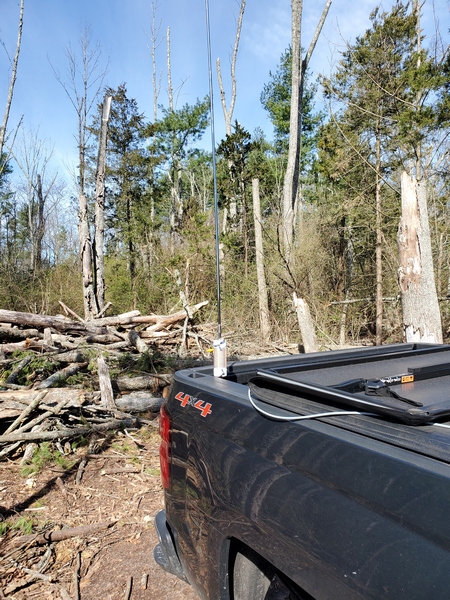
It was a chilly morning with below freezing temperatures, so there weren’t many people in the park when I arrived. I parked next to a wooded area and started setting up. As I was setting up the antenna, I encountered an overhanging branch that was in the way. After moving to a better spot, I was back in business. I used my usual setup with my Penntek TR-35 (5 watts CW) and 12-foot whip with a homebrew loading coil.
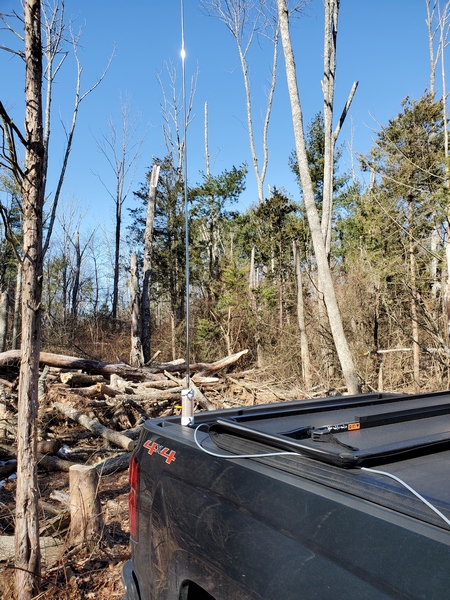
My location next to a pile of downed trees
I spent most of my time on 40M and 30M today, with my last few contacts on 20M. All in all, I made 39 contacts, with two European contacts (Italy and France).
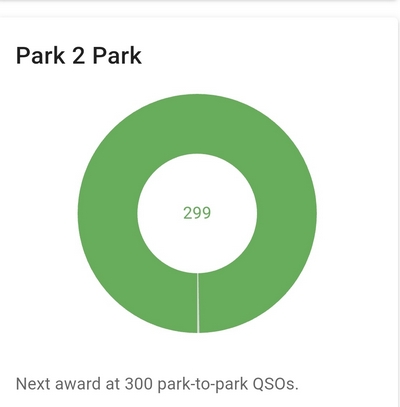
For the past couple of weeks, I have been sitting at 299 park-to-park contacts, just one shy of the next award level. With five P2P contacts today, I easily crossed the 300 mark.
My park-to-park total starting out today
When my supply of hot coffee ran out, it was time to pack up and head home. The weather man says warm temperatures are on the way this week. I’m looking forward to that.
I was long overdue for some portable operation. Between family obligations, malfunctioning toilets, and a couple of snowstorms this week, opportunities were few and far between. Since I had gotten past all that, I headed out for a short activation at Marsh Creek State Park (K-1380, KFF-1380).
It was downright chilly this morning. When I left the house, the temperature was in the teens (°F). By the time I arrived at the park, the temperature had moderated to a balmy 25°F. I rolled into my favorite section of the park, and for a while, I had the place to myself.
My truck all alone in the parking lot.
I operated from my truck using my trusty TR-35 (5 watts) and my 12-foot loaded whip. Starting out on 40M, it took all of 10 minutes to make my first 10 contacts. I made about half of my total contacts today on 40M. I spent some time on 30M, before finishing up on 17M.
Towards the end of my outing, some strong winds had kicked up, and my antenna was whipping around in the breeze. I figured it was a good time to pack up.
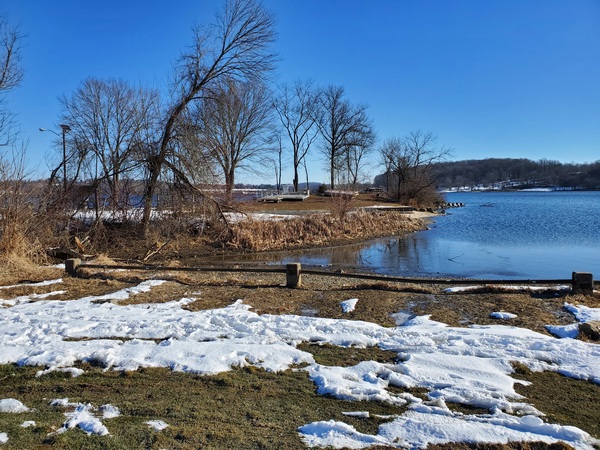
The lake in Marsh Creek State Park (K-1380, KFF-1380) with the remnants of the snow we received earlier in the week.
I ended up with 41 contacts in just under an hour. I didn’t have any park-to-park contacts (that I know of), but I worked nine European stations:
Slovak Republic (3)
France
Germany
Lithuania
Ukraine
Sweden
Denmark
I also worked a station in Washington State. It always amazes me when my little five-watt CW signal makes it out to the West Coast and into eastern Europe in the same session.
Hopefully, I’ll be able to get out more often in the coming months.
I mentioned in an earlier post that I bought my Elecraft AX1 antenna not long after they came out. Although I carried in my pack as a backup antenna for a few years, I never used it much. That changed last year, when I started giving it some serious use. It’s now one of my go-to options for casual, impromptu portable operation.
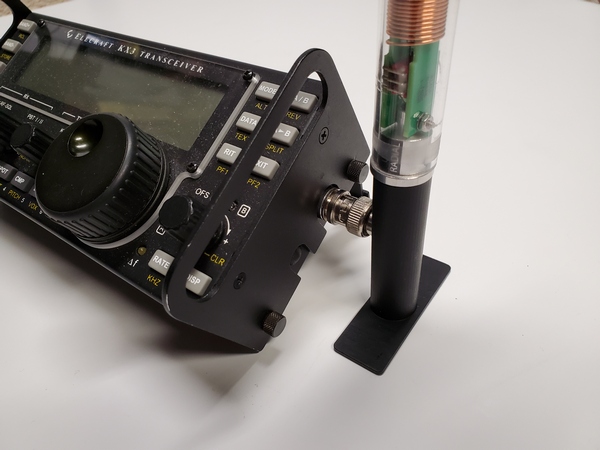
Of course I bought a few accessories for the AX1. I typically use the AXB1 Bipod with the AX1 attached directly to my KX3. While that works fine, I saw mention of an interesting alternative to the bipod, the Byonics KX3 AX1 Stand. My curiosity got the better of me, so I ordered one.
It’s a clever little 3D printed stand that weighs next to nothing. To use it, attach the BNC elbow adapter to the AX1 and set it in the stand. Scoot the stand up to the radio and connect the AX1 to the radio. That’s it!
The Byonics KX3 AX1 Stand
I set it up at home, and it seems pretty stable. The thing I like about it is that there are no adjustments. Since Byonics makes these stands for specific radios, the KX3 version won’t fit a KX2 and vice versa. That’s not a problem for me, since I don’t currently own a KX2. The Elecraft bi-pod, of course, can be adjusted to fit either radio.
I’m looking forward to trying it out in the field sometime soon.
Heading out for some portable operations yesterday, I had a few objectives in mind. First, I needed to take some pictures of an antenna mount for an article I’m working on. I also wanted to do a POTA activation, while also making some Winter Field Day (WFD) contacts. Lastly, I wanted to try out an inexpensive LiFePO4 battery I recently purchased.
I planned to do all this stuff while at Ridley Creek State Park (K-1414, KFF-1414). I started off by setting up to take the pictures for the article. After getting the shots I needed, I set up to get on the air. Today, I was using my KX3 (5 watts CW) and 12-foot loaded whip. I also had a 29-foot vertical wire fed through a 9:1 unun.
My POTA/Winter Field Day setup. The straight key was pressed into service for a Straight Key Century Club contact.
I finished setting up about 10 minutes before WFD kicked off, so I started calling “CQ POTA” on 30M. By the time WFD started, I had the required 10 POTA contacts in the log. After marking myself as “QRT” on the POTA spotting page, I started “searching and pouncing” on the bands. I was hunting for WFD, POTA, or anything else that seemed interesting.
After a little under two hours, I wrapped up with 25 contacts in my log. Thirteen of them were WFD contacts. I also had a park-to-park QSO with AA4XX down in North Carolina. It’s always a pleasure to work Paul. A Straight Key Century Club contact with K3Y/8 rounded out my log.
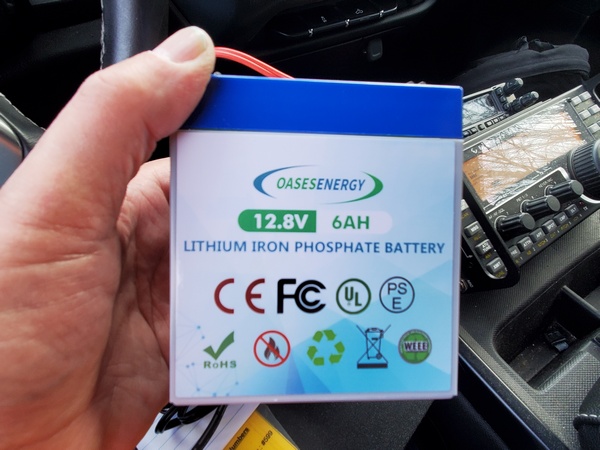
The battery I was using today was a 6 Ah LiFePO4 battery I found on Amazon for about $20 (US). My trusty Bioenno batteries are still hanging tough after more than six years of use, but I was curious to see how this cheap battery would work. It did just fine, but we’ll see how it holds up over time.
The $20 6Ah LiFePO4 battery I used for the first time today. It got the job done.
With some welcomed mild weather yesterday, this wasn’t the most wintry of Winter Field Days here in Pennsylvania. I wish I had more time for it this weekend, but life had other plans for me. Best of luck to everyone taking part in WFD.
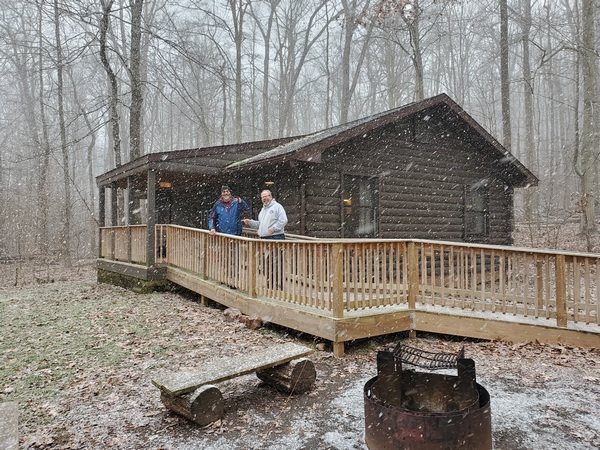
The Boschveldt QRP Club got together for our annual Winter outing, from January 11-14, 2024. Our little group of QRPers has been getting together each January for many years. This year, we were in a cabin in French Creek State Park (POTA K-1355)
Some members stayed for four nights, while others stayed over for various portions of the weekend or just stopped in to visit. This year, the following folks attended: Ed K3YTR, Ed K3BVQ, Glen NK1N, Ed WA3WSJ, John NU3E, Walt KB3SBC, Rob KE3TI, Ron WA8YIH, W3CJW, and me WB3GCK.
Some of the group arrived on Thursday and, after settling in, got some radios and antennas set up. They followed that up by dinner at a local restaurant and a movie back at the cabin.
NU3E (left) and NK1N outside the cabin during a snow squall
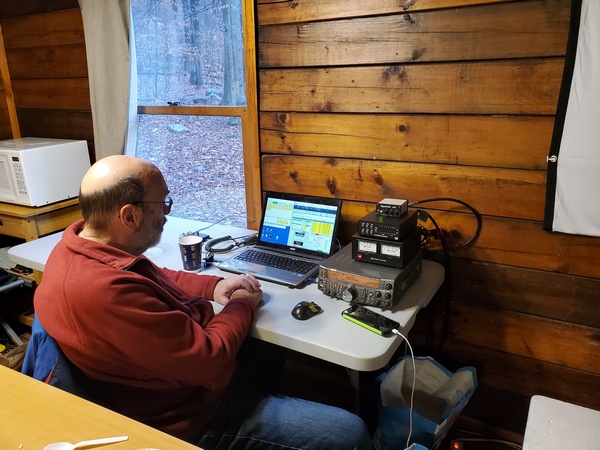
John NU3E operating FT8 as W3BQC from the cabin
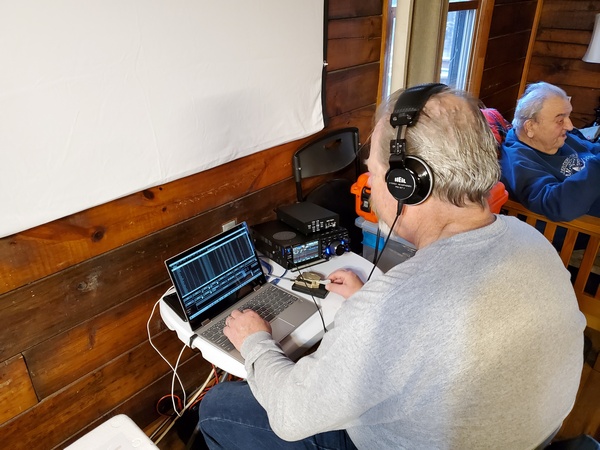
Glen NK1N operating CW as W3BQC from the cabin
WB3GCK at Hopewell Furnace National Historical Site (K-0834, KFF-0834)
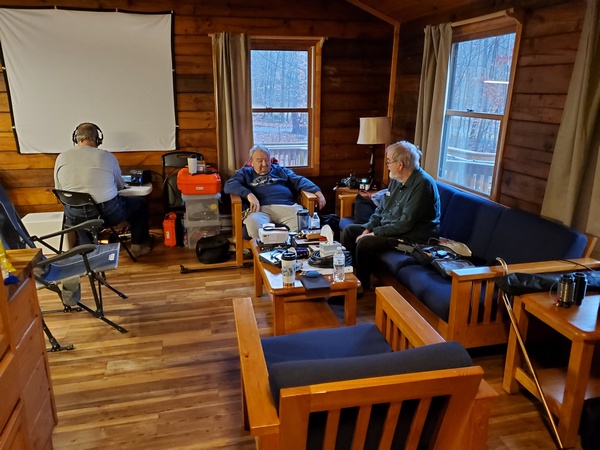
(l-r) NK1N (on the radio), K3BVQ, and K3YTR in the cabin
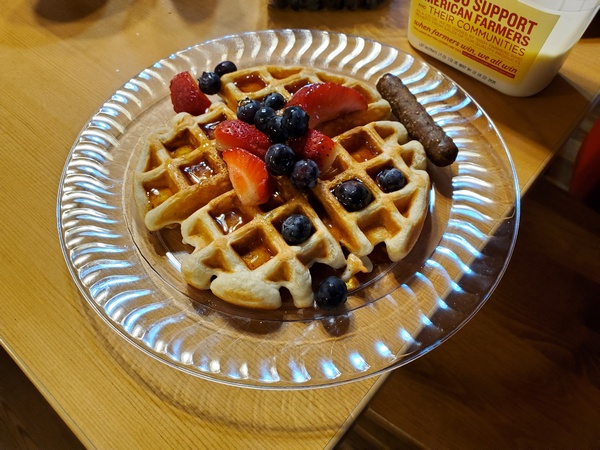
Sunday’s breakfast featured NU3E’s famous waffles
By the time I arrived on Friday afternoon, NU3E and NK1N were busy activating the park using the Boschveldt Club’s callsign, W3BQC. After a lot of socializing and reminiscing, we made dinner in the cabin and ended the evening with another movie.
After breakfast on Saturday morning, I headed over to Hopewell Furnace National Historic Site (K-0834, KFF-0834) for the Parks on the Air activation. Using my TR-35 and 12-foot loaded whip, I logged 41 contacts in just under an hour. Among those, I had two park-to-park contacts with W3BQC back at the cabin.
Later that day, KB3SBC and WA3WSJ did a three-park rove, operating FT8 and FT4 using the club callsign. They activated French Creek State Park (K-1355), Hopewell Furnace NHS (K-0834), and William Penn State Forest (K-5481), which are all within minutes of each other.
On Saturday night, our group descended on a local Italian restaurant for a fantastic meal and some adult beverages. Once again we watched a movie back at the cabin before turning in for the night.
Breakfast on Sunday featured waffles and all the fixings courtesy of John NU3E. John’s waffles have been a Sunday morning tradition for us for many years. Not long after breakfast, we started receiving cell phone alerts for an impending snow squall. Sure enough, the snow came down heavily, greatly reducing visibility. Fortunately, it didn’t last too long.
After lunch, several members—me included—started packing up and heading home. A few members were staying over for one more night before vacating the cabin.
At the end of our winter gathering, W3BQC had 346 contacts in the log. Most of the contacts were from K-1355 (319) with the rest from K-0834 and K-5481. Hopefully, some of you managed to work W3BQC over the weekend.
After spending the last two winter gatherings in a freezing lodge at the Daniel Boone Homestead, the comfortable—and well-heated—cabin in French Creek was a definite step up. We unanimously decided to hold next year’s outing at French Creek.
It’s always great to spend some time catching up with my old QRP buddies. The weekend went by far too quickly, though.
According to the weatherman, we have a nor’easter heading our way. We’re supposed to get some snow, which will quickly give way to heavy rain. Not wanting to drive around in a sloppy mess, I did an early morning activation in Valley Forge National Historical Park (K-0761, KFF-0761).
I chose Valley Forge, since it’s one of the closest parks to my home. I figured if the snow got going earlier than predicted, I didn’t have too far to go to bail out.
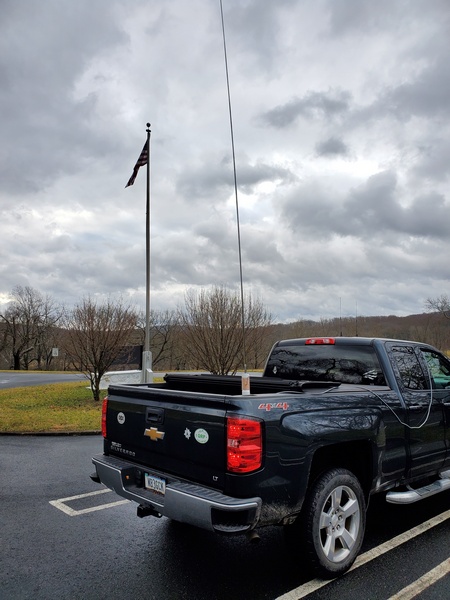
Obligatory picture of the back of my truck. This time it’s at a trailhead in Valley Forge National Historical Park (K-0761, KFF-0761).
I rolled into a trailhead parking lot at 9am (local time) and grabbed one of the last few parking spaces available. I suppose folks wanted to get their hiking and dog walking in before the snow started.
With my current go to set up (TR-35 and 12-foot loaded whip), I was on the air in less than five minutes. I operated on 40M, 30M, and 17M today, and there was no shortage of hunters on any of those bands.
I called it quits after an hour and twenty minutes. It wasn’t because of the snow and rain; my fingers were getting cold and my sending was getting sloppy. Even in the confines of the truck, the temperature was about 45 F (7 C). I ended with 51 QSOs in the log. I had one park-to-park and seven DX contacts:
France (2)
Italy (2)
Hungary
Belgium
Ukraine
It’s snowing now as I write this. Luckily, the winter weather held off until after I got home and unloaded the truck. So far, the snow in this area isn’t amounting to much. Stay safe, if you’re in an area getting the heavier snow from this storm.




 WB3GCK QRP Amateur Radio