More SKCC Fun

Straight Key Century Club (SKCC) logoThe past few weeks have been interesting for me.  Despite poor band conditions, I managed to qualify for some more Straight Key Century Club (SKCC) awards.
Two weeks ago I received my Prefix x2 (Px2) award and a 40 meter endorsement on my Px1 award.  The SKCC Prefix awards are awarded on a point system for working a unique set of prefixes and summing up the membership numbers of the stations you work.  The PX1 award requires 500,00 points and the Px2 award requires 1,000,000 points.  So, I had 1,000,000 points on all bands and more than 500,00 on 40 meters alone.  It’s a lot easier to reach these numbers than you would think.

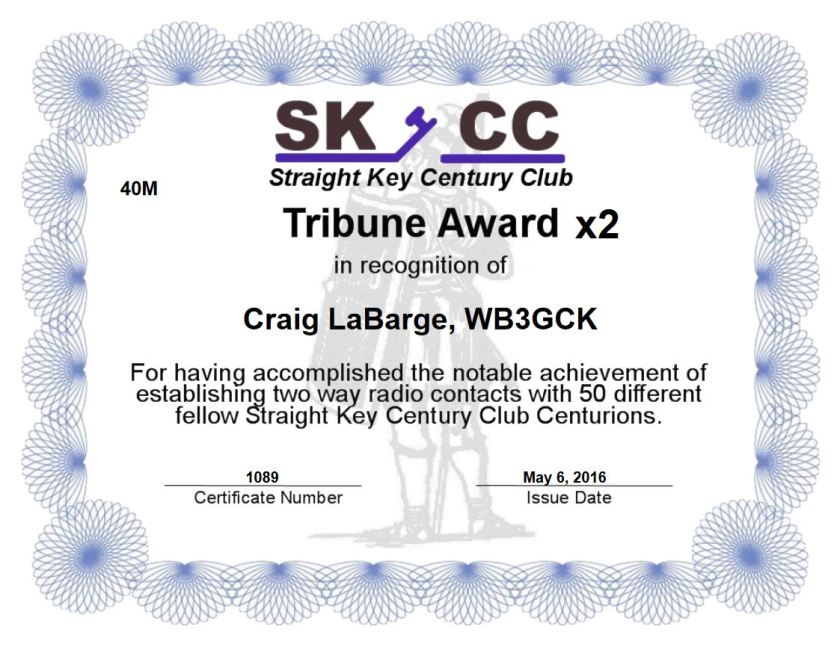
Yesterday afternoon, I got on 40 meters for a bit to see if I could find two more Centurion or higher contacts to reach the Tribune x2 level.  After working Tom N2TRJ in New Jersey, I heard him working Conrad W3ZMN.  Conrad is about 45 miles north of me in my hometown of Bethlehem, PA.  After they finished, I gave Conrad a quick call.  We were 339 both ways but managed to complete the exchange.  My thanks to these two folks for getting me to the Tx2 level!

My SKCC Tribune x2 certificate for working 100 unique Centurion, Tribune and Senator level members. I still need about 500 more to reach the Senator level.

Today, along with my Tx2 award, I also received my 1xQRP award.  This award is a point-based award for working a sufficient number of stations while running 5 watts or less.  The points for each QSO vary according to the band used.  There is also a 2xQRP award for making 2-way contacts but that is going to be much harder to achieve.

While I was in my SKCC logging program, I noticed that I was also qualified for 40 meter endorsements on my Centurion X1 and Tribune X1 awards.  I also received those endorsements today.

The SKCC awards certainly become more challenging as you move up the ranks.  I think that one of the things I enjoy most about the SKCC is that even someone like me with a QRP rig and a crappy antenna (more on that in another post) can earn some wallpaper.  Being able to pick up an award now and then gives me a sense of accomplishment that has kept my interest peaked.  Plus, you get to interact with some really friendly hams in the process.

73/72, Craig WB3GCK

Save

Portable for a Good Cause

The QRP to the Field (QTTF) contest is one that I look forward to every year.  This year, however, it coincided with a long-standing commitment to take part in a public service event.

For many years, I’ve been coordinating my local ARES-RACES group’s support for the March of Dimes’ annual March for Babies event in Valley Forge, Pennsylvania.  In addition to enhancing the safety of the participants, events like this also provide a low-stress environment to hone our emergency communications skills.

The event got off to an unpleasant start.  Paul, KB3ZOH, and I arrived early to set up a crossband repeater at the Net Control location.  We wound up having to set things up in a steady downpour.  Fortunately, the rain let up by the time the walkers set out on the course.

Paul KB3ZOH assuming the Net Control duties

From an ARES-RACES standpoint, it was an uneventful event.  We had solid communications around the course and there were no incidents or issues to handle.  In addition to KB3ZOH and me, The Chester County ARES-RACES team included Leslie KC3EOR, Joe W3JY, Will K3WIL, and Rob W3OWM.

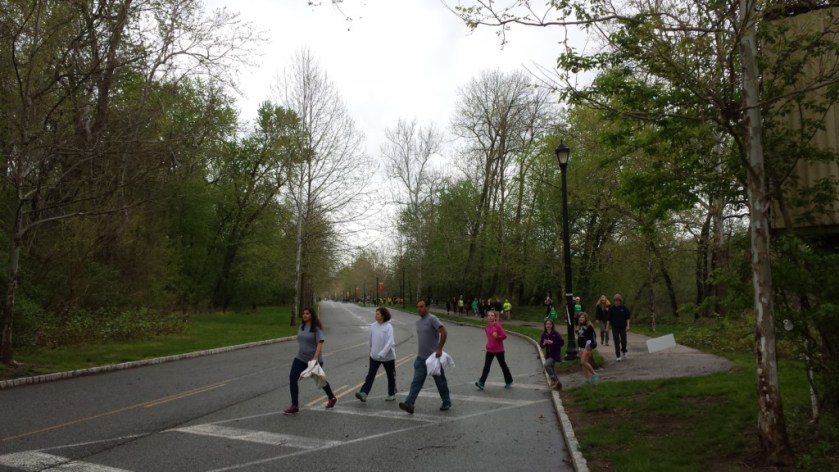
Walkers passing by my position. The weather was dreary but, at least, it was raining.

Since the March for Babies course was located about 100 yards from Valley Forge National Historical Park, my original plan was to head over there after the event for some QTTF action.  With another obligation later in the day, however, QTTF was clearly not in the cards for me.

So, I look forward to next year’s contest.  At least I was able to do some portable operating for a good cause this morning.

72, Craig WB3GCK

Three Birds, One Stone

I was on a mission today and there were three things I wanted to accomplish.  With one trip to a local park, I was able to check them all off of my list.

First, I submitted a write-up on my homebrew, drive-on antenna mount for the Ideas Exchange column in the QRP Quarterly publication.  Mike WA8MCQ, the column’s editor, asked for some more pictures.  So, I needed to get out and set up somewhere to take a few shots.

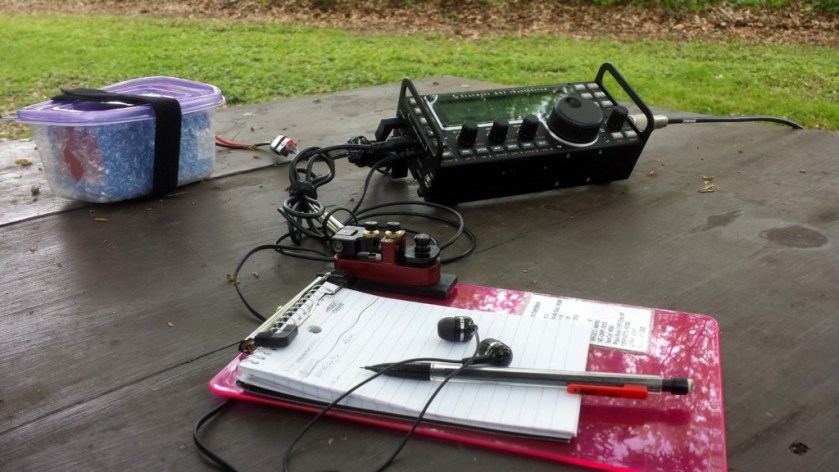
Next, I wanted to field test my little American Morse MS2 straight key and the homebrew magnetic mount I built for it.  I had used it at home but I was anxious to see how it works out in a portable setting.

Finally, I wanted to get out and make some Straight Key Century Club (SKCC) QSOs using a real antenna (as opposed to using my downspout at home).  I only had an hour, so I needed to move quick.

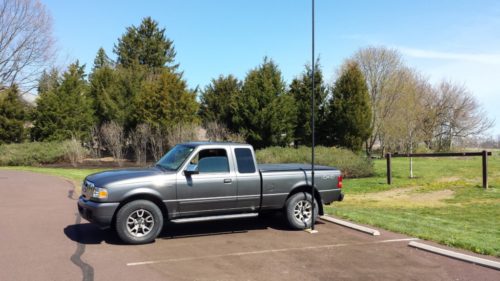
I headed out for Black Rock Sanctuary, which is just outside Phoenixville, PA.  On arrival, I set up the drive-on mount and took some pictures before and after deploying my 31-foot Jackite pole.  I used a 29.5-foot vertical wire with one counterpoise wire fed through a 4:1 unun.  My rig today was my trusty YouKits HB-1B powered from a small gel cell battery.

Drive-on antenna support

I started on 40M and posted my frequency on the SKCC Sked Page.  Almost immediately, I got a call from KB1WOD in Vermont.  He gave me a decent signal report, despite some less-than-optimal band conditions.  A few minutes later, I had a 2-way QRP QSO with KD3CA here in Pennsylvania.  I finished out my brief session with a 2-way QRP QSO on 20 meters with AA4MX in Florida.

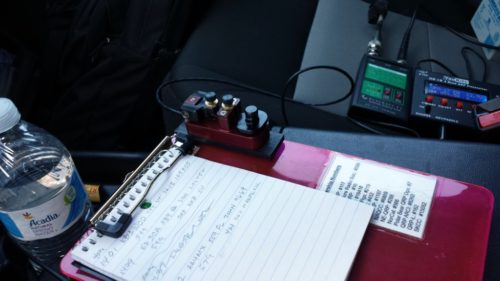
As for the MS2 straight key, I have to say it worked pretty well.  My homebrew magnetic mount held the key firmly to my clipboard.   I was pleased with that.  Using a straight key in the confines of my pickup truck’s cab was a little challenging, though.  I also found the feel of the key a little loose, so I’ll need to tighten up the spring tension a bit.

MS2 miniature straight key and magnetic mount in use.

So, in about an hour, I accomplished my mission.  I got the pictures I needed, tested my little straight key/clipboard setup, and made a few SKCC QSOs to boot.

72, Craig WB3GCK

Good Week for SKCC Activity

Straight Key Century Club (SKCC) logoLife-in-general made this a somewhat slow ham radio week for me.  It did, however, get off to a great start for my Straight Key Century Club (SKCC) activities.

Having reached the Centurion level (100 SKCC member QSOs) back in mid-March, I set my sights on reaching the Tribune level (50 QSOs with Centurion or higher members).  Thanks to the many SKCC members who were eager to add me to their logs with my new “C” designation, I made great progress over the following 2 weeks.

So, by last Monday (March 28th), I needed just 3 more QSOs to reach the Tribune level.  Despite some rough band conditions, it only took about 30 minutes to reach my goal.  The QSO that put me over the top was a nice chat on 20 meters with Pablo KP4SJ in Puerto Rico.  Pablo’s QSO helped me reach Tribune on the 2-month anniversary of my SKCC membership.  It was especially gratifying doing it with 5 watts into my rainspout antenna.  SKCC members, apparently, have very good ears!

Now begins the long climb towards the Senator level.  That entails 350 more contacts with Centurion or higher members and 200 more contacts with Tribune or Senator level members.  That, for sure, is going to take quite a while.

I made a number of 2-way QRP SKCC QSOs during the week, as well.  I worked K8FAC in Ohio, NC4RT in North Carolina, N0HYD (portable) in Kansas, AH6AX in Maryland, and NF1U in Connecticut.

I’m hoping that “Life-in-General” settles down a bit next week and lets me get out for some portable operating.

72, Craig WB3GCK

Hopewell Furnace NPOTA Activation

ARRL National Parks on the Air logoOn Good Friday, I found myself with a free afternoon.  I decided to take advantage of the great Spring weather and make a spur-of-the-moment trip to activate the Hopewell Furnace National Historic Site (NS37).  I hastily threw some equipment into my truck and headed out.
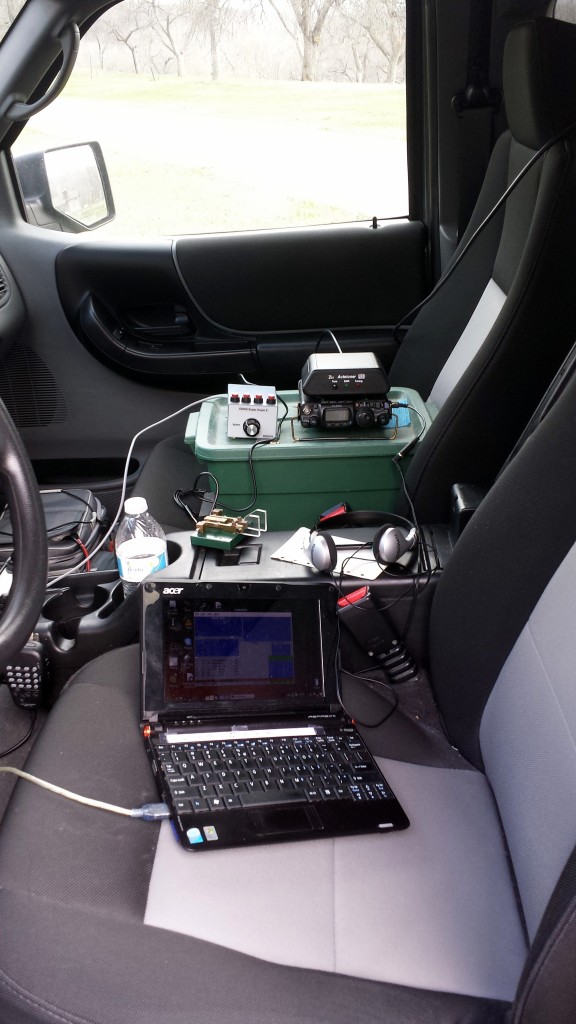
About 45 minutes later, I was on site and ready to get started.  But first, I  had to resolve some antenna issues.  For some reason, my SWR was higher than normal and not very stable.  I found a loose BNC connector on my 4:1 unun that I think was the culprit.  I eventually managed to get things stabilized enough to operate.  I was using my FT-817 at 5 watts into a 29.5-foot vertical wire antenna with two counterpoise wires.  I operated all CW.

The somewhat cramped operating position in my truck.

I couldn’t spot myself due to lack of a cell signal, so I just started calling, “CQ NPOTA.”  After about 35 minutes with no takers, I was pretty close to packing up and heading home.  Finally, I worked a Wisconsin station on 20 meters.  I tuned down the band a bit and heard N4CD activating a park in Texas.  I got him on the first call.  So, at least, I was getting out to somewhere.

I moved down to 40 meters and worked stations in New York and Michigan.  One of them must have spotted me because things picked up quickly after that.  I spent the rest of my time on 40 meters and wound up with 30 contacts in the log (including 2 park-to-park QSOs) after an hour and forty-five minutes.

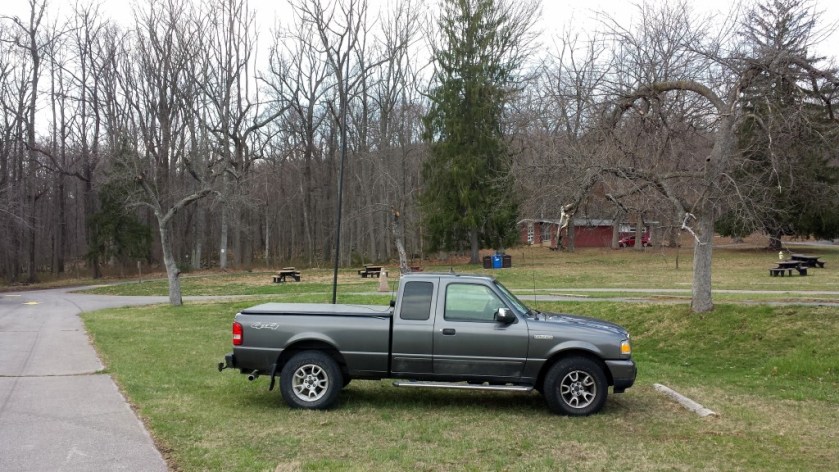
My 31-ft Jackite pole supported with a drive-on mount

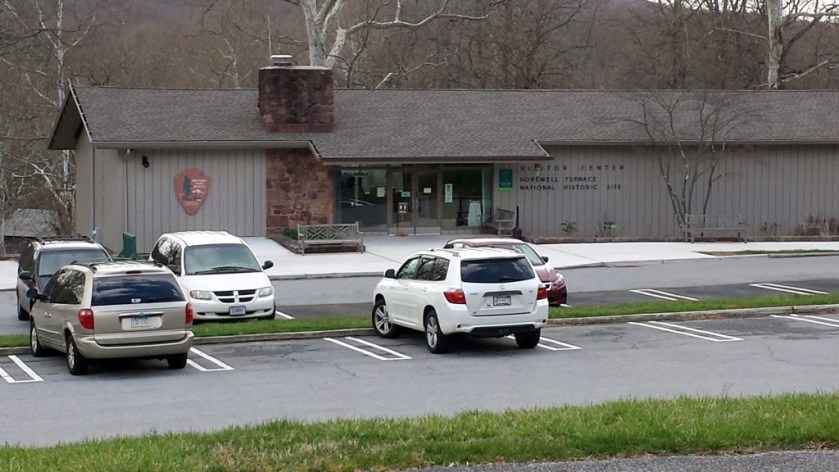
After I packed up, I stopped by the visitor center and chatted a bit with the park rangers.  They were very welcoming and happy to have their park activated again.  They were curious about how many contacts I made and how far I was able to get out.  As I was leaving they thanked me for putting their park on the air.

Hopewell Furnace visitor's center
Hopewell Furnace visitor’s center

I have some repair work to do on my antenna but it was a nice afternoon for an NPOTA activation.

72, Craig WB3GCK

Rediscovering the Straight Key

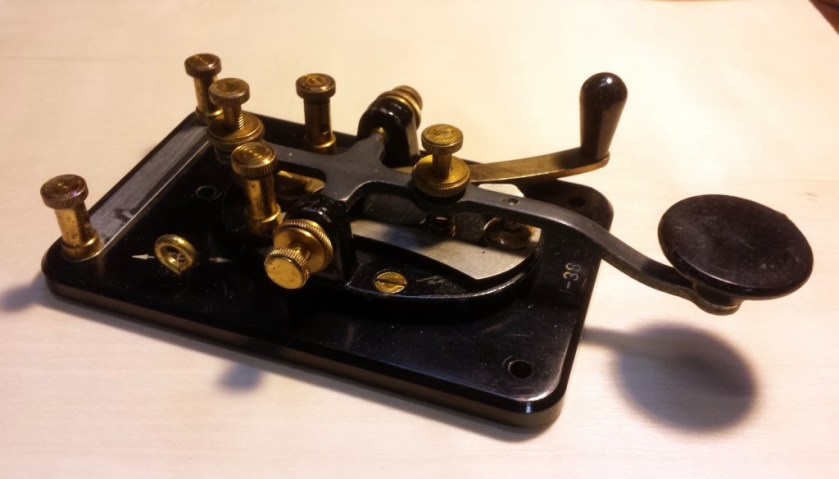
Back in January, I decided I wanted to add a new facet to this hobby that I’ve enjoyed for more than 42 years now.  I have always heard a lot of Straight Key Century Club (SKCC) activity on the bands and it sounded like fun.  So, I signed up for an SKCC number, dusted off my trusty J-38 key and jumped into the fray.

More than 20 years had passed since I made the switch to paddles and Iambic Mode B keying.  Needless to say, my straight key fist was very rusty.  After some off-air practice, I heard NN9K near Chicago calling, “CQ SKCC,” on 30 meters one day.  I grabbed the J-38 and a few minutes later, Peter had given me my first official SKCC contact.

I bought this J-38 from a military surplus store around 1975. Nothing special but I love the feel of it. It reminds me of my Navy days, I guess.

A few days later, it was time for the February SKCC Weekend Sprintathon (WES).  The monthly, weekend-long WES contests are like most other CW contests except they are friendlier and run at a slower pace.  After a fun weekend operating on and off, I ended up with 38 more SKCC contacts in the log.  One particular highlight was working Bert F6HKA on two bands with my meager 5 watts and rainspout antenna.  (Full disclosure:  Bert’s awesome station gets most of the credit for these contacts.  He was louder than most stateside stations.) After my first WES, I was hooked.

Even though SKCC promotes the use of manual keying methods, i.e., straight key, bug, cootie key; they have some pretty sophisticated, computer-based tools that can help you reach the various award levels.  There are a few SKCC-specific logging programs.  I use AC2C’s SKCC Logger for logging during WES contests and keeping track of all of my SKCC contacts.   The K3UK SKCC Sked Page is an online gathering place for members looking for contacts.  Another slick tool is the SKCC Skimmer.  This software tells me who is online on the Sked Page and which SKCC members have been spotted on the Reverse Beacon Network (RBN).  Most importantly, it lets me know if they have SKCC numbers I need for award levels I’m pursuing.

The thing I like most about SKCC is the friendly attitude of the members.  They are particularly helpful to newbies and will always slow down to match the sending speeds of slower operators.  Many times, operators would recognize my new SKCC number and take the time to welcome me to the club — even during contest exchanges.

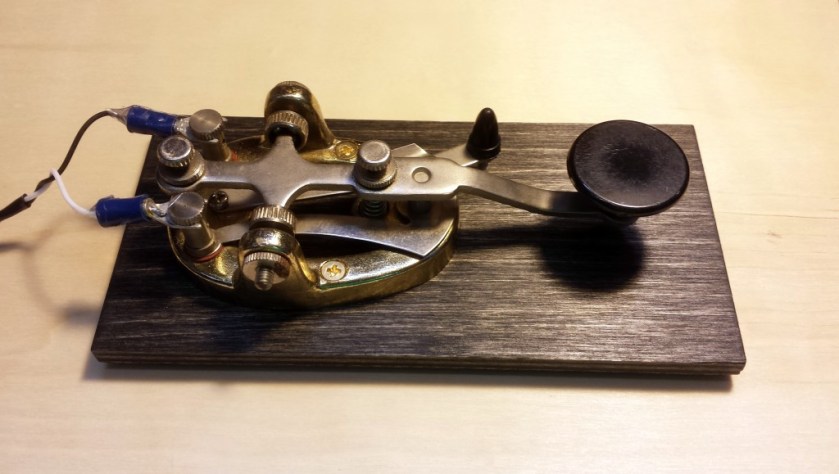
This is my first key as a ham. I bought this at a Radio Shack store in 1974. It still sees occasional use.

After a month and a half of general operating and two WES contests, I found myself with 99 SKCC contacts.  I needed just one more to reach the SKCC Centurion level.  With some sort of geomagnetic disturbance going on, I resorted to the SKCC Sked Page for help.  Within minutes, there were several stations trying to work me to put me over the top.  Werner, N8BB in Michigan, was finally able to get me there.  I applied for my Centurion award and received it later that day.  I’m now in the process of trying to work 50 Centurion, Tribune, or Senator level members for the Tribune level.

I’m pleased to report that my old straight key fist is back in shape and I have rediscovered the elegant simplicity of the straight key.  Many thanks for the good folks who run the SKCC organization.  It’s easy to see why the SKCC is one of the fastest growing clubs in ham radio.

72, Craig WB3GCK

FYBO 2016

I didn’t have a lot of time today but I wanted to get out for an hour or two for the annual Freeze Your B—- Off (FYBO) contest.  FYBO is sponsored by the Arizona ScQRPions.  I didn’t do a lot of  advanced planning for this event, so I threw my backpack into my truck and headed out with a couple of possible locations in mind.

I ended up in the Schuylkill Canal Park in Mont Clare, Pennsylvania, just a few miles away from home.  I’ve been to this park many times but I had never operated from there.  The spot I had in mind had some high voltage power lines nearby so I headed a little further down the road.  I wound up in a parking lot next to the canal lock.  There was still some snow on the ground and the area looked muddy, so I set up in the truck with the window down.  (It was 36F when I started.)  I used my YouKits HB-1B and a 29.5-foot vertical.

FYBO "Stationary-mobile" set up
FYBO “Stationary-mobile” set up

Now, normally, when people see my antenna, they usually just give some curious stares and move on.  Not so today.  Before I had even made a contact, I noticed a county park ranger drive by.  He circled back around and pulled up next to me.  He was curious about the antenna and I ended up discussing ham radio with him for the next 5 minutes or so.  He wished me well and drove off.

A few minutes later, I looked in my rearview mirror and saw a car with two park rangers behind me.  They were staring at the antenna, so I got out and went over to talk to them.  I gave them my ham radio spiel and a few minutes later they drove off.  I was finally able to get back to the radio and start making some contacts.

In my hour or so of operating, I only managed to work 3 FYBO contesters on 20 meters.  There was very little FYBO activity heard.  In fact, I worked more Minnesota QSO Party stations than FYBO stations.  Before I packed up, I dropped down to 40 meters and picked up a Vermont QSO Party station.

Just before shutting down, a fellow who had been walking his dogs walked up to my truck and asked about what I was doing.  Once more I gave my ham radio spiel.  In all the years I’ve been operating from portable locations, I can’t remember ever getting this much attention.  Maybe I enlightened a couple of folks today.

Lock 60 and the Canal Keeper's House at Schuylkill Canal Park, Mont Clare, Pennsylvania
Lock 60 and the Canal Keeper’s House at Schuylkill Canal Park, Mont Clare, Pennsylvania

Even though it was a short outing and I’m sure I wasn’t a big threat in the FYBO contest, it’s always good to get out and play some radio.

72, Craig WB3GCK

Winter Field Day 2016

My original plan was to get outside or, depending on the weather, operate “stationary-mobile” from my truck for Winter Field Day 2016.  However, my XYL and I had a long-standing obligation to head out of town for a weekend of babysitting our grandson.  So, “Plan B” was put into effect.  I would have to operate in the “Indoor” category and, at least, hand out some points to those braving the elements.

On Saturday morning, I started to set up my portable station at my daughter’s house.  I secured the feed point of my LNR EFT-10/20/40 end-fed antenna and tossed the rest of the antenna out of a second story window.

Antenna support for my LNR EFT-10/20/40 EFHW antenna

The next part was a little tricky since there was still more than a foot of snow in the backyard and I neglected to bring boots.  Anyway, I trudged through the snow to secure my 31-foot Jackite pole to the fence.  I used three velcro cinch straps that I had recently purchased.  I used some twine to hoist up the far end of the antenna.  It turned out to be mostly horizontal but with a little bit of sag in it.  Then, I set up my YouKits HB-1B and my logging computer on the dining room table.

My portable station for Winter Field Day 2016

About 2 hours before the start of Winter Field Day, I fired up my YouKits HB-1B and had a nice 2-way QRP chat with John, W3FSA, up in Maine. So, my slightly sagging antenna wasn’t doing too badly.

In between entertaining my 1-year-old grandson and taking my grand-dog out for walks, I got on the radio.  There didn’t seem to be a large number of stations on, so I bounced back and forth between 40 and 20 meters.  At the end of the first day, I had worked 22 stations and a few stations not in the contest.

I got on for a bit on Sunday morning but things had really thinned out a lot.  I made a few non-contest contacts.  It was a while before I heard any WFD activity.  I only managed to pick up one new one.   Around 10 AM, I packed up and tore down my antenna.

With my 23 contacts, I certainly didn’t set any records.  It was, however, a fun event.  Hopefully, I can get outdoors next year.

72, Craig WB3GCK

Delaware Water Gap Activation

ARRL National Parks on the Air logoEach year, I spend a weekend in January with some QRP friends in the Delaware Water Gap Recreation Area.  We’re all members of a loosely-organized group of QRPers known as the Boschveldt QRP Club.  We stay in a cabin at the Mohican Outdoor Center (MOC) near Blairstown, New Jersey.  We have come to call this annual trip, “Camp Run-a-MOC.”  This year, the Boschveldt crew convened Camp Run-a-MOC over the weekend of January 15-17.  There were four QRPers in attendance:  WA3WSJ, NK1N, KB3SBC and me.  As a bonus, this year’s trip coincided with the National Parks on the Air (NPOTA) event.

Mohican Outdoor Center is run by the Appalachian Mountain Club.  It is located within the Delaware Water Gap National Recreation Area and is popular stop-over point for Appalachian Trail through hikers.

Our home for the weekend at Mohican Outdoor Center

Day 1

I rolled into camp around mid-day on Friday and the others were waiting for me in the parking lot.  I got out of my truck and threw my backpack into WA3WSJ’s truck and we took off for a hike up to the Catfish Fire Tower.  We hiked up the Fire Tower road and connected up with the Appalachian Trail. This location was an NPOTA “twofer.”  It encompasses both the Delaware Water Gap (RC07) and the Appalachian Trail (TR01).

Hiking to Catfish Fire Tower. L-R: KB3SBC, NK1N, WB3GCK. (Photo by WA3WSJ)

While the others were operating pedestrian mobile, I hiked a little further down the trail in search of a good place to hang my EFHW antenna.  There weren’t a lot of good options.  There were a lot of dense woods up on this high ridge and the trees weren’t particularly tall.  I eventually got my antenna up in an inverted vee configuration.  It was NVIS at best.  I set up my YouKits HB-1B on a convenient flat rock and got on the air.

Catfish Fire Tower
Catfish Fire Tower

I worked one station on 20M CW but I didn’t hear much other activity.  I moved down to 40M and started calling CQ.  I fired off a quick text message to my friend, Carter N3AO, down in Virginia.  A few minutes later he answered my CQ.  After he spotted me on the cluster, I was soon met with a hoard of very strong signals calling me.  However, the pile-up was short-lived and the activity quickly slowed down.  About that time, the wind was blowing across the top of the ridge and it started getting cold up there.  I packed up and rejoined the others for the hike back down the hill.  I ended the day with 17 QSOs, most of them on 40M CW.

Operating along the Appalachian Trail near Catfish Fire Tower
Operating along the Appalachian Trail near Catfish Fire Tower (Photo by NK1N)

Day 2

After breakfast, we all packed up and headed out to the Crater Lake area to activate RC07.  While, the others continued on to Crater Lake, I pulled off into the Blue Mountain Lake trailhead parking lot.  It was a bit colder than the day before, so I opted to operate “stationary-mobile” from my truck.  I set up a 30 foot vertical on the back of my truck, using my bike rack mount, and set up my station in the truck.

Stationary-mobile setup at the Blue Mountain Lakes trailhead

I worked several stations on 20M including WA3WSJ who had hiked up to Kittatinny Mountain for a combined SOTA (W2/NJ-003) and NPOTA activation.  I heard a lot of activity on 30 meters, so I moved there next.  That turned out to be a very productive move.  I finished out my session on 20 meters.  I worked NK1N who was with KB3SBC several miles away at Crater Lake.

The Boschveldt QRPers at Crater Lake. L-R: WB3GCK, WA3WSJ, NK1N, KB3SBC. (Photo by WA3WSJ)

The skies were starting to look threatening, so I started packing up.  Over 2m simplex, WA3WSJ told me he had started hiking back down to Crater Lake.  I drove over to Crater Lake to join up with the rest of the crew and we soon headed back to the cabin for lunch.  It was a short session but I ended with 21 QSOs.

Once again, we had a great winter QRP getaway at Mohican Outdoor Center.  The Boschveldt QRPers are already making plans for next year.

72, Craig WB3GCK

New Year’s Day NPOTA Activation

ARRL National Parks on the Air logoA few years ago, I started a tradition of going out on January 1st for some QRP portable operating.  Since the ARRL National Parks on the Air (NPOTA) program kicked off today, I headed over to nearby Valley Forge National Historical Park to operate.

I set up in the parking lot for the Wayne’s Woods area of the park.  I picked a secluded corner of the lot so I would be away from hikers and bikers using a nearby trail.  I used my drive-on mast support to support my antenna.  I used a 29.5-foot vertical wire supported by a 31-foot pole.  I laid out two 29.5-foot radials.  One was run around my truck and the other was laid out in a grassy area behind the truck.  The antenna was coax-fed through a 4:1 unun.

My “stationary-mobile” location

I used my FT-817 at 5 watts, along with a Z-817 tuner.  As mentioned in an earlier post, I used the YFKtest logging program on my little Linux netbook computer.

My somewhat messy operating position

I started out on 20M and my first contact was with RA1M/MM who was also running QRP.  After making a second contact on 20M things slowed down.  I dropped down to 40M and started calling, “CQ NPOTA.”  It took a while before I got a response.  I was beginning to think I wasn’t going to make the requisite 10 contacts to validate my activation.  Just then, Dave Benson, K1SWL, called from New Hampshire, followed by Jim W1PID.  After Dave spotted me on QRPSPOTS, I had a mini pile-up on my hands.  I’m normally a “search and pounce” kind of operator, so I wasn’t prepared to hear a bunch of stations calling me at the same time!

YFKtest logging software on my Linux netbook computer

As it turns out, I wasn’t the only Valley Forge activator today.  Fellow QRPer, Walt KB3SBC, was parked on Mount Joy about a mile or so away.  Walt and I worked each other on 2 meters simplex.  Walt was running SSB and had a good morning.  He logged about 38 QSOs until he ran out of paper!

After two hours, I was starting to get hungry and a little chilly.  I packed up and headed home.  I ended my activation with 25 CW QSOs and the one FM contact with Walt.

National Memorial Arch at Valley Forge

My next activation will be the Delaware Water Gap Recreation Area and Appalachian Trail in New Jersey in a few weeks.  Walt, KB3SBC, will be there also.     This is going to be a fun year!

72, Craig WB3GCK