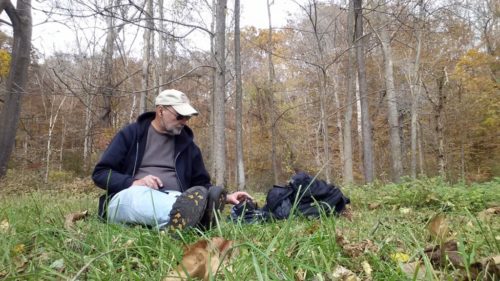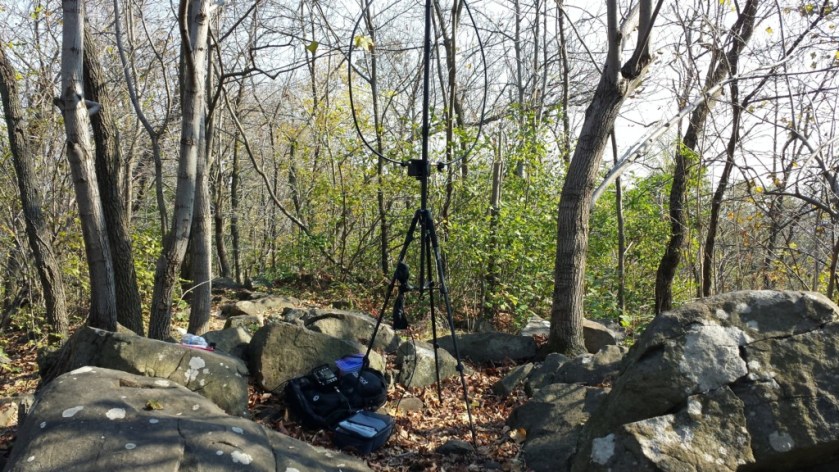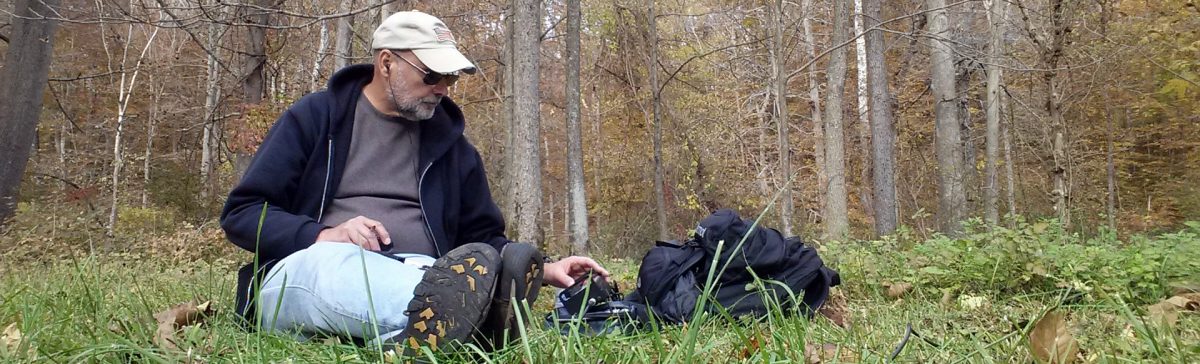
I went out in search of some polar bears this afternoon. The Polar Bear Moonlight Madness Event (PBMME), sponsored by the Polar Bear QRP Ops group, is a very informal QRP field event. It occurs monthly from October through March on the Saturday closest to a full moon.
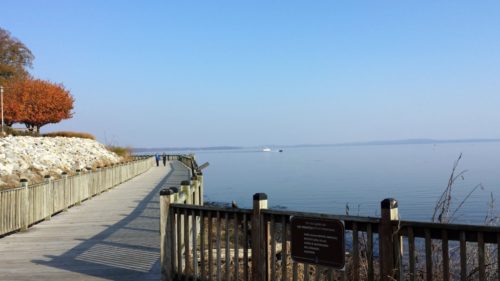
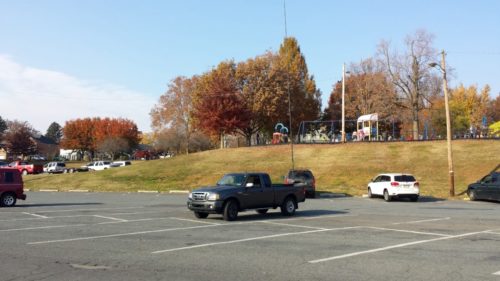
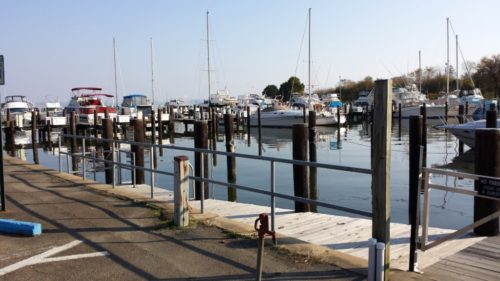
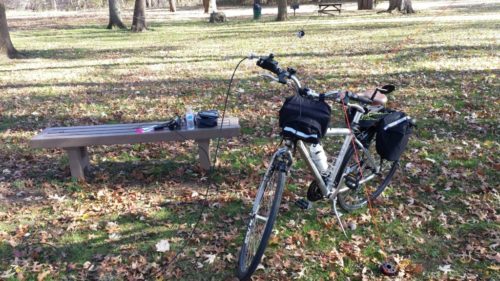
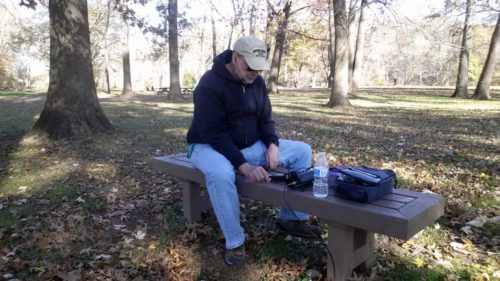
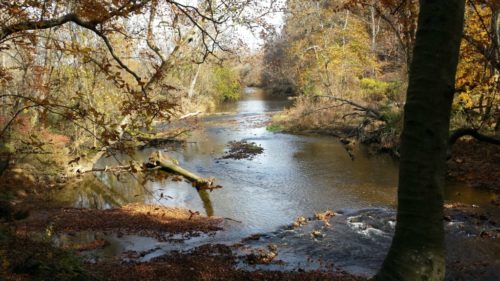
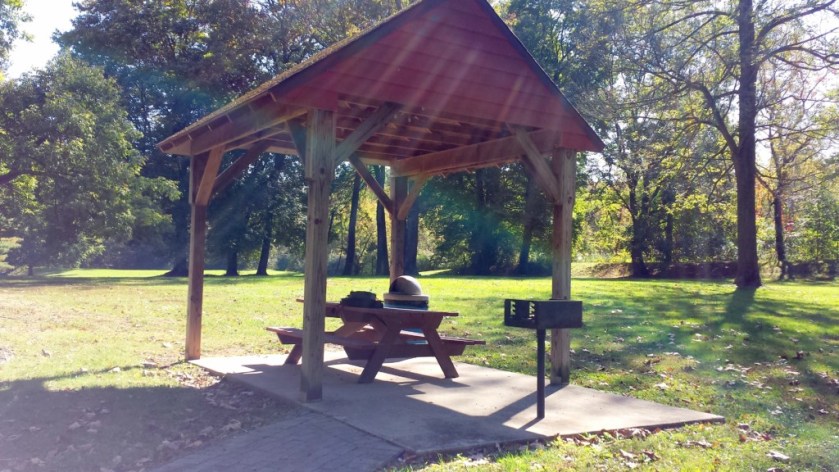
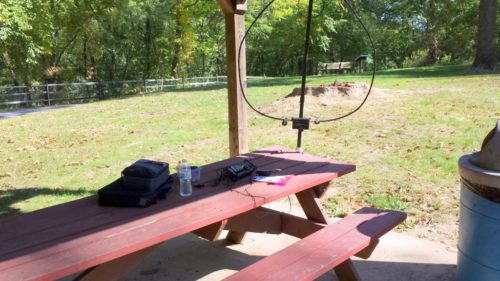
For this month’s event, I traveled to Towpath Park near Pottstown, PA on the banks of the Schuylkill River. This was my first time operating from this park, so I did a little exploring when I arrived. I set up my KX3 and AlexLoop on a picnic table underneath a little pavilion.
My pavilion at Towpath Park.
Polar Bears generally hang out near the traditional QRP calling frequencies so I started out on 14.060 MHz. I called CQ for a while with no takers. I was about to change bands when I got a call from OK1DVM. Miro had a very nice signal and gave me a 559. I moved down the band a bit and worked PF30EUDXF, a special event station in the Netherlands. At least I was making it into Europe.
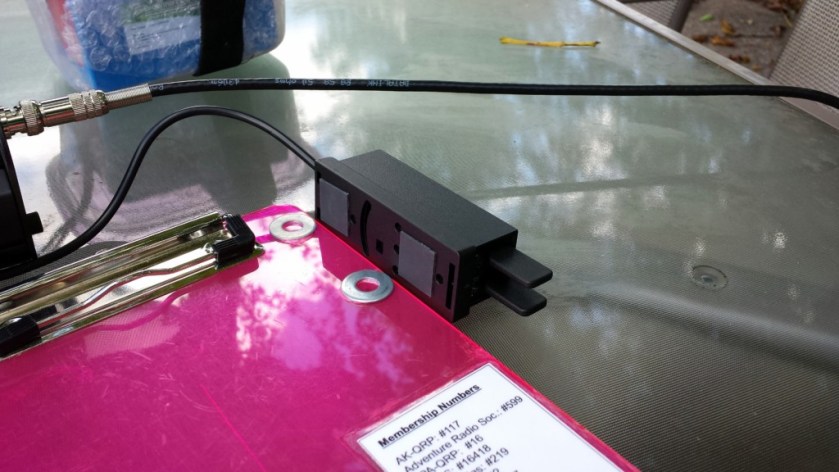
My operating position. The AlexLoop is attached to the picnic table.
I didn’t work any bears down on 40 meters but I did work a couple of stations in the New York QSO Party. Thirty meters seemed to be open but I had no takers there. Back on 20 meters, I worked a station in the Iowa QSO Party before calling it quits.
Sadly, I didn’t work any of my Polar Bear friends today but it was nice to be out on this beautiful Fall day. Hopefully, I’ll be able to give it another shot next month.
I spent the weekend camping in French Creek State Park near Elverson, Pennsylvania. The Straight Key Century Club’s (SKCC) monthly Weekend Sprintathon (WES) was held this weekend, so I spent some time making straight key contacts.
I was set up in my pop-up camper using my KX3 at 5 watts on battery power. My antenna was my trusty “Pop-up Vertical.”
Working the SKCC WES contest from the camper
Prior to the start of the WES contest, I had a nice 2-way QRP chat with John W3FSA up in Maine. John’s YouKits HB-1B was putting a great signal into Pennsylvania.
Working the contest on and off over the weekend, I logged 39 contacts. Some of the highlights included:
Working F6EJN and DK7OB. Both were new additions to my SKCC log.
An early morning QSO with Tony K6ELQ in California on 40 meters. I have to admit, the credit needs to go to Tony and his phenomenal station. It’s not the first time I’ve worked the West Coast on 40 meters during daylight hours but I always like when that happens.
Adding enough new contacts to my SKCC log to qualify for the Tribune x3 level. I was stuck at the Tx2 level for a while, so I was pleased to finally get to the next level.
While tuning around 40 meters on Saturday afternoon, I heard my old QRP buddy, WA3WSJ, making some contacts in the Pennsylvania QSO Party. I gave Ed a contact and let him know I was camping not far from his home. A little while later, Ed stopped by the campsite for a visit. He even came with some food items he acquired during one of his NPOTA trips. It’s always fun to do some catching up with Ed.
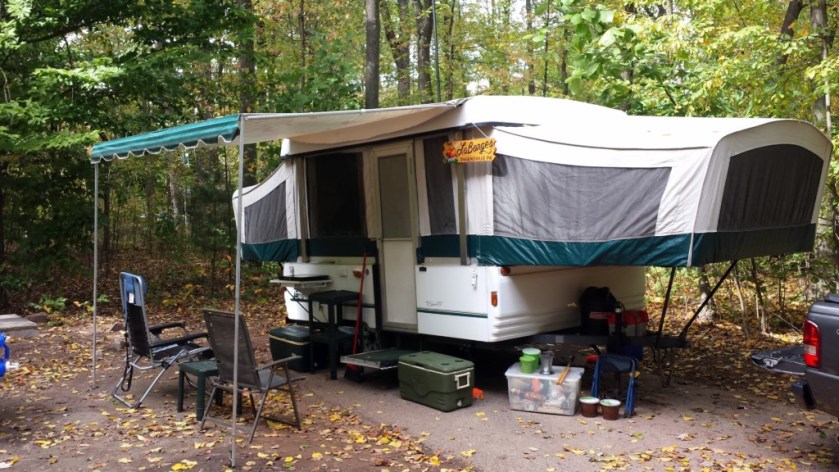
Our pop-up camper on its final camping trip (with us, at least).
I had a bittersweet moment this morning as I was taking down the Pop-up Vertical for the last time. My XYL and I decided to retire the pop-up camper and go with something different next year. Over the past 19 years, my ham radio setup in the camper has evolved to where I could be up and operating in minutes. The Pop-up Vertical has always performed well for me. So, I’ll have to start all over working out a new antenna setup for whatever kind of camper we end up with next year. That should be fun.
I operated in the Peanut Power Sprint for the first time today. This sprint is sponsored by the good folks of the North Georgia QRP Club. It’s a short, two-hour sprint, which works nicely with my short attention span.
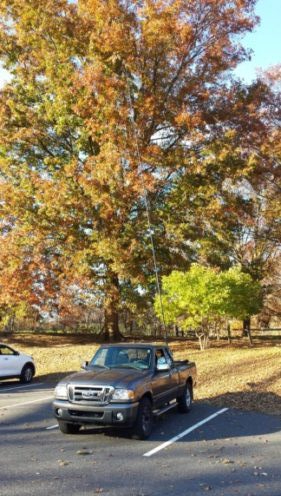
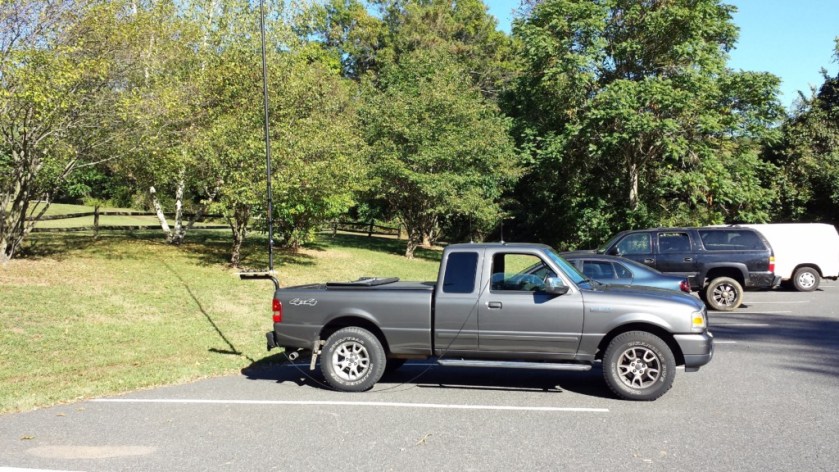
I headed out to a nearby park to operate portable. Since the Peanut Power Sprint is a short contest and I was pressed for time anyway, I kept my setup simple. I used the same setup I have used for some recent NPOTA activations. I operated from my truck with a 29.5-foot vertical wire supported by a 31-foot Jackite pole on my bike rack. I fed the vertical wire with a 9:1 unun and 18 feet of coax. I set up my KX3 on the passenger seat of my truck.
My “stationary-mobile” setup at the Upper Schuylkill Valley Park. The Jackite pole is mounted on the rear of the truck.
Before the sprint started, I worked AB7RW who was doing an NPOTA activation from the Curecanti National Recreation Area (RC06) in Colorado. So, it looked like the antenna was working.
Propagation on 20 meters was a little flakey and 40 meters was plagued by wall-to-wall RTTY contest stations. Despite the challenges, I ended up with 19 contacts in the log. Even though my operating location was along the Schuylkill River and I didn’t have the benefit of altitude, I managed to work the west coast (WA). I also worked N8XX and WD8RIF who were both operating from the North Country National Scenic Trail (TR04). My last contact was with Greg N4KGL who was operating pedestrian-mobile from Florida.
I’m glad I decided to operate in this year’s Peanut Power Sprint. It was a fun way to spend a beautiful Fall afternoon.
My XYL and I were long overdue for a weekend of camping. We towed our old pop-up camper to one of our favorite campgrounds, French Creek State Park near Elverson, PA. It was a happy coincidence that the New England QRP Club’s QRP Afield contest was being held while I was camping. OK, so maybe it wasn’t just a coincidence.
Our pop-up camper and sometimes portable radio shack.
I operated from inside the camper using my KX3 on battery power. The antenna was my “Pop-up Vertical” that I have used with the camper for years. Basically, the antenna is a 27-foot wire vertical fed through a 4:1 unun. I use the body of the camper for ground. The wire is supported by a 31-foot Jackite pole attached to the side of the camper with some velcro straps. I run a 10-foot length of coax into the camper to the radio. The KX3’s internal tuner will easily load up the antenna from 40 meters through 6 meters. The KX3 can also tune it on 80 meters but it isn’t very efficient on that band.
The “Pop-up Vertical” fastened to the camper.
During the contest, I didn’t hear much activity on 20 meters. I made one QRP Afield QSO there. I made the rest of my contacts on 40 meters. I ended up with only 11 contacts in the log. It wasn’t a great showing but I had fun.
Outside of the contest, I worked several Route 66 special event stations, along with a few National Parks on the Air (NPOTA) stations. I also worked TM77X, a special event station in France. There were a couple of nice rag chew QSOs in there, too.
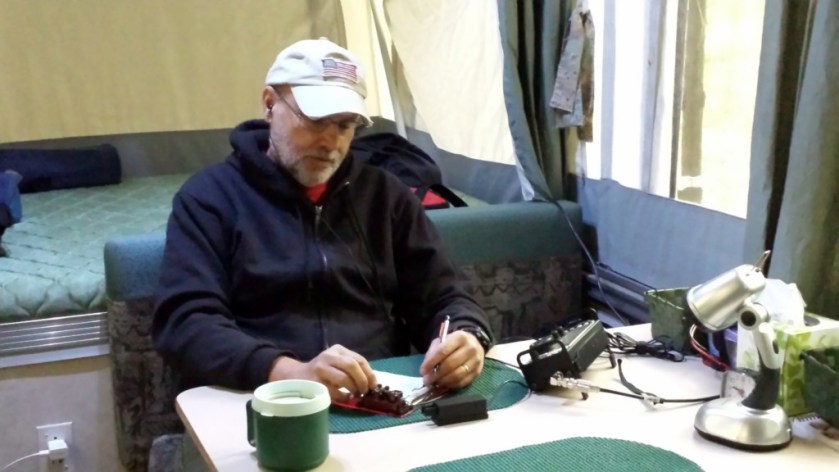
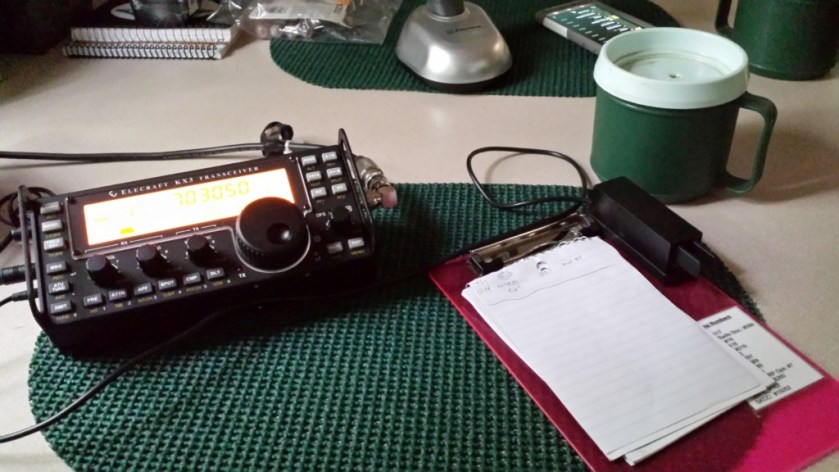
My operating position inside the camper. The coffee cup. of course, is a mandatory accessory.
We have one more outing with the camper scheduled for October. Not only will this be the last camping trip of the year for us, it will be the last camping trip with our old camper. It has served us well for the past 19 years but, like me, it’s starting to show its age. My XYL and I decided it’s time to retire it and replace it with something new for next year.
I’ll miss our little tent-on-wheels. My family made a lot of memories with that camper and I made a lot of fun QRP QSOs from it.
My XYL and I traveled out to the Harrisburg, PA, area over the weekend to spend some time with our daughter and her family. Yesterday, I set up my KX3 and Alexloop in the backyard to make a few SKCC Weekend Sprintathon (WES) contacts. Ol’ Murphy was certainly with me.
First, I had a problem with my little American Morse MS2 straight key. Well, not the key itself, but rather a bad connector or cable. I spent some time playing around with it but I had no multimeter to troubleshoot it and no parts to repair it.
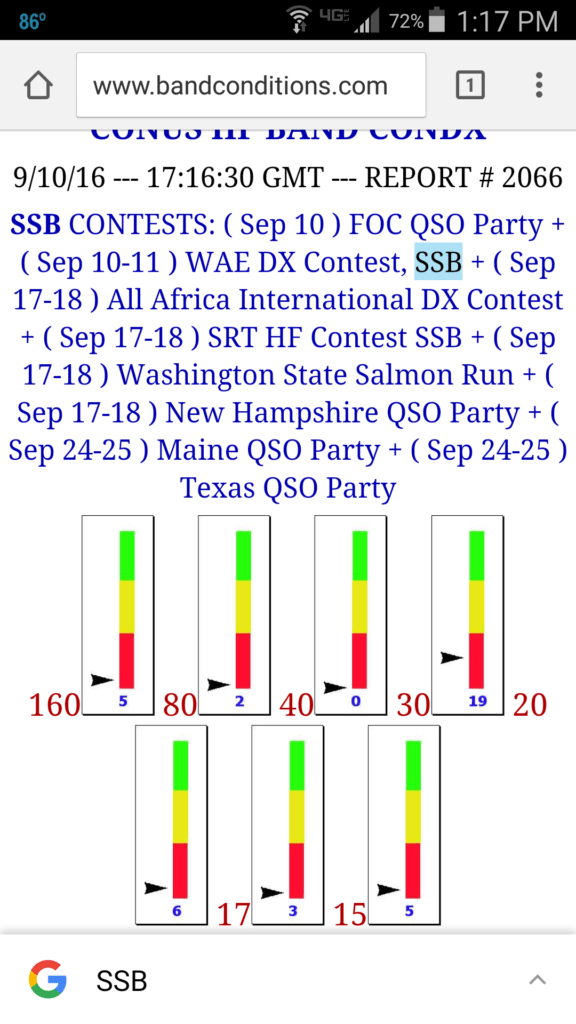
Tuning around the bands, I couldn’t hear a lot of activity. The SKCC stations I heard seemed pretty weak and I wasn’t having any luck making contacts. I checked the Band Conditions website and saw that the bands were in bad shape. At that point, I threw in the towel and chalked up a win for Murphy.
Tough going on the bands
Today I decided to give it another shot. The bands sounded better and I could hear some WES activity. I remembered a trick that Burke N0HYD employed to pull off an SKCC contact with me a while back. So, I channeled my inner MacGyver and set up the KX3 for a straight key and connected my Palm mini paddles. I turned the paddles over on their side and used one lever as a straight key. The straight key workaround worked surprisingly well. The “feel” wasn’t half-bad, actually.
My sideways paddles. The top paddle was used as the straight key.
With the improved band conditions and the straight key workaround, I made several SKCC WES contacts, including one with Bert F6HKA. Bert has great ears and has managed to pull my puny QRP signal out of the noise on several occasions. I finished my session with a nice two-way QRP QSO with Mac NN4NC down in North Carolina on 40 meters. I was only on for an hour or so but it was fun.
Despite my lack of a functioning straight key, I managed to put a few new SKCC stations in my log today. MacGyver would have been proud.
I had some plans for the Labor Day holiday but I wanted to get out to play radio for a bit. I threw my KX3 and Alexloop into my truck and drove to nearby Upper Schuylkill Valley Park. Although there were more people picnicking than usual, I found an isolated spot along the river.
It only took a few minutes to set up. It was a little breezy along the river, so I clamped the Alexloop to the picnic table.
My set-up along the Schuylkill River in Upper Schuylkill Valley Park.
I started out on 30 meters and gave KB6NU a call. Dan heard me out in Michigan but the QSB was really bad. He gave me an RST of 229. Next up was a nice chat with John WW4DX in North Carolina. He was really booming into Pennsylvania this morning.
I moved up to 20 meters and had a short QSO with Sam WZ4L in Tennessee. I wrapped up with a nice two-way QRP chat with Grady AJ4YA in North Carolina. We experienced some QRM but managed to complete the QSO.
The bands seemed to be a little “short” this morning and I definitely had a pipeline to the South. I have used the Alexloop at this location a few times before and it always seems to favor a southerly direction.
Although I could have stayed out there all day in this great weather, I needed to get home to throw some chicken on the smoker and make sure the beer is cold. As always, I have my priorities in order!
I hope all of my U.S. friends have a safe and enjoyable Labor Day holiday.
I headed out this afternoon for a bike ride along the Schuylkill River Trail. I pulled off the trail where it passes through Valley Forge National Historical Park. I wanted to ride across Sullivan’s Bridge, which opened recently. This pedestrian and biking bridge crosses the Schuylkill River and provides a connection to other trails.
After riding across the new bridge and back, I made a pit stop in the Betzwood Picnic Area. I wanted to do some testing with an antenna that I’ve been playing around with lately. It’s simply a lightweight, 19-foot vertical fed through a 9:1 unun. It’s built around an inexpensive, lightweight, Chinese fishing pole I bought on eBay.
I set up at a picnic table under a shady tree. I mounted the vertical on a tripod, using an adapter that I cobbled together from PVC pipe this morning. The internal tuner in the KX3 tuned it up on every band from 40 meters through 6 meters.
My setup in the Betzwood Picnic Area in Valley Forge National Historical Park.
I didn’t hear any activity around the 30 and 20 meter QRP watering holes, so I moved down to 40 meters. Forty meters is the least efficient band for this antenna but I worked a few Ohio QSO Party stations. I also worked Joe N2CX who was doing an NPOTA activation in Ohio (NS78). I didn’t set out to activate Valley Forge today but I sent Joe the NPS unit number (HP46). I have to confess that I cranked my power up to 10 watts for the QSO with Joe. I think that’s the first time I’ve used more than 5 watts on the HF bands in the past 20 years or so.
Heading back to the Pawlings Road Trail Head along the Schuylkill River Trail
Feeling comfortable that this short vertical seems to be making some radio waves, I packed up the bike and got back on the trail for the ride back.
It was a nice day but I’m glad I got my ride in before it really started warming up.
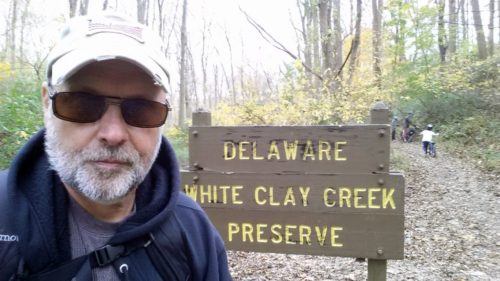
The NJQRP Skeeter Hunt is one of my favorite QRP field contests. This year, I planned to do some biking along White Clay Creek but the dire weather forecasts made me opt for “Plan B.” “Plan B,” in this case, was to activate nearby Valley Forge National Historical Park (HP46) and operate from my truck. This was my first time back at Valley Forge since I activated it on New Year’s Day.
I chose a parking spot that was away from the trees. I also made sure to face west, so I could keep an eye on the approaching storms. I took a few pictures before the Skeeter Hunt started, while the weather was still decent.
I used a 30-foot wire vertical mounted on the back. This antenna, fed with a 9:1 unun and 18-feet of coax served me well on several NPOTA outings recently. I set up my KX3 on the passenger seat of my truck.
A few QSOs into the contest, a park ranger rolled up next to me and asked what I was doing. I mentioned National Parks on the Air and he said, “that’s cool.” He also warned me about the approaching storms. I assured him that I planned to shut down if there was any lightning.
At about 20 minutes into the contest, the rain started and never really stopped. It varied between slight drizzle and torrential downpours. When the rain forced me to roll up my windows, the cab of the truck got unbearably warm. I couldn’t operate with the truck running due to electrical noise from the engine. Every so often, I took a break from the radio and ran the air conditioner to cool off.
My “stationary-mobile” set up in Valley Forge. You can see the wind bending the fiberglass pole.
The bands seemed to be in pretty good shape. After a little more than two and a half hours of operating, I had 29 QSOs in the log.
The rain was really starting to come down heavily, so I put on my rain gear and tore down the antenna. The park ranger was parked in the lot behind me. He was probably getting a chuckle out of the crazy old guy taking down his antenna in a downpour.
As I was making the 3-mile trip home, the rain stopped and the sun came out. Go figure! Anyway, I had a fun time, despite the rain. Once again, a tip of the hat goes to Larry, W2LJ, for coordinating this fun contest.
My free time has been somewhat limited lately, so I’ve been itching to get out for some QRP-portable operating. A rare mid-week opportunity presented itself, so I decided to take a quick bike ride and make a few ham radio contacts while I was out.
I threw some radio gear into my pannier bags and headed out on the Schuylkill River and Perkiomen trails. Before heading back, I made a stop at Lower Perkiomen Valley Park. There weren’t many people around on a Wednesday morning.
My first attempt to put a line into a tree got some great elevation but I missed my target branch completely. My second attempt caught a lower branch. Since I was limited on time, I decided to go with that. My 30-foot wire ended up as a sloper. I used my bike as a tie-off for my halyard and attached my 9:1 unun to one of the handlebars.
My operating location along the Perkiomen Trail
I tuned around 30 meters and heard Roger KO5Q calling CQ from Georgia. We chatted for a few minutes but there was some deep fading on the band. Roger said my signal came up to 599 for a bit and faded quickly.
I moved up to 20 meters and called CQ. Enzo VE3VTG called me from the Toronto area. He had a great signal. If I copied correctly, he said he was running 2 watts into a beam.
After that, I packed up the bike for the ride back to the trailhead. The beautiful weather and a couple of QRP-portable contacts were enough to tide me over until the QRP Skeeter Hunt this weekend.
Another Flight of the Bumblebees (FOBB) is in the books. This year, I was going to travel to my operating site by bicycle but forecasts for thunderstorms forced a last-minute change of plans.
I ended up in French Creek State Park (PA) near the Hopewell Fire Tower. This area has good elevation and there usually aren’t many other visitors around. Dark clouds were moving in, so I opted to set up in the shelter of an old picnic pavilion. Fortunately, the storm skirted around my location.
My operating location near the Hopewell Fire Tower in French Creek State Park (PA)
I kept my antenna simple, in case I needed to bail out in a hurry. I strapped my 31-foot Jackite pole to a small tree next to the pavilion and set up a 30-foot wire vertical with a 9:1 unun. I ran 18 feet of coax over to one of the picnic tables. I had my KX3 set up and ready to go about five minutes before the contest started.
My antenna support. I strapped my Jackite pole to a small tree near the pavilion.
Conditions were pretty rough. There was heavy fading on 20 meters and lots of static on 40 meters. Early on, most of the activity was on 20 meters but 40 meters started to come alive later on.
Despite the conditions, I managed to eek out 19 contacts in about 3 hours. I heard a lot of familiar callsigns. I was pleasantly surprised to work N6GA, Cam, in California. I guess my simple antenna was getting out OK. I also worked fellow Polar Bear QRPer, Kelly K4UPG in Florida. In addition to the contest exchange, Kelly and I exchanged the traditional Polar Bear greeting, “GRRR.” Right before I packed up, I found QRP friends, Larry W2LJ and Carter N3AO, on 40 meters.
My operating position for Flight of the Bumblebees 2016
It turned out to be a pretty nice day. The thunderstorms stayed away and not a drop of rain. I was in the shade and there was just enough of a breeze to make the heat and humidity bearable and keep the mosquitoes at bay. Thanks to the Adventure Radio Society for sponsoring this fun contest.