Boschveldt (W3BQC) Field Day 2017

Once again, I joined my fellow Boschveldt QRP Club members for Field Day. We’re a loosely-organized group of QRPers who enjoy portable operating. Field Day is one of the few times each year that we get together, so it’s always good to see everyone and do some catching up. This year we held Field Day on a beautiful piece of land owned by a close family friend of one of our members. We were situated on top of a hill, so we had some good elevation, too.

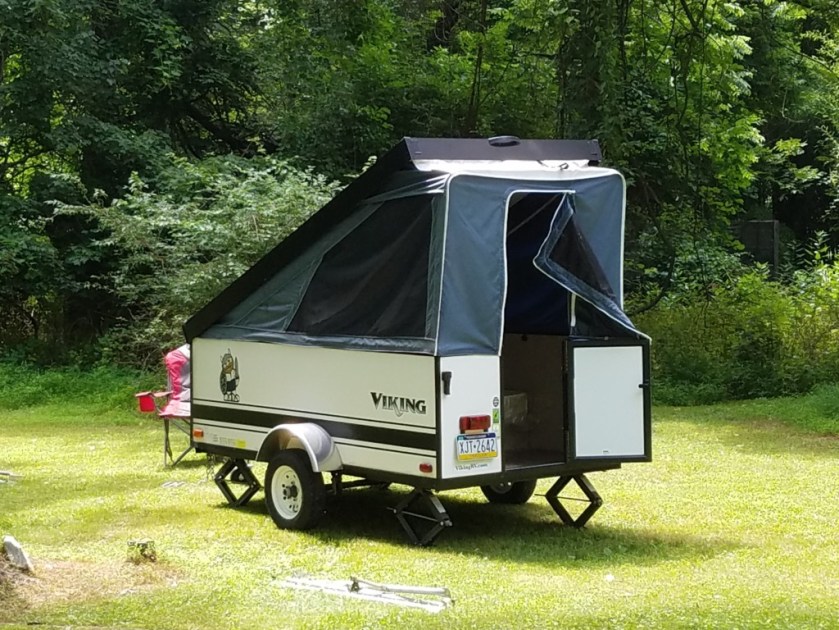
This is the little camper K3YTR used. Besides sleeping, there was enough room for his radios.

Ed K3YTR, Glen NK1N and I arrived mid-afternoon on Friday and set up our tents. We were expecting some heavy rains from the remnants of Tropical Storm Cindy so we held off setting up our radio equipment. We were joined later that night by Ron WA8YIH.

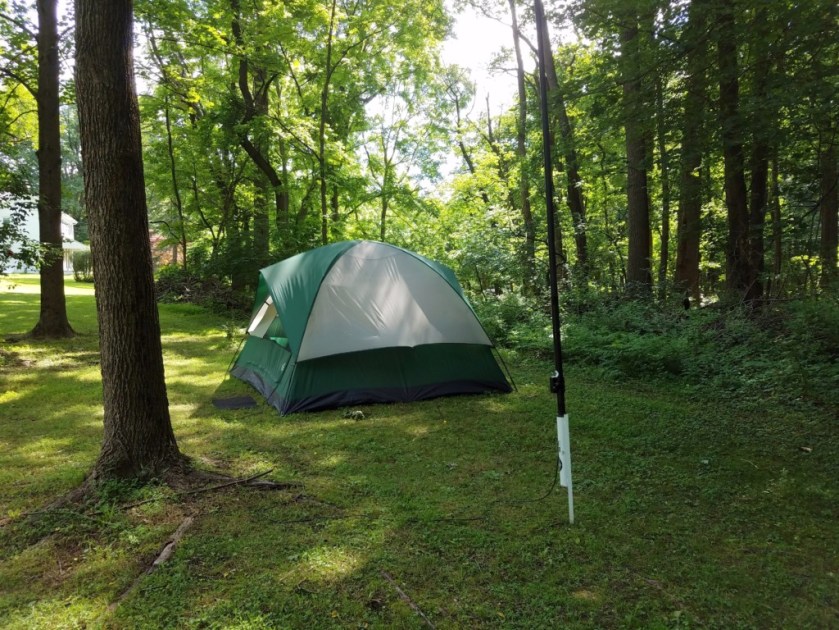
This is my (WB3GCK) tent. The Jackite pole in the foreground is supporting the vertical portion of my 58-ft inverted L antenna.

We sat around chewing the fat until it started to rain around 10:30 PM. At that point, we retreated to our tents for the night to ride out the storm. It certainly was a rough night, with some of the heaviest rain I have ever experienced in a tent. My old tent made it through the night with only some slight leaks. WA8YIH’s canopy, unfortunately, was destroyed by the heavy rain. Other than that, we got through the night otherwise unscathed.

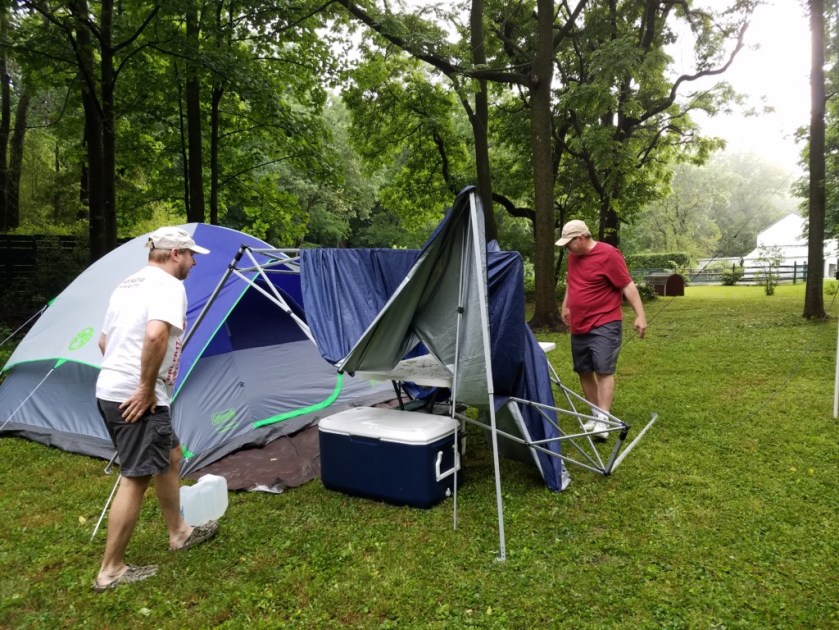
Ron WA8YIH (left) and Glen NK1N surveying the aftermath of Tropical Depression Cindy. Ron's canopy was a total loss.
Ron WA8YIH (left) and Glen NK1N surveying the aftermath of Tropical Depression Cindy. Ron’s canopy was a total loss.

After breakfast on Saturday, we went about setting up our radio equipment. Ed WA3WSJ arrived mid-morning.

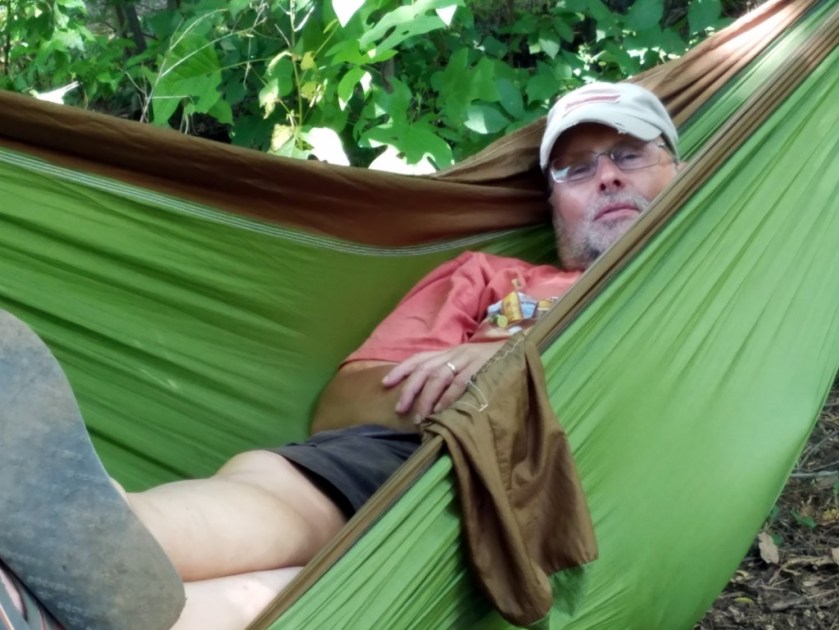
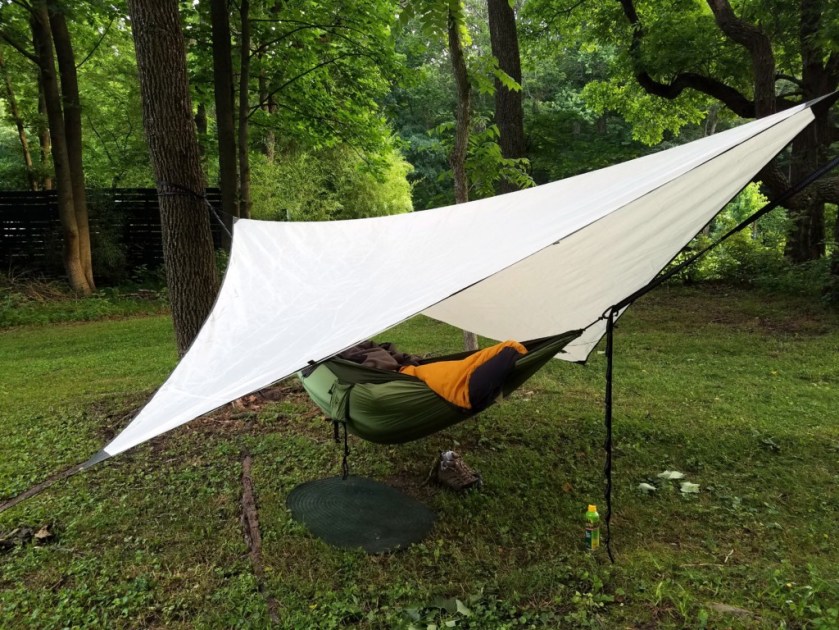
Ed WA3WSJ camped out in his hammock. He's in there somewhere.
Ed WA3WSJ camped out in his hammock. He’s in there somewhere.

This year, we operating as Class 3A EPA, using our club callsign, W3BQC. We were all QRP on battery power. I operated CW while WA8YIH operated SSB, digital and a little CW. NK1N worked satellites using his new portable setup. K3YTR worked 2M and 440 SSB. WA3WSJ assisted with all the stations.

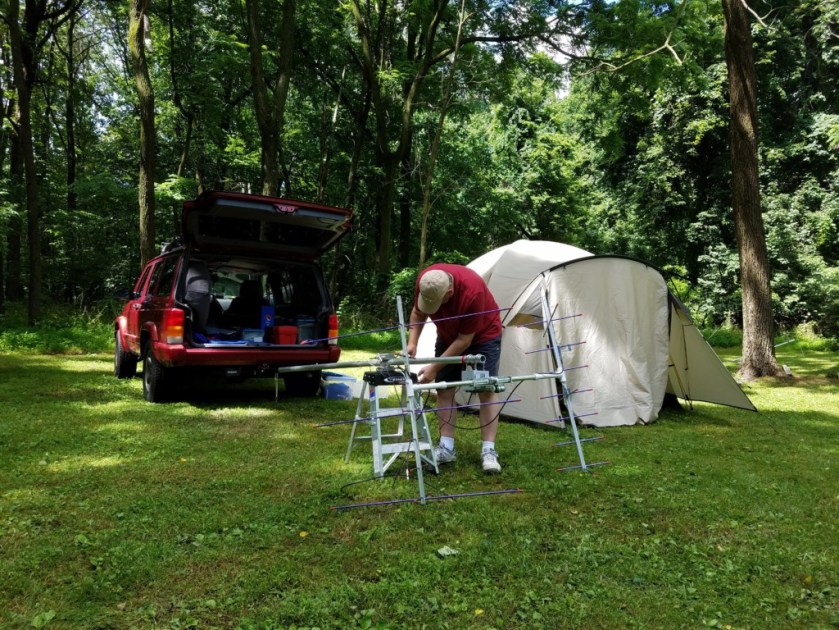
Glen NK1N setting up his antenna array for satellite communications.

On HF, WA8YIH and I were both running KX3s and inverted L antennas fed through 9:1 ununs. Propagation seemed fair on Saturday but was much better on Sunday. Despite all the wet foliage around us, NK1N managed to make some decent satellite contacts. On Saturday night, I switched my station over to digital to copy the W1AW Field Day Bulletin on 80 meters.

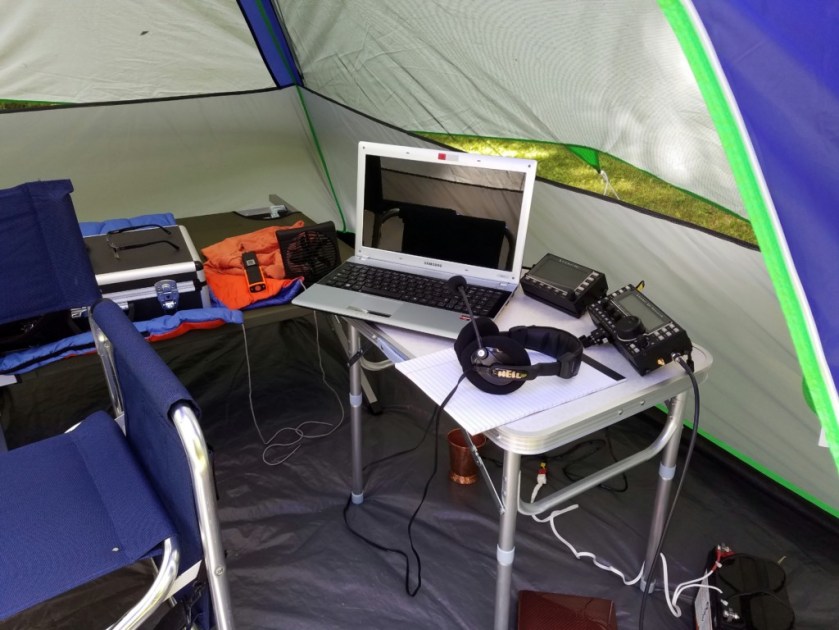
This is Ron WA8YIH's station running SSB and digital.
This is Ron WA8YIH’s station running SSB and digital.

Field Day with the Boschveldt QRP crew is always a somewhat laid-back affair. None of us are serious contesters, so there is always a lot of socializing going on during the weekend. During the evening, we assemble around the campfire to swap tall stories. We never rack up huge scores but we always have a lot of fun.

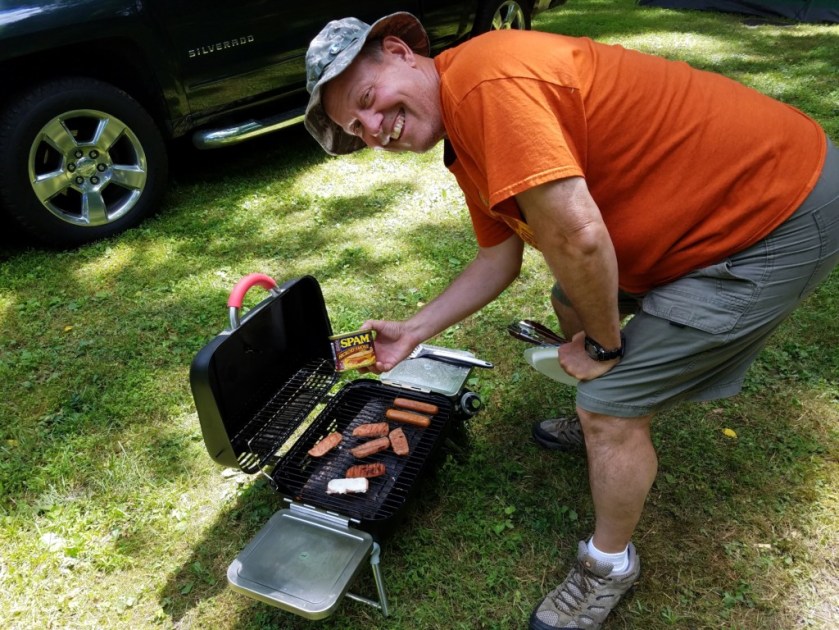
WA3WSJ grilling Spam for lunch on Sunday

After a Sunday lunch of grilled Spam sandwiches, we started tearing down and packing up. We haven’t compiled our logs yet, so I don’t know what our final score is yet. I’m sure we didn’t set any records but, if they gave out bonus points for having fun, the Boschveldt crew would be at the top of our category.

For more (and much better) pictures of our Field Day, visit the Boschveldt QRP website.

72, Craig WB3GCK
Father’s Day Weekend Camping

As is my usual practice, I spent Father’s Day weekend camping with my XYL. One of my Father’s Day “gifts” is a relaxing weekend with some occasional ham radio.

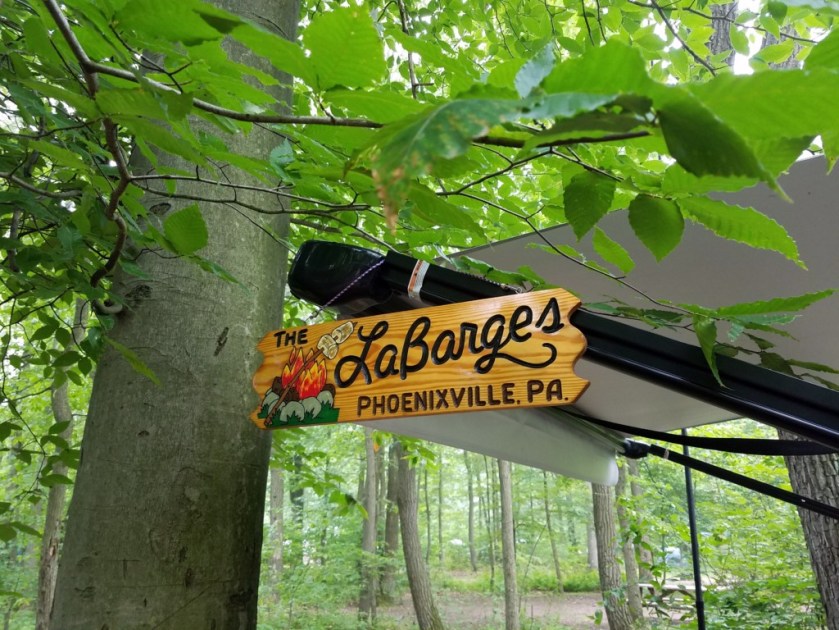
Our camp sign. A local artisan made this for us many years ago.

We took our travel trailer up to nearby French Creek State Park. On our maiden voyage with the trailer, I encountered some noise issues. Not this time. Since the trailer was only on battery power this time, I didn’t have the noisy 12V converter to contend with. Plus, I used my Jackite ground mount to mount my antenna further away from the trailer.

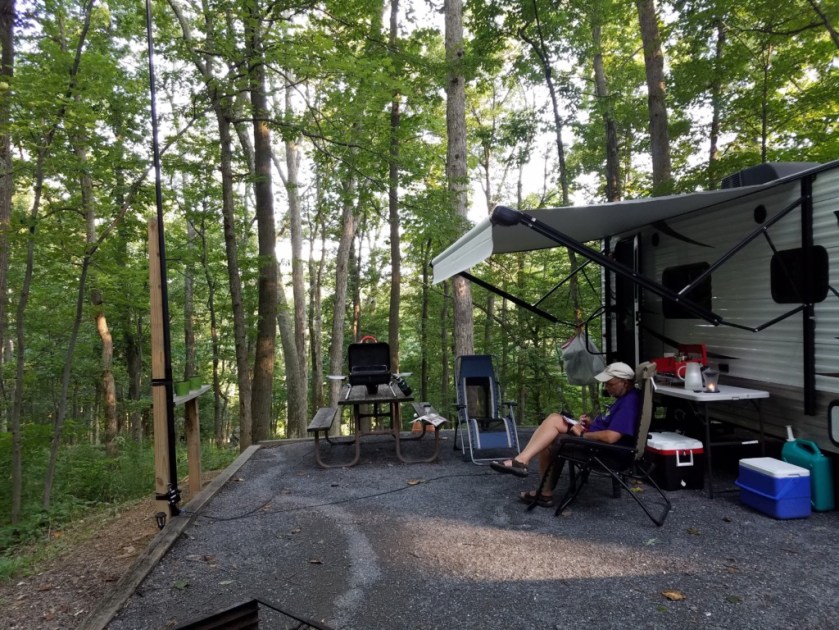
My 31-foot Jackite pole. This time I located the antenna about 10 feet away from the trailer.

For this trip, I used the 31-foot Jackite pole to support a 30-foot wire and fed it with a 9:1 unun. Inside the trailer, I used my KX3 with a small LiFePO4 battery. Using the KX3’s internal antenna tuner, I was able to load up on all bands from 80-6 meters. The KX3’s tuner never ceases to amaze me.

Operating on and off over the weekend, I made a dozen or so casual contacts. Some of them were pretty interesting:

  • On Saturday, I worked WB2LQF in New York. Stan was running 1W to his attic dipole and was delivering an amazing signal into southeastern Pennsylvania. On Sunday, I worked Stan again. This time he was operating WW2DEM aboard the USS Slater in Albany. Like me, Stan is a former Navy Radioman.
  • I worked N2CX who was doing a Parks on the Air (POTA) activation from Big Pocono State Park (KFF-1333) in the Pocono Mountains of Pennsylvania. I was monitoring his usual 40-meter frequency and caught him when he first came on the air.  After working Joe, I decided to start submitting my POTA logs.
  • I worked K1ZK as he was testing his new MTR rig on 20 meters. Zack and I had a nice two-way QRP chat. I was pleased to be his first contact with the new rig.
  • I wrapped up the weekend by working the NAQCC guys operating NY3EC aboard the USS Requin.

I also had a chance to do a quick test of the vertical antenna I have been working on. It’s getting better but the 30-meter band is still resonating a bit low. I’ll be doing another loading coil tweak this week.

My experimental vertical antenna set up on our campsite for some quick SWR measurements.

Next weekend I’ll be out with the Boschveldt QRP gang for Field Day. If you hear W3BQC on the air, give us a shout.

72, Craig WB3GCK
Weekend Antenna Testing

Carrying on from the initial testing I did last week, I went out for a bike ride yesterday and took my experimental vertical along.  (I gave a general description of this antenna project in my previous post.)  I rode a few miles up the Schuylkill River Trail and on to a park along the Perkiomen Trail.

I set up in a remote section of the picnic area and quickly took some readings on 40 and 30 meters with my antenna analyzer.  I had done some tweaking to the loading coil but, unfortunately, both bands were still resonating too low.

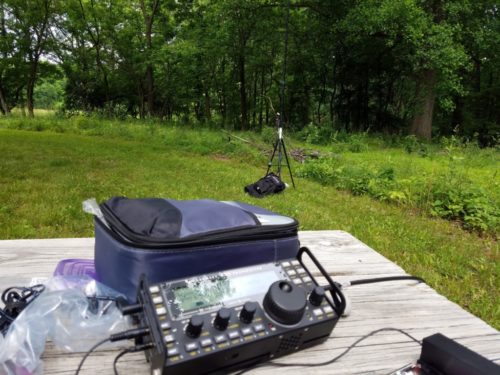
My set up at Lower Perkiomen Valley Park. If you look closely at the S-meter in the upper right of the display, you can see the horrendous noise level on 40 meters.

I set up my KX3, intending to make some contacts.  This, however, was not to be.  There was a background noise level that was higher than I had encountered on a previous visit to this park.  As I was tuning around, I looked over and saw that the wind had blown my antenna over.  I neglected to bring anything along that I could use to stabilize the antenna and tripod.  I set it back up but it wasn’t long before the antenna was on the ground again.  After it blew over a 3rd time, I gave up.  I packed up the bike and rode back down the trail to my truck.

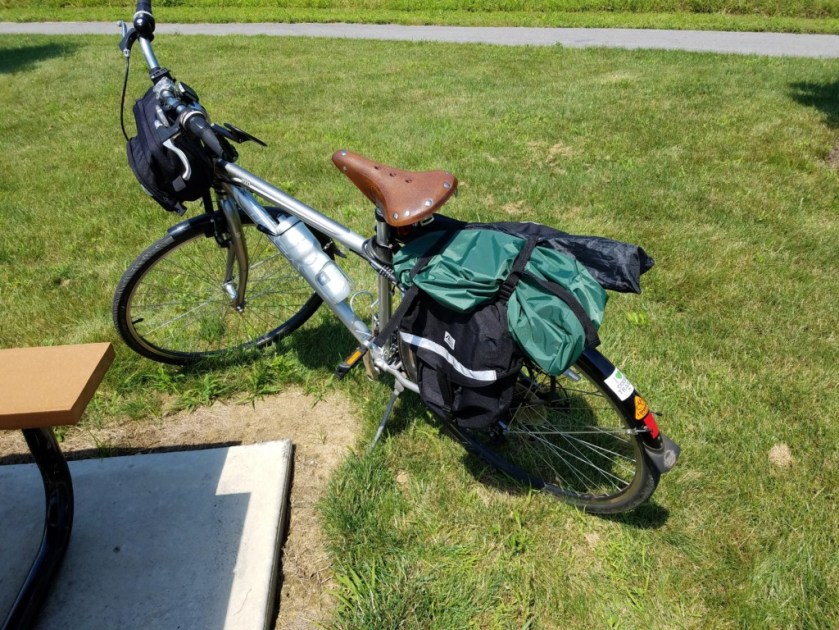
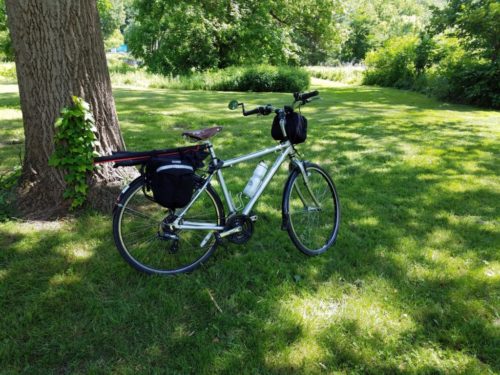
My bike loaded up for the trip home. No contacts today but at least I had a nice bike ride!

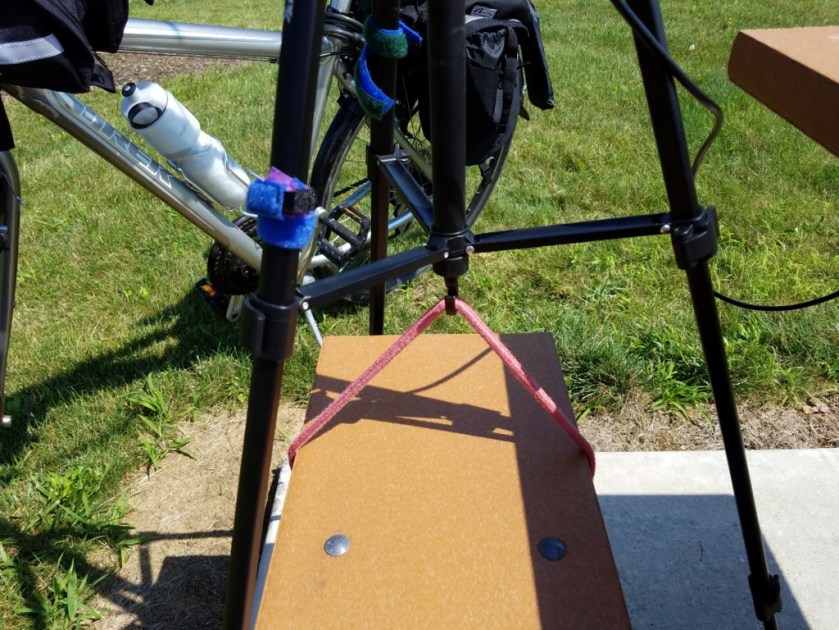
This morning I made another adjustment to the antenna’s loading coil and headed over to Valley Forge Park to test it.  Like yesterday, it was somewhat breezy.  This time, I hung my backpack from a hook on the bottom of the tripod to make sure the antenna stayed upright.

My set up at Valley Forge National Historical Park. I hooked my backpack to the bottom of the tripod to help stabilize it in the wind.

I took some antenna analyzer readings and found that the 40-meter band was now resonating right where I wanted it.  I saw some improvement on 30 meters but it was still resonating below the band.  Obviously, the tap for the 30-meter band is in the wrong place.

As I tuned around, it the bands seemed better this morning.  I worked N5P in Texas on 20 meters.  N5P was participating in the Museum Ships Weekend event from the National Museum of the Pacific War.  I moved down to 30 meters and heard a couple of strong stations.  I didn’t make any contacts there, though.

I called CQ on 40 meters and quickly got a call from N1PVP in Massachusetts.  I remembered working Marino a couple of weeks ago.  He always has a very strong signal into Pennsylvania.  I wrapped up with a two-way QRP QSO with Alan AC8AP in Ohio.

Antenna-wise, I have to do some thinking about how to proceed with my experimental vertical.  As I see it, I have a few options:

  • I could continue to tweak the existing coil.  If I remove turns from the bottom of the coil while adding the same number of turns to the top of the coil, this would effectively move the tap point for the 30-meter band.
  • It might be easier to just re-wind the coil and add a few more tap points.  I could do some testing to see which tap works the best.
  • I could always invoke the “do nothing” option.  The SWR on 30 meters is only about 4.3:1, which is a trivial match for the KX3’s internal tuner.

In any event, the antenna is useful as it stands.  I’ll take some time this week to consider my next move.

72, Craig WB3GCK
Memorial Day Antenna Testing

Some time ago, I bought a small, lightweight telescopic fishing pole from a Chinese vendor on eBay.  It’s about 19.5 feet tall and collapses down to about 26 inches.  It’s a great size for backpacking or transporting on my bike.  It weighs practically nothing.  In fact, it’s too light for supporting anything but a lightweight vertical wire.  Although I have used it a few times to support various antenna configurations, I never really found one that was a “keeper.”

Since I had some time over the long holiday weekend, I scratched out a quick design for yet another vertical antenna and cobbled it together with parts I had on hand in my junk box.  I designed it to operate as a base-loaded resonant vertical on both 40 and 30 meters.  On 20 meters and higher, it operates as a non-resonant wire; thus, an antenna tuner is required on those bands.  Along with the loading coil, the matching unit contains a 1:1 choke balun to isolate the feedline.    Both the choke balun and tapped loading coil are wound on toroids and mounted in a small, plastic enclosure.  The radiator is a 19-foot piece of #28 wire.  I could have shortened the radiator to make it resonant on 20 meters also, however, I went with the longer radiator for better performance on 40 meters.  I used four 12.5-foot radials that I made from a 25-foot roll of cheap speaker wire.

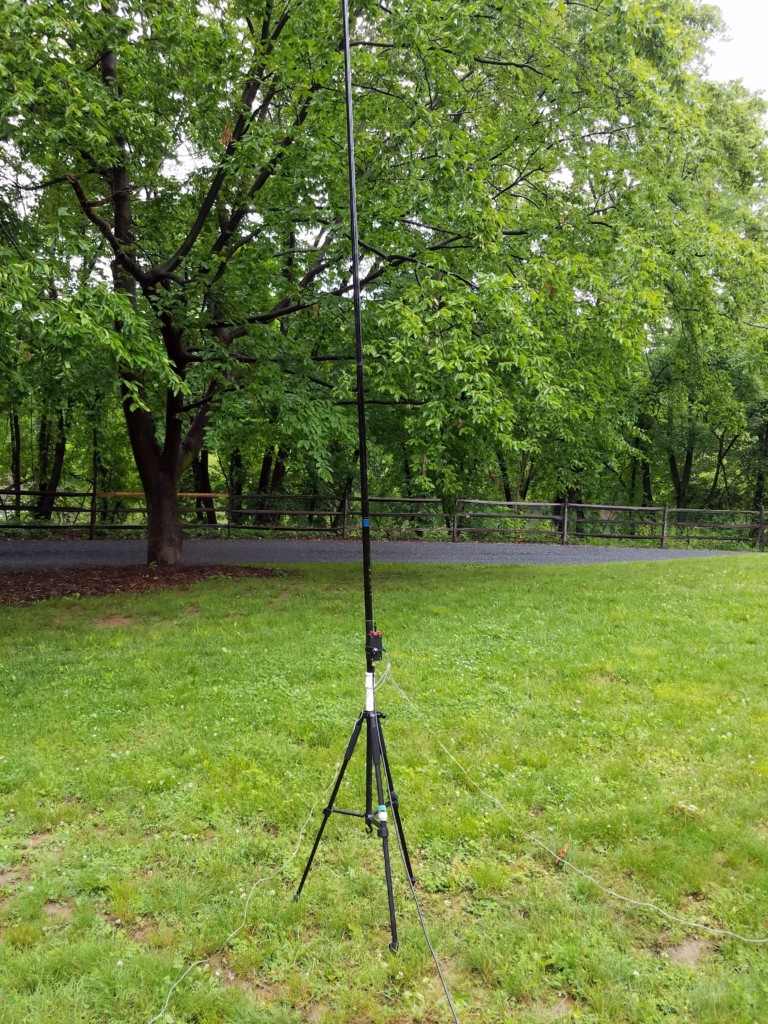
The antenna I was testing. The white piece between the telescopic pole and the tripod is an adapter I made from PVC pipe.

Normally, I like to use the “build a little, test a little” approach.  Since I don’t have the luxury of space at home for antenna testing, I just took my chances and built the whole thing.  I headed out to a local park yesterday to give it the “smoke test” and see how close I came with my loading coil design.

My operating location on a cloudy and rainy morning

It took less than 5 minutes to set it up.  I used an antenna analyzer to take some initial measurements.  On both 20 and 30 meters, the resonant frequencies were low and fell outside the band.  I still have some work to do there.  On 20 meters and up, the KX3’s tuner loaded it up easily.

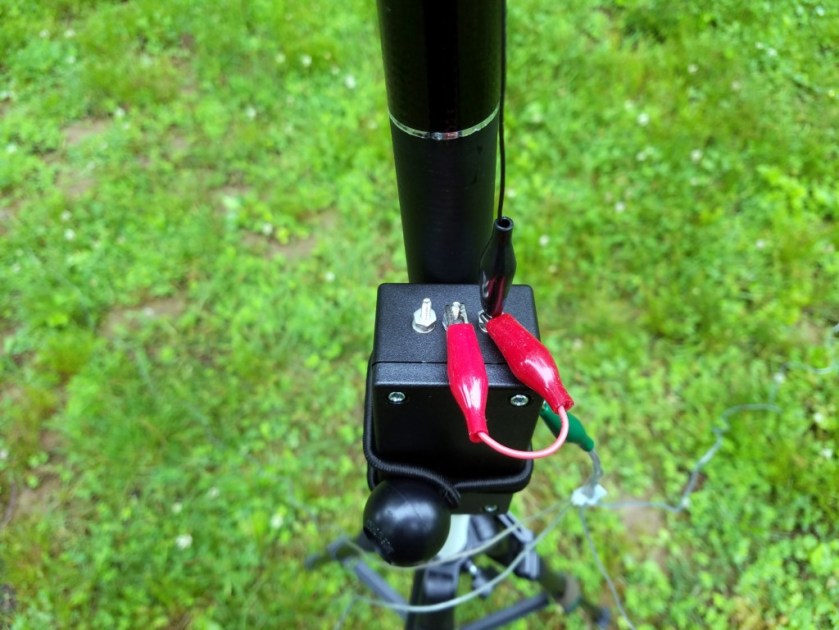
The antenna matching unit. The red jumper is used to change bands.

Next, I wanted to put it on the air.  I started on 40 meters and used the KX3’s tuner to tweak the SWR.  I called CQ a few times and eventually got a call from K4ALE in Virginia.  Bevin said I was 559 with QSB.  Despite the poor band conditions, we had a nice chat.

After I signed with Bevin, I set the antenna for 30 meters and kicked in the KX3’s tuner.  I called CQ and was quickly answered by NN4NC in North Carolina.  Jim gave me a 569.  At times, the band would fade to just about nothing.  As I was chatting with Jim, some drizzle started blowing in under the pavilion where I was sitting.  So I signed with Jim and quickly packed up.

I’ll be doing some adjustments to the antenna over the coming weeks.  It looks, though, that this could be a useful portable antenna, once I get the loading coil straightened out.

Since this is a work in progress, I left out the details for now.  After I get the antenna working as intended, I’ll provide a detailed description, schematic and parts list in a future post.

72, Craig WB3GCK
IFR – The Curse is Broken!

field_radio_logoI went out to a nearby park to operate for a bit in the International Field Radio Event.  It took 3 of these events but I finally worked another IFR participant!

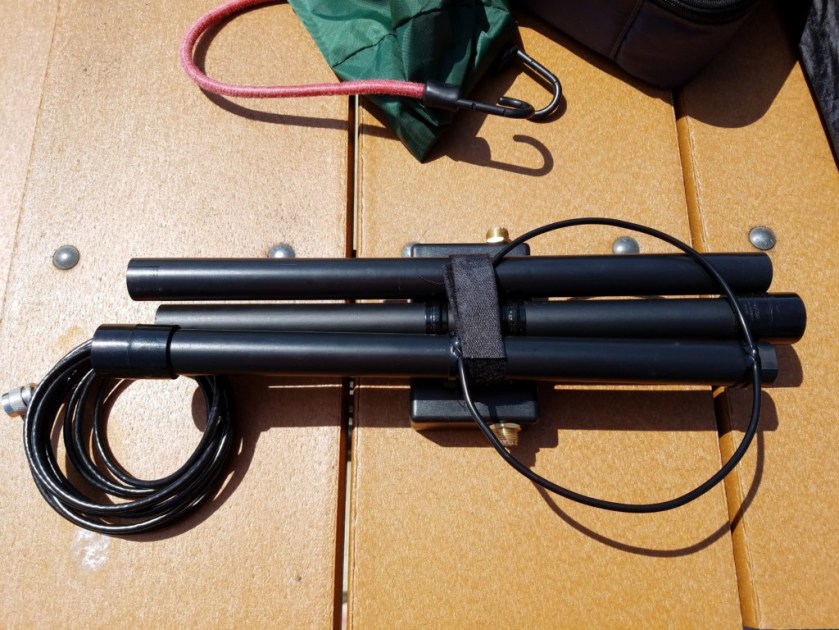
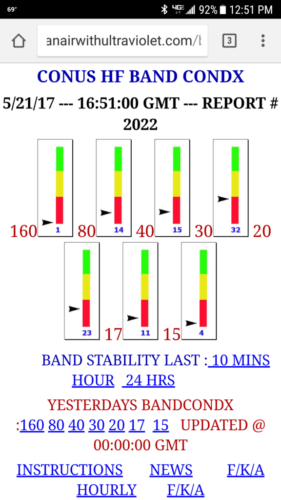
I didn’t expect to be out for very long so I kept my setup pretty basic.  I set up my Alexloop on a short tripod on top of the picnic table.  (That decision would come back to haunt me later.)   I fired up my KX3 and found the bands were suspiciously quiet.  In fact, it was hard to get enough receiver noise to peak up the Alexloop.  That’s usually a bad omen.  A check of the Band Conditions website confirmed that.

Band conditions weren’t the greatest today.

Undeterred, I started calling CQ on 14.035 MHz, the Field Radio group’s 20M calling frequency.  I got a call from NE3I whose signal was very strong. It turned out that Bob was only about 5 miles away from me.  As he noted during our conversation, we could have done the QSO on 2M simplex.   Bob wasn’t in the IFR event but I appreciated his call; I wasn’t going to get skunked today.  As I was working Bob, I was keying with one hand and swatting at bugs with the other.

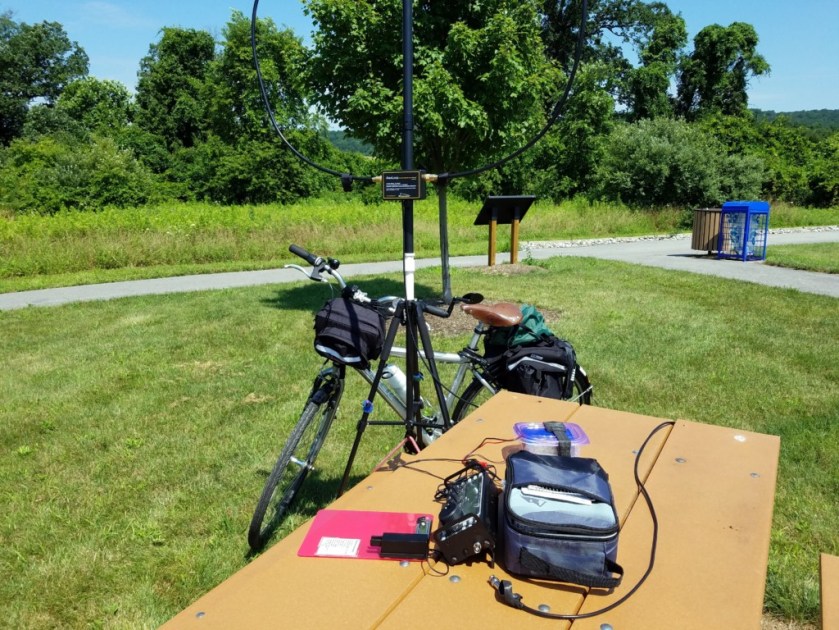
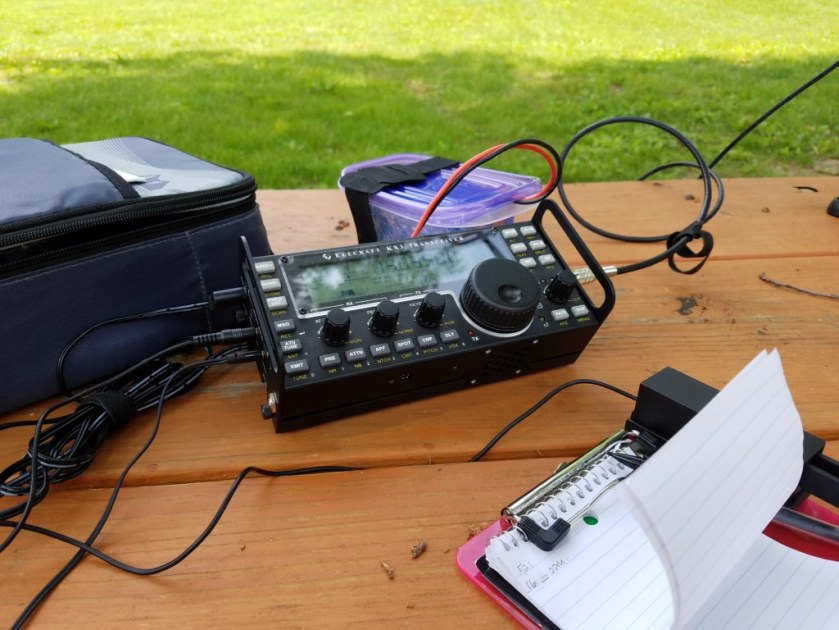
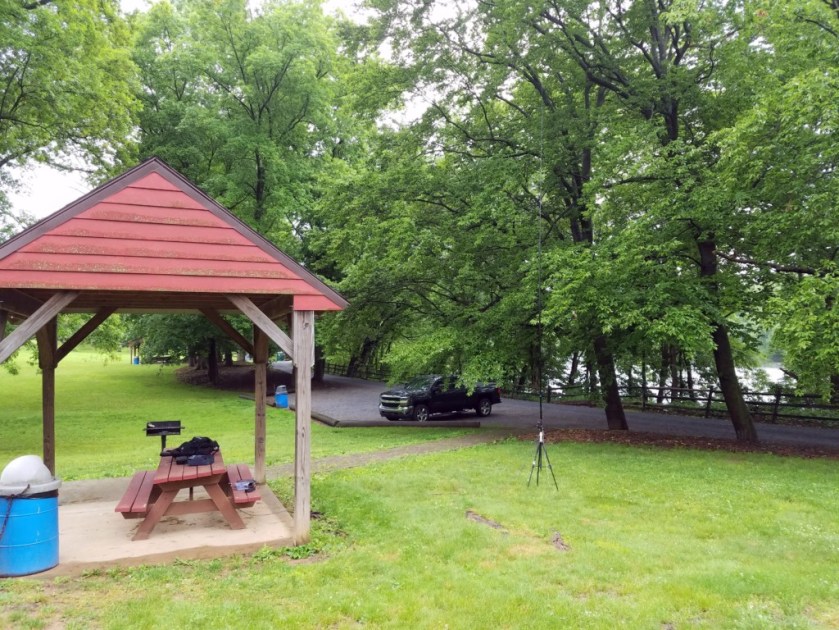
Picnic table portable for the International Field Radio Event. The Alexloop was on a short tripod on top of the table.

I moved down to the 40-meter calling frequency (7.035 MHz) and had a short two-way QRP contact with another non-participant, K3JPT.  He was two counties west of me.  After a while, W3DET in North Carolina came up on the frequency and called, “CQ IFR.”  I gave him a call and he came right back to me.  Happy dance!  After we exchanged IFR numbers, Dave noted that this was his first IFR contact.  I replied that it was mine also.  How about that?  I finally made an IFR contact!

I wrapped things up with another non-IFR contact with N1PVP in Massachusetts.  As I was signing with Marino, the wind kicked up and knocked the Alexloop over.  That was my clue that it was time to pack up.  Yep, I probably shouldn’t have set the tripod up on the table.

With my first International Field Radio Event contact in the log, I declared victory and headed home.

For more information on the Field Radio group, visit www.fieldradio.org.

72, Craig WB3GCK
A Memorable Contact

I’m sure we’ve all had memorable contacts.  You know, the ones where you can recall the content and the events surrounding them, even decades later.  I was going through one of my old logbooks today and I saw an entry from almost 22 years ago that brought back a flood of memories.

Back in August of 1995, my wife and I took our two daughters on a weeklong tent camping trip to the Eastern Shore of Virginia.  My wife had a “milestone birthday” that week (I won’t say which one) and that’s how she wanted to spend it.

We arrived at our campsite on Saturday, August 12th, 1995, and quickly set up our tents.  As is my usual custom, I brought a QRP rig along.  My simple set up for this trip was my old MFJ-9030 30M rig and my old J-38 straight key.  I strung a lightweight dipole between two pine trees and ran the RG-174 coax down to a picnic table.  The rig was powered by a 7 A-H gel cell battery, which was enough power for a week of casual operating.  The MFJ-9030 put out about 3 watts under battery power.  On a typical day, I got on the radio each morning for a couple of contacts and again later in the day.

Our vacation got off to a great start.  While my wife was away from the campsite on her birthday, the girls and I threw her a surprise birthday celebration.  We decorated the campsite with balloons and streamers.  My family enjoyed spending time outdoors without the distraction of TV and telephones.  Back in 1995, smartphones weren’t available and I didn’t own a cellphone yet.  By Monday, there weren’t any other campers near us.  So, we were blissfully unaware of what was going on in the world outside of our little campsite.

The morning of Tuesday, August 15th, 1995, was a typical morning for me while camping.  I was up earlier than the rest of the family.  I got the percolator ready and fired up our old Coleman camp stove.  While the coffee was brewing, I turned on the radio and tuned around the 30-meter band.

Just before 7:00 AM local time, I made contact with Clark W8IHN/8.  Clark was operating portable from Houghton Lake, Michigan.  We had a very nice rag chew.  During our CW conversation, Clark mentioned that he was 79 years old and had been on CW for 66 years!  He was interested in our camping set up and our location.  He asked me if I was following the news.  I said I hadn’t been.  He said I should since there was a hurricane heading our way.  He said it looked like the Virginia coast was going to be getting high winds and “big surf.”  He advised that we not wait too long to leave the area.  We signed off after an enjoyable 45-minute chat.  In my notebook, I wrote, “QSL for sure.  Send a postcard.”

QSL card from W8IHN. On the back of the card, he wrote: “What can I say, Craig, it’s not often that I run into a fellow ham that I take a liking to. I do hope we can meet up again on 30M.”

Concerned by Clark’s warning, I got in the car and tuned the radio to a local broadcast station. Clark was right — Hurricane Felix was heading our way.  Before we left Pennsylvania, Felix was still churning around in the Caribbean.  It didn’t seem to be much of a threat to our vacation plans.  Now, a hurricane warning, which included our location near the lower Chesapeake Bay, had been issued.  To the south of us, they were planning an evacuation of the Outer Banks of North Carolina.  Things were getting serious.

We spent the day listening to the news on the car radio and considering our options.  I suggested that we head inland and look for a safer campsite.  In the end, we decided to just head home the next day.

The next morning, I made two last contacts on 30 meters before taking the dipole down.  After breakfast, we tore down the tents and packed up for the trip back to Pennsylvania.  We stopped in the campground office to check out.  They said they were planning to evacuate the campground later that day.  Since they were planning to close the campground, they gave us a credit for our unused nights.

We were all disappointed that our vacation was cut short.  At least, we able to get out of the area, avoiding the traffic and confusion of an evacuation.  As we drove home, I was glad that I brought the QRP rig along and very grateful for that CW contact with W8IHN that had tipped us off to the bad weather heading our way.

In the end, Felix never did make landfall in the U.S.  It did, however, impact the East Coast.  In addition to major beach erosion,  nine unfortunate souls lost their lives due to the heavy surf.

Clark and I exchanged QSL cards but I don’t think I ever worked him again after that.  His real name was Whittier E. Clark.  Doing some Internet research, I found out that he became a Silent Key two years after our contact.

Wherever you are, Mr. Clark, I still think about our CW contact in the summer of 1995 and the concern you showed for me and my family.

73, Craig WB3GCK
QRP to the Field 2017

I missed the QRP to the Field (QTTF) contest last year due to family obligations.  I almost missed it again this year for the same reason.  I had some family coming in this weekend but I managed to sneak out for a few hours to make a few contacts.

The theme this year was, “A River Runs Through It.”  Stations operating near a river get a higher multiplier for their score.  Living near the Schuylkill River, I have a lot of options.  I decided to head over to Upper Schuylkill Valley Park, which is one of my regular operating spots.

A view of the Schuylkill River from Upper Schuylkill Valley Park.

The weather forecast was calling for periods of rain throughout the day, so I opted to operate from inside the truck.  As it turns out, that was a wise decision.  It rained most of the time I was operating.

My “stationary-mobile” set up for QRP to the Field

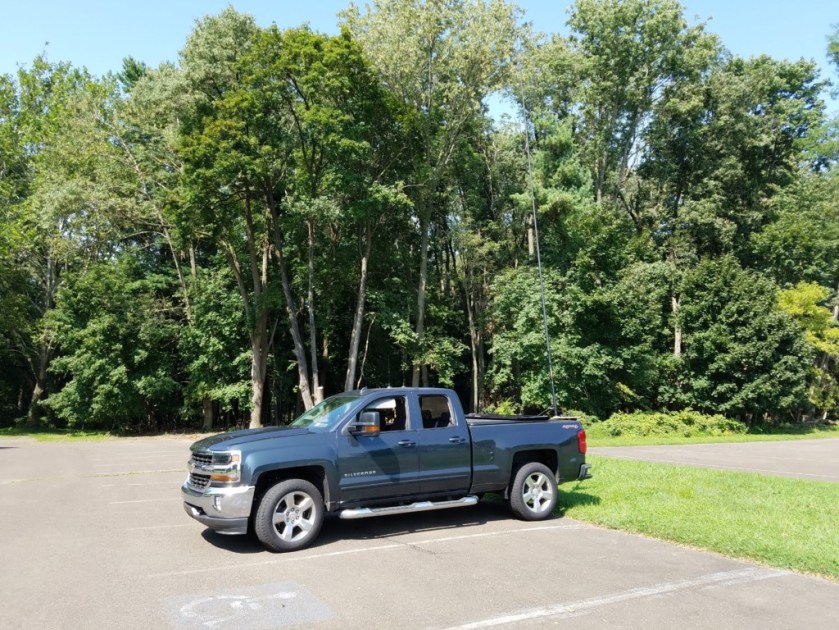
I set up my trusty 30-foot vertical on the back of my truck and set up my KX3 on the center console.  I was quickly on the air but I wasn’t hearing much.  Between some solar storms and static from the rain, band conditions were pretty lousy.

My operating position in the truck.

After a while, 40 meters opened up a bit.  I had a brief run of stations there.  Twenty meters remained pretty dismal.  I heard W0RW/M out in Colorado early on but could connect with him.  I eventually worked Tom K4AKC in Alabama.  Besides that, I didn’t hear much of anything on 20 meters.

After about two hours, I had to leave.  The rain started picking up, so I quickly took down the antenna and headed home.  I ended the day with 10 contacts on 40 meters and just 1 on 20 meters.

As I was packing up, a large group of kayaks traveled down the river.

I sure could have used some better band conditions and weather but, all things considered, I was happy with the 11 stations I managed to work.

72, Craig WB3GCK

Back in the Saddle Again

I took advantage of this sunny Spring day to get in my first bike ride of the year.  The Straight Key Century Club’s  Weekend Sprintathon (WES) was in progress, I figured I would stop along the way to make a few contacts.

I rode a few miles down the Schuylkill River and Perkiomen Trails and set up in a park.  I’ve operated from this spot on many occasions.  The ground was still muddy from recent rains but, fortunately, there’s a convenient bench there.

My antenna launching arm was a bit rusty.  It took a few tries to get my line over the tree branch I was aiming for.  I set up the radio on the park bench and tuned around.  The bands seemed a bit quiet for a contest weekend.

My trusty bike once again serving as the anchor for my 30-foot wire antenna.

I alternated between calling, “CQ WES,” and searching around for other SKCC stations.  I wasn’t having much luck.  I got my phone out and checked a couple of propagation sites and wasn’t encouraged by what I saw.  I checked RBN and saw that I wasn’t getting many spots.  I was also getting an S4 noise level on 40 meters.  There was a park building about 100 yards away from me.  I’m guessing that something over there was causing the noise.  All-in-all, this wasn’t shaping up to be a memorable day for QRP operating.

Park bench portable in Lower Perkiomen Valley Park.

Fortunately, W8IQ heard me in Ohio and rescued me from getting skunked today.  Sometimes there are days when it would have been more productive to pack a fishing rod instead of a radio.

Anyway, it was a great day to get back out on the bike and loosen up these old knees of mine.

72, Craig WB3GCK

Back to the Field Again

Boy, it sure has been a while since I’ve done any portable operating.  Other projects and interests seemed to have overtaken ham radio for the past few months.  With temperatures near 70F today, I couldn’t resist the opportunity to shake off my cabin fever.

My XYL was planning to drive out to our daughter’s house to help her out with a household project.  I decided to tag along and do some operating from my daughter’s property.  I purchased a new truck about a month ago and had yet to do any QRP operating from it.  Today looked like a great opportunity to do a little testing.

I parked the truck in a remote corner of my daughter’s property, next to her neighbor’s corn field.  I set up a 29.5-foot vertical using my bike rack mount on the rear of my truck.  I fed it through a 9:1 unun and ran a 25-foot coax cable into the passenger side window of the cab.  So far so good.

My new truck's first QRP-portable outing.
My new truck’s first QRP-portable outing.

Given that this truck is larger than my last one and the configuration of the center console is much different, I had to do some finagling to place my KX3.  I used a small Rubbermaid® container on the passenger seat and placed the KX3 on top of it.  Due to the distance involved, I had to place my clipboard and paddles on the console in order for the cable to reach the rig.  (Unfortunately, I forgot to take a picture of the setup.)  It worked OK but I need to figure out a more comfortable arrangement.  I have some ideas that I’ll be exploring.

Bike Rack Antenna Mount. A 9:1 unun is attached to the Jackite pole with a bungee cord.

My goal for today was to make contacts on 40, 30 and 20 meters.  I started out calling CQ on 40 meters and NN4NC in North Carolina came back with a very strong signal.  During our QSO, Mac reduced his power to match my 5 watts and he continued to boom into southeastern Pennsylvania.  I then moved up to 30 meters and had a short exchange with W1TEF in South Carolina.

When I moved to 20 meters, I heard WU5M calling CQ near the QRP watering hole.  I gave Bryan a call and we had a two-way QRP QSO, despite some fading on the band.  It started to rain so I signed with Bryan and quickly took down the antenna.  I was parked in an area that tends to get very muddy when it rains.

So, everything worked fine with the new truck but I do need to work out some better ergonomics.  It felt good to get back out in the field again, even if only for an hour or so.

72, Craig WB3GCK

Winter Field Day 2017

Well, there wasn’t much “field” in Winter Field Day (WFD) for me.  My XYL and I traveled out to central Pennsylvania for the weekend to babysit our 2-year old grandson.  My plan was to sneak out into the backyard for a few hours each day to operate in WFD as category 1O (outdoor).  Before the weekend, however, I came down with a wicked cold (courtesy of my other grandson).  I decided that operating out in the cold probably wasn’t a good idea.

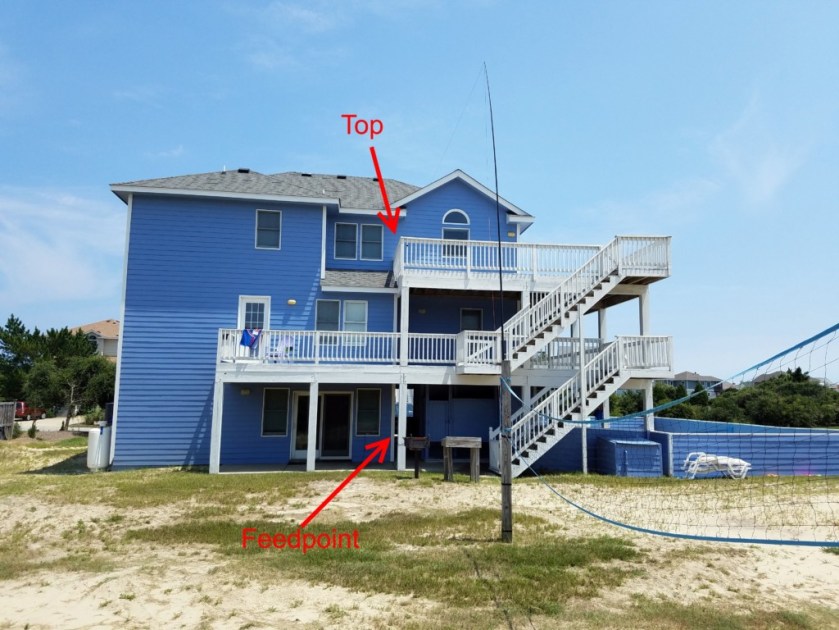
I strapped my 31-foot Jackite pole to the fence in the backyard and used it to support the far end of my LNR EFT-10/20/40 end-fed halfwave antenna.  The feed point was just inside a second story window.  I set up my KX3 and operated under battery power.  I read over the rules and concluded that I was a “1H” (home) station.

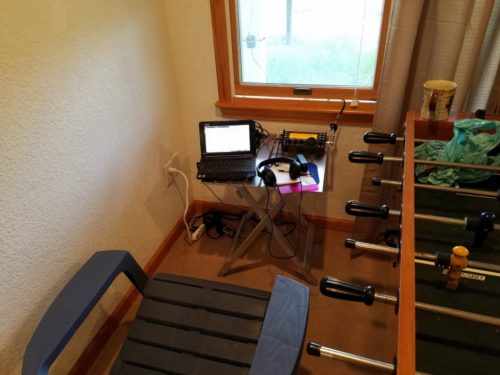
My temporary indoor station for Winter Field Day

After setting up, I had a warm-up QSO on 20M with K0WEW in Kansas.   Everything appeared to be working.  I operated mostly during nap time (my grandson’s, not mine).  With just a couple of hours of actual operating,  I ended up with 20 CW Winter Field Day stations in the log.  I’m sure I could have logged more if I had plugged in the microphone.  I just couldn’t bring myself to do that.

Outside of the contest, I worked TM1A (France) in the REF Contest (on 40 meters, no less).  I also had a nice two-way QRP QSO with W4MQC.  Alan was operating portable from New Hampshire.

Even though it wasn’t much of a Field Day for me, it wasn’t without some excitement.  At one point, all the signals on 40 meters suddenly dropped way down.  I looked out the window and saw that the wind caused my Jackite pole to collapse putting half of my antenna on the ground.  My halyard line got caught between two sections of the pole when it collapsed.  It took me about 30 minutes to get that mess straightened out.

My hat goes off to all the hardy hams who braved the cold for Winter Field Day.  Hopefully, next year I’ll get out there, too.

73, Craig WB3GCK