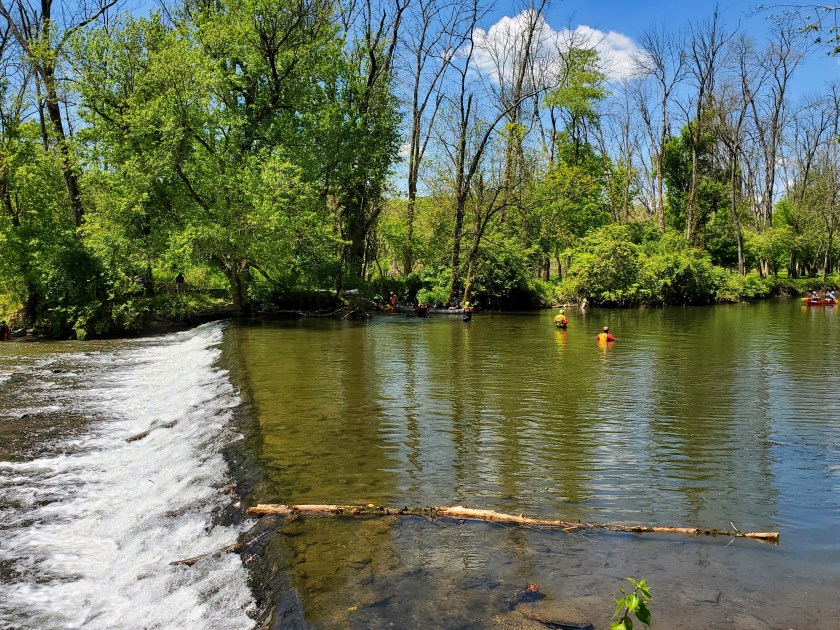
I’ve been slowly sneaking up on a POTA Repeat Offender Activator award for Valley Forge National Historical Park (K-0761), so I headed over there this morning for another activation. Now that the picnic areas and restrooms are open for the season, I drove to Varnum’s Picnic Area, one of my usual spots.
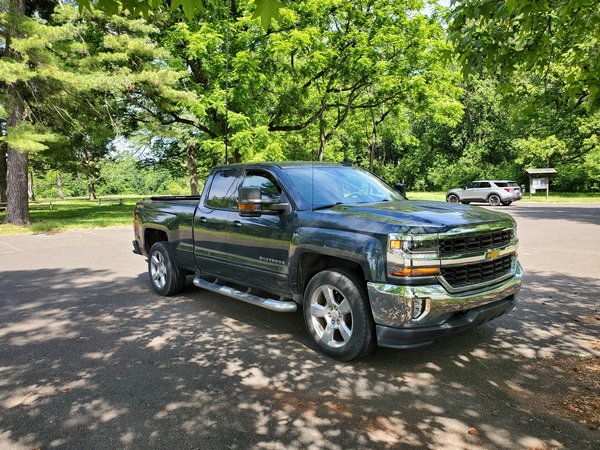
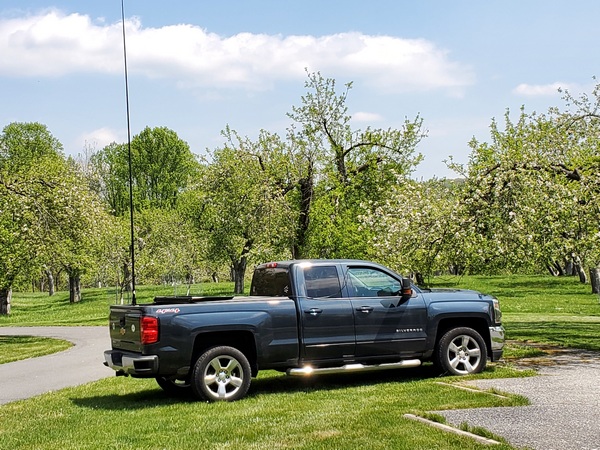
I was originally thinking of operating from a picnic table today, but the wind changed my mind. Instead, I parked in a remote corner of the parking lot and operated from the truck. My rig today was my trusty Penntek TR-35, along with my homebrew vertical.
I started on 40M and quickly made my first 10 contacts. I operated for about an hour, ending up with 28 QSOs in the log. Among those were four park-to-park contacts.
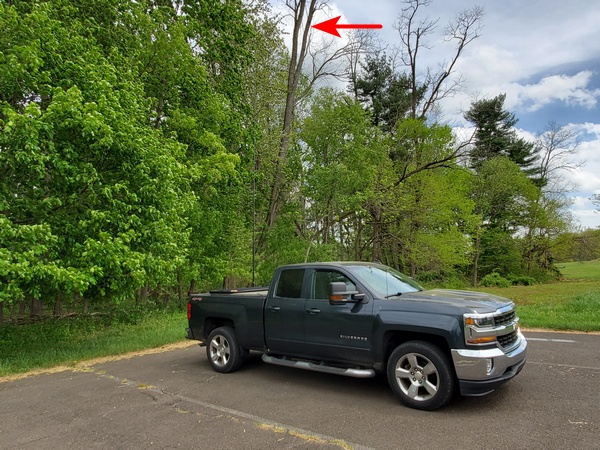
My location today at Valley Forge National Historical Park (K-0761). The dead tree in the background was really starting to sway in the wind.
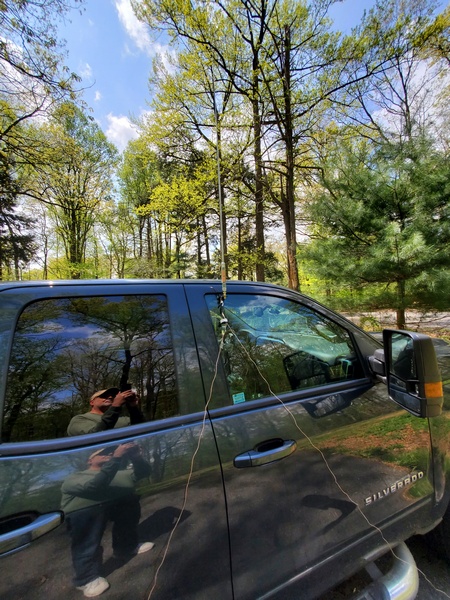
As I got out of the truck to change bands on the antenna one last time, I heard a loud creaking noise coming from the wooded area behind me. It was a large, dead tree (aka a “widow maker”) swaying in the wind. Although it wasn’t directly behind me, I was certainly within striking distance if it fell to the side. Yep, it was time to take the antenna down and head home.
As I write this, we have some severe thunderstorms headed our way later. Time to batten down the hatches.
I have been mostly off the air for the past few weeks, dealing with more knee issues. The bum knee felt a little better this morning, so I headed out for some long-overdue QRP-portable operation.
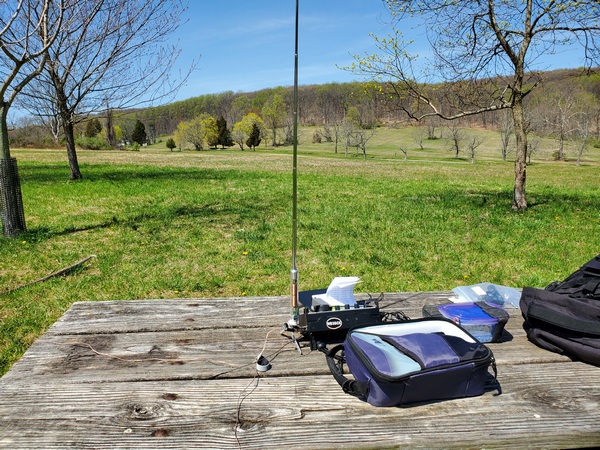
I drove over to nearby Valley Forge National Historical Park (POTA K-0761) for a short activation this morning. There was a picnic table close to where I parked, so I didn’t have to haul my gear very far. (My knee thanked me.)
It was a great day for portable operations in Valley Forge National Historical Park (K-0761).
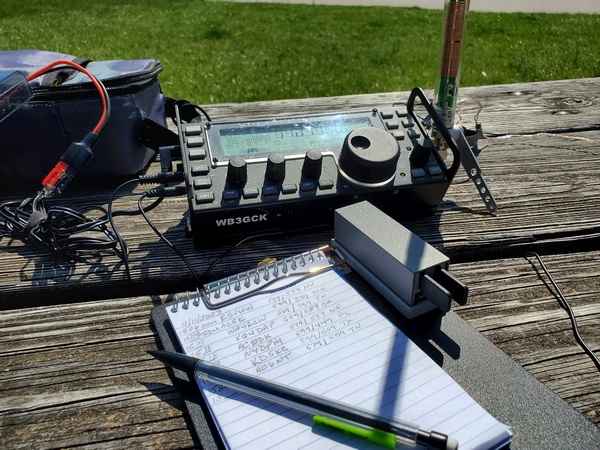
This morning, I used my KX3 (5 watts) and my AX1 antenna. I started out with the AX1 on a little tripod on the picnic table, but the KX3’s tuner seemed to struggle to find a match on 20M. I swapped out the 3-foot coax I was using for a 6-foot length I had on hand. That didn’t help. Next, I connected the AX1 directly to the KX3 and used the AXB1 bipod to stabilize it. After rearranging the radials a few times (I used three today), the KX3 eventually found a 1:1 match on 20M.
My picnic table operating position.
Once on the air, a station in Nevada kicked things off. After a few more, things slowed down. It seemed like I was stuck at eight QSOs for the longest time. Fortunately, things eventually picked up again, and I made enough contacts to qualify the activation.
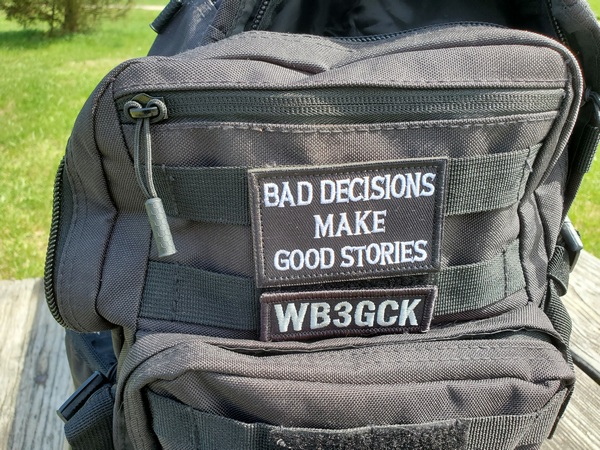
My backpack. My activation today was a good decision.
The picnic table I was using was out in the open with no shade. The sun felt great; but when the wind kicked up, that was a different story. I decided to pack up and head home for lunch. My log for today had 14 contacts, with two park-to-park. My best “DX” today was a park-to-park contact with California on 15M.
It was nothing earth-shattering today, but it sure felt good to be back out there again.
Along with the usual junk mail yesterday, the mailman brought a couple of envelopes from the Straight Key Century Club (SKCC) QSL Bureau. Among the QSL cards I received, were two special ones.
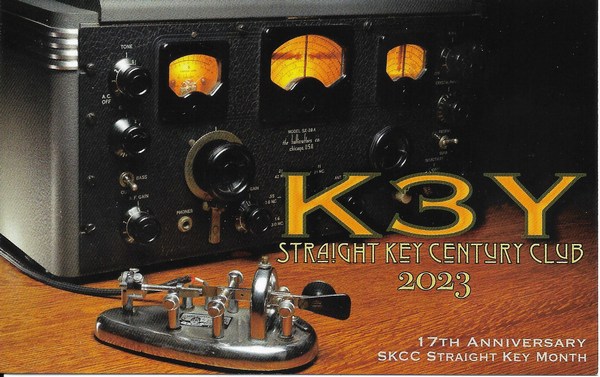
First was a QSL card confirming contacts I made with K3Y stations during the annual Straight Key Month (SKM) event. SKM is held each January with event stations operating around the world. I didn’t have my best year in the event, but I worked K3Y stations in eight of the ten call areas in the continental U. S. I also worked SKM stations in Puerto Rico and Portugal this year.
K3Y Straight Key Month QSL card for 2023
Each year SKCC members submit designs for the K3Y QSL card, and members vote to select the final design. I always try to work some of the K3Y stations each year to ensure I receive a QSL card.
Another card I received was for the VC3Y Canadian Operating Event. Taking place during the month of September, this is an annual SKCC event that promotes the club’s many Canadian members. This year, I worked VC3Y/VY2 (Prince Edward Island) on 40M and 20M. I remember those particular QSOs because I was out bicycle-portable in a local park at the time.
VC3Y QSL card for the 2022 Canadian Operating Event
Sadly, when the mailman came by today, it was back to the usual junk mail.
I made a quick run down to Ridley Creek State Park (K-1414) for an early morning POTA activation. For a few minutes, though, I thought I might fall short of the 10 contacts needed to complete the activation.
I dusted off my old MFJ-1820T 20M whip antenna and thought I’d try it out on my window mount. Inside the truck, my Elecraft T1 tuner loaded it right up. After calling CQ a few times, I checked the Reverse Beacon Network (RBN). The first spot I received was from Costa Rica. So, the antenna seemed to get out OK. I was running about five watts from my TR-35.
The MFJ-1820T 20M whip on my old window mount
Things got off to a good start on 20M. I had a steady stream of callers for the first several minutes, and I was getting strong RBN spots to the west of me. Then, things slowed down. It was five minutes before the next QSO. Then another six minutes after that. I was beginning to consider the prospect of a busted activation when activity picked up again. I suspect it was just a bit too early on a Sunday morning.
After I had 11 contacts in the log, I switched to the Elecraft AX1 to give 17M a try. I didn’t hear much activity there, and the RBN wasn’t seeing me at all. I stayed with the AX1 and went back to 20M.
The activity on 20M started picking up this time around. When I wrapped things up, I had 20 contacts in the log, with two park-to-park QSOs. I didn’t have any DX contacts today, but I did work two Idaho stations.
I continue to be amazed at what you can do with five watts and one of these little whip antennas.
Pressed for time this weekend, I drove down the road to Valley Forge National Historical Park (K-0761) to get in a quick activation. I was only on the air for about 40 minutes, but it was a very productive outing.
The weather this morning was chilly but sunny and clear. The crowded trailhead parking lot I pulled into reflected that. I had the good fortune to find a spot where I could set up and not be in the way.
To keep things simple, I used my Elecraft AX1 and window mount, along with my KX3. It took me all of a minute to set up the antenna. I really like that about the AX1.
My location in the crowded trailhead parking lot. It’s hard to see, but the AX1 is mounted on the passenger-side window with two counterpoise wires.
Starting out on 20M, the calls came fast and furious for the first 10 minutes or so. The second station to call was F4ILH. Given my 5 watts and little antenna, I was thrilled with that. Later on I worked IK4IDF up on 17M. The little AX1 never ceases to amaze me.
At the end of my brief activation, I had 18 contacts in the log. Along with the two DX contacts today, I had one park-to-park QSO.
Not too bad for an early morning, spur-of-the-moment activation, I suppose.
I had two different portable operations this weekend—a mixed bag of sorts.
Yesterday morning, I took part in an EmComm exercise with my local ARES-RACES group. We have a relatively new network of Vara FM digipeaters and Winlink gateways around the county, and the exercise was intended to try them from various locations.
For this exercise, I deployed to the local high school, where I operated “stationary-mobile” from the parking lot. My task was to connect to the county Emergency Operations Center (EOC) and send a Field Situation Report using Winlink over Vara FM on 2M. Then, I connected to the EOC using VarAC and sent a text file containing my Field Situation Report data. I was running 5 watts for both voice and data, so, technically, this was a QRP operation.
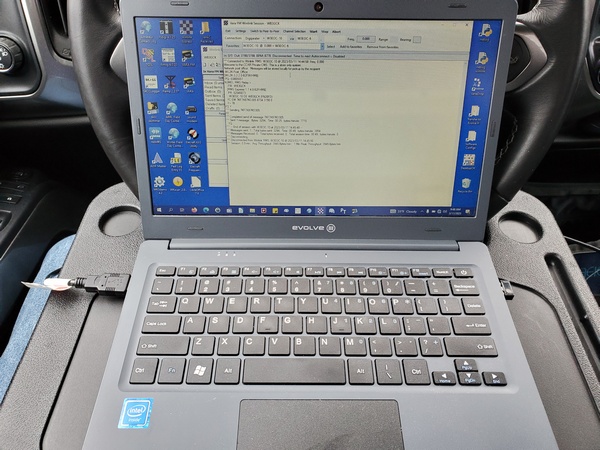
Winlink session on my Evolve laptop. This was my first time using the steering wheel tray, and it worked great.
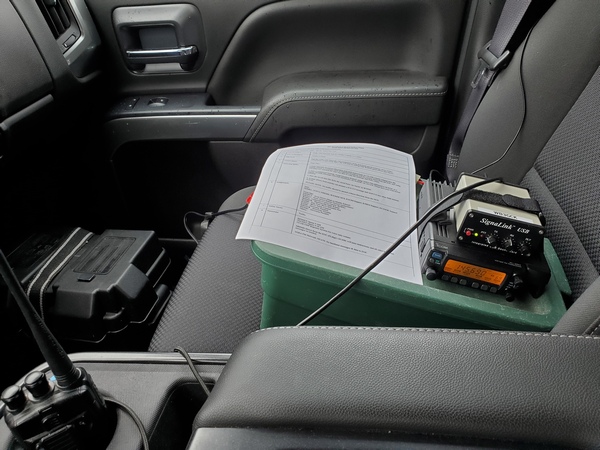
My setup in the truck worked great. I used one of those plastic steering wheel trays to support my little Evolve laptop. I used my trusty old Icom IC-207H dual band rig and a Signalink for the data. Both the IC-207H and the Yaesu FT-8800 I used for voice were powered by separate deep cycle batteries. While everything worked fine, I have a couple of cables I’m going to build to simplify the battery connections.
My setup for Vara FM. The radio was powered by the deep cycle battery on the floor.
This morning, I went to nearby Evansburg State Park (K-1351) for a quick POTA activation. I used my TR-35, T1 tuner, and my 19-foot vertical mounted on my truck. (I didn’t take any pictures today, but, then again, there wasn’t anything special about my setup.) In about an hour, I logged 30 QSOs, including three park-to-park contacts.
While tuning around looking for park-to-park contacts, I worked a station operating with the Straight Key Century Club’s callsign, KS1KCC. My last contact of the day was with NL7V in North Pole, Alaska, on 17M. It’s always a thrill for me to work an Alaskan station. Paul gave me a 229 report, but I’ll take it.
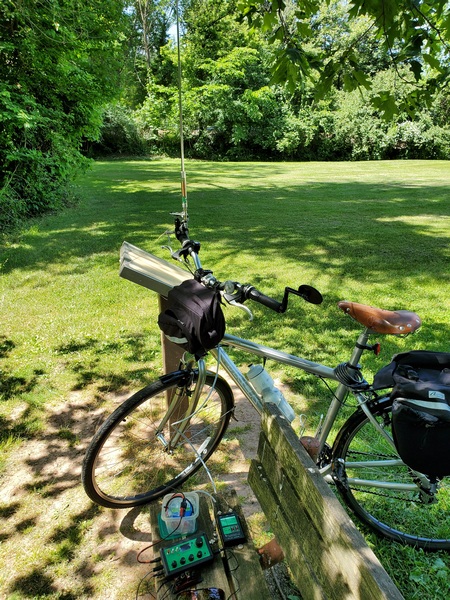
Sometimes, you just have to be flexible. Originally, I had planned to do some bike riding today and experiment with a bike mount I cobbled together for my Elecraft AX1 antenna. However, Mother Nature decided to throw some freezing temperatures at me today. Instead of a cold bike ride, I opted for a more comfortable “stationary-mobile” POTA activation.
I loaded up my gear and made the quick trip to nearby Evansburg State Park (K-1351). My setup today was similar to the one I used a couple weeks ago. I used my AX1 antenna on a window mount. The rig today was my PennTek TR-35 (5 watts), coupled with an Elecraft T1 tuner. The TR-35 limited my operation to the 20M and 17M bands. With this simple setup, I was on the air within a couple of minutes of arriving.
My window-mounted AX1 antenna
Contacts on 20M came as easily today as my last activation with the window mounted AX1. I had my first 10 contacts in about 15 minutes. I was pleased to get a call from K4SWL down in North Carolina. Thomas has a bunch of recent posts on the AX1 over at qrper.com. Of course, I had to let him know I was using an AX1 today.
The organized chaos in the cab of my truck, which includes my PennTek TR-35 and Elecraft T1 ATU.
After logging 20 contacts on 20M, I changed over to 17M. I didn’t have as much luck, but I made four contacts there. After that, I went back to 20M to make a couple of park-to-park contacts. My last contact was with WA3GM. Greg is a local ham who is spending some time in Florida and was activating a park down there.
I shut down after an hour of operating with 26 contacts in the log including 3 park-to-park contacts.That exactly matched the results from my last activation with the AX1. This little antenna never ceases to amaze me.
Hopefully, we’ll get some more moderate temperatures this week, so I can finally get that bike ride in.
Recently, Thomas K4SWL over at QRPer.com featured an excellent guest post from W2AEW describing a car window mount Alan built for his Elecraft AX1 antenna. Inspired by Alan’s post, William KR8L, did some experimenting and came up with his own window mount. These folks got me thinking—a dangerous thing, sometimes.
I remembered a commercially made window mount I bought 25+ years ago. (I think it came from RadioShack, but I’m uncertain of that.) Back then, I was traveling for work a lot, and I usually took my old RadioShack HTX-202 HT along with me. When I was using a rental car, I used the window mount with a rubber duck antenna. When parked, I used a 2M half wave telescopic antenna on it. I hadn’t used it—or seen it—in years. It was somewhere amongst the miscellaneous stuff acquired over my 48 years in ham radio.
It took a little searching, but after rummaging through some old parts, I found the old window mount. The mount is made of steel with a female BNC connector on it. It also has six feet of RG-58 coax attached. The coax is more than enough to reach the center console of my truck from the passenger side window.
The old window mount I resurrected from the junk box. The bolt next to the BNC connector is something I added.
The next task at hand was to figure out a way to connect a counterpoise wire to the mount. The steel mount has a black coating on it, which electrically isolated the BNC connector from the mount. To resolve that, I removed the BNC connector and used a rotary tool to remove some of the coating around the mounting hole. Then, I drilled a hole for a small bolt that I could use as a place to attach an alligator clip for the radials.
I already had an Elecraft AX1 antenna that I bought years ago when they first came out. I usually carry it in my backpack as a backup antenna, but I really haven’t used it very much. So, I guess it’s time to put it to use.
To see how this setup worked, I drove over to nearby Valley Forge National Historical Park (POTA K-0761) for a brief activation. Along with the AX1 on the window mount, I used two 12.5-foot radials. I have to admit it was nice being able to deploy an antenna in less than a minute.
My AX1 deployed on the window mount with two radial wires clipped on.
Back in the truck, I fired up my KX3 running five watts. I was prepared to crank the power up to 10 watts, if need be, but that proved unnecessary. Within a minute of spotting myself, the calls started coming in. The signal reports were decent, and I was seeing some strong hits on the Reverse Beacon Network. It took all of 12 minutes to make my prerequisite ten contacts.
In less than an hour, I had 14 contacts on 20M, nine on 17M, and three on 15M. Among those 26 QSOs, I had one park-to-park contact with a station in Quebec. At one point on 17M, I had a DX station calling. I believe it might have been Italy, but I just couldn’t pull out the entire callsign. My apologies to that station, wherever they were.
The AX1’s performance was a pleasant surprise. Although it has been in my antenna arsenal for a few years now, I really haven’t given it a serious test. Well, that changed today. It has proven itself to be a worthy antenna choice, when a larger antenna is impractical.
Thanks to W2AEW and KR8L for inspiring me to dust off my old window mount and put it to good use.
Because of the cold weather, I operated from the truck, using my KX3 (5 watts) and homebrew vertical. At 23F (-5C), my weather was nowhere near what folks up north were experiencing. Still, it was a little colder than I wanted to deal with today. The sun coming through the windshield kept my operating position around a comfortable 58F.
The WB3GCK “QRP-Mobile” at Ridley Creek State Park (K-1414}
After approximately 90 minutes, I had 31 stations in my log. Among those were two fellow Polar Bears, John VA3KOT and Jamie AA4K. Jamie was one of five park-to-park contacts I made today. I didn’t hear any FYBO stations. I spent most of my time calling, “CQ POTA.,” so I wasn’t really looking too hard.
Towards the end of my outing, I spent some time up on 15M. My 5-watt signal was getting some strong European hits on RBN, but I didn’t hear much activity on the band. I eventually had four contacts on 15M, including Belgium and Italy.
Starting tomorrow, we’ll be getting back to more moderate weather here in Pennsylvania. I’m looking forward to it.
I’ve been a little under the weather this week, but I managed to get out and make a some Winter Field Day contacts. I was on the air for a couple of hours each day, operating in the new “Mobile” category.
My location this year was on some land owned by my daughter and her husband. I operated from my truck on top of a hill, which has always been an excellent location for me. (Thanks to my son-in-law for clearing out the area for me.)
My Winter Field Day set up on Saturday
On Saturday, I operated during the first hour or so of the contest, using my KX3 and homebrew vertical. I spent all of my time on 40M, and the band was in great shape. I logged 23 CW contacts. Among those, were three SSB contacts I made for the extra multiplier. Winter Field Day is usually the only time I use a microphone on HF, so it always feels awkward for me.
I went back out there on Sunday morning, but this time things got off to a rough start. After I set up my antenna, I got in the truck to set up my KX3 only to find I left it at home. Fortunately, I had my TR-35 in the truck as a backup. (I guess I need to go back and read my old post on checklists.) There was also a protracted search for an adapter I dropped. Eventually, I got my act together and got on the air.
The Rybakov vertical I used on Sunday
The setup this time out was my TR-35, Elecraft T1 ATU, and a Rybakov vertical. The antenna was simply a 25-foot (7.6M) vertical wire fed through a 4:1 unun that I built recently. I used another 25-foot (7.6M) wire on the ground for a radial. Since I only worked 40M the day before, I planned to concentrate on 20M, 15M, and 10M. With the TR-35, however, 20M was as high as I could go for Winter Field Day.
The 4:1 unun used with the Rybakov vertical
Most of my contacts this time around were on 20M. The band was in good shape, and the Rybakov vertical performed well for me. I was able to work just about every station I could hear including a couple of west coast stations.
I ended the weekend with a total of 46 WFD contacts in 25 sections. While I never set any records, WFD is always one of my favorite events.