Pre-Holiday QRP Portable

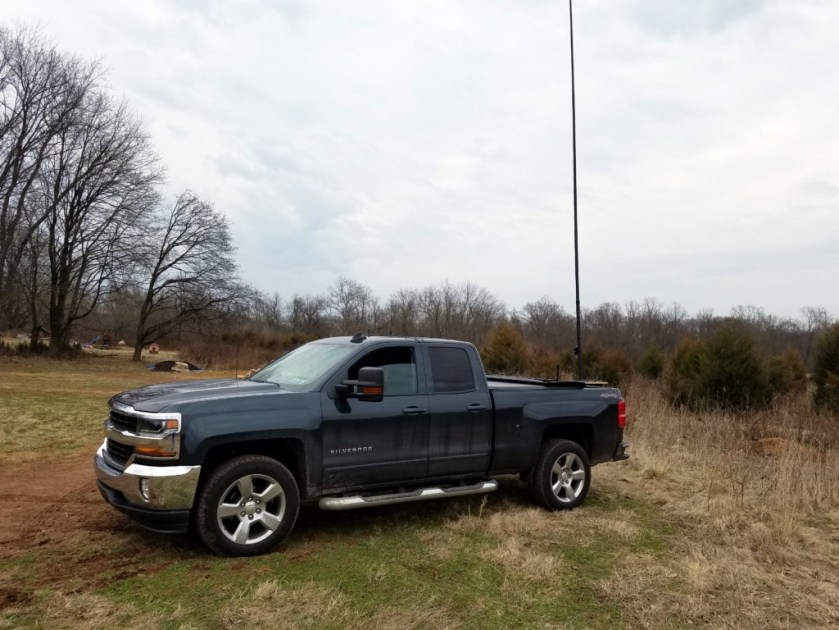
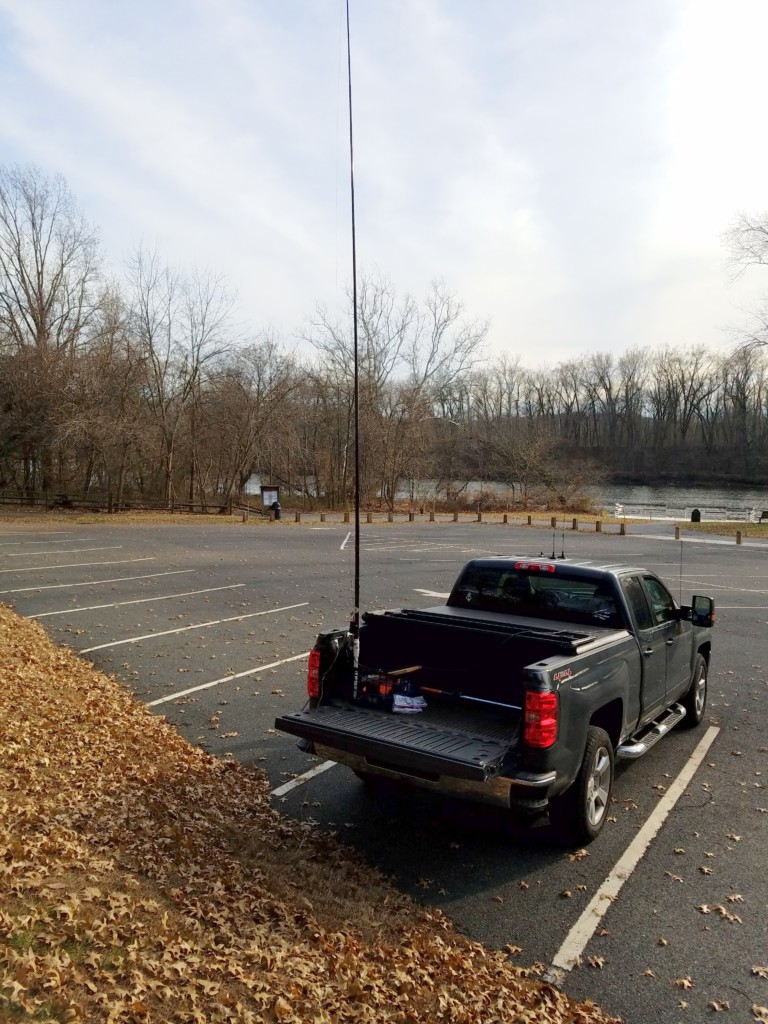
I wanted to get out and do a little QRP-portable before all the holiday festivities get started. I hadn’t operated from Black Rock Sanctuary in a while, so I headed over there. It was dreary and drizzly today, so it was a good day to operate from the truck and give my homebrew 19-foot vertical another workout.
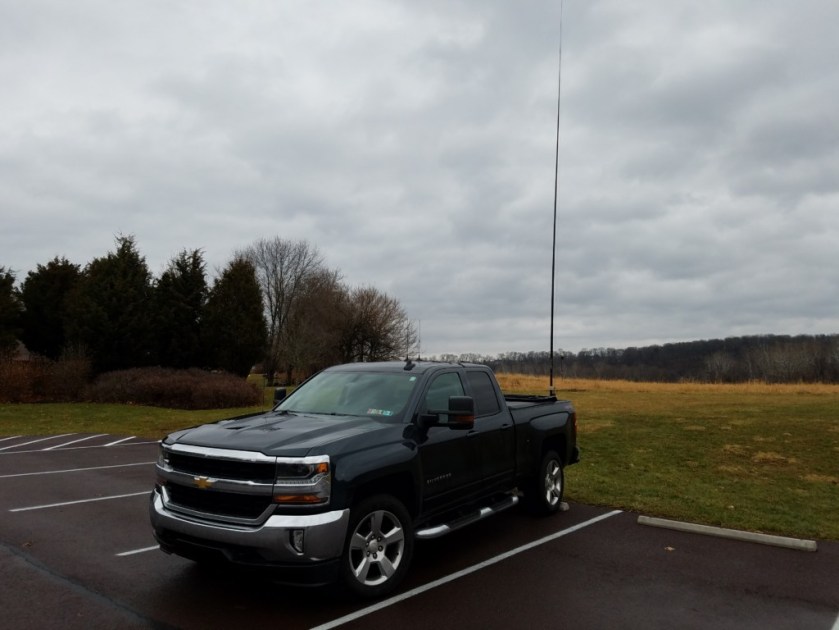
The vertical antenna in use at Black Rock Sanctuary

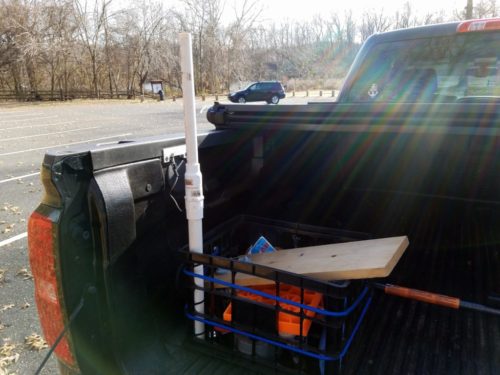
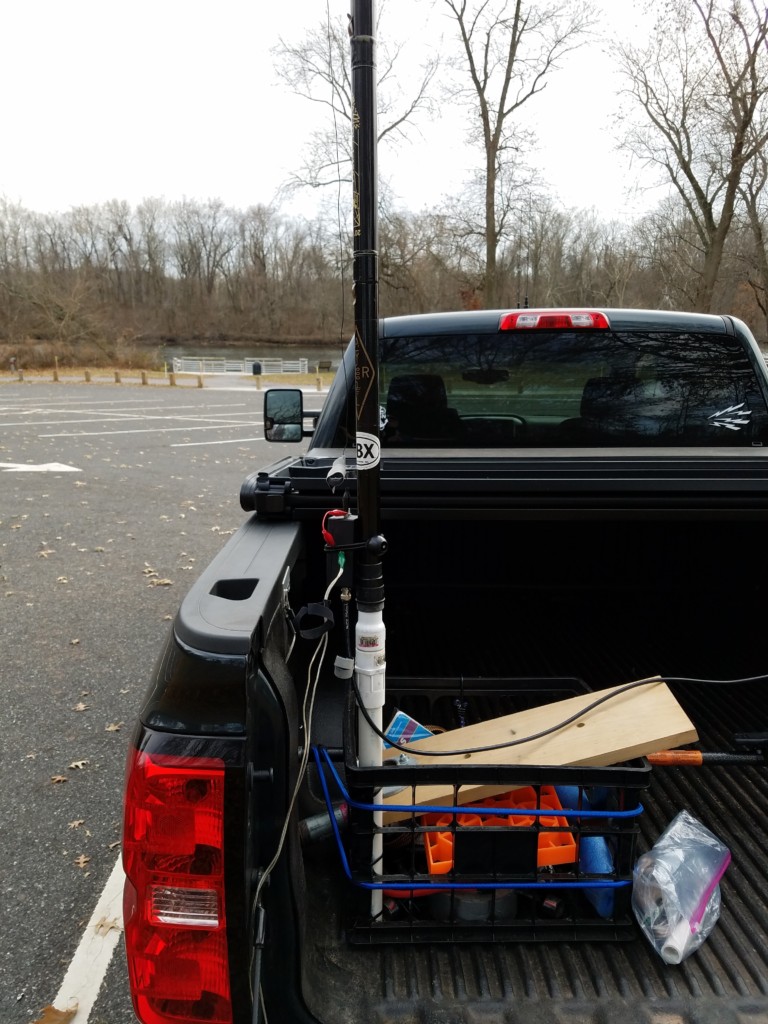
Since the last time I used the 19-foot vertical in the truck, I found a way to ground the antenna to the body of the truck. It was a simple matter of backing out one of the screws that hold the bed liner in place and using it to attach a small L bracket. This now provides a convenient spot to attach my ground lead.
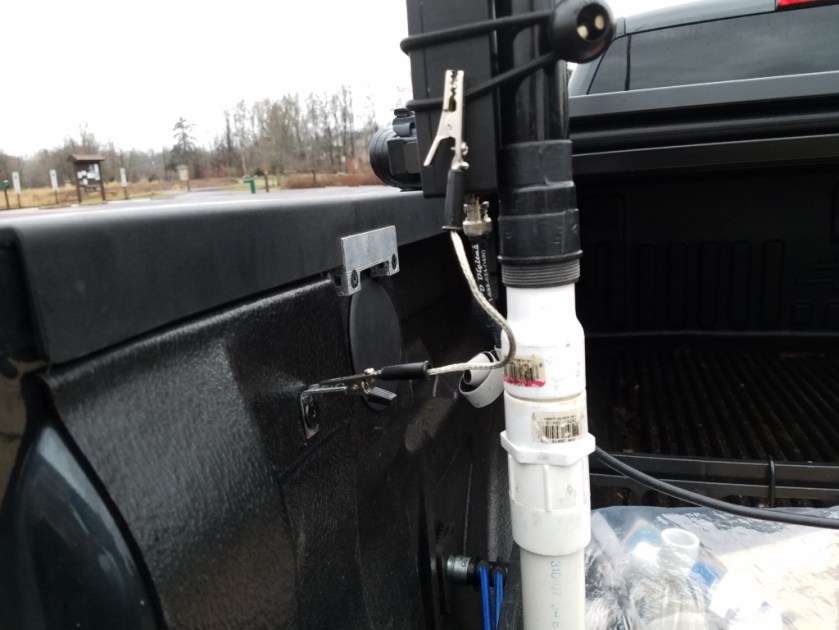
Ground connection for the vertical antenna.

I was using my little MS2 straight key with the KX3 today. The bands were in pretty decent shape and the antenna seemed to be working great. I made a half-dozen SKCC contacts on 40 and 20 meters with some respectable signal reports. One SKCC’er in California called me on 20 meters but the frequency was taken over by other stations. I wasn’t able to complete the QSO but at least I was being heard on the West Coast.

Operating position in the truck

I also had some nice two-way QRP QSOs. W4UV in North Carolina had a great signal on 40M with his Ten Tec QRP rig. Jim N0UR was really pounding in from Minnesota on 20 meters. My favorite QSO of the day was with Dirk W8IQX. Dirk was running 2 watts from his FT-817 to an AlexLoop on 20 meters. If I copied correctly, he was in Florida. QRP never ceases to amaze me!

Happy Holidays to you and yours.

72, Craig WB3GCK
Bike Rack Vertical

[This is an updated version of a post that appears on my old website. – WB3GCK]

I do quite a bit of my QRP operating from portable locations. I like to use simple wire antennas but, truth be told, I really dislike spending my limited operating time trying to get antenna wires up into trees.  Also, when activating parks for Parks on the Air (POTA), I often operate from the cab of my truck and need an antenna that is self-contained and quick to deploy.  This set up fits the bill.

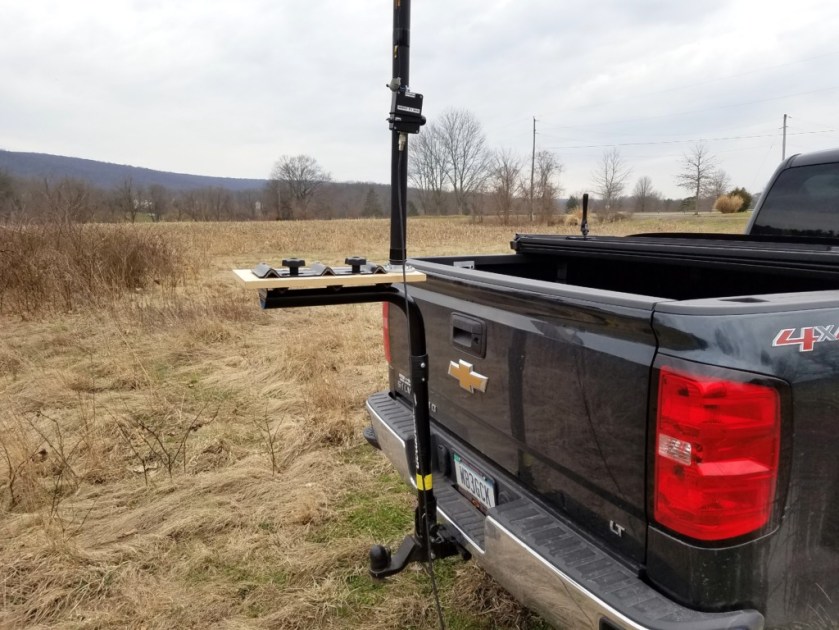
What I did was modify my homebrew roll-on mast support so I could use my hitch-mounted bicycle rack to support it. This only required the drilling of two holes in the roll-on mount. Figure 1 shows the roll-on mount clamped into the bike rack. In this case, I was supporting a 31-foot Jackite pole. After extending the pole and removing the bottom cap, I just lower the pole onto the 1-1/4 inch pipe. That’s all there is to it.

Bike Rack Antenna Mount. A 9:1 unun is attached to the Jackite pole with a bungee cord.

By selecting the right size of pipe, I can use this technique to support a variety of masts. For example, I’ve used this type of mount to support two 5-foot sections of TV antenna mast. I used this configuration to support a 1.2 GHz yagi for DStar digital communications during an ARES-RACES drill years back.

My new truck's first QRP-portable outing.
The Bike Rack Vertical in use

When operating QRP-portable, I often use a vertical antenna made from a 30-foot piece of hook-up wire and fed through a homebrew 9:1 unun with an 18-foot length of RG-8x coax. The unun is just attached to the 31-foot Jackite pole using some small bungee cords. No radials are used, which gives this set-up virtually a zero footprint. You can find more information on this configuration on the EARCHI website. I’ve successfully used this antenna in the field over the past few years. It’s a bit of a compromise, as antennas go, but it has always served me well. The extra height using the bike rack mount seems to help performance a bit. (Although I can’t quantify that, I’m sure the extra height doesn’t hurt.) With the internal antenna tuner in my KX3, I can work all bands from 40 through 10 meters.  Heck, I’ve even used it on 80 meters a bunch of times.

I used this particular antenna configuration countless times in recent years.  It was my “go to” antenna for NPOTA activations.  Within 5 minutes of arrival, I can be on the air. When it’s time to leave, tear down is just as fast. Now, that’s what I’m talkin’ about!

73, Craig WB3GCK

“Stationary-Mobile” with My 19-foot Vertical

Earlier this year, I built a lightweight, 19-foot vertical. Intended for tripod or ground mounting, I did the initial tuning and pruning of the vertical in that configuration. Today, I thought I’d see if it would work mounted on my pickup truck.

I have this plastic crate that I keep in the bed of the pickup truck. I use it to hold parts for my drive-on antenna mount, along with some tools and miscellaneous “stuff.” I hold the crate in place using bungee cords attached to a cargo bar that spans the width of the bed. I decided to make use of the crate as a quick and dirty antenna mount.

I took some 1-inch PVC pipe with a female threaded coupler from a previous antenna project and attached it to an inside corner of the crate with heavy-duty zip ties. I kept this part short enough to fit underneath the tonneau cover when traveling. To mount my 20-foot Black Widow pole, I used a 1-inch PVC male coupler and a reducer to go down to a 3/4-inch PVC pipe. The 3/4-inch PVC pipe fits nicely up inside the Black Widow pole. I went with the Black Widow pole rather than the lighter weight pole I normally use with this antenna since I already had all the PVC parts I needed to mount it.

My makeshift mount. The PVC mount is attached to the plastic crate, while the crate is attached to a cargo bar using bungee cords. The random junk I store in the crate keeps things stable.

I headed out to a local park today to give it a try. It only took a few minutes to get it set up. From the antenna, I ran some RG-8x coax through a window and into the cab of the truck. I connected the antenna ground to the body of the truck using a short piece of braid to a metal plate used to latch the tonneau cover closed.

The Black Widow pole installed on my makeshift mount.

I fired up my antenna analyzer and the SWR was off the charts. On closer inspection, I found the plate I was using for my ground wasn’t actually attached to the body of the truck. Instead, I connected two radials and ran them off the back of the truck. This time the SWR on 40 and 30 was much better. The resonant frequencies in this configuration were higher than when ground-mounted but my KX3’s internal tuner easily handled the minor mismatches.

I started out on 20 meters where this antenna operates as a random wire. I heard N5PHT doing a Parks on the Air (POTA) activation (KFF-3023) down in Texas. I gave him a call and exchanged reports. Moving down the band, I worked XE1XR in Mexico. So, the antenna seemed to be working fine. I checked 30 meters but it was devoid of activity.

The 19-ft vertical in operation.

Down on 40 meters, I had a nice ragchew with Bernard VE9BEL. Bernard was operating a club station (VE9CRM) in New Brunswick, Canada. He gave me a 599 and said I was “booming” into New Brunswick. Not bad for 5 watts into a 19-foot loaded vertical. I last worked Bernard a few years ago from Mt. Misery in Valley Forge National Park. We had strong signals both ways on that day, too.

So, it looks like this antenna is usable from the truck. I still need to find a way to connect the ground to the body of the truck. If possible, I’d like to avoid drilling holes in my new truck. This antenna is a little easier to deploy than my usual “Bike Rack Vertical.” The downside is I have to exit the truck to change bands. Life is a series of trade-offs, I guess.

73, Craig WB3GCK

A Digital Weekend

I’m not much of a contester or DX chaser, so I decided to I decided to avoid the CQWW CW contest this weekend. It’s been awhile since I’ve done any digital mode stuff, so I thought I’d focus on that for a change.

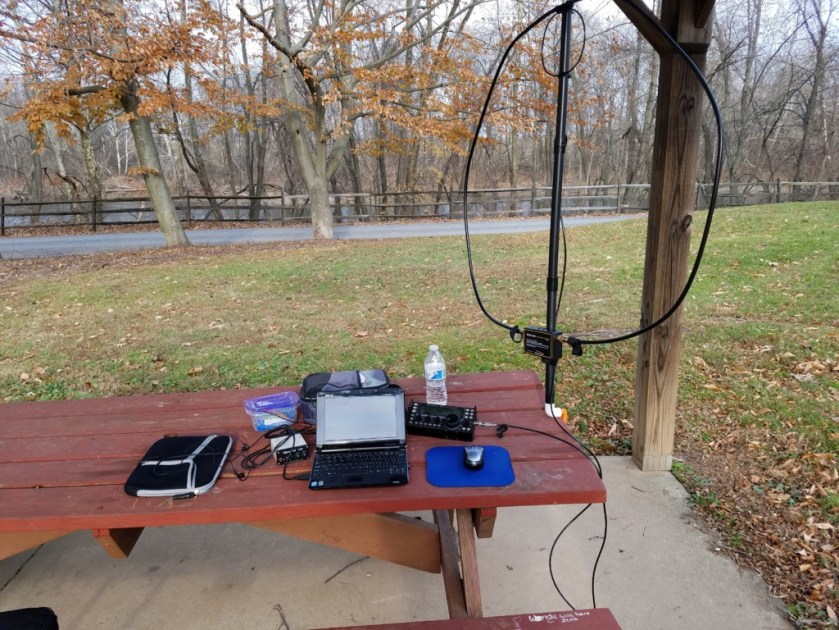
We had some pretty good weather (for Pennsylvania in late November, that is) on Saturday, so I headed out to a local park to operate for a while. I set up my AlexLoop and KX3 in a little picnic pavilion. I also brought along my old Acer Aspire One netbook, which I converted to Ubuntu Linux a few years back. It only took a few minutes to get set up and get the loop tuned.

I started out on PSK-31. Although the band seemed a little flakey, I worked stations in Florida and Arkansas. I moved up the band a bit to see if there was any Olivia activity. I saw one station with a QSO in progress. I tuned up from him and called CQ for a while. No dice. I went back to the PSK-31 area and worked another Florida station. Towards the end of our QSO, my netbook gave me a “low battery” alert, so I quickly wrapped up and shut down for the day. (Note to self: It’s time to replace the battery in the netbook.)

Operating digital modes from a local park.

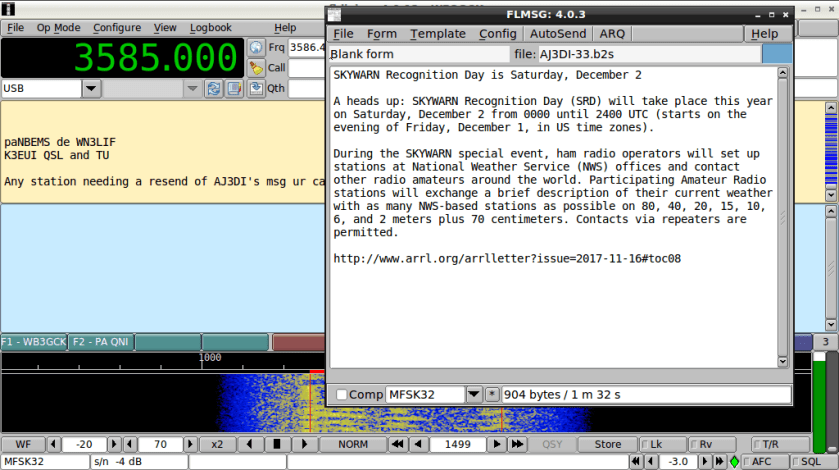
Back at home, I checked into the paNBEMS Net on 80 meters on Sunday morning. This is a state-wide digital net that makes use of the NBEMS suite of software (i.e., fldigi, flmsg and flamp). Here in Chester County, Pennsylvania, our local ARES-RACES group makes heavy use of NBEMS for emergency communications, so this net is always good practice. Even though I was running just 5 watts to my rainspout antenna, I was easily heard by the Net Control Station in northeastern Pennsylvania. Despite my S7-S8 noise levels on 80 meters, I was able to copy all the message traffic passed. The paNBEMS Net convenes every Sunday morning at 0800 Eastern time on 3585KHz (1500Hz on the waterfall). Message traffic is sent using MFSK-32 but various modes are used for check-ins. Today the net used Thor-22. So, make sure your RxID is on.

Message traffic sent on the paNBEMS Net. K3EUI relayed the message original transmitted by AJ3DI.

Following the paNBEMS Net, I fired up WSJT-X and tried the FT8 mode for the first time. I made my first-ever FT8 contact with VA3VF on 40 meters plus several others. Like the “JT” modes, I find the technology fascinating, however, I still tend to prefer more keyboard-to-keyboard interaction. That being said, I’ll still probably use it from time to time.

Finally, I did a little SWL’ing Sunday afternoon. I tuned into the
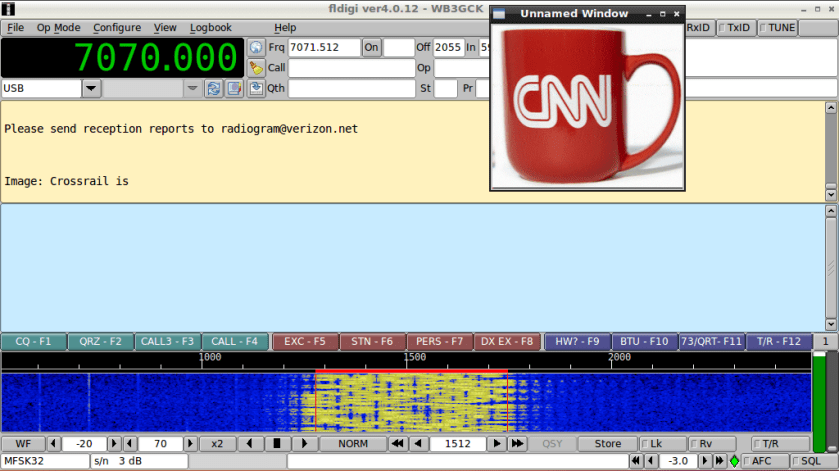
Shortwave Radiogram digital broadcast via WRMI in Miami, Florida. I had seen announcements for these broadcasts on some of the ham radio mailing lists I subscribed to but never tuned in until today. They broadcast news articles and images at various times during the weekend. The broadcast I monitored at 2030 UTC was on 11.580MHz using the MFSK-32 mode. Over about 30 minutes, I had near-perfect copy on the text and good quality on the 4 images transmitted.

One of the images captured during the Shortwave Radiogram broadcast on WRMI in Florida. The broadcast was on 11580 KHZ, not 7070KHz, as indicated in fldigi.

It was a nice change of pace to spend some time on the digital modes this weekend but I still like CW the best.

72, Craig WB3GCK

The Quickie Whip

This week, my ham radio activity was focused on an emergency communications exercise with my local ARES-RACES group.  I thought I’d do a post about the simple whip antenna I used with a dual-band radio.  I cobbled this  set up together a few years back and it has come in handy on several occasions.

During the exercise, I was operating indoors with easy access to our local repeaters. I was copying digital traffic using the Narrowband Emergency Messaging System (NBEMS), so a handheld radio wasn’t a good option. In this situation, a dual-band mobile radio and this little whip antenna hack were able to get the job done.

The Quickie Whip attached to my old Icom 207-H dual band radio

For the whip, I use commercially available, collapsible BNC whip antennas for the 2 meter and 440 bands.  To connect the whip to the radio, I use a UHF-Male to BNC-Female right angle adapter I picked up on eBay. To help improve the efficiency, I attach two 1/4-wave counterpoise wires, one for 2 meters (about 19 inches) and one for 440 (about 6.3 inches).

Quickie Whip Antenna components: telescopic whip antenna, PL-259 to BNC-F right-angle adapter, and the modified 9V battery clip for the counterpoise wires.

To attach the counterpoise wires, I re-purposed a 9-volt battery holder. I just drilled out one of the mounting holes and used a small bolt and nut to attach the wires. The clip is just about the perfect size to snap onto the right angle adapter.

The antennas I use came from Smiley Antenna. I have 5/8-wave whips for 2 meters and 440, along with a halfwave whip for 2 meters. Although some of the antennas are specified to handle 50 watts, I generally use them only for 10 watts or less (in the interest of RF safety). If I need to run more power, I’ll go with an antenna placed a safe distance away.

I’ve used this simple antenna arrangement in several situations in recent years. It’s become a permanent part of my emergency communications go-kit.

73, Craig WB3GCK


Ganshahawny Park

I haven’t had much time for radio the past couple of weeks and I needed a QRP-portable fix. I decided to explore a new (to me) local park this afternoon.

The road I travel to get to my daughter’s house parallels the Schuylkill River. There’s a park on the opposite side of the river that I always see. Today, I decided to head over there to check it out.

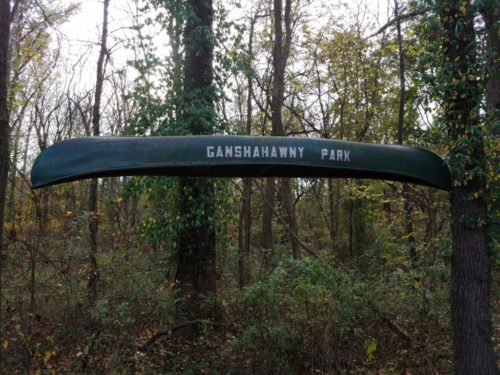
The park I had seen from across the river is Ganshahawny Park, a small municipal park in Douglass Township, Pennsylvania. Ganshahawny is a Lenape word for “tumbling waters,” the native American name for the river that the European settlers called the “Schuylkill.”

Ganshahawny Park’s unique sign.

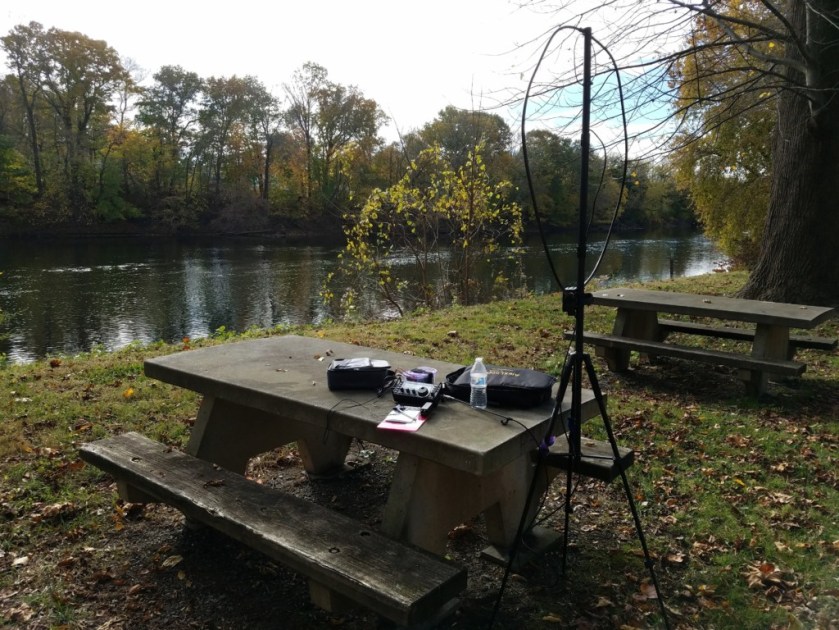
When I arrived, I was the only one in the park. I set up my KX3 and AlexLoop at a picnic table about 15 feet away from the river bank. There was a major highway about 100 yards away on one side and a well-traveled road just across the river. Despite all that activity, the park was extremely “RF quiet.”

My operating location along the Schuylkill River.

Tuning around on 40M, I heard a strong station ending a QSO and gave a call. Howard K4LXY/3 was operating from nearby French Creek State Park.

Next, I moved up to 20M and found WV0H in Colorado. Myron was also operating QRP-portable from a park.  He was using one of his famous portable doublet antennas and had a pretty nice signal into Pennsylvania.

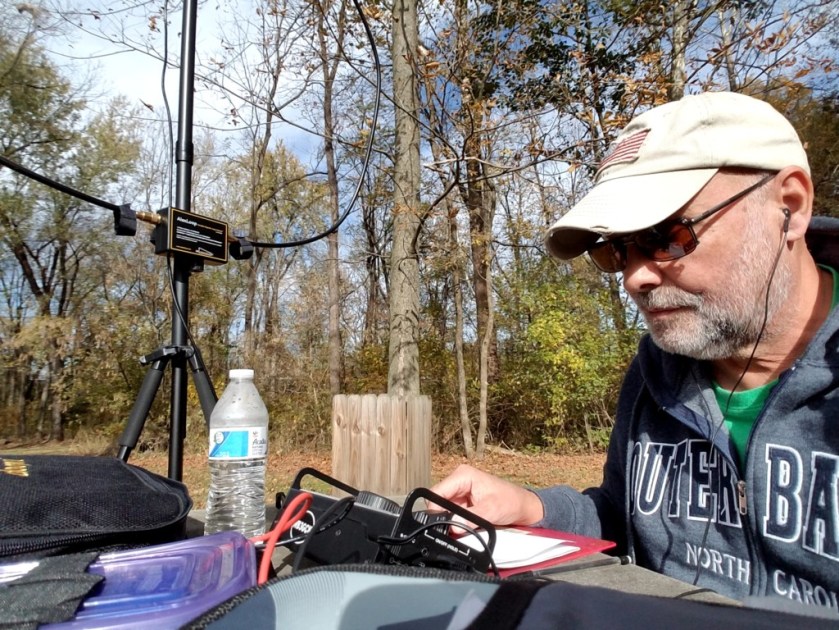
WB3GCK scouring the bands for a contact.

On 30M, I faintly heard Joe N2CX who was doing a POTA activation in Pennsylvania somewhere. I gave him a call but I’m not sure if I made it into his log or not. There was a strong station from the Netherlands calling CQ that covered him up.

I wrapped up on 40M with a nice two-way QRP chat with Jay KB3ERI in central Pennsylvania. I had a few more things to take care of at home, so I packed up and took a few pictures before heading out.

It was a nice afternoon to be out doing some casual operating and I found a great place for future portable operations.

72, Craig WB3GCK
Trailer Operations – Lessons Learned

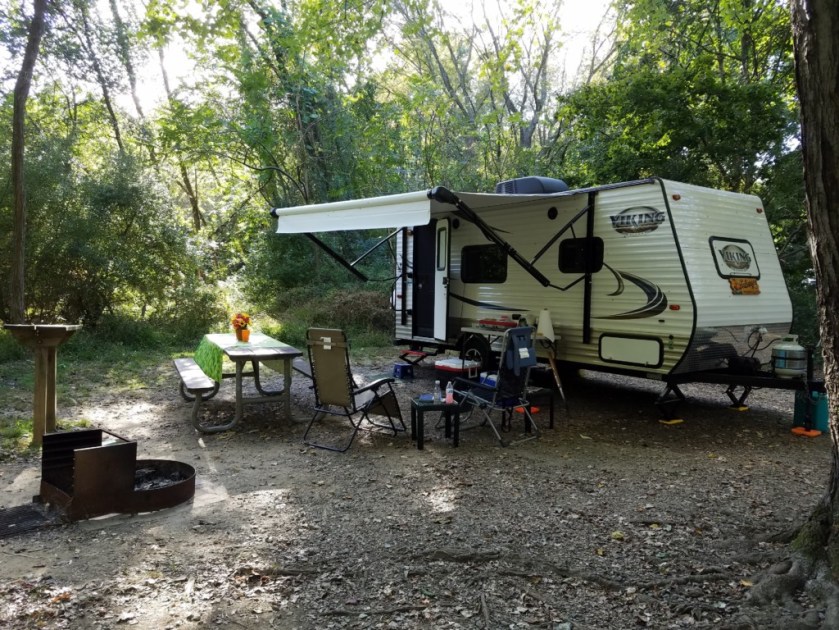
We recently wrapped up our first camping season with our little travel trailer. Over the past 6 months, I learned a few things about operating inside a metal box that has lots of electrical doo-dads inside.

Antenna

Over the 18 years of camping in a pop-up tent trailer, I evolved to a simple but effective vertical antenna, which was supported by the trailer. We basically used the old camper as a tent on wheels.  It had few electrical amenities, so noise wasn’t an issue.  Being mostly canvas, the pop-up camper had little influence on the vertical antenna I attached to it.

On our first trip with the new camper, I tried something similar. I used the new camper to support my vertical antenna.  Bad choice.  I quickly learned that the new travel trailer was a different animal.  I made contacts but there were two main issues: 1) The camper is a big metal object and 2) it’s noisy as heck when plugged into AC power at the campsite.

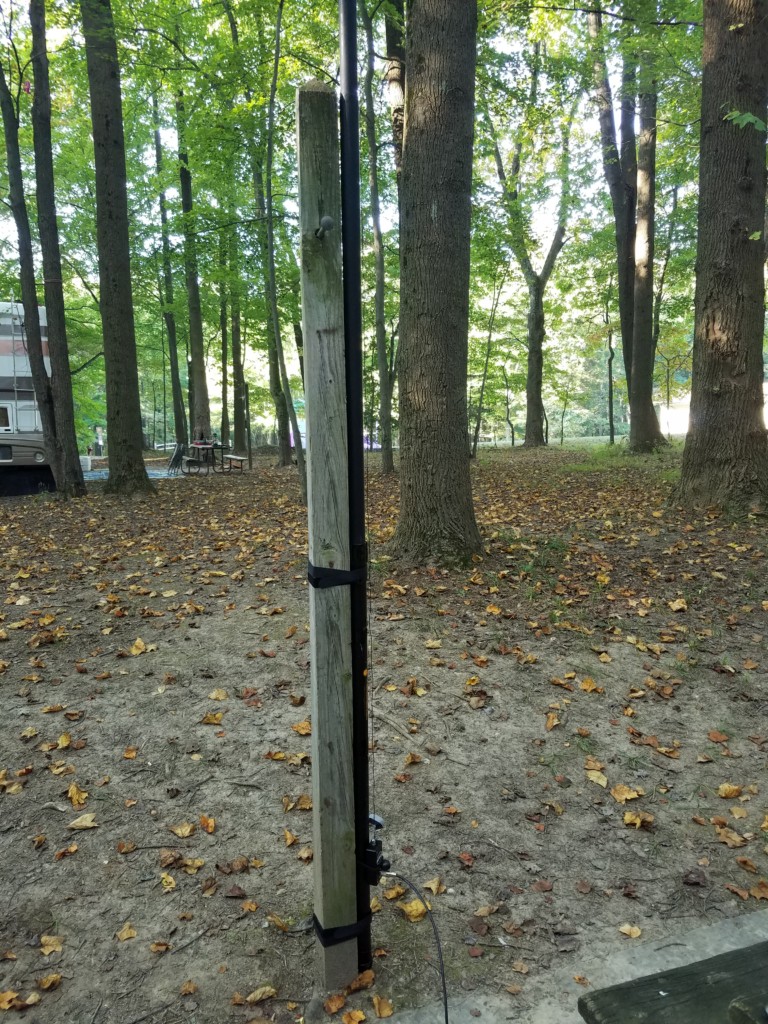
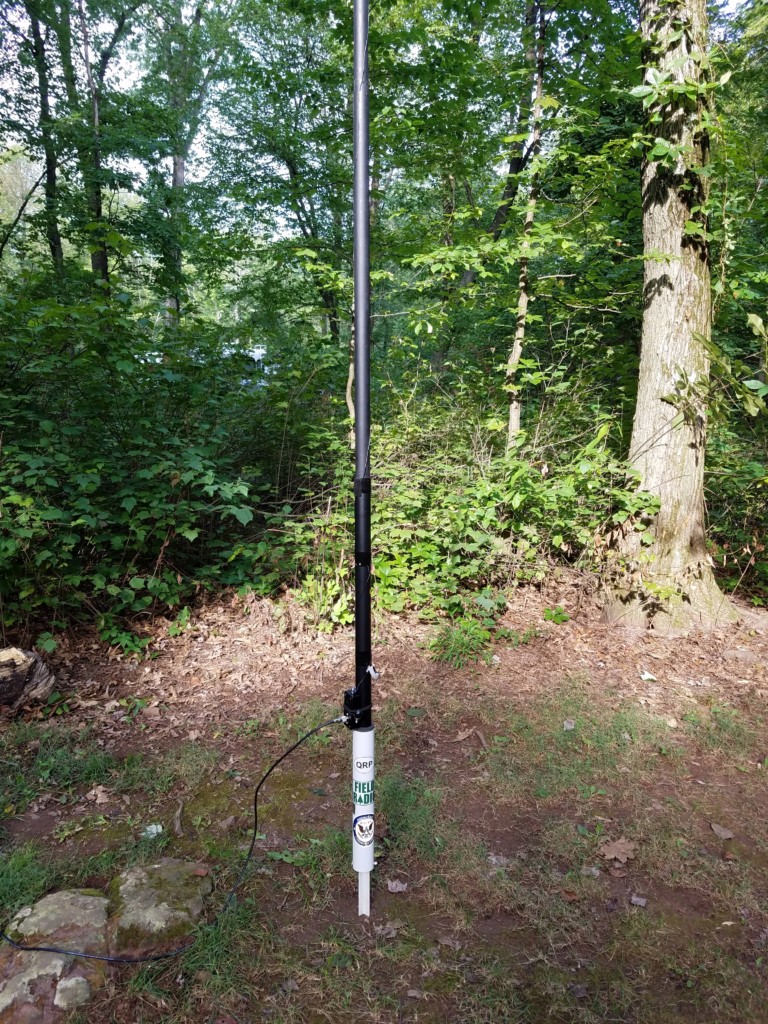
It became quickly apparent that I needed to keep the antenna as far away from the trailer as possible. For most trips, I used a 29.5-foot vertical wire supported by a 31-foot Jackite pole. I fed it with a 9:1 unun and ran a 25-foot piece of coax into the trailer. In some campgrounds, I was able to strap the Jackite pole to a lantern post or other object. Otherwise, I used my Jackite ground mount. (Unfortunately, Jackite no longer sells this ground mount.)

Some state parks provide lantern hanging posts that make great antenna supports. These are pretty common in Maryland state parks.

This set up worked well for me. There’s still some intermittent noise on 40 meters but it’s still usable. The other bands are pretty quiet. A pleasant surprise is that my KX3 loads up this antenna on 80 meters and the noise there is very low. I’ve had some nice late night/early morning contacts on 80 meters. On trips when we camped without an electrical hookup and used battery power only, I had no issues at all with noise.

My trusty 29.5-foot wire vertical. It's supported by a 31-foot Jackite pole and fed with a homebrew 9:1 unun.
Jackite ground mount. I bought this years ago. This particular mount is no longer sold by Jackite.

Radio Location

When the weather is decent, I prefer to operate outside of the camper, either from my camp chair or picnic table. However, when the weather is cold or rainy, I seek the shelter of the camper.

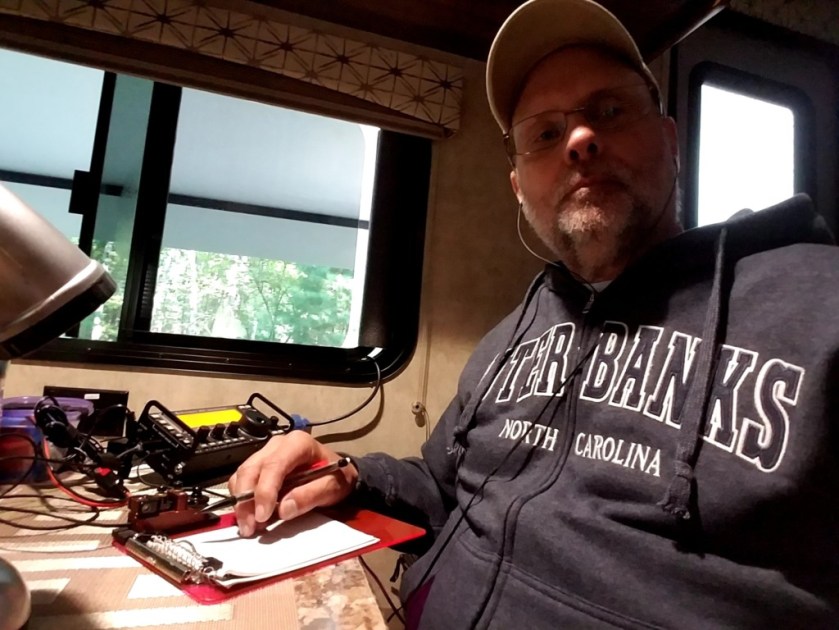
WB3GCK making some straight key contacts from the trailer.
Radio set up inside the trailer. The coax is routed through the window.

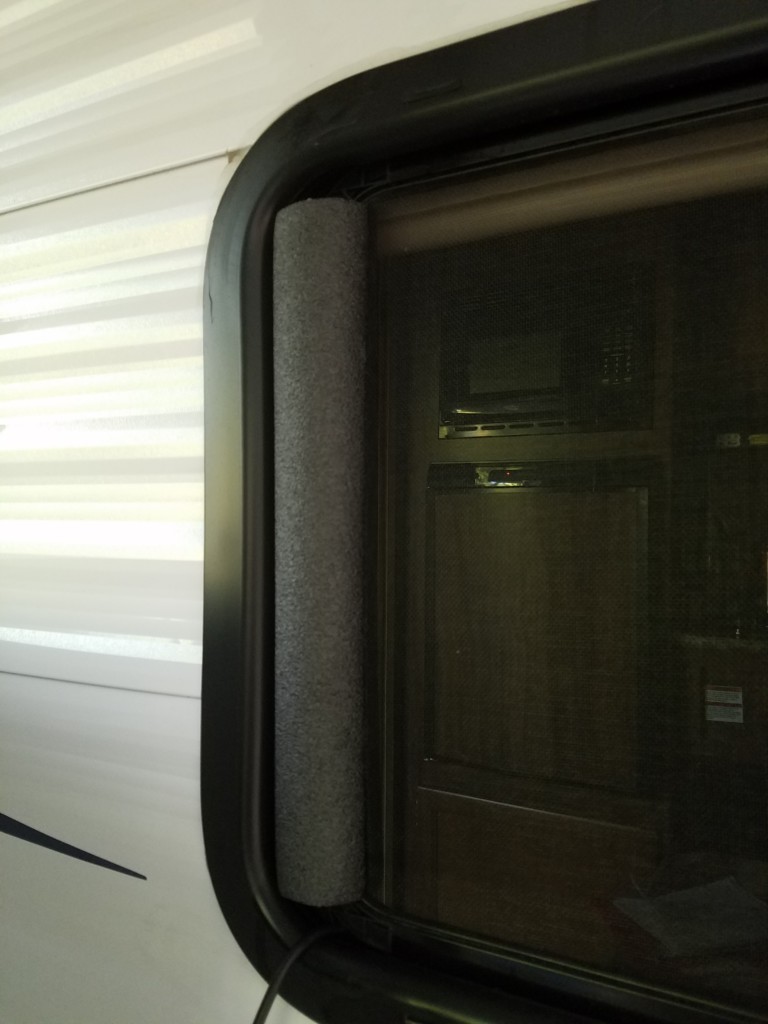
Initially, my big dilemma was routing a coax cable into the trailer. I really didn’t want to drill holes in a brand new trailer so I took the easy way out. There’s a conveniently located window next to the dinette table, so I brought the coax through there. To keep the bugs and inclement weather out, I used a piece of pipe insulation to help close up the gap. This window is also under the awning, so I get some additional weather protection there.  The dark-colored pipe insulation isn’t very noticeable, so my set up is “XYL-approved.”

Pipe insulation used to help close the gap in the window. The black pipe insulation is barely noticeable making it XYL-approved.

Wrapping It Up

So, now it’s time to Winterize the trailer and put it into hibernation until Spring. Over the Winter, I’ll have lots of time to look into other antenna options I can try next year.

73, Craig WB3GCK

Zombie Shuffle 2017

This year’s QRP Zombie Shuffle coincided with our last camping trip of the season with our little travel trailer. We wrapped up our camping season in French Creek State Park in southeastern Pennsylvania.

After setting up camp and eating dinner, I spent some time on the radio in search of my fellow zombies. It’s customary to complain about contest band conditions but this year the complaints were justified. I never really heard any strong signals and there was severe fading on the bands.

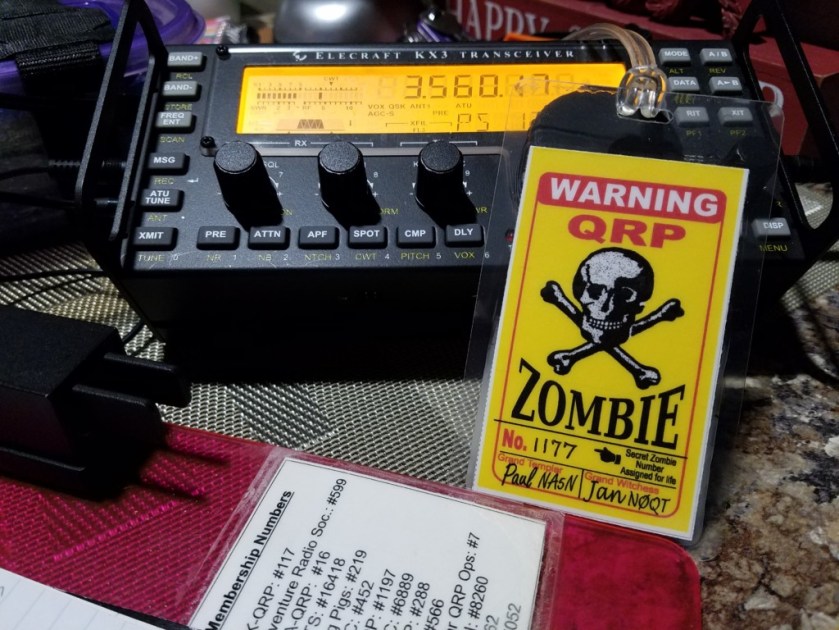
My official QRP Zombie credentials.

Despite the frightful conditions, I managed to log 8 zombies this year. Six of my eight contacts were on 80M. I was using a 29.5-foot wire vertical and 9:1. I’m always amazed at how well this relatively short antenna gets out on 80M.

One of the highlights was working Ed WA3WSJ while he was operating from a shelter on the Appalachian Trail. He was also using the Boschveldt QRP Club call, W3BQC. I’ve made hundreds of Field Day QSOs as W3BQC but this was the first time I have been on the receiving end.

So, another Zombie Shuffle is in the books and it’s time to crawl back into the crypt.  I can’t wait to shuffle again next year.

72, Craig WB3GCK

A “Cooler” Idea

When I was in need of a container to transport my QRP rig, my XYL came up with an inexpensive solution. The answer was as close as the nearby grocery store.

A few years ago, I was using a plastic food container to keep my little YouKits HB-1B and accessories organized and protected in transit. It had enough room for the radio, a Li-Ion battery, keyer, paddles, K1 tuner, earphones, my clipboard/paddle mount, and assorted cables and connectors. Life was good until I cracked the plastic box while out in the field for a QRP Skeeter Hunt contest. I started searching for a replacement.

I mentioned my dilemma to my XYL. She came back into the room carrying a nifty insulated lunch box that she was using for a first-aid kit. I emptied out the first aid stuff and found that it could hold all of my radio stuff. I was particularly happy that my clipboard/paddle mount fit in there perfectly. I made a trip to the grocery store where she found the container and bought one for myself.

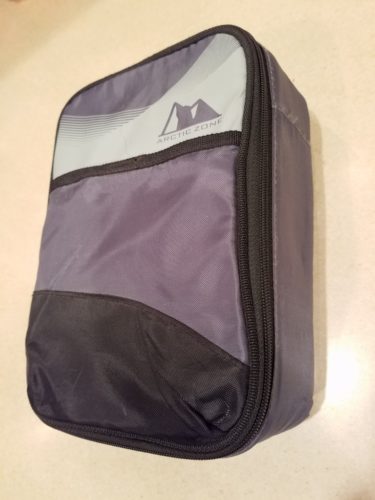
Arctic Zone Upright HardBody® Lunch Box. This one has seen years of use and now holds my KX3 and accessories.

The box my XYL found was the Upright HardBody® Lunch Box made by Arctic Zone. The outer material is padded for insulation and it has a rigid plastic liner that provides some extra protection. It also comes with an adjustable divider, which might be useful in some cases. There’s an outside pocket that I use to hold a notebook and pencil for logging. At the time, I paid less than $10 USD for it.

Last year, when I bought my KX3, I went through the same trial and error with the lunch box. I was able to get the KX3, Palm Mini paddles, MS2 straight key, microphone, earphones, clipboard and assorted cables and adapters in there. It holds everything but my LiFePO4 battery and antenna. (These items can vary from trip to trip, so this isn’t much of an inconvenience for me.)  So, off to our local KMart store I went. I bought two of the lunch boxes this time — one for the KX3 and one for a first-aid kit for in my truck.

This is the lunch box with the KX3 and accessories packed up. Out of sheer paranoia, I normally wrap the KX3 in a layer of bubble wrap for extra protection. When placed on top of everything, the clipboard provides another rigid surface for even more protection.

When I load up the KX3 box, the other items keep the radio for shifting around while in transit. Out of sheer paranoia, I put a layer of bubble wrap around the KX3. I’m not really sure that’s necessary though. When I’m ready to head out to the field, I just grab the KX3 box, my battery, and antenna of choice for the day and I’m all set.

There are certainly better, more expensive containers available. For the price, it’s hard to beat these lunch boxes. Maybe I should buy another one to hold my lunch and a couple of cold ones when I go into the field.  Hmmm…

73, Craig WB3GCK

Susquehanna State Park (Again)

I’ve been a little under the weather and haven’t done much radio stuff lately. A weekend of camping in Susquehanna State Park in Maryland turned out to be just what the doctor ordered. I worked some of the SKCC Weekend Sprintathon (WES) contest and I did a Parks on the Air (POTA) activation (KFF-1601).

During my last visit a couple of months ago, my results were less than stellar. This weekend, the bands seemed to be in better shape. My results this time were much improved.

The WB3GCK "QRP" camper at Susquehanna State Park (KFF-1601)
The WB3GCK “QRP” camper at Susquehanna State Park (KFF-1601)

On the WES front, I worked a lot of the SKCC regulars and added a few new ones to my log. In particular, 80 meters was very active Saturday night and Monday morning.  Tony K6ELQ in California managed to hear my QRP signals on two bands.  One of those bands was 40 meters, so he really must have good ears.  It was also good to work Bert F6HKA again.  Bert also has great ears.

My POTA activation got off to a slow start. I had poor cell phone coverage from the campsite, so self-spotting on Facebook and the DX cluster was difficult. I attempted to post a spot on Facebook but I’m not sure if it actually got through the first time or not. I spent about 30 or 40 minutes calling CQ on 40 and 20 meters with no takers. I knew that Joe N2CX was activating a park up the Susquehanna River from me so I set up on a frequency just below Joe’s usual 40M hangout. My hope was that folks looking for Joe would also stumble across me. It worked! I started getting some calls from POTA regulars who spotted me on the DX clusters.

When I wrapped up for the weekend, my log included France (3 QSOs), Croatia (2 QSOs), Netherlands, Belgium and park-to-park QSOs with N2CX and F4GYG. Coupled with my earlier visit, I amassed enough QSOs to exceed the 44 QSOs needed for a Worldwide Flora and Fauna (WWFF) activation.

After spending a relaxing weekend in the woods playing radio, I’m pleased to report that I’m feeling much better now.

72, Craig WB3GCK