My (far) better half and I traveled to the Outer Banks of North Carolina last week for our annual family vacation. As we have done for the better part of 30 years, we rented a house on Currituck Sound and spent the week with our two daughters and their families. Although ham radio didn’t figure prominently on this vacation, I got on the air and made a few QSOs each day.
After the long drive from Pennsylvania to North Carolina, we unloaded three vehicles and got everything situated for the week ahead. I was assigned the task of grilling hotdogs and burgers for dinner, and getting everyone fed was the top priority. After that, I finally had some time to unpack some of my radio gear. We rented the same house we were in last year, so I knew exactly how I was going to set up.
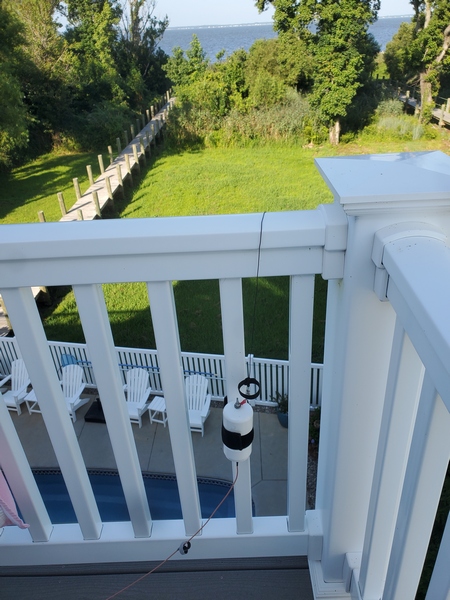
I went with the same antenna I used last year: a 35-ft end-fed wire sloping down from a third-floor deck to a fence in the pool area. To feed the wire, I used my weather-resistant 9:1 unun and ran 25 feet of RG-316 coax into a screened-in section of the deck. While it’s not the greatest antenna in the world, it works reasonably well, sets up in minutes; and is nearly invisible. Given the development the rental house is in, the stealthiness is a big plus.
I didn’t get on the air until the next day. Again, my rig was identical to last year. I used my KX3 with a common-mode choke on the antenna input. I kept everything on a plastic tray, so I could move the station in and out of the screened-in porch.
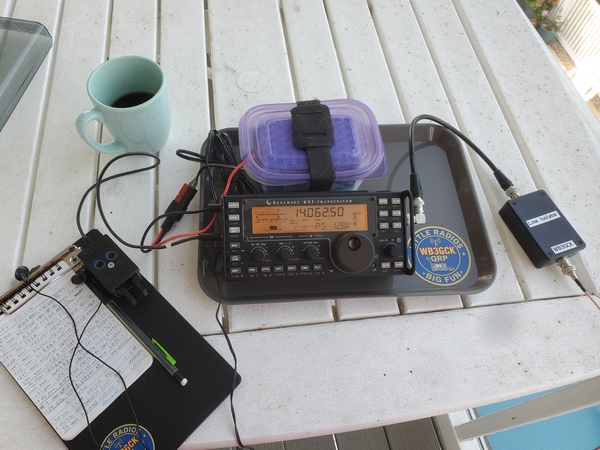
The monthly SKCC Weekend Sprintathon was on, so I caught a bit of that. This month’s theme was homebrew keys, so I had packed an old straight key I built from an assortment of junk box parts.

When I fired up the KX3, I encountered some local noise, but it didn’t seem as bad as I remembered from last year. I did a quick check and noted that the KX3 loaded up the antenna on every band from 80M through 10M. With an A Index of 27, the band conditions weren’t all that great. Regardless, I worked some SKCC stations and the occasional POTA activator.
It was very hot and humid, so I operated in three short shifts. Towards midday, I started to lose my shade. When that happened, I called it quits. I had 11 WES contacts, including one bonus contact with the club station KS1KCC. I also hunted four POTA activators. After that, I brought the rig inside and went out to spend the afternoon in the pool.
For the rest of the week, I operated on and off from the screened-in porch with the KX3. I limited my operating time to the morning hours while I had shade. I didn’t do any POTA activations this year. Mostly, I tuned around the bands, working whatever stations I could hear. The rest of the day was devoted to typical beach vacation activities.
One morning, I took the KH1 out to the dock for some POTA hunting. The dock is at the end of a 100-yard wooden walkway out on Currituck Sound. I parked myself on a bench and ran the counterpoise wire back down the walkway. I don’t know if being surrounded by water was the reason, but some of the activators were really booming in. I was able to get them on the first call.

Mid-week, a UFI (unidentified flying insect) stung me on the finger while I was in the pool. In the aftermath of the vicious and unprovoked—and perhaps exaggerated—attack, my finger was a little swollen. Thankfully, it didn’t impede my ability to send CW.
In what seemed like the blink of an eye, our week was over. On our last day, I made a few more contacts from the house before taking down the antenna and packing up the radio gear. I ended the week with about 47 contacts, mostly with POTA activators. Among those contacts were eight with KG1A at US-6305 in Florida. I worked him at least once each day I was on the air. Hunting with QRP, a funky antenna, and lots of residential noise is more challenging than activating, but it was still fun.
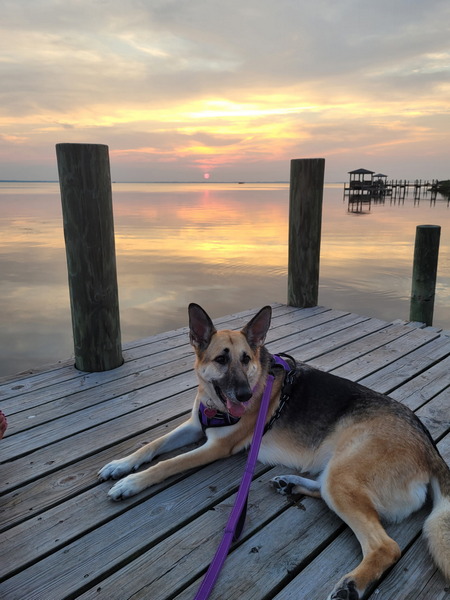
I had a great time spending the week with my daughters, sons-in-law, grandkids, and the grand-dog. Of course, getting in a little ham radio time with some beautiful scenery wasn’t bad, either.
72, Craig WB3GCK

