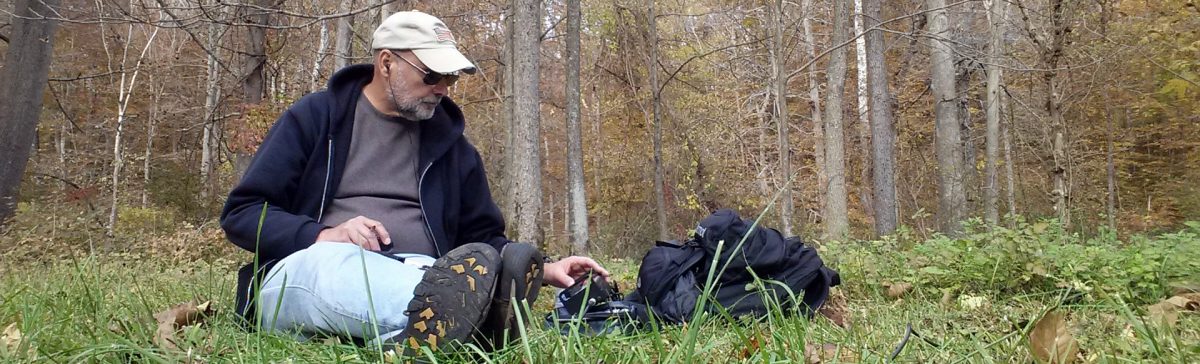
My original plan was to do a bicycle-portable activation in Valley Forge National Historical Park (US-0761, KFF-0761). Lousy weather and another commitment put those plans on hold. Instead, I did a short stationary-mobile activation there instead.
The two main picnic areas in Valley Forge opened for the season on April 1st, so I rolled into one of my favorite spots. Not surprisingly, I was the only one there. I don’t think that too many folks want to have a picnic at 0830 (local time) in the rain.
I set up my usual Penntek TR-35 (5 watts, CW) and 12-foot loaded whip and started out on 40M. The bands were recovering from some geomagnetic storming yesterday, but were still a little flakey. Contrary to propagation predictions, 40M turned out to be the most productive band for me today. The 20M band only produced two contacts, while 17M was a total bust today.
One of my hunters on 40M sent me his SKCC number. I always keep a straight key connected to the TR-35, so I easily completed an SKCC contact with him.
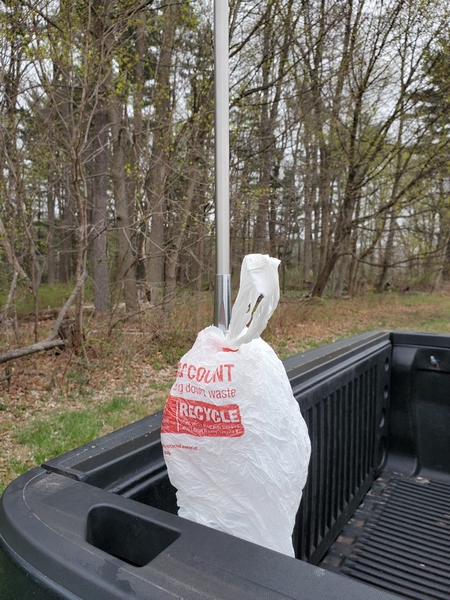
Part way through my activation, the rain started picking up. I headed around to the back of the truck to put a plastic bag on my homebrew loading coil.
After 20 minutes of futile CQing on 17M, I decided to call it quits. I ended up with 18 contacts. No DX today, but there were two known park-to-park contacts.
Hopefully, I’ll be able to get the bike out sometime next week.
72, Craig WB3GCK
 WB3GCK QRP Amateur Radio
Fun idea of doing ham radio when no one else would be there for a picnic early in the rainy morning. I loved your simple plastic bag to keep your coil dry. your picture didn’t include the bottom of the antenna and I wonder how you kept the bottom of the antenna dry as well. I assume water can go into a coax connector.
LikeLike
I just leave it open at the bottom so any rain water getting in has a way to drain out. The bag also covered the coax connection at the bottom of the coil. It works well enough as a temporary measure. 73, Craig WB3GCK
LikeLike