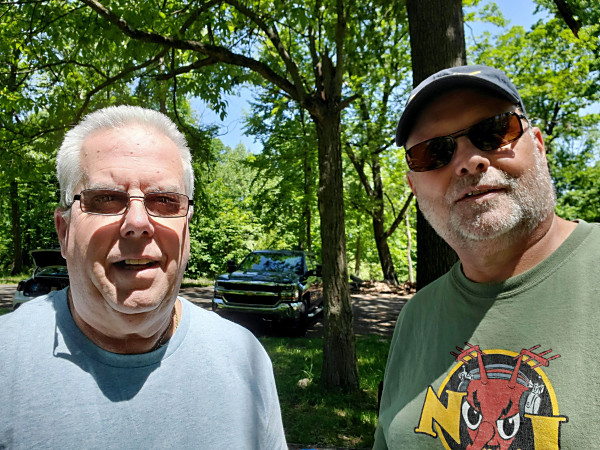
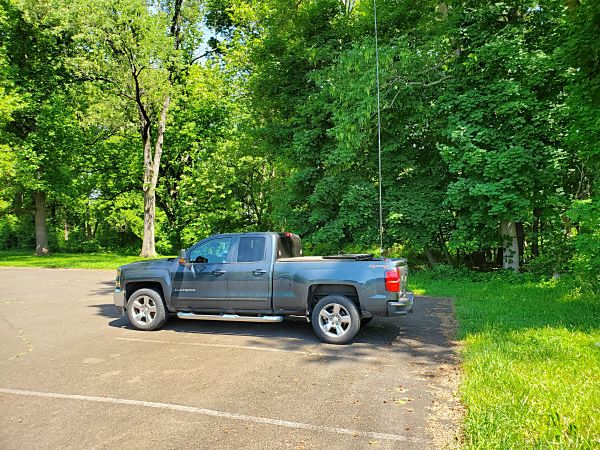
For most of this year, I’ve fallen into the habit of activating the same familiar parks. Today, I wanted to go out to a park I haven’t been to before. After looking at the map on the POTA website, I chose Big Elk Creek State Park (K-9721/KFF-6093) as today’s destination.
Big Elk Creek received its state park designation back in September, making it one of Pennsylvania’s newest state parks. I did a little Google Earth reconnaissance to get a feel for the area. There are no amenities to speak of, but it has some trails and two trailhead parking lots. I entered both trailheads into my navigation app before heading out.
Big Elk Creek near the Springlawn Trail
After driving about an hour, I stopped first at the Springlawn trailhead. Being a low-lying area, it didn’t look promising for radio. A sign showed that the trail was closed temporarily because of hunting in the area. I moved on to the second parking area shown on the park map.
I pulled into the Fair Hill Trailhead. This spot was wide open, had good elevation, and I was the only one there. I set up my usual Penntek TR-35 (5 watts) and my homebrew vertical.
Fair Hill Trailhead in Big Elk Creek State Park
I started on the 40 meters CW. Right after I spotted my location and frequency, I was greeted by a large pile-up that took a little while to work through. Being a new park, Big Elk Creek has only been activated a handful of times. I’m guessing that’s what attracted all the hunters.
During my activation, I also spent time on 30, 20, and 17 meters. After about an hour and 15 minutes, I had 42 stations in my log. I had three park-to-park QSOs, and I also worked England, Italy, and Portugal.
Right as I was reaching for the power switch to turn off the radio, I heard PG4I calling “CQ SKCC” on 17M. I quickly grabbed my straight key and called him. We exchanged our SKCC info, and Jo gave me a 559 from the Netherlands. That brought my total to 43 with four DX contacts today.
A car pulled into the parking lot as I was taking down my antenna. The driver walked over to inquire about my antenna. I gave him a brief explanation of the Parks on the Air program, and we had a nice chat about the park. He told me about the trail that heads south for about a mile to the Maryland state line. The Fair Hill State Natural Area (K-6387) is just across the state line.
I’m planning to come back at some point to do a little hiking and activate both Big Elk Creek and Fair Hill.
Traditionally, the day after the Thanksgiving holiday here in the U.S. is the start of the Christmas shopping season. People flock to the stores looking for bargains. This time of year is typically when stores start turning a profit (operating in the black), hence the name “Black Friday.” Wanting to avoid all of that craziness, I went a different way and headed out to a nearby park for a POTA activation.
For a variety of reasons, I haven’t been on the air much this month. I was overdue for some QRP-portable operating, so I headed to nearby Evansburg State Park (K-1351, KFF-1351). It was rainy here in southeastern Pennsylvania this morning. When I arrived at the park, I was the only one there for a while.
WB3GCK at Evansburg State Park (K-1351) on a damp and dreary morning
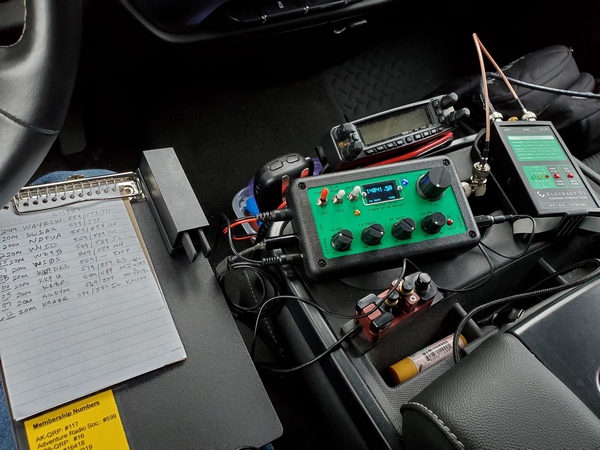
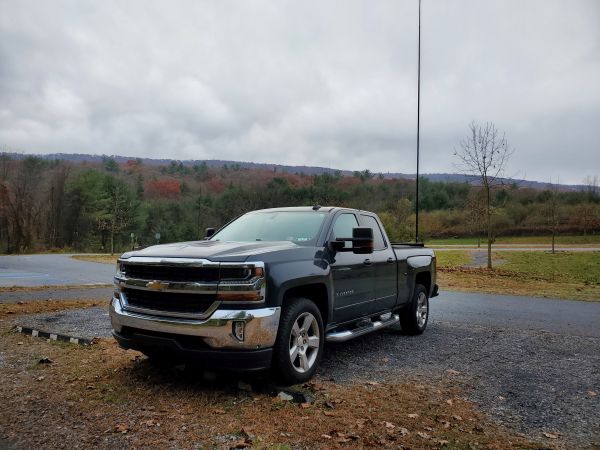
I set up my TR-35 (5 watts) inside the truck and installed my trusty 19-foot vertical on the back. The hunters quickly showed up after I spotted myself. I had my required ten contacts in about ten minutes. After I had logged 16 contacts on 40M, a station came on frequency and started CQing. I figured that was a good time to check some other bands.
The organized chaos inside my truck
Up on 20M, the signals didn’t seem as strong. Nevertheless, I picked up 15 more contacts. I made four more contacts on 17M before pulling the plug.
After a little more than an hour, I ended up with 36 contacts. Among those were four park-to-park contacts. I also logged four DX contacts: DL1AX (on two bands), SP6GNJ, and F4ILH.
It felt great to be back out activating. Hopefully, I can get back out again over the weekend.
I had a rare free day today. The only thing on my agenda was to drive out to see my grand-kids in central Pennsylvania. I made a last-minute decision to activate a park on the way there.
Just minutes before I left the house, I looked at the map of parks on the POTA website and selected Swatara State Park (K-1426/KFF-1426). I’d never been there, so I took a quick look at a map of the park and spotted a trailhead with restrooms. So, I put the address for the Trout Run Trailhead in my GPS and took off.
I rolled into the parking lot about 90 minutes later. Except for a park maintenance truck, I was the only one there. I quickly set up and got busy. The rig today was my TR-35 (5 watts) and my trusty 19-foot vertical.
WB3GCK all alone in the Trout Run trailhead parking lot at Swatara State Park
The cell coverage was great, so I easily spotted myself. A minute or two later, the hunters came calling. I spent most of my time on 40M, but I also made contacts on 30M and 20M.
After about 90 minutes, I had 54 CW contacts in the log. Among those were six park-to-park QSOs and one DX contact (CU3AA).
Swatara State Park is another park worth further exploration. There aren’t many amenities, but there are lots of trails. It appears to be a popular spot for mountain biking.
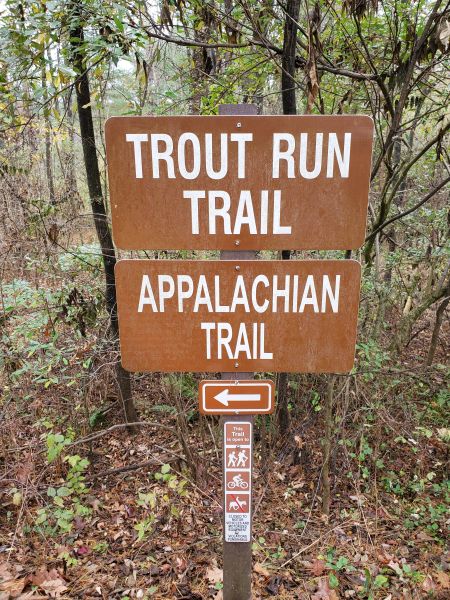
Trail signs at Swatara State Park. The Appalachian Trail runs through the park, but I wasn’t close enough for a “two-fer.”
There was a trailhead for the Appalachian Trail just down the road from where I was. If I hadn’t been so hasty with my planning, I could have gone there and activated a “two-fer.” Maybe next time.
Normally, my (far) better half and I do a lot of camping in French Creek State Park (K-1355/KFF-1355). This year, because of medical and other issues, we didn’t take the QRP Camper out at all. In fact, it’s been about a year since our last camping trip there. So, I paid a visit to French Creek this morning for a long-overdue POTA activation.
Virtually all of my activations in this park have been from campsites. This morning, though, I operated from a parking lot near a picnic area and boat launch. I operated from my truck, using my TR-35 (around 5 watts) and my 19-foot homebrew vertical.
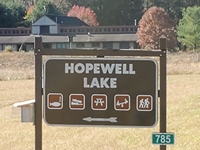
Hopewell Lake in French Creek State Park (K-1355/KFF-1355)
Hopewell Lake in French Creek State Park (K-1355/KFF-1355)
My cell coverage wasn’t very good, so I had trouble spotting myself. Fortunately, the Wi-Fi in my truck uses a different carrier and allowed me to get my spot posted. Almost immediately, the hunters started calling.
After an hour, I had 36 in the log, including two park-to-park contacts. I also worked Germany and Poland on 17M.
Hopefully, we’ll be getting back to camping at French Creek again next year. In the meantime, I’ll be doing some more activations here for sure.
I haven’t activated a park recently, so I made a point to get out today. This weekend is the Parks on the Air Fall Support Your Parks weekend. What better time to activate?
I made a last-minute decision to head back to the western boat launch area in Marsh Creek State Park (K-1380, KFF-1380), a site I’ve been to a few times in the past year. Looking at the surrounding terrain, you would think this is a terrible location. It’s down at water level near the lake, and you have to descend a large hill to get down there. Despite the terrain, I’ve always had good luck from there. Today was no exception. Not to mention there’s a beautiful view of the lake.
WB3GCK at Marsh Creek State Park (K-1380)
Using my TR-35 and my 19-foot vertical, I started out on 40M. Initially, I had a little trouble spotting myself. Even before I was spotted, a station in New York stumbled upon me and got things started. Eventually, my spot went through, and things really picked up. I made 28 contacts on 40M in the first 45 minutes. Up on 30M, I picked up 11 more contacts.
Before I left, I checked 17M, and I’m glad I did. I was getting some very strong Reverse Beacon Network (RBN) spots from Europe. In short order; I had three contacts, with the last two being SP6GNJ and CU3AA. Happily, my puny five-watt signal was making the trip across the pond.
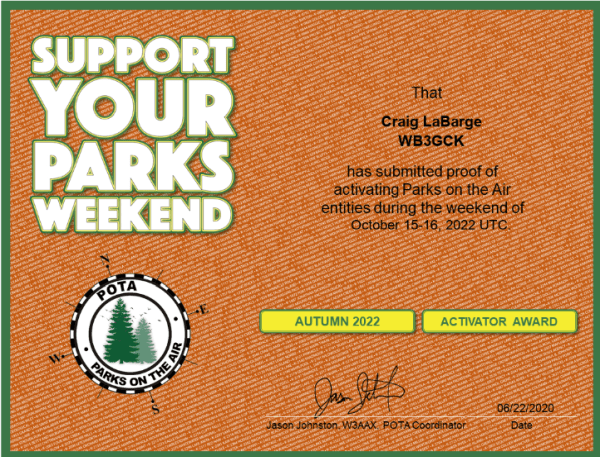
Support Your Parks Weekend Activator Award
I ended up with 42 contacts, including two park-to-park QSOs, and the two DX contacts. Right after I uploaded my log, I received a certificate for activating a park during Support Your Parks weekend. I made a few contacts as a hunter yesterday, so I also received a hunter certificate.
After a long drive home from North Carolina yesterday, we were still unpacking from our vacation and getting caught up on things today. I couldn’t pass up the annual Skeeter Hunt QRP contest, so I snuck out to make a few contacts. Besides, I was issued a single-digit skeeter number (#7) this year, so I couldn’t let that go to waste.
I drove a few miles over to Valley Forge National Historical Park, hoping to catch enough skeeters for a valid POTA activation (K-0761). The area I was in was busy with folks enjoying their picnics, so I parked my truck well away from them.
I didn’t plan to stay long, so I operated from the truck. I used my Penntek TR-35 and my trusty homebrew vertical. That turned out to be a wise move, since the truck provided some shade and an occasional cross-breeze through the windows.
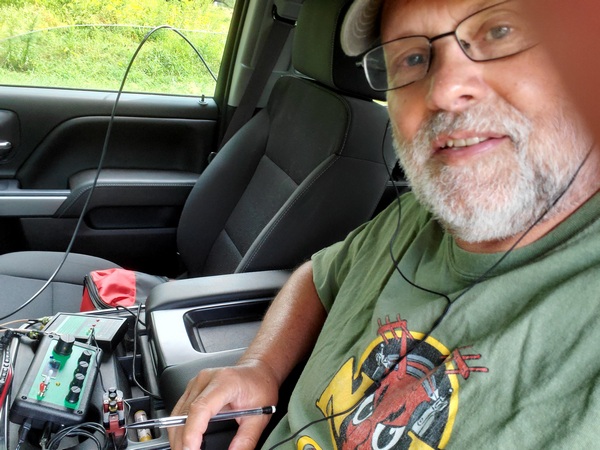
Yours truly operating in the 2022 Skeeter Hunt QRP contest
When I turned on the rig, the 40M band was buzzing with QRP skeeters, and I made most of my contacts there. Conditions, at times, seemed pretty good; I worked stations in WI, MO, and GA on 40M from here in southeastern PA. After running out of new ones on 40M, I moved up to 20M and picked up a few there.
At the end of my 1.5 hour session, I had worked 16 skeeters, one non-skeeter QRPer. There were other skeeters operating from POTA entities; I had at least four park-to-park contacts I know of.
The Skeeter Hunt is always a good time. I’m glad I could take part, even if just for a part of the contest. A big shout-out to Larry W2LJ for organizing this fun event.
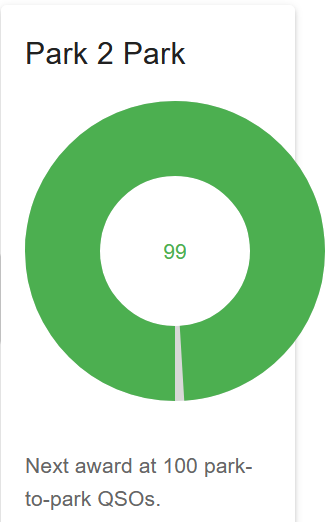
I logged into the POTA.app site this morning and noticed that I had 99 park-to-park QSOs, just one away from the next award level. With my vacation coming up, I probably won’t be able to activate a park for another couple of weeks. My obsessive nature couldn’t take looking at that 99 number all that time, so I set out today to rectify that.
I started the day just one away from the next POTA Park-to-Park award. Of course, I had to go out and get a few more.
I drove down to Valley Forge National Historical Park (K-0761/KFF-0761) this morning for a quick activation. We’re still under a heat advisory, so I got there early to avoid the worst of it. On arrival, I found a shady spot and parked my truck.
I set up a camping chair and small table in the shade and used my 19-foot vertical on the back of my truck. My rig today was my Penntek TR-35 at 5 watts.
My setup behind my truck at Valley Forge National Historical Park (K-0761/KFF-0761)
The CW hunters were out in force early today. It took all of 15 minutes to make my first ten contacts. Operating for exactly an hour, I finished with 25 QSOs in my log. Best of all, five were park-to-park QSOs, so I had more than enough to put me over the top.
With my mission accomplished, I can stop fixating on that pesky “99.”
My daughter and her family went on a road trip to Michigan for my grandson’s hockey tournament. They needed someone to stay with their dog, Cooper, who is recovering from recent leg surgery. I volunteered to stay at their house near Harrisburg, Pennsylvania, while they were gone and spend some one-on-one time with my “grand-dog.” Of course, I took some radio gear along with me.
Cooper is recovering nicely from his surgery, but he still needs to restrict his activity. He’s OK on his own for a few hours, so I planned to squeeze in a couple of short radio-related outings while out there.
Boyd Big Tree Preserve Conservation Area (K/KFF-4356)
After feeding and walking the grand-dog on Thursday morning, I headed out for a quick POTA activation. The Boyd Big Tree Preserve Conservation Area—now that’s a mouthful—is only about 25 minutes away, so I could get an activation in without leaving the dog alone for too long.
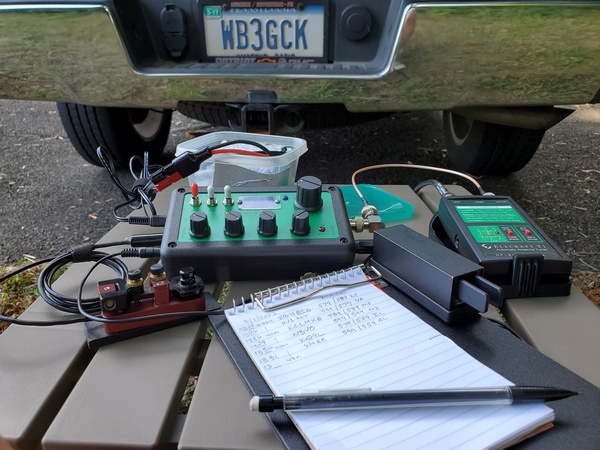
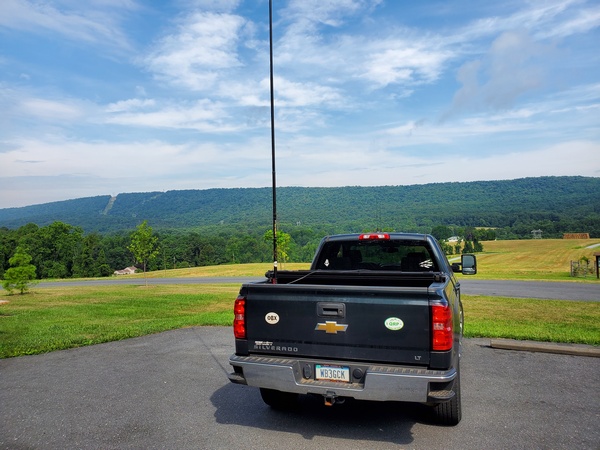
The parking area, on a hill, was vacant when I pulled in. I passed a huge high tension tower near the park entrance, but, fortunately, the power lines didn’t run anywhere near the parking lot. I set up the TR-35 in the cab and mounted my trusty homebrew vertical on the back of the truck.
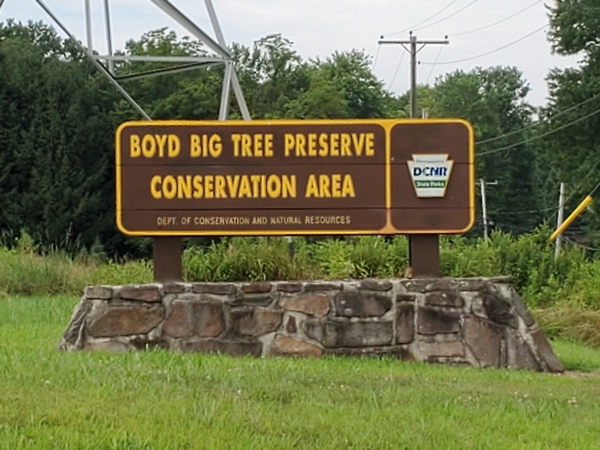
Boyd Big Tree Preserve Conservation Area entrance. You can see one leg of a huge high tension tower behind it. Fortunately, the powerlines didn’t run near the parking lot.
I started out on 40M, and the band was in excellent shape. Despite being sandwiched in between some mountains, my five-watt signal was getting out fine. I was getting some very strong spots on the Reverse Beacon Network. I logged my first ten contacts in less than 15 minutes.
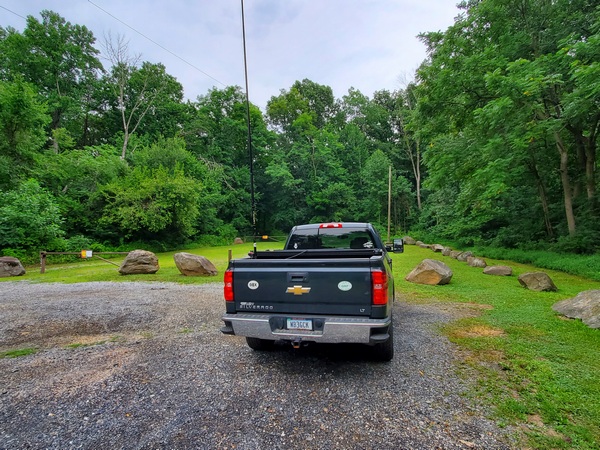
My parking spot at the Boyd Big Tree Preserve Conservation Area. The woods were behind me, out of the shot.
After making 20 contacts on 40M, I moved up to 20M. There, I logged another 10 contacts, including SM0NSJ in Sweden. After about 50 minutes on the air, I started packing up to make my way back to the house.
The final tally was 30 contacts, with one park-to-park, and one DX QSO. Looking at the POTA website, it looks like this was the first CW activation at this park in more than two years.
I didn’t see much of the park, but what I saw looks beautiful. I will definitely need to go back there to do some hiking on the trails.
PA State Game Land 246 (K-8941)
My original plan for Friday morning was to take a bike ride on the Northwest Lancaster County River Trail and operate from somewhere along the trail. I’ve been wanting to ride this trail since I did some portable operating from the trailhead about 4 years ago. Unfortunately, as I was putting the bike on the rack for the trip out here, I found that the rear brake was locked up. I didn’t have time to deal with it; so, sadly, I left the bike at home. Another time, I guess.
With the bike out of the question, I instead drove a few miles down the road to PA State Game Land 246 for another POTA activation. There was only one other vehicle in the parking lot, and he left about 15 minutes later.
All alone in the parking lot for Pennsylvania State Game Lands 246 in Middletown, PA
Band conditions seemed in great shape; it didn’t take long to make my first ten contacts. One of my first contacts was with fellow QRPer, W1PID, in New Hampshire. I hadn’t worked Jim in a while, so it was good to hear him calling.
I had a few stations that worked me on multiple bands. W6OUL in California heard my five-watt signal on 30 and 20 meter bands. Those were my longest contacts of the day. Meanwhile, K9VIC in Illinois reached me on all three bands used today (40M, 30M, and 20M).
I was on the air for exactly one hour, ending up with 34 QSOs with one park-to-park contact. After that, I packed up for the short drive back to the house to hang out with the grand-dog.
Backyard Bust
On Saturday, I stayed around the house and planned to do some casual operating from the backyard. It’s been a couple of years since I last operated from here, and it has always been somewhat of a challenge. It’s in a low spot, and surrounded by houses, but I thought I’d give it a go today.
I started with my trusty 19-foot vertical on my homebrew ground mount. The receiver noise was horrendous. The Reverse Beacon Network (RBN) showed I was getting out with double-digit signal-to-noise readings. I just couldn’t hear anything. I figured the vertical was just the wrong choice for this environment.
Next, I went with the Alexloop, figuring that it would be better in this noisy environment. Like the vertical, I was getting decent SNR readings on RBN, but it was receiving only slightly better. Not great, but a little better.
Although I got skunked, I got some practice using the Alexloop with the TR-35. I used a resistive SWR bridge between the TR-35 and the loop, and I figured out the output power settings that work best on each band to get the bridge’s LED to extinguish at resonance. I also got to test a little battery pack I put together with three 18650 Li-ion cells.
So, this little mis-adventure wraps up my operations from here in south-central Pennsylvania, and I’m heading back home tomorrow (Sunday). At least I got in a couple of fun POTA activations while I was here.
I made a return trip to Fort Washington State Park (K/KFF-1352) this morning for a Parks on the Air (POTA) activation. I activated this park back in October of last year, so I wanted to give it another go today. Along with some over-the-air contacts, I made a fun eyeball QSO.
My location and setup were nearly identical to my last visit. I started on 40M, and within a few minutes, the POTA hunters showed up. After I had logged 14 contacts, I was getting ready to change bands. I noticed a car going by with a familiar callsign on its license plate.
Greg WA3GM turned around and stopped behind my truck. I have worked Greg many times in recent years. He’s a frequent POTA activator and a fellow SKCC member. Despite those contacts, we have never met in person. After chatting for a few minutes, Greg left to find somewhere to set up for his activation.
After spending some time on 30M and 20M, I did some searching and pouncing to pick up a few park-to-park contacts. Right before pulling the plug, I found Greg on 40M and had a quick park-to-park QSO with him. Of course, we were 599 both ways.
Greg WA3GM activating Fort Washington State Park (K-1352)
I packed up my gear and spent some time driving around the park to see if I could find Greg. I found him less than a mile away, operating from a picnic table near some group campsites. Greg was using his trusty Rybakov antenna. We chatted for a while and learned that we have a bunch of friends in common. After posing for some selfies, I let Greg get back to his activation and headed off on my drive home.
WA3GM (left) and WB3GCK during a chance POTA meet-up in Fort Washington State Park (K-1352)
I ended up with 19 contacts in my log, with 3 park-to-park contacts and a nice eyeball QSO.
May has been a busy month around here, and I haven’t had much time to get out and do some portable operating. So, on the last day of the month, I made a quick trip to nearby Valley Forge National Historical Park for a short POTA activation (K-0761, KFF-0761).
I had some plans for later today, so headed out early. Most of the holiday picnic goers would likely arrive later to observe Memorial Day and take advantage of the glorious weather. Based on previous activations, I knew where to find a shady parking spot. Once situated there, I set up my 19-foot vertical on the back of my truck. I operated my trusty KX3 in the truck, this time out.
My parking spot at Valley Forge National Historical Park (K-0761, KFF-0761)
Starting out on 40M, I made the requisite ten contacts in about 15 minutes. My best “DX” of the day was California and Washington State, both on 20M with 5 watts. I operated for a little over an hour and ended up with 32 contacts with four park-to-park QSOs.
Now that I’m driving again, life seems a little more normal. It was good to do an activation with no chauffeur. My (far) better half was a good sport, but I know she has things she’d rather be doing.
Friends here in southeastern Pennsylvania have been talking about how bad the ticks are this year. I think they’re right. As I was driving out of the parking lot, I found one crawling on the back of my neck. So, be careful out there.
Finally, I’d like to wish everyone an enjoyable and safe holiday. Please be sure to take time to remember and honor those who made the ultimate sacrifice for our freedoms.