POTA/WWFF & WES at Marsh Creek

I was out of town this past week puppy-sitting my grand-dog recovering from surgery. Although I brought my KH1 along, I didn’t have an opportunity to use it. Today was the first day I could get in some radio time. Since I hadn’t been there in a while, Marsh Creek State Park (US-1380, KFF-1380) seemed like an appropriate destination. 

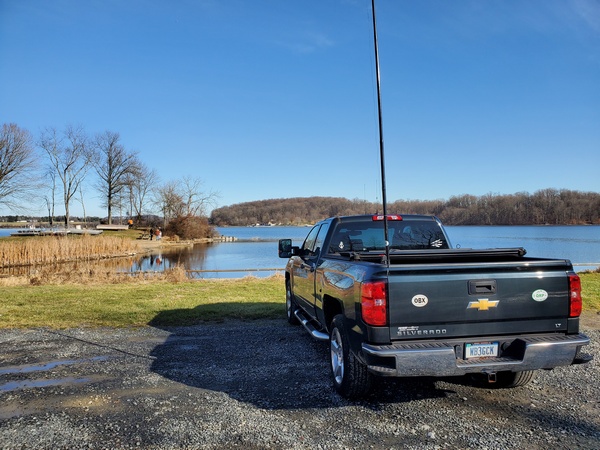
My (far) better half and I had plans for the afternoon, so I got an early start. The weather was somewhat dreary with some occasional drizzle, so the park wasn’t very crowded. I hunkered down in the truck with my usual Penntek TR-35 and 12-foot loaded whip.
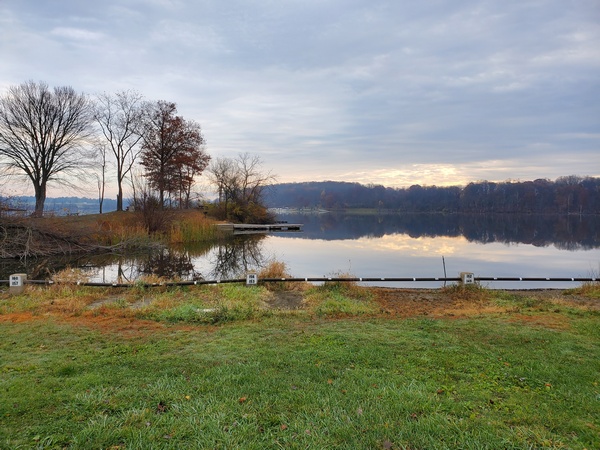
Marsh Creek Lake on a hazy morning

As is my custom, I started on 40M. Since the Straight Key Century Club’s (SKCC) monthly Weekend Sprintathon (WES) was in progress, I grabbed my straight key and worked a half-dozen SKCCers. One thing I love about the TR-35 is that it has separate inputs for paddles and straight key, and you can switch between the two at will. That’s perfect for mixing SKCC and POTA/WWFF.

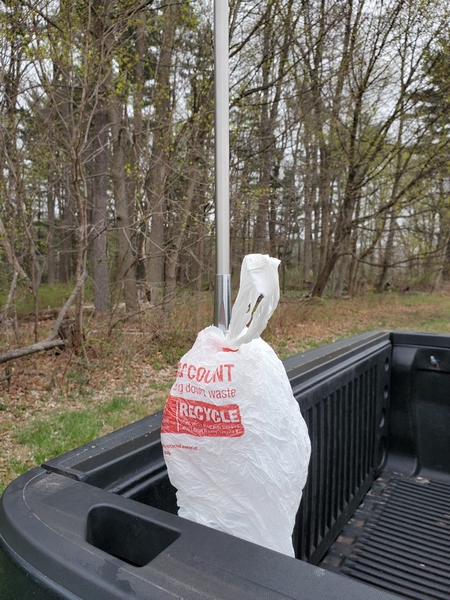
I started calling CQ on 40M and worked 13 POTA/WWFF hunters before a digital station started transmitting on top of me. Right about then, it started raining, so I grabbed a plastic bag to protect my loading coil. From that point on, I stayed on the WARC bands, picking up some more contacts on 30M and 17M. 
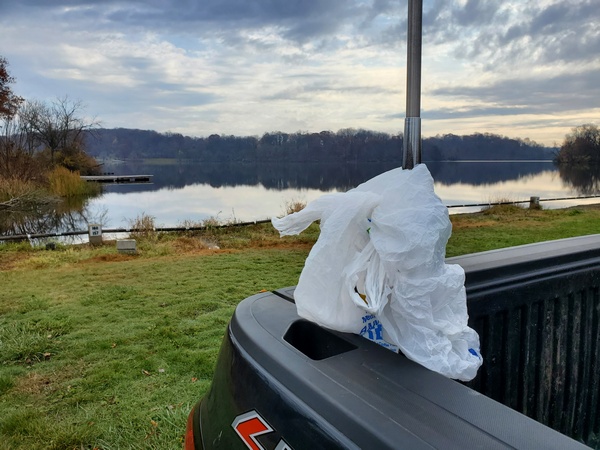
My loading coil protected rom the rain

After an hour and 10 minutes, I had logged 35 contacts. The bands seemed to be in decent shape, although there was some static from storms along the east coast. Despite the occasional noise, I had contacts with both California and Poland on 17M. 

Although it was another of my typical short-duration activations, it was great to get back on the air. And I’m happy to report that my grand-dog is recovering nicely and doing great.

72, Craig WB3GCK
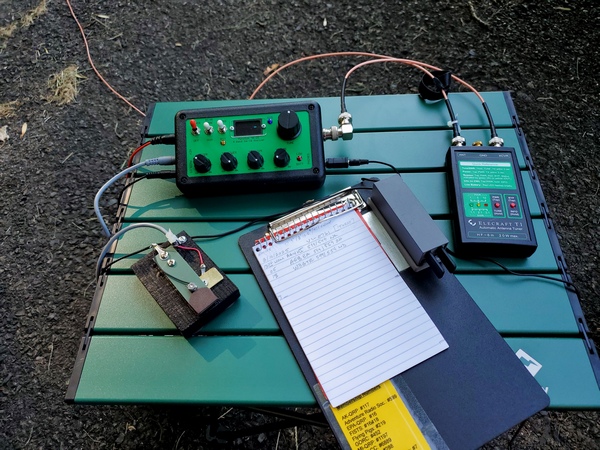
More Antenna Testing in Valley Forge

In my last post, I talked about using a simple antenna comprising a 15-foot radiator, a 7.5-foot counterpoise, and a 4:1 unun. It worked well, but I found it a little touchy to tune on 40M. Today, I tried the same configuration, but with a slightly longer radiator and counterpoise.

I wanted to add a little length to the radiator, but limit it to 19 feet, so I could still use my lightweight 19.5-foot telescoping pole to support it. Looking at a table of random wire antenna lengths to avoid, it seemed like 18 feet might be a good choice for 40M through 15M, my primary bands of interest. Scaling the counterpoise wire proportionately, I went with a length of 9 feet. 

Just as I was getting ready to cut a set of wires to try out, I stumbled on a video by Thomas K4SWL. In the video, he was using an antenna built by AD8HK that used a radiator length of 17’9” and a counterpoise length of 8’10.5”. I went with those dimensions, since they were very close to what I was considering and seemed to work with Thomas’s KH1.  

On the Air

To try it out, I made a quick trip over to Valley Forge National Historical Park (US-0761, KFF-0761). Using the same 4:1 unun and coax as the last time, I made a quick check to see how my Elecraft T1 loaded up on the bands. The tuner quickly found a match on 40M, 30M, 20M. On 17M, however, it seemed to struggle. I went back to 40M and got started with my activation. 

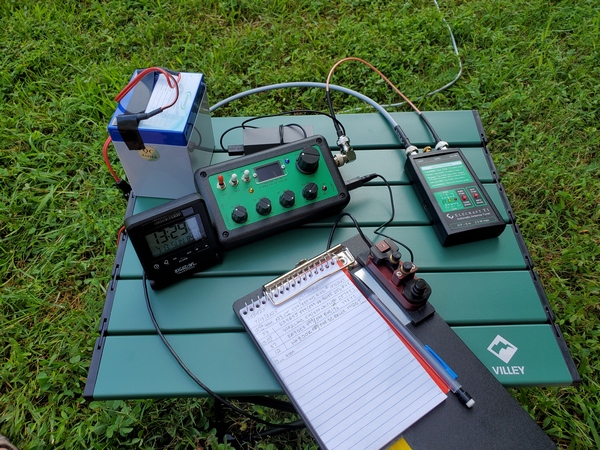
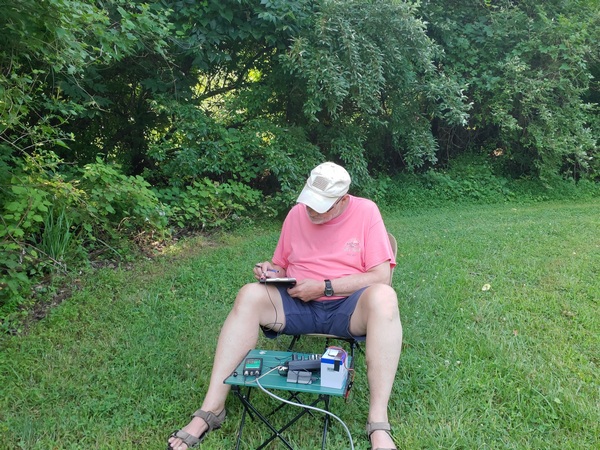
My radio equipment at Valley Forge NHP

This wasn’t the best day to be doing this. The geomagnetic field was unsettled with a K index of 4 and the A index sitting at 47. Nevertheless, the callers showed up, although at a somewhat slower pace than usual. 

After I had 14 contacts in the log, I decided to spend the rest of my limited time playing around with the antenna. When I went back and checked 17M, the T1 tuned it up without flinching. I also rearranged the counterpoise wire so it ran 180 degrees opposite of my coax. Checking the bands again, the T1 reliably matched 40M through 17M. 

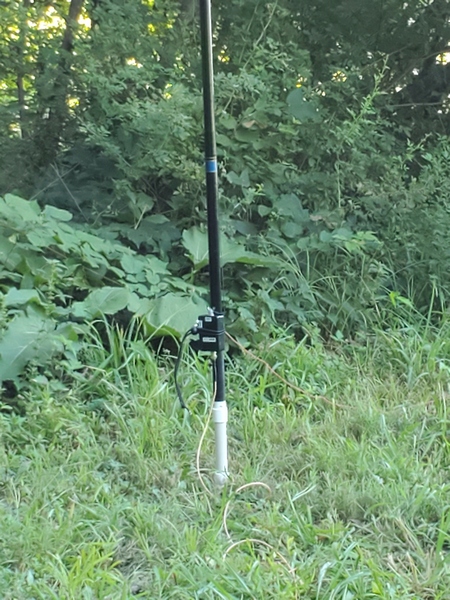
My antenna at Valley Forge NHP

Convinced that the new wire lengths work, I went back to the 15-foot radiator and 7.5-foot counterpoise I used a few days earlier. This time, the T1 had no issues loading up on 40M. Go figure! 

I really wanted to give the unun with the smaller ferrite core another shot. When I last tried it with the 15-foot & 7.5-foot wires, neither my KH1 nor my T1 could find a match on 40M. Unfortunately, I neglected to put it in my backpack before I left. I’ll have to save that for another time. 

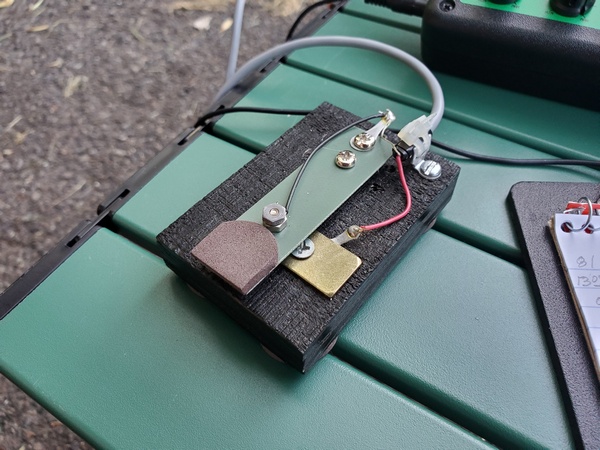
The Straight Key Century Club (SKCC) Weekend Sprintathon contest was going on this weekend, and I worked one SKCC station while tuning around the bands. This month, the WES theme was homebrew keys. In the spirit of the contest, I made the contact using a straight key I built a few years ago from junk box parts. 

My homebrew straight key constructed from odds and ends in my junk box
My homebrew straight key constructed from odds and ends from my junk box

Conclusions

So it looks like both the 15’/7.5’ and 17’9”/8’10.5” configurations are usable with my homebrew 4:1 unun. Given a choice, though, I would probably stick with the longer wires. 

One other thing is clear: short random wires can sometimes be finicky little critters.  When in doubt, rearrange the counterpoise wire.

72, Craig WB3GCK

WES & POTA at Ridley Creek

I made some contacts in the monthly Straight Key Century Club (SKCC) Weekend Sprintathon (WES) this morning and completed a POTA activation while I was at it. My operating site today was Ridley Creek State Park (US-1414, KFF-1414).

I rolled into one of my favorite spots and set up my table and chair in the grass behind my truck. From previous activations, I knew this spot always has lots of shade. Of course, with the heavily overcast skies this morning, sun exposure wasn’t much of an issue. 

I mounted a 17-foot whip and my homebrew loading coil on my truck and ran some coax back to my operating position. Rig-wise, I used my Penntek TR-35 (5 watts, CW), Elecraft T1 tuner and my little American Morse MS2 straight key

WB3GCK's radio setup at Ridley Creek State Park (US-1414, KFF-1414)

My strategy today was to operate in the WES for an hour. If I hadn’t reached 10 contacts by then, I planned to break out the paddles and finish up as a POTA activator. 

It was a good thing I had a “Plan B.” After an hour, I had only scratched together six WES contacts. I don’t know if it was the unsettled geomagnetic conditions or just a lack of early morning participants, but I didn’t hear much WES activity on 40M and 20M. 

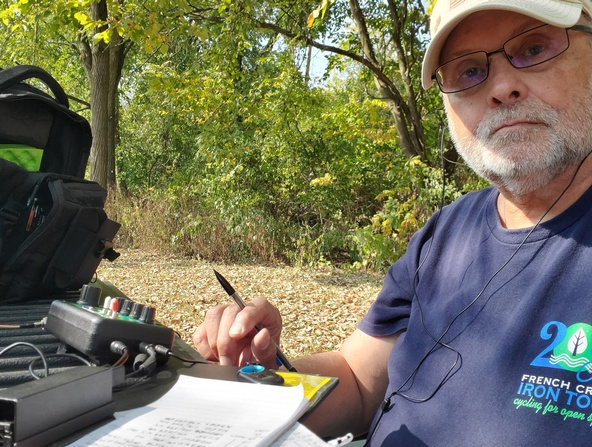
WB3GCK operating in the SKCC WES contest at Ridley Creek State Park (US-1414, KFF-1414)

After spotting myself on the POTA and WWFF websites, I easily made the requisite 10 contacts on 20M plus three more for good measure. One of those contacts was a park-to-park. 

It wasn’t my best outing, but far from my worst. Even with the humid weather and the occasional mosquito, it was nice to do a little outdoor operating and log some familiar SKCC and POTA callsigns.

72, Craig WB3GCK

Dreary Morning in Valley Forge

My original plan was to do a bicycle-portable activation in Valley Forge National Historical Park (US-0761, KFF-0761). Lousy weather and another commitment put those plans on hold. Instead, I did a short stationary-mobile activation there instead.

The two main picnic areas in Valley Forge opened for the season on April 1st, so I rolled into one of my favorite spots. Not surprisingly, I was the only one there. I don’t think that too many folks want to have a picnic at 0830 (local time) in the rain. 

I set up my usual Penntek TR-35 (5 watts, CW) and 12-foot loaded whip and started out on 40M. The bands were recovering from some geomagnetic storming yesterday, but were still a little flakey. Contrary to propagation predictions, 40M turned out to be the most productive band for me today. The 20M band only produced two contacts, while 17M was a total bust today.

One of my hunters on 40M sent me his SKCC number. I always keep a straight key connected to the TR-35, so I easily completed an SKCC contact with him. 

Part way through my activation, the rain started picking up. I headed around to the back of the truck to put a plastic bag on my homebrew loading coil

My homebrew loading coil wrapped with a plastic bag for weather protection.
I had to break out the foul weather gear for my loading coil.

After 20 minutes of futile CQing on 17M, I decided to call it quits. I ended up with 18 contacts. No DX today, but there were two known park-to-park contacts. 

Hopefully, I’ll be able to get the bike out sometime next week.

72, Craig WB3GCK

Slick Activation at Valley Forge

We had a real pot-pourri of winter weather overnight here in southeastern Pennsylvania. It was a combination of snow, sleet, and freezing rain. Despite some residual ice on the roads, I went over to Valley Forge National Historical Park (US-0761, KFF-0761) this morning for a quick activation.

Before I could go anywhere, I had to scrape a thick layer of ice off my windshield. The temperature was slightly above the freezing mark, so it came off easier than I expected. The roads in my neighborhood were covered, but the main roads were mostly clear.

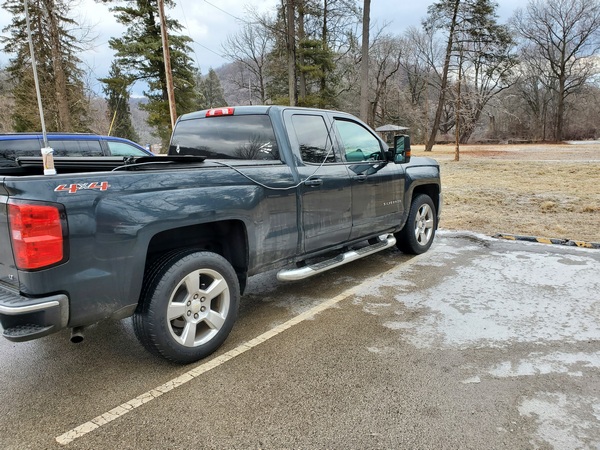
When I got to the parking lot in Valley Forge, it looked like it had been recently salted. The parking spaces were still ice-covered, and my truck was completely surrounded by it. Needless to say, I had to tread carefully around the truck.

At the end of my activation in Valley Forge, the ice was melting fast.
By the end of my activation in Valley Forge, much of the ice had melted off.

I used my little Penntek TR-35 (5 watts, CW) and 12-foot loaded whip. This has been my go-to setup of late. I started off on 40M, making three Straight Key Century Club (SKCC) contacts in the monthly Weekend Sprintathon (WES) contest. I switched to my paddles and started calling, “CQ POTA.” Activity on the 40M band was a bit slow for me; it took about 20 minutes to make my first 10 contacts. Fortunately, there was more activity on 20M and 17M. 

After about an hour and 15 minutes, I had 47 contacts in my log. The European WWFF hunters were out in full force, especially the German stations. I had 13 DX contacts:

  • Germany (8)
  • Slovak Republic (2)
  • Italy
  • France
  • Poland

I also worked three West Coast stations (two in California and one in Washington), so all in all it was a good morning. By the time I started packing up, the sun was out and much of the ice in the parking lot was gone. Happily, the drive home was uneventful.

Now it’s time to settle in, over-eat, and watch the Super Bowl. 

72, Craig WB3GCK

Sprinting in the Park

No, I wasn’t running through the park. I was operating in the Straight Key Century Club’s Weekend Sprintathon contest from a POTA/WWFF entity. I ended up with two POTA/WWFF activations as a result. 

On Saturday morning, I drove over to Norristown Farm Park (US-4363, KFF-4363), which has become one of my favorites. It was pretty chilly when I started, so I set up in the truck. (That turned out to be a poor decision.) I used my Penntek TR-35 (5 watts) and my trusty 12-foot loaded whip. I used my little MS2 straight key for the SKCC contacts.

My setup in the truck on Saturday. My little American Morse MS2 straight key looks unusual but has a great feel.
My setup in the truck on Saturday. My little red American Morse MS2 straight key looks unusual but has a great feel.

My plan was to operate in the WES and only spot myself on the POTA and WWFF websites if I had trouble making my 10 contacts. The band conditions had improved significantly from the severe geomagnetic storms over the previous couple of days, so I was optimistic. 

Starting out on 40M, I was pleasantly surprised to find a bunch of SKCC stations. I worked 13 WES stations on 40M before moving up to 20M to work a few more. SKCC WES contacts come at a slower pace than POTA contacts, so after an hour and 20 minutes, I only had 16 contacts. I was happy with that, though. 

By that time, the temperature had gone up, and the sun was beating down on the windshield. It was really getting hot in the truck, so I pulled the plug and packed up for the day. 

On Sunday morning, I went back to Norristown Farm Park for more of the SKCC WES. This time, I operated from the tailgate of my truck. I rarely do that, because the tailgate is too high off the ground. I had backed the truck up to a slight slope, so my chair was a bit higher than if I had been on flat ground. Still, it wasn’t all that comfortable for keying. I ended using my clipboard on my lap. My equipment was the same as the day before.

Operating from the tailgate on Sunday morning.

This time there was much less SKCC activity on 40M. Despite numerous CQ calls, I only logged four WES contacts. So, I made the command decision to spot myself on the POTA website and switch over to the paddles. The activity picked up dramatically after that.

This time I ended up with 21 contacts, which included three park-to-park QSOs. All together, I made 20 SKCC WES contacts over the weekend, which is not too bad for me. 

I’ll have to try this again for next month’s Weekend Sprintathon. 

72, Craig WB3GCK

POTA Repeat Offender and SKCC WES

The monthly running of the Straight Key Century Club’s Weekend Sprintathon (WES) contest was this weekend. I needed two more activations at Marsh Creek State Park for a POTA “Repeat Offender” award, so I headed out both Saturday and Sunday for POTA/WWFF activations and to make a few WES contacts.

We had some outstanding weather here in southeastern Pennsylvania, so I knew Marsh Creek (US-1380, KFF-1380) was going to be pretty busy. Given that, I headed out early on Saturday morning. I found a parking spot in the boat launch area, but the parking lot was filling up fast. 

My location in Marsh Creek State Park (US-1380, KFF-1380) for a POTA activation and the SKCC WES
My location in Marsh Creek State Park (US-1380, KFF-1380) for a POTA/WWFF activation and the SKCC WES

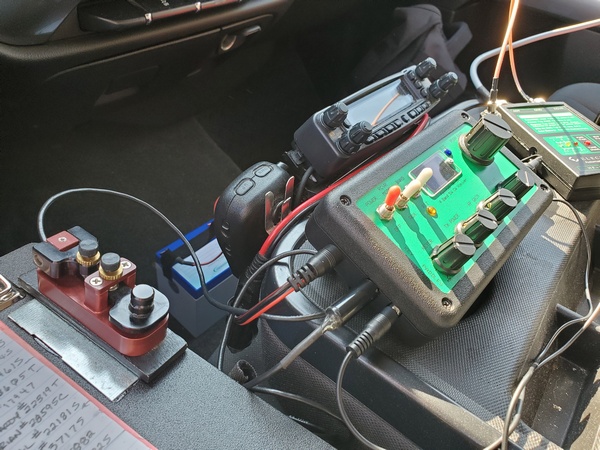
My trusty Penntek TR-35 was the perfect rig for this weekend. The TR-35’s separate straight key and paddle inputs let me instantly switch between the two without having to make configuration changes in the radio. I also went with my usual 12-foot whip and homebrew loading coil

The separate straight key and paddle inputs on the TR-35 lets me instantly switch between the two. (Note to Self: Clean out your truck!)

The 40M band was alive and well, so I spent most of my time there. I alternated between calling “CQ POTA” with the paddles and searching and pouncing SKCC WES stations with my little MS2 straight key. In about an hour of operating, I logged 26 contacts. Among those were three park-to-park QSOs and six SKCC WES QSOs. 

As great as the weather was on Saturday, it was even better on Sunday. I wanted to attend my grandson’s hockey game, so I went out even earlier this time and kept it even shorter. Even though I got an earlier start than the day before, the parking lot was even more crowded this time around. 

Once again, 40M was in excellent shape, and I ended up staying there for the duration. I logged 19 contacts in about 45 minutes, with three park-to-park and three more WES contacts. Then it was time to head home to take care of a few things before going to the soccer game.

In the end, I didn’t set any records in the WES contest, but I got in the two activations needed for my Repeat Offender award. 

72, Craig WB3GCK

Gone Before the Wind

The weather prognosticators said we’re under a Wind Advisory from midday today through tomorrow. In the best interest of my antenna, I got an early start this morning to avoid confronting the forecasted 45 MPH wind gusts. 

Instead of doing a normal POTA or WWFF activation, I headed down to Ridley Creek State Park (K-1414, KFF-1414) to take part in the Straight Key Century Club (SKCC) Weekend Sprintathon (WES) contest. I haven’t been very active in the WES contests of late, so I focused my attention on that. 

I used my usual Penntek TR-35 transceiver (5 watts CW) and my 12-foot loaded whip antenna. I also used my little American Morse MS2 straight key. The MS2 is an unusual-looking key, but I’ve really grown to love it over the years. I did some earlier posts on the MS2 and the magnetic base I built for it.

My little MS-2 straight key attached to my clipboard with a homebrew magnetic base I made for it
My little MS2 straight key attached to my clipboard with a homebrew magnetic base I made for it

Most of my operation today was on 40M. I split my time between calling CQ and search-and-pounce. The WES contests are rather laid back, compared to a typical POTA activation. The WES QSOs come at a much slower pace. I didn’t log my 10th contact until about 45 minutes in. 

As I was making my tenth contact, it started raining. So, I grabbed a plastic bag and went back to wrap up my loading coil. It was only a passing shower, so I removed the antenna’s “raincoat” a short while later. 

The "raincoat" I fashioned to protect my loading coil from the rain
The “raincoat” I fashioned to protect my loading coil from the rain

I ended up this morning with 15 contacts in my log. Thirteen were with SKCC stations, and two were POTA park-to-park contacts. I also worked KS1KCC, the SKCC club station in Michigan, on both 40M and 20M. 

This was a fun change of pace today, and I added a few new SKCC numbers to my log. 

72, Craig WB3GCK

Something Good in the Mail

Along with the usual junk mail yesterday, the mailman brought a couple of envelopes from the Straight Key Century Club (SKCC) QSL Bureau. Among the QSL cards I received, were two special ones.

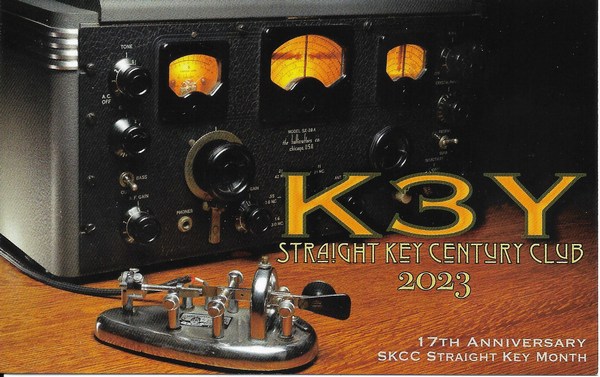
First was a QSL card confirming contacts I made with K3Y stations during the annual Straight Key Month (SKM) event. SKM is held each January with event stations operating around the world. I didn’t have my best year in the event, but I worked K3Y stations in eight of the ten call areas in the continental U. S. I also worked SKM stations in Puerto Rico and Portugal this year. 

K3Y Straight Key Month QSL card for 2023

Each year SKCC members submit designs for the K3Y QSL card, and members vote to select the final design. I always try to work some of the K3Y stations each year to ensure I receive a QSL card. 

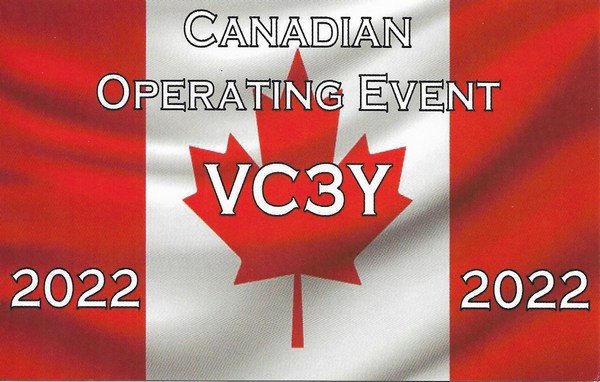
Another card I received was for the VC3Y Canadian Operating Event. Taking place during the month of September, this is an annual SKCC event that promotes the club’s many Canadian members. This year, I worked VC3Y/VY2 (Prince Edward Island) on 40M and 20M. I remember those particular QSOs because I was out bicycle-portable in a local park at the time. 

VC3Y QSL card for the 2022 Canadian Operating Event

Sadly, when the mailman came by today, it was back to the usual junk mail. 

73, Craig WB3GCK

Three-in-One Outing

I combined three activities into one outing today. The Polar Bear QRP Club was doing a Polar Bear Moonlight Madness Event (PBMME), and the SKCC Weekend Sprintathon (WES) started today. I planned to make some contacts in both, while doing a POTA activation.

The Polar Bear group traditionally schedules outings on the Saturday nearest a full moon. Rather than hold a separate on-air event, the Polar Bear ops are encouraged to conduct their usual portable operations (e.g. POTA, SOTA, picnic table portable somewhere, etc.) and give the other Polar Bears a heads-up so they can keep an ear out for them. The SKCC WES is held every month, and it just happened to coincide with the PBMME.

For today’s event, I chose to do a POTA activation at Marsh Creek State Park (K-1380). I used my Penntek TR-35 (CW @ 5W) and my 19-foot vertical. I operated from the West Launch parking area with a beautiful view of the lake. My plan was to call “CQ POTA” on each band for a while. Before changing bands, I planned to “search and pounce” looking for Polar Bears and SKCC stations. 

Western boat launch area in Marsh Creek State Park (PA)
West Launch area in Marsh Creek State Park (PA)

After about two hours, I had 37 contacts in my log. I spent most of my time making POTA contacts, so I only made three SKCC QSOs. I found two Polar Bears on the air, however. NJ7V was doing a combined POTA and SOTA activation out in Arizona. I saw Charlie’s spot come up on the POTA website, so I called him on 20M. We had a “tuner-upper” on the frequency, but we got our park-to-park QSO done. I also had a park-to-park QSO with AE5X, another Polar Bear member. John was activating a park down in Florida. Altogether, I had ten park-to-park QSOs today. 

I have to say this was a fun way to spend a chilly December morning.

72, Craig WB3GCK