This year’s QRP Zombie Shuffle coincided with our last camping trip of the season with our little travel trailer. We wrapped up our camping season in French Creek State Park in southeastern Pennsylvania.
After setting up camp and eating dinner, I spent some time on the radio in search of my fellow zombies. It’s customary to complain about contest band conditions but this year the complaints were justified. I never really heard any strong signals and there was severe fading on the bands.
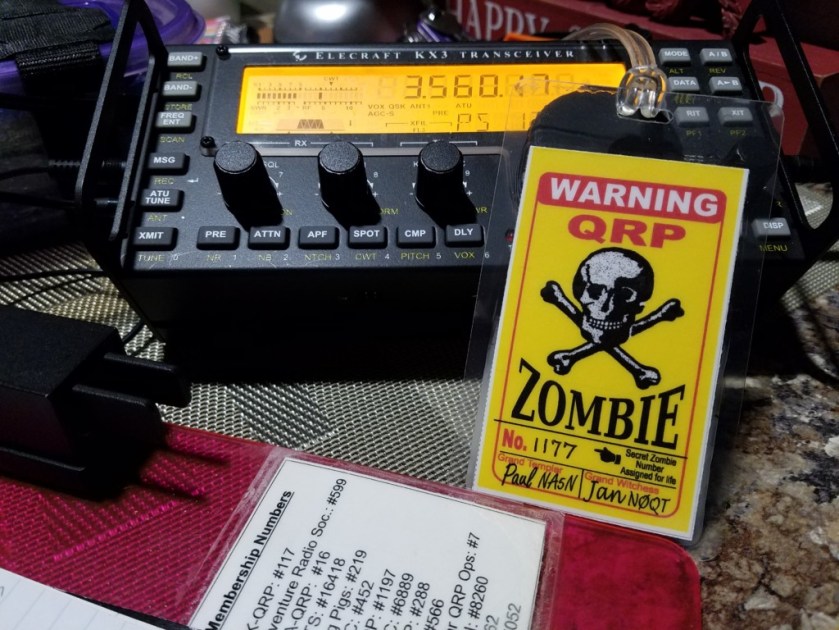
My official QRP Zombie credentials.
Despite the frightful conditions, I managed to log 8 zombies this year. Six of my eight contacts were on 80M. I was using a 29.5-foot wire vertical and 9:1. I’m always amazed at how well this relatively short antenna gets out on 80M.
One of the highlights was working Ed WA3WSJ while he was operating from a shelter on the Appalachian Trail. He was also using the Boschveldt QRP Club call, W3BQC. I’ve made hundreds of Field Day QSOs as W3BQC but this was the first time I have been on the receiving end.
So, another Zombie Shuffle is in the books and it’s time to crawl back into the crypt. I can’t wait to shuffle again next year.
I’ve been a little under the weather and haven’t done much radio stuff lately. A weekend of camping in Susquehanna State Park in Maryland turned out to be just what the doctor ordered. I worked some of the SKCC Weekend Sprintathon (WES) contest and I did a Parks on the Air (POTA) activation (KFF-1601).
During my last visit a couple of months ago, my results were less than stellar. This weekend, the bands seemed to be in better shape. My results this time were much improved.
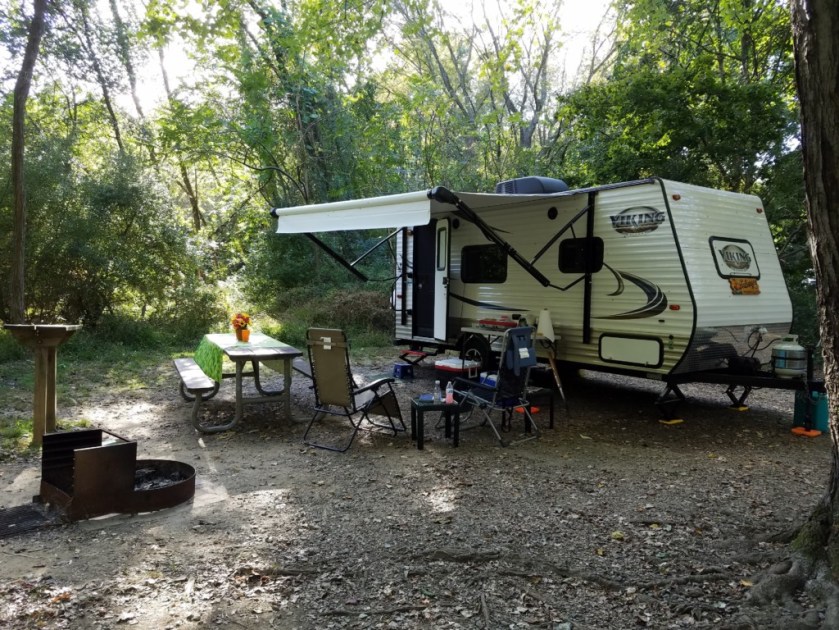
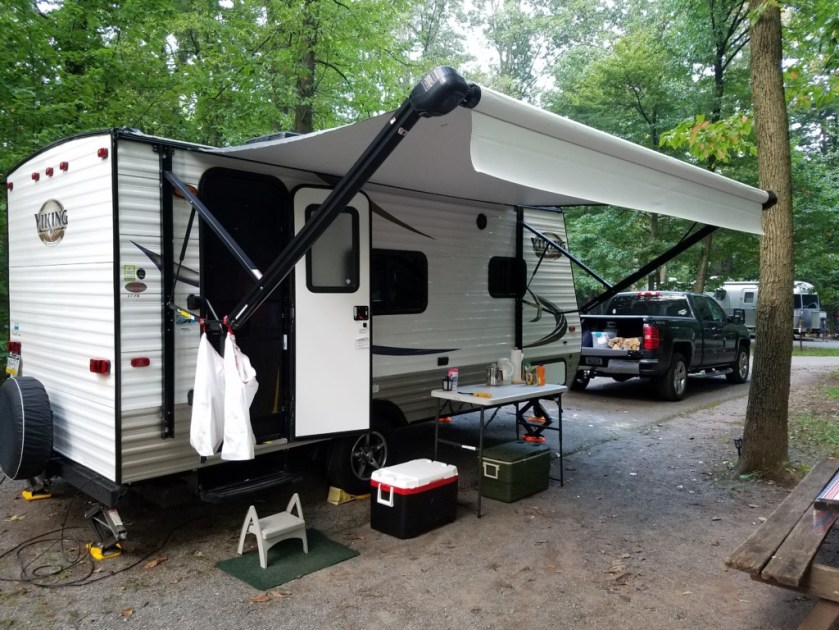
The WB3GCK “QRP” camper at Susquehanna State Park (KFF-1601)
On the WES front, I worked a lot of the SKCC regulars and added a few new ones to my log. In particular, 80 meters was very active Saturday night and Monday morning. Tony K6ELQ in California managed to hear my QRP signals on two bands. One of those bands was 40 meters, so he really must have good ears. It was also good to work Bert F6HKA again. Bert also has great ears.
My POTA activation got off to a slow start. I had poor cell phone coverage from the campsite, so self-spotting on Facebook and the DX cluster was difficult. I attempted to post a spot on Facebook but I’m not sure if it actually got through the first time or not. I spent about 30 or 40 minutes calling CQ on 40 and 20 meters with no takers. I knew that Joe N2CX was activating a park up the Susquehanna River from me so I set up on a frequency just below Joe’s usual 40M hangout. My hope was that folks looking for Joe would also stumble across me. It worked! I started getting some calls from POTA regulars who spotted me on the DX clusters.
When I wrapped up for the weekend, my log included France (3 QSOs), Croatia (2 QSOs), Netherlands, Belgium and park-to-park QSOs with N2CX and F4GYG. Coupled with my earlier visit, I amassed enough QSOs to exceed the 44 QSOs needed for a Worldwide Flora and Fauna (WWFF) activation.
After spending a relaxing weekend in the woods playing radio, I’m pleased to report that I’m feeling much better now.
My XYL and I took our “QRP” travel trailer down to Maryland over the weekend. We stayed in one of our favorite campgrounds, Elk Neck State Park. I did a brief Parks on the Air activation on Saturday.
Elk Neck State Park is located on a peninsula bounded by the Chesapeake Bay to the west and the Elk River to the East. Besides camping, there are numerous hiking trails, a beach on the Chesapeake side for swimming and access for boating. The park is home to the scenic Turkey Point Lighthouse, which overlooks the Chesapeake Bay.
Our campsite in Elk Neck State Park. Once again, I used a lantern post to secure my Jackite pole.
Our campsite was located on the Elk River side near Stony Point. For this trip, we chose a campsite without electrical hookups. Since the trailer was powered only by battery, I didn’t have any noise to contend with. This made for some nice, quiet conditions on the bands.
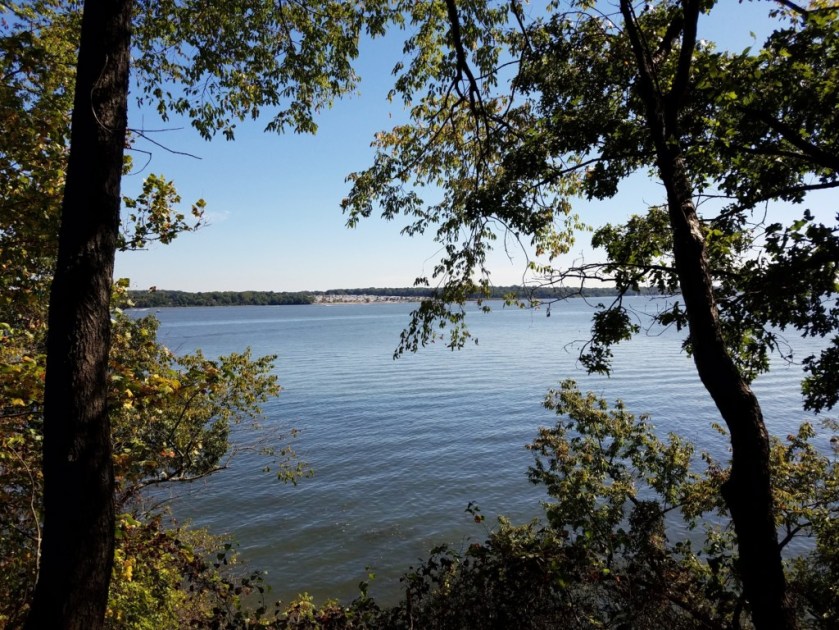
The view of the Elk River from Stony Point.
I operated on Saturday afternoon for about an hour. I made a few contacts on 40M but interference from an RTTY contest made it tough. When I moved up to 20M, things perked up a bit. To the west, I worked British Columbia and California. To the east, several of the European regulars showed up. I worked stations in Sweden, Poland, Germany, and Croatia.
Later in the evening, I got on 80M for about 20 minutes. I worked a few relatively local stations plus two in Michigan. It was starting to get dark so I shut down for the night and got a campfire started.
I ended the weekend with 19 stations in my log. Not too bad, considering the short amount of time I invested.
I bought a lightweight telescoping pole on eBay a while back. It collapses down to 26 inches and weighs less than 12 ounces. Best of all, I only paid around $10 for it. While it was advertised as a 7.2-meter pole (approximately 23.6-feet), it actually measures about 19.5-feet when extended. This pole was just begging for some sort of antenna to support.
After trying different types of non-resonant wires with it, I decided to build some sort of resonant antenna. For quick excursions to the field, I often take the AlexLoop. However, sometimes it’s nice to have something a bit more frequency-agile. I wanted something that is easy to deploy and could cover the 40, 30, and 20-meter bands.
I started off planning to build a vertical with a 16.5-ft radiator to make it resonant on 20 meters. I could then build some loading coils to make it resonant on 40 and 30 meters. In the end, I went a slightly different way with this antenna.
With the lousy band conditions lately, I spend most of my time on 40 meters. I decided to take advantage of the full length of the pole. So, my concept was to use a 19-foot radiator with loading coils for 40 and 30. On 20M and higher, I would use the radiator as a random wire and use a tuner.
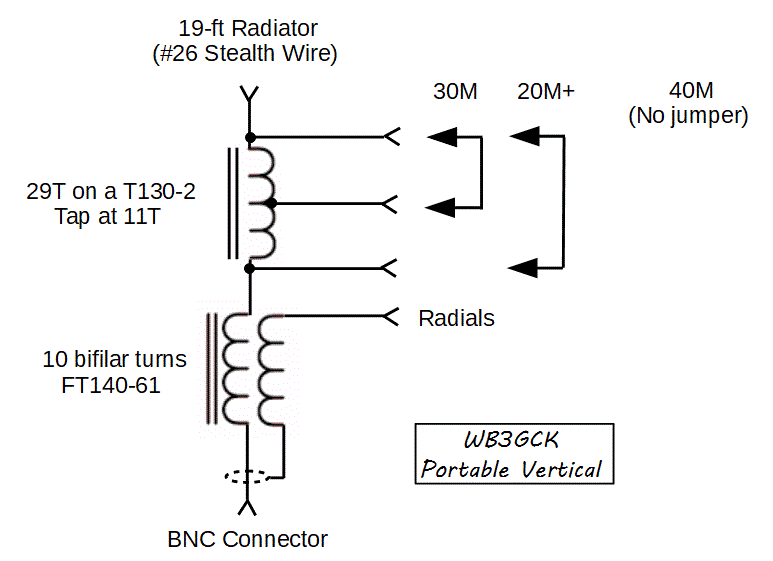
Schematic diagram of the matching network for the 19-ft vertical
As you can see in the schematic, I feed the antenna through a 1:1 choke, consisting of 10 bifilar turns of #22 hookup wire on an FT140-61 toroid. I calculated the values for the loading coil using some online calculators (see notes below). From there, I went through several iterations of testing and adjusting to arrive at the final values. For the 40M loading coil, I ended up with 29 turns of #22 enameled wire on a T130-2 toroid. I made a tap at 11 turns for the 30M band.
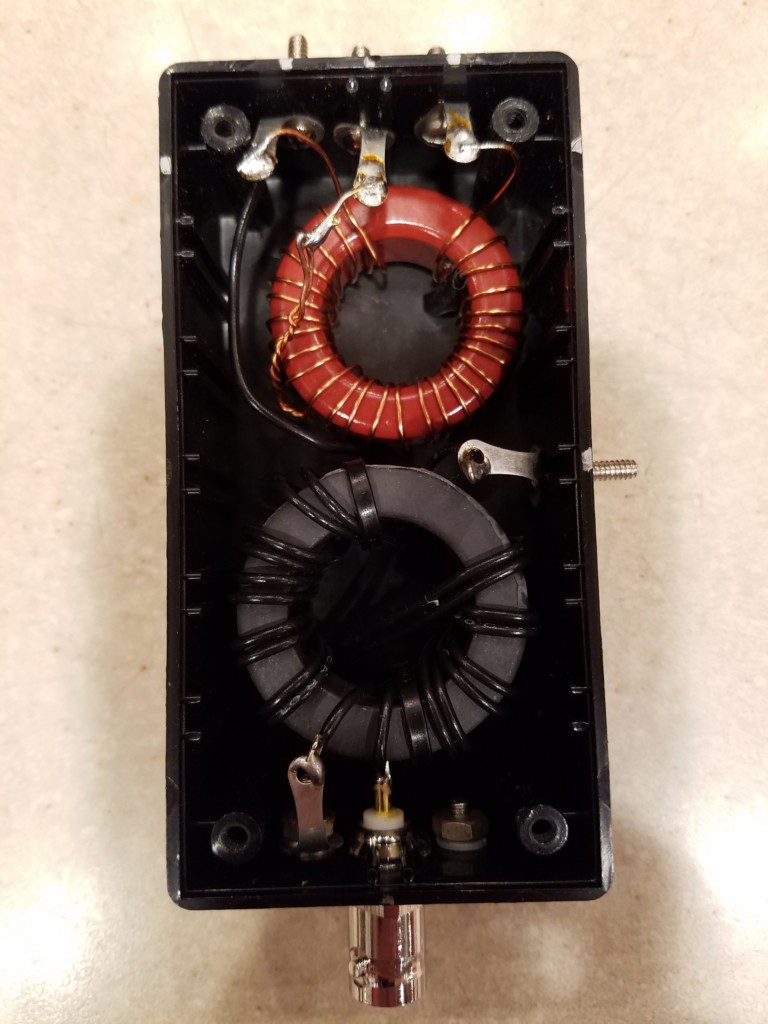
Interior of the matching unit
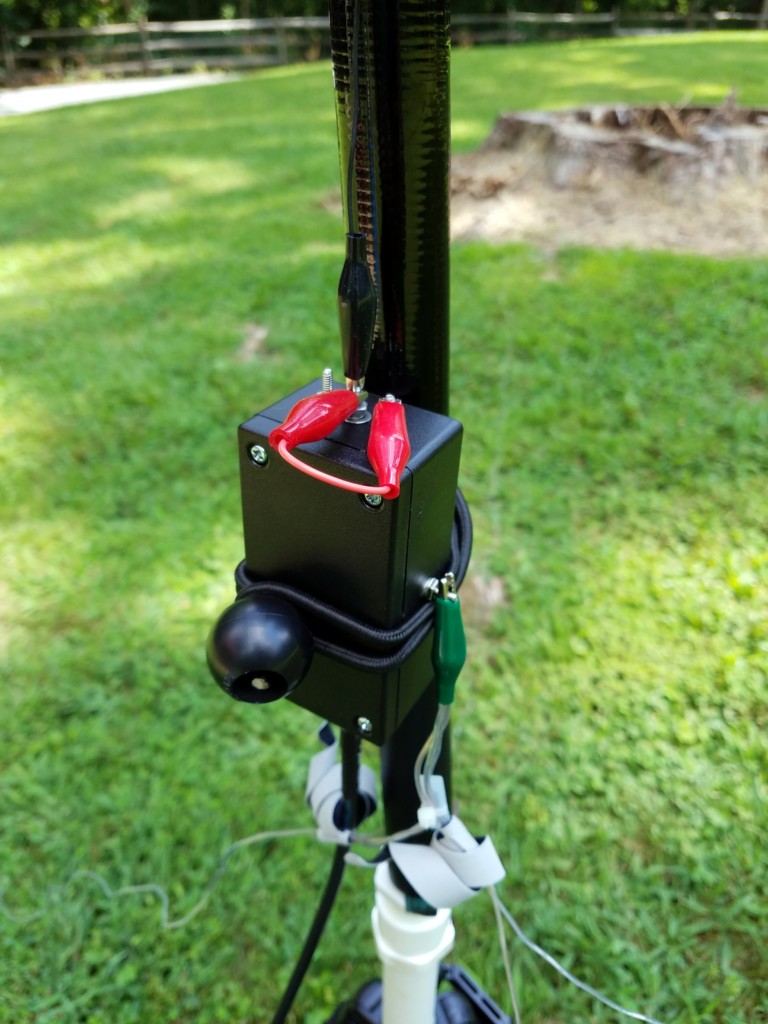
I mounted both coils in a small box and used some small bolts to make the tap points accessible for band changing. I also made a little jumper with alligator clips to short out various portions of the loading coil for the different bands.
The matching network is attached to the pole with a small bungee cord. In this picture, the red jumpers are configured for the 30M band.
The pole won’t support much weight, so I built the 19-foot radiator from #26 Stealth wire (Part #534) from the Wireman. Because the pole is made from carbon fiber, I try to let the top of the pole bend over slightly, to keep the wire away from the pole. I don’t know how much influence the carbon fiber pole would have on tuning but I figure I’d avoid introducing another variable.
For radials, I used a 25-foot roll of cheap speaker wire and used it to throw together four 12.5-foot radials. Again, I grabbed what I had on hand and went with it. While the four radials seem to be working out OK, I plan to add a couple more for good measure.
I should note that all the materials here were selected based on availability in my junk box. So, there’s certainly plenty of wiggle room here for experimenting.
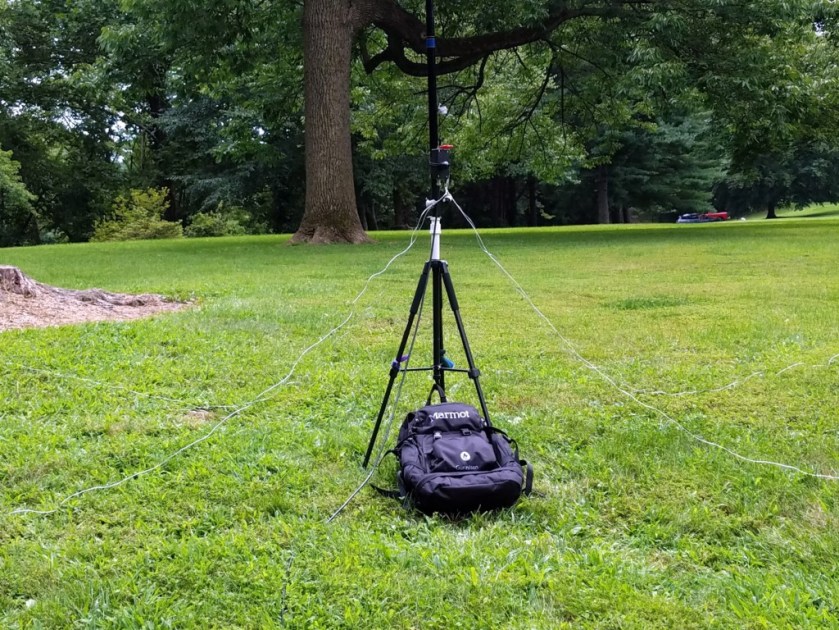
I made up a little tripod adapter out of some PVC pipe. One end slides over the post on my tripod, while the other end slides up inside the bottom of the collapsible pole. I also found a screw driver with a handle that fits nicely inside the bottom of the pole. So, for ground-mounting, I can just shove the screwdriver in the ground and place the pole on top of it. This works surprisingly well and allows me to leave the tripod at home.
Vertical mounted on a tripod. My backpack is attached to the bottom of the tripod to help stabilize it in the wind.
After considerable tweaking I ended up with SWRs of less than 2:1 across the entire 40M band and less than 1.5:1 across the 30M band. On 20M and higher, the tuner in my KX3 loads it up with no problems.
The vertical ground-mounted. The pole is light enough to be supported by a screwdriver shoved into the ground.
I’ve been very pleased with the results on 40M so far. It seems to radiate pretty well. I’ve also made contacts on 30M and 20M but, honestly, I need to use it more on those bands to get a better feel for the performance. It’s hard to evaluate antennas when the band conditions are as poor as they have been lately.
Although the antenna works, there are a few things I would do differently, if I were to build another one:
My physical packaging could be better. While the enclosure I used is nice and compact, it’s a little cramped for experimentation. During development, coil adjustments were tough.
Separate coils for 40M and 30M would make the tuning much easier. The tapped coil was a challenge to adjust.
I like the form factor and easy setup of this antenna. I can set it up in a few minutes and it is very easy to transport by backpack or bike. Now to give it some more air time in the field.
Time will tell if it’s a keeper.
72, Craig WB3GCK
Notes:
Loading coil calculator: http://www.k7mem.com/Ant_Short_Dipole.html (Note: The calculator I originally used for this project is no longer online. This calculator should work. Just use one leg of the dipole.)
The XYL and I made the 2+ hour trip to spend the weekend at Pine Grove Furnace State Park, one of our favorite campgrounds. It’s a beautiful park and is the halfway point on the 2000 mile Appalachian Trail. It had been 2 years since our last visit here, so we were definitely overdue.
Located in south-central Pennsylvania, Pine Grove Furnace is one of Pennsylvania’s gems. The park features the remains of the Pine Grove Iron Works, along with two mountain lakes, hiking trails (in addition to the Appalachian Trail) and a beautifully wooded campground. If you stop by the camp store, you might see Applachian Trail “thru hikers” celebrate reaching the halfway point by taking the “Half-Gallon Challenge”. The challenge is to eat a half-gallon of ice cream in one sitting. Pine Grove is also home to the fascinating Appalachian Trail museum.
Although it wasn’t my primary focus this weekend, I got a little radio time in. The monthly SKCC Weekend Sprintathon (WES) contest was going on and I wanted to squeeze in a Parks on the Air (POTA) activation of KFF-1398.
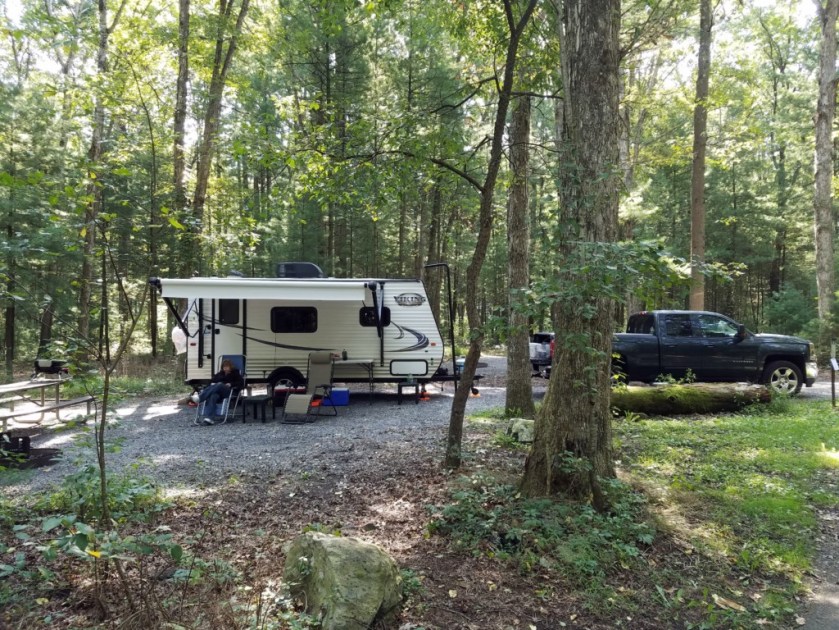
Our campsite at Pine Grove Furnace State Park.
We had almost no cell phone service at our campsite, so I was concerned about not being able to spot myself for the POTA activation. Fortunately, while we were out getting a few supplies, I managed to post my operating plans on the POTA Facebook group.
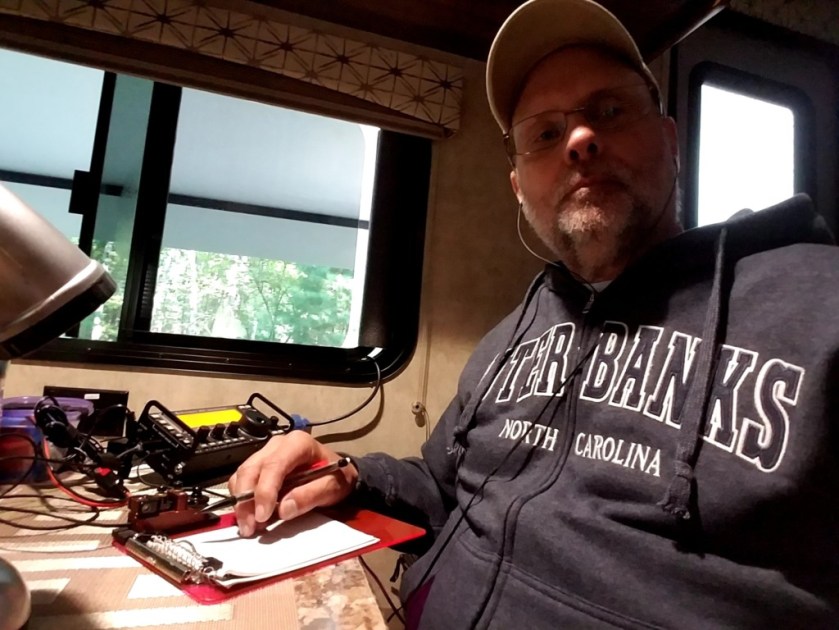
WB3GCK making some straight key contacts from the trailer.
When I got back to our campsite, I called CQ for about 30 minutes on 40, 30 and 20 meters with no success. Eventually, KG8P found me on 40 meters and gave me a call from Michigan. After he spotted me on the DX reflector things picked up for a bit. I wrapped up my one-hour session falling a few short of the ten contacts needed to qualify my activation. The good news, however, is that the SKCC contacts I made pushed me well over the top.
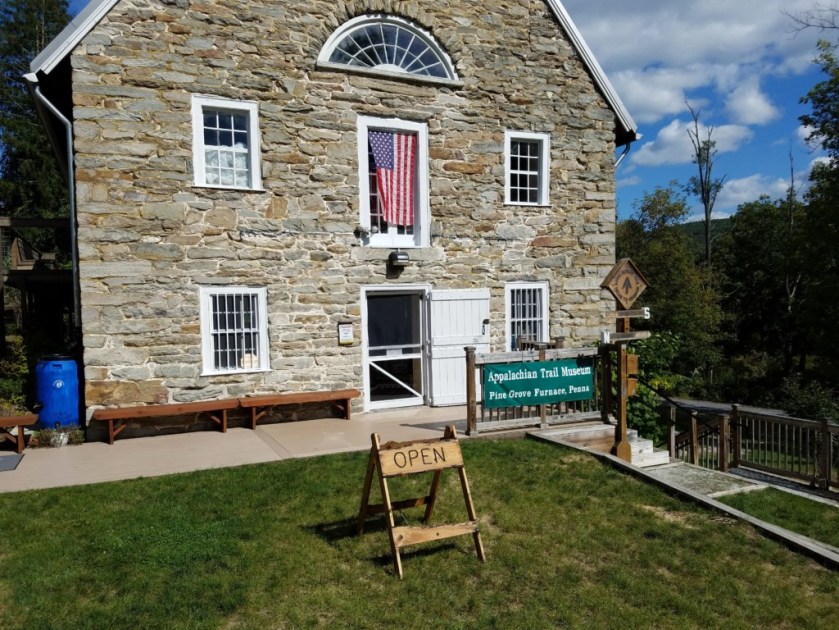
Pine Grove Furnace State Park is also home to the Appalachian Trail Museum. They have some fascinating exhibits on the history of the trail and some of the early hikers.
It was a nice weekend with some great Fall weather. We won’t wait so long for our next trip to this great park.
I took some time on Labor Day to do a quick Parks-on-the-Air (POTA) activation from Norristown Farm Park. This nearby park has only been activated one other time. In fact, KFF-4363 was activated for the first time yesterday by K0BAK.
Earlier this year, our local ARES-RACES group provided the communications for a March of Dimes event at this park. In preparation, I spent some time running communications tests around the park. Being familiar with this park and its terrain, I set up today in a parking lot across from the park office. This spot is the highest elevation in the park that you can get to by car.
My location at Norristown Farm Park. You can see the corn fields behind my truck.
I operated from my truck today, using my trusty KX3 and a 29.5-foot vertical. I started out on 20M and things were a bit slow at first. After people noticed my spots, I worked enough to qualify my activation including a couple of the European regulars. I dropped down to 40M and picked up several more stations but came up empty on 30M. I went back to 20M and picked up two more to finish out the day. I was hoping to work some West Coast stations but Kansas was as far west as I got today.
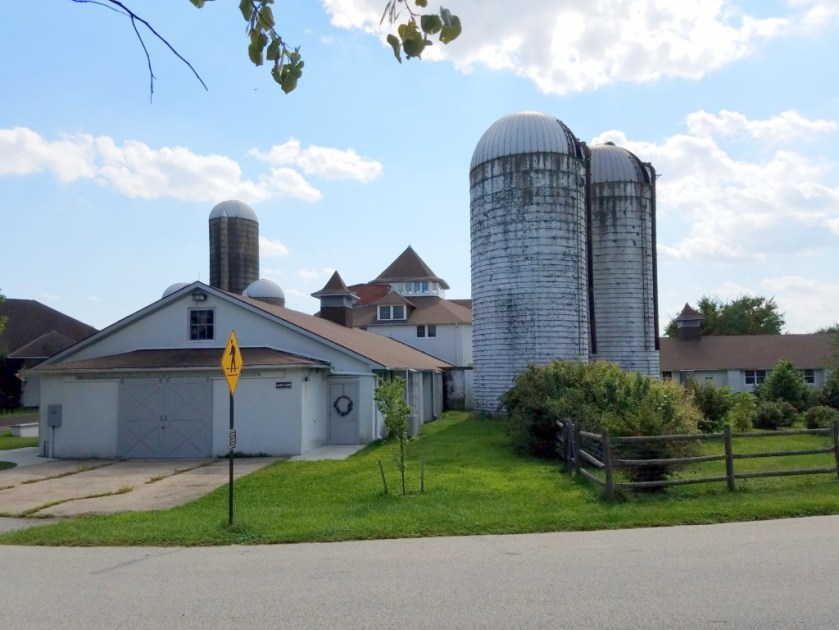
Norristown Farm Park is a working farm in continuous use since colonial times.
At one point, a couple of curious Park Rangers rolled up to see what I was up to. They were familiar with ham radio since the park hosts several public service events each year. After chatting for a few minutes, they wished me luck and moved on.
I wasn’t out very long but I had a great time today. I hope all of my U.S. friends also had a happy and safe Labor Day.
My XYL and I took our little camper up to nearby French Creek State Park (PA) for the weekend. In between entertaining our visiting grand-kids and grilling hotdogs, I managed to get in a brief Parks on the Air (POTA) activation (KFF-1355).
We usually camp at French Creek several times each year. It’s a great campground and just a short drive from home. It’s an easy weekend getaway for us. This weekend, our two daughters and our three grand-kids came up on Saturday to visit our campsite for the day.
My “portable hamshack” at French Creek State Park near Elverson, PA.
At one point, everyone headed down to the playground with the kids. I stayed behind and got on the radio for about 20 minutes or so. I spotted myself on the Facebook POTA group and on the DX cluster. Twenty meters must have been in pretty good shape because I was soon met with a mini pileup of European stations. I wasn’t expecting that.
After I worked my way through the calling stations, I had worked Sweden, Belgium (2 stations), Croatia (2 stations), Italy and Spain. There were also two Texas stations and one from Oregon. My trusty 29.5-foot vertical wire had really gone the distance for me.
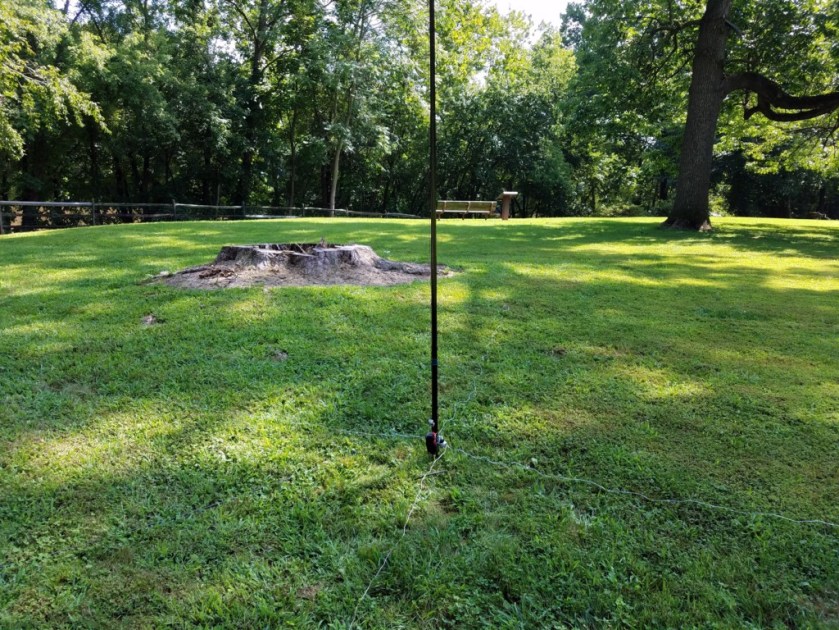
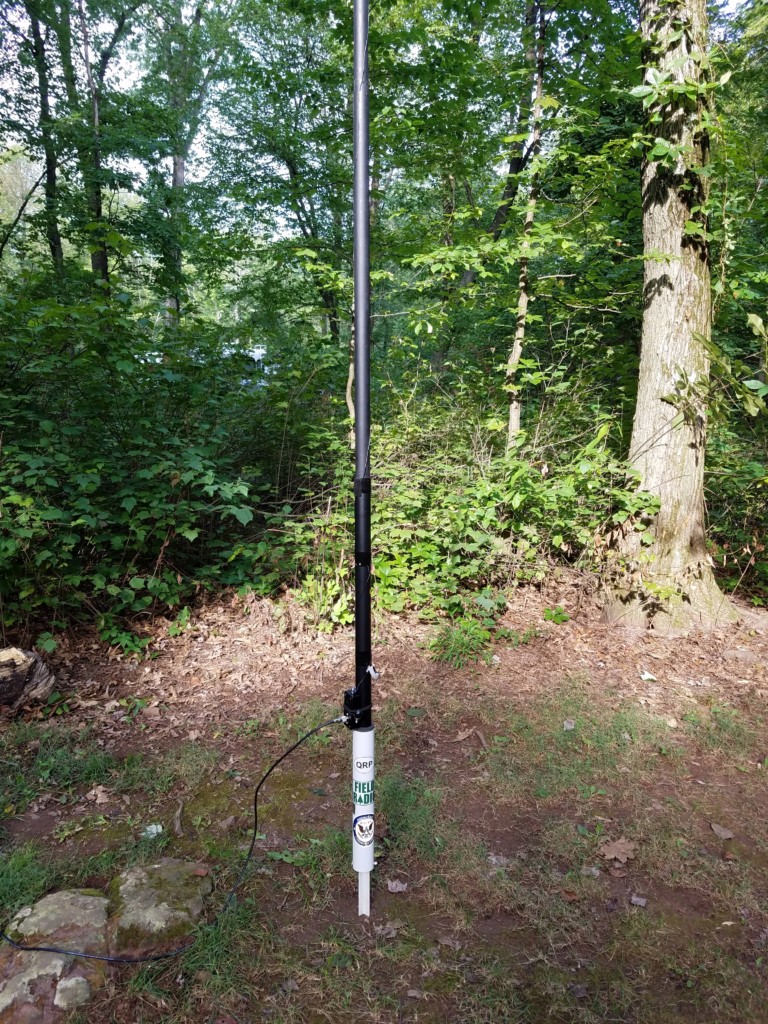
My trusty 29.5-foot wire vertical. It’s supported by a 31-foot Jackite pole and fed with a homebrew 9:1 unun.
I got on again later in the evening and picked up a few more POTA hunters before re-joining my better half at the campfire. I worked a few more the next morning (including EA1DR in Spain for the second time) before packing up and heading for home. There were a lot of familiar callsigns in the log.
I didn’t have a lot of time for radio this trip but the dedicated POTA “regulars” came out to play and made it a lot of fun.
Another NJQRP Skeeter Hunt is in the books. This year, stations operating from Parks on the Air (POTA) entities earned bonus points. So, I did a repeat of last year’s contest and operated from Valley Forge National Historical Park (POTA designator KFF-0761).
I operated from my truck in the Varnum’s Picnic Area of the park. I like this spot because it’s quiet, RF-wise, and has decent elevation. Most importantly, it has a restroom, which is important for us old guys.
In my haste to get set up and on the air, I made a huge mistake by parking in an area without shade. (More on that later.) As I was mounting my 31-foot Jackite pole on the back of my truck, an elderly gentleman approached and inquired about my antenna. He was very curious about ham radio, so after I got set up, I let him listen to some signals on my KX3. After about 10 minutes, he wished me luck and moved on.
My unshaded site at Valley Forge. It’s hard to see, but my 31-foot Jackite pole if mounted is mounted on a bike rack on the back of my truck.
Propagation was weird today. At times, 40M seemed to be very long. I worked stations in Michigan and Wisconsin while struggling to work my friend Carter N3AO down in Virginia. The bands seemed to be up and down all afternoon.
In the course of nearly 3 hours of operating, the sun was baking me and my radio inside the cab of my truck. At one point, the KX3 rolled its power back to 3 watts. I never had that happen before. After rearranging some things, I got the KX3 out of the direct sunlight and things eventually went back to normal.
Towards the end of my operating session, I was struggling to find stations I hadn’t already worked. Since the heat was taking its toll on me and the radio, I decided to pack up and head home.
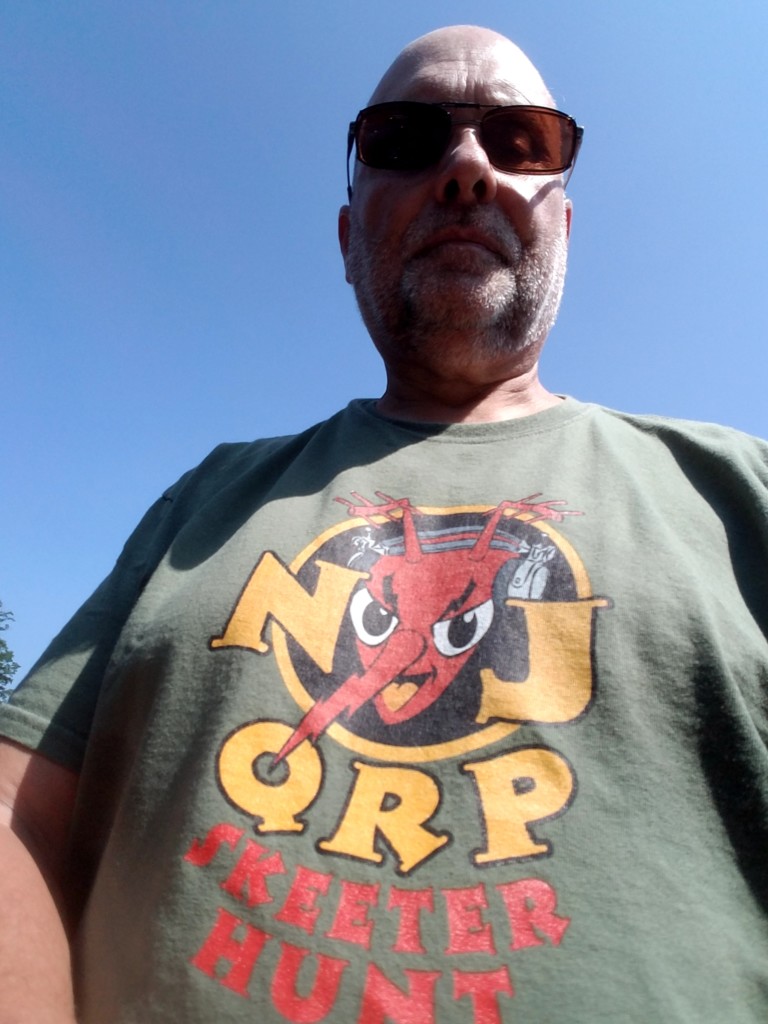
My lucky Skeeter Hunt t-shirt.
Even though I was wearing my lucky Skeeter Hunt t-shirt, I only ended up with 19 QSOs in the log. Four of those were park-to-park QSOs, though. I didn’t do as well as last year but it was still a fun event. Thanks for Larry W2LJ and the NJQRP Club for putting the Skeeter Hunt together.
[This is an updated version of a post that appears on my old website. – WB3GCK]
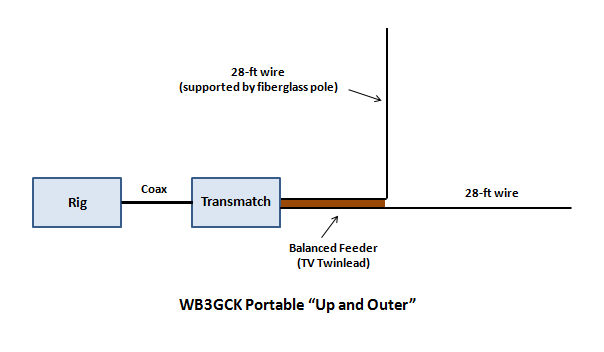
Something about the “Up and Outer” antenna has fascinated me since I first came across it in the 1974 edition of the ARRL Antenna Book. This antenna, which was once popular many years ago, is about as simple as it gets. Simply put, the Up and Outer is a dipole or doublet where one leg is vertical while the other leg is horizontal. Although it seems to be overlooked by Amateurs these days, this antenna offers some significant benefits:
It’s a good limited space antenna since one leg of the doublet is vertical. It only requires half of the space that a horizontal doublet would take up.
When fed with balanced line and used with a suitable transmatch, it’s a good multi-band antenna.
It combines characteristics of both verticals and horizontal wire antennas. That is, it is good for both local and DX work.
It’s very easy to build and erect.
The “Up & Outer” is essentially a doublet with one vertical leg and one horizontal leg.
First, a little background on this antenna. According to some handwritten notes from QRP Hall of Famer, C. F. Rockey W9SCH (SK), this antenna goes back to the 20s and 30s. Lew McCoy W1ICP (SK) wrote about it in the October 1960 edition of QST [1]. He didn’t use the name, “Up and Outer;” he merely referred to it as a “limited space antenna.” McCoy recommended horizontal and vertical elements of 30-feet each for operation on 80-10 meters. He also recommended using an open-wire feedline to minimize losses. Information from McCoy’s article has appeared for years in the ARRL Antenna Book. (I first saw it in my 1974 edition [2] and it was still shown in the 1997 edition [3].)
W9SCH wrote a couple of articles about this antenna for SPRAT and appears to have coined the term, “Up and Outer.” In the first SPRAT article [4], Rock suggested using 1/4 wave elements for the lowest band and feeding it with either coax (for single band operation) or balanced line (for multi-band operation). In a follow-up article [5], Rock suggests pruning the horizontal element to equalize the current in the balanced feeder. He noted the imbalance when operating with the horizontal element close to ground. He started with 16-foot elements to cover 30-10 meters.
Another Hall of Famer, L. B. Cebik W4RNL (SK), wrote about a coax-fed version of this antenna for 10 meters [6]. Cebik built his antenna using aluminum tubing and referred to it as the “L Antenna.”
I also exchanged some correspondence years ago with Fred Bonavita K5QLF (SK), another QRP Hall of Famer and fan of the Up and Outer. He told me that W9SCH once mentioned using the copper ball from an old toilet float to top-load the vertical element of the antenna. I later came across a brief write-up by W9SCH on his Copper-Top antenna in the October 1995 edition of QRP Quarterly [7]. Using the toilet ball for top loading, Rock was able to reduce the height of his vertical element by 2-1/2 feet.
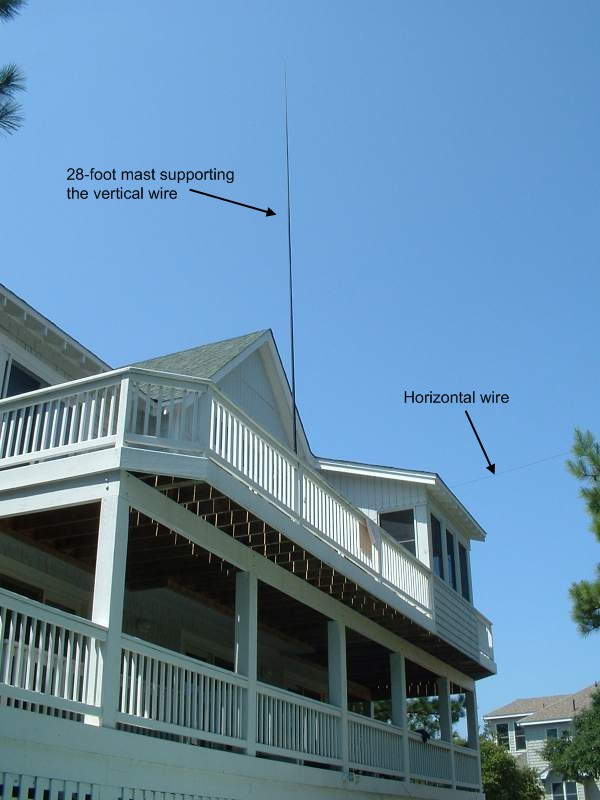
The “Up and Outer” antenna mounted on a 3rd-story deck in Corolla, North Carolina.
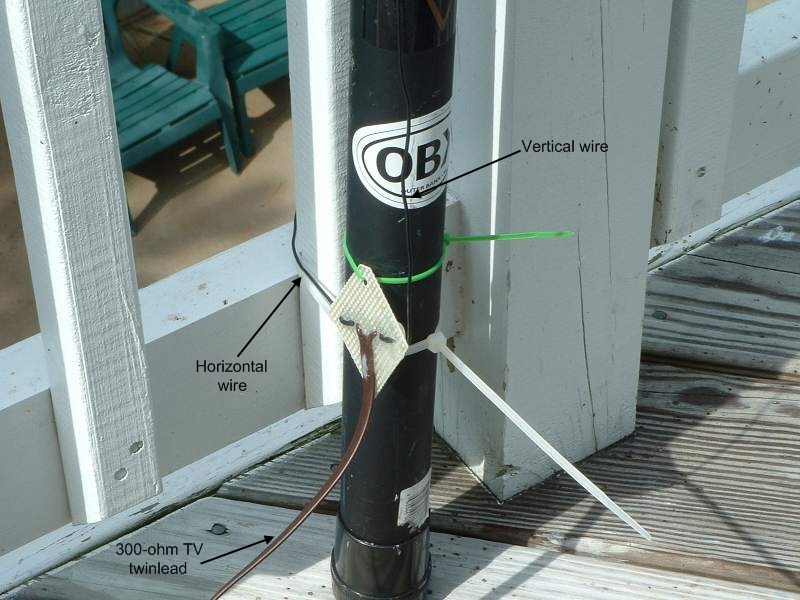
For me, the Up and Outer has turned out to be an ideal portable antenna to use while on vacation in a rented house on the Outer Banks of North Carolina. For several years I’ve used a 56-foot doublet with one wire supported by a 28-foot fiberglass telescopic mast and one 28-foot leg run horizontally. The vertical radiator is typically situated on a 3rd or 4th story wooden deck with the horizontal wire secured to a nearby tree or other support. For feedline, I use 25-feet of TV twinlead (the cheap brown stuff). Using either a homebrew Z-match tuner or an autotuner with a short run of coax to an external 4:1 balun, I’ve been able to use this antenna on 40-10 meters. Your mileage may vary. Depending on the transmatch you use, you might need to adjust the length of the feedline to get a good match on 40 meters.
“Up and Outer” feedpoint
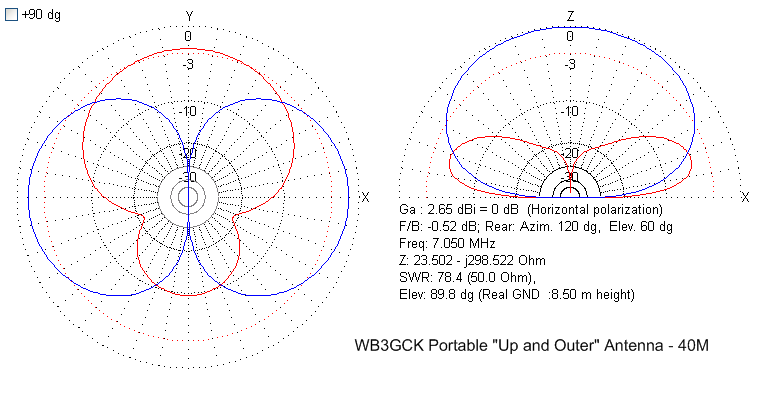
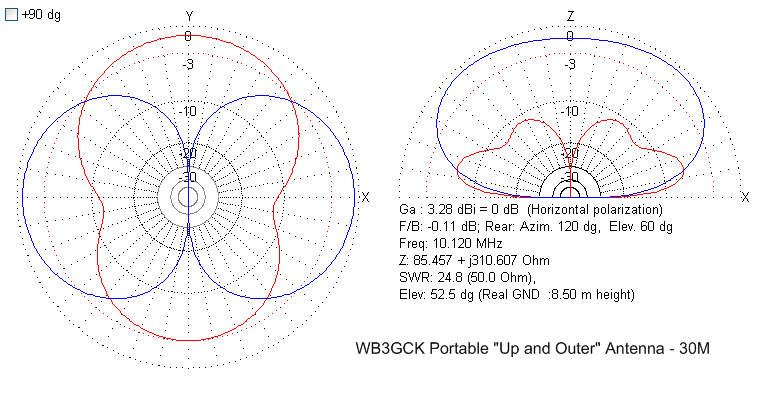
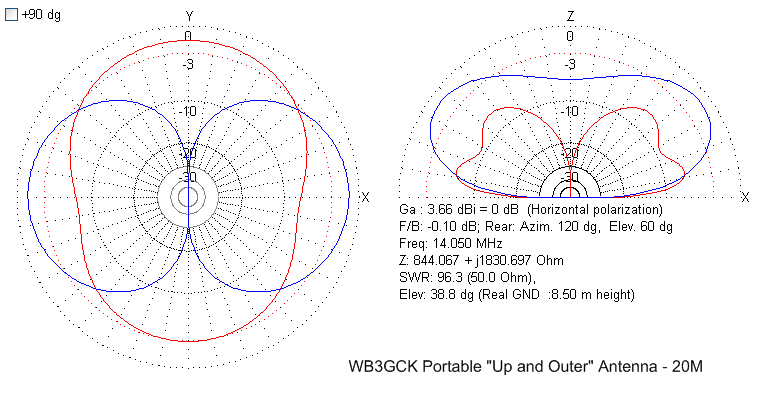
I did some quick modeling of a typical Outer Banks installation using MMANA-GL and you can clearly see the results of the combined horizontal and vertical elements. The horizontal polarity (shown in blue) shows lobes perpendicular to the axis of the horizontal wire, similar to a dipole. The vertical polarity (shown in red) shows a fairly low take-off angle and exhibits some slight directivity on 40 meters in the direction of the horizontal wire. This effect is due to the proximity to ground of the horizontal element and diminishes as you go higher in frequency. So, try to mount the Up and Outer as high above ground as you can.
“Up and Outer” 40M pattern“Up and Outer” 30M pattern“Up and Outer” 20M pattern
The modeling bears out my empirical results with the antenna. My version of the Up and Outer has worked very well for both stateside contacts and DX. In particular, it has been very effective for DX contacts on 30 meters. As an added bonus, the 56-foot doublet can also be pressed into service as a normal horizontal antenna in locations where the Up and Outer configuration isn’t possible. So, it’s like getting two antennas in one. Can’t beat that.
If you are looking for a limited-space antenna, give this obscure classic a try!
73, Craig WB3GCK
References: 1. McCoy, Lewis G. “A Limited-Space Antenna.” QST October 1960: pp 23-25. (Available in the ARRL online archives) 2. “The ARRL Antenna Book.” 13th Edition, 1974. Newington, CT. pp 187-188. 3. “The ARRL Antenna Book.” 18th Edition, 1997. Newington, CT. pp 7-15, 7-16. 4. Rockey, C. F. “Up and Outer.” SPRAT Issue #67 (Summer 1991): p 18. 5. Rockey, C. F. “A Four Band Up and Outer Antenna.” SPRAT Issue #69 (Winter 1991/1992): p 16. 6. Cebik, L. B. “Whips, Tubes and Wires: Building a 10-Meter L Antenna.” QST December 1999: pp 52-54. (Available in the ARRL online archives) 7. Rockey, C.F. “The Copper-Top Antenna.” QRP Quarterly, October 1995: pp. 40-41.
My better half and I took our little camper down to Cunningham Falls State Park for the weekend. Located in central Maryland, Cunningham Falls has always been one of our favorite campgrounds. While I was there, I did some ham radio, including a Parks on the Air (POTA) activation of KFF-1566.
I did all of my operating outside under the camper’s awning. My antenna was my usual 30-foot vertical wire fed through a 9:1 unun. I strapped my 31-foot Jackite pole to a wooden lantern stand. With the bands being a bit flakey, I cranked my KX3 up to 10 watts for the POTA contacts.
Operating from our campsite in Cunningham Falls State Park in Thurmont, Maryland. My 31-foot Jackite pole is strapped to the lantern post on the left.
Despite some solar storming and generally poor propagation, I managed to squeeze out more than enough contacts to qualify the POTA activation. I certainly appreciate the effort put forth by the “hunters” to dig my low-power signal out of the noise. In particular, W6LEN in California was particularly persistent in tracking me down. Although our signals were only slightly better than ESP levels, we managed to connect on both 30 and 20 meters.
I also had a few nice rag-chew QSOs, too. On Saturday afternoon, I heard NA1CC/2 calling CQ and gave him a call. As it turns out, Wes was running QRP while camping near Cranberry Lake in New York. It always fun to have a campsite-to-campsite QRP QSO.
We also took a ride over to Catoctin Mountain Park. This national park is right across the road from Cunningham Falls and is also where Camp David is located. I activated Catoctin Mountain Park during the National Parks on the Air (NPOTA) event last year but had no time for a POTA activation there on this trip.
We had great weather for camping this weekend, although the space weather could have been better.

 I took some time on Labor Day to do a quick
 Another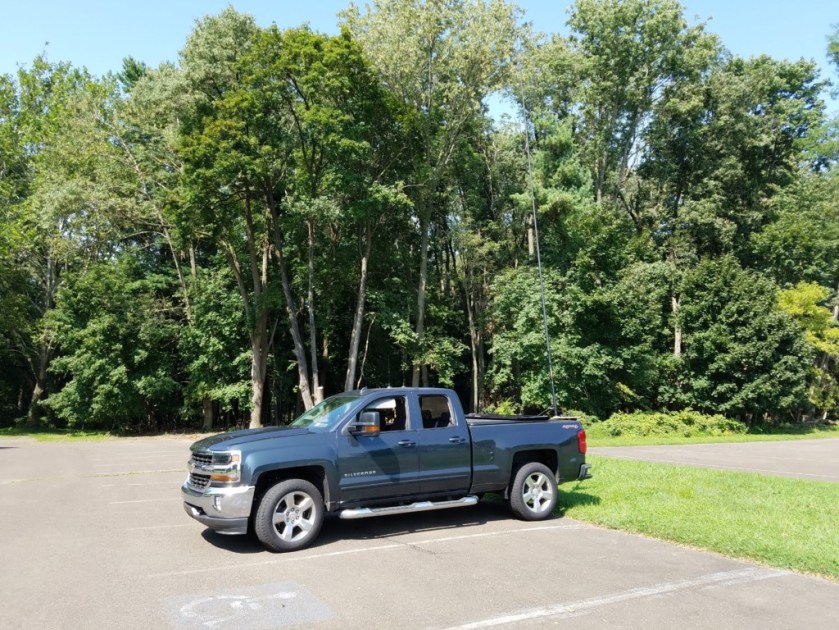

 WB3GCK QRP Amateur Radio