It’s been my custom to start the new year with some QRP-portable operating. For various reasons, I missed the past two years. One of my New Year’s resolutions (well… my only resolution) was to start this year off right.
I headed out to a nearby county park but that was a bust. The County closed the park for the holiday. So, I turned around and paid another visit to nearby Black Rock Sanctuary near Phoenixville, Pennsylvania. This was the same park I operated from on Christmas Eve.
The temperatures today were well above normal for this time of year. The moderate temperatures, however, also brought some antenna-bending wind gusts. My 19-foot vertical swayed in the wind but still performed well.
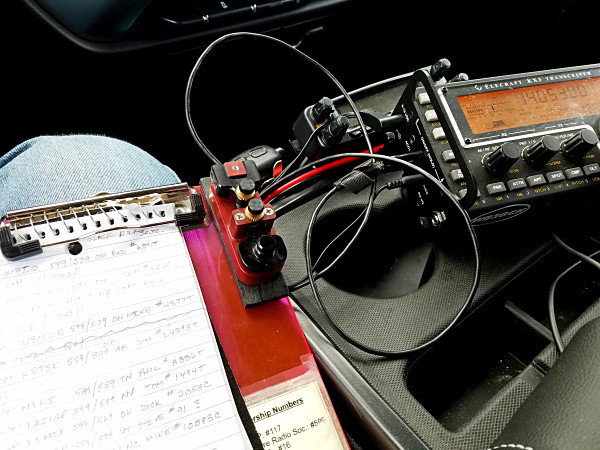
My somewhat cluttered operating position inside my truck.New Year’s Day at Black Rock Sanctuary near Phoenixville, Pennsylvania.
My focus today was making some SKCC contacts and I wasn’t disappointed. With Straight Key Night (SKN) still in progress, there were a bunch of SKCC members on the air this afternoon. Some seemed to be collecting SKCC numbers, while others were looking for SKN contacts. I was more than happy to accommodate both.
Most of the activity seemed to be on 40M and that’s where I made all my contacts today. I called CQ and received a steady stream of callers. I stayed for about an hour and a half and ended up with a dozen SKCC members in my log. The best “DX” of the day was Arkansas on 40M. Three of the contacts were new ones in my SKCC log, so 2019 is off to a decent start (for me, at least).
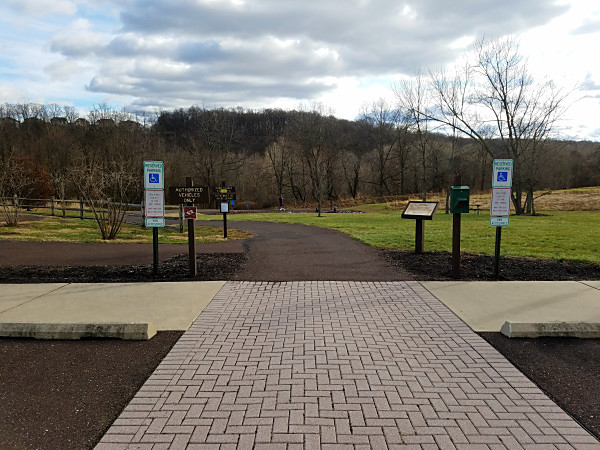
The walking path at Black Rock Sanctuary.
For some reason, my antenna attracted more curious passersby than usual today. I’m always happy to entertain their questions. I’m always ready to give them my “30-second elevator speech” about ham radio and what I’m doing. I’ll expound on this topic in a future post.
So, from my shack to yours, have a very happy new year. I look forward to hearing you on the air in 2019.
For a variety of reasons, I’ve been pretty much missing in action, radio-wise, for the past few weeks. Today I took a brief break from the holiday preparations to scratch my QRP-portable itch.
I drove out to nearby Black Rock Sanctuary in Phoenixville, PA; a place I haven’t operated from in a while. Except for a few dog walkers, I had the place to my self. It was cloudy, windy, and cold, so I stayed in the relative warmth of my truck with my 19-foot vertical mounted on the back.
My operating location at Black Rock Sanctuary
I fired up the KX3 on 40M and made a couple of quick SKCC contacts with K1NIE in Ohio and K1EDG up in Maine. I tuned down to 7.030 and answered W9KY’s CQs from Indiana. Our signals weren’t very strong but we had a nice ragchew.
Next, I called CQ on 20M a few times and N0KCJ in Minnesota gave me a call. He was using a 3-foot loop in his shack. Cool! We got in a couple of exchanges before the band started fading.
I tuned down to 30M and had a short QSO with AE4DB in Florida. After we wrapped up, I packed up and headed home to spend the rest of Christmas Eve with my (far) better half. It was another short outing but it’s always fun to get out there.
I want to wish you all a Merry Christmas and a joyful and peaceful holiday season.
Some recent Internet discussion got me thinking about the Rybakov 806 Vertical antenna. This easy-to-build antenna has served me well over the years. So, I went back and revisited some of the ways I’ve used it.
What the heck is a Rybakov anyway?
The Rybakov 806 Vertical appears to be the brainchild of Enrico IV3SBE from Italy (now 5Z4ES in Kenya). The term, Rybakov, is Russian for “fisherman.” That’s right… It’s an antenna with a Russian name designed by an Italian who lives in Africa — truly an international creation. From what I could glean from exhaustive Internet searches, this design dates back to the mid to late 2000s. I found numerous references to it from 2009.
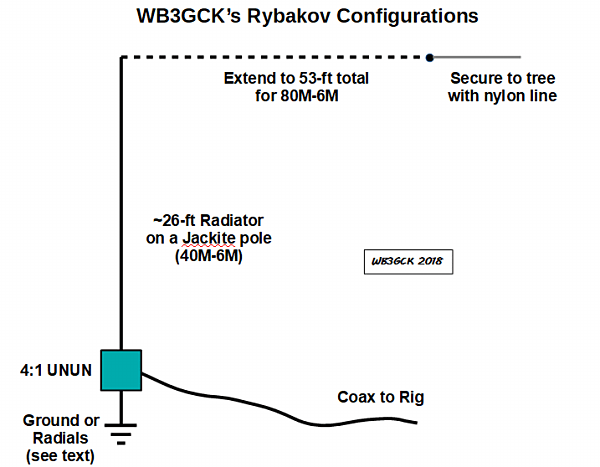
The classic Rybakov configuration is a 7.6m or 8m (~25 or 26 feet) wire fed through a 4:1 UNUN. The length isn’t critical, as long as you avoid resonance on the bands of interest. It’s often supported by a telescopic fishing pole (hence, the name, “Rybakov”). Being a non-resonant antenna, you need to use an antenna tuner to make it work. You also need to use radials or some other type of ground.
The antenna can cover 80M through 6M (the “806” part of its name, I suppose). The band coverage depends on the wire length used and the capabilities of your tuner. With a 7.6M wire, you can cover 40M and up without problems. For 80M coverage, plan on using a longer radiator.
The only thing you need to build is the 4:1 UNUN. The IW7EHC website provides detailed instructions for building one. Beyond that, you just need to cut some wire to length for the radiator and radials. Easy peasy!
My experience with the Rybakov
I had been using this type of antenna before I even knew it had a name. Rick KC8AON had a version of this type of antenna he called, “The Untenna.” That’s where I found it.
My first experiment with it was in a “stationary mobile” setup. I rigged up a 26-foot vertical wire and grounded the UNUN to the body of my truck. My Z-817 tuner was able to load it up with no difficulty. I had no problem making contacts and I liked the multi-band coverage.
I next used the Rybakov at a Boschveldt QRP Club Field Day. I set up a 26-foot ground-mounted vertical and used about six 16-foot radials with it. Again, the performance seemed decent and I remember doing well on 10M that year. The only shortcoming was that it wouldn’t load up on 80M.
The next year, I solved the 80M problem by using a 50-foot wire in an inverted L configuration. For the ground, I used six 16-foot radials and two 33-foot radials. This configuration gave me full coverage from 80M to 10M and it worked great. This antenna configuration became my “go to” Field Day for several years. In later years, I used a 53-foot radiator re-purposed from another antenna project.
My typical implementation of the Rybakov 806 antenna. A length of 25 to 27 feet does well from 40M and up. I go with a 50 or 53-foot radiator for 80M coverage.
I used another version of the Rybakov with the pop-up camper that I used to own. I strapped a 31-foot Jackite pole to the camper and used it to support a 27-foot wire. I grounded the UNUN to the body of the camper. This antenna worked great on 40M to 6M and, best of all, I didn’t need to go outside at night to change bands. I used this antenna with good results for several years until I sold the camper.
I also built a Rybakov that I use as a backup antenna in the field. I built a small 4:1 UNUN that I use with a 25-foot radiator and a 25-foot radial. The antenna, along with a short length of coax, is easy to carry in my pack.
The bottom line (for me, at least)
I’ve had good luck with the Rybakov Vertical over the years. Is it the best antenna? Nope. Purists will argue about UNUN, ground, and coax mismatch losses. Yep, there are those. Yet, its simplicity and “no gap” band coverage are hard to beat. It’s easy to deploy in the field and it really does work.
If you’re in the market for a simple portable antenna project, the Rybakov 806 is an easy one.
[Update 4/3/2019: I’ve always wondered about the rationale behind the 25-foot radiator often used with the Rybakov antenna. An article in QST [1] by Joe Reisert W1JR shed some light on that for me. Joe’s article discusses the 3/8-wave vertical antenna. According to the article, the 3/8-wave antenna has a low take-off angle and its 200-ohm feedpoint is easily matched with a 4:1 transformer. Its higher radiation impedance provides good performance with just four 1/4-wave radials. For 20M, a 3/8-wave radiator is about 25-ft. Similarly, for 40M, it would be 50-feet. So, my guess is that’s the concept behind the Rybakov design.]
My XYL has accused me of being obsessed with bags, backpacks, and storage containers of all sorts. She’s an excellent judge of character. This one, fortunately, wasn’t very expensive.
A few years ago I bought a backpack with ham radio in mind. I wanted one big enough to carry my Alexloop antenna, along with my QRP rig, battery, and, assorted emergency and survival-type gear. (I could survive a zombie apocalypse with all the stuff I put in that pack.) Although it continues to serve me well, at 35 liters it’s a bit overkill when I don’t need to carry all that stuff. I wanted something a bit smaller and lighter for short hikes and casual outings.
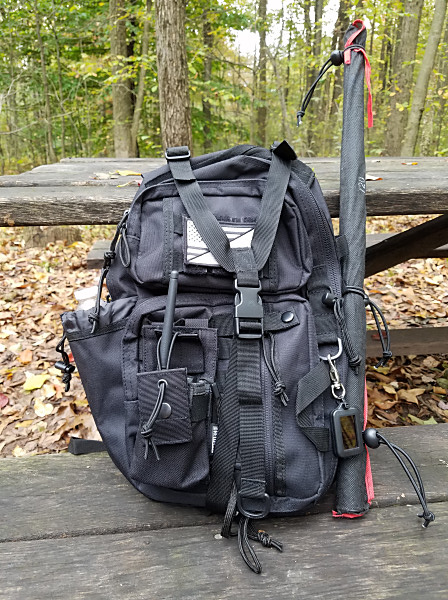
After looking at a dizzying array of small packs, I settled on the Rambler sling pack from Red Rock Outdoor Gear. It’s a bit larger than most other sling packs but I needed one that would accommodate my essential radio gear. It measures about 10 inches x 16 inches x 4 inches and has lots of compartments and MOLLE webbing.
The main compartment comfortably accommodates the box that holds my KX3 and accessories. I also carry a LiFePO4 battery and my antenna wires in this compartment. I use one of the outer compartments to hold safety and comfort items, e.g., first aid kit, sunblock, insect repellent, emergency poncho, etc. In the remaining outer pocket, I keep a headlamp, emergency whistle, compass, a copy of my Amateur Radio license and a notepad and pencil. There’s a compartment on the back of the pack that’s perfect for carrying a folding sit pad and a large contractor garbage bag that I use as a ground cloth. With the water bottle pouch on the side of the pack, I don’t have to use up space inside the pack to carry water.
My Red Rock Rambler sling pack. My 19-ft fiberglass pole is attached to MOLLE webbing on the side of the pack. The HT pouch I added is on the lower left of the pack.
The Red Rock Sling Pack also does double-duty for public service events with my local ARES-RACES group. I just remove the QRP gear from the main compartment and replace it with my HTs, spare batteries, emergency vest, etc. Oh, did I mention snacks? Yeah, lots of snacks.
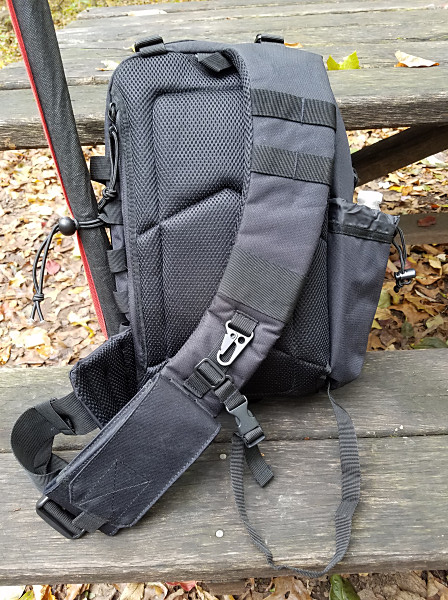
With all the MOLLE webbing on the pack, I couldn’t resist adding a few things. On the back of the pack, I added a pouch for my HT. I added a cell phone holder in the front on the shoulder strap. I use the webbing on one side of the pack to carry my telescopic fiberglass pole, which I fasten with some adjustable bungee cords. And just for the heck of it, I added some molle-compatible velcro strips for attaching a morale patch.
The back side of the Red Rock Rambler sling pack. There’s a pouch behind the padded back of the pack that holds a folding sit pad. The smaller waist strap at the bottom of the picture helps to stabilize the pack but can be tucked away if not needed. My cell phone pouch is at the bottom of the shoulder strap.
In use, I find it very comfortable. The padded strap is non-reversible and goes over my left shoulder. That’s my preference anyway. The zippers on this bag have all worked smoothly without a lick of trouble. (Nothing frustrates me more than balky zippers!)
After nine months of use, the sling pack is holding up well and has fit my needs exactly. It provides a handy and comfortable way of carrying my radio stuff out into the field. There certainly are more expensive packs available but, for less than $50.00 USD, the Red Rock Sling Pack has been money well spent.
Now, all I need is to find some time to get back out into the field for some QRP fun.
72, Craig WB3GCK
[Disclaimer: I have no financial interest in Amazon or any these products. I’m just a satisfied customer.]
It had been a while since I’ve done any portable operating. I decided to remedy that with a trip to a nearby park today.
I took a short drive over to Upper Schuylkill Valley Park, one of my favorite spots. It would have been a good day to operate outside, but melting snow from a recent storm had made a mess of things. Instead, I opted to set up my KX3 in the truck with my usual 19.5-foot vertical on the back.
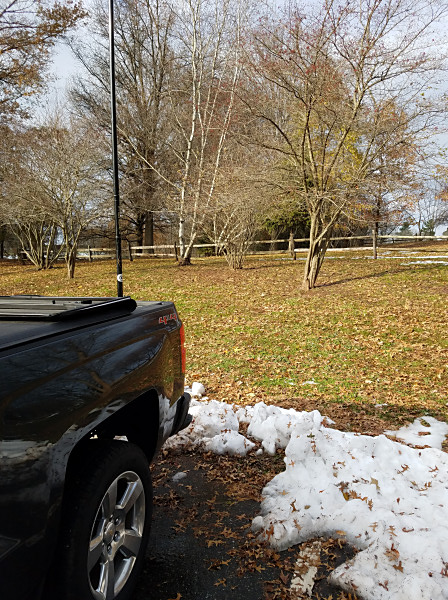
My antenna near the last vestiges of the nor’easter we had this week.
When I turned on the radio, I found the 40M band to be in pretty good shape. I heard K4MHC in North Carolina calling “CQ SKCC” and gave him a call. Keith was also running QRP. After exchanging SKCC numbers, we had a nice chat. Over the next hour or so, I added a few more SKCC stations to my log and had a couple of nice ragchews in the process.
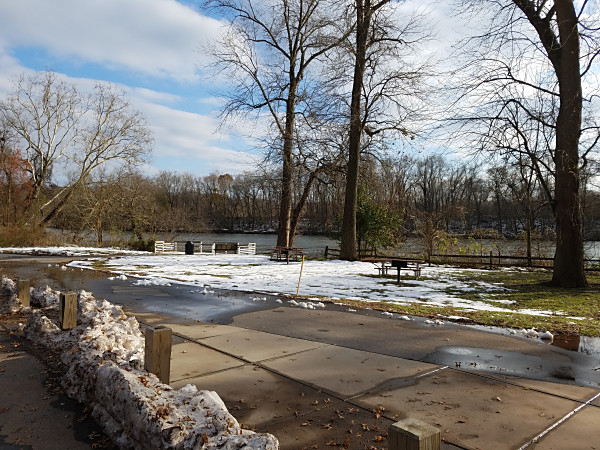
A view of the Schuylkill River at Upper Schuylkill Valley Park
It wasn’t the most exciting outing but it sure was good to be back out there.
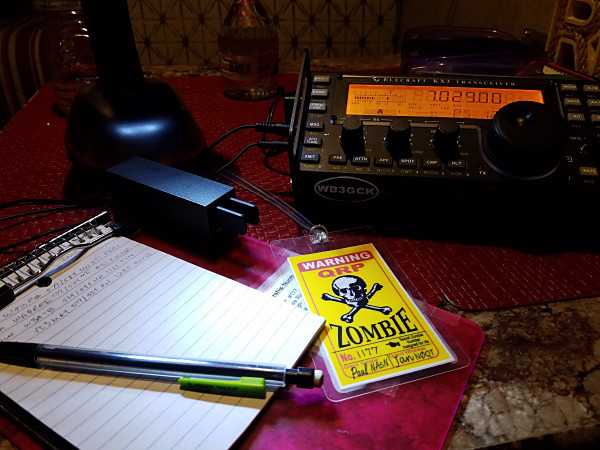
Once again, the Zombie Shuffle QRP contest coincided with the last trip of the year with our little travel trailer. I did slightly better than last year.
We again wrapped up our camping season at nearby French Creek State Park near Elverson, Pennsylvania. After setting up the trailer, my XYL and I had an errand to do. As a result, I got started a little later than I wanted to.
The WB3GCK mobile zombie hunting command and control center
When we got back to the campsite, I hastily set up my 29.5-foot vertical about 25 feet away trailer. Since the weather was a bit breezy and chilly, I ran the coax into the trailer and set up the KX3 in there.
The campground was a little noisier (RF-wise) than usual but it didn’t stop me from making contacts. Fittingly, my first contact was with W0UFO on 20M. I managed to find 8 more zombies on 40M, including my friend, Ed WA3WSJ who lives fairly close to French Creek. I dropped down to 80M and bagged two more zombies there.
My Zombie Shuffle operating position inside the WB3GCK QRP Camper
With 11 zombies in the log, I had my best year yet. Among those 11 zombies were 4 “Elvis” stations. This silly, laid-back contest is one of my favorite QRP events of the year. Many thanks to Paul NA5N and Jan N0QT for organizing the Shuffle. It’s always a fun time.
On a sadder note… It’s now time to Winterize the QRP camper and put it into hibernation until Spring. Hopefully, the Winter goes by fast.
I was pleased to be able to participate in the first-ever running of the Leaf Peepers QRP Contest. This new contest is the brainchild of Tim W3ATB. Although the Fall colors are barely getting started here in southeastern Pennsylvania, it was a good reason to get out and do some portable operating.
In the spirit of killing two birds with one stone, I headed up to Evansburg State Park (K/KFF-1351) near Collegeville, Pennsylvania. I figured I would work the contest while making Parks on the Air (POTA) contacts. Although this park is only about 25 minutes away from my home, I have never done a POTA activation from there. Today was the day.
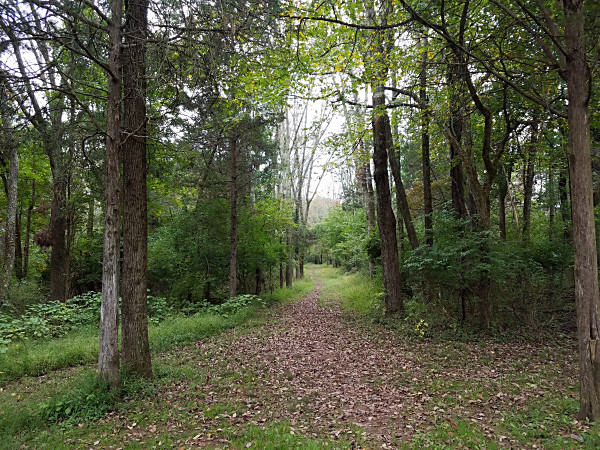
The Skippack Creek Loop Trail in Evansburg State Park
I found a nice parking spot across the road from some restrooms. (This is a major consideration for us old guys.) There were very few others nearby so I practically had the place to my self. I put my 19.5-foot vertical on the back of my truck and set up my KX3 in the cab.
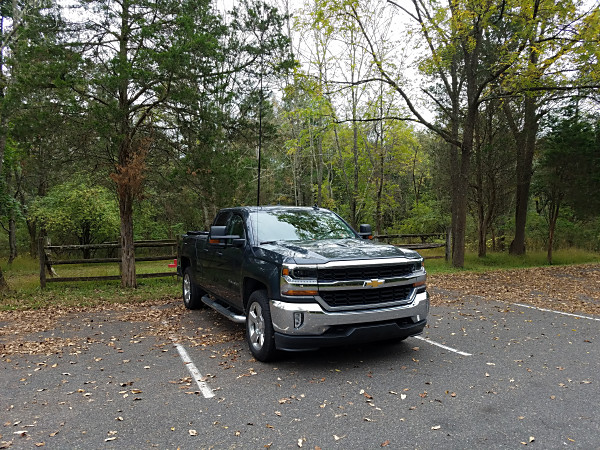
My parking spot in Evansburg State Park
I started out on 40M and found some fellow Leaf Peepers but the QSOs were coming at a “relaxed” pace. Given that there were 180 registered Leaf Peeper stations, I thought I would hear more activity. However, I was able to work stations from New Hampshire to Florida and out to Michigan on 40M. The band yielded 7 Leaf Peepers before I switched over to 20M.
On 20M, my CQs yielded one more Leaf Peeper. Since the SKCC QSO Party was underway, I put the KX3 in straight key mode and flipped my paddles on their side to create a straight key. It’s awkward but it works. I picked up two SKCC contacts before pulling the plug.
Here are some of today’s highlights:
My second QSO was with Tim W3ATB, creator of the contest and Leaf Peeper #1.
I had a park-to-park QSO with Joe N2CX. Joe was at Washington Crossing State Park (K-1634) over in New Jersey.
I had another SKCC QSO with Bert F6HKA. He always has a great signal and is usually able to pull my QRP signal out of the noise.
After a little less than 2 hours, I had to pack up to run some errands before heading home. All in all, it was a fun outing and my 10 contacts were enough to qualify as a POTA activation. I don’t know why I waited so long to activate this park.
Thanks to Tim W3ATB for coming up with this contest. I always enjoy these QRP field contests and I’m looking forward to operating in this one again next year.
My XYL and I took the “QRP camper” back down to Elk Neck State Park in Maryland for the weekend. We had a couple of days of nice Fall weather but that did little to offset the mediocre propagation. By the end of the weekend, the weather became as bad as the band conditions.
When we arrived on Friday I set up my usual 29.5-foot vertical. I initally gave some thought to putting up an inverted L but I didn’t see a conveniently-placed tree to support the far end. In hindsight, having more wire up in the air would have been a good idea this weekend. I made a couple of contacts to make sure things were working before getting a campfire started.
On Saturday, I worked an assortment of stations (SOTA, special events, SKCC, etc.) but it seemed like almost every QSO was a struggle. With an A Index of 27, that wasn’t too surprising. After several attempts, I finally got through to N8N in Michigan on 40M for a park-to-park contact. Hank N8XX was operating with a special event callsign for National Trails Day. He was operating from the North Country Trail (KFF-1555). (Elk Neck State Park is KFF-1569.)
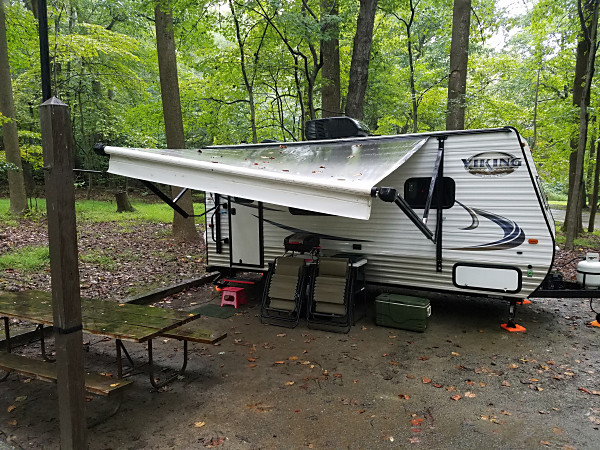
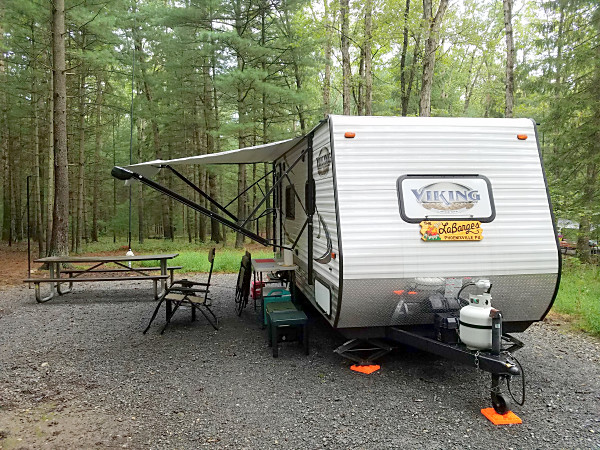
The WB3GCK camper on a rainy morning in Elk Neck State Park in Maryland. My Jackite pole is strapped to the lantern post on the left.
The beautiful weather was short-lived. By Sunday morning, a steady rain had moved in, so I hunkered down with the KX3 in the camper to give the bands one more shot. I ended up with a very nice chat on 80M with NS3X. Mark is located in north-central Maryland and was a new SKCC number for my log. After I signed with Mark, I packed up the radio and began the unpleasant task of breaking camp in the rain.
I only logged a paltry 8 contacts over the weekend but that was enough to reach the 44 contacts needed for a WWFF-KFF activation.
We have two more trips planned for October before it’s time to winterize the camper and put it into hibernation until Spring. Time sure flies…
Our reservations for a weekend of camping at Pine Grove Furnace State Park (K/KFF-1398) in south-central Pennsylvania coincided nicely with the New England QRP Club‘s (NEQRP) QRP Afield contest. Although I didn’t hear much QRP Afield activity there was a lot going on this weekend, radio-wise.
We had a great campsite this time. It was large and isolated from our neighbor campers. Behind our site, there was nothing but woods. This site was screaming for a larger antenna. I put up a 53-foot inverted “L” antenna about 25 feet tall. I ran the horizontal section back into the woods and tied it off in a pine tree. It only took two attempts to get my line where I wanted it. I’m embarrassed to say I missed the tree completely on my first toss!
The WB3GCK QRP camper at Pine Grove Furnace State Park. If you look closely, you can see my antenna behind the picnic table. The white object is a plastic bag protecting the 9:1 unun from the rain we had on Friday night. The horizontal part of my inverted L runs back into the woods.
When I fired up the KX3 Friday night, the bands sounded great. I made several SKCC contacts, including KA4RUR out in Missouri. Fred is a retired Coast Guard Radioman and a fellow Field Radio member. I also had a nice chat with Jim WT2W in New York on 60M. Jim told me he was a Navy Radioman on a “tin can” (destroyer). It was great to work these fellow former military radio operators.
The next day, I set up outside the trailer and got ready for the contest. Unfortunately, there wasn’t much QRP Afield activity on the bands. I only worked two stations — W0UFO in Minnesota and W1C at the Chowdercon QRP gathering. I briefly heard another station but couldn’t connect.
WB3GCK operating at Pine Grove Furnace State Park.
Despite the lack of QRP Afield activity, there was plenty of other stuff going on to keep me occupied. I worked several stations in the Washington State Salmon Run, Iowa, and New Jersey QSO parties. I had park-to-park contacts with VE2DDZ (VEFF-0365) and K5KJ (K-3031) and also worked 3 SOTA stations — N0TA, KX0R, and AC1Z.
My favorite QSO of the weekend, though, was a two-way QRP chat with UR5FA/MM. I heard Oleg calling CQ on 30M and gave him a call. He was aboard a Ukranian cargo ship in the Atlantic, west of Gibraltar and bound for Canada. After chatting for a bit about our respective set-ups, I wished Oleg a safe voyage and he wished me an enjoyable camping trip. I was pleased to add UR5FA/MM to my log once again. That contact sure brought a smile to my face.
My XYL and I spent the weekend camping at Codorus State Park (K/KFF-1342) in south-central Pennsylvania. When we were here last year, we had a weekend of bad weather. This year, it was a tale of bad traffic, bad knees and bad propagation.
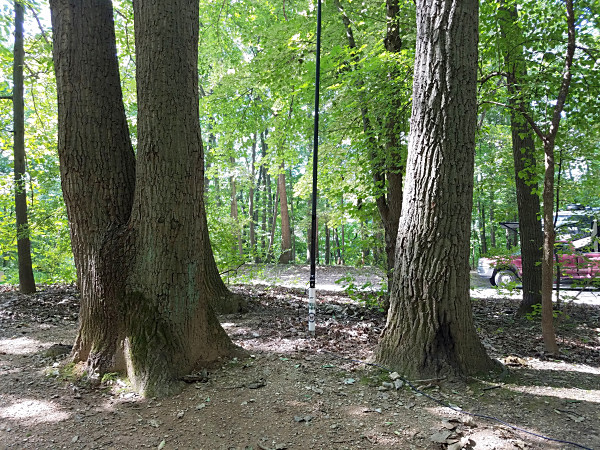
With a late start and heavy traffic, it was dark by the time we arrived at Codorus on Friday. After setting up the trailer it was getting late so I decided to wait until morning to set up my antenna. We were in a heavily-wooded camp site, so my antenna wound up surrounded by large trees.
My antenna at Codorus State Park. The trees helped to maintain a low profile but probably didn’t do much for its efficiency.
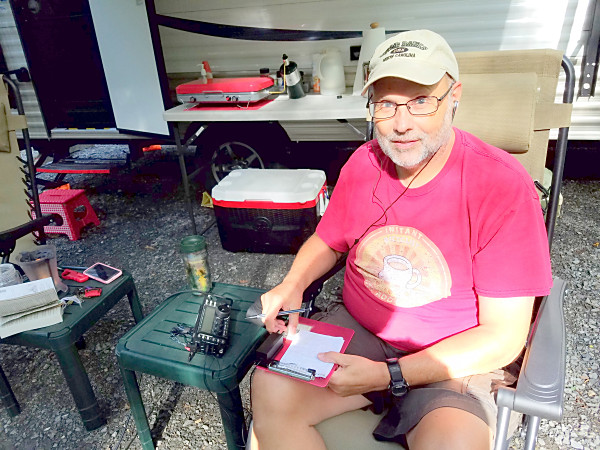
The day before we left for Codorus, I injured my knee and paid a visit to the local urgent care facility. The doctor said I needed to stay off of it for a few days and ice it several times each day. Following my doctor’s orders, I spent much of the weekend relaxing in my reclining camp chair with my KX3 on a table next to me.
Icing my injured knee while making contacts.
I didn’t do an announced activation at Codorus; instead, I just tuned around making contacts where I could find them. Along with some Ohio and Kansas QSO Party stations, I worked an interesting assortment of stations. On Sunday morning, I woke up to the news that there was a geomagnetic storm in progress. The dead bands confirmed that; I only managed a few more contacts over the rest of the weekend. Fortunately, I made more than enough contacts on Saturday for a qualifying POTA activation.
Here are some of the highlights:
I made park-to-park contacts with Joe N2CX at K/KFF-1461 and K/KFF-1452 in Wisconsin.
On Saturday afternoon, Ron WB3KVR answered my CQ on 40M. It turned out that Ron was also camping in Codorus and operating QRP. After we signed, I drove over to his campsite for an “eyeball QSO.” Ron stopped by my campsite the next day to see my set up.
On Saturday evening, I worked LZ1146SPS in Bulgaria on 30M. The unusual callsign is for a special event by the Bulgarian Radio Club Blagovestnik.
I wrapped things up on Monday morning with a contact on 30M with K0RU/M in Kansas City, Kansas. Rob was operating while driving to work. I’m always amazed by hams who can carry on a CW conversation while driving. Very impressive!
Although the bands could have been better, I still enjoyed my lazy weekend resting my ailing knee and playing around on the radio.



 WB3GCK QRP Amateur Radio