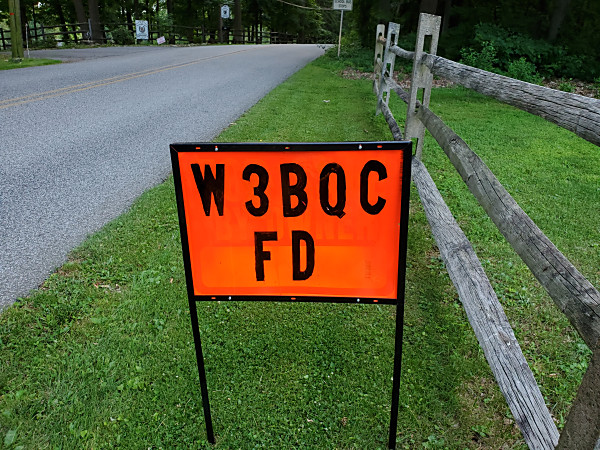
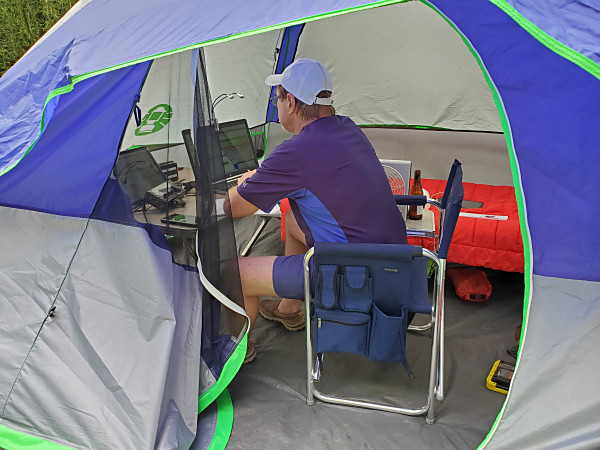
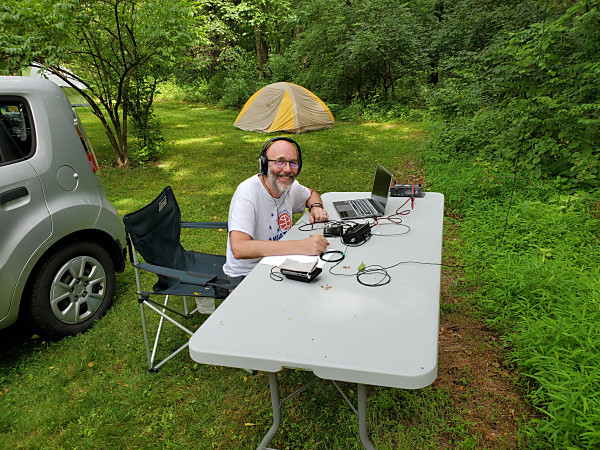
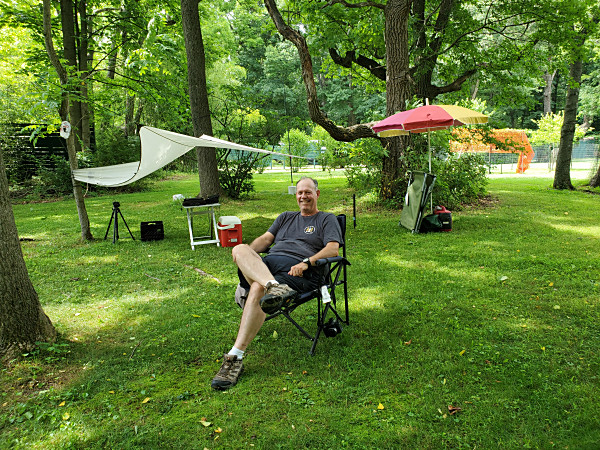
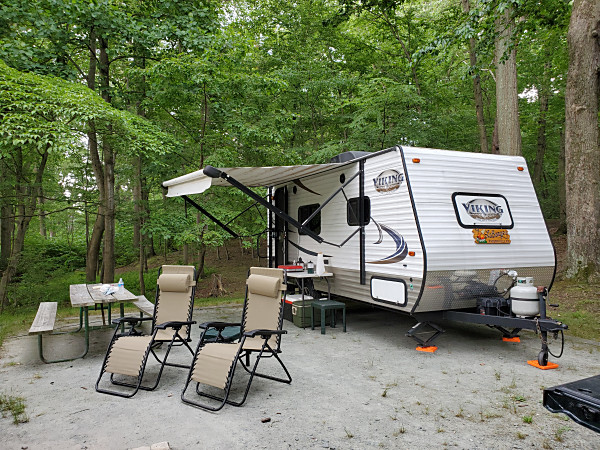
A few of the Boschveldt QRP Club members descended upon Pine Grove Furnace State Park over the weekend for some camping, hiking, and radio. Although the weather was hot, we had a rain-free weekend and a good time hanging out with old friends.
Located in Cumberland County in south-central Pennsylvania, Pine Grove Furnace is a beautiful park with a wooded campground. For this trip, there were four of us occupying two campsites: Ed WA3WSJ, Glen NK1N, John NU3E, and me, WB3GCK.
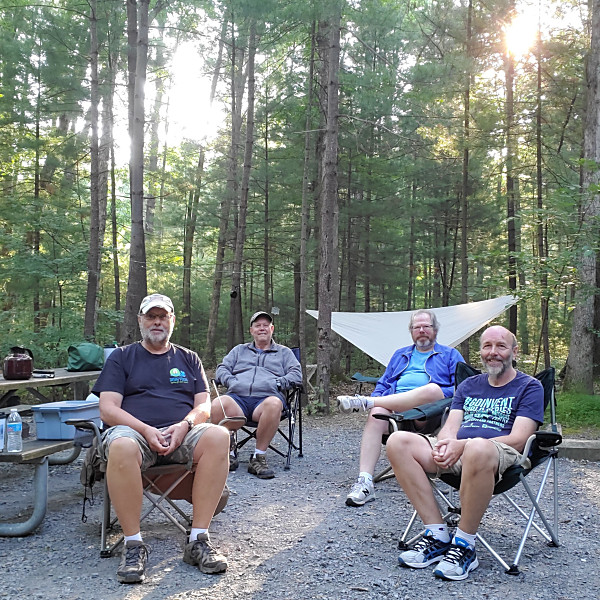
(L-R) WB3GCK, WA3WSJ, NK1N, and NU3E at Pine Grove Furnace State Park
On Saturday, Ed, Glen, and John set out to hike the Pole Steeple Trail, a short but steep trail leading to a scenic overlook. NK1N was planning to operate in the CQ Worldwide VHF Contest as a Hilltopper station, and the others went for the view. Ron WA8YIH and his family also came out for the day to join them for the hike.
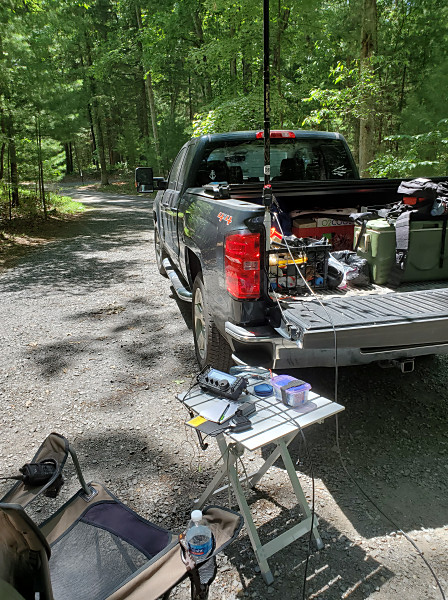
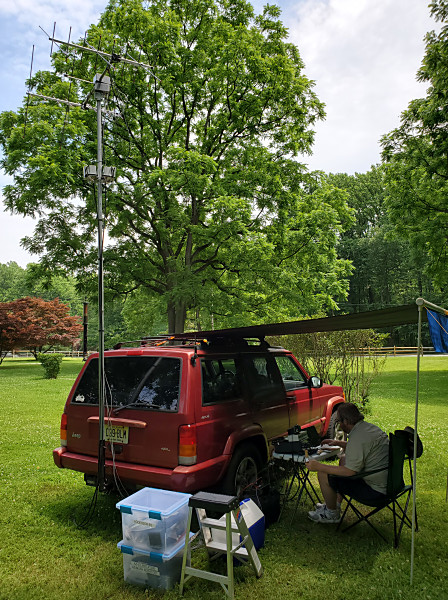
I decided not to challenge my knees with the steep climb and opted to stay back at the campsite for a POTA activation. (Pine Grove Furnace is K-1398 for POTA and KFF-1398 for WWFF.) I set up my 19-foot vertical on the back of my truck and fired up my KX3 at 5 watts.
WB3GCK set-up for a POTA/WWFF activation at Pine Grove Furnance State Park.
Despite my low power, I managed to put 27 CW contacts in the log, including one park-to-park contact. At one point, I took a break from my activation to work NK1N on 6M SSB and 2M FM, along with NU3E on 2M FM. I was happy with the 30 contacts, given that this was a short, impromptu activation. Due to the lousy cell phone coverage in the campground, I was unable to spot myself. So, I’m grateful to the kind folks who stumbled upon my QRP signal and spotted me.
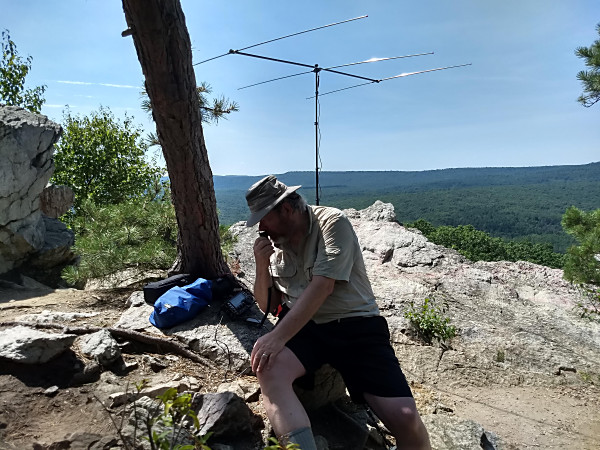
NK1N operating in the CQ Worldwide VHF Contest from the Pole Steeple Trail. (Photo by NU3E)
Following the hike, the other guys stopped for well-deserved ice cream before returning to the campsite. Their tales of hiking the steep trail in the high heat confirmed that I was right in opting out. With my knee issues, that hike would have been risky for me.
After breakfast on Sunday, we started packing up before the temperatures heated up again. On my two-hour drive home, I was able to talk to WA3WSJ and NU3E at various times on 2M, and that helped to make the drive seem shorter.
It was great hanging out with the Boschveldt crew again, but it’s also great to be back in air conditioning again.
This year has presented some challenges, but the members of the Boschveldt QRP Club were up for those challenges. We adapted to the current situation and held our annual Field Day outing—with suitable precautions, of course.
We convened at the same location we’ve used for the past few years. A local businessman graciously allows us to camp on a section of his property for the weekend. We had the following members in attendance this year: Ed WA3WSJ, Glen NK1N, Ed K3YTR, Ron WA8YIH, John NU3E, and me.
Now, here’s where things changed a bit. Due to the COVID-19 pandemic, we implemented some guidelines:
Tents had to be at least 10 feet apart—no problem, given the large field we were on.
No central food preparation area. Each member was responsible for providing and cooking their food.
No sharing of radio equipment
Maintain social distancing, especially around the campfire.
No outside visitors
This year we operated in the 4A Battery category—using QRP, of course. We ran 4 HF stations, plus a satellite station and a VHF/UHF station.
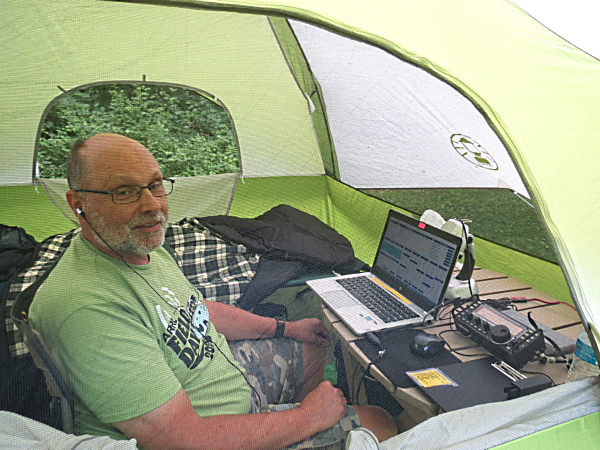
As usual, I ran CW on 40M and 80M, with my tent serving as both my sleeping quarters and radio shack. I ran my KX3 into a 53 foot inverted L. I used a 17-AHr gel cell for my rig and a deep cycle battery to charge my laptop.
Yours truly, WB3GCK, operating CW from my tent. (Photo by WA3WSJ)
Glen NK1N worked the satellites and had a slick setup for his Jeep. The Jeep also served as his sleeping quarters. There’s a lot of tree cover at this site, so Glen set up in an open spot near the entrance to the property. As a result, he had his best year ever from this site.
NK1N working the satellites
Glen NK1N took a break from the satellites to tune into the W1AW digital broadcasts to copy the Field Day Bulletin. He also checked into the paNBEMS on Sunday morning to pass our Field Day radiogram to the EPA Section Manager.
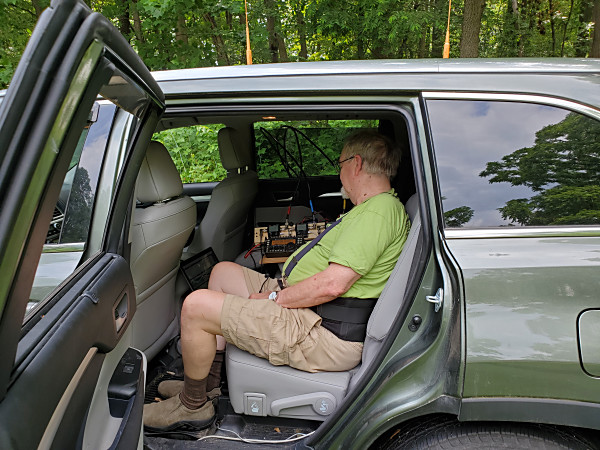
Not far from the satellite station, Ed K3YTR operated the VHF/UHF station from his car. Like last year, Ed slept in a slick, little teardrop trailer he rented for the weekend.
K3YTR working VHF and UHF from his car.
Ron WA8YIH operated both digital modes and phone from his tent/sleeping quarters. He also used a KX3 with an inverted L. Ron supplied the firewood for our evening campfires, which is a traditional feature of a Boschveldt Field Day.
WA8YIH operating FT8 from his tent
John NU3E has been a member of this group for a long time, but this was his first Field Day with us. John operated CW on 15M and 10M using a KX2 with a dipole. John used his backpacking tent for lodging.
NU3E operating CW. This was John’s first Field Day with the Boschveldt QRP Club.
Ed WA3WSJ operated CW on 20M, using his KX2 and an inverted L. Ed spent the first night on a cot underneath a tarp. He also had a neat sleeping setup in his car. He used that on Saturday night, due to the weather forecast.
WA3WSJ taking a break. Ed’s station is in the background.
Field Day for the Boschveldt QRP Club is by and large a social event; we aren’t in it for the score. Sure, we operate, but there are lots of breaks and plenty of socializing. We had a campfire each night and exercised our tradition of roasting marshmallow Peeps®. (If you haven’t tried roasting Peeps®, you haven’t lived!)
The initial weather forecast for Saturday looked dire. We were under a severe thunderstorm watch for Saturday afternoon and evening. Instead, we only had some light rain on Saturday morning. The rest of the weekend was dry and storm-free.
Despite our social distancing protocols, we had a fun weekend. It sure was great to be out of our homes and camping with old friends again.
After months of closed state park campgrounds due to the pandemic, I was finally able to go camping in our little trailer. I was expecting a relaxing and peaceful weekend, but what I got was something different.
Back before the pandemic shut everything down, I made a reservation at Elk Neck State Park in Maryland for Father’s Day weekend. So we headed out on Friday for the delayed start of our camping season.
We had a great campsite; it was large, private, and surrounded by woods. The site didn’t have electricity for the camper, but we often camp that way. Propane and battery power are all we need for a weekend of camping in the camper. After getting situated, we had dinner and enjoyed a relaxing campfire. And, of course, my antenna went up, and I set up the radio.
Our campsite at Elk Neck State Park in Maryland. This was literally the calm before the storm.
During the evening, the trailer battery started to fade. Eventually, it died altogether. It’s a 100 Ah deep cycle battery that has served us well for several camping seasons. Without it, we had no lights, the propane refrigerator wouldn’t start, and we had no water for the toilet. (I can hear the backpackers out there laughing right now.)
Fortunately, I had an extra 35 Ah battery I could press into service as a backup. After swapping a few connections, we were back in business. We used some alkaline battery-powered lights inside the camper to minimize the current draw on the smaller battery.
On Saturday, we awoke to some great weather and watched a deer pass by in the woods. Radio-wise, I started the day with a CW chat with KB4GYT in South Carolina. But, as the morning progressed, we started hearing some rumbling off in the distance. By mid-day, the storms moved in, and it continued to rain the rest of the afternoon.,
To our good fortune, the rain let up around dinner time. As we were finishing our dinner, however, we heard the propane gas detector in the trailer starting to chirp. That chirp meant we had another depleted battery on our hands.
At that point, we could have reverted to tent camping mode, using our battery operated lights and making use of the campground bathroom facilities. (We had other workarounds for using the toilet in the trailer, but I’ll spare you those details.) We had two coolers, so we could deal with the loss of the refrigerator. Plus, we still had another battery for charging phones and running a fan. We tent-camped for many years, so we’ve done all this before.
In the end, we decided we didn’t want to spend our time implementing workarounds for our workarounds to extend our stay one more night. We had to be out by mid-day the next day, anyway. So, we took advantage of the remaining daylight to hastily pack up and head home.
In between the thunderstorms and dealing with trailer battery issues, I managed to make a half-dozen contacts. Of those, two were Parks on the Air (POTA) park-to-park contacts. At times, the static crashes made radio reception difficult. I can only imagine what my 5-watt signal sounded like on the other end.
It was nice while it lasted. Well, most of it was, anyway. Instead of camping, I’ll spend Father’s Day getting my tent camping gear together for Field Day next weekend. Oh yeah… and shopping for a new battery.
I’ve been intrigued by the half-square antenna for some time now. I don’t have the real estate to put one up at home, so I built one for portable use. Like my other speaker wire projects, this antenna is built from a 50-foot length of cheap, two-conductor wire.
You can think of the half-square as two quarter-wave verticals spaced a half-wavelength apart. It provides some gain over a quarter-wave vertical and has a low take-off angle. The half-square has a bi-directional pattern with lobes broadside to the antenna and nulls off of the ends.
Normally, the half-square is fed with coax at the top of one of the vertical elements and functions as a single-band antenna. The coax should be kept perpendicular to the vertical leg, to avoid interaction. That arrangement, however, would be somewhat awkward for a portable antenna.
For expediency in the field, I went in a different direction. I decided to feed it at the bottom of one of the vertical legs, which is a high impedance point. I use a 9:1 unun to reduce the high input impedance to something easier for a tuner to handle.
I designed this antenna for the 20M band, but I wanted to use it on other bands as well. By using the 9:1 unun to feed the bottom of the antenna, I’m able to squeeze some more bands out of it. A tuner is required, of course.
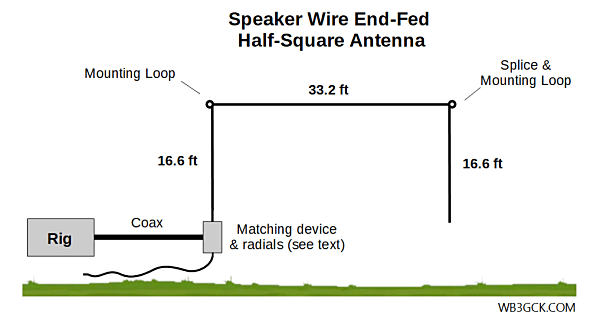
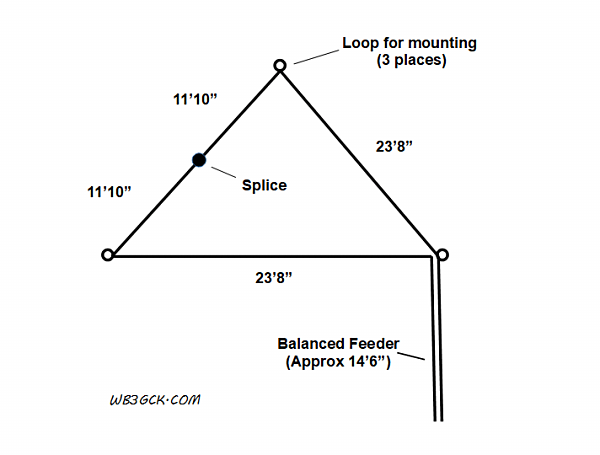
Refer to the accompanying diagram to help make sense of the following steps.
Separate the speaker wire into two 50-ft wires
On one of the wires, install a spade lug at one end. This will be the connection to your matching device)
From the spade lug, measure up 16′ 7.2″ and make a small loop using two small zip-ties.
From the second wire, cut a length that is about 16′ 9″ or so.
Strip and splice the smaller wire to the end of the larger wire. After soldering it, I covered the splice with heat-shrink tubing.
Next to the splice, make another small loop, using two zip-ties.
At the end of that wire, twist the wire to form an attachment loop. When you do this, make sure you have 16′ 7.2″ from the splice to the attachment loop.
I applied some Goop® adhesive to the loop at the end of the wire to hold it together. I also added Goop® to each of the other attachment loops.
As is my usual practice, I added some Goop® to where the wire enters the spade lug to add some strain relief.
At this point, the antenna is finished. You can, however, cut the leftover wire in half to make two radials for 20M (approximately 16 feet, give or take). I installed a spade lug on each of these wires and twisted the other ends to make a small loop. You guessed it; I put Goop® on these wires, as well.
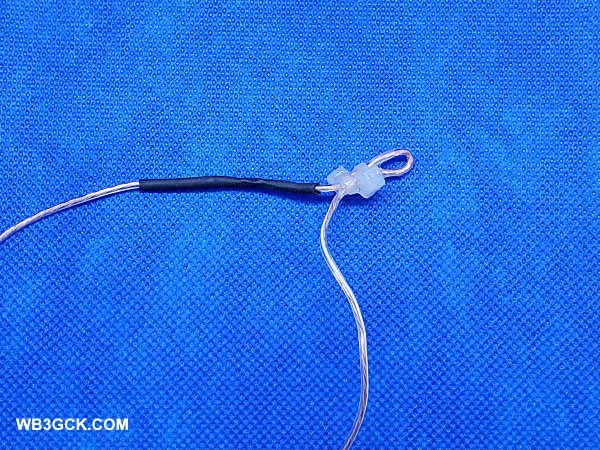
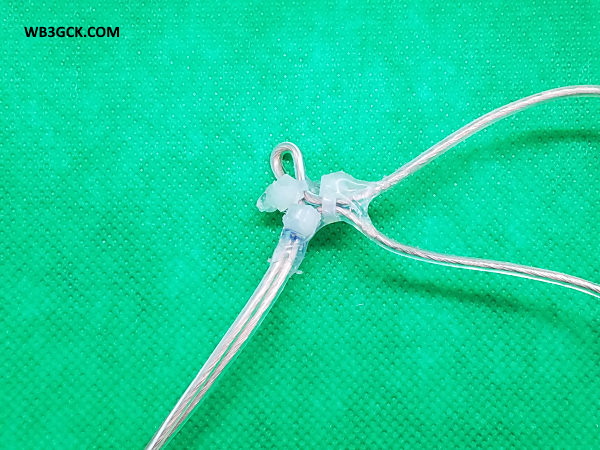
This photo shows the splice and one of the mounting loops used in the Speaker Wire Half-Square.
Matching
[Update (6/17/2020) – After initially publishing this post, I received some great feedback from readers. As a result, I have updated, clarified, and expanded this section.]
For my first couple of outings with this antenna, I used a 9:1 unun as a quick and dirty way to get it on the air. I run about 18 feet of RG-8x coax from the unun to the radio. There’s nothing particularly critical about the coax length, but I would recommend a minimum of 16-feet for 40M and up. The exact length of the radials isn’t critical either since they’re laying on the ground. In fact, you can probably use the antenna without them. In this case, you’re relying on the coax shield for the counterpoise.
While the 9:1 worked fine, there are more efficient ways to match this antenna. I plan to continue experimenting with other methods to match the high-impedance input on 40M and 20M.
I haven’t tested them myself, but the end-fed halfwave tuners from Pacific Antenna and QRPGuys should work on 20M and 40M. They use a parallel resonant circuit and are designed to match an end-fed halfwave (EFHW) antenna.
An EFHW transformer, like the ubiquitous 49:1 transformer, should also work. You will likely need to do some pruning on the antenna to get the SWR where you want it.
Finally, a simple L-Match antenna tuner with a tapped inductor in series and a variable capacitor across the output looks like it may be the best solution for me. It should handle the high impedances on 40M and 20M, and work on other bands like a random wire tuner. This will definitely be part of my next round of experiments.
Deployment
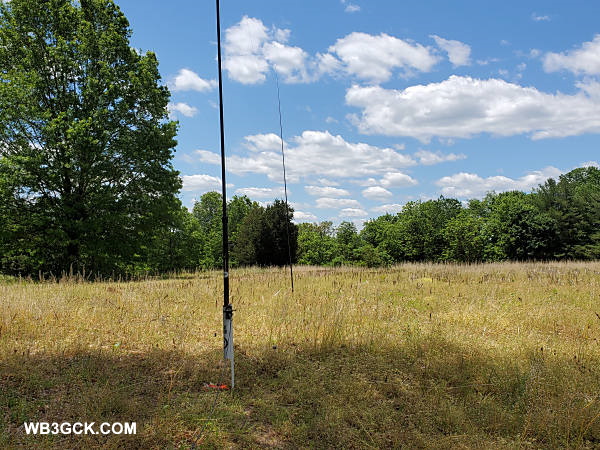
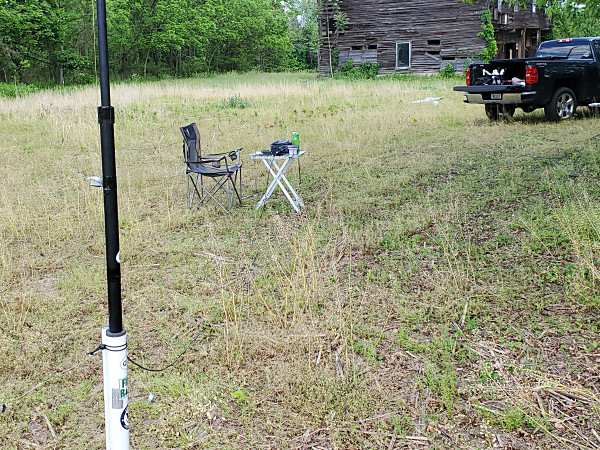
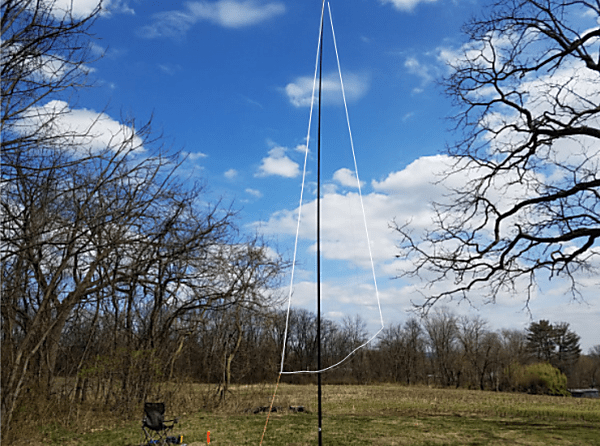
Deploying this antenna is a snap and takes me about 5 minutes. I use two collapsible poles to support it. I attach one corner to a partially-extended 28-foot Jackite pole. The feed point of the antenna is about 3 feet off the ground.
These are the two poles I used to support the Speaker Wire Half-Square. Unfortunately, the wire is too thin to be visible in this picture.
I use a 20-foot Black Widow pole (actual length about 19.5 feet) to support the other end. I support this pole with an appropriately-sized screwdriver shoved in the ground. The handle of the screwdriver fits snugly inside the bottom section of the pole. After attaching the other corner of the antenna to top of this pole, I extend the pole and remove the bottom cap. Next, I walk the pole back until the horizontal section is taut. Then, I just shove the screwdriver in the ground and place the pole over it.
With appropriate trees nearby, you might be able to eliminate one or both of the poles. I’m not usually that lucky.
Results of Field Testing
I was pleased with the results of my initial field tests with the half-square. The internal tuner in my Elecraft KX3 was able to load the antenna from 80M through 6M. (Since the antenna’s input impedance is low on 80M, I wouldn’t recommend using the 9:1 there.) The SWR was 1.2:1 or better on all bands with the tuner.
During my first outing with the half-square, I was able to make contacts on 40M, 20M, and 15M at 5 watts with no difficulty. The antenna is a half-wavelength on 40M, and it appears to play well on that band. I had numerous Reverse Beacon Network spots on 40M showing a signal-to-noise of 20db or better.
I also used it in the field during a recent QRP contest with similar results. Signals were strong on 40M, and I worked Georgia and Quebec on 20M.
This was hardly a rigorous scientific evaluation, but I’m happy with this antenna so far. One of these days, I’d like to do some modeling to see what the radiation patterns look like on the various bands. In the meantime, I’ll do some more experimenting with impedance matching.
Wrap-Up
This was an easy and fun project. It certainly made good use of a roll of cheap speaker wire. After using this antenna in the field a couple times, I have officially added it to my arsenal of portable antenna options.
After some damaging storms this week, we were blessed with some great weather for the weekend. Today was a perfect day to head outdoors for the annual Cookie Crumble QRP Contest.
The Cookie Crumble is a QRP contest run by Tim Carter W3ATB and Emily Saldana WC3R. It was inspired by the cookies that Emily used to make during the 2016 National Parks on the Air event. You get bonus points for working stations designated as Cookie Monsters. What’s unique about this contest is that you lose points for working Burnt Cookie stations. In any event, it’s a lot of fun.
My set up for the Cookie Crumble QRP Contest.
This year, I headed out to my daughter’s farm to operate from one of the fields. My setup was almost identical to the setup I used last weekend. I used a half-square antenna made from cheap speaker wire, along with my KX3. I set up my chair under a shady tree—for a while, at least.
I wasn’t out for too long, but I worked 10 stations in the contest. One of those was a Cookie Monster station. Fortunately, I didn’t encounter any burnt cookie stations.
Some of the highlights from today included:
My first QSO was with my old friend, Carter N3AO, down in Virginia. It was great to hear him again.
I worked VE2DDZ, who was doing a joint Cookie Crumble and SOTA activation. Malcolm had a great signal into Pennsylvania.
Outside of the contest, I worked WD8RIF who was doing a Parks-on-the-Air (POTA) activation from Ohio.
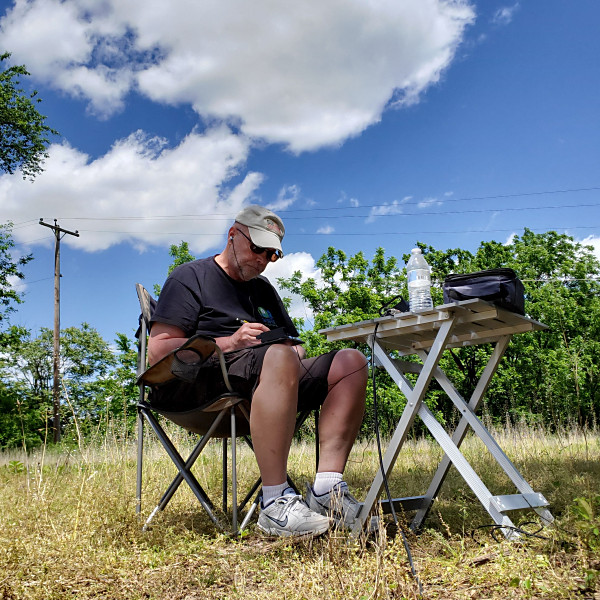
WB3GCK hard at work (or hardly working) in the Cookie Crumble QRP Contest.
After a while, I began to lose my shade and I was starting to get a little sunburned. Right before I started tearing down, I heard another old friend, Dan KA3D, very faintly. I gave him a couple of calls but, sadly, he couldn’t hear me. We were probably a little too close for 40M. Maybe next time.
It was a great day to be outside playing radio. I also got some more on-the-air experience with my homebrew half-square antenna, which I’ll document in my next post.
Thanks for Tim W3ATB and Emily WC3R for running this fun contest.
It was a beautiful day yesterday, here in southeastern Pennsylvania. I hadn’t done any portable operating lately, so this was a perfect day to get out there to test a new antenna I built.
I headed back out to the property my daughter and son-in-law own. They are in the process of restoring an old farmhouse on a large piece of land. Like my last outing there, I had the place to myself.
I mentioned in a previous post that I had built a half-square antenna out of speaker wire. So, I set it up in what had been a cornfield and gave it a go.
My setup out in what had been a cornfield. The old barn in the background is slated to be replaced later this year.
The bands were wall-to-wall with participants in the CQ WW PX Contest. While I was playing around with the antenna, I worked several contest stations on 40M, 20M, and 15M. Running five watts, I was able to work most of them on the first call. Contesters, of course, have exceptional ears.
All in all, I was pleased with the half-square antenna. I used a slightly different approach to this antenna, which gave me some multi-band capabilities. The KX3 was able to load it up from 80M through 6M. A detailed post on this speaker wire antenna project is in the works.
After two months away from it, it sure felt great to be back out in the field again playing with the radio.
Here’s an example of what can happen when you have a hunk of cheap wire and a little too much time on your hands.
Years back, I did a write-up on a simple, random wire antenna made from a 50-foot roll of speaker wire from a local dollar store. I nick-named it the Dollar Store Special. I had a similar roll of wire in my junk box, so I set out to see if I could build another useful portable antenna from it.
This time out, I wanted to build something more elaborate than a random wire. After some sketching with a pencil and paper, I came up with this simple portable delta loop.
There are certainly better ways to construct a delta loop. However, I just wanted to see if I could build a functional antenna using only cheap speaker wire. So, with that in mind, here’s how I did it.
The Design
The antenna I built was inspired by a portable delta loop designed by Doug DeMaw, W1FB. [1] Doug’s multiband delta loop was designed for the 40M band and used a 300-ohm balanced feeder.
According to Doug’s book, this type of antenna should work well on the fundamental frequency and higher. For the next band below the fundamental, he suggests connecting the feeder wires together and using it like a random wire. I figured I’d just try loading it up as is to see what happens.
Given that I constrained myself to a 50-foot roll of speak wire, I scaled my antenna for the 20M band. Using the formula, 1005 divided by the frequency in megahertz, I calculated a total length of 71 feet (21.6 meters) for the center of the 20M band. That would leave some of the two-conductor wire for an improvised balanced feeder.
Feeding the delta loop in a corner (with the apex of the loop pointing up), gives the antenna vertical polarity with a low take-off angle.[2] As with most antennas, higher is better. However, this antenna is still quite useful at practical heights in the field.
Since a tuner will always be necessary, I expended no effort trying to optimize the design.
Construction
Schematic diagram of the delta loop antenna
If you’re a visual person like me, refer to the diagram to help make sense of the directions below.
Measure off 35.5 feet from one end of the speaker wire. Place a small zip-tie around the wire at this point.
Separate the 35.5-foot end of the speaker wire into two separate wires.
Strip and solder the loose ends of the 35.5-foot wires together. Put some electrical tape or shrink tubing over the splice.
Make 3 small loops in the wire, as shown in the diagram. You can see an example in the accompanying photo. These are going to be the attachment points. I used some Goop® adhesive on the zip-ties to help hold things in place.
Finally, install some spade terminals on the ends of the shorter conductors. These will be used to attach the antenna to your tuner or balun.
Example attachment point. This is the feedpoint of the antenna. The two wires to the right are part of the loop antenna, while the wires towards the bottom serve as the balanced feedline. I used some Goop® adhesive on the zip-ties to help hold them in place.
Deployment
For my initial tests, I used a 28-foot Jackite pole to support the antenna. I only partially-extended the pole, such that the bottom of the antenna was about 4 to 5 feet off the ground. I used some nylon twine and a couple of tent stakes to tie off the two bottom corners.
This is the delta loop set up for my intial testing. The light-colored wires were difficult to photograph, so I enhanced them for visibility.
The setup was somewhat more complicated than most portable antennas I use. It took me about 20 minutes to get it set up, but I suppose that wasn’t too bad for my first time.
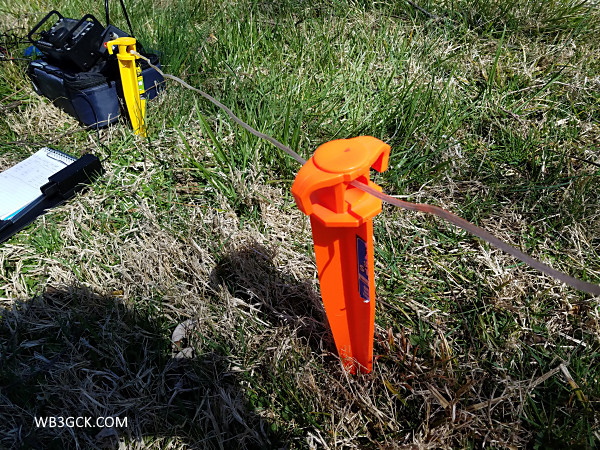
I used a couple of large tent stakes to keep the feedline off the ground. I connected the antenna to my KX3 using a 4:1 balun and a 1-foot piece of coax.
I used a couple of large tent stakes to keep the balanced feedline portion of the antenna off the ground.
Results
I first did a quick check to see what bands the KX3’s internal antenna tuner would handle. I found that I could load it up on every band from 60M through 6M, although I couldn’t get the SWR below 2:1 in the low end of 40M. That’s not surprising for a 20M loop, I suppose. I did have a usuable match between 7.030 and 7.060, where I normally operate.
I was only about 50 yards away from some powerlines, but the loop seemed quiet on receive.
On 20M, a French station answered my third CQ. I also made contacts with Missouri and wrapped up with yet another French station.
From the signal report the last station gave me, this antenna appears to do reasonably well with DX on 20M running QRP. It was a chilly and windy day, so I didn’t stay out there to try for contacts on other bands.
Wrap-Up
Although my initial outing with this antenna was promising, I need to spend some more time using it on bands other than 20M. In any event, it was a fun—and cheap—antenna project.
73, Craig WB3GCK
References:
[1] DeMaw, D. (1991). Technical Bits & Pieces. In W1FB’s QRP Notebook (2nd Edition, pp. 157–161). Newington, CT: QST. [2] DeMaw, D., & Aurick, L. (1984, October). The Full-Wave Delta Loop at Low Height. QST, 24–26.
With the COVID-19 pandemic, I have been spending a lot of time at home lately. We had some decent weather today, so I went out to do some portable operating while practicing social distancing.
My daughter and son-in-law recently purchased an old farmhouse that they are restoring. The farmhouse is located on a large piece of property with plenty of room for QRP-portable operating. No one was there today, so I had all that acreage to myself. That made the social distancing thing easy.
I had a portable delta loop antenna that I built a year or two ago but never tested. Today seemed like a good time to try it out. I set the antenna up behind an old barn and operated my KX3 from a camp chair. (I’ll be doing a detailed write-up on this antenna soon.)
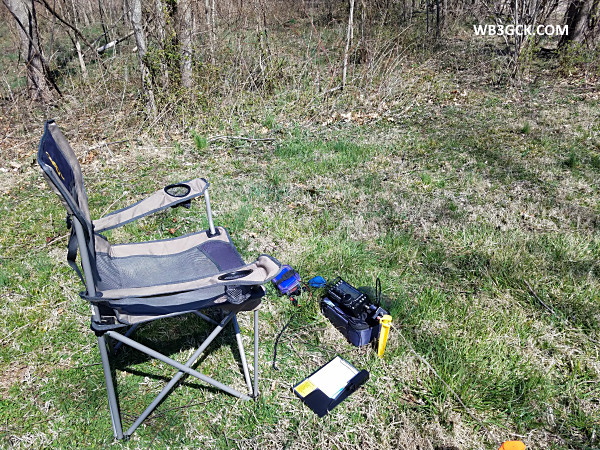
My operating position today
I spent some time seeing which bands the KX3 would tune. Once that initial testing was done, I tuned up on 20M and started calling CQ. After the third CQ, I received a call from fellow SKCC member F8FSC in France. We both struggled with fading, but I was thrilled that he heard my meager 5-watt signal.
I bumped my power up to 10 watts to improve my odds. I heard N3PDT calling CQ from Missouri and gave him a call. We exchanged SKCC numbers and chatted for a bit.
Tuning down the band, I heard F6HKA booming in from France. I sent my callsign once, and he got it the first time. Bert gave me a 549 and said I was peaking at 569. We exchanged SKCC numbers and chatted for about 10 minutes before signing. I’ve worked Bert many times, and it’s always a pleasure.
It was sunny but somewhat chilly and windy out there today. As I was working Bert, though, it started getting cloudy. I was starting to feel the cold, so I figured it was a good time to pack up and head home.
It felt great to be playing radio outside and not thinking about the pandemic.
In a recent post, I covered some (very) basic information about the venerable doublet antenna. This time around, I’ll cover some practical examples. These are antennas I have used and one unique design I know of.
Doublet Fed with TV Twinlead
My go-to portable antenna for several years was a simple doublet fed with 25 feet of that cheap, brown TV twin-lead. For the radiating elements, I used some #22 stranded hookup wire.
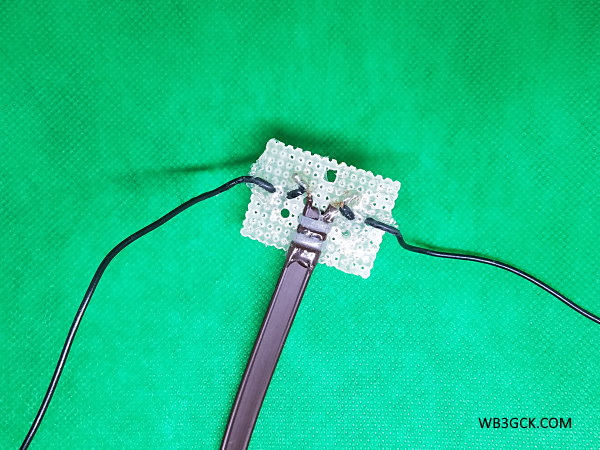
I first built the antenna as a 40M dipole fed with RG-174 coax. After a while, I wanted to cover multiple bands, so I removed the coax and replaced it with the twin-lead. I used a small piece of fiberglass perf board for the center insulator.
I have often used my homebrew Z-match tuner to load it up, although a 4:1 balun and a short run of coax to my rig’s internal tuner works fine, too. The whole antenna weighs next to nothing, and fits in a sandwich-sized Ziplock® bag.
Nothing fancy but it works great.
This is the center connector for my 66-foot doublet. The feedline is the old, cheap TV twin-lead.
Up and Outer
The Up and Outer is simply a doublet with one vertical leg and one horizontal leg. I had done some experimenting with this old-time antenna and decided to build one to use while on vacation in the Outer Banks of North Carolina.
I planned to support the vertical leg with a 28-foot Jackite pole, so I made a simple modification to a 44-foot doublet I had on the shelf. I spliced 6 feet of additional wire to each of the elements down to 28 feet each, and I was in business. Like my 40M doublet, the Up and Outer is fed with TV twin-lead and uses a perf board center insulator.
This antenna always goes with me on our annual Outer Banks vacation. I’ve used it from numerous beach rental houses, and it’s perfect for use on a second story deck. I used it last summer with great results, connecting it directly to my KX3. And, if I need to, I can use it as a normal horizontal doublet.
Appalachian Trail (AT) Dipole
This design is the brainchild of my friend, Ed Breneiser WA3WSJ, and goes back about 20 years. Rich Arland K7SZ, wrote about it in his QRP column in QST [1] back in 2001 and devoted a few pages to it in one of his books [2].
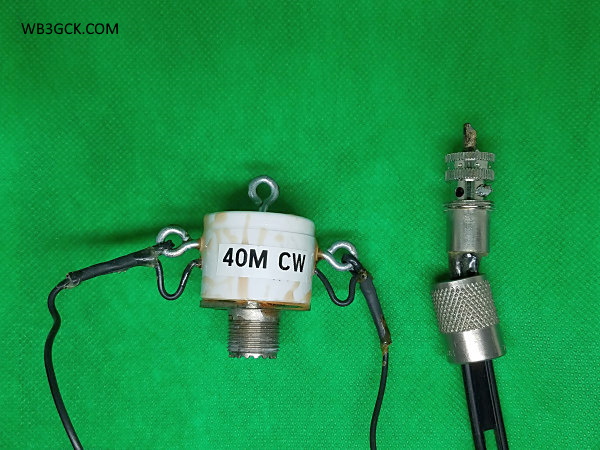
In simplest terms, it’s a 40M doublet made from #26 copper-clad stealth wire. Ed used a 3/4-inch PVC end cap for the center insulator (see photo). After soldering wires to an SO-239 socket and routing the wires through the end cap, the inside of the end cap is potted with epoxy. This makes it pretty much bomb-proof.
The antenna is fed with 300-ohm ladder line, which is soldered to a PL-259 UHF connector. The PL-259 probably causes a slight imbalance, but in the field, you’ll never notice it. You can also feed it with coax and use it as a normal 40M dipole. Pretty cool, huh?
When I built mine, I went with some #22 stranded hookup wire I had on hand. Although I departed from Ed’s design a bit, this doublet has been a reliable portable antenna over the years.
My version of the WA3WSJ AT Dipole. The discoloration on the PVC end cap is from a mishap I had while potting it with epoxy. On the right is a PL-259 connector used with 300-ohm ladder line. As you can probably tell, this antenna has seen years of heavy use.
WV0H Park Doublet
Myron WV0H designed a unique doublet that he dubbed The WVØH Park Portable Doublet. He uses two 50-foot pieces of wire to create a 60-foot doublet fed with a built-in open-wire feeder. I won’t attempt to offer a detailed description here; Myron’s blog post provides all the details you need to build one. Go check it out.
While I’ve never used Myron’s unique antenna, I can vouch that it works. I worked Myron a few years back while he was out in a park with his doublet. I can attest that it puts out a great QRP signal.
Wrap-Up
Well, that’s about it. If you need a reliable, easy-to-build, multi-band antenna, give the time-tested doublet a try.
73, Craig WB3GCK
References: [1] Arland, R. (2001, July). QRP Power – Antenna Time. QST, p. 100. [2] Arland, Richard K7SZ, Low Power Communication – The Art and Science of QRP, The American Radio Relay League, 2nd Edition, 2004, Chapter 6, pp. 6-36, 6-37
I was recently going through my stash of portable wire antennas and came across one of my old favorites—the doublet. I don’t see too many references to this type of antenna these days, but the doublet provides a great portable antenna option.
What is it?
The doublet, simply put, is just a dipole. The difference is that you feed it with a balanced feeder, rather than coax.
Hams have been using doublets for many years. The earliest reference I could find in the ARRL QST archives was from September of 1929.[1] In this write-up, Clair Foster W6HM describes a 40M doublet fed with twisted wire lamp cord used for receiving.
Advantages of the Doublet
The balanced feeder provides some advantages. Depending on how it’s constructed, it can withstand higher SWR with lower losses than coax. Because of the low losses at high SWR, you can use the doublet as a multi-band antenna.
As a portable antenna, it’s hard to beat, especially as an inverted vee. Use a tree branch or telescopic pole to hoist up the center, tie off the ends, and you’re in business. [2]
Some Disadvantages
This multi-band capability comes with some disadvantages, though. Fortunately, none of them are insurmountable.
First, you’ll need a transmatch that can handle balanced feedlines. Typical commercially-available feedlines have either 300 or 450-ohm characteristic impedances. For open-wire feedlines, the impedance can sometimes be 600 ohms or more.
I’ve had success using a homebrew Z-match tuner. Companies like Pacific Antenna and QRP Guys sell Z-match tuner kits that will handle balanced lines. They offer tuners that are small and light enough for QRP-portable use.
You can also use a balun to transition from the balanced feedline to 50-ohm coax. While this isn’t an optimum approach, it works. Textbooks often recommend a 4:1 balun, and that’s a good starting point. If you go this route, I recommend keeping the coax as short as practical. If you run into matching problems on some bands, try another balun ratio (e.g., 1:1), or change the length of your feedline.
The second drawback is that you need to be careful of how you route balanced lines. You need to avoid getting it too close to metal or laying it on the ground. Both can upset the line’s balance. This can cause it to radiate or introduce losses. If you have excess line, don’t coil it up. Operating outdoors, I found these restrictions aren’t very difficult to work around; you just need to be mindful of them.
Construction
Building the doublet is pretty simple. Many folks suggest making the doublet a half-wavelength long at the lowest band you intend to use. I’ve built one for 40M and it worked well on 40M and higher. Depending on your tuner, it may also be usable on the next lower band.
L. B. Cebik W4RNL (SK) popularized the 44-foot doublet for 40M-10M. According to Cebik’s analysis, this length produces a more consistent radiation pattern across the bands.
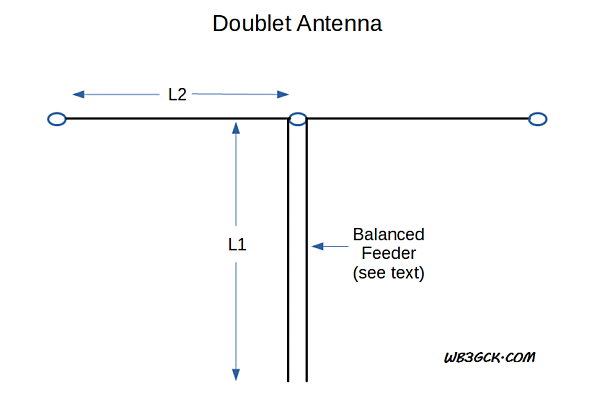
Doublet diagram. One rule-of-thumb suggests avoiding combinations of feedline electrical length (L1) and one leg of the radiator (L2) that are odd multiples of an eighth-wavelength.
Regardless of the size of the doublet, you should try to avoid certain feedline lengths. One rule-of-thumb suggests avoiding combinations of feedline electrical length plus one leg of the radiator that are odd multiples of an eighth-wavelength. [3] If you run into matching problems, you can try adjusting the length of either the feedline or the radiating elements.
Feedline Options
You have several options here:
Commercial 450-ohm or 300-ohm ladder line. These are commonly available, and they work great.
Homebrew open-wire feeders. This is the most efficient option. If you do some Internet searching, you’re likely to find lots of ways to build open-wire feeders. SOTABEAMS has a great example on their website.
TV twin-lead. I’ve used the cheap, brown stuff quite a bit for portable doublets. Unfortunately, it’s nearly impossible to find these days. If you come across it somewhere, stock up!
Lamp cord or speaker wire. This works and I’ve seen folks use it for portable antennas. However, it can be lossy, compared to window line or open-wire feeders.
More Later
If you want more technical details on this antenna, information abounds on the Internet and in antenna books. In particular, Cebik wrote some great articles that are worth searching for.
In a future post, I’ll cover some practical examples that I have come across or used in the field.
73, Craig WB3GCK
References: [1] Foster, C. W6HM (1929, September). Experimenters’ Corner: The “Doublet” for Receiving. QST, p. 39. [2] DeMaw, D. W1FB (1991). Technical Bits & Pieces. In W1FB’s QRP Notebook (2nd Ed., pp. 157–161). Newington, CT: QST. [3] Heys, John D., G3BDQ (1989). Center-fed antennas using tuned feedlines. In Practical Wire Antennas. Bedford, UK: Radio Society of Great Britain, p 7.