CW – A Workout for Your Brain

For those of us who use it, the advantages of the CW mode are well known. It’s efficient and cuts through noise better than voice. CW is also well-suited for low-power (QRP) communications, enabling the use of modest equipment and power sources. Another important advantage is that learning and using Morse code is good for your brain. 

It should come as no surprise that ham radio demographics skew heavily towards older adults. Folks over the age of 55 make up roughly 60% to 70% of the ham radio community.1 It’s also widely known that cognitive decline often comes with age. I’ve always believed that Morse code is good exercise for your brain. In doing some research, I found that scientists have studied this, and there’s solid scientific evidence supporting my beliefs. 

AI-generated cartoon image showing a human brain lifting weights in a gym.

Five Ways Your Brain Benefits From Morse Code

Mental Exercise There are several studies out there that show the benefits of learning and using a new skill, such as a new language or playing a musical instrument. With Morse code, you are essentially learning and using a new language, since you are translating sound patterns into letters and words. This type of activity strengthens memory and attention.2 

Promotes Neuroplasticity. There are studies that show measurable changes in CW operators’ brains related to listening and motor control. Activities like this have been shown to promote neuroplasticity, or the ability to adapt and create new pathways in the brain.3 4 I’m no neuro-scientist, but I’m told this is a good thing for your brain. 

Improved Auditory Processing. Copying Morse code by ear is all about recognizing patterns, rhythms, and differences in pitch. This can sharpen auditory discrimination and focus. It seems to me that recognizing patterns, rhythms, and pitches is pretty similar to playing a musical instrument. 

Focus and Mindfulness. Copying CW requires our complete attention and sustained concentration. This exercises your brain, not unlike playing a challenging game or solving a puzzle. 

Social Interaction. When you use Morse code to communicate with others, it keeps you socially engaged, which is increasingly important as we age. Social engagement is not limited to just Morse code; hams communicate with each other using a variety of modes. Belonging to a radio club or participating in nets also provides social interaction. During my 50-plus years in ham radio, I have had the pleasure of developing countless friendships, both on the air and in person. 

It’s Never Too Late to Start

When I was an 18-year-old sailor training to become a U.S. Navy radio operator, I soaked up Morse code like a sponge. Studies show there’s a good reason for that. Younger brains work faster, while processing speed and working memory can decline with age. That doesn’t mean we older folks should throw in the towel on learning new skills. Au contraire! Remember that neuroplasticity I mentioned earlier? Well, science shows that the ability to form new pathways and connections in the brain continues well into our twilight years.5 Contrary to the old adage, it seems you can teach an old dog new tricks.

While younger brains have their speed advantage, older adults approach learning armed with a lifetime of experiences. Because of these accumulated experiences, older folks are often better at problem solving and pattern recognition. Also, our retention and conceptual understanding are often better. We just might need more repetition and smaller chunks of information while learning something new. 

Take Your Brain to the Gym

If you don’t already use CW, consider giving it a shot. It can be challenging, but it’s certainly worth the effort. Just be patient and stick with it. I think you’ll find it’s a fun way to communicate. 

If you’re already a CW aficionado, grab that key and join me on the air for a workout!

73, Craig WB3GCK 

DIT DIT

References:

    1. Mann (N0SSC), S. (2021, April 23). There Is Youth in Ham Radio. On All Bands. https://www.onallbands.com/there-is-youth-in-ham-radio/ ↩︎
    2. Wu, R., & Jessica, C.-L. (2023, June 23). To Stay Sharp as You Age, Learn New Skills. Scientific American. https://www.scientificamerican.com/article/to-stay-sharp-as-you-age-learn-new-skills/ ↩︎
    3. Schlaffke L, Leemans A, Schweizer LM, Ocklenburg S, Schmidt-Wilcke T. Learning Morse Code Alters Microstructural Properties in the Inferior Longitudinal Fasciculus: A DTI Study. Front Hum Neurosci. 2017 Jul 26; 11:383. doi: 10.3389/fnhum.2017.00383. PMID: 28798672; PMCID: PMC5526915. https://pubmed.ncbi.nlm.nih.gov/28798672/ ↩︎
    4. Schmidt-Wilcke T, Rosengarth K, Luerding R, Bogdahn U, Greenlee MW. Distinct patterns of functional and structural neuroplasticity associated with learning Morse code. Neuroimage. 2010 Jul 1;51(3):1234-41. doi: 10.1016/j.neuroimage.2010.03.042. Epub 2010 Mar 24. PMID: 20346399. https://pubmed.ncbi.nlm.nih.gov/20346399/ ↩︎
    5. Greenwood & Parasuraman (2010). Neuronal and cognitive plasticity: A neurocognitive framework for cognitive training in older adults. Restorative Neurology and Neuroscience. https://www.frontiersin.org/journals/aging-neuroscience/articles/10.3389/fnagi.2010.00150/full ↩︎

    Operating a QRP Classic: The Tuna Tin 2

    I learned recently that Ed Hare, W1RFI, passed away. Ed was a long-time lab engineer at ARRL. I didn’t really know him, but I had the pleasure of meeting him at a QRP gathering 25 years ago. The post below originally appeared on my old website, but I thought I’d share it over here in Ed’s memory. – WB3GCK

    During the 2000 Atlanticon QRP convention at Glen Mills, Pennsylvania, I had the distinct honor of operating a bit of QRP history. Ed Hare, W1RFI, brought the original Tuna Tin 2 transmitter and put it on the air as a special event station operating as W1FB/3.

    For those unaware of the significance, the Tuna Tin 2 was built by famed QRPer, Doug DeMaw, W1FB, and featured in QST back in the 70s [1][2]. It was stored at ARRL headquarters for many years until it mysteriously disappeared. It was later discovered by Ed Hare in a hamfest junk box 100 miles away. Ed bought it back for a dollar and has been putting this classic rig on the air on a regular basis. The fact that it still exists at all makes it a very special piece of equipment. The design has been updated over the years and QRPers still continue to build versions of this venerable classic.

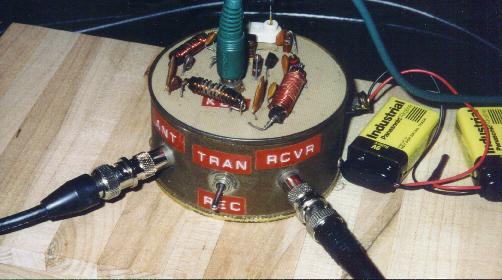
    The Tuna Tin 2 transmitter

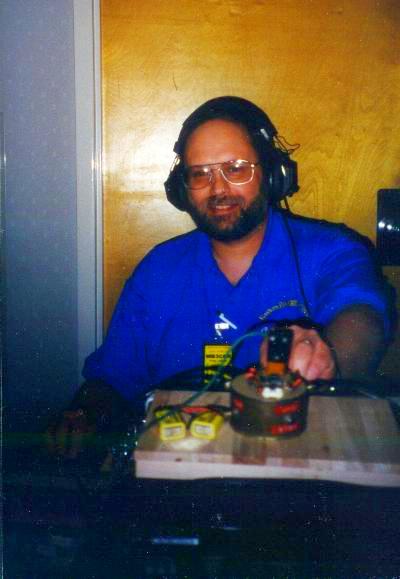
    Technically speaking, it’s not much of a transmitter. A couple of 2N2222s in a simple, crystal-controlled circuit putting out about a half-watt or so (or about 800mW with the two 9-volt batteries shown). Using a toggle switch to switch from transmit to receive brought back memories of my Novice days. My only QSO was with another QRPer on the 4th floor of the hotel. Still, I was thrilled to be able to briefly operate this famous little transmitter. Especially, under Doug DeMaw’s callsign, W1FB. That really made it special. 

    WB3GCK operating W1FB's famous Tuna Tin 2 transmitter at Atlanticon in 2000.

    © 2000-2025 Craig A. LaBarge

    [1] DeMaw, Doug. “Build a Tuna Tin 2.” QST, May 1976, pp. 14–16. Available in the QST archives at ARRL.org.
    [2] Hare, Ed. “The Tuna Tin 2 Today.” QST, Mar. 2000, pp. 37–40. Available in the QST archives at ARRL.org.

    Of Hams and Bikes

    I received an email from Jim N4JAW last week, letting me know he was planning to mention me in an upcoming blog post. Jim is an avid cyclist and is the owner of the Ham on a Bike blog. He’s doing a series of posts highlighting other hams who incorporate cycling into ham radio activities (or vice versa), titled “I Am Not Alone. There Are Many Of Us.” 

    Jim gave me a shout-out in Part 2 of his series. I’m honored to have my meager cycling activities included among such a distinguished group of hams on bikes. There is a really impressive collection of videos and pictures in Jim’s posts.

    My park bench setup in Towpath Park
    Operating bike-portable a couple of years back

    All of this reminds me I’m long-overdue for some bike-portable operation. Now that the weather is warming up a bit, I need to get the bike out on the trails. 

    Be sure to check out Jim’s blog. He has some great stuff over there. 

    72, Craig WB3GCK

    The Mystery of the Sticky Feet

    I’ve been powering up some of my old QRP gear to see if any of it still works. The gear has been stacked up on a shelf above my operating position for years. In testing some of this gear, I came across a curious problem.

    Last night I was rearranging some of my equipment and re-routing some coax cables. When I went to move my Oak Hills Research power meter, it was stuck to the shelf. The rubber feet on the bottom of the meter had become slightly soft and sticky. I didn’t think too much of it at the time. I just finished connecting the cables and placed it back on the shelf. 

    Today, I took my old MFJ-9030 transceiver down from the shelf and was greeted with a gooey mess. The rubber feet had completely dissolved and turned into a sticky, tar-like mess. Using a single-edged razor blade, I scraped off as much as I could from both the radio and the residue on the shelf. I used some mineral spirits to clean up as best I could. The mineral spirits worked great, but I still had sticky spots where the feet were attached to the radio. I cut some pieces of aluminum duct tape to cover those spots, and I applied four new feet from my junk box. 

    This is the underside of my 31 year old MFJ-9030 transceiver showing the black goo from the dissolved feet. The clear feet were added by me.
    This is the underside of my 31 year old MFJ-9030 transceiver showing the black goo from the dissolved feet. The clear feet were added by me.

    My theory is that the rubber (or whatever material they are) feet reacted with the finish on the shelf. I know that vinyl guitar straps and accessories can damage the lacquer finish used on some high-end guitars (like my 1973 Martin D35 acoustic), so I suspect something like that happened to my radio equipment. I built the shelf and my operating table from some repurposed shelves that were in the house when we moved in back in the late 70s. So, I have no idea what kind of finish is on them. 

    Besides the power meter I mentioned earlier, it looks like my old MFJ-941-E antenna tuner is also affected. So, I’ll have to replace the feet on those items and clean up the residue on the shelf with the mineral spirits. Needless to say, some of this equipment hasn’t been moved in years.

    This wasn’t exactly how I wanted to spend my afternoon, but I’m glad I spotted the problem.

    72, Craig WB3GCK

    Drive-on Antenna Mount Article

    Drive-on Antenna Mast Mount

    Back in December, Becky Schoenfeld W1BXY, Editorial Director for ARRL’s On the Air magazine, asked me if I would be interested in writing a detailed set of step-by-step instructions for my Drive-on Portable Antenna Support. Naturally, I said I would.

    I submitted my manuscript, along with an all-new set of pictures. The article was published in the current issue (May/June 2024) of On the Air (pages 20-22).

    If you’re interested, have a look. ARRL members have access On the Air as part of their membership.

    73, Craig WB3GCK