Once again, the NJQRP Skeeter Hunt contest coincided with our annual family vacation to the Outer Banks of North Carolina. I’m certainly not a hardcore contester, but I wanted to set aside some time to make a few contacts from North Carolina. Although our rental house was beautiful, it presented some challenges for ham radio.
Operating in the NJQRP Skeeter Hunt contest
After a long drive down and all the unloading/unpacking the day before, I didn’t feel like getting too crazy putting up an antenna. Although this was our first time in this rental house, I had a good feel for the layout from online research.
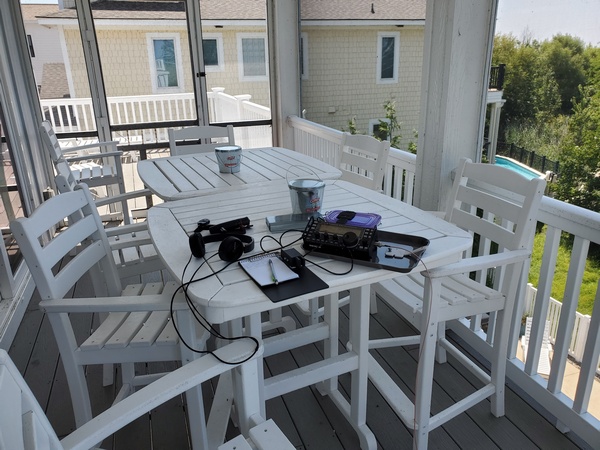
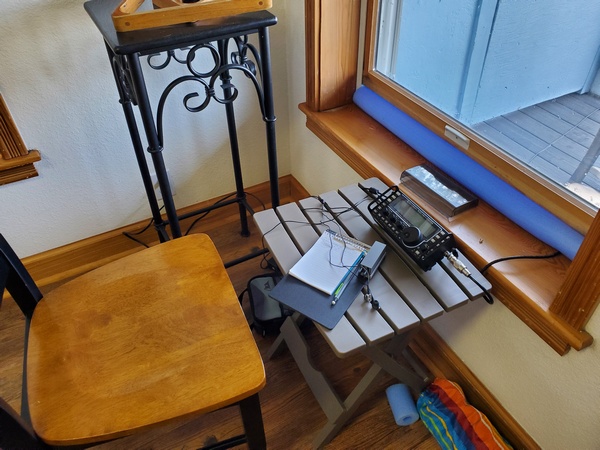
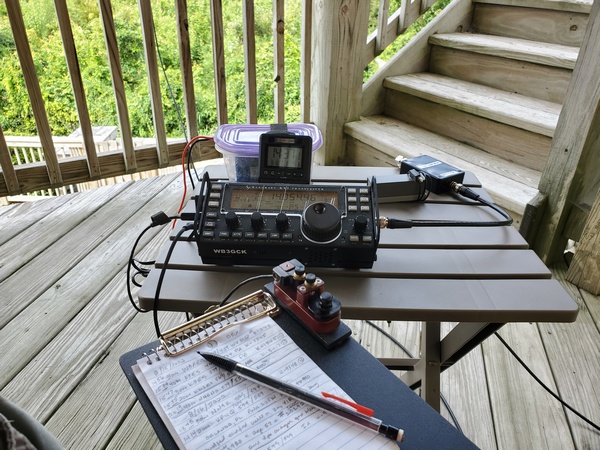
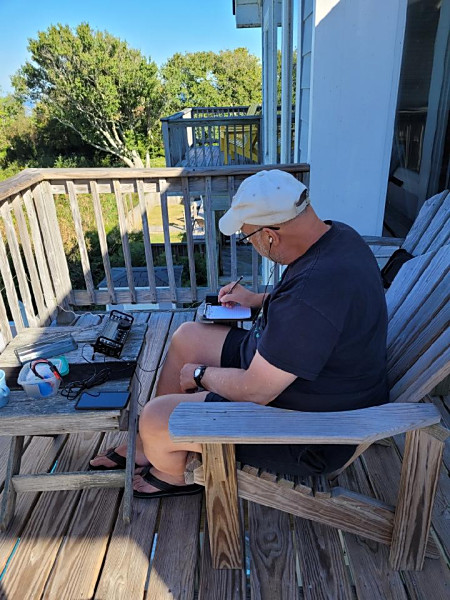
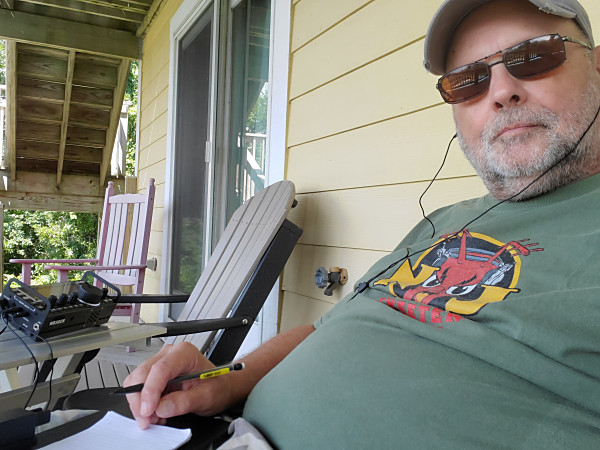
My “shack” for the week
My previous experience has shown that these rental properties come with a lot of RF noise, both from within the house and from neighboring houses. The house this year was no exception. So, I stayed away from vertical antennas near the house and went with an end-fed random wire sloper.
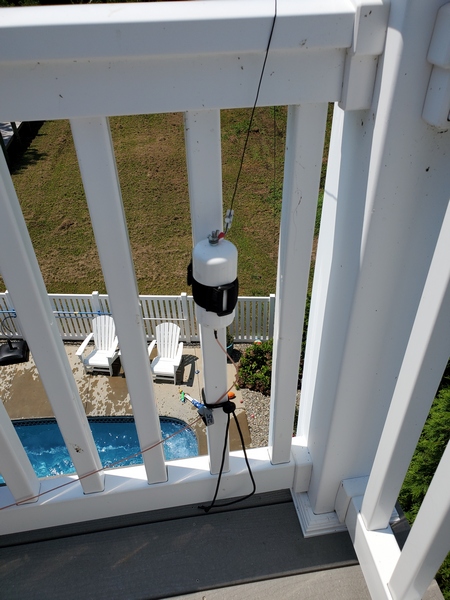
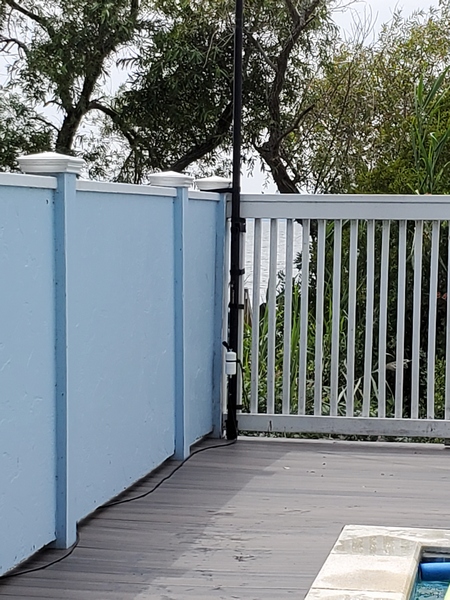
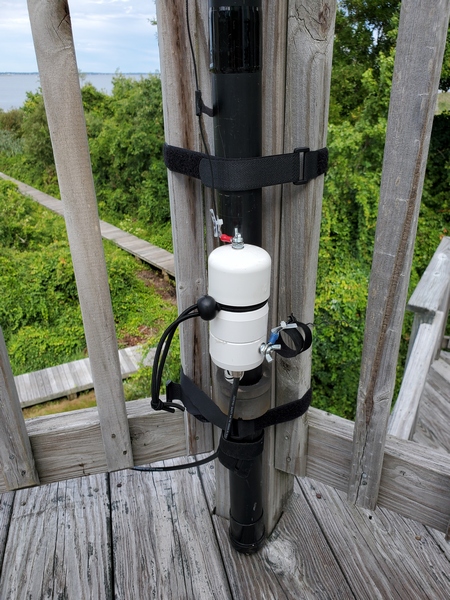
The antenna this year was a 35-foot wire, sloping down from the 3rd-story deck. I fed it through my homebrew weather-resistant 9:1 unun and ran 25 feet of coax into a screened-in porch on the same level. I attached the end of the wire to a fence around the pool area, making sure it wouldn’t get in anyone’s way. The wire was a bit long, so I ran the last two feet horizontally along the top of the fence.
My antenna feedpoint. The far end of my random wire sloped down to the fence by the pool.
I fired up my KX3 and checked the bands. A quick contact with a POTA activator on 40M confirmed it was putting out some sort of signal. The noise on 40M, however, was horrendous in places. The higher bands were better but still somewhat noisy. I hunted four POTA activators while experimenting with the antenna. Two of the contacts were easy, while the other two were tough going.
I also had to contend with some audio interference from my grandkids having fun in the pool down below. Anticipating this, I brought along a pair of over-the-ear headphones this year. Unfortunately, the headphones were no match for four exuberant kids.
Once the contest started, the noise level on 40M was about S3 in parts of the band, and S5-S7 in other parts. There was also a loud noise signal that would slowly sweep across the band from time to time. Despite the noise, I worked four skeeters and one very confused QRO station who wasn’t in the contest. He probably thought I was a POTA activator and couldn’t figure out why I needed to know his power output.
Up on 20M, the noise was lower but still present. I didn’t hear much Skeeter Hunt activity, despite getting some respectable hits on the Reverse Beacon Network. I ended up with a pair of Missouri skeeters in the log. I tried calling CQ on 15M with no luck.
After a little over an hour, I threw in the towel. My operating position was facing west across Currituck Sound, so my nice shady spot was giving way to the afternoon sun. Before I pulled the plug, I had one last contact on 40M with a friend back in Pennsylvania.
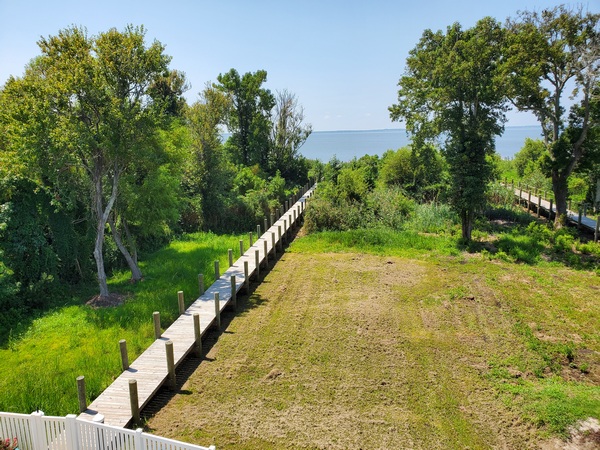
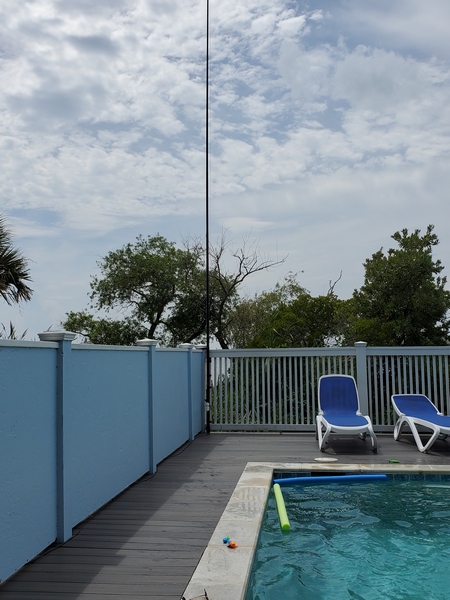
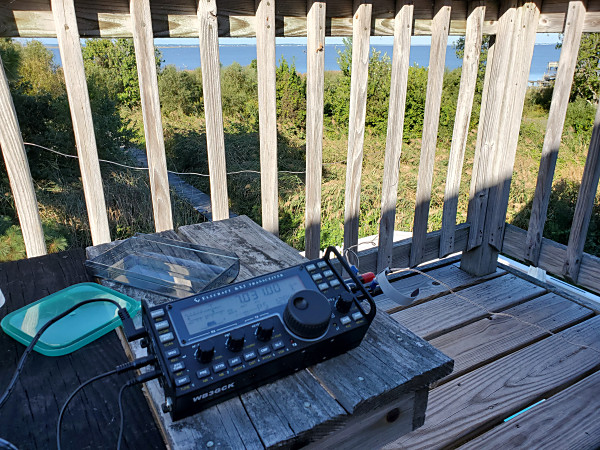
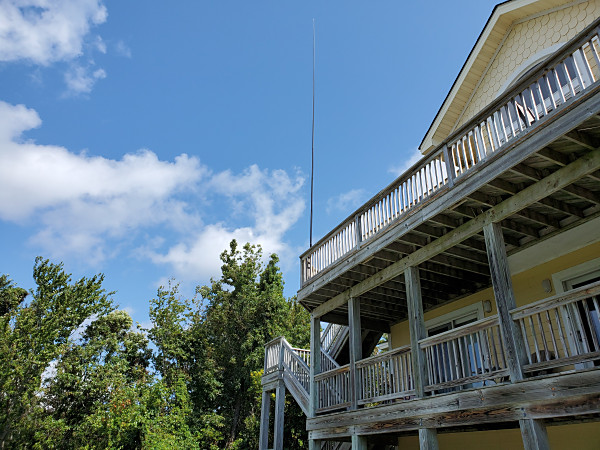
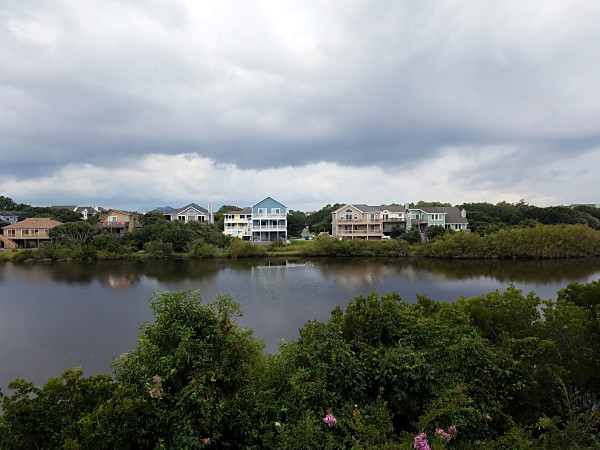
The view from the antenna
So, my 2025 Skeeter Hunt results were less than stellar. Although it was frustrating working through the noise, I still had fun. Plus, the scenery from my temporary “shack” was outstanding.
Well, the 2024 edition of our annual Outer Banks family vacation has come and gone. My (far) better half and I, along with our two daughters and their families, converged on a rental house in Duck, North Carolina. Of course, ham radio (for me, at least) was a part of that vacation.
Our view of Currituck Sound
After an early morning start, our long drive from Pennsylvania to North Carolina on Sunday was relatively uneventful, and the traffic on the Outer Banks wasn’t too bad. We all arrived safely, albeit a little road weary.
This year, we rented the same house overlooking Currituck Sound we were in last year. Being familiar with the layout of the rental house, I had an entire year to think about my antenna situation. The vertical I used the last time was somewhat noisy on 40M, and my 31-foot Jackite pole really took a beating in the wind. This year, I tried something a little different.
My antenna layout. The wire wasn’t visible in the picture, so I enhanced it. The coax dropped straight down from the unun and through the ground floor window.
I wanted to avoid using a telescopic pole, so I strapped my homebrew weather-resistant 9:1 unun to the railing on the third floor deck. From there, I configured a 29.5-foot wire as a sloper, and tied it off to a fence post. I dropped 35 feet of RG-8x coax off the deck and fed it through a ground floor window, where I set up my KX3. I also used a 1:1 choke at the radio end. I’ve used this antenna configuration in the past with good results, so I was confident it would work here.
My homebrew 9:1 unun strapped to a 3rd story deck railing
Giving it a quick test, I found the noise on 40M was only S1-S2. That was an improvement from last year. There were no noise issues on 30M and up. I tuned around on 40M and made two quick Straight Key Century Club (SKCC) Weekend Sprintathon (WES) contacts. There were some storms in the area, so I declared victory, disconnected the antenna, and cracked open a cold adult beverage.
My portable station next to a window in the game room on the ground floor. I re-used the foam pool noodle from last year to seal the window opening where my coax enters.
Although most of my time was devoted to other vacation activities, I squeezed in some radio time and made a few contacts from the house each day. I mostly hunted POTA activators and SKCC members.
When I’m down here, I always like to check into the Outer Banks Area Wide Net on Thursday evening at 8pm (local time). They are always a friendly and welcoming group. The Outer Banks Repeater Association maintains a linked system of repeaters covering the entire area, so I easily hit a repeater across the sound with an HT while sitting out on the deck.
Jockey’s Ridge State Park (US-2737, KFF-2737)
I planned to do one or two POTA/WWFF activations during the week. On Tuesday, I took a 30-minute drive down to Jockey’s Ridge State Park. Since this is a family vacation, I went out early and kept it short, so I could get back and spend time with the grand-kids.
It had been 25 years or more since my last visit to the park. So, when I rolled into the main parking lot, it was nothing at all like I remembered. Still, I found a shaded parking spot and set up my 12-foot whip and homebrew loading coil on the back of the truck. I used my trusty Penntek TR-35 (5 watts, CW) up front in the truck.
Activating Jockey’s Ridge State Park (US-2737, KFF-2737)
I was glad to see that the bands had started to bounce back after the severe geomagnetic storms of the previous couple of days. In less than an hour of air time, I logged 23 contacts with four park-to-park contacts. I didn’t work any DX, although I heard a French station calling. They were just too far down in the noise to copy their callsign. On the plus side, however, I worked a station in Nevada on 20M.
This is the sandy trail in Jockey’s Ridge State Park that leads back to the dunes.
Jockey’s Ridge is known for having the tallest living sand dune system on the East Coast. It’s also a very popular spot for hang gliding. I didn’t have time to make the trek out to the dunes this time, but I have been there before. I didn’t take any pictures that do the park justice, but the Outer Banks Visitor’s Guide website has some great ones.
Nags Head Woods Preserve (US-3862, KFF-3862)
I got in one more POTA/WWFF activation during the week. This time I drove down to Nags Head Woods Preserve, an interesting park that was not without some (radio) challenges.
I rolled into the parking lot and grabbed a spot near the entrance and away from the other cars. I was in a hurry to get set up. My friend, N3FLL, was activating a park back home in Pennsylvania and I wanted to snag a park-to-park QSO with him.
I used my usual setup: Penntek TR-35 (5W CW) and 12-foot loaded whip. I powered up and found lots of electrical noise on 40M. Noise notwithstanding, I quickly found Frank, and after a few attempts to break the pile up, I finally got him.
My parking spot in Nags Head Woods Preserve.
I moved up the band a bit and started calling CQ. The cell service was poor, but I was able to use the Wi-Fi hotspot in my truck to put out a spot. It was slow going at first, and the noise was relentless. Eventually things picked up, and I worked 9 stations on 40M before things dried up.
I checked 30M to look for P2P contacts, and the noise was still there. Not hearing anyone, I moved on. The 20M band was no different, noise-wise, but at least there was more activity. I managed 11 more contacts before deciding to declare victory and pack up. Right before I turned off the rig, I heard a Straight Key Century Club (SKCC) member calling CQ, so I had a quick contact with him.
Entrance to the office at Nags Head Woods Preserve
As I was taking my antenna down, I saw the likely source of the noise I had been hearing. When I first pulled in, I didn’t notice the power lines that crossed the parking lot. On the other side of the parking lot from me, there was a utility pole with two transformers on it. As I started back down the gravel road to leave, I noticed a large transformer not far from the parking lot. No wonder it was noisy there.
Wetlands in Nags Head Woods Preserve
After an hour of operating, I had 21 contacts in my log, including four park-to-park QSOs. Once again, I had no DX contacts, but I did work two California stations on 20M.
One of the trails in Nags Head Woods Preserve
I took a short walk around the Preserve before leaving. It’s a fascinating place that definitely warrants further exploration in the future. There are wetlands and several beautiful trails with some really cool wooden bridges. Maybe next year, I can talk the grandkids into going on a nature hike there.
And That’s a Wrap
After a few final QSOs on Saturday, it was time to take down the antenna and pack up the radios. Our week on the Outer Banks was over before we knew it. Time flies when you’re having fun, I guess.
Sunset over Currituck Sound
The sloper antenna I used at the rental house did pretty well, even with the geomagnetic storms over the first day or two. I had room to accommodate a longer wire, so next year I’ll pack 36-foot and 44-foot wires and give those a try. This is our last year renting this house, but I’m sure I can make the sloper work wherever we end up next year.
We made a trip to the Outer Banks of North Carolina this week for our annual family vacation. As in previous years, we rented a house on Currituck Sound. This time, however, we were just outside the village of Duck.
This was our first time renting this house, so I did a little prior research on the layout using pictures on the Realtor’s website and Google Earth. OK, I’ll be honest; I was looking for places to put my antenna. I had a couple of possibilities in mind, but I waited until we got there to decide where to set up.
My Set-up
It was brutally hot when we arrived on Sunday afternoon, August 13th; so I decided to forego putting up an antenna until the following morning. Instead, I surveyed the property to find a spot to set up the radio gear.
Later the next day, I strapped my 31-foot Jackite pole to a fence near the pole. The wind was pretty strong, so I used every velcro strap I had with me. Since these rental houses usually come with high noise levels, I kept the antenna about 40 feet from the house. I used the pole to support a 29.5-foot vertical wire, which was fed through my weather-resistant 9:1 unun. I had to use 50 feet of RG-8x to connect to the rig. That’s longer than I usually use, so I’m sure I was introducing increased coax losses. Life is full of trade-offs, I guess.
My 31-foot Jackite pole strapped to a fence about 40 feet away from the house
We were under an excessive heat warning for the first few days, so I kept my radio inside the building. I unclipped the bottom of the window screen enough to accommodate the coax. I cut a foam pool noodle to fit the width of the window. Then I made a lengthwise cut so I could fit it onto the window frame and seal the window a bit.
My operating position. A piece of foam “pool noodle” was used to seal the window where the coax enters.
After getting it all together, I did a quick test. The KX3’s tuner provided a good match on every band from 80M to 10M. I’m sure the coax losses were helping to make it easier to tune the antenna. There was a fair amount of noise on 40M and below, but the higher bands weren’t too bad.
Antenna feedpoint. My homebrew, weather-resistant 9:1 unun was used to feed a 29.5-foot vertical wire.
While I was on 30M, I heard a station in Arkansas calling CQ. Despite some deep fading and static from storms in the area; we managed to complete the QSO. The antenna, while nowhere near optimal, was functional. Satisfied with that, I declared victory and headed out to join the rest of the family in the pool.
Wright Brothers Memorial (K-0797, KFF-0797
For the past several years, I thought about activating a park or two on the Outer Banks. For various reasons (mostly laziness), it hasn’t happened. I set out to change that this time around.
On Wednesday, I drove down to the Wright Brothers National Memorial (K-0797, KFF-0797), about 30 minutes away from where we were staying in Duck. I planned to go the day before, but I delayed it by a day, because of an excessive heat warning. There’s normally a fee to enter this park, but my Veterans ID card got me in for free.
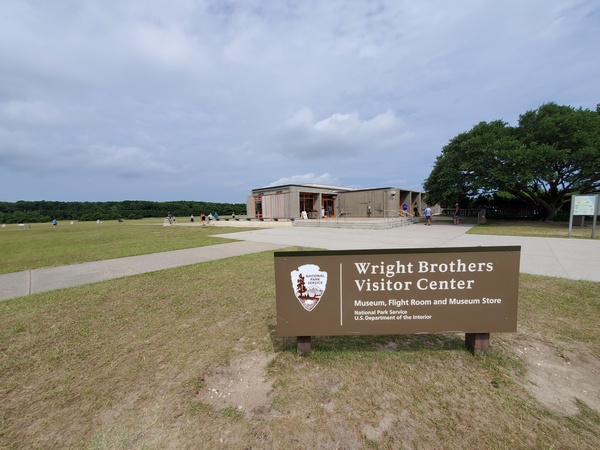
Wright Brothers National Monument (POTA K-0797) Visitor Center
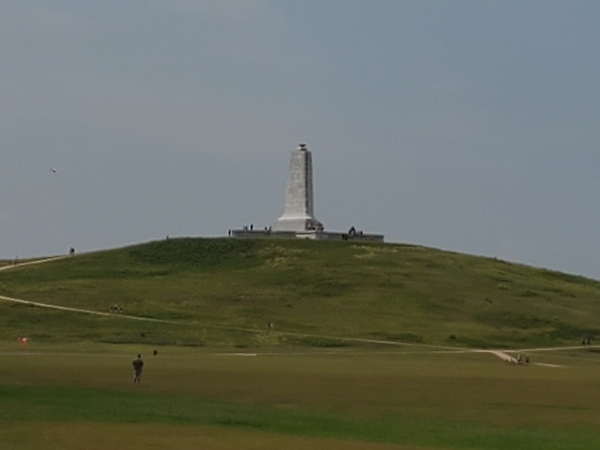
The Wright Brothers Monument
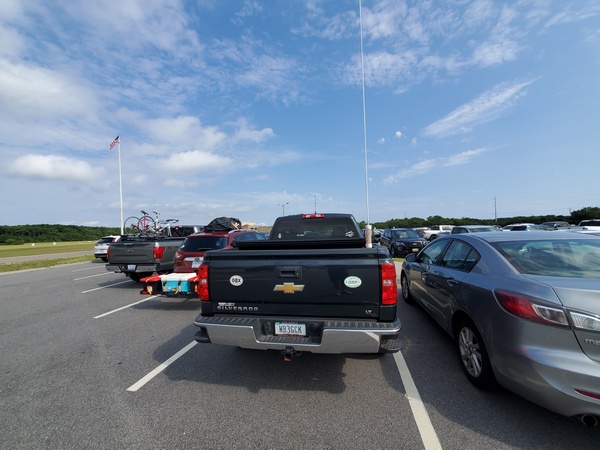
My parking spot at the Wright Brothers Monument (K-0797). There was no one around me when I started.
I operated from my truck in the main parking lot, using my TR-35 (five watts) and 12-foot loaded whip antenna. The bands were in great shape; I made my first ten contacts in ten minutes.
After about 50 minutes, it started getting hot and crowded; so I started packing up. This park is a very popular attraction; the empty parking lot I started in was now full. I ended up with 30 contacts in my log, including six park-to-park QSOs.
I had planned to activate a second park this week, but that didn’t work out. I’ll save that for next year.
Operating from the House
Besides the POTA activation, I made a handful of QSOs each day. The 30M and 20M bands, both having a low noise floor, were the most productive for me. These rental houses are chock full of light dimmers and other noise-producing amenities, so operating on the lower bands can be challenging.
Tuesday, August 15th, was the 30th anniversary of my first QRP portable operation. I wrote about that trip in a post from five years ago. It was fitting, I suppose, that I was portable this week.
Things also got a little dicey Tuesday evening. A storm blew in, and the high winds were bending my 31-foot Jackite pole further than I had ever seen. I hurried out and collapsed the pole before the heavy rain started. That pole has really taken a beating over the years, and this year was no different. The wind collapsed it a few times during the week.
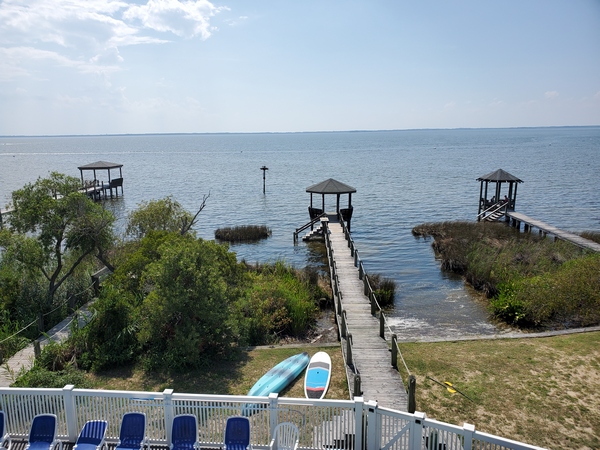
Our view of Currituck Sound from the 3rd story deck
One of my last QSOs for the week was with EC1R, who was activating a park in northern Spain. I had to crank up the KX3 to 15 watts to make it, but I managed to bust through the pile-up he had going.
After a few final QSOs on Saturday morning, it was time to take down the antenna and pack up the radio gear. Our annual family vacation always seems like the shortest week of the year. This year was no exception.
We arrived on Saturday, after a long drive from southeastern Pennsylvania. After unloading and getting organized in the house we rented in Corolla for the week, I went outside and set up an antenna.
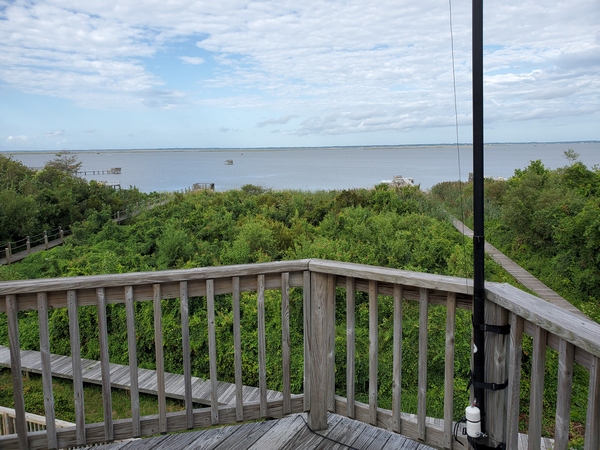
Currituck Sound, as seen from my antenna.
For the past two years at this house, I used a 29-foot vertical fed through a 9:1 unun. During both trips, I struggled with noise issues. I had a couple of antenna options I wanted to try this year.
This time around, I went with a Rybakov-type antenna. I strapped a 28-foot Jackite pole to the railing of the 3rd floor deck. I used a 26-foot vertical wire fed through my recently built weather-resistant 4:1 unun. My 26-foot counterpoise wire ran out to the side of the antenna and down the side of the deck stairs. It was a weird configuration, for sure. I ran 25 feet of RG-8X coax down to the second floor, where I could operate in the shade—in the morning, at least.
My Rybakov vertical configuration. The red line shows how I ran the counterpoise wire. Despite this weird-looking setup, it worked pretty well.
I didn’t test the antenna until early Sunday morning, and my KX3’s tuner matched it on every band from 40M through 10M. The noise levels on 40M and 20M were down around S2, a dramatic improvement over previous years and completely workable. The higher bands were dead quiet.
My antenna feedpoint. I used my weather-resistant 4:1 to create a Rybakov-type vertical.
My first contact was an interesting one. Fellow Boschveldt members, Glen NK1N and Rob KE3TI, were on an overnight backpacking trip on the Appalachian Trail in Pennsylvania. I sent Glen NK1N a text message to let him know I was on the air, and we connected on 40M. We chatted for a bit and exchanged SKCC numbers. Conditions were rough in the beginning but, towards the end of our contact, our signals improved.
Before quitting, I logged 10 SKCC Weekend Sprintathon (WES) contacts. There were bonus points for using a homebrew key, so I used a straight key I cobbled together a few years ago. I also worked Greg WA3GM, who was doing a POTA activation at a park near to my home in Pennsylvania. So, my jury-rigged Rybakov seemed to get out OK.
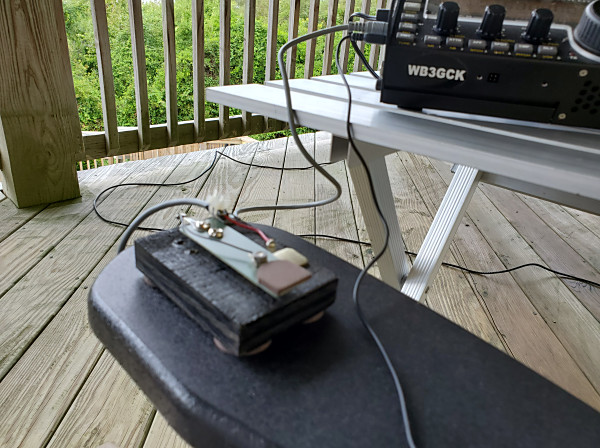
The homebrew straight key I used during the SKCC Weekend Sprintathon (WES).
Monday morning, I got set up on the deck to make a few contacts. I noticed the antenna was acting up a bit on the 40M band. The KX3’s tuner showed it found a 1:1 match, but the SWR went up when I transmitted. I had no issues with the other bands, just 40M. It seemed like I was getting some RF on the coax shield, so I added a common mode choke at the transceiver and changed to a shorter length of coax. That cleared up the issue. I’m guessing there was some interaction between the antenna’s counterpoise and the coax on 40M. Even before I resolved the antenna issue, I logged a half-dozen contacts.
My radio setup on the 2nd story deck of the rental house.
With six adults, four grand-kids, and two grand-dogs, there was always something going on in the house. However, I managed to get on the air for about an hour each morning after breakfast to make a few contacts.
Thursday evening was busy. I kept track of Winlink check-ins for an ARES-RACES net back home. Using DMR, I checked into another ARES-RACES net in Pennsylvania. When I’m down here, I always like to check into the Outer Banks Area Wide Net. Then, it was out to the dock to join my grand-kids for some crabbing.
As I was finishing up breakfast on Friday, I got a text message from my friend, Frank N3FLL, asking if I was on the air. I quickly moved my radio out to the deck and had a nice QSO with him. I also worked a few POTA activators including Greg WA3GM. I worked Greg on the first day, so it was only fitting that I work him on the last day, too. After that, it was time to take down the antenna and pack up the radios.
I didn’t spend as much time on the air as in previous years, but I worked some fellow SKCC members, chased a few POTA activators, and had a couple of nice ragchews. All in all, it was a great vacation with excellent weather. I’m already looking forward to next year.
I was back down in the Outer Banks of North Carolina for a few days this week. Since I was there for a family function, there wasn’t much time for ham radio. I did, however, get on the air for a bit one morning with a haphazard antenna.
We were staying with family in a rental house just down the road from the one we were in last month. Like the previous house, it had a beautiful view of Currituck Sound.
One morning, everyone went over to the beach for some surf fishing. Since I’m still dealing with my knee issues, I stayed behind and broke out the radio.
I took my KX3 out to a small, 3rd story deck and broke out two 25-foot pieces of speaker wire for an antenna. I wrapped one around the deck railing for the radiator. For a counterpose, I tossed the other wire off the deck. I used a BNC-to-binding post adapter to connect up to the KX3.
Operating from the deck in Corolla, North Carolina, on the Outer Banks
Frankly, I wasn’t expecting much from this antenna with 5 watts. When I turned on the rig, though, I heard some very loud signals on the 40M band. After calling CQ a few times, I saw a dozen spots on the Reverse Beacon Network (RBN).
Over the next forty-five minutes, I had a couple of rag chews with stations in New York and New Jersey. I also logged a Parks of the Air (POTA) station in Connecticut.
My KX3 out on the deck. You can see the two pieces of speaker wire I used for an antenna.
Before packing up, I moved up to 20M and heard a French station calling CQ. I threw out my call and heard, “WB3?.” My 5 watts and the thrown-together antenna made it to France. Unfortunately, a loud, low-pitched version of my CW was coming from somewhere down below. As it turns out, the wire hanging off the deck was right next to an outdoor speaker. I didn’t complete the contact for fear of creating too much of a racket.
By this time, I was losing my shade anyway, and it was getting hot out there. So, I took down my makeshift antenna and packed up the radio. This brief—but fun—session was the only opportunity I had on this trip for ham radio.
It never ceases to amaze me what you can do with 5 watts and a couple of pieces of wire.
Yep, it’s that time of year again. My extended family and I headed down to Corolla on the Outer Banks of North Carolina for our annual vacation. Of course, I spent some of that time on the radio.
On Friday August 14th, after a long drive and a bunch of unpacking, I went about setting up an antenna. We had rented this house before, so I was familiar with the layout.
I considered other antenna options, but in the end, I went with my trusty 29.5-foot vertical wire and 9:1 unun. With my limited mobility right now, it was a quick and easy option. Like last year, I mounted the 31-foot Jackite pole on the 3rd story deck and set up my radio in the shade on the 2nd story deck overlooking Currituck Sound.
After breakfast on Sunday morning, I set up the radio to test the antenna. I made three quick POTA contacts to verify that things were working.
Later that day, I participated in the New Jersey QRP Club’s Skeeter Hunt contest. Storms in the area made for some rough conditions, and the static crashes were horrendous at times. After an hour and a half, I saw some lightning across Currituck Sound from a storm cell headed my way. With 8 QSOs in the log, I decided to pull the plug and head indoors.
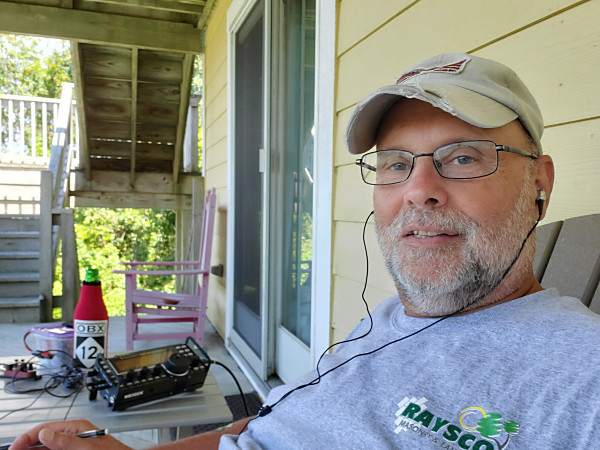
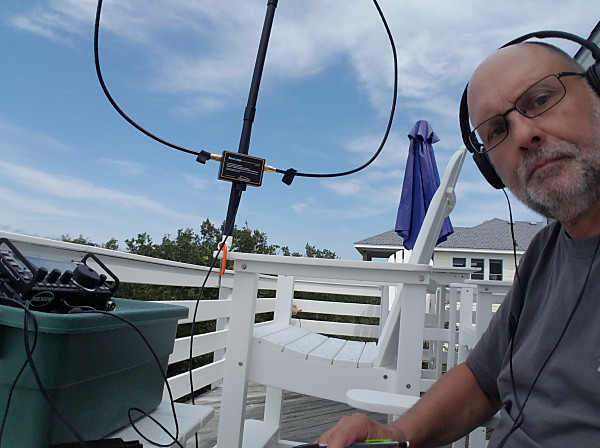
WB3GCK operating in the NJQRP Club’s Skeeter Hunt contest from the Outer Banks of North Carolina. This was also my “shack” for the remainder of the week.
For the rest of the week, I got on the air each day after breakfast for an hour or so. I made a handful of CW contacts each day, primarily chasing POTA activators. There was no shortage of activators to hunt, and I worked a couple of ATNOs (all-time new ones). These are parks activated for the very first time.
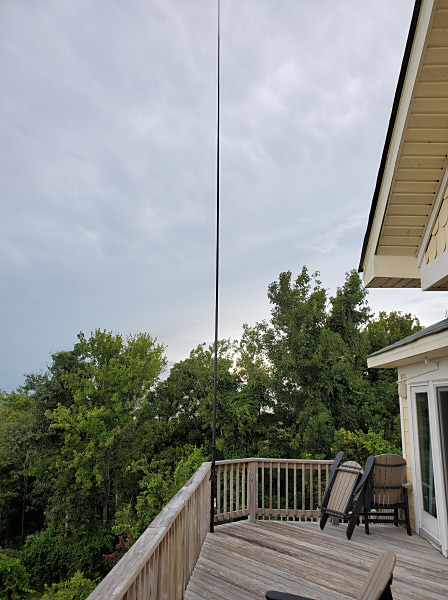
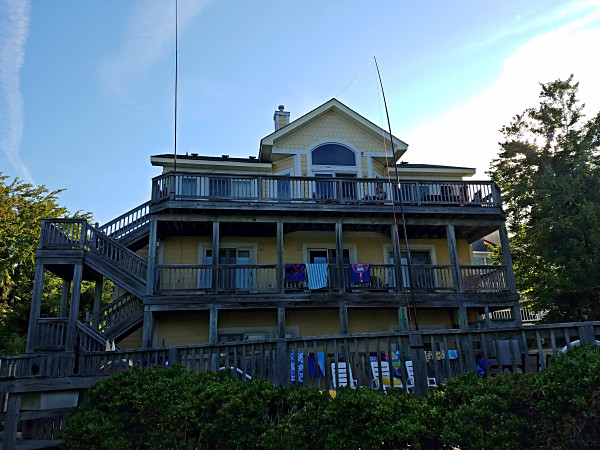
My antenna set up on the 3rd story deck of the house we rented for the week.
Like last year, I had intermittent noise on 40M, presumably, from something inside the house. That’s not unusual, as I generally run into some degree of noise issues in these rental houses. I still managed to make contacts, but it was a real challenge at times. I’ll probably try a different antenna next year. My Up & Outer worked well here in 2019, so I’ll probably go that route again next time.
The forecast for Friday—our last full day—was calling for rain and thunderstorms most of the day. So, I decided to take the antenna down a day early. Despite the noise and weather, I ended up with 37 CW QSOs in the log for the week.
I also like to check into the Thursday night net on the local repeater system when I’m here. The Outer Banks Repeater Association maintains linked repeaters that cover the entire area. Last night they were running a hurricane exercise and passing simulated emergency traffic. Being involved in EmComm myself, I enjoyed listening in on their emergency operations.
Man, this week went by fast. It seemed like I turned around, and it was time to pack up for the long drive home. We’re already looking ahead to next year, though, and we’ll probably rent the same house again. So, I have a year to think about next year’s antenna.
Once again, our family headed down to the Outer Banks of North Carolina for our annual vacation. Naturally, I made ham radio a part of my vacation.
We rented the same house in Corolla that we were in last year. It’s a great place that overlooks the Currituck Sound. Plus, I already knew what to expect, radio-wise, and how to set things up.
After a long but uneventful drive down on Saturday, we arrived at the rental house. So did some thunderstorms. Despite the weather, it didn’t take us too long to get unpacked and settled in.
After the storm had passed, I took a few minutes to set up an antenna for HF. I kept things simple this year. I strapped my 31-foot Jackite pole to the railing on the 3rd-floor deck and set up a 30-foot vertical wire and 9:1 unun. I ran 25 feet of coax down to the second-floor deck, so I had a shady place to operate during the day.
My 31-foot Jackite pole strapped to the railing on the 3rd story deck of the rental house. I operated from the deck below with a great view of Currituck Sound.
After a late breakfast on Sunday, I took my KX3 out to the deck to catch a little bit of the monthly SKCC WES contest. This month’s theme was Homebrew Keys, so I brought along one that I made a couple of years ago. The band conditions weren’t great, but I ended up with 10 QSOs before pulling the plug and heading for the pool.
My homebrew key for the SKCC Weekend Sprintathon (WES). For a bunch of junkbox parts, it has a suprisingly good feel.
During the WES, I encountered much more RFI coming from the house than I experienced last year. To my good fortune, whatever was making the racket stopped after a while, and things improved somewhat. For most of the week, I still had some S2-S3 noise at times, but it was manageable.
For the remainder of the week, I did a little casual operating each morning, while I still had shade out on the deck. I spent the rest of the day doing the usual Outer Banks vacation stuff—swimming, crabbing, and just hanging out with my family.
WB3GCK operating in Corolla, NC, on the Outer Banks (with a cold “807” on the table)
Most of my contacts this week were casual rag-chews along with a few POTA stations here and there. During the week, John W3FSA worked me twice from Maine. It’s always good to chat with him.
For something different, I checked into the Outer Banks Area Wide Net on Thursday evening, while enjoying the sunset from the deck. I used my handheld to access one of the linked repeaters in a system that covers the entire Outer Banks. The net had a friendly mix of locals and visitors to the area.
For the most part, the weather was great this week—sunny, hot, and rain-free. Things got a little unsettled on the last day, though. There were storms in the area, but I still got in some more time on the air before tearing down the antenna and packing up the radio. My last QSO of the week was on SSB with my friend, Glen NK1N, who was doing a POTA activation in New Jersey.
I always say that our annual vacation on the Outer Banks is the shortest week of the year. That was true again this year, as the week just flew by.
Once again, my family made our annual vacation trip to North Carolina. We rented a house in Corolla on the Outer Banks for the week. Of course, in between the usual vacation activities, there was some ham radio involved.
For various logistical and traffic reasons, it took us longer than usual to get there. It wasn’t until the next day (Sunday), that I was able to get an antenna up. This year, I went with my trusty “Up & Outer” antenna.
I mounted a 28-foot pole on the 3rd story deck for the vertical element. I strapped a smaller pole to a fence to support the horizontal element. I put a BNC-to-binding post adapter on my KX3 and fed the 300-ohm twin-lead directly. It loaded up fine from 60M through 10M. Surprisingly, the ambient noise levels were low. Man-made noise is usually a challenge in these rental houses.
Poles supporting my “Up & Outer” antenna. The pole on the left is supporting the vertical wire. The pole on the right is the end support for the horizontal wire.
I operated from a 2nd-floor deck on the rear of the house. This spot provided some nice shade for most of the day and gave a great view of Currituck Sound.
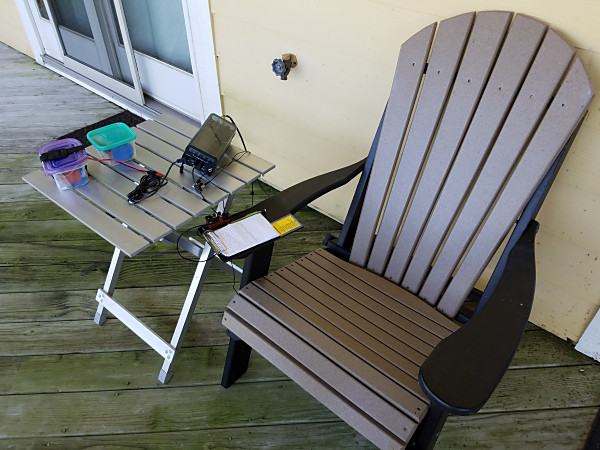
My outdoor shack for the week. The chair was particularly comfortable and the view of Currituck Sound was great.
I managed to catch a few hours of the SKCC Weekend Sprintathon (WES) contest. Running 10 watts, I worked 20 stations and added 8 more new contacts to my quest for the Senator Award. For good measure, I also worked DP6A in Germany who was participating in another contest. So, the antenna set-up appeared to be working fine.
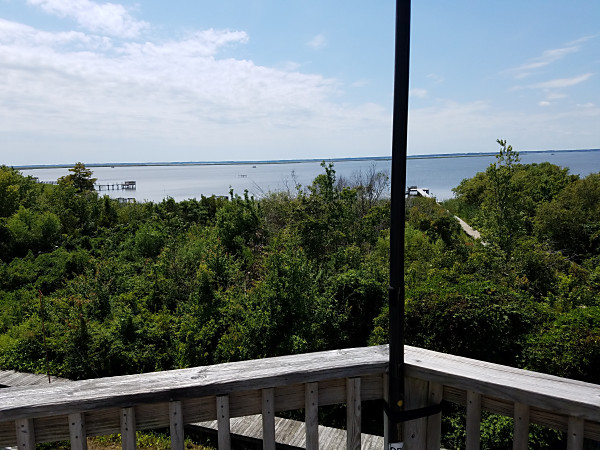
The view of Currituck Sound from my antenna.
For the rest of the week, I fell into a pattern of casual QRP operating for a bit in the late mornings. The rest of the time was spent swimming, crabbing, and riding bikes with my grandkids. I still managed to make a handful of contacts each day and enjoyed some nice rag-chews.
Mid-week, we had some unsettled weather. I had a “Plan B” for inclement weather, though. I planned to move my radio gear into an unused sitting area not far from my outdoor location. I was going to use a small piece of pipe insulation to route the twin-lead in through a sliding door and keep it from touching the metal door jamb. Fortunately, the weather cooperated and “Plan B” never came into play.
As usual, the week went by too fast. On our last day, I made two more contacts before it was time to pack up the radio and tear down my antenna.
This was another fun vacation, radio-wise. I made 40 contacts, including some very nice early morning CW chats. I also worked a couple of stations who were also operating portable while on vacation and made a couple of DX contacts to boot. Plus, I continued my slow-but-steady progress towards my SKCC Senator Award, adding 16 new ones this week.
It was nice to be using a decent antenna in a low-noise environment — a welcomed change of pace from my home station!
My family and I went on our annual vacation in Corolla on the Outer Banks of North Carolina. Ham radio-wise, it started off as a challenging week.
We arrived at the house we rented for the week after a long but fairly non-eventful drive. As we were unloading at the house, a storm rolled in. This delayed getting an antenna set up.
We were also visited by a security officer for the development we were in. Apparently, my daughter’s small cargo trailer was in violation of the Development’s rules. I won’t go further into that but, because of that drama, I decided to keep my antenna as low-profile as possible.
On Sunday afternoon, I finally got an antenna set up. I sloped a 29.5-foot wire down from a 3rd story deck to a wooden fence behind the house. It tuned up OK and I appeared to be getting out. Unfortunately, the local noise level was horrendous. Despite the high noise levels, I managed three quick contacts in the SKCC WES contest.
My Alexloop set up out on the deck.
On my second full day there, I used my Alexloop outside on the deck. It helped to make the noise situation more manageable on most bands. The 20M band was still a bit noisier than I would have liked, though. Even though we were only 2 blocks from the ocean, our rental house overlooked a scenic little lake. The struggle with the noise levels was at least partially offset by the great view I had.
My view from the 3rd story deck
On the third day, I removed the sloper and installed a 53-foot inverted L antenna. I mounted a 9:1 UNUN near ground level and ran the wire up the deck support. I ran the horizontal portion of the wire along the top rail of the deck. I estimate that the vertical portion was about 20 feet with the remaining 33 feet running horizontally. Surprisingly, the inverted L had significantly lower noise levels and seemed to be getting out pretty well. There was a picnic table conveniently-located near the antenna’s feed point, which provided a shady spot in the morning hours.
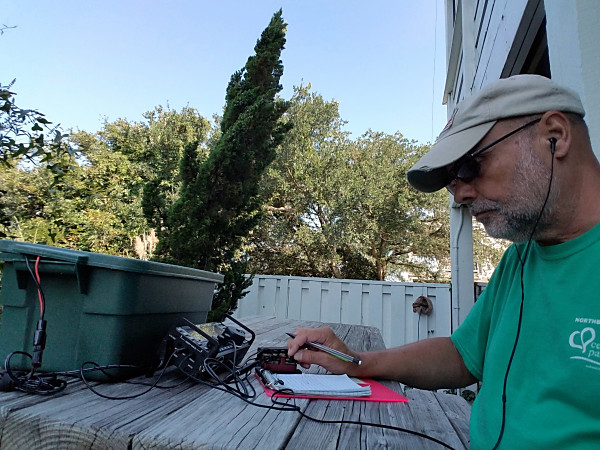
Operating from the picnic table. Above my arm, in the background, you can see the feedpoint for the inverted L antenna. My 9:1 UNUN is wrapped up for weather protection.
For the remainder of the week, I fell into a pattern of getting on the air each morning for a few QSOs. Most of my contacts were casual rag chews. It was nice to chat with a few familiar stations I haven’t worked in a while. The shade out there was usually gone by 1PM, so I limited my operating to the morning hours. The rest of the time was spent with the family and doing the usual things you would expect for a beach vacation.
It was a great vacation. This week was a perfect example of why I always like to bring several options for antennas. These rental houses are all different and sometimes you never know what you’re going to run into when you get here.
[This is an updated version of a post that appears on my old website. – WB3GCK]
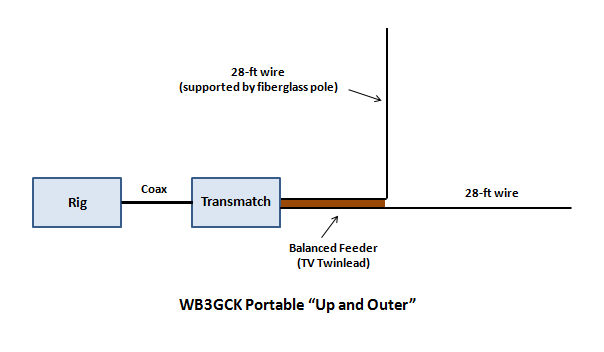
Something about the “Up and Outer” antenna has fascinated me since I first came across it in the 1974 edition of the ARRL Antenna Book. This antenna, which was once popular many years ago, is about as simple as it gets. Simply put, the Up and Outer is a dipole or doublet where one leg is vertical while the other leg is horizontal. Although it seems to be overlooked by Amateurs these days, this antenna offers some significant benefits:
It’s a good limited space antenna since one leg of the doublet is vertical. It only requires half of the space that a horizontal doublet would take up.
When fed with balanced line and used with a suitable transmatch, it’s a good multi-band antenna.
It combines characteristics of both verticals and horizontal wire antennas. That is, it is good for both local and DX work.
It’s very easy to build and erect.
The “Up & Outer” is essentially a doublet with one vertical leg and one horizontal leg.
First, a little background on this antenna. According to some handwritten notes from QRP Hall of Famer, C. F. Rockey W9SCH (SK), this antenna goes back to the 20s and 30s. Lew McCoy W1ICP (SK) wrote about it in the October 1960 edition of QST [1]. He didn’t use the name, “Up and Outer;” he merely referred to it as a “limited space antenna.” McCoy recommended horizontal and vertical elements of 30-feet each for operation on 80-10 meters. He also recommended using an open-wire feedline to minimize losses. Information from McCoy’s article has appeared for years in the ARRL Antenna Book. (I first saw it in my 1974 edition [2] and it was still shown in the 1997 edition [3].)
W9SCH wrote a couple of articles about this antenna for SPRAT and appears to have coined the term, “Up and Outer.” In the first SPRAT article [4], Rock suggested using 1/4 wave elements for the lowest band and feeding it with either coax (for single band operation) or balanced line (for multi-band operation). In a follow-up article [5], Rock suggests pruning the horizontal element to equalize the current in the balanced feeder. He noted the imbalance when operating with the horizontal element close to ground. He started with 16-foot elements to cover 30-10 meters.
Another Hall of Famer, L. B. Cebik W4RNL (SK), wrote about a coax-fed version of this antenna for 10 meters [6]. Cebik built his antenna using aluminum tubing and referred to it as the “L Antenna.”
I also exchanged some correspondence years ago with Fred Bonavita K5QLF (SK), another QRP Hall of Famer and fan of the Up and Outer. He told me that W9SCH once mentioned using the copper ball from an old toilet float to top-load the vertical element of the antenna. I later came across a brief write-up by W9SCH on his Copper-Top antenna in the October 1995 edition of QRP Quarterly [7]. Using the toilet ball for top loading, Rock was able to reduce the height of his vertical element by 2-1/2 feet.
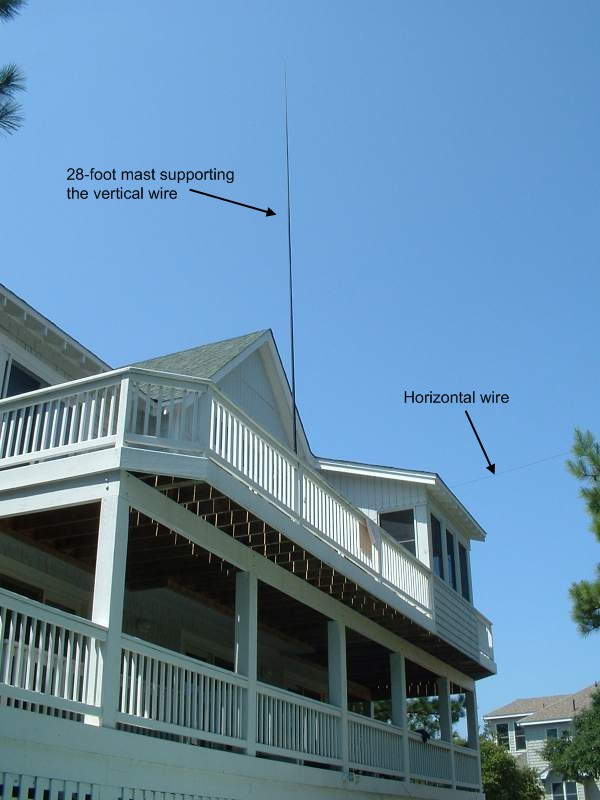
The “Up and Outer” antenna mounted on a 3rd-story deck in Corolla, North Carolina.
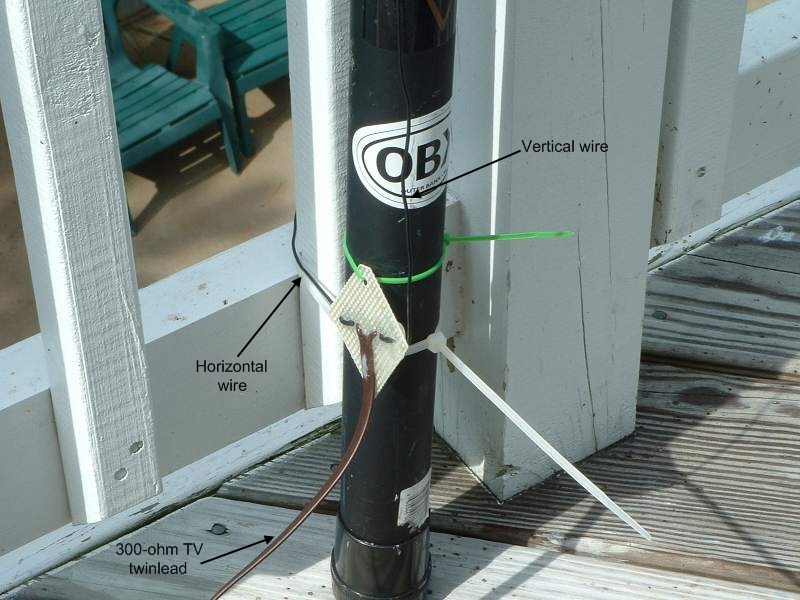
For me, the Up and Outer has turned out to be an ideal portable antenna to use while on vacation in a rented house on the Outer Banks of North Carolina. For several years I’ve used a 56-foot doublet with one wire supported by a 28-foot fiberglass telescopic mast and one 28-foot leg run horizontally. The vertical radiator is typically situated on a 3rd or 4th story wooden deck with the horizontal wire secured to a nearby tree or other support. For feedline, I use 25-feet of TV twinlead (the cheap brown stuff). Using either a homebrew Z-match tuner or an autotuner with a short run of coax to an external 4:1 balun, I’ve been able to use this antenna on 40-10 meters. Your mileage may vary. Depending on the transmatch you use, you might need to adjust the length of the feedline to get a good match on 40 meters.
“Up and Outer” feedpoint
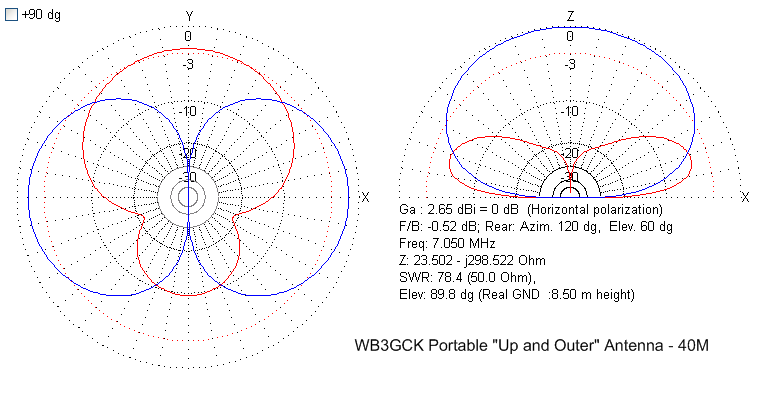
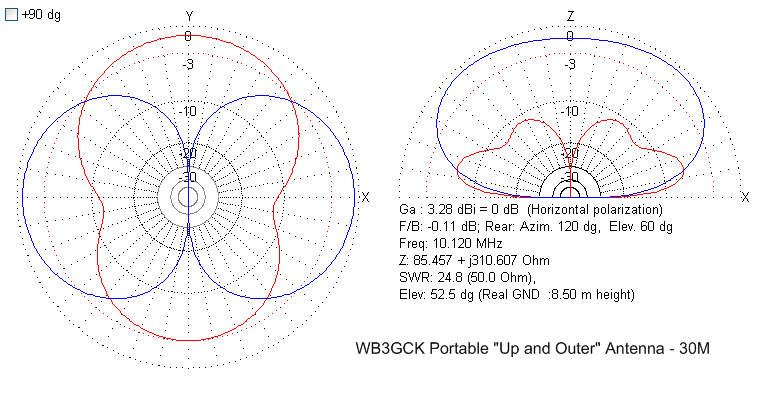
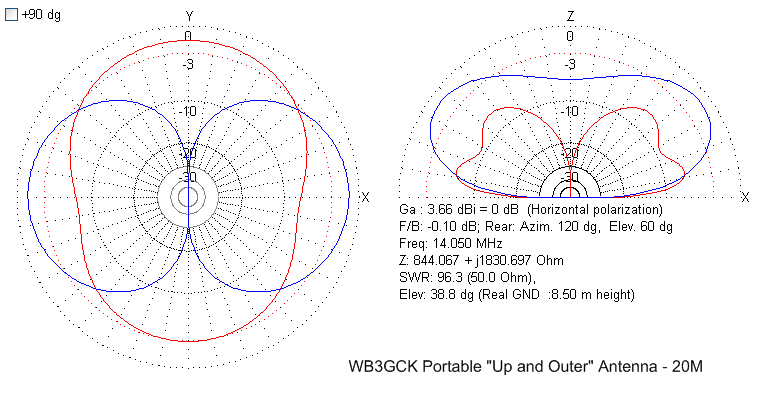
I did some quick modeling of a typical Outer Banks installation using MMANA-GL and you can clearly see the results of the combined horizontal and vertical elements. The horizontal polarity (shown in blue) shows lobes perpendicular to the axis of the horizontal wire, similar to a dipole. The vertical polarity (shown in red) shows a fairly low take-off angle and exhibits some slight directivity on 40 meters in the direction of the horizontal wire. This effect is due to the proximity to ground of the horizontal element and diminishes as you go higher in frequency. So, try to mount the Up and Outer as high above ground as you can.
“Up and Outer” 40M pattern“Up and Outer” 30M pattern“Up and Outer” 20M pattern
The modeling bears out my empirical results with the antenna. My version of the Up and Outer has worked very well for both stateside contacts and DX. In particular, it has been very effective for DX contacts on 30 meters. As an added bonus, the 56-foot doublet can also be pressed into service as a normal horizontal antenna in locations where the Up and Outer configuration isn’t possible. So, it’s like getting two antennas in one. Can’t beat that.
If you are looking for a limited-space antenna, give this obscure classic a try!
73, Craig WB3GCK
References: 1. McCoy, Lewis G. “A Limited-Space Antenna.” QST October 1960: pp 23-25. (Available in the ARRL online archives) 2. “The ARRL Antenna Book.” 13th Edition, 1974. Newington, CT. pp 187-188. 3. “The ARRL Antenna Book.” 18th Edition, 1997. Newington, CT. pp 7-15, 7-16. 4. Rockey, C. F. “Up and Outer.” SPRAT Issue #67 (Summer 1991): p 18. 5. Rockey, C. F. “A Four Band Up and Outer Antenna.” SPRAT Issue #69 (Winter 1991/1992): p 16. 6. Cebik, L. B. “Whips, Tubes and Wires: Building a 10-Meter L Antenna.” QST December 1999: pp 52-54. (Available in the ARRL online archives) 7. Rockey, C.F. “The Copper-Top Antenna.” QRP Quarterly, October 1995: pp. 40-41.






 WB3GCK QRP Amateur Radio