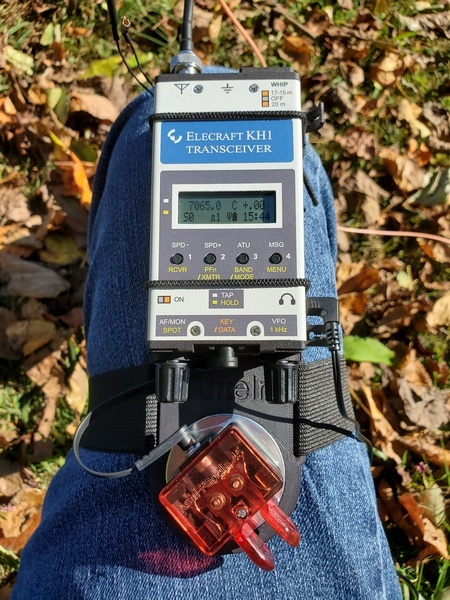
TUMD Stainless Steel Paddles

I mentioned in a previous posting that I have a fascination (obsession) with unusual CW paddles. These paddles are the last in a series of recent purchases (but I doubt it).

These rather industrial-looking paddles are not new; they have been around for a while. They are often sold under various brand names or no name at all. The eBay listing I purchased mine from didn’t specify a particular brand, but they came branded as “TUMD.” The paddles I ordered were shipped from China and took about a month to arrive.

I’m not providing a specific link, since these things are available all over the place. Just search on “stainless steel paddles” and you’re sure to find them.

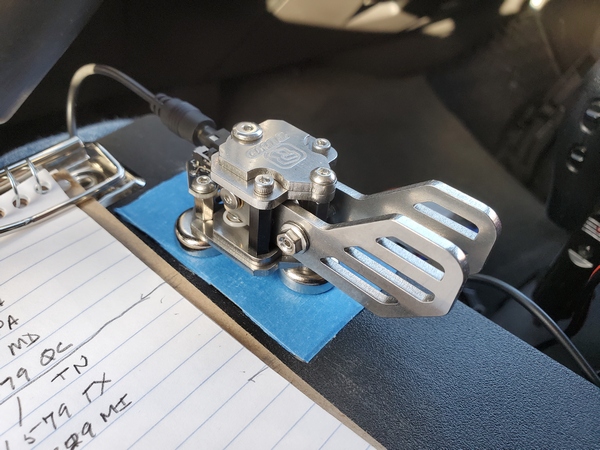
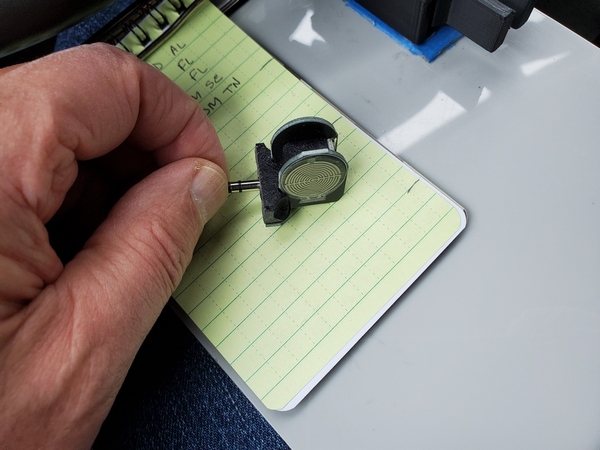
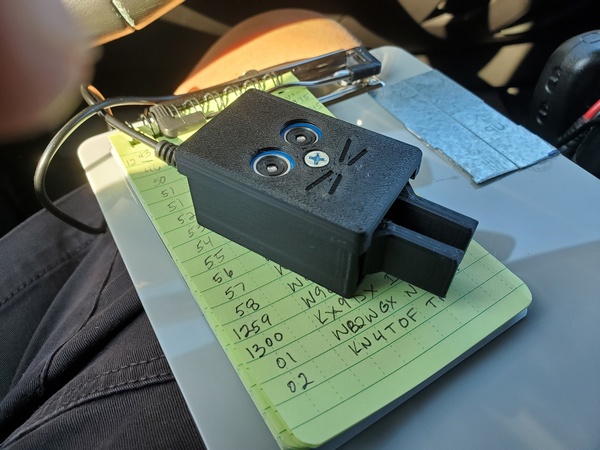
The Tumd paddles attached to my clipboard. The three magnets are super strong.

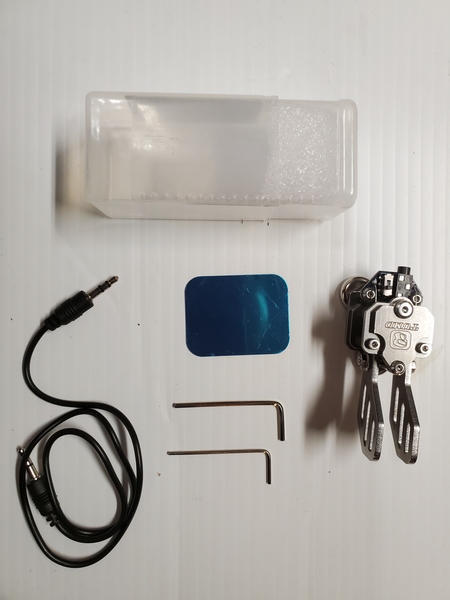
Here’s what was included in the box:

  • The paddles, of course
  • A stereo cable with 3.5mm connectors
  • A two-piece plastic case large enough to hold the paddles and cable
  • Two Allen wrenches
  • A small adhesive metal disc for applying to the surface of your choice
The accessories I received with my Tumd stainless steel paddles.

The first thing that struck me was that these paddles are built like a tank. The base has three powerful magnets, which I like. At the rear of the paddles next to the 3.5mm jack, is a small slide switch for reversing the “dit” and “dah” paddles. They look great, but my purchase was not without a couple of minor issues right off the bat. 

Based on the picture in the eBay listing, I ordered a version of the paddles with smaller, square paddles. What I received, however, was a version with larger paddles reminiscent of the fins on a 1959 Cadillac. Instead of going through the hassle of returning them to China, I opted to keep them.

The next issue was adjusting the paddle spacing. As received, the paddles had different spacing. The paddles each have a hex bolt within a larger locknut of some sort. There were no instructions provided, and neither of the included Allen wrenches fit. Fortunately, Charlie NJ7V over at the Red Summit RF YouTube channel provided all the answers I needed. He has a video detailing how to adjust them and what size wrenches you need. I had the tools I needed in my toolbox, so I had the paddles adjusted to my liking in short order. 

I’ve used these paddles on quite a few outings and have grown to like them a lot. Here are some pros and cons from my viewpoint—your mileage may vary:

Pros:

  • The three magnets on the bottom are seriously strong. They hold tight to the steel strips on my clipboard. I love that!
  • Once adjusted, they have a great feel and key reliably. They do, however, require a slightly heavier touch. That’s a matter of personal preference, so others may disagree. 

Cons:

  • Weighing in at 3.8 ounces (106 grams), they are heavier than other paddles I use in the field. This is a minor issue or no issue at all, depending on how you operate.
  • You need two tools to adjust the paddle spacing. From what I’ve seen online, some sellers include both wrenches; mine did not. Again, this is also a minor issue, since the paddle adjustments hold very well and shouldn’t need further adjusting in the field.

Lately, these paddles have been my first choice for portable operation. For $50 (US) or less, they are a pretty decent value.

73, Craig WB3GCK

Playing with Paddles in the Park

I headed down to Ridley Creek State Park (US-1414, KFF-1414) this morning for a pre-Thanksgiving POTA/WWFF activation. While I was there, I wanted to field test a couple of paddles, one new ‌and one I slightly modified.

I mentioned in a previous post (or two) that I somehow damaged the paddles that came with my Elecraft KH1. In searching for an alternative, I came across the KH1 Pressure Paddles from K6ARK. The kits were selling for a mere $22 on Amazon, so I fired off an order. 

K6ARK Pressure Paddles

I’m not as good at building kits with small parts as I used to be. My close-up vision hasn’t gotten any better with age. However, with the aid of my lighted magnifying glass, I assembled the kit in less than 30 minutes with no major issues. The only issue I ran into was the 3-D printed cover didn’t fit against the KH1 too well and needed a little sanding. Once I took care of that, the paddles worked great. Using pressure-sensitive paddles feels a little different at first, but I quickly adapted. 

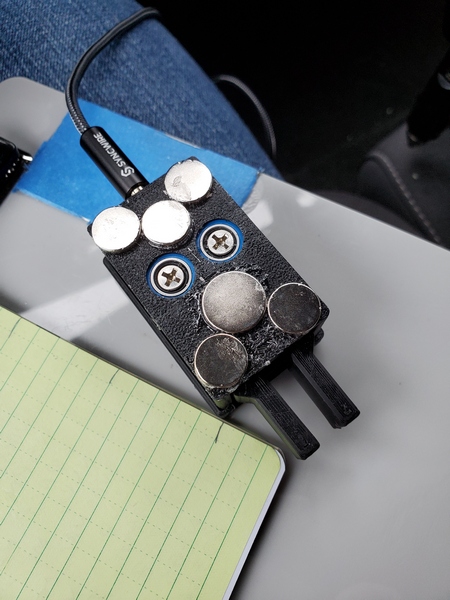
The other thing I did was glue two more magnets onto the bottom of my CWMouse paddles. The four I glued on initially weren’t quite enough to keep the paddles from moving when attached to my clipboard. Two additional magnets seemed to do the trick. 

More magnets on my CWMouse paddles
The magnets on my CWMouse paddles. I recently added the two towards the middle.

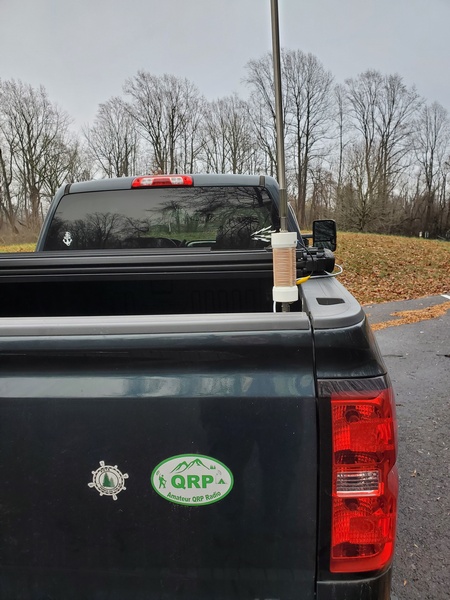
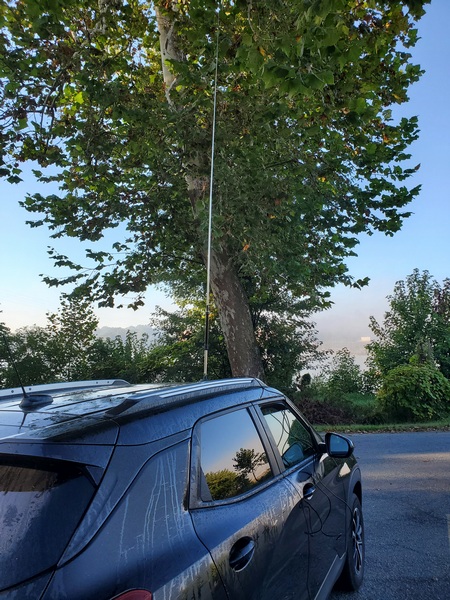
When I rolled into my usual spot in the park, the place was deserted. I wasn’t too surprised, since it was a weekday and drizzling to boot. My original plan was to operate the KH1 handheld to give the K6ARK paddles a good workout. Given the lousy weather, I abandoned that plan and set up in the truck. I used my trusty 12-foot loaded vertical on the back of the truck. 

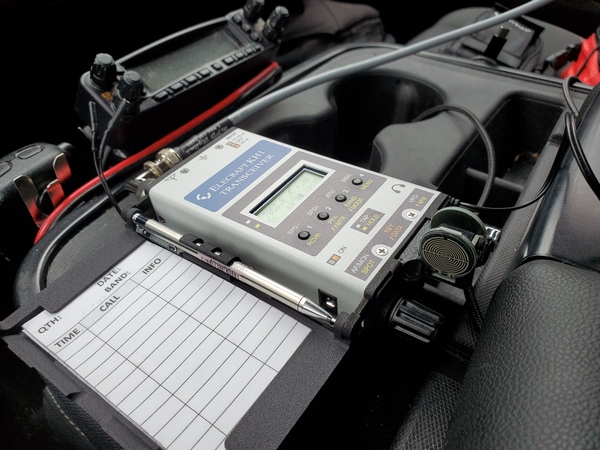
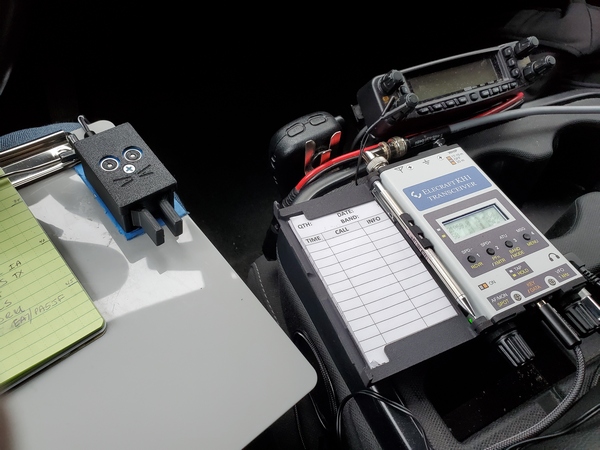
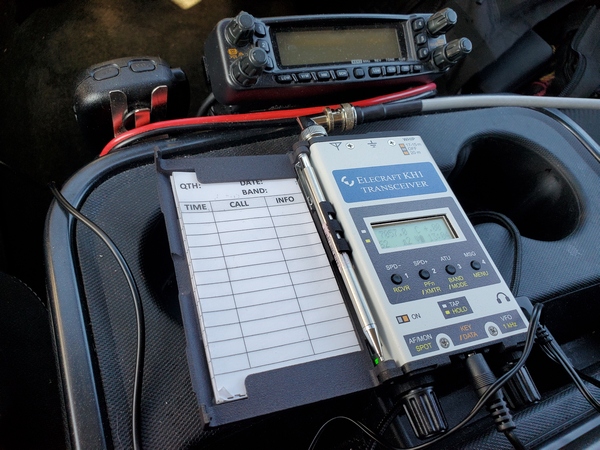
KH1with the K6ARK Pressure Paddles attached

I started off trying to use the K6ARK paddles with the KH1 on the center console. After two contacts, I decided that wasn’t the most comfortable way to operate. The pressure paddles worked fine, though. I switched over to the CWMouse paddles attached to my clipboard, and the magnets held nicely. It helps that the CWMouse paddles have a light touch, so I’m not slamming them side to side. 

On the air, the bands were as mediocre as the weather this morning. According to my band conditions app, we were experiencing an unsettled geomagnetic field. Starting out on 40M, it took longer than usual to make my first ten contacts. After I had 15 in the log, I switched to 20M and picked up a few more. I spent the rest of my time on 17M and 15M. As predicted, the band conditions up there were fair at best. I worked two domestic stations on 17M, and stations in Germany and Texas on 15M. 

My loaded whip at Ridley Creek State Park (US-1414, KFF-1414)

I was getting ready to call it quits, but I wanted to adjust the KH1’s real-time clock before shutting down. It had gained a minute or two over the past couple of months, so it just needed a tweak. As I navigated through the menus to set the clock, I heard a very loud IK1LBL calling me. I quickly exited out of the menu and completed the contact. After that, I set the KH1’s clock and packed everything up.

As activations go, this one was nothing special. However, my new KH1 paddles and my modified CWMouse paddles were a rousing success.

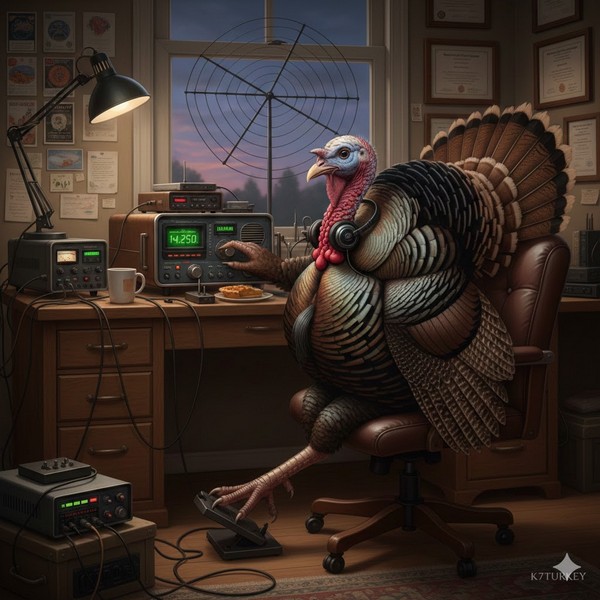
And finally, I’ll leave you to ponder this curious AI-generated image of a turkey operating a radio. It appears the turkey might be keying with his left foot (QLF?). 

AI-generated image of a turkey operating a radio

Happy Thanksgiving to you and yours.

72, Craig WB3GCK

Fun Morning at US-1351/KFF-1351

It’s been a busy week here, with a major ARES-RACES exercise, medical appointments, and some unexpected repairs on my truck. With all that behind me, I was more than ready for a QRP-portable outing. 

When I drove up to Evansburg State Park (US-1351, KFF-1351) early this morning, the weather was dreary, and everything was wet from the rain we had overnight. I did a quick check of the band conditions app on my phone, which showed only fair conditions on the higher bands. Conditions can sometimes change minute to minute, so I don’t let those band predictions deter me from getting on the air.

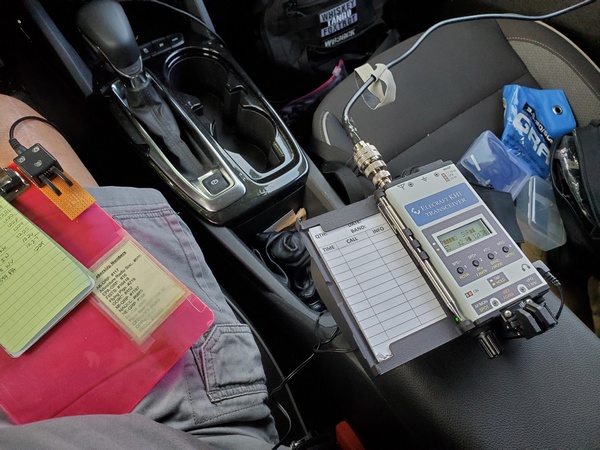
I installed my trusty 12-foot loaded whip on the back of the truck and set up my Elecraft KH1 on the center console in the cab. I also used my CWMouse paddles, which are among my favorite paddles these days. 

My Elecraft KH1 and CWMouse paddles in use at Evansburg State Park (US-1351, KFF-1351)

As I was setting up my antenna, a woman with a group of hikers yelled over to me, “What are you going to do with that big antenna?”. I gave her my 30 second explanation of ham radio and Parks on the Air. She told me to have fun and continued on her way. Normally, I just get curious stares, but now and then someone will ask about what I’m doing. 

The 40M band was really hot this morning. I made my first 10 contacts in about eight minutes. I logged 24 contacts before the activity thinned out. 

Like my last activation, I wanted to focus my attention on 20M through 15M. The 20M band was a little disappointing for me today, producing only two contacts. I spent the rest of my time on 17M and 15M. Even with the “fair” band conditions, these two bands did not disappoint. My 4.5 watts was getting some strong European hits on the Reverse Beacon Network. 

Today’s DX contacts included:

  • 17M: Italy (2), Slovak Republic, Finland, Germany (2)
  • 15M: Spain, Czech Republic, Germany, Italy (2), Switzerland, France, Denmark, Poland (2)

The action wasn’t exactly fast and furious on 17M and 15M, but I definitely had fun working the DX stations. Many of them were hunters in the World-Wide Flora & Fauna (WWFF) parks program, who sent the traditional WWFF greeting, “44.”

I shut down after an hour and 50 minutes, which is a little longer than my usual activations. In the end, I had 56 contacts in my log, including two park-to-park contacts. 

After more than 50 years in ham radio, I still find it amazing that a little radio running less than 5 watts can be heard thousands of miles away. I think that’s what has kept me interested in QRP all these years.

72, Craig WB3GCK
The Ashi Paddle 45

After my inexpensive QU-21C paddles started acting up again during a recent activation, I went on a paddle binge, ordering some new, reasonably-priced paddles to try out. First up was the CWMouse paddles, which I really like. Next was the Ashi Paddle 45 purchased from N6ARA Electronics. 

The paddles are designed and built by 7L4WVU in Japan and imported by N6ARA. I’ve had my eye on these paddles for a while, so I thought I’d buy them and give them a go.

After using the Ashi paddles on a few POTA/WWFF activations, I thought I’d document my impressions.

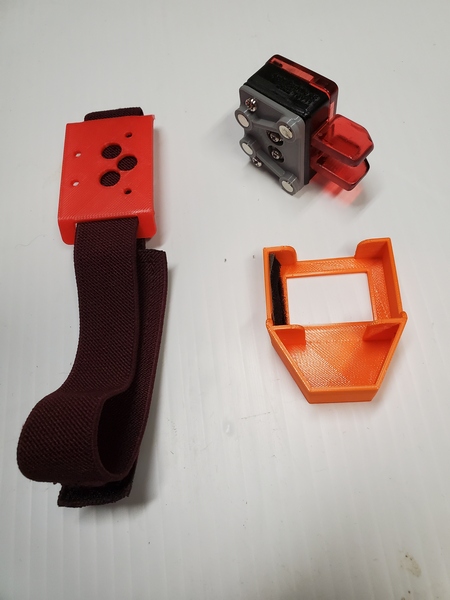
General: I was looking for small paddles to keep in my Elecraft KH1 kit, and the Ashi Paddle 45 fits the bill. They measure approximately 1-1/16″ x 2-1/8″ x 1″ (27mm x 54mm x 25.4mm) and weigh just 1.1 ounce (32g) with the magnetic mount attached. They are constructed from high quality 3D printing, and come with two mounting options: a magnetic mount and a leg strap. Two screws are provided for attaching the paddles to the mount you choose. 

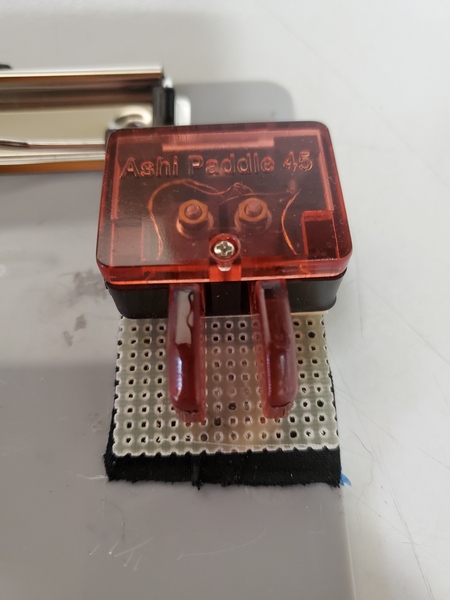
The Ashi Paddle 45 leg mount (left), the paddles with the magnetic mount attached (upper right), and the protective case for the paddles.

Overall Feel: Like the CWMouse paddles, the Ashi Paddle 45 uses microswitches for the contacts. Thus, the tension and throw are not adjustable. Of course, paddle spacing and tension are matters of personal preference. Being an Iambic Mode B user, timing is critical, so I prefer narrow spacing and light tension. The Ashi paddles’ spacing seems slightly wider than the CWMouse paddles, and the tension feels just a bit heavier. 

When I first started using the Ashi paddles, I would occasionally get an extraneous “dit” when forming characters with a single squeeze, like the letter K. My guess is the microswitches are a little slow breaking contact after releasing the paddles. I have to send more deliberately and remove my fingers completely from the paddles after each character. Fortunately, it didn’t take long to get used to the feel, and I had no issues sending with the paddles. Of course, this is all based on my personal preferences, so your mileage may—and probably will—vary. 

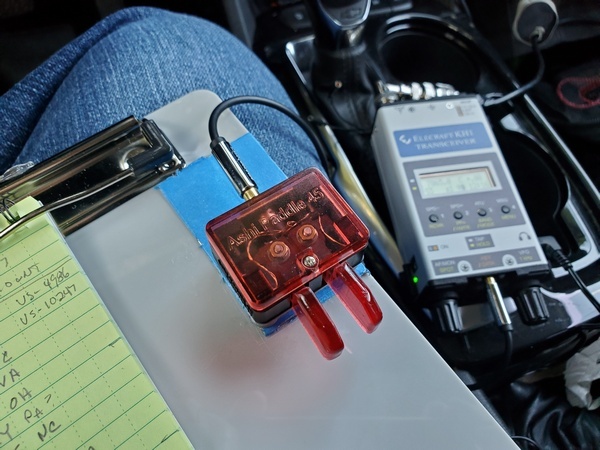
The Ashi paddles attached magnetically to my clipboard

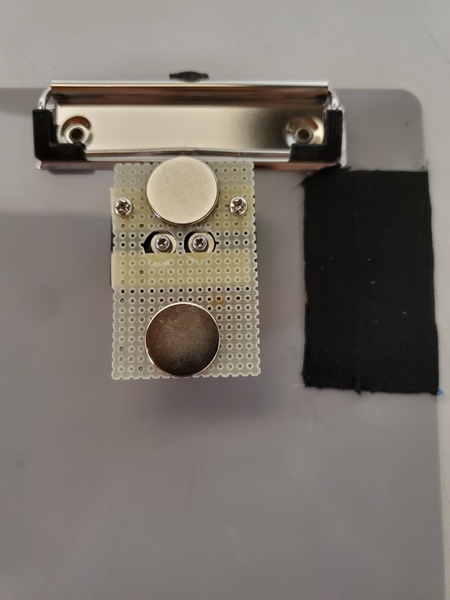
Mounting: My preferred method of sending is with the paddles attached magnetically to my little clipboard or a kneeboard for my KH1. So, naturally, I tried the magnetic mount first. Like my QU-21C paddles, the body of the key is small relative to the paddles. This makes magnetic mounting problematic. When I attach the paddles to a steel surface (like on my clipboard), they have a tendency to move side to side when keying. I have to use my hand to keep them steady. Not a huge thing, but I’d prefer they didn’t move at all. I have an idea in mind for an improved magnetic mount. If that works out, I’ll do a separate post on it. 

Using the Ashi paddles on a KH1 kneeboard

I haven’t used the leg mount in the field, but it worked great in the shack. That would probably be a great mounting option in some situations. The leg mount is cleverly designed so that you can angle the paddles to the left or right, if you like.

Overall, I like these paddles. Once I adapted to the feel, they worked reliably in the field. So, the Ashi paddles definitely replaced my quirky QU-21C paddles in my backpack.

72, Craig WB3GCK
Trying Out a KH1 Kneeboard

I ordered a KH1 kneeboard from Tufteln, and it arrived in the mail earlier this week. I was out of town for most of the week, so today was my first opportunity to try it out. 

I drove down to Ridley Creek State Park (US-1414, KFF-1414) and headed up to one of the picnic areas. This area is one of the highest elevations in the park. My original plan was to set up in an out-of-the-way clearing in the woods, but with rain in the forecast I thought it would be smarter to stay close to my truck. (Spoiler alert: It was.)

I backed my truck into a parking space away from everyone else and set up a 12-foot whip and my homebrew loading coil on the back of the truck. Next, I ran 18 feet of RG-8x coax over to my camping chair. 

My 12-foot loaded whip mounted on my truck

I ordered the kneeboard version with a metal plate for magnetic mount paddles. Mike KE8PTX, designer of the kneeboard, recommends using a short audio cable with right-angle connectors for connecting your paddles to the KH1. I bought a couple but neglected to bring them along this morning. Instead, I used a 3-foot cable. It was a little awkward, but worked just fine. 

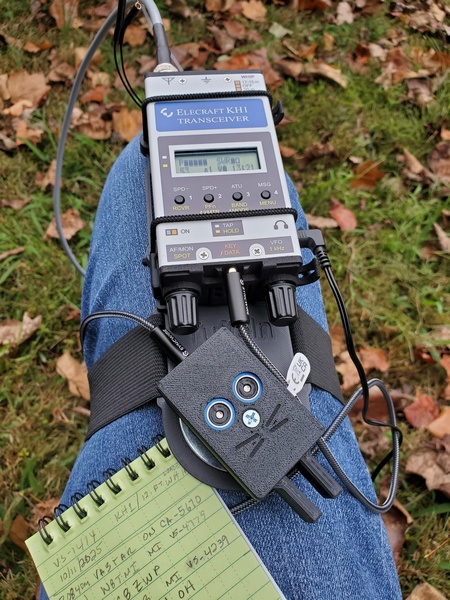
The leg strap provided with the kneeboard was easy to adjust and comfortable to use. I used my CWMouse paddles, and the magnets I glued onto them held on to the kneeboard’s metal plate with no issues. For logging, I used a 3” x 5” weatherproof notebook, which I balanced on my leg by the kneeboard. 

The KH1 and CWMouse paddles mounted on the Tufteln KH1 Knee Board

Settled comfortably into my chair, I got started on 40M. After logging a quick eight contacts, the hunters thinned out. I eventually made my required 10 contacts plus a few more before moving to 30M. After logging eight contacts on 30M, I moved to 20M for five more.

After an hour on the air, I felt a few raindrops and figured I had better pack up. That was an excellent decision, as it started raining as soon as I put the KH1 in the truck. I quickly took down my antenna and tossed my chair in the back of the truck.

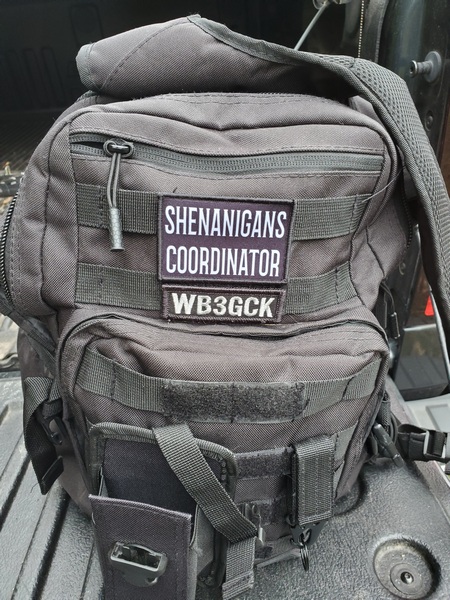
My radio backpack

Although the rain interrupted my activation, I ended up with 27 contacts. Some highlights included:

  • I got a call from F1BLL on 20M. He was an honest 599 into southeastern Pennsylvania this morning.
  • I worked fellow Polar Bear QRP member VE3DN on 40M and 30M. 
  • W9DP and W9GTA each hunted me on two bands.

I have to say that I really enjoyed using the kneeboard. In fact, this might be my new favorite way to operate with the KH1.

72, Craig WB3GCK

Another Short but Successful POTA Activation

Lately, I’ve had to squeeze in my ham radio opportunities whenever I can. (That seems to be a common theme for this blog these days.) This past weekend was a perfect example. While spending the weekend with family in central Pennsylvania, I got in a very short activation and still made it back in time for breakfast with the family.

Always the early riser, I was up on Sunday morning before the rest of the family. After grabbing a quick cup of coffee, I threw my backpack in the car and headed out just after sunrise.

I activated the Captain John Smith Chesapeake National Historic Trail (US-4567) from a boat launch in Lancaster County. Equipment-wise, this activation was a carbon copy of my last visit—minus the paddle issues. I used my Elecraft KH1 in my (far) better half’s compact SUV. Once again, I used my Gabil GRA-7350TC vertical and magnetic mount on the roof of the car. The paddles I used this time out were the Ashi Paddle 45 from N6ARA Electronics. (More on those in a future post.)

Ashi Paddle 45 and Elecraft KH1

After parking in my usual spot, I placed the antenna on the roof of the car and roughly adjusted the coil slider for 40M. I got out my antenna analyzer and conected the coax to fine-tune the antenna. However, when I turned on the antenna analyzer, it showed a 1.26:1 SWR—no adjustment needed! I couldn’t do that again if I tried.

Gabil GRA-7350TC on a mag mount

After hunting for a few park-to-park contacts, I found a vacant frequency and started calling CQ. Like on my last visit, the 40M band was so productive I spent my whole activation there. I operated for about 30 minutes, logging 19 contacts—not too bad for about 4.5 watts into an eight-foot vertical on a mag mount, I guess. Once again, I connected with N4JAW (aka Ham on a Bike). Jim was out doing his usual bike-portable activation at US-7956 in Kentucky.

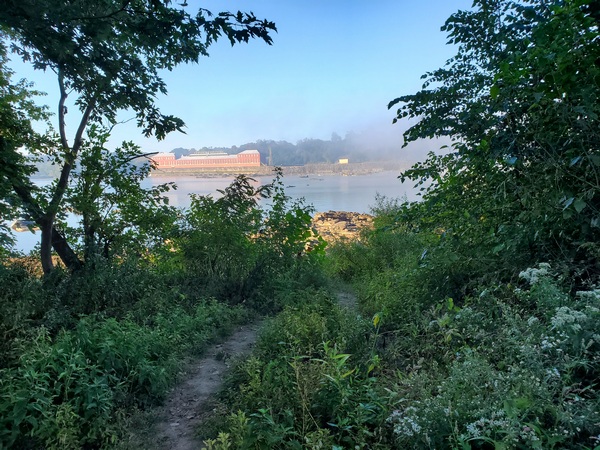
Some morning fog on the Susquehanna River

I packed up in a couple of minutes and was back at the house about 15 minutes later. My time on the air was a little shorter than I would have liked, but at least I had no paddle issues this time.

72, Craig WB3GCK

KH1 Picnic Table Ops

My (far) better half and I had plans to go watch our grandson’s soccer game yesterday, but I still squeezed in a short, early morning activation. I headed over to nearby Valley Forge National Historical Park (US-0761, KFF-0761) and allotted myself an hour of operating time. While I was there, I tried out a few things with my Elecraft KH1.

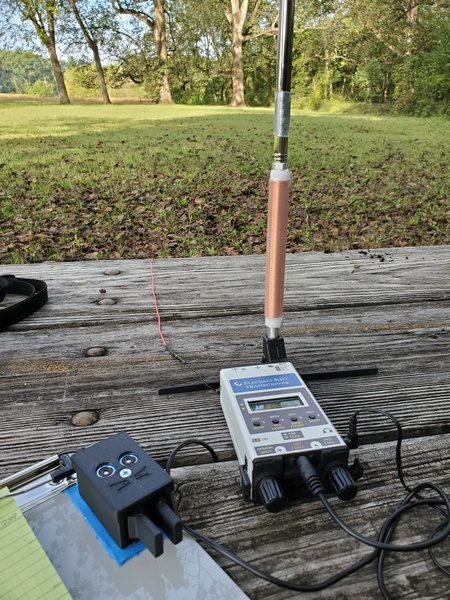
I set up the KH1 at a picnic table and used the whip antenna and AXE1 extender coil. I supported the antenna with a right-angle adapter from Tufteln. This was the first opportunity I had to use the adapter, so I was anxious to try it out. For my counterpoise, I used a homebrew setup with a 13-ft wire and a 20-foot extension for 40M.

The KH1 with the AXE1 loading coil for 40M/30M and the Tufteln right-angle adapter.

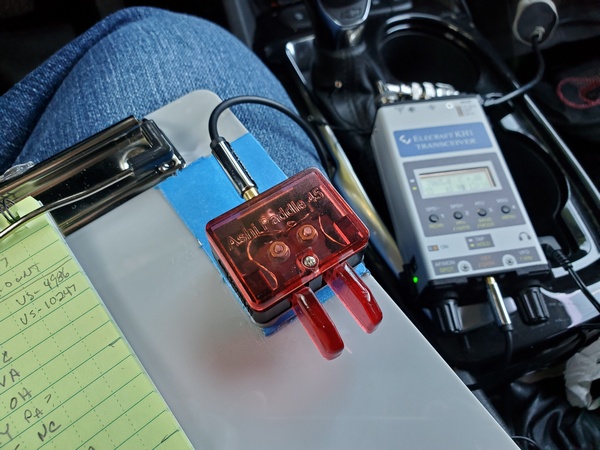
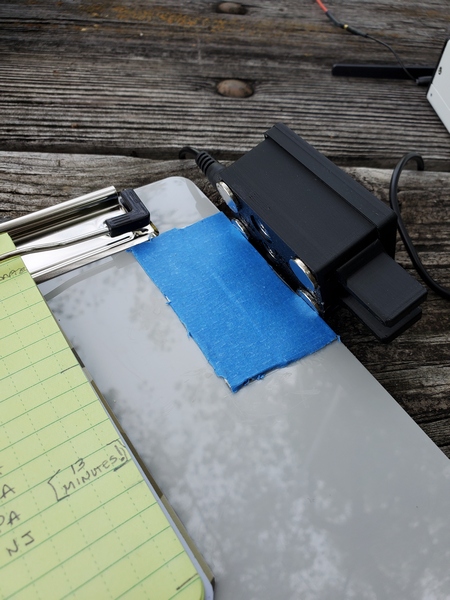
I also gave my CWMouse paddles another go. I glued four small magnets to them the night before, so I wanted to see how they worked with my clipboard. KE8PTX had a Facebook post recently in which he mentioned using painter’s tape on the metal surface of his knee board to give his paddles a little extra traction. As luck would have it, I was doing some painting this week and had some tape handy. I put some on the steel strips on my clipboard right before I left the house. 

I glued some magnets to my CWMouse paddles. The blue painter's tape helps the magnets get a better grip. You can see the notation I made in my log for my 10th contact.
I glued some magnets to my CWMouse paddles. The blue painter’s tape helps the magnets get a better grip on the steel strips glued to the clipboard. You can also see the notation I made in my log for my 10th contact.

With everything set up, I tuned up the KH1 and got started. My results on 40M really surprised me. Although my signal reports were on the low side, I was getting some decent spots on the Reverse Beacon Network. It took only 13 minutes to log my first 10 contacts. I continued making contacts for 30 minutes, while brushing ants off of my log. (I think there was an anthill under the picnic table. Doh!)

I spent the rest of my hour-long activation on 30M and 20M. There was less activity there, but I picked up a few more contacts on each band.

When my hour was up, I packed up and gave the ants exclusive use of the picnic table. I finished up with 25 contacts in my log; I’ve done much worse with much better antennas. The KH1 did an amazing job with just the whip antenna, and my modified CWMouse paddles worked great attached to my clipboard. 

As you can probably tell, I’m having fun with my new rig. 

72, Craig WB3GCK

POTA with the CWMouse Paddles

I did a POTA/WWFF activation this morning and used it as an opportunity to try out a new set of paddles. During a recent activation, I encountered a recurring problem with the cheap QU-21C paddles I keep in my backpack as a backup. As a result, the finicky paddles have lost out on their role as my backup. 

Always a sucker for unusual paddles, I came across an interesting offering I couldn’t resist. I fired off an order for the CWMouse paddles and had them in my hot little hands two days later. Mike KN6FQM designed the CWMouse paddles, which are currently selling on Amazon for $39.00 (US).

The CWMouse paddles are made from 3D-printed parts and include sealed ball bearing races, two sealed microswitches, and an ⅛-inch stereo jack. One thing that drew me to these paddles was the small size: 74mm/2.9in L x 36mm/1.4in W x 28mm/1.1in H. They weigh a mere 1.5oz/45g, making them ideal for portable use. See the CWMouse website for the complete specifications.  

The CWMouse paddles. For size reference, they are on a 3"x5" notepad.
The CWMouse paddles. For size reference, they are on a 3″x5″ notepad.

My destination this morning was Marsh Creek State Park (US-1380, KFF-1380). I usually operate near one of the boat launches, which can sometimes get crowded during the summer. Given that it was a weekday in September, there was plenty of room in the parking lot. 

My rig today was my Elecraft KH1 into a 12-foot whip and homebrew loading coil. Starting out on 40M, I found lots of strong signals. I made a couple of quick park-to-park contacts before settling on a frequency and calling CQ. I quickly achieved the required 10 contacts and then some. 

My KH1 fit nicely on the center console of my truck.

After 20 minutes, the activity on 40M tapered off, so I moved up to 20M. The action wasn’t as busy on 20M, but I made 11 contacts. One of those was with a station in California—I like when that happens. The 17M band produced three more before I called it quits. After a bit more than an hour, I had logged 32 contacts with six park-to-park contacts. 

The CWMouse paddles performed flawlessly. Because of the microswitches, there are no adjustments for throw or tension. However, they felt great right out of the box. They have a nice, light touch, which is what I prefer. 

One potential issue is the plastic used for the 3D printing. The website is very clear that the paddles should not be stored at temperatures above 100F. This could easily happen in a closed vehicle, so I’ll have to keep that in mind.

I used the “two-handed” technique with the paddles this morning, which is not my preferred way of operating. I’ll probably glue on some magnets, so I can attach the paddles to my clipboard. 

Overall, however, I really like these paddles. It was a pleasure operating with them this morning. 

72, Craig WB3GCK

Paddle Problems & POTA

My (far) better half and I spent the past weekend with family out in central Pennsylvania. During the weekend, I squeezed in a quick, early morning POTA activation. The great band conditions made for a fun activation, but paddle problems made it challenging at one point.

On Saturday morning, I was up before everyone else. After downing a cup of coffee, I took a short drive to a boat launch on the Susquehanna River to activate the Captain John Smith Chesapeake National Historic Trail (US-4567).

We drove out in my (far) better half’s car, so I used a simple antenna setup that produced decent results in the past. I used my Gabil GRA-7350TC on a small magnetic mount. Like the last time I used it on my (far) better half’s car, I easily adjusted it for a 1.3:1 SWR on 40M. I fed the coax through the passenger side window.

Gabil GRA-7350TC antenna on a magnetic mount

Inside the car, I set my Elecraft KH1 on the center console. I used my cheap QU-21C paddles attached to a clipboard with a homebrew magnetic mount I made for them. 

The 40M band was hot with no trace of the QRM I experienced the last time I was there. It only took 14 minutes to log my first 10 contacts, the contacts came in steadily for the next 45 minutes.

I was cruising right along for about 30 minutes until my cheap paddles decided to start dropping “dits” here and there. Based on my crazy sending, I’m sure some folks thought I was experiencing some sort of medical emergency.

I frantically searched for my N6ARA Tiny Paddle that I always carry as a backup. Of course, they were nowhere to be found. I ended up using the stock KH1 paddles attached to the radio, with the KH1 on the center armrest. This setup was an ergonomic nightmare, with my elbow in the backseat area. Despite the awkward position I was in, I was able to finish up my activation.

My setup after my paddle problems started. On hindsight, I could have arranged things better to make my operating position a little less awkward.

After an hour, I had 39 contacts in my log. I was so occupied on 40M, I never got around to trying the higher bands. My log included 7 park-to-park contacts. One of those was with N4JAW (aka Ham on a Bike). It’s always fun working Jim down in Kentucky. 

I also heard from my friend, Greg WA3GM. It had been a while since our last QSO, so it was great to hear him again.

Susquehanna River
Susquehanna River

The Gabil antenna and mag mount setup once again proved to be a great antenna when using my (far) better half’s car. With about 4.5 watts out on 40M, I worked stations up and down eastern U.S. and Canada and out to several mid-west states.

The QU-21C paddles, however, are a different story. This is the second time I have had issues with them. A squirt or two of contact cleaner will usually fix the problem—for a while, anyway. As they say: You buy cheap, you get cheap. 

And, of course, I found my N6ARA paddles as I was packing up. Doh!

72, Craig WB3GCK

More Antenna Testing in Valley Forge

In my last post, I talked about using a simple antenna comprising a 15-foot radiator, a 7.5-foot counterpoise, and a 4:1 unun. It worked well, but I found it a little touchy to tune on 40M. Today, I tried the same configuration, but with a slightly longer radiator and counterpoise.

I wanted to add a little length to the radiator, but limit it to 19 feet, so I could still use my lightweight 19.5-foot telescoping pole to support it. Looking at a table of random wire antenna lengths to avoid, it seemed like 18 feet might be a good choice for 40M through 15M, my primary bands of interest. Scaling the counterpoise wire proportionately, I went with a length of 9 feet. 

Just as I was getting ready to cut a set of wires to try out, I stumbled on a video by Thomas K4SWL. In the video, he was using an antenna built by AD8HK that used a radiator length of 17’9” and a counterpoise length of 8’10.5”. I went with those dimensions, since they were very close to what I was considering and seemed to work with Thomas’s KH1.  

On the Air

To try it out, I made a quick trip over to Valley Forge National Historical Park (US-0761, KFF-0761). Using the same 4:1 unun and coax as the last time, I made a quick check to see how my Elecraft T1 loaded up on the bands. The tuner quickly found a match on 40M, 30M, 20M. On 17M, however, it seemed to struggle. I went back to 40M and got started with my activation. 

My radio equipment at Valley Forge NHP

This wasn’t the best day to be doing this. The geomagnetic field was unsettled with a K index of 4 and the A index sitting at 47. Nevertheless, the callers showed up, although at a somewhat slower pace than usual. 

After I had 14 contacts in the log, I decided to spend the rest of my limited time playing around with the antenna. When I went back and checked 17M, the T1 tuned it up without flinching. I also rearranged the counterpoise wire so it ran 180 degrees opposite of my coax. Checking the bands again, the T1 reliably matched 40M through 17M. 

My antenna at Valley Forge NHP

Convinced that the new wire lengths work, I went back to the 15-foot radiator and 7.5-foot counterpoise I used a few days earlier. This time, the T1 had no issues loading up on 40M. Go figure! 

I really wanted to give the unun with the smaller ferrite core another shot. When I last tried it with the 15-foot & 7.5-foot wires, neither my KH1 nor my T1 could find a match on 40M. Unfortunately, I neglected to put it in my backpack before I left. I’ll have to save that for another time. 

The Straight Key Century Club (SKCC) Weekend Sprintathon contest was going on this weekend, and I worked one SKCC station while tuning around the bands. This month, the WES theme was homebrew keys. In the spirit of the contest, I made the contact using a straight key I built a few years ago from junk box parts. 

My homebrew straight key constructed from odds and ends in my junk box
My homebrew straight key constructed from odds and ends from my junk box

Conclusions

So it looks like both the 15’/7.5’ and 17’9”/8’10.5” configurations are usable with my homebrew 4:1 unun. Given a choice, though, I would probably stick with the longer wires. 

One other thing is clear: short random wires can sometimes be finicky little critters.  When in doubt, rearrange the counterpoise wire.

72, Craig WB3GCK