Weekend Antenna Testing

Carrying on from the initial testing I did last week, I went out for a bike ride yesterday and took my experimental vertical along.  (I gave a general description of this antenna project in my previous post.)  I rode a few miles up the Schuylkill River Trail and on to a park along the Perkiomen Trail.

I set up in a remote section of the picnic area and quickly took some readings on 40 and 30 meters with my antenna analyzer.  I had done some tweaking to the loading coil but, unfortunately, both bands were still resonating too low.

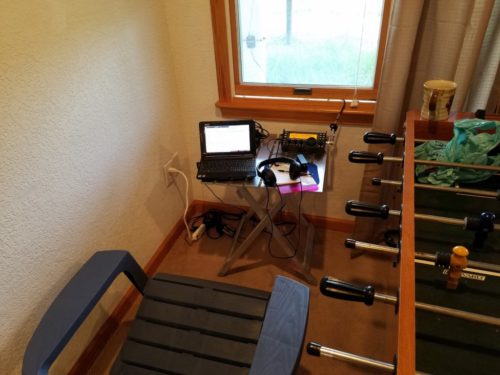
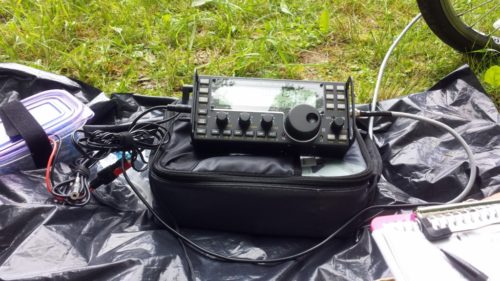
My set up at Lower Perkiomen Valley Park. If you look closely at the S-meter in the upper right of the display, you can see the horrendous noise level on 40 meters.

I set up my KX3, intending to make some contacts.  This, however, was not to be.  There was a background noise level that was higher than I had encountered on a previous visit to this park.  As I was tuning around, I looked over and saw that the wind had blown my antenna over.  I neglected to bring anything along that I could use to stabilize the antenna and tripod.  I set it back up but it wasn’t long before the antenna was on the ground again.  After it blew over a 3rd time, I gave up.  I packed up the bike and rode back down the trail to my truck.

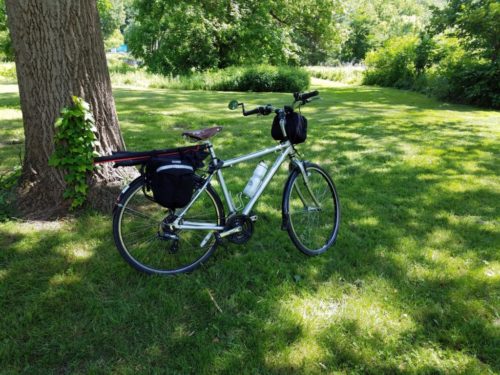
My bike loaded up for the trip home. No contacts today but at least I had a nice bike ride!

This morning I made another adjustment to the antenna’s loading coil and headed over to Valley Forge Park to test it.  Like yesterday, it was somewhat breezy.  This time, I hung my backpack from a hook on the bottom of the tripod to make sure the antenna stayed upright.

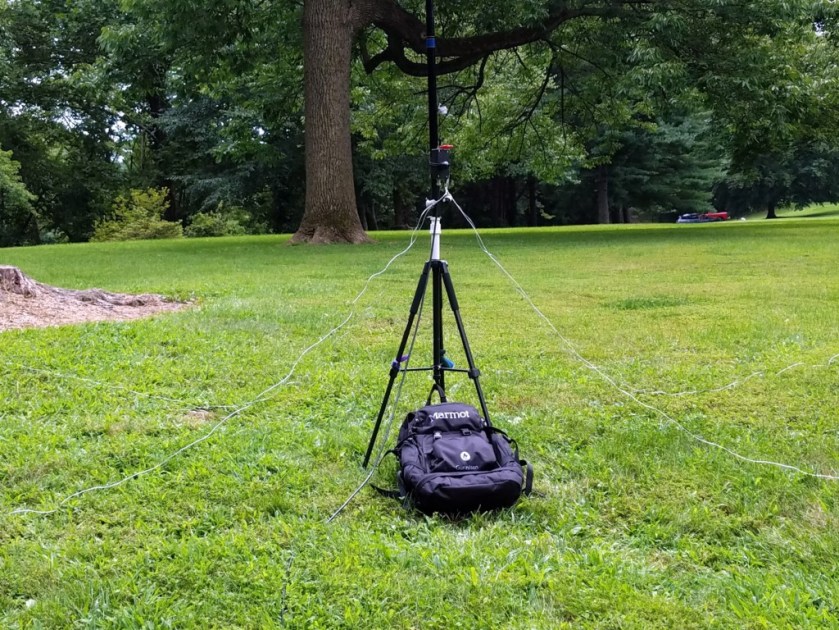
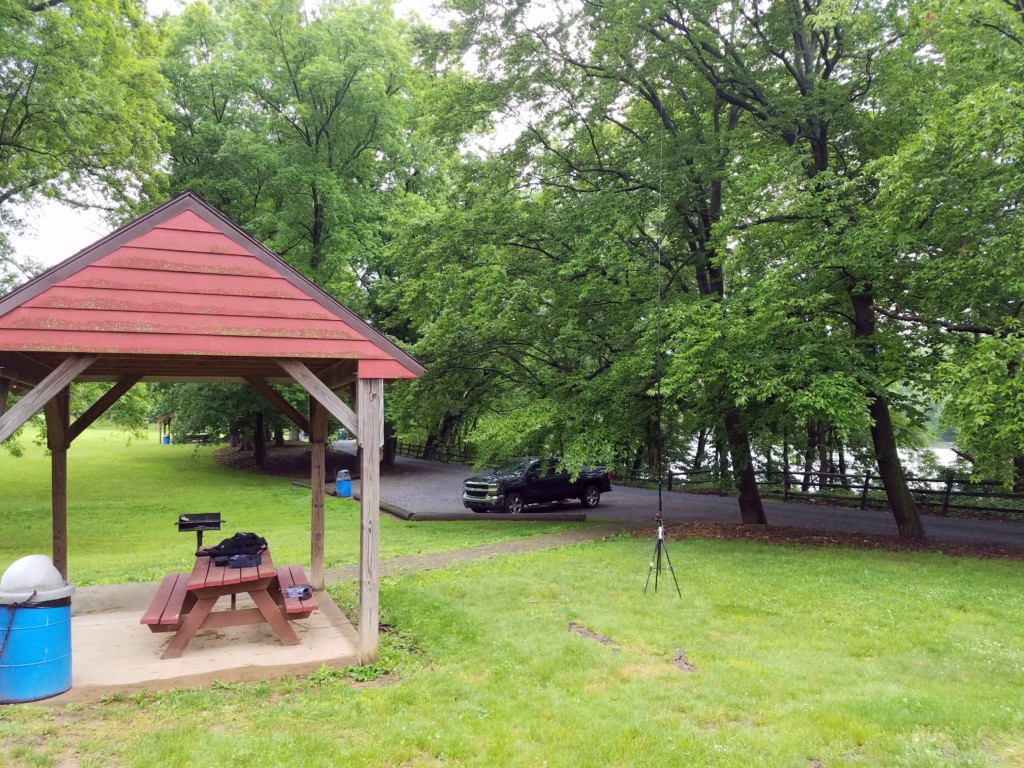
My set up at Valley Forge National Historical Park. I hooked my backpack to the bottom of the tripod to help stabilize it in the wind.

I took some antenna analyzer readings and found that the 40-meter band was now resonating right where I wanted it.  I saw some improvement on 30 meters but it was still resonating below the band.  Obviously, the tap for the 30-meter band is in the wrong place.

As I tuned around, it the bands seemed better this morning.  I worked N5P in Texas on 20 meters.  N5P was participating in the Museum Ships Weekend event from the National Museum of the Pacific War.  I moved down to 30 meters and heard a couple of strong stations.  I didn’t make any contacts there, though.

I called CQ on 40 meters and quickly got a call from N1PVP in Massachusetts.  I remembered working Marino a couple of weeks ago.  He always has a very strong signal into Pennsylvania.  I wrapped up with a two-way QRP QSO with Alan AC8AP in Ohio.

Antenna-wise, I have to do some thinking about how to proceed with my experimental vertical.  As I see it, I have a few options:

  • I could continue to tweak the existing coil.  If I remove turns from the bottom of the coil while adding the same number of turns to the top of the coil, this would effectively move the tap point for the 30-meter band.
  • It might be easier to just re-wind the coil and add a few more tap points.  I could do some testing to see which tap works the best.
  • I could always invoke the “do nothing” option.  The SWR on 30 meters is only about 4.3:1, which is a trivial match for the KX3’s internal tuner.

In any event, the antenna is useful as it stands.  I’ll take some time this week to consider my next move.

72, Craig WB3GCK

Memorial Day Antenna Testing

Some time ago, I bought a small, lightweight telescopic fishing pole from a Chinese vendor on eBay.  It’s about 19.5 feet tall and collapses down to about 26 inches.  It’s a great size for backpacking or transporting on my bike.  It weighs practically nothing.  In fact, it’s too light for supporting anything but a lightweight vertical wire.  Although I have used it a few times to support various antenna configurations, I never really found one that was a “keeper.”

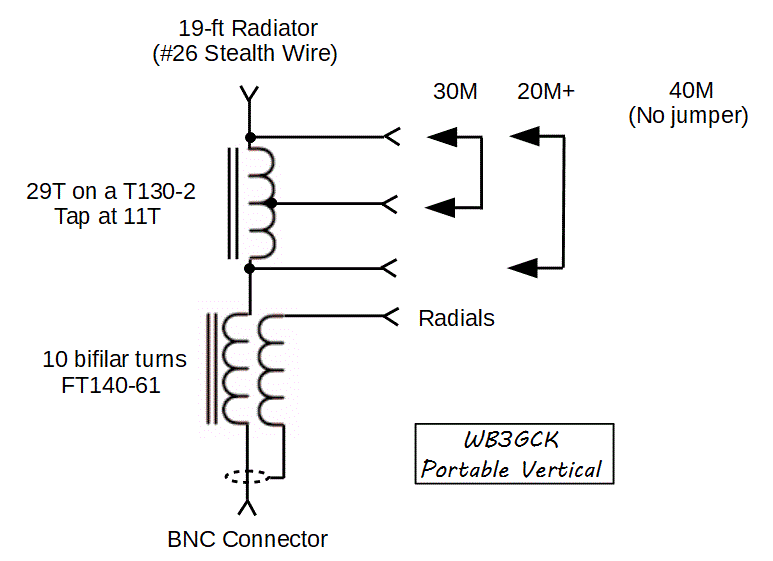
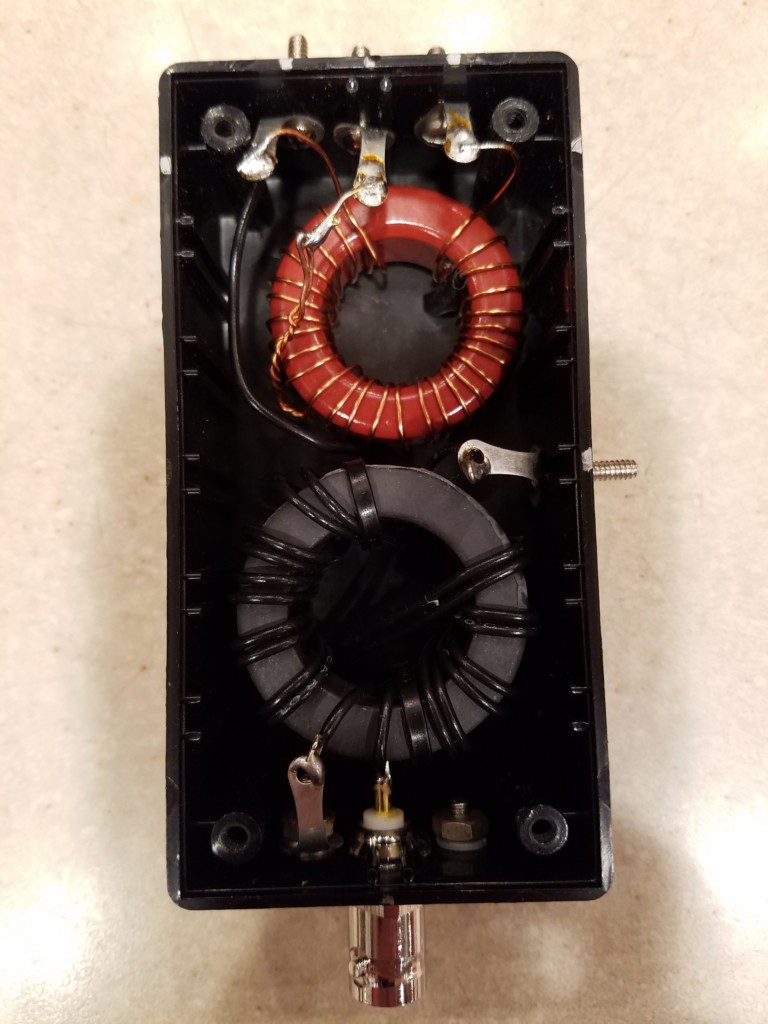
Since I had some time over the long holiday weekend, I scratched out a quick design for yet another vertical antenna and cobbled it together with parts I had on hand in my junk box.  I designed it to operate as a base-loaded resonant vertical on both 40 and 30 meters.  On 20 meters and higher, it operates as a non-resonant wire; thus, an antenna tuner is required on those bands.  Along with the loading coil, the matching unit contains a 1:1 choke balun to isolate the feedline.    Both the choke balun and tapped loading coil are wound on toroids and mounted in a small, plastic enclosure.  The radiator is a 19-foot piece of #28 wire.  I could have shortened the radiator to make it resonant on 20 meters also, however, I went with the longer radiator for better performance on 40 meters.  I used four 12.5-foot radials that I made from a 25-foot roll of cheap speaker wire.

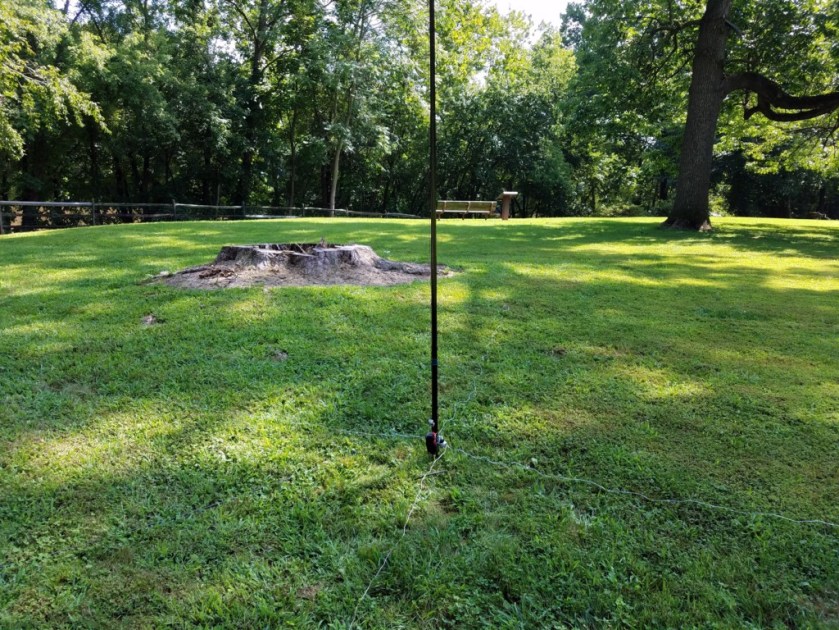
The antenna I was testing. The white piece between the telescopic pole and the tripod is an adapter I made from PVC pipe.

Normally, I like to use the “build a little, test a little” approach.  Since I don’t have the luxury of space at home for antenna testing, I just took my chances and built the whole thing.  I headed out to a local park yesterday to give it the “smoke test” and see how close I came with my loading coil design.

My operating location on a cloudy and rainy morning

It took less than 5 minutes to set it up.  I used an antenna analyzer to take some initial measurements.  On both 20 and 30 meters, the resonant frequencies were low and fell outside the band.  I still have some work to do there.  On 20 meters and up, the KX3’s tuner loaded it up easily.

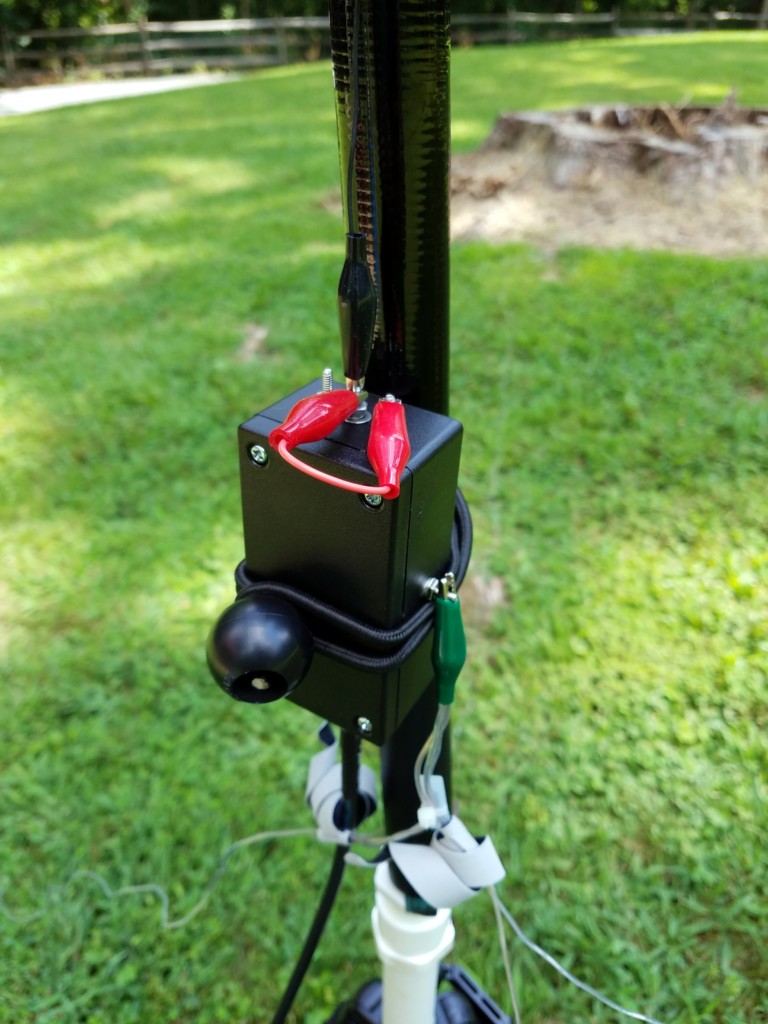
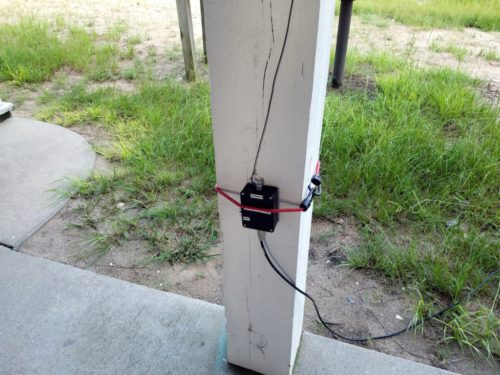
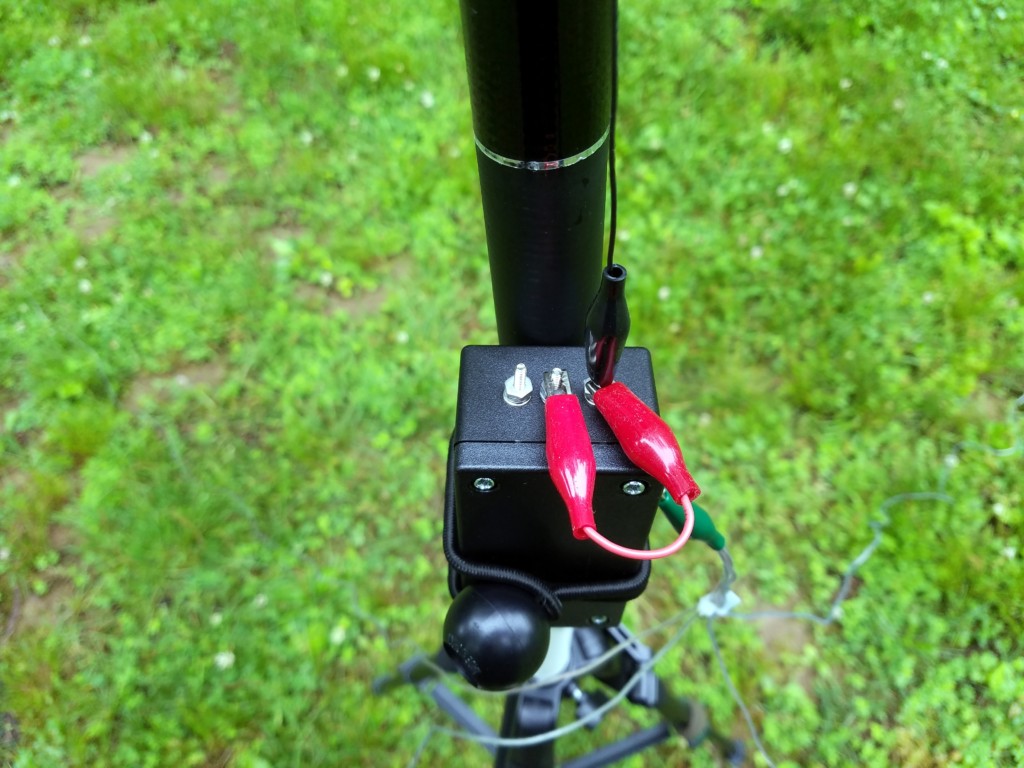
The antenna matching unit. The red jumper is used to change bands.

Next, I wanted to put it on the air.  I started on 40 meters and used the KX3’s tuner to tweak the SWR.  I called CQ a few times and eventually got a call from K4ALE in Virginia.  Bevin said I was 559 with QSB.  Despite the poor band conditions, we had a nice chat.

After I signed with Bevin, I set the antenna for 30 meters and kicked in the KX3’s tuner.  I called CQ and was quickly answered by NN4NC in North Carolina.  Jim gave me a 569.  At times, the band would fade to just about nothing.  As I was chatting with Jim, some drizzle started blowing in under the pavilion where I was sitting.  So I signed with Jim and quickly packed up.

I’ll be doing some adjustments to the antenna over the coming weeks.  It looks, though, that this could be a useful portable antenna, once I get the loading coil straightened out.

Since this is a work in progress, I left out the details for now.  After I get the antenna working as intended, I’ll provide a detailed description, schematic and parts list in a future post.

72, Craig WB3GCK

Trailer ‘Tenna

We recently retired our old pop-up tent trailer and acquired a small hard-sided travel trailer.  The antenna I used with the pop-up camper evolved over 19 camping seasons to a pretty decent all-band antenna.  It covered 80 through 6 meters (with a tuner) and required almost no space at all when deployed.  I needed to come up with something similar for the new trailer.

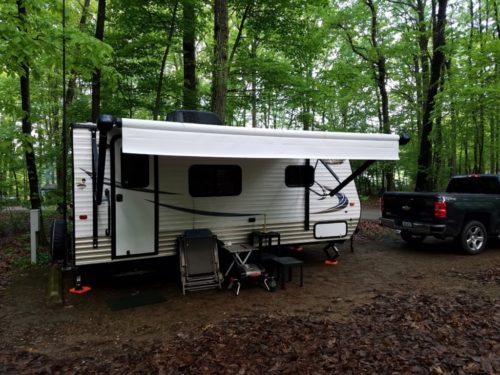
My new travel trailer on its maiden voyage to Codorus State Park in south-central Pennsylvania.

For the first outing, I went with a modified version of the Pop-Up Vertical.  In a nutshell, I used a 30-foot vertical wire, fed through a 4:1 unun.  The ground side of the unun was attached to the frame of the trailer.  My 31-foot Jackite pole supported the wire.  I used my drive-on mast support to hold up the pole.  Instead of parking one of the trailer’s tires on top of the drive-on mount, I put it under one of the trailer’s stabilizer jacks to hold it down.

This is the drive-on mount that supported the Jackite pole. The black box is the 4:1 unun. To the left of the unun, you can see the clamp for the ground connection to the trailer’s frame.

On our first camping trip with the new trailer, I was able to quickly set up the antenna.  For the feedline, I used an 18-foot length of RG-8X coax, which I ran through a window to the dinette table inside the trailer.

Using the tuner in my KX3, I was able to get the antenna to load up on 80 through 6 meters.   The 80M band was a bit touchy but the KX3 was able to get to 1:1 SWR.  I had a nice CW chat on 40M with N1ESZ up in Connecticut.  Tony gave me a great signal report.  This thing appeared to be radiating!  I was a little concerned because part of the antenna was close to the metal wall of the trailer but my signals were going somewhere.

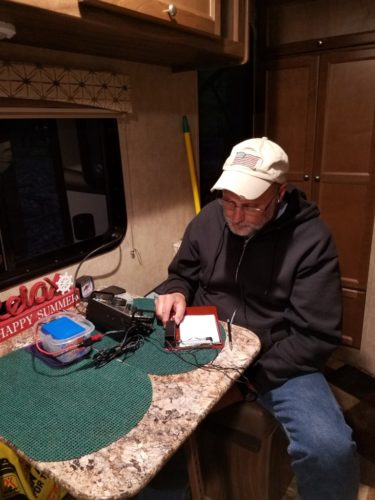
WB3GCK operating from the new trailer. My XYL took this picture while I was working N1ESZ on 40 meters.

I made another half-dozen QSOs on 80, 40 and 20 meters over the weekend.  The antenna performed well during some lousy band conditions but I did encounter some issues.

There was some noise that appeared about every 25 or 30 KHz that moved around a bit.  It was loudest on 40 meters.  I suspect that the trailer’s converter, which converts 120 VAC to 12 volts DC, is the culprit.  My antenna was pretty close to the trailer’s power cable that connects to “shore power.”  I could have picked up the noise from there.  Also, during a QSO with KK0I in Wisconsin on 40 meters, I noticed that a LED on the trailer’s control panel was flashing in unison with my CW.  My 5-watt signal was finding its way into the trailer’s circuitry.  The extra amenities and gadgets in the new trailer are convenient but not necessarily radio-friendly.

Not unlike the antenna on my old camper, this will be a work-in-progress.  On our next trip, I’ll be relocating the antenna to a corner of the trailer that’s further away from the electrical stuff.  I also have some tweaks to the antenna configuration that I want to try.  If all else fails, I’ll just have to mount the antenna further away from the trailer.

Stay tuned…

72, Craig WB3GCK

The Splice of Shame

[Disclaimer:  Any misadventures I have had with this antenna were purely my fault and, in no way, reflect on LNR and their excellent product.]

I bought the LNR EFT-10/20/40 trail-friendly end-fed halfwave (EFHW) antenna about a year and a half ago, after seeing one at Field Day.  It’s a great, portable antenna.  It packs up small and weighs hardly anything.  I often use non-resonant antennas because I like to work a variety of bands.  However, I always carry the LNR end-fed in my pack as a backup antenna.  The EFT requires some initial pruning before use.  This is where my misadventures start.

I don’t have enough real estate at home for antenna testing.  Instead, I did the initial pruning of the antenna while setting up for the Skeeter Hunt QRP contest in August of 2015.  Trimming an inch at a time was getting a little tedious for me.  I incorrectly estimated how much I needed to cut to have the antenna favor the CW section of 40 meters.  As you might guess, I screwed up and cut off too much.  Resonance was at about 7.110 MHz and frequencies below 7.023 MHz were outside the 2:1 SWR curve.  20 and 10 meters were fine, however.  I operated in the contest with no issues.

I resolved to correct my mistake and added that task to my “job jar,” where it languished for the next year and a half.  In the meantime, the antenna was used for numerous outings, including a National Parks on the Air (NPOTA) activation of the Appalachian Trail.  I just needed to avoid the bottom end of 40 meters.

Fast-forward to this past weekend.  I finally got around to doing something about the tuning of this antenna.  I had ordered some #26 Poly-STEALTH™ wire from the good folks at Davis RF.  First, I measured the top section of the antenna (from the top of the loading coil to the end of the antenna) in its current state.  Then I cut the wire about a foot or more from the end.  Since the splice wouldn’t fit through the holes in the end insulator, I wanted to keep the splice away from it.  I did this if I would ever want to re-tune the antenna for the phone section of 40 meters.  I next spliced on a piece of Poly-STEALTH™ wire that made the overall length about 2.5 inches longer than before.  After soldering the splice and applying some shrink tubing, I was ready to give it a test in the field.

The Splice of Shame. This is the splice I had to put onto my LNR EFT-10/20/40 EFHW antenna to correct my pruning error.
The Splice of Shame

I was out in central Pennsylvania over the weekend doing some babysitting for my grandson.  As I have done at this location before, I strung the EFT-10/20/40 from a second story window to a Jackite pole strapped to the fence in the backyard.  The antenna was roughly horizontal and up about 25 feet or so.  I wanted to make sure that the range from 7.000 MHz to 7.125 MHz fell within the 2:1 SWR bandwidth.  My antenna analyzer showed that it was just a bit long.

After I lowered the antenna and cut off a half-inch, the SWR was pretty much where I wanted it.  Now it was resonant around 7.040 MHz and the 2:1 SWR bandwidth spanned 7.000 to 7.130 MHz.  On 20 meters, the SWR was less than 1.5:1 across the band.  On 10 meters, the SWR was less than 2:1 across the band.  The SWR indicator on my KX3 confirmed the results.

Final 40M SWR plot for my LNR EFT-10/20/40 antenna. The 2:1 SWR curve covers 7.000 through 7.130 MHz.

At one point, my inner obsessive-compulsive perfectionist said I could cut off another half-inch and make it better.  Fortunately, my practical side was able to resist and leave well enough alone.  As they say, perfect is the enemy of the good.  So, I declared victory and went on to make some nice CW and PSK-31 contacts with my properly tuned antenna.

The antenna works great but that splice will be a constant reminder of what happens when you rush things and try to cut corners.

72, Craig WB3GCK

Drive-on Portable Antenna Support

[This is an updated description of the drive-on antenna support that I have been using for many years.  This version originally appeared in the July 2016 edition of QRP Quarterly in the “Idea Exchange” column and most-recently  in the October 2024 edition of Radio ZS, The Journal of the South African Radio League.  You can still find the older article here.  A revised, “step-by-step” version appeared in ARRL’s On the Air Magazine (May/June 2024 edition). ]

Here’s a simple, inexpensive drive-on mast support that I have been using for more than ten years now.  It’s been particularly handy for quick trips to the field, such as National Parks on the Air (NPOTA) activations.

Over the years, telescopic fiberglass poles have become popular as portable supports for lightweight antennas.  Two popular suppliers of these collapsible poles are Jackite (http://www.jackite.com/) and SOTABeams (http://www.sotabeams.co.uk/).  I typically use my 31-foot Jackite pole to support a vertical wire along the outside of the pole.  I have also used them to support lightweight dipoles and a variety of end-fed wire antennas.

One trip to your local hardware store will get you everything you need for this project.  To support a 31-foot Jackite pole, here’s what you’ll want to buy:

  • 1-1/4 inch floor flange
  • 18-inch length of 1-1/4 inch threaded steel pipe
  • (4) 1/4-20 x 1-1/2-inch flathead bolts
  • (4) 1/4-20 nuts
  • (4) 1/4-inch flat washers
  • (4) 1/4-inch lock washers
  • 18 to 24-inch length of 1×8 lumber (I used a piece of maple.  A piece of 1×6 lumber would also work)

[NOTE: I’ve heard that the dimensions of newer Jackite poles may be different. Use the dimensions given here as a general guide, and be sure to double-check the dimensions of your particular pole before buying materials.]

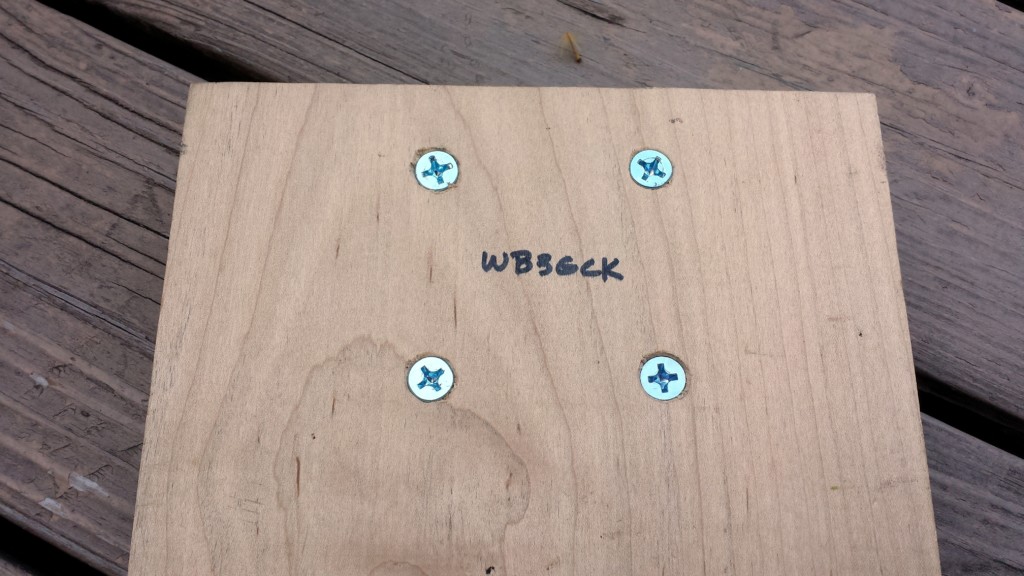
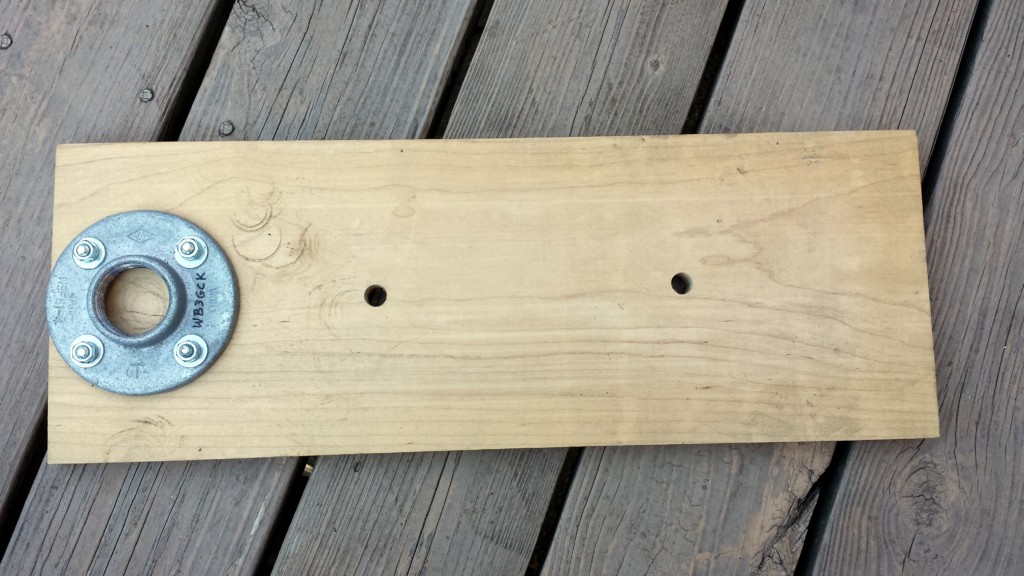
Figure 1. Drill 4 countersunk holes for the floor flange at the end of the board.

Assembly is pretty straightforward.  Drill four holes to mount the flange to the board.  The flathead bolts go in from the bottom.  You need to countersink the bolts so they will flush with the bottom of the board.  Attach the flange with the flat washers, lock washers and nuts.  That’s about it.

Figure 2. Here is the floor flange mounted on the board.

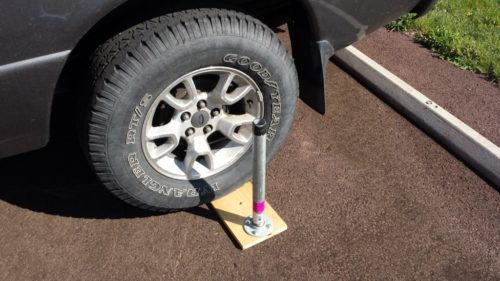
To use the mount, I just set it on the ground and run one of my vehicle’s tires up on it.  Next, I screw the threaded pipe into the flange.  Once the pole is fully extended and the bottom cap removed, I just slide the pole over the pipe.  For my 31-foot Jackite pole, I use a little electrical tape on the pipe to give a snug fit.

Figure 3. Drive onto the mount and screw in the pipe.
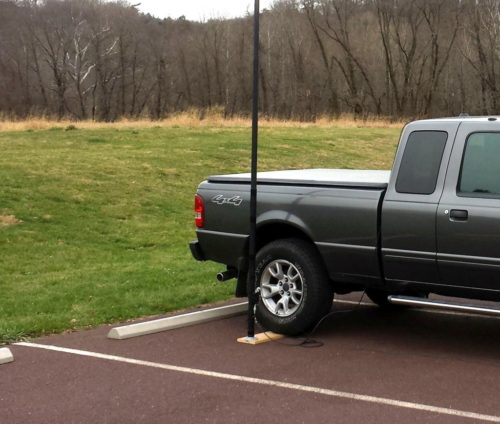
Figure 4. Drive-on mast in use supporting a vertical wire.

You can also adapt this for other size poles.  For my 28-foot Jackite pole, for example, I use a 1-inch pipe.  For my 20-foot Black Widow pole (https://www.bnmpoles.com/), I use a 3/4-inch pipe.  You can buy reducers (adapters) in the plumbing department that will allow you to use the smaller diameter pipes with the 1-1/4 inch flange.  If you only use one particular pole, you can always buy a smaller flange and build your mount with that.

This design is more than sufficient for a lightweight, telescopic fiberglass mast. If you need to support something heavier, like a steel mast, you’ll need a more robust support than this.

DE WB3GCK

The WB3GCK Downspout Antenna Revisited

[A ham friend of mine recently asked me for the details of how I use my rain gutter and downspout as an antenna.  I originally did a write-up on it in 1994.  That article found its way into several ham radio publications and newsletters.  Most of the original article is still relevant but I have made some changes in the way I feed the “antenna.”  So, here’s an updated description of my Downspout Antenna. – WB3GCK]

After years of trying to come up with a good way to get on the HF bands from my little townhouse (without attracting a lot of attention from my neighbors), I started experimenting with using my aluminum rain gutter and downspout for an antenna. The results have been surprisingly good. In fact, it has turned out to be the ultimate low-profile antenna!

The downspout has a vertical run of about 16 feet, connecting the horizontal rain gutter which is about 16 feet long across the front of the house. Including the feed wire into the shack, the total length is in the neighborhood of 42 feet; over a quarter wavelength for 40 meters and almost a half-wave for 30 meters. The house is made of brick, so the entire system is isolated from ground.

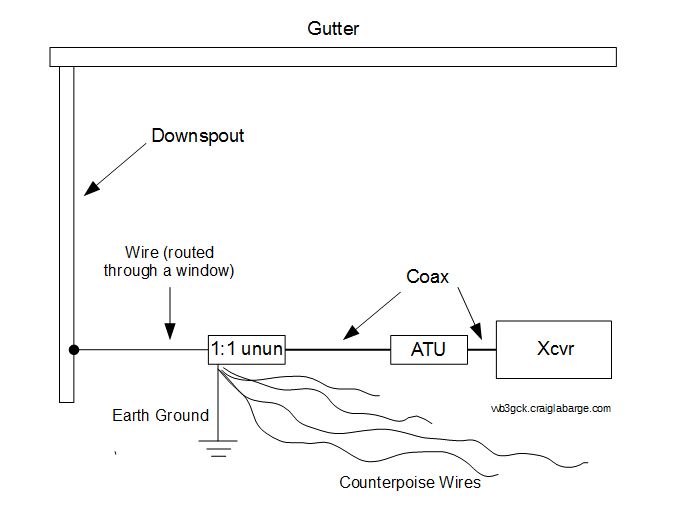
Diagram of the WB3GCK Downspout Antenna
WB3GCK Downspout Antenna

I use my downspout like a random wire antenna, using a commercial autotuner (or internal tuner, in the case of my KX3). I feed the antenna through a homebrew 1:1 unun.  I use a short run of coax between the unun and the autotuner on my operating table.  A length of #22 stranded hookup wire is used to connect the output of the unun to the downspout outside.

To connect the wire to the downspout, I first sanded the downspout and connected the wire using three sheet metal screws.  I used multiple screws to help ensure a low resistance connection.  After making the connections to the downspout, I sealed them up using an adhesive/sealant called Goop.  Goop is available at most hardware stores.

With the downspout behaving essentially like an end-fed wire, it really helps to work this type of antenna against a good ground. Fortunately, my basement operating position is only a few feet away from where the water supply pipe enters the house. I used a piece of 1/2-inch copper pipe as a ground bus between my operating position and the incoming water pipe. A tinned copper braid strap and a couple of ordinary automotive hose clamps were used to connect the bus to the water pipe. A short braid strap connects the ground stud on the unun to the copper ground bus.

For good measure, I attached counterpoise wires to the ground stud of the unun; one each for 40, 30, 20, and 15 meters. The counterpoise wires are made from garden variety stranded hookup wire cut to a quarter-wavelength. I just run these wires around the shack, hiding them under the rug. Operation on the 80 meter band has been successful using just the ground bus.

How well does it work? During the first few months of operation, I worked 49 states; all with 5 watts or less. I’ve also worked a bunch of DX stations (though I’m more of a casual rag chewer than a DX-chaser). The length of the “antenna” is somewhat short for 80 meters, but performance on that band has been a big surprise. Signal reports on 30 and 40 meters, my primary bands, have been consistently good. In fact, the downspout has been my main antenna at home for more than 20 years.

While this arrangement has served me well, it is not without an issue or two.  I find that it helps to clean up and re-do the connections at the downspout periodically.  Typically, I do this maintenance every other year or so.  Also, I have noticed that my local noise levels on 80 and 40 meters have steadily increased over the years.  I attribute this to the proliferation of electronic gadgets both in my house as well as my neighbors’ houses.  Those bands are still usable, though.

Some words of caution are in order, however, if you plan to use your rainspout as an antenna:

  1. Make sure your gutter and downspout are isolated from ground.
  2. Make sure there is solid electrical continuity between the various sections of your downspout and gutter. Mine are fastened with pop rivets (not the greatest for RF work, but they appear to be doing the job.)
  3. Watch your power. I wouldn’t recommend running a kilowatt into your rainspout. Ham radio is fun, but not worth burning down your house.
  4. Make sure people and pets won’t come in contact with the “antenna” while you’re transmitting. This isn’t too much of a problem at QRP power levels, but be careful.

So, if you find your HF antenna options are limited by either space or legal restrictions, take a look at the outside of your house. There just might be a free multi-band antenna hanging out there!

72, Craig WB3GCK


Horse-Shoe Trail Bike Ride

I headed out this morning with the dual purposes of getting in a bike ride and doing a little portable QRP operating.  My destination was a 3-mile section of the historic Horse-Shoe Trail that runs through Warwick County Park.

I had never been on this section of the trail before, so I didn’t know exactly what to expect.  It’s a beautiful trail and very well maintained.  The stone and sometimes rocky surface was better suited for a mountain bike.  My old hybrid bike was able to handle it with no problems, though.  At the bottom of a rocky hill, I came across an open field and decided to set up the radio there.

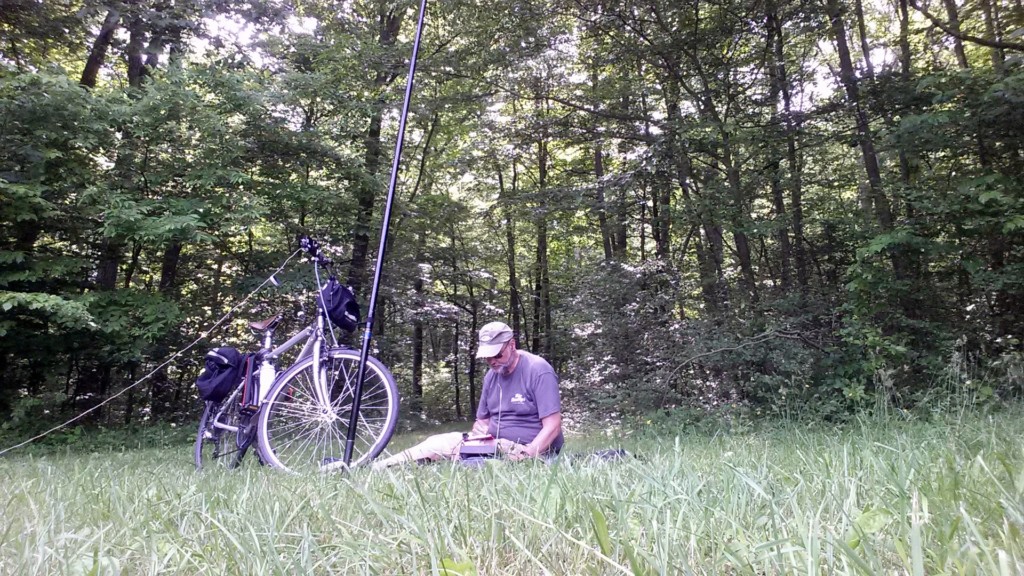
Operating from the Horse-Shoe Trail Field North.

I set up an experimental antenna that uses a compact 20-foot telescopic pole I picked up recently on eBay.  It’s basically a variation of the Rybakov Vertical with a 25-foot wire fed through a 4:1 unun.  I laid out one 25-foot radial on the ground.  I mounted the pole by simply placing it over a screwdriver shoved into the ground.  Since the wire is longer than the pole, I attached the unun to the bike’s handlebar and ran a short coax down to my KX3.  The KX3’s ATU matched it easily from 40 through 10 meters.

My operating position

I called CQ on 20 meters and had a nice chat with Lynn, NG9D, near Chicago.  I think he thought I was crazy using an untested antenna out on a trail.  (I had a backup!)

Moving down to 30 meters, I worked Mike, W9KY, in Indianapolis.  I finished up on 40 meters with a short 2-way QRP QSO with Jack, WD4E, in North Carolina and a nice QSO with NY2MC aboard the USS Ticonderoga in Whitehall, NY.  I did a little more experimenting with the antenna before packing up the bike for the ride back.

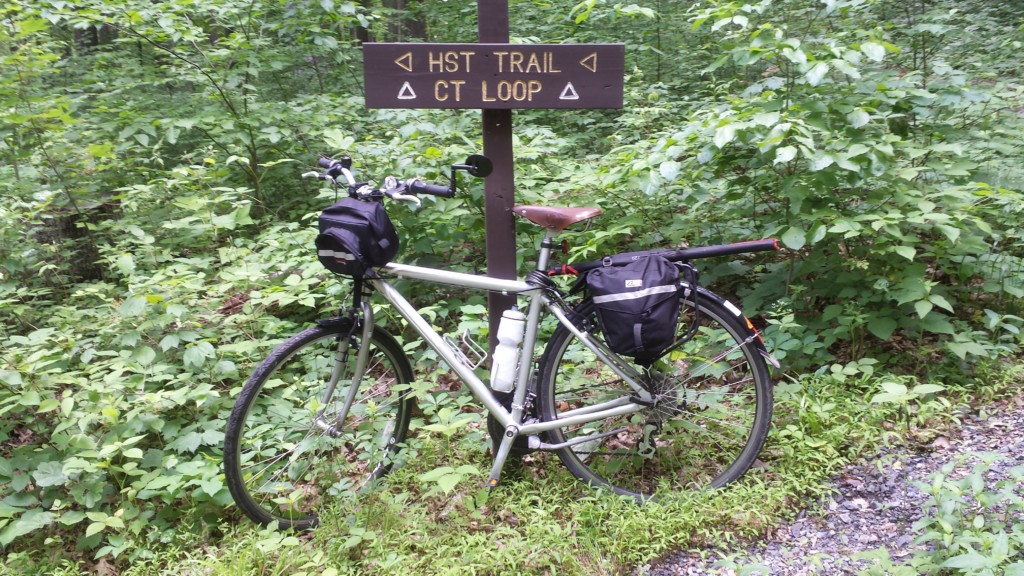
My trusty bike loaded up on the ride back to the trailhead

As I expected, this antenna isn’t a real barn burner on 40 meters but it seems to work well enough for casual operating.  The pole weighs about 12 ounces and collapses down to about 26 inches, making it easy to transport via bike or backpack.   I definitely need to make some refinements to the antenna, though.  If it works out, it will be the subject of a future post.

It was a nice morning in a beautiful park.  I’m looking forward to exploring some of the other trails.

72, Craig WB3GCK

New AlexLoop Tripod

As mentioned in a earlier post, I have been using the Vivitar VPT-1250 tripod with my AlexLoop, as suggested by the vendor, Alex PY1AHD.  The Vivitar tripod has a few advantages.  It’s very light, fits in the AlexLoop carrying case and it’s inexpensive.  On the downside, it’s not particularly rugged.  It’s a great solution for casual operating but I wanted something a bit more robust for operating in the field.

UltraMaxx Model# UM-TR60BK tripod. The camera mount and carrying handle have been removed.

After doing some searching, I came across the UltraMaxx UM-TR60BK.  It’s 60-inch tripod that is much sturdier than the Vivitar tripod.  In particular, the very bottom sections of the legs are thicker than those of the Vivitar tripod.  The bottom sections of the UltraMaxx are about 19/32″ (13.7mm) compared to 5/16″ (7.85mm) for the Vivitar.  It also wasn’t very expensive.  I found a source on eBay for less than $20 shipped.

Comparing the diameter of the bottom leg sections of the UltraMaxx Model# UM-TR60BK tripod (top) and the Vivitar VPT-1250 (bottom).

One nice feature of the UltraMaxx is the accessory hook at the bottom of the center post.  This can be used to suspend some weight to help stabilize the tripod in windy conditions.  I envision using a bungee cord between the accessory hook and my backpack on the ground beneath the tripod.

UltraMaxx UM-TR60BK accessory hook on the bottom of the center post.

Adapting the UltraMaxx tripod for use with the AlexLoop was a snap.  I easily removed the pan head/camera mount, leaving just the bare center post.  The center post is just slightly smaller than the opening of the AlexLoop tubing.  So, I took a velcro cable tie, doubled it over and placed it on the center post as I placed the AlexLoop over the post.  This gave a nice, snug fit.  I also removed the handle attached to the underside of the tripod; I don’t envision a scenario where I would use it.

This is how I arrange the Velcro strap before placing the AlexLoop on the tripod. This gives a nice, snug fit.

The sturdiness of the UltraMaxx tripod does come at a price.  With the head removed, it only collapses down to 19 inches (48cm) compared to 14.5 inches (37cm) for the Vivitar.  The UltraMaxx doesn’t fit inside the AlexLoop bag but it does attach neatly to the outside of my backpack.  Also, the UltraMaxx weighs in at 1.3 lbs (584g) compared to 12 ounces (341g) for the Vivitar.  For my purposes, this isn’t a huge trade-off.

I don’t plan to retire the Vivitar tripod anytime soon.  It will keep its permanent spot inside the AlexLoop bag.  It’s still a good solution for quick excursions to the local park.  But when I’m out in more rugged conditions, I think the new UltraMaxx tripod will suit my needs a little better.

Now, all I need is some spare time to do some field testing the with the new tripod.

72, Craig WB3GCK


Antenna Testing at Black Rock Sanctuary

I almost talked myself out of going out today.  My grandkids got together and gave me one heck of a cold for Christmas.  Thanks a lot, kids.  🙂  Despite being a little under the weather, I packed up and headed out.  I’m glad I did.

I drove to nearby Black Rock Sanctuary to test the equipment I plan to use for a National Parks on the Air (NPOTA) activation on New Year’s Day.  My antenna today was a 29.5-foot vertical wire with two similar wires on the ground for a counterpoise.  I ran one of the wires around the tires of my truck.  I ran the other wire into a grassy area directly behind the truck.  I figured I was in an area that wouldn’t see any pedestrians.  (More on that faulty assumption later.)  My rig was my old Yaesu FT-817 and Z-817 tuner.

My vertical antenna. 29.5-foot radiator fed through a 4:1 unun with two 29.5-foot radials.
My vertical antenna. 29.5-foot radiator fed through a 4:1 unun with two 29.5-foot radials. It loaded up great 40M through 10M.

I had last used the FT-817 on 14.060.  So, when I powered up the radio, I immediately heard my QRP buddy, Ed WA3WSJ, and gave him a call.  Ed was operating pedestrian mobile on Monocacy Hill about 20 miles away from me.  He had a great signal.  Right after I signed with WA3WSJ, Ed W1GUE gave me a call from New Hampshire.

A view of the "cockpit" of my truck.
A view of the “cockpit” of my truck.

On 15 meters, I called CQ on 21.060 and got a quick response from WA8IWK/8.  Allen was portable in Michigan.  While I was working Allen, a woman walked her dog directly behind my truck.  I noticed her child looking down at the ground.  After they left, I went back to check.  They apparently had gotten caught up in my counterpoise wire.  I re-routed the wire around the truck.  Fortunately, I didn’t notice any difference in the antenna tuning.

I moved down to 17 meters and heard Jim W1PID working HK1MW.  Jim was hiking in New Hampshire with W3ATB.  I moved down a little bit and called CQ.  I was hoping that I would catch Jim’s attention.  It worked!  Conditions were great on 17 meters and Jim said I was very strong into New Hampshire.

On 30 meters, I got a call from a familiar callsign.  Wink WA8KOQ from Tennessee is a regular on 30 meters.  I’ve worked Wink many times over the years and it was good to hear him again.

I went back to 20 meters to see if I could find Tim W3ATB.  No luck today.

Finally, I went back to 17 meters and had a quick QSO with John, YV5IUA in Venezuela.

I’m glad I went out today.  The bands were in good shape and my antenna seems to be working great.  I should be ready for my NPOTA activation next week.

72, Craig WB3GCK

‘Twas the day before Christmas…

Or was it?  You certainly couldn’t tell by the weather.  It reached a balmy 71 degrees F today here in southeastern Pennsylvania.  It just doesn’t seem right being outside in late December wearing a T-shirt.

Christmas Eve 2015 Weather

Anyway, the shopping was done and the presents were wrapped, so I decided to sneak out to a local park for a little QRP-portable.  I drove a couple of miles down the road to Charlestown Township Park and set up in my truck.  The forecasters were predicting possible storms, so I operated in the truck today.  I used my roll-on support to put my 31-foot Jackite pole up.  I used one 30-foot wire as a vertical and another on the ground for a counterpoise.  I fed it through a homebrew 4:1 unun.  I used my YouKits HB-1B running 4 watts.

Stationary-mobile set up in Charlestown Township Park
Stationary-mobile set up

I started out on 20 meters but had no luck there.  Moving down to 30 meters, I got a call from Walt WB8E near Detroit.  Walt had a nice signal in Pennsylvania, despite some fading on the band.  Next, I went to 40 meters and had a nice, long chat with Lou WA3MIX in Williamsport, PA.  Lou grew up in my area and has some relatives in nearby towns.  Finally, I went back to 20 meters and called CQ on 14.060MHz a few times.  As I reached over to shut off the radio, I heard Dave KB8XG calling me from Michigan.  This was Dave’s second CW contact.  After wrapping up with Dave, I packed up and headed home.

Whatever your weather is like, I hope you have a very Merry Christmas!

72, Craig WB3GCK