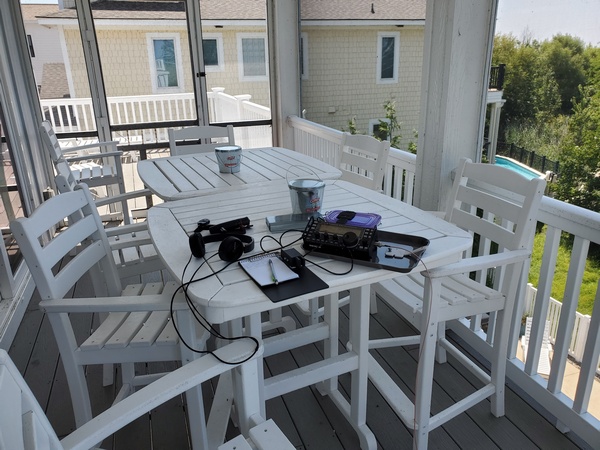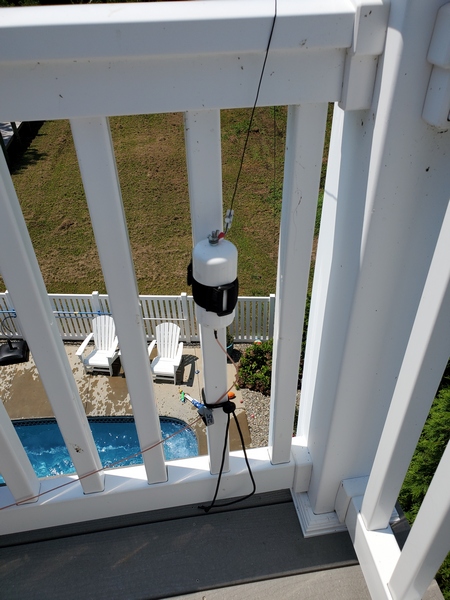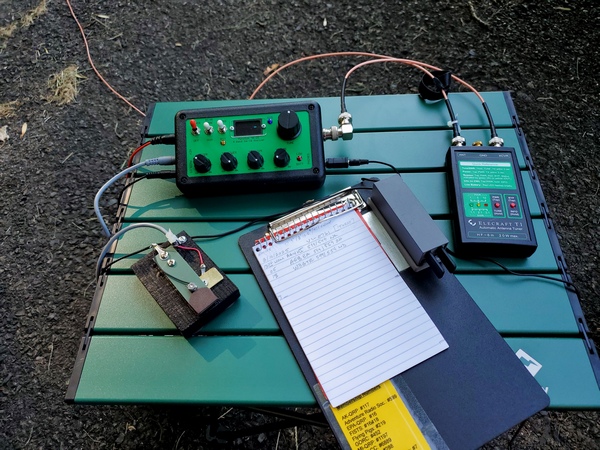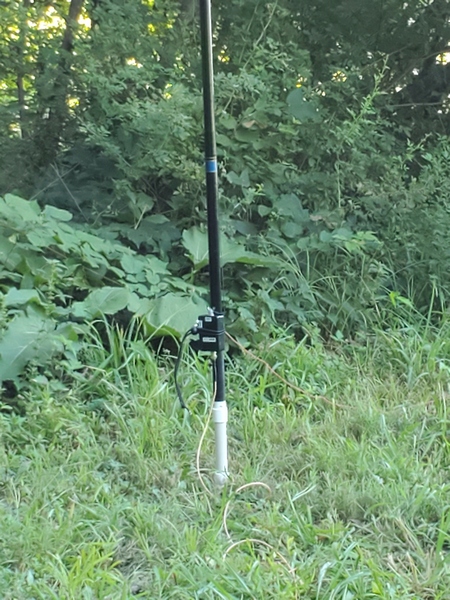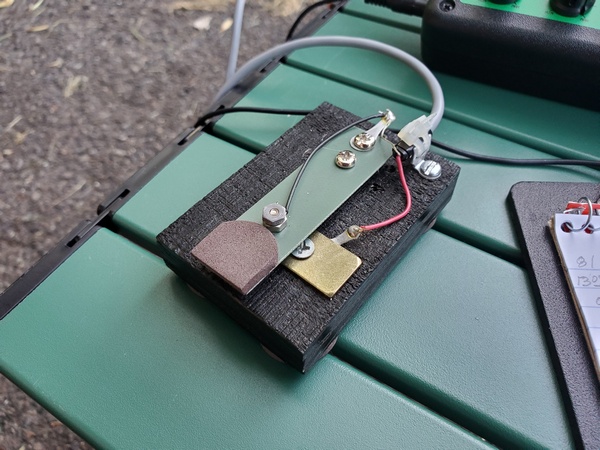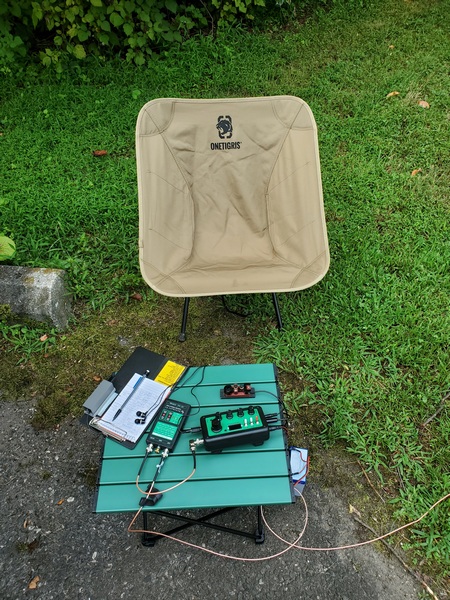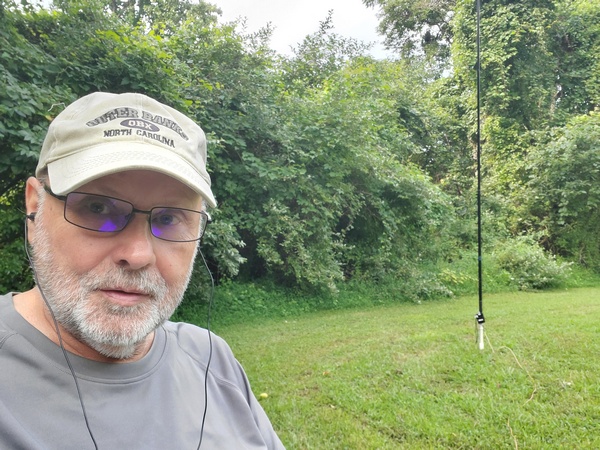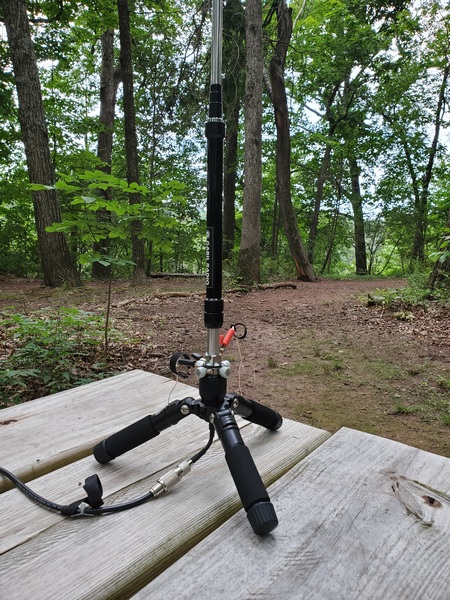
Wanting to take advantage of the excellent weather today, I drove up to Evansburg State Park (US-1351, KFF-1351) for a quick morning activation. I wanted to give my Gabil GRA-7350TC vertical some air time, so I tossed it into the truck and headed out to the park.
The picnic table I planned to use had been moved from its usual spot. Not wanting to drag the heavy table back to where it belongs, I set up at a table I have used previously. It’s close to a hiking trail, so I needed to make sure my radials wouldn’t be a trip hazard for passersby.
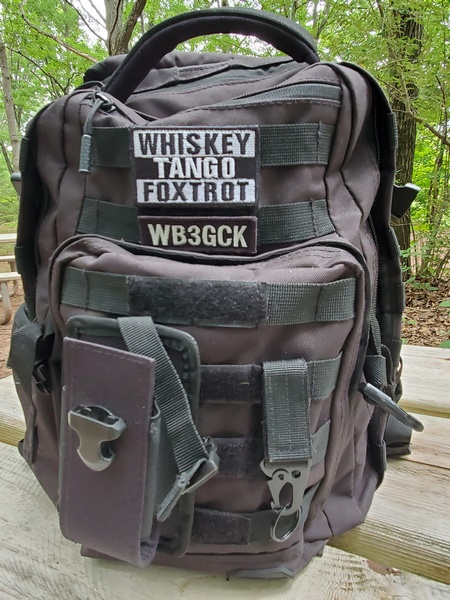
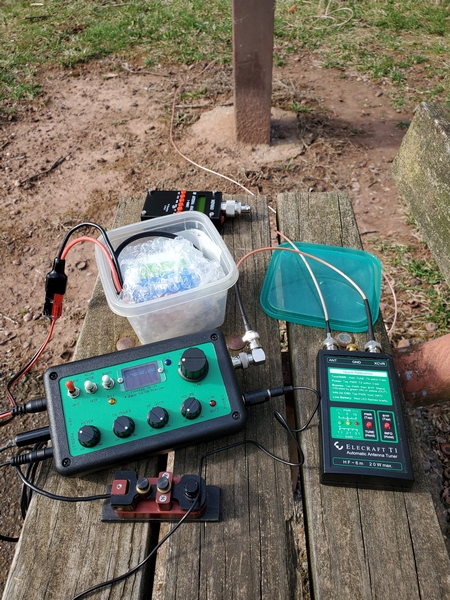
I set up the Gabil antenna on its tripod at one end of the table. To facilitate tuning, I set up my Penntek TR-35 (5 watts, CW) and Elecraft T1 ATU within arm’s reach of the antenna. I meant to bring a 3-foot coax along, but it didn’t make it into my backpack. A 10-foot cable was the best I could do, so I just coiled up the excess. (Note to self: Keep a 3-foot cable in the backpack.)
I started out on 40M, so I laid out a 33-foot counterpoise wire on the ground. I reached for my little SWR meter, but it wouldn’t power on. It had been a while since I had last charged it, so the battery appeared to be dead. I ended up adjusting the antenna for maximum noise in the receiver and used the T1 to do the final matching.
After I had a few contacts in the log, I changed over to 20M. I built my 33-foot counterpoise wire so I could split it into two 16.5-foot wires. After laying out the two counterpoise wires, I tried to peak the noise. No joy. I just couldn’t find a discernible peak.
Just then, I remembered I had a 12-volt power cable for the SWR meter. Duh! Why didn’t I think of that sooner? After temporarily disconnecting the TR-35, I used the battery to power the SWR meter. I quickly got the antenna adjusted to a 1.3:1 SWR. I reconnected the TR-35 and got started. (Note to self: Throw a Powerpole splitter in the backpack.)
The action was relatively slow-going this morning, but there were a fair number of activators on the air. After a little over an hour, I had 14 contacts, nine of which were park-to-park.
Despite some minor glitches, it was an enjoyable morning operating in the park.
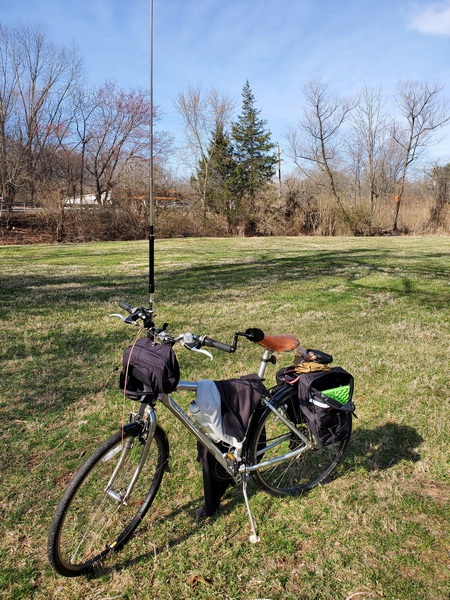
It has been quite a while since I’ve done any bike-portable operating. Over the past couple of years, I’ve dealt with medical issues of one sort or another. This year, I’ve avoided any serious issues, so I dusted off the bike and went out for a ride. While I was out, I tested some new gear for the bike. (I purchased all of the products mentioned with my own money.)
Antenna Mount
I make no claims of originality for this setup. I first saw this antenna mount in a YouTube video by VA7BIX. So, I found one on eBay and fired off an order to give it a try.
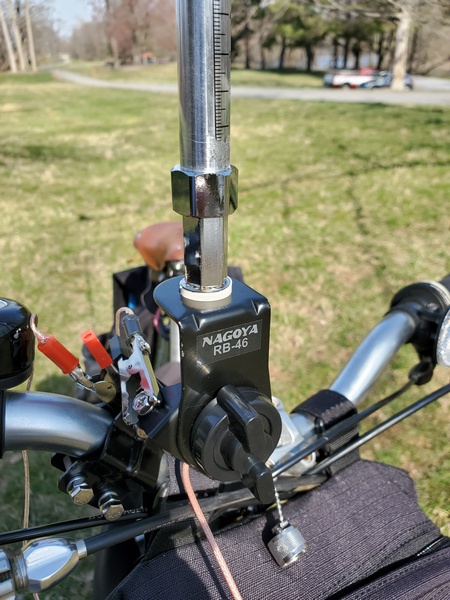
The antenna mount in question is a Nagoya RB-46. I had been looking for a way to mount my Gabil GRA-7350TC antenna (or any antenna with a ⅜-24 mount) on my bike. Originally intended for mounting on a car’s roof rack, the RB-46 can be clamped to the handlebars on bikes. With the kickstand down, my bike leans a bit. Fortunately, I can the adjust the RB-46 in two directions, so the antenna stays vertical. It accommodates a standard SO-239 to ⅜-24 antenna stud mount, which I had on hand.
Installing the RB-46 is quick and easy—for normal people. My installation, however, required extra time for searching the garage floor for dropped nuts and washers. Hardware mishandling aside, I installed the mount on my handlebars and adjusted it so the antenna would be vertical with the bike’s kickstand down.
Nagoya RB-46 antenna mount attached to my handlebars with my Gabil GRA-7350TC installed.
I also had a protective cap for the SO-239 in my junk box, so I put it to use here. Just in case it rains while I’m riding, I carry a ⅜-24 bolt in my handlebar bag. I figure I could put that in the antenna mount to keep the rain out. That’s probably overkill, but that’s how I roll. (No pun intended.)
New Panniers
I really like the cheap set of pannier bags I have been using for more than a decade. Sadly, they were really showing their age and were being held together with liberal applications of duct tape. Figuring I had gotten my money’s worth out of the old bags, I ordered a set of Bushwhacker Moab pannier bags.
The new bags are slightly larger than my old ones, so there’s more than enough room to carry my radio gear. My Bushwhacker handlebar bag has been going strong for about 12 years, so I’m hoping my new panniers also have a long life.
Schuylkill River Trail
I’m fortunate to live near the Schuylkill River Trail, a beautiful multi-use trail that runs along—you guessed it—the Schuylkill River. Since I haven’t been on the bike in a while, I chose a section of the trail for a three-mile ride that leads to a quiet local park.
Before loading up my bike, I always check the tire pressure. This morning, the front tire had gone flat, despite having fully inflating it a couple days earlier. After installing a new tube, I was finally on my way. Then, as I was driving to the trailhead, it started raining. Geez, what else!? Thankfully, the rain stopped by the time I reached the trailhead.
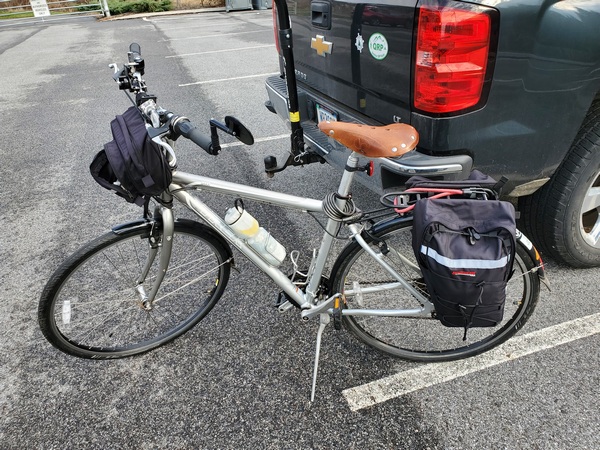
Bike loaded up and ready to roll
I rode about three miles to Towpath park, a ride I’ve done many times in recent years. The ride was uneventful, and I was soon setting up the GRA-7350TC on my new antenna mount. I used two 17-foot radials laid out on the ground and 25 feet of RG-316 coax. It was easy to get a 1.3:1 SWR on 20M.
Set up and on the air in the park
To see how it works, I set up my Penntek TR-35 on a nearby park bench. Tuning around I found some POTA activators to call. I ended up working three of them. It was fitting that one of my contacts was with Jim N4JAW. Jim is a bicycle/ham radio enthusiast I wrote about in a recent post. (Jim told me later that he was also bike-portable. You can read about his POTA activation operation and our QSO on his Ham on a Bike blog.)
My Penntek TR-35 set up on a park bench
Before tearing down, I checked the other bands with an antenna analyzer. I was able to get good matches on 30M through 12M. The 10M band was a little finicky. I didn’t use my longer radials, so I knew 40M would be tough.
Happy with the results, I loaded up the bike for the ride back to my truck.
Wrapping Up
I have a few takeaways from today’s ride:
The antenna mount worked great. However, using a PL-259 to BNC-F adapter on the antenna mount caused some clearance issues. It was a little tricky connecting the coax. I need to try using a right angle adapter next time.
The new panniers were easy to put on and take off the bike. Having a little extra room is a plus.
My short ride today was no Tour de France, but it reminded me how much I enjoy riding my bike. Yep. I definitely need to do more bike-portable outings this year.
My (far) better half and I spent the weekend in Central Pennsylvania watching the grandkids, while our second harmonic and her husband were off celebrating their anniversary. Of course, I took some radio gear along to do some QRP-portable operating while I was out there.
I had a brief window of opportunity on Saturday morning, so I drove to the Falmouth Access boat launch along the Susquehanna River to activate the Captain John Smith National Historic Trail (US-4567). Since we used the (far) better half’s car this weekend, I used this opportunity to try out my Gabil GRA-7350TC vertical and magnetic mount on her car for the first time. I also brought along my trusty Penntek TR-35 (5 watts, CW).
The Gabil GRA-7350TC & mag mount on my (far) better half’s car, while activating the Captain John Smith National Historic Trail (US-4567)
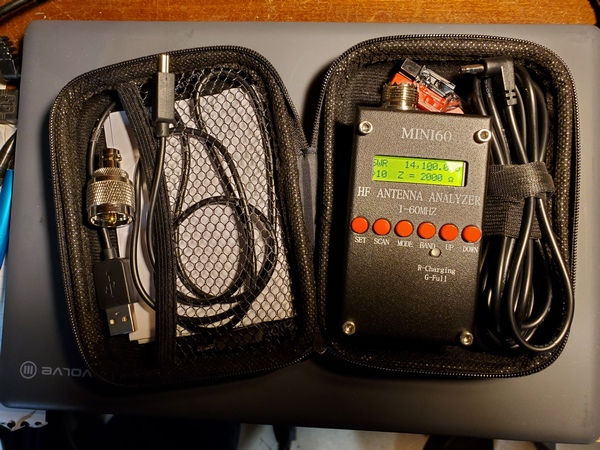
To facilitate tuning the vertical, I used a recently acquired Mini60 analyzer I bought off AliExpress. It’s cheap and a little quirky, but it’s small and its simple SWR readings got the job done. I started on 40M and got the SWR down to 1.3:1 without adding radials. That’s better than I had ever gotten on my pickup truck. I guess the roof on my XYL’s little SUV provides a better ground plane than my truck.
The Mini60 Antenna Analyzer. I found a case on Temu just the right size to hold the Mini60 and some accessories.
Band conditions were generally lousy, and there was some horrendous local noise in 40M and 20M. I didn’t experience any noise issues the last time I activated from here. Despite all that, I managed to scrape together 17 contacts in about 35 minutes, including one with F4ILH on 17M. Also, thanks to W5KEB for working me on two bands. (My apologies to a couple of hunters I couldn’t pull out of the crazy noise in 40M and 20M.)
Even though the bands weren’t too hot, I was pleased with the performance of the Gabil antenna. It’s another good antenna option when I’m using my (far) better half’s car (or any car, for that matter).
Back in 2017 I built my 19-foot wire vertical, which was my go-to portable antenna for about 4 or 5 years. The concept was simple: It functions as a base-loaded resonant vertical on 40M & 30M and as a random wire on 20M and up. The matching unit contains a tapped toroid for 40M & 30M and is fed through a built-in 1:1 choke. It occurred to me I could do something similar with the 12-foot telescopic whip and homebrew loading coil I’ve been using on my truck of late.
My 12-foot whip setup is resonant on 40M through 17M. You’re probably thinking: “Why not just bypass the loading coil and adjust the length of the whip for 15M through 10M?” Well, being as lazy as I am, that would make band changes a little more involved than I want to deal with. I like having some “frequency agility,” and I’m not above using an ATU to achieve that.
To emulate the scheme I used for the 19-foot vertical, I just needed a choke at the input to my homebrew loading coil. (I could probably go without the choke, but I wanted to keep the coax from becoming part of the antenna.) So, I use the 12-foot whip as a base-loaded resonant vertical on 40M through 17M. For 15M through 10M, I would bypass the coil and use an ATU.
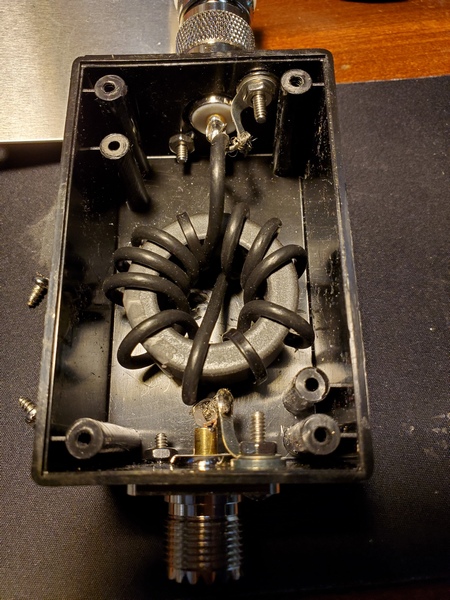
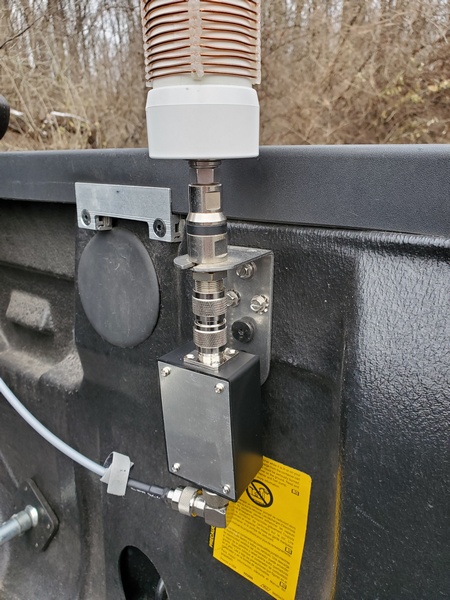
To test this out, I threw together a choke using parts I had on hand. I wound 10 turns of RG-174 on an FT-140-43 toroid. A Radio Shack project box I had in my stash of parts was the perfect size to house the toroid. (I bought it a decade or two ago, and it was still unopened in the original Radio Shack packaging.) Since I installed SO-239 connectors on each end, I had to use an adapter to connect the choke to the SO-239 on the antenna. To hold the coil in place, I wedged a piece of foam packing material between the lid and the core. The completed choke is functional, albeit a little cheesy-looking.
The choke is 10 turns of RG-174 coax on an FT140-43 toroid.
My first test using the 12-ft whip on the higher bands was a success. While activating Ridley Creek State Park (US-1414, KFF-1414), I used my KX3 (5 watts, CW) and installed the choke at the antenna feedpoint. On 40M through 17M, the loading coil functioned as it normally does. On 15M, 12M, and 10M, I bypassed the coil entirely and relied on the KX3’s internal ATU to load up the whip.
The choke installed at the antenna’s feedpoint
The KX3 easily found matches on all three bands, and my results on the air were encouraging. On 15M, I worked stations in Poland, Belgium, France, Ukraine, Germany (3), and the Slovak Republic. I made two stateside contacts on 12M. Up on 10M, I worked some more DX: Germany (2), Italy, and Czech Republic. One of the German contacts was park-to-park.
I’ve used this arrangement on a few more activations since then, including Winter Field Day. My results have been consistently good.
I haven’t done any modeling, but the 12-foot whip seems to be a pretty good length for operating like this. It’s just a little longer than a ¼-wave on 15M and a little shy of ⅜-wave on 10M. On 12M, it’s somewhere between ¼ and ½-wave; so it isn’t resonant on any of the bands of interest.
Although I was pleased with these initial results, I might do a little more tinkering with this setup. I’m toying with repackaging the choke to make it a little more weather resistant. I encountered some rain during the first activation using it. There was no damage to the choke at all, but I always have a tendency to over-engineer things—it keeps me occupied and out of trouble, I suppose.
No scientific breakthrough here. Just a lazy guy “force feeding” a fixed length whip to squeeze a few more bands out of it.
During a recent activation, my beloved MFJ 12-foot telescopic whip came apart. I’ve had it for a long time, so I was really disappointed when it broke. I specifically designed my homebrew loading coil to pair with a 12-foot whip. With this setup, I can work 40M through 17M by changing the tap on the coil. I don’t need to adjust the whip. These bands match the bands covered by my Penntek TR-35.
When the old whip broke, I salvaged the parts and tried to put it back together when I got home. No joy was to be had. However, all was not lost.
Although 12-foot telescopic whips aren’t aren’t as widely available as the ubiquitous 17-foot whip, I found one in stock at Ham Radio Outlet. After placing my order, I had the antenna on my porch 24 hours later on Christmas Eve. (I have no financial interest in HRO. I’m just a very satisfied customer.)
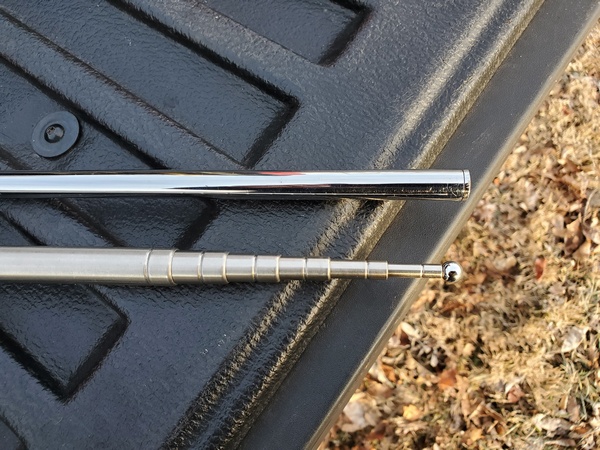
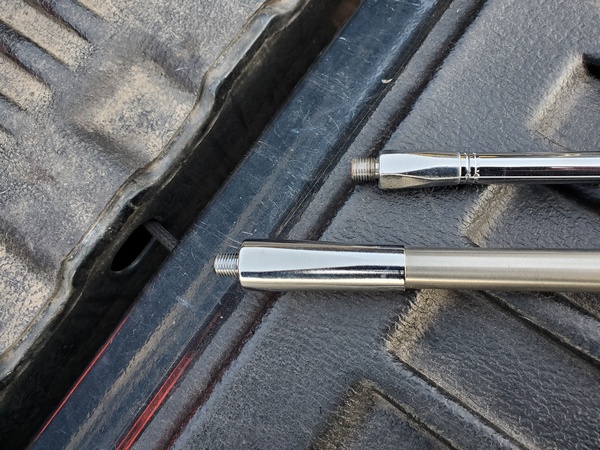
This new whip is an MFJ-1977, and it’s distinctly different from my old MFJ-1956 whip. The new whip’s construction is the first obvious difference. Additionally, the stainless steel has a less polished finish. The MFJ-1977 is also a little heavier, and its collapsed length is an inch or two longer than the older whip. In the pictures below, the older MFJ-1956 is on the top and the new MFJ-1977 is on the bottom:
The new MFJ-1977 had its maiden deployment at Norristown Farm Park (US-4363, KFF-4363). I used the antenna with my Penntek TR-35 (5 Watts) on 40M, 20M and 17M. As expected, the new antenna seemed to perform as well as its predecessor. After an hour and 10 minutes, I had 42 in the log with three DX contacts: two from France and one from Germany.
My old 12-foot whip saw heavy use, and it served me well. In the future, however, I plan to rotate whips occasionally. I extended my MFJ-1979 17-foot whip to 12 feet and marked it with a permanent marker. I did the same with my cheap 5.6M whip from AliExpress. Hopefully, having two other whips available will let me avoid beating up my 12-foot whip and extend its life.
Reading through some blog posts recently, I came across an interesting idea from John AE5X. In the comments section of a recent post, John mentions adding a ground stud to a magnetic mount. The ground stud allows him to connect two ¼-wave radials (for 20M) for his MFJ-1979 telescopic vertical. So what follows is my implementation of John’s clever idea.
On occasion, I’ve used my Gabil GRA-7350TC vertical with a small magnetic mount salvaged from an old 2M/440 antenna. I plan to use this configuration on my (far) better half’s car while visiting family over the holidays. The mag mount is only 3.5 inches in diameter, so I’m sure it’s not providing much of a ground connection. While the Gabil vertical is certainly usable with this mount, I’ve always felt that it needed more of a counterpoise on 40M and 30M to obtain a better match. I figured John’s idea might be the way to go.
Since I needed to drill a hole from inside the mount, I had to remove the foil covering from the bottom of the mount. This magnetic mount is probably around 25 years old, so removing the foil wasn’t too difficult. Using my pocket knife, I was able to peel the foil off, while keeping it intact.
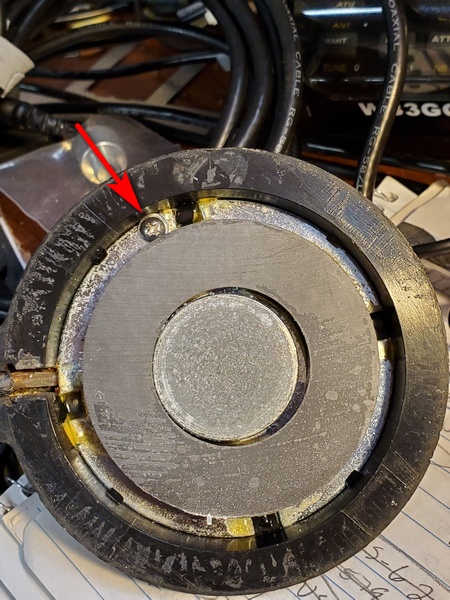
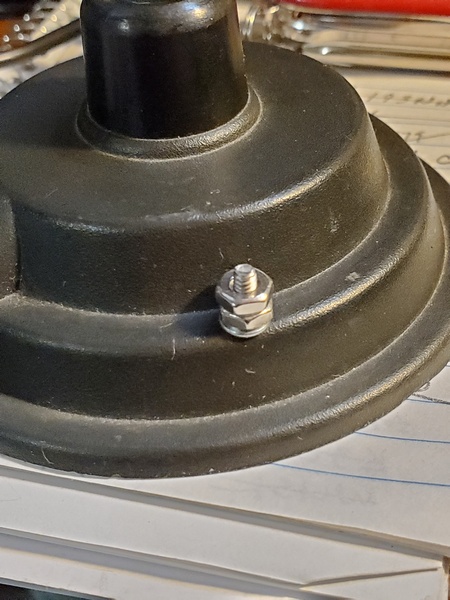
Next, I drilled a ⅛-inch hole through the ground plate and out through to the top of the mount. It was a tight squeeze, but I was able to get a 4-40 bolt and a star washer in there. On the outside of the mount, I used a nut and lock washer.
Interior view of the magnetic mount. It was a tight squeeze, but a 4-40 screw and star washer just fits in there.
The final step was to re-apply the foil covering on the bottom of the mount. I used some rubber cement to reattach it. I don’t know how well the rubber cement will hold up over time, but it won’t be seeing heavy use. It seems fine so far.
Exterior view of the old magnetic mount. I later removed the second nut from the screw I installed.
While I was at it, I replaced the PL-259 connector. The years had not been kind to the connector that was on there.
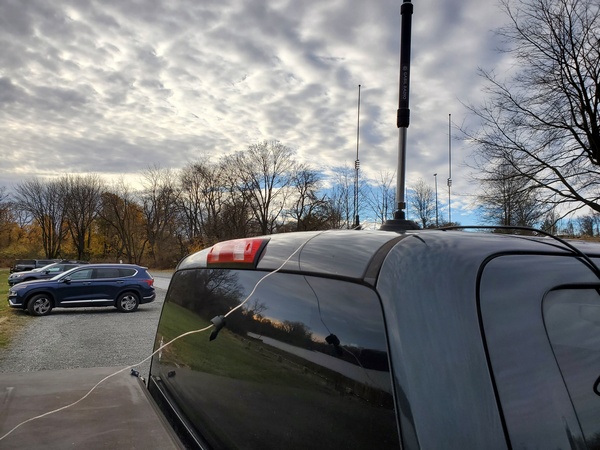
I gave the modified mag mount a try during a recent activation at US-1380, KFF-1380. I used the GRA-7350TC and mag mount on the roof of my truck. With no counterpoise wire attached, the best match I could get on 40M was just a hair under 3:1.
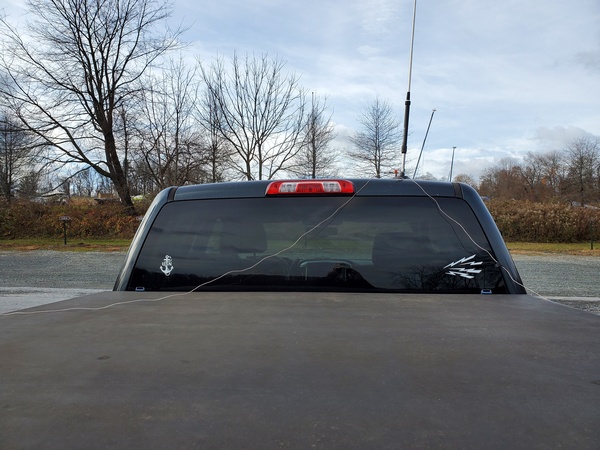
Next, I attached a 33-foot counterpoise wire to the mag mount. I ran the wire off the back of the truck and onto the ground. To avoid creating a trip hazard for others, I wrapped the wire around the side of the truck. In this configuration, I got the SWR down to about 1.2:1. Success!
The Gabil GRA-7350TC and magnetic mount with one 33-foot counterpoise attached. The wire dropped to the ground behind the truck and wrapped around the side.
Using the same counterpoise, the best I could do on 30M was a little under 2:1. I tried two 16.5-foot wires, but the result was about the same. No worries. An SWR of 2:1 is a piece of cake for the Elecraft T1 tuner.
In this configuration, I had two 16.5-foot counterpoise wires attached.
I ran the entire activation on 40M and 30M with great results (40 contacts in less than an hour). In fact, it was the best I have done with the Gabil antenna and mag mount. Was it because of the counterpoise wire? Maybe. Regardless, my five-watt signal was getting out just fine with this thing.
The (far) better half and I made a trip out to central Pennsylvania to attend some activities our grand-kids are taking part in. I had some time on Saturday morning for a quick activation, so I drove a few miles down the road to nearby PA State Game Lands (US-8941, KFF-5862).
We made the trip in the (far) better half’s little Chevy Traiblazer, so like a previous trip, I went with a simple setup. Along with my Penntek TR-35 (5W, CW), I used my Elecraft AX1 on a clip-on window mount. The diminutive AX1 has always gotten the job done in the past, so I hoped for similar results today.
My AX1 on the window mount
Today, I had a couple of things working against me: doing an early morning activation (0900 local time) on 20M coupled with some unsettled geomagnetic conditions. Not to mention running 5 watts into a 45-inch loaded whip. Still, I enjoy a challenge. Or maybe I’m just a glutton for punishment.
With the AX1, it only took a few minutes to get set up and get on the air. After spotting myself, it took nine minutes of CQing to make my first contact. Then, 19 minutes after that, I made contact number two. Yikes! It was looking like I was headed for my first busted activation with the AX1. I also began wishing I had brought my Gabil GRA-7350TC and mag mount, so I could have made some contacts down on 40M. Undeterred, I pressed on.
The crowded operating position in my (far) better half’s car
Not too long after that, things picked up a bit, and I started getting some more callers. Either the band conditions were improving or the hunters were waking up and getting out of bed. One of those callers was OH1MM. I had a weak copy on him, so I can only imagine what my QRP signal sounded like in Finland.
An hour after arriving onsite, I had 14 contacts, including one park-to-park and one DX contact. I was happy with that, so I packed up and headed back to my daughter’s house for a late breakfast.
So, despite getting off to a slow start, my little AX1’s undefeated streak remains intact.
It’s been a while since I’ve done a cheap speaker wire antenna, so here’s another one for you. Back in the early to mid-2000s, an antenna commonly referred to as the “No Counterpoise Antenna” was making the rounds on the Internet. I thought I might give it another look.
The No Counterpoise Antenna is either a 25-foot or 50-foot length of two conductor wire with half of one conductor removed. Essentially, it’s a radiator fed through a balanced line feeder. The 25-foot version is said to cover 20M through 10M, while the 50-foot version is supposed to cover 40M through 10M. It was usually connected to a balanced tuner of some sort or sometimes fed through a 4:1 balun. It was typically constructed from zip cord or speaker wire. So, this is perfect for another speaker wire project. (Actually, I built the 50-foot version years ago, but I don’t recall ever putting it on the air.)
A picture is worth a thousand words, so here goes:
I’ve seen this antenna sometimes referred to as a Zepp. A true Zepp is basically a half wave radiator with a quarter wave balanced line matching section. Unlike a true Zepp, the No Counterpoise Antenna is non-resonant, so I guess it’s actually “Zepp-ish.” Because it’s non-resonant, a tuner is required for this antenna.
I did some extensive research into the origins of this antenna. (OK… I just did a few Google searches.) Jeff Imel K9ESE came up with this design. I remember Jeff used to sell a high-quality version of the antenna on eBay. The reviews were generally positive.
Pete Millis, M3KXZ, is another name often associated with this antenna. I think that’s how I first came across it. Pete once made a phased array from two 25-foot versions.
In the August 2020 edition of Ozark QRP Banner, the Four State QRP Group’s newsletter, Terry Fletcher, WAØITP, had a nice write-up about it. He discusses his experience with both the 25- and 50-foot versions.
This antenna design has been around the block a time or two. So, there’s no innovation here on my part whatsoever.
Construction
I happened to have a 25-foot roll of #18 awg speaker wire on hand, so this time around, I opted to build…you guessed it… the 25-foot version.
Construction was about as easy as it gets:
I split the speaker wire halfway and cut off one side
Next, I twisted a loop at the end of the single wire and secured it with some Goop® adhesive. As an alternative, you could just tie a loop at the top or crimp a ring lug over the wire’s insulation.
I stripped and tinned the wires at the feedpoint and installed spade lugs. You can just strip and tin the wires, if you like.
To keep the speaker wire from splitting further, I put some heat shrink tubing a couple of inches up from the lugs. I also added a dab of Goop® in the middle of the antenna where one side of the wire was removed. All of this is completely optional.
Construction probably took me all of 15 minutes or so. That doesn’t include allowing the adhesive to cure overnight. However, the antenna was certainly usable without the adhesive and heat-shrink tubing I used. I’m just prone to overkill.
On the Air
To test the No Counterpoise Antenna, I drove down to Ridley Creek State Park (US-1414, KFF-1414). Using my drive-on mount, I supported the antenna from a 28-ft Jackite pole. I used a homebrew 4:1 unun at the feedpoint and ran 15 feet of coax into the cab of my truck to my KX3 (5 watts, CW). I used the long side of the antenna as the radiator.
I used my roll-on mount to support a 28-ft Jackite pole
Before I got started, I checked to see how the tuner in the KX3 would handle the antenna. The KX3 easily found a 1:1 match on all bands from 40M through 10M. Just for the heck of it, I tried 60M and 80M. The KX3 was able to find a good match on those bands, too. (That’s not too surprising, given that I once forgot to attach my coax to an antenna, and the KX3 still found a match.) I doubt this antenna would work well on 60M and 80M—but stranger things have happened. I wasn’t able to try it, but I’m sure the KX3 would be able to match it directly connected to the radio without the 4:1 and coax.
I used a 4:1 unun at the feedpoint
Band conditions weren’t very good, so this wasn’t an ideal test. Despite the mediocre band conditions, I logged 13 contacts during my short activation. Most of my contacts were on 40M. There was considerable fading on 30M and 20M, but I made a contact on each of those bands.
This was hardly a rigorous evaluation, but the 25-foot No Counterpoise Antenna got the job done. I need to give it another try, when conditions are better.
Anyway, if you have some speaker wire and a few minutes to spare, give this one a try and see what you think.
I had a chance to use the inexpensive whip I bought through AliExpress recently. While it performed well enough, I encountered a couple of minor quality issues. That’s certainly not surprising, given its $18 USD price tag.
Extending the whip, I noticed that two of the sections were pretty tight and took some effort to pull them out. Better tight than loose, I guess. Another issue is that the crimp that holds the mounting stud in the bottom section of the antenna was a little loose. When the antenna was fully seated in the mount, I could still rotate the antenna.
My $18 (USD) whip from AliExpress mounted on my homebrew loading coil
Because this whip is longer than a quarter wave on 20M, I didn’t extend the first section from the bottom. Using an antenna analyzer, I was seeing SWR readings similar to my MFJ-1979 whip. The SWR readings seemed stable. So, I guess the suspect crimp is making a good enough connection.
Band conditions seemed so-so this morning. Despite that, I logged 25 contacts on 40M and 20M in an hour, including three park-to-park contacts. I didn’t work any DX stations today, but I worked a station on the west coast in Washington on 20M.
Even with its issues, the whip did a pretty decent job this morning. It won’t replace my MFJ whip, but it will have a place in my antenna arsenal.
A while back, I ordered a 5.6M/18.4 foot. telescopic whip from a seller on AliExpress. I didn’t really need it, but having seen them on the Interwebs, I was curious to see what you get for $18 USD. Heck, at that price, why not take a chance?
You can find these whips all over AliExpress. (I have also seen them on Amazon for about $10 more.) One nice thing about them is they are 7.5 inches shorter than an MFJ-1979 when fully collapsed. So, it might fit in backpacks easier. The shorter collapsed length is due to having 14 telescoping sections compared to the MFJ-1979’s 10 sections. Because of its thinner metal and lack of a reinforced base, the AliExpress whip weighs 4.4 ounces/125g less than the MFJ whip. Of course, the other obvious advantage is the incredibly low cost.
There are some downsides though. The threads are metric (10mm), so you need an adapter to use it with a ⅜-24 mount. Fortunately, adapters are readily available as well. The other downside that I’ve noticed is that the metal they are made of is pretty thin. (More on that in a bit) The MFJ whip has a heavy stainless steel reinforcement at the bottom, while the AliExpress whip does not.
My antenna arrived from China about a week and a half later. It came wrapped in several layers of bubble wrap with a tough plastic outer wrap. I eagerly opened the package, but I was disappointed to see that the bottom section was damaged. It looked like either someone dropped something heavy on it or Big Foot stepped on it. As I mentioned previously, the metal is pretty thin.
While traveling half-way around the globe, this telescopic whip antenna encountered some rough handling.
When I finished uttering every expletive in my vocabulary, I contacted the seller through the AliExpress app and sent pictures of the damage. They promptly shipped out another antenna, and they didn’t want the old one back. So, I set the wounded whip aside, while I awaited its replacement.
The replacement whip arrived 6 days later, which is pretty impressive for a shipment from China. Happily, this shipment arrived intact. I would be remiss if I didn’t give props to the HUI BANG TE Store on AliExpress. Their customer support was top-notch.
When I get a chance, I’ll take the inexpensive whip out to a park to give it a go. I laid the AliExpress whip next to the MFJ-1979, and it looks like collapsing one section from the bottom on the AliExpress whip makes it about the same length as the MFJ.
I also have some ideas on how to straighten and reinforce the damaged whip to make it usable. That might be a winter project.