Trying Out a KH1 Kneeboard

I ordered a KH1 kneeboard from Tufteln, and it arrived in the mail earlier this week. I was out of town for most of the week, so today was my first opportunity to try it out. 

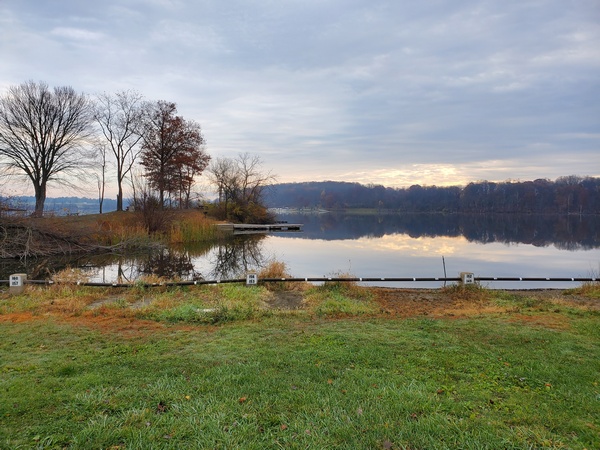
I drove down to Ridley Creek State Park (US-1414, KFF-1414) and headed up to one of the picnic areas. This area is one of the highest elevations in the park. My original plan was to set up in an out-of-the-way clearing in the woods, but with rain in the forecast I thought it would be smarter to stay close to my truck. (Spoiler alert: It was.)

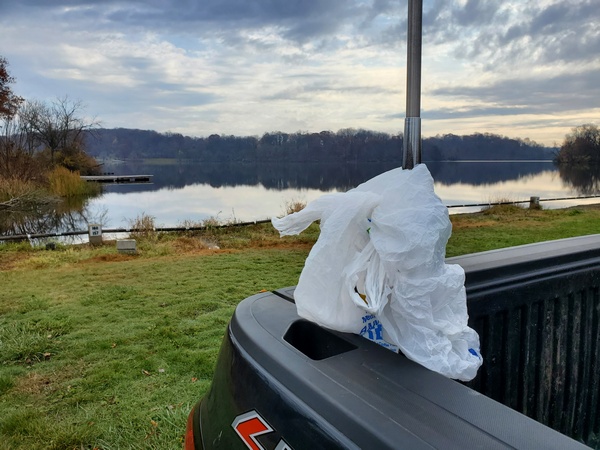
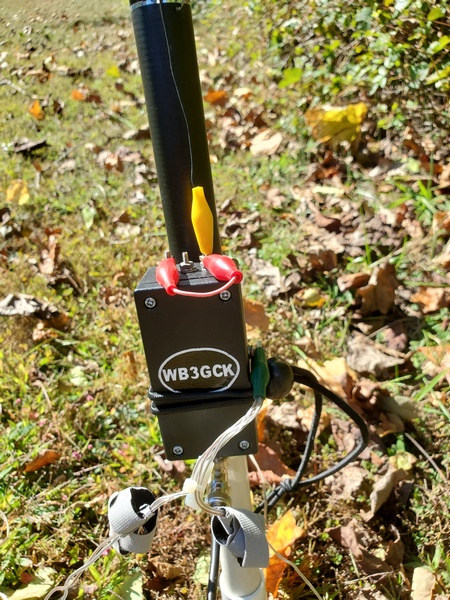
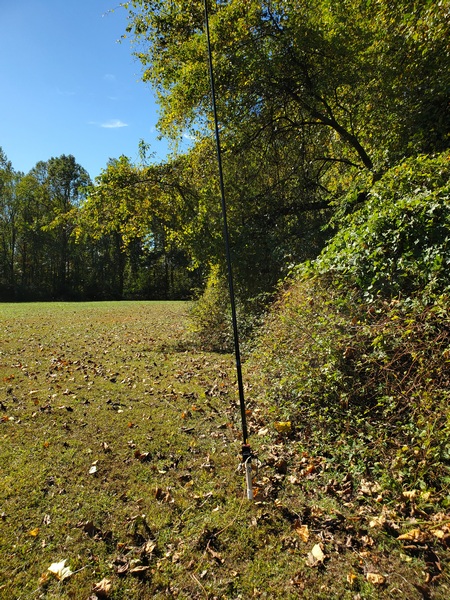
I backed my truck into a parking space away from everyone else and set up a 12-foot whip and my homebrew loading coil on the back of the truck. Next, I ran 18 feet of RG-8x coax over to my camping chair. 

My 12-foot loaded whip mounted on my truck

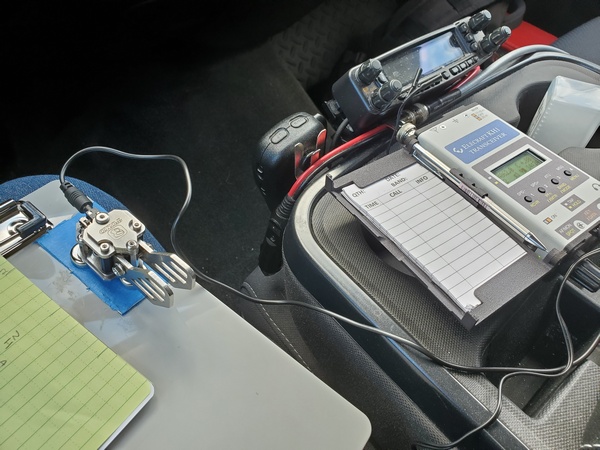
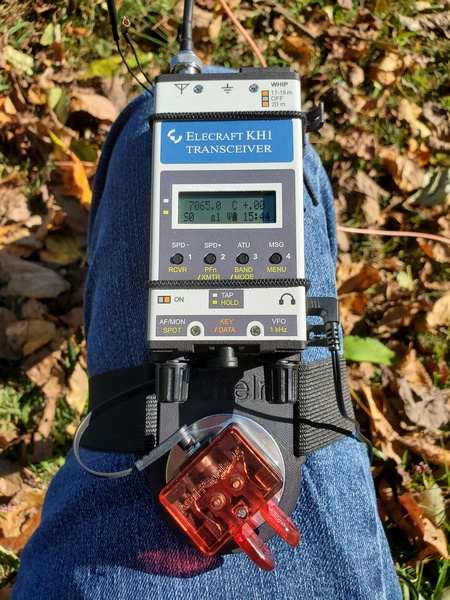
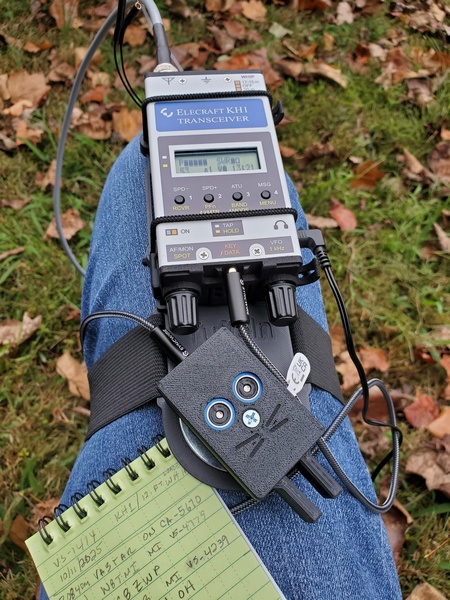
I ordered the kneeboard version with a metal plate for magnetic mount paddles. Mike KE8PTX, designer of the kneeboard, recommends using a short audio cable with right-angle connectors for connecting your paddles to the KH1. I bought a couple but neglected to bring them along this morning. Instead, I used a 3-foot cable. It was a little awkward, but worked just fine. 

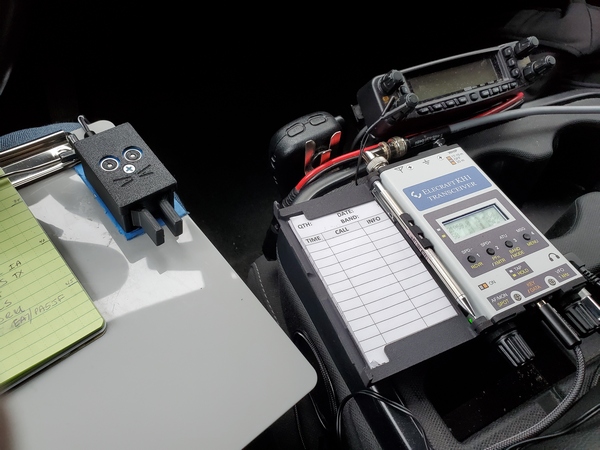
The leg strap provided with the kneeboard was easy to adjust and comfortable to use. I used my CWMouse paddles, and the magnets I glued onto them held on to the kneeboard’s metal plate with no issues. For logging, I used a 3” x 5” weatherproof notebook, which I balanced on my leg by the kneeboard. 

The KH1 and CWMouse paddles mounted on the Tufteln KH1 Knee Board

Settled comfortably into my chair, I got started on 40M. After logging a quick eight contacts, the hunters thinned out. I eventually made my required 10 contacts plus a few more before moving to 30M. After logging eight contacts on 30M, I moved to 20M for five more.

After an hour on the air, I felt a few raindrops and figured I had better pack up. That was an excellent decision, as it started raining as soon as I put the KH1 in the truck. I quickly took down my antenna and tossed my chair in the back of the truck.

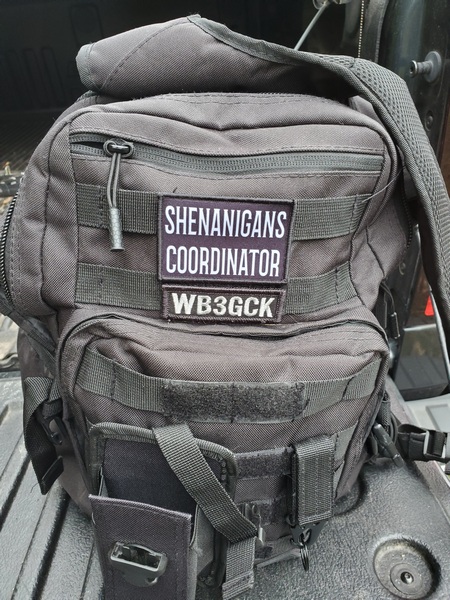
My radio backpack

Although the rain interrupted my activation, I ended up with 27 contacts. Some highlights included:

  • I got a call from F1BLL on 20M. He was an honest 599 into southeastern Pennsylvania this morning.
  • I worked fellow Polar Bear QRP member VE3DN on 40M and 30M. 
  • W9DP and W9GTA each hunted me on two bands.

I have to say that I really enjoyed using the kneeboard. In fact, this might be my new favorite way to operate with the KH1.

72, Craig WB3GCK
Another Short but Successful POTA Activation

Lately, I’ve had to squeeze in my ham radio opportunities whenever I can. (That seems to be a common theme for this blog these days.) This past weekend was a perfect example. While spending the weekend with family in central Pennsylvania, I got in a very short activation and still made it back in time for breakfast with the family.

Always the early riser, I was up on Sunday morning before the rest of the family. After grabbing a quick cup of coffee, I threw my backpack in the car and headed out just after sunrise.

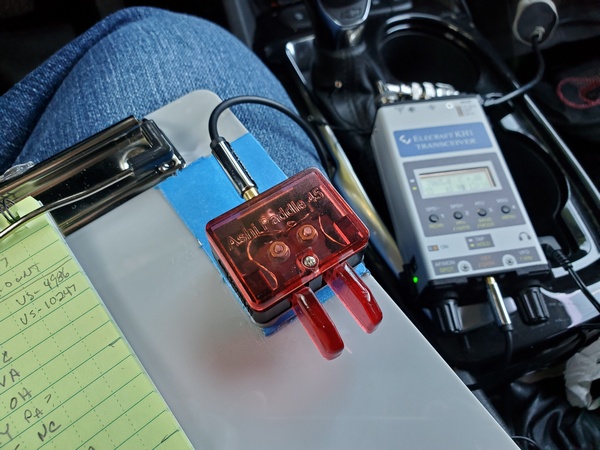
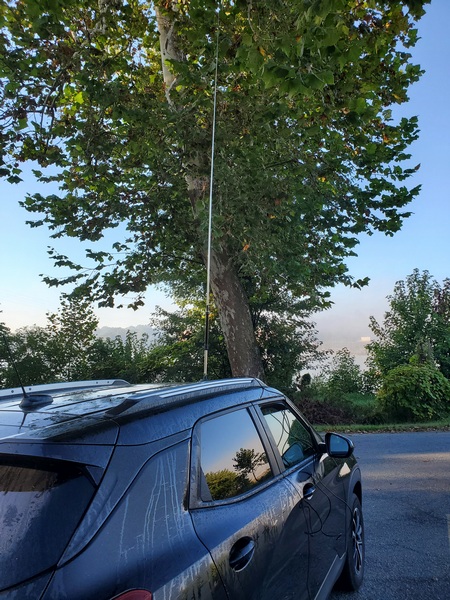
I activated the Captain John Smith Chesapeake National Historic Trail (US-4567) from a boat launch in Lancaster County. Equipment-wise, this activation was a carbon copy of my last visit—minus the paddle issues. I used my Elecraft KH1 in my (far) better half’s compact SUV. Once again, I used my Gabil GRA-7350TC vertical and magnetic mount on the roof of the car. The paddles I used this time out were the Ashi Paddle 45 from N6ARA Electronics. (More on those in a future post.)

Ashi Paddle 45 and Elecraft KH1

After parking in my usual spot, I placed the antenna on the roof of the car and roughly adjusted the coil slider for 40M. I got out my antenna analyzer and conected the coax to fine-tune the antenna. However, when I turned on the antenna analyzer, it showed a 1.26:1 SWR—no adjustment needed! I couldn’t do that again if I tried.

Gabil GRA-7350TC on a mag mount

After hunting for a few park-to-park contacts, I found a vacant frequency and started calling CQ. Like on my last visit, the 40M band was so productive I spent my whole activation there. I operated for about 30 minutes, logging 19 contacts—not too bad for about 4.5 watts into an eight-foot vertical on a mag mount, I guess. Once again, I connected with N4JAW (aka Ham on a Bike). Jim was out doing his usual bike-portable activation at US-7956 in Kentucky.

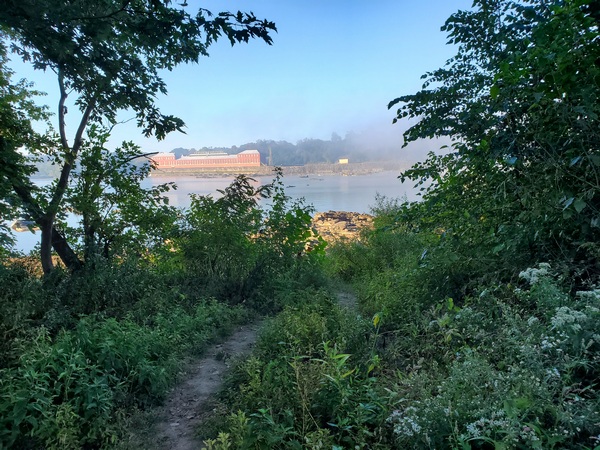
Some morning fog on the Susquehanna River

I packed up in a couple of minutes and was back at the house about 15 minutes later. My time on the air was a little shorter than I would have liked, but at least I had no paddle issues this time.

72, Craig WB3GCK
KH1 Picnic Table Ops

My (far) better half and I had plans to go watch our grandson’s soccer game yesterday, but I still squeezed in a short, early morning activation. I headed over to nearby Valley Forge National Historical Park (US-0761, KFF-0761) and allotted myself an hour of operating time. While I was there, I tried out a few things with my Elecraft KH1.

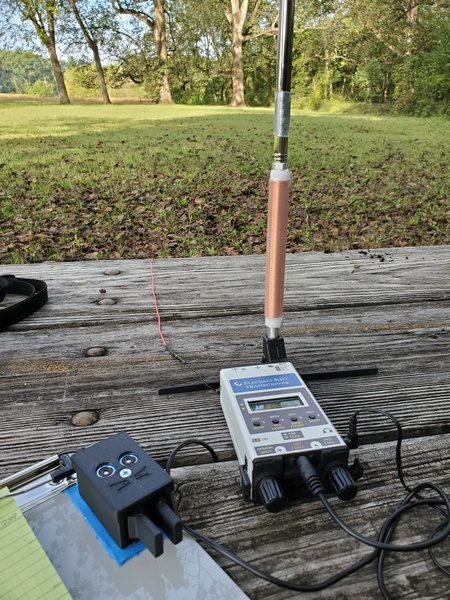
I set up the KH1 at a picnic table and used the whip antenna and AXE1 extender coil. I supported the antenna with a right-angle adapter from Tufteln. This was the first opportunity I had to use the adapter, so I was anxious to try it out. For my counterpoise, I used a homebrew setup with a 13-ft wire and a 20-foot extension for 40M.

The KH1 with the AXE1 loading coil for 40M/30M and the Tufteln right-angle adapter.

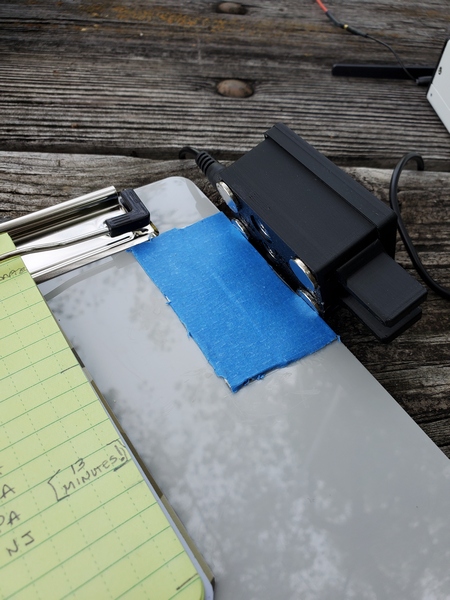
I also gave my CWMouse paddles another go. I glued four small magnets to them the night before, so I wanted to see how they worked with my clipboard. KE8PTX had a Facebook post recently in which he mentioned using painter’s tape on the metal surface of his knee board to give his paddles a little extra traction. As luck would have it, I was doing some painting this week and had some tape handy. I put some on the steel strips on my clipboard right before I left the house. 

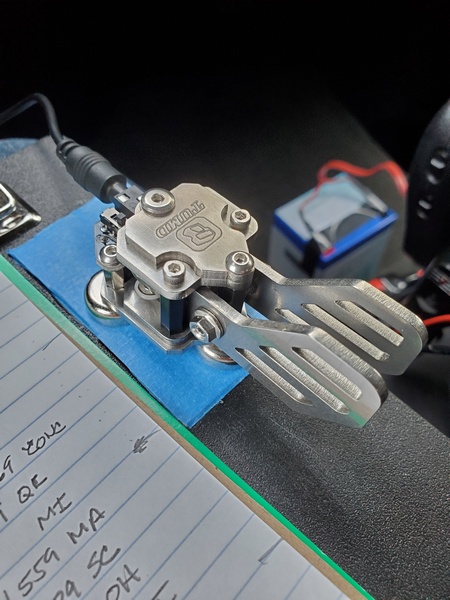
I glued some magnets to my CWMouse paddles. The blue painter's tape helps the magnets get a better grip. You can see the notation I made in my log for my 10th contact.
I glued some magnets to my CWMouse paddles. The blue painter’s tape helps the magnets get a better grip on the steel strips glued to the clipboard. You can also see the notation I made in my log for my 10th contact.

With everything set up, I tuned up the KH1 and got started. My results on 40M really surprised me. Although my signal reports were on the low side, I was getting some decent spots on the Reverse Beacon Network. It took only 13 minutes to log my first 10 contacts. I continued making contacts for 30 minutes, while brushing ants off of my log. (I think there was an anthill under the picnic table. Doh!)

I spent the rest of my hour-long activation on 30M and 20M. There was less activity there, but I picked up a few more contacts on each band.

When my hour was up, I packed up and gave the ants exclusive use of the picnic table. I finished up with 25 contacts in my log; I’ve done much worse with much better antennas. The KH1 did an amazing job with just the whip antenna, and my modified CWMouse paddles worked great attached to my clipboard. 

As you can probably tell, I’m having fun with my new rig. 

72, Craig WB3GCK

POTA with the CWMouse Paddles

I did a POTA/WWFF activation this morning and used it as an opportunity to try out a new set of paddles. During a recent activation, I encountered a recurring problem with the cheap QU-21C paddles I keep in my backpack as a backup. As a result, the finicky paddles have lost out on their role as my backup. 

Always a sucker for unusual paddles, I came across an interesting offering I couldn’t resist. I fired off an order for the CWMouse paddles and had them in my hot little hands two days later. Mike KN6FQM designed the CWMouse paddles, which are currently selling on Amazon for $39.00 (US).

The CWMouse paddles are made from 3D-printed parts and include sealed ball bearing races, two sealed microswitches, and an ⅛-inch stereo jack. One thing that drew me to these paddles was the small size: 74mm/2.9in L x 36mm/1.4in W x 28mm/1.1in H. They weigh a mere 1.5oz/45g, making them ideal for portable use. See the CWMouse website for the complete specifications.  

The CWMouse paddles. For size reference, they are on a 3"x5" notepad.
The CWMouse paddles. For size reference, they are on a 3″x5″ notepad.

My destination this morning was Marsh Creek State Park (US-1380, KFF-1380). I usually operate near one of the boat launches, which can sometimes get crowded during the summer. Given that it was a weekday in September, there was plenty of room in the parking lot. 

My rig today was my Elecraft KH1 into a 12-foot whip and homebrew loading coil. Starting out on 40M, I found lots of strong signals. I made a couple of quick park-to-park contacts before settling on a frequency and calling CQ. I quickly achieved the required 10 contacts and then some. 

My KH1 fit nicely on the center console of my truck.

After 20 minutes, the activity on 40M tapered off, so I moved up to 20M. The action wasn’t as busy on 20M, but I made 11 contacts. One of those was with a station in California—I like when that happens. The 17M band produced three more before I called it quits. After a bit more than an hour, I had logged 32 contacts with six park-to-park contacts. 

The CWMouse paddles performed flawlessly. Because of the microswitches, there are no adjustments for throw or tension. However, they felt great right out of the box. They have a nice, light touch, which is what I prefer. 

One potential issue is the plastic used for the 3D printing. The website is very clear that the paddles should not be stored at temperatures above 100F. This could easily happen in a closed vehicle, so I’ll have to keep that in mind.

I used the “two-handed” technique with the paddles this morning, which is not my preferred way of operating. I’ll probably glue on some magnets, so I can attach the paddles to my clipboard. 

Overall, however, I really like these paddles. It was a pleasure operating with them this morning. 

72, Craig WB3GCK

Paddle Problems & POTA

My (far) better half and I spent the past weekend with family out in central Pennsylvania. During the weekend, I squeezed in a quick, early morning POTA activation. The great band conditions made for a fun activation, but paddle problems made it challenging at one point.

On Saturday morning, I was up before everyone else. After downing a cup of coffee, I took a short drive to a boat launch on the Susquehanna River to activate the Captain John Smith Chesapeake National Historic Trail (US-4567).

We drove out in my (far) better half’s car, so I used a simple antenna setup that produced decent results in the past. I used my Gabil GRA-7350TC on a small magnetic mount. Like the last time I used it on my (far) better half’s car, I easily adjusted it for a 1.3:1 SWR on 40M. I fed the coax through the passenger side window.

Gabil GRA-7350TC antenna on a magnetic mount

Inside the car, I set my Elecraft KH1 on the center console. I used my cheap QU-21C paddles attached to a clipboard with a homebrew magnetic mount I made for them. 

The 40M band was hot with no trace of the QRM I experienced the last time I was there. It only took 14 minutes to log my first 10 contacts, the contacts came in steadily for the next 45 minutes.

I was cruising right along for about 30 minutes until my cheap paddles decided to start dropping “dits” here and there. Based on my crazy sending, I’m sure some folks thought I was experiencing some sort of medical emergency.

I frantically searched for my N6ARA Tiny Paddle that I always carry as a backup. Of course, they were nowhere to be found. I ended up using the stock KH1 paddles attached to the radio, with the KH1 on the center armrest. This setup was an ergonomic nightmare, with my elbow in the backseat area. Despite the awkward position I was in, I was able to finish up my activation.

My setup after my paddle problems started. On hindsight, I could have arranged things better to make my operating position a little less awkward.

After an hour, I had 39 contacts in my log. I was so occupied on 40M, I never got around to trying the higher bands. My log included 7 park-to-park contacts. One of those was with N4JAW (aka Ham on a Bike). It’s always fun working Jim down in Kentucky. 

I also heard from my friend, Greg WA3GM. It had been a while since our last QSO, so it was great to hear him again.

Susquehanna River
Susquehanna River

The Gabil antenna and mag mount setup once again proved to be a great antenna when using my (far) better half’s car. With about 4.5 watts out on 40M, I worked stations up and down eastern U.S. and Canada and out to several mid-west states.

The QU-21C paddles, however, are a different story. This is the second time I have had issues with them. A squirt or two of contact cleaner will usually fix the problem—for a while, anyway. As they say: You buy cheap, you get cheap. 

And, of course, I found my N6ARA paddles as I was packing up. Doh!

72, Craig WB3GCK

Going with Plan C

I set off this morning to activate Norristown Farm State Park (US-4363, KFF-4363) with a specific plan in mind. We’re talking about me, of course; so things don’t always go as planned. Today was a good example of that.

If a specific parking space was available, I planned to use a loaded whip on my truck and operate from a nearby park bench. Failing that, I figured I would set up at one of the picnic pavilions with a vertical of some sort. When I rolled in, however, the parking lot was crowded and people were setting up for an event under the pavilions. So, I was off to come up with a Plan C.

I drove back up the road a bit and pulled into a mostly empty trailhead parking lot. Off to one side, I found a secluded picnic table tucked away in a wooded area. About five minutes later, I was on the air. 

My Elecraft KH1 with the antenna off in the distance

I sometimes think that my 50+ years of ham radio have been an ongoing quest to simplify my operations. My recently acquired KH1 is definitely a giant step in that direction. Everything I need (except for my earbuds) is attached to the radio.

Looking at the propagation forecast, I opted to forego the KH1’s whip antenna and go with something larger. So, I went with the 9:1 end-fed random wire from AD8HK Antenna Systems mounted on a cheap 19-foot telescopic pole. The ground was a little soft, so it took me a few tries with my homebrew ground mount to get the antenna reasonably vertical. 

Even with a vertical just under 18 feet, the 40M band was productive today. After eight quick‌ contacts, things slowed down, and I changed bands. The 30M band produced one contact, while 20M was good for a half-dozen more. I went back down to 40M to pick up a few more before calling it quits. After about an hour, I ended up with 18 contacts, five of which were park-to-park.

My Elecraft KH1 at Norristown Farm State Park (US-4353, KFF-4363)

I have to say I’m really having fun with the KH1. It’s ideal for the short activations I tend to do. The battery life is nothing short of exceptional. This was the second activation since I last charged it, and I could probably do four or five more.

72, Craig WB3GCK

Getting Re-Acquainted with my KH1

A little over a month ago, the finals in my brand new Elecraft KH1 gave up the ghost during my second outing with it. After a trip back to the factory for some TLC from the Elecraft folks, the rig safely arrived back in Pennsylvania this week. I anxiously took the little rig out to the field this morning to get re-acquainted with it. 

My destination today was Evansburg State Park (US-1351, KFF-1351). With an active geomagnetic field, I knew band conditions could make for a tough outing. 

Along with my KH1, I used a new antenna I bought from AD8HK Antenna Systems and received just yesterday. This antenna features a 9:1 unun with 17’9.5″ radiator and a 8’10.5″ counterpoise wire. The unun assembly has an integrated wire winder, making for a neat, compact little antenna. I mounted the antenna on a 19-foot pole and ran 20 feet of RG-316 back to the KH1.

The AD8HK 9:1 Random Wire Antenna strapped to a telescoping pole

With the KH1 resting on my knee, I did a quick check of the bands from 40M through 15M. The KH1’s internal tuner easily found a decent match on all five bands. I went back to 40M and got started. 

My newly-repaired Elecraft KH1 balanced on my knee

Despite the questionable band conditions, I logged seven contacts in about 15 minutes. I made another five contacts on 20M and 17M before calling it quits. The nice shady spot where I started out was quickly becoming a toaster oven. 

I ended my brief outing with twelve contacts, including four park-to-park contacts. My KH1 has been out of commission for the past month, so I spent a good portion of my time refreshing my memory on the KH1’s menus and functions. The KH1 is thoughtfully laid out, so it all came back quickly. 

Today wasn’t the best day for evaluating a new antenna, but the AD8HK EFRW did a decent job. Plus, it was great to have the KH1 back on the air. Both will see more use in the field in the future.

[Update 9/9/2025: During this activation, the KH1’s output power seemed low. As it turned out, the KH1 had been inadvertently set for low power. So, I was only running about two watts. Doh! I guess I need some more re-familiarization with this rig!]

72, Craig WB3GCK

End of Summer Activation

Wait… It’s September already? Where did the summer go? Anyway, I observed the (unofficial) end of summer with a POTA/WWFF activation—and it was a fun one.

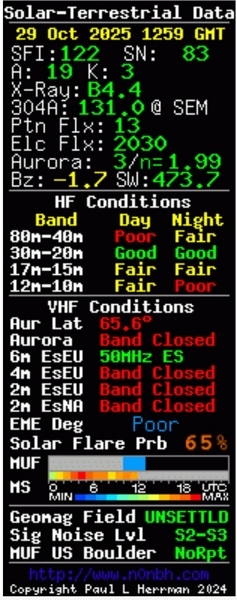
I drove up to Norristown Farm State Park (US-4363, KFF-4363) for an early morning activation. I tend to do early activations to avoid the crowds. There was another reason to get out early this morning: NOAA was predicting some geomagnetic storms starting later in the day.

NOAA geomagnetic forecast for September 1-3

I parked my truck near a nice shady spot. For today’s activation, I used a 12-foot whip and my homebrew loading coil mounted on the truck. I ran a coax cable over to my table back under the trees. My rig today was my trusty Penntek TR-35 (5 watts, CW) with my Elecraft T1 tuner. 

My equipmet set up at Norristown Farm State Park

Even though the bands would probably be rough later on, they were in great shape this morning. I logged 25 contacts on 40M, and most of the signals were very strong. After things slowed down on 40M, I made some more contacts on 30M, 20M, and 17M.

My Penntek TR-35 and Elecraft T1 at Norristown Farm State Park

After about an hour and 20 minutes, I pulled the plug with ‌43 contacts in the log, including 7 that were park-to-park. I worked a few of the stations on multiple bands:

  • Three bands: W9GTA
  • Two bands: KJ4R, K4NYX (P2P), and KI5GTR

One advantage of participating in both the Parks on the Air (POTA) and World-Wide Flora and Fauna (WWFF) parks programs is that you broaden the pool of hunters. Spots on the WWFF website often bring out the European hunters. That was the case today on 17M, with calls from DK9HN, F4ILH, and DM5WW. (Check out this website for more information on “dual activating.”)

So, that wraps up the summer of 2025. It was a fun morning; the bands were busy, and the weather was perfect.

I hope my U.S. and Canadian friends had a great Labor Day weekend. 

72, Craig WB3GCK

Round Two with the AD8HK EFRW

A while back I purchased one of AD8HK’s end-fed random wire (EFRW) antennas. I tried it for the first time during my ill-fated Flight of the Bumblebees (FOBB) outing. With everything that went wrong that day, the AD8HK antenna certainly deserved a better evaluation—at least one where I wasn’t in a panic over problems with my newly acquired Elecraft KH1.

The AD8HK EFRW is a really slick little antenna. It consists of a 15-foot radiator and a 7.5-foot counterpoise wire. It has a neat 3-D printed winder for the wires that also incorporates a 4:1 unun and BNC connector. It’s compact and well-built. AD8HK Antenna Systems sells this antenna (and other offerings) through eBay.

During my infamous FOBB outing, I fed the antenna with 6 feet of RG-316 coax. It loaded up on 30M through 15M, but neither my KH1 nor my Elecraft T1 tuner could find a match on 40M. I’m not sure what the issue was, but I didn’t have much time to look into it.

Sometime later, tried the same length wires with one of my homebrew 4:1 ununs. That time I used 20 feet of RG-316, and it loaded up fine on all bands.

The AD8HK winder/unun. The gray thing is a Velcro strap I used to secure it to the pole.
The AD8HK winder/unun secured to the pole with a Velcro strap.

This morning I took the AD8HK EFRW over to Valley Forge National Historical Park (US-0761, KFF-0761) for an activation. I supported the antenna with a 20-foot pole and my homebrew ground mount. I fed the antenna with 20 feet of RG-316, and this time my T1 ATU easily found a match on 40M. It also loaded up fine on 30M through 17M. 

My antenna pole
My antenna pole

A 15-foot radiator isn’t going to be a barn burner on 40M; however, this little antenna certainly held its own today. I easily logged 13 contacts on 40M before moving on to try other bands. When I wrapped up after a little over an hour, I had twenty contacts in the log, with four park-to-park contacts. I made contacts on all four bands covered by my Penntek TR-35 (40M-17M), and I was pleased to work W6LEN out in California on 20M. 

My usual set up: Penntek TR-35 and Elecraft T1 ATU

After today, the AD8HK EFRW has definitely earned a spot in the KH1 kit I’m putting together. It’s easy to deploy and has a relatively small footprint. 

Thanks to NU4F for the nice spot from Florida

Speaking of my KH1… I heard from Elecraft a few days ago. They replaced the FET in the final amplifier, and now the rig is on its way home. I can’t wait to get it back on the air.

72, Craig WB3GCK

Skeeter Hunt 2025

Once again, the NJQRP Skeeter Hunt contest coincided with our annual family vacation to the Outer Banks of North Carolina. I’m certainly not a hardcore contester, but I wanted to set aside some time to make a few contacts from North Carolina. Although our rental house was beautiful, it presented some challenges for ham radio.

WB3GCK operating in the NJQRP Skeeter Hunt contest
Operating in the NJQRP Skeeter Hunt contest

After a long drive down and all the unloading/unpacking the day before, I didn’t feel like getting too crazy putting up an antenna. Although this was our first time in this rental house, I had a good feel for the layout from online research. 

My "shack" for the week
My “shack” for the week

My previous experience has shown that these rental properties come with a lot of RF noise, both from within the house and from neighboring houses. The house this year was no exception. So, I stayed away from vertical antennas near the house and went with an end-fed random wire sloper.

The antenna this year was a 35-foot wire, sloping down from the 3rd-story deck. I fed it through my homebrew weather-resistant 9:1 unun and ran 25 feet of coax into a screened-in porch on the same level. I attached the end of the wire to a fence around the pool area, making sure it wouldn’t get in anyone’s way. The wire was a bit long, so I ran the last two feet horizontally along the top of the fence. 

My antenna feedpoint. The far end of my random wire sloped down to the fence by the pool.

I fired up my KX3 and checked the bands. A quick contact with a POTA activator on 40M confirmed it was putting out some sort of signal. The noise on 40M, however, was horrendous in places. The higher bands were better but still somewhat noisy. I hunted four POTA activators while experimenting with the antenna. Two of the contacts were easy, while the other two were tough going. 

I also had to contend with some audio interference from my grandkids having fun in the pool down below. Anticipating this, I brought along a pair of over-the-ear headphones this year. Unfortunately, the headphones were no match for four exuberant kids. 

Once the contest started, the noise level on 40M was about S3 in parts of the band, and S5-S7 in other parts. There was also a loud noise signal that would slowly sweep across the band from time to time. Despite the noise, I worked four skeeters and one very confused QRO station who wasn’t in the contest. He probably thought I was a POTA activator and couldn’t figure out why I needed to know his power output.

Up on 20M, the noise was lower but still present. I didn’t hear much Skeeter Hunt activity, despite getting some respectable hits on the Reverse Beacon Network. I ended up with a pair of Missouri skeeters in the log. I tried calling CQ on 15M with no luck.

After a little over an hour, I threw in the towel. My operating position was facing west across Currituck Sound, so my nice shady spot was giving way to the afternoon sun. Before I pulled the plug, I had one last contact on 40M with a friend back in Pennsylvania.

The view from the antenna

So, my 2025 Skeeter Hunt results were less than stellar. Although it was frustrating working through the noise, I still had fun. Plus, the scenery from my temporary “shack” was outstanding.

72, Craig WB3GCK