Captain John Smith Trail with the Gabil GRA-7350TC Antenna

My (far) better half and I spent the weekend in Central Pennsylvania watching the grandkids, while our second harmonic and her husband were off celebrating their anniversary. Of course, I took some radio gear along to do some QRP-portable operating while I was out there.

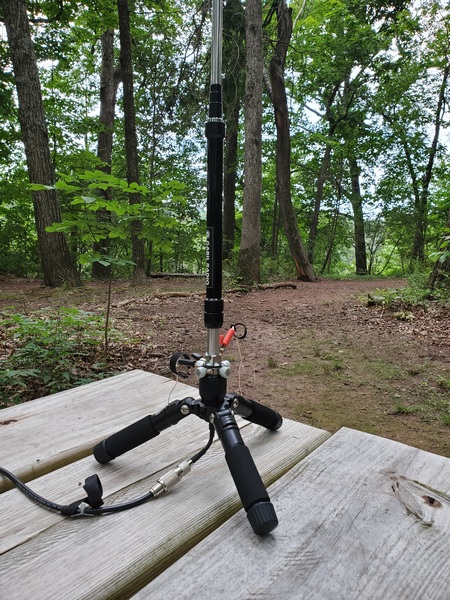
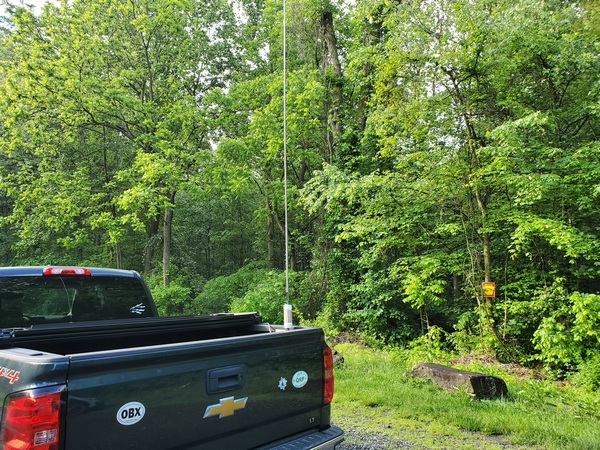
I had a brief window of opportunity on Saturday morning, so I drove to the Falmouth Access boat launch along the Susquehanna River to activate the Captain John Smith National Historic Trail (US-4567). Since we used the (far) better half’s car this weekend, I used this opportunity to try out my Gabil GRA-7350TC vertical and magnetic mount on her car for the first time. I also brought along my trusty Penntek TR-35 (5 watts, CW).

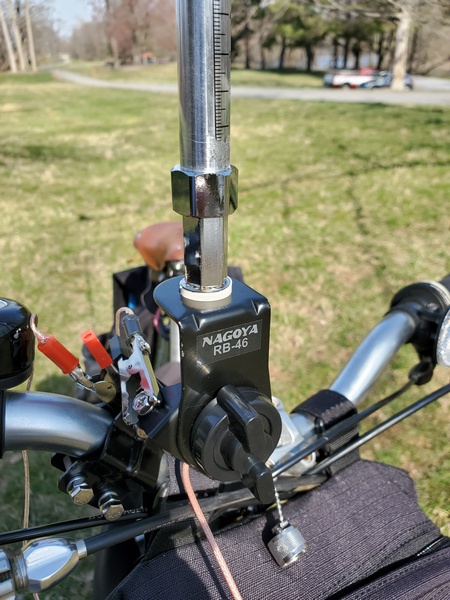
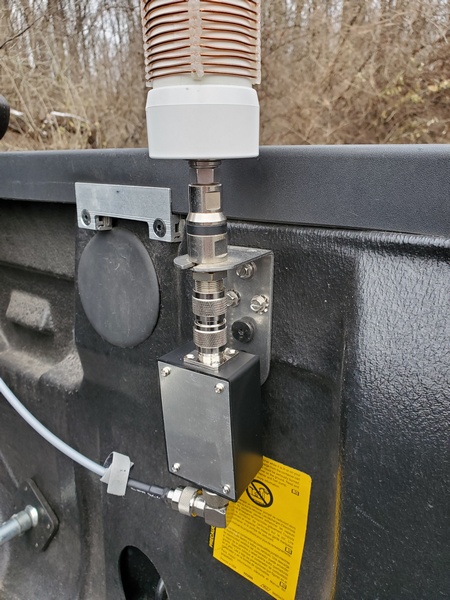
The Gabil GRA-7350TC & mag mount on my (far) better half's car, while activating the Captain John Smith Chesapeake National Historic Trail (US-4567)
The Gabil GRA-7350TC & mag mount on my (far) better half’s car, while activating the Captain John Smith National Historic Trail (US-4567)

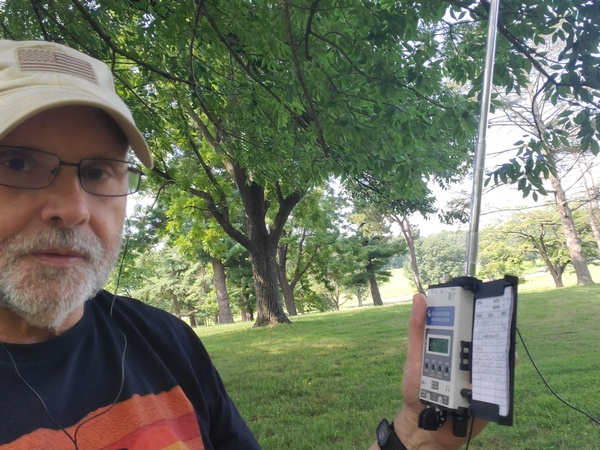
To facilitate tuning the vertical, I used a recently acquired Mini60 analyzer I bought off AliExpress. It’s cheap and a little quirky, but it’s small and its simple SWR readings got the job done. I started on 40M and got the SWR down to 1.3:1 without adding radials. That’s better than I had ever gotten on my pickup truck. I guess the roof on my XYL’s little SUV provides a better ground plane than my truck.

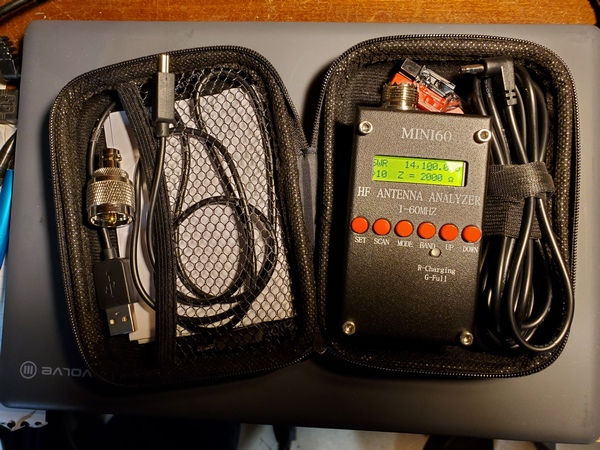
The Mini60 Antenna Analyzer. I found a case on Temu just the right size to hold Mini60 and some accessories.
The Mini60 Antenna Analyzer. I found a case on Temu just the right size to hold the Mini60 and some accessories.

Band conditions were generally lousy, and there was some horrendous local noise in 40M and 20M. I didn’t experience any noise issues the last time I activated from here. Despite all that, I managed to scrape together 17 contacts in about 35 minutes, including one with F4ILH on 17M. Also, thanks to W5KEB for working me on two bands. (My apologies to a couple of hunters I couldn’t pull out of the crazy noise in 40M and 20M.)

Even though the bands weren’t too hot, I was pleased with the performance of the Gabil antenna. It’s another good antenna option when I’m using my (far) better half’s car (or any car, for that matter). 

72, Craig WB3GCK

Covering More Bands with My 12-ft Whip

Back in 2017 I built my 19-foot wire vertical, which was my go-to portable antenna for about 4 or 5 years. The concept was simple: It functions as a base-loaded resonant vertical on 40M & 30M and as a random wire on 20M and up. The matching unit contains a tapped toroid for 40M & 30M and is fed through a built-in 1:1 choke. It occurred to me I could do something similar with the 12-foot telescopic whip and homebrew loading coil I’ve been using on my truck of late. 

My 12-foot whip setup is resonant on 40M through 17M. You’re probably thinking: “Why not just bypass the loading coil and adjust the length of the whip for 15M through 10M?” Well, being as lazy as I am, that would make band changes a little more involved than I want to deal with. I like having some “frequency agility,” and I’m not above using an ATU to achieve that.

To emulate the scheme I used for the 19-foot vertical, I just needed a choke at the input to my homebrew loading coil. (I could probably go without the choke, but I wanted to keep the coax from becoming part of the antenna.) So, I use the 12-foot whip as a base-loaded resonant vertical on 40M through 17M. For 15M through 10M, I would bypass the coil and use an ATU. 

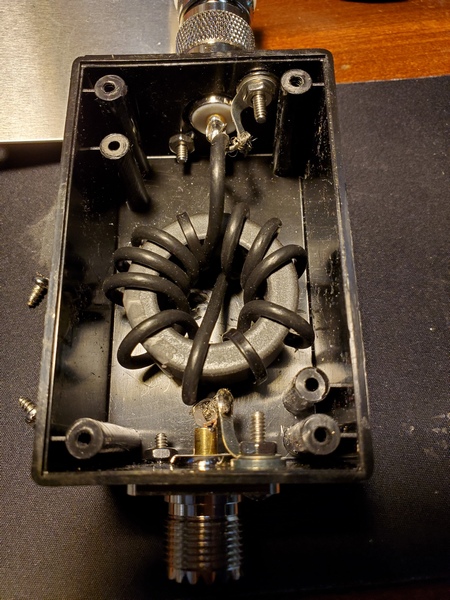
To test this out, I threw together a choke using parts I had on hand. I wound 10 turns of RG-174 on an FT-140-43 toroid. A Radio Shack project box I had in my stash of parts was the perfect size to house the toroid. (I bought it a decade or two ago, and it was still unopened in the original Radio Shack packaging.) Since I installed SO-239 connectors on each end, I had to use an adapter to connect the choke to the SO-239 on the antenna. To hold the coil in place, I wedged a piece of foam packing material between the lid and the core. The completed choke is functional, albeit a little cheesy-looking. 

The choke is 10 turns of RG-174 coax on an FT140-43 toroid.

My first test using the 12-ft whip on the higher bands was a success. While activating Ridley Creek State Park (US-1414, KFF-1414), I used my KX3 (5 watts, CW) and installed the choke at the antenna feedpoint. On 40M through 17M, the loading coil functioned as it normally does. On 15M, 12M, and 10M, I bypassed the coil entirely and relied on the KX3’s internal ATU to load up the whip. 

The choke installed at the antenna's feedpoint
The choke installed at the antenna’s feedpoint

The KX3 easily found matches on all three bands, and my results on the air were encouraging. On 15M, I worked stations in Poland, Belgium, France, Ukraine, Germany (3), and the Slovak Republic. I made two stateside contacts on 12M. Up on 10M, I worked some more DX: Germany (2), Italy, and Czech Republic. One of the German contacts was park-to-park. 

I’ve used this arrangement on a few more activations since then, including Winter Field Day. My results have been consistently good.

I haven’t done any modeling, but the 12-foot whip seems to be a pretty good length for operating like this. It’s just a little longer than a ¼-wave on 15M and a little shy of ⅜-wave on 10M. On 12M, it’s somewhere between ¼ and ½-wave; so it isn’t resonant on any of the bands of interest. 

Although I was pleased with these initial results, I might do a little more tinkering with this setup. I’m toying with repackaging the choke to make it a little more weather resistant. I encountered some rain during the first activation using it. There was no damage to the choke at all, but I always have a tendency to over-engineer things—it keeps me occupied and out of trouble, I suppose. 

No scientific breakthrough here. Just a lazy guy “force feeding” a fixed length whip to squeeze a few more bands out of it. 

72, Craig WB3GCK

No-Name Mini Straight Key

I needed another mini straight key like a hole in the head. With my fascination for these things, however, I just couldn’t help myself. 

The key in question came from AliExpress and cost me about $18 USD. Although it has no markings on it, it appears to be from the same manufacturer as the QU-21C paddles I bought a while back. The basic design is the same as the QU-21C, and it came with identical packaging and accessories. After modifying the magnetic base, the paddles have served me well. So I took a chance on the look-alike straight key. 

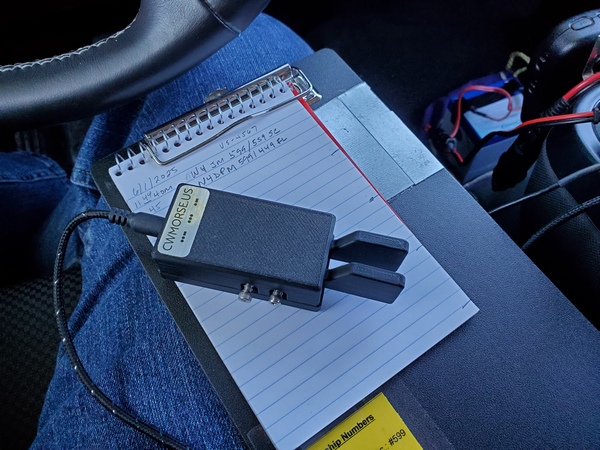
My No-name mini straight key from AliExpress during a recent portable outing. The key is magnetically attached to steel strips I glued to my clipboard.
My no-name mini straight key from AliExpress during a recent portable outing. The key is magnetically attached to steel strips I glued to my clipboard.

Out of the box, the straight key’s contact spacing was a little wide for my taste. Using the included Allen wrench, I adjusted the key more to my liking. For a cheap key, it has a pretty good feel to it, and it keys cleanly. 

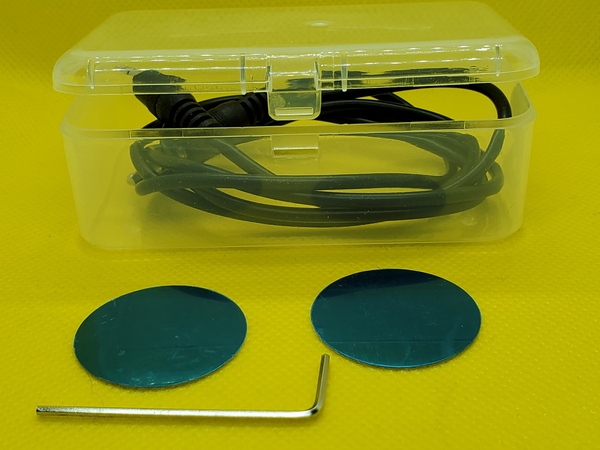
The accessories that came with the mini straight key. (Not shown is an adhesive rubber square that I attached to the bottom of the key.)

Based on my experience with the QU-21C paddles, I had some reservations about the highly polished square magnet on the bottom. However, since the motion of the straight key is the vertical plane instead of side-to-side, the magnet is less of an issue.

I used the key during a recent outing, and I had no major issues with it. I have some a couple of steel strips glued to my clipboard, and I stuck the key there. There was a little movement, but nowhere near as bad as the paddles. I just needed to make sure I didn’t get too vigorous with my keying. After I use them some more, I’ll decide if I want to modify them like I did with the paddles.

Most of the time I get what I pay for, but in this case, I think I got a decent product for the price. I let you know if my opinion changes with time. 

72, Craig WB3GCK

Replacing My Broken Whip

During a recent activation, my beloved MFJ 12-foot telescopic whip came apart. I’ve had it for a long time, so I was really disappointed when it broke. I specifically designed my homebrew loading coil to pair with a 12-foot whip. With this setup, I can work 40M through 17M by changing the tap on the coil. I don’t need to adjust the whip. These bands match the bands covered by my Penntek TR-35. 

When the old whip broke, I salvaged the parts and tried to put it back together when I got home. No joy was to be had. However, all was not lost.

Although 12-foot telescopic whips aren’t aren’t as widely available as the ubiquitous 17-foot whip, I found one in stock at Ham Radio Outlet. After placing my order, I had the antenna on my porch 24 hours later on Christmas Eve. (I have no financial interest in HRO. I’m just a very satisfied customer.)

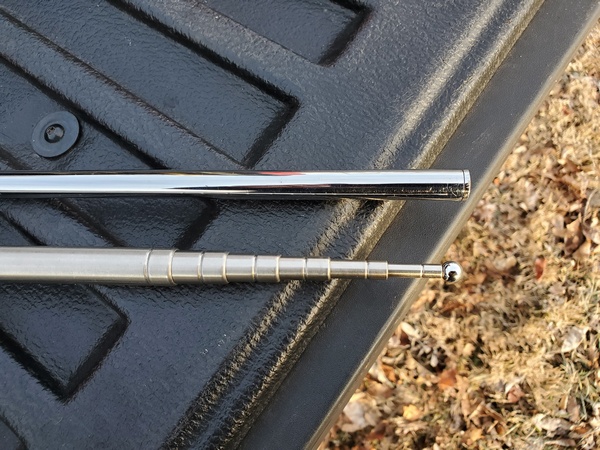
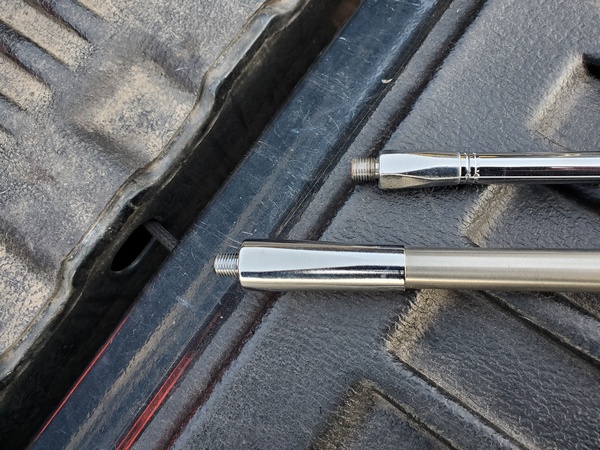
This new whip is an MFJ-1977, and it’s distinctly different from my old MFJ-1956 whip. The new whip’s construction is the first obvious difference. Additionally, the stainless steel has a less polished finish. The MFJ-1977 is also a little heavier, and its collapsed length is an inch or two longer than the older whip. In the pictures below, the older MFJ-1956 is on the top and the new MFJ-1977 is on the bottom:

The MFJ-1977 and MFJ-1956 12-foot whips compared. The older, discontinued MFJ-1956 whip is on top.

The new MFJ-1977 had its maiden deployment at Norristown Farm Park (US-4363, KFF-4363). I used the antenna with my Penntek TR-35 (5 Watts) on 40M, 20M and 17M. As expected, the new antenna seemed to perform as well as its predecessor. After an hour and 10 minutes, I had 42 in the log with three DX contacts: two from France and one from Germany. 

My old 12-foot whip saw heavy use, and it served me well. In the future, however, I plan to rotate whips occasionally. I extended my MFJ-1979 17-foot whip to 12 feet and marked it with a permanent marker. I did the same with my cheap 5.6M whip from AliExpress. Hopefully, having two other whips available will let me avoid beating up my 12-foot whip and extend its life. 

72, Craig WB3GCK

Hacking the QU-21 Mini Paddles

When I bought the QU-21C Mini Paddles a while back, I wasn’t crazy about the small square magnet attached to the base. It didn’t seem to hold very well. When subjected to vigorous keying, the paddles would sometimes move side-to-side. I came up with a quick and dirty hack that resolved the issue for me. 

A little backstory is in order. I’ve never been a big fan of “two-handed” keying; that is, holding the paddles in one hand while sending with the other. I modified a small clipboard by gluing two steel washers to it, such that they lined up with the two magnets in my Palm Mini paddles. The clipboard securely holds the paddles and gives me a nice writing surface for logging in the field. I’ve been using clipboards like this for about 10 years now.

In just a few minutes, I modified my QU-21C paddles to adapt them to my clipboards and make them more suitable for “single-handed” keying. The first order of business was to remove the square magnet from the bottom of the paddles. That was almost too easy. I wedged a knife blade between the base and the magnet, and the magnet popped right off. 

Magnets glued to the underside of the perf board to line up with the steel washers on my clipboard

Next, I took some perf board from my junk box and cut off a 3.5 x 1 inch piece. I used some Goop® adhesive to attach two magnets on one side of the board. I placed them so they had the same spacing as the magnets on my Palm paddles. Then I glued the QU-21C paddles to the other side of the perf board. Except for the drying time for the adhesive, I completed the project in about 10 minutes. 

The QU-21 paddles glued to the perf board and ready for use

The magnets I used are really strong and probably overkill for this application. But, I had a bunch of them on hand, so I put them to use. 

Admittedly, this cheesy little hack doesn’t look like much. If I feel ambitious sometime, I might come up with something more elaborate. Maybe something like the base I made for my little MS2 straight key. For now, though, this will suffice.

72, Craig WB3GCK

Adding Radials to a Mag Mount

Reading through some blog posts recently, I came across an interesting idea from John AE5X. In the comments section of a recent post, John mentions adding a ground stud to a magnetic mount. The ground stud allows him to connect two ¼-wave radials (for 20M) for his MFJ-1979 telescopic vertical. So what follows is my implementation of John’s clever idea. 

On occasion, I’ve used my Gabil GRA-7350TC vertical with a small magnetic mount salvaged from an old 2M/440 antenna. I plan to use this configuration on my (far) better half’s car while visiting family over the holidays. The mag mount is only 3.5 inches in diameter, so I’m sure it’s not providing much of a ground connection. While the Gabil vertical is certainly usable with this mount, I’ve always felt that it needed more of a counterpoise on 40M and 30M to obtain a better match. I figured John’s idea might be the way to go. 

Since I needed to drill a hole from inside the mount, I had to remove the foil covering from the bottom of the mount. This magnetic mount is probably around 25 years old, so removing the foil wasn’t too difficult. Using my pocket knife, I was able to peel the foil off, while keeping it intact. 

Next, I drilled a ⅛-inch hole through the ground plate and out through to the top of the mount. It was a tight squeeze, but I was able to get a 4-40 bolt and a star washer in there. On the outside of the mount, I used a nut and lock washer.

Interior view of the magnetic mount. It was a tight squeeze, but a 4-40 screw and star washer just fit in there.
Interior view of the magnetic mount. It was a tight squeeze, but a 4-40 screw and star washer just fits in there.

The final step was to re-apply the foil covering on the bottom of the mount. I used some rubber cement to reattach it. I don’t know how well the rubber cement will hold up over time, but it won’t be seeing heavy use. It seems fine so far. 

Exterior view of the old magnetic mount. I later removed the second nut from the screw I installed.

While I was at it, I replaced the PL-259 connector. The years had not been kind to the connector that was on there. 

I gave the modified mag mount a try during a recent activation at US-1380, KFF-1380. I used the GRA-7350TC and mag mount on the roof of my truck. With no counterpoise wire attached, the best match I could get on 40M was just a hair under 3:1. 

Next, I attached a 33-foot counterpoise wire to the mag mount. I ran the wire off the back of the truck and onto the ground. To avoid creating a trip hazard for others, I wrapped the wire around the side of the truck. In this configuration, I got the SWR down to about 1.2:1. Success!

The Gabil GRA-7350TC and magnetic mount with one 33-foot counterpoise attached. The wire dropped to the ground behind the truck and wrapped around the side.

Using the same counterpoise, the best I could do on 30M was a little under 2:1. I tried two 16.5-foot wires, but the result was about the same. No worries. An SWR of 2:1 is a piece of cake for the Elecraft T1 tuner. 

In this configuration, I had two 16.5-foot counterpoise wires attached.

I ran the entire activation on 40M and 30M with great results (40 contacts in less than an hour). In fact, it was the best I have done with the Gabil antenna and mag mount. Was it because of the counterpoise wire? Maybe. Regardless, my five-watt signal was getting out just fine with this thing.

Thanks again to John AE5X for the inspiration.

72, Craig WB3GCK

Oops! It Lives!

I’m almost too embarrassed to even post this, but it looks like I resolved my issues with my Elecraft T1 ATU. I think it might have been a monumental example of “cockpit error.”

This morning, a few hours after my last post went live, I sat down and went back through the T1 user manual. One line jumped out at me:

When bypassed, the T1 can still show SWR; activate TUNE mode, then key the transmitter.

Hmmm… So, that got me thinking. That would explain the behavior I have been seeing: indicating SWR while not trying to find a match.

I went downstairs to the shack to check the T1 again. When I entered the pushbutton sequence to enter the BYPASS mode, the T1 actually toggled into the “ATU Inline” mode. DOH! I connected the T1 up to my KX3 and rain gutter antenna, and it tuned up like a champ. 

So, it looks like I might have accidentally put the T1 in BYPASS mode. Two errant presses of the push-buttons is all it would have taken. I’ll have to watch out for that, going forward.

Needless to say, I’m a happy boy again. Red-faced but happy.

72, Craig WB3GCK

Equipment Failure but Activation Success

Another busy weekend here in my neck of the woods. We had a family get-together in central Pennsylvania on Saturday, and I took part in a public service event with my local ARES-RACES group on Sunday. Despite everything going on, I squeezed in a short POTA/WWFF activation on Saturday morning before heading out of town.

I chose a spot in Valley Forge National Historical Park (US-0761, KFF-0761) that’s only a few miles from home. The parking lot serves as a trailhead for a popular trail, and it can be a busy place during the summer months. It wasn’t too bad today. 

My original plan was to use some different gear and try out some antenna configurations. Being pressed for time, I went with my usual setup, which I knew—or thought—would work. That, of course, was my Penntek TR-35, Elecraft T1 tuner, and my 12-foot whip and homebrew loading coil combination. The SWR is a little higher on 40M and 30M, so I use the T1 to keep the rig happy.

I scanned the 40M band, and it was hopping. I planned to pick off some park-to-park QSOs before setting in on a frequency to call CQ. When I hit the T1, it didn’t even try to find a match, and the LEDs showed a 3:1 (or higher) SWR. I tried other bands, including ones I knew were close to 1:1, and the T1 wouldn’t budge. 

I couldn’t remember the last time I changed the battery, so I put in a fresh one. No go. Next, I ran through the T1’s internal diagnostics. Nothing out of the ordinary there that I could see. On (very) rare occasions over its 11 years of service, the T1 would get fussy and refuse to match certain bands. Just running through the diagnostics seemed enough to clear up those issues—but not today.

I disconnected the T1 and went straight from the TR-35 to the antenna. The truck-mounted whip has very low SWR on 20M and 17M, so I confined my operation to those bands. 

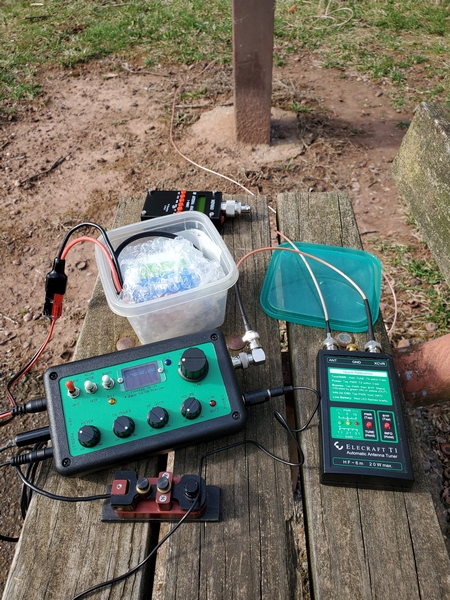
My ailing T1 after disconnecting it
My ailing T1 after I disconnected it

Fortunately, 20M was in great shape for 0930 (local time), and I had a steady stream of hunters. I needed to leave at 1000 (local), and I had spent an inordinate amount of time playing around with the T1. However, my 30-minute activation netted me 26 contacts with two of them park-to-park. Most of the contacts were on 20M, but I had five on 17M before pulling the plug. 

I drove back home, saddened that my trusty T1 was having issues. It has been so reliable over the years that I just took for granted that it would always work and match whatever antenna I was using. 

Back at home, I did a couple of quick checks with different antennas, but no joy was to be had. I suspect a stuck relay, but I’m not really sure how to discern that from the internal diagnostics routine. I bought it assembled and tested, so I’ve never poked around inside. I’ll have to download the instructions for the kit version to see if that offers any insights. 

When I get some time this week, I’ll pursue this further and decide how to proceed. If any T1 users out there have advice to offer, I’m all ears. 

[Update: I resolved the issue with the T1. It appears to have been a case of “cockpit error.” Here’s what it was.]

72, Craig WB3GCK

POTA with the (tr)uSDX

Although I bought my little (tr)uSDX transceiver two years ago, it has only seen sporadic use. Other than an occasional contact or two, it has been mostly relegated to the shelf. I figured it was about time to put it to serious use in a POTA/WWFF activation. 

I made a return visit to Norristown Farm Park (US-4363, KFF-4363) for another activation. It was raining on and off this morning here in southeastern Pennsylvania, so I pretty much had the place to myself. 

I set up the (tr)uSDX with my Elecraft T1 tuner in the cab of my truck. I used three 18650 Li-ion batteries power the radio. As usual, I went with my 12-foot whip and homebrew loading coil on the back of the truck.

I’m getting a little better at navigating the (tr)uSDX’s menus and using the controls. There are a lot of functions covered by three controls. To refresh my memory, I used the rig last night with my rain gutter “antenna” to make a couple of contacts. I also brought along a cheat sheet today, which I didn’t need.

Just for the fun of it, I started off using my little N6ARA TinyPaddles. They match the orange radio, so why not. Unfortunately, I had some issues with them, so I switched over to my Palm Mini paddles. I have to tweak the contact spacing on the N6ARA paddles. 

My (tr)uSDX. The N6ARA paddles are in the lower left.
My (tr)uSDX. The N6ARA TinyPaddles are in the lower left.

Starting out on 40M, the signals were strong and plentiful. It only took me about 11 minutes to log my first 10 contacts. When things slowed down on 40M, I made a few contacts each on 30M and 20M. After 45 minutes, I had 21 contacts in the log with one park-to-park QSO.

My trusty homebrew loading coil. In hind sight I should have used a plastic bag to protect it from the rain this morning.
My trusty homebrew loading coil. In hindsight I should have used a plastic bag to protect it from the rain this morning.

The (tr)uSDX is an incredible little rig. They packed an awful lot of features into a tiny package, but it’s not really a high-performance radio. I have to admit it wasn’t the most pleasant rig to listen to; there were some pops and clicks in the sidetone when keying. It could have been the earbuds I was using. I also need to go back through the menu settings to make sure I haven’t missed something. Looking at my RBN spots, I could see I need to tweak the frequency calibration a bit. It’s transmitting a little lower than the displayed frequency. Having said all that, I can’t be too critical of radio at this price point.

In the end, though, the little rig got the job done today. Not bad for a five-band, multi-mode radio that costs less than $140 assembled. 

72, Craig WB3GCK
The Mystery of the Sticky Feet

I’ve been powering up some of my old QRP gear to see if any of it still works. The gear has been stacked up on a shelf above my operating position for years. In testing some of this gear, I came across a curious problem.

Last night I was rearranging some of my equipment and re-routing some coax cables. When I went to move my Oak Hills Research power meter, it was stuck to the shelf. The rubber feet on the bottom of the meter had become slightly soft and sticky. I didn’t think too much of it at the time. I just finished connecting the cables and placed it back on the shelf. 

Today, I took my old MFJ-9030 transceiver down from the shelf and was greeted with a gooey mess. The rubber feet had completely dissolved and turned into a sticky, tar-like mess. Using a single-edged razor blade, I scraped off as much as I could from both the radio and the residue on the shelf. I used some mineral spirits to clean up as best I could. The mineral spirits worked great, but I still had sticky spots where the feet were attached to the radio. I cut some pieces of aluminum duct tape to cover those spots, and I applied four new feet from my junk box. 

This is the underside of my 31 year old MFJ-9030 transceiver showing the black goo from the dissolved feet. The clear feet were added by me.

My theory is that the rubber (or whatever material they are) feet reacted with the finish on the shelf. I know that vinyl guitar straps and accessories can damage the lacquer finish used on some high-end guitars (like my 1973 Martin D35 acoustic), so I suspect something like that happened to my radio equipment. I built the shelf and my operating table from some repurposed shelves that were in the house when we moved in back in the late 70s. So, I have no idea what kind of finish is on them. 

Besides the power meter I mentioned earlier, it looks like my old MFJ-941-E antenna tuner is also affected. So, I’ll have to replace the feet on those items and clean up the residue on the shelf with the mineral spirits. Needless to say, some of this equipment hasn’t been moved in years.

This wasn’t exactly how I wanted to spend my afternoon, but I’m glad I spotted the problem.

72, Craig WB3GCK