After spending the morning traveling to watch my grandson play soccer, I had some time to go play radio. I made a trip to nearby ValleyForge National Historical Park (K-0761, KFF-0761) for a quick activation. I almost talked myself out of going, but I’m glad I went ahead with it.
I pulled into a trailhead parking lot, where I’ve operated from a bunch of times in the past. I used my Penntek TR-35 (5 watts) in the truck, with my 12-foot whip and homebrew coil mounted on the back.
My location at the Yellow Spring Road trailhead in Valley Forge National Historical Park
I started off on 40M, but I only made two contacts there. The 20M band was where the action was this afternoon. I searched around for some park-to-park contacts before parking on a frequency and calling CQ. I spotted myself on the POTA website, and the hunters started calling. Today, I also spotted myself on the WWFF spotting page. Right after that, I started getting calls from DX stations.
After operating for about an hour and 20 minutes, I had 44 contacts in the log, with five park-to-park QSOs. Twelve of my contacts were with DX stations on 20M and 17M. I worked the following countries today:
Italy (3 contacts. One station worked me on two bands.)
Sweden (2 contacts)
France (2 contacts)
Ukraine
Finland
Poland
Czech Republic
Switzerland (WWFF park-to-park)
I also worked Michael VA2NB, a fellow Polar Bear QRPer operating from Quebec.
Well, that sure was fun today. When I have to talk myself into doing an activation, I usually end up having a good time.
I headed out for an early morning activation at Evansburg State Park (K-1351, KFF-1351). The weather forecast was calling for scattered showers today. I consulted my weather radar app before leaving the house. It looked like I could get an activation done before the next round of rain came through. Ha!
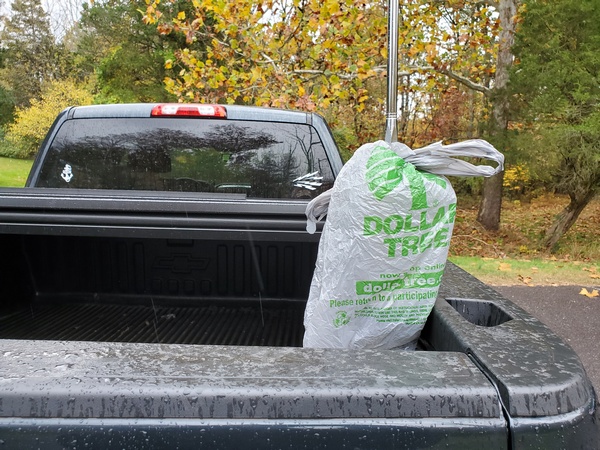
It was raining lightly when I got to the park, and it continued most of the time I was there. I set up my homebrew loading coil and 12-ft whip on the back of the truck. I used a plastic shopping bag to fashion a “raincoat” to protect the coil from the elements. To keep things classy, I used a bag from a local dollar store. It looked pretty cheesy, but it worked. I used my TR-35 (5 watts) in the cab of the truck.
An improvised “raincoat” for my homebrew loading coil
Despite the lousy weather, I had a successful activation. After 90 minutes of operating, I had 45 QSOs in the log with 5 known park-to-park contacts. The 40M band was the most productive for me today. I had 22 contacts on 40M, with the rest divided between 30M and 20M.
Thanks to all the hunters out there who kept me busy this morning.
Zombies were out haunting the bands last night, during the Zombie Shuffle. As always, I had fun taking part in this crazy QRP event.
Once again, I operated from home using my KX3 and rain gutter antenna. I always have some local noise issues, but this year the noise was a bit lower than usual.
I got on the air and immediately encountered a zombie bonus station on 20M. From there, I was off and running. I worked nine more zombies on 40M before taking an extended dinner break.
In the exchange, you get to use a name of your choosing. This year, I once again used “Bones.”
I got on the radio again after dark, but there seemed to be fewer zombies to work. Normally, the rain gutter antenna goes long on 40M after dark. Last night was different, though. I worked a fair number of my fellow Pennsylvanians and one Delaware zombie. I don’t often work Delaware stations on 40M, especially after dark. Maybe the bands really were haunted last night.
After a while, I was running out of zombies to work. I even invoked the “Rebirth Rule” for the first time this year. This rule says you can work the same station on a band every two hours. I eventually pulled the plug and went upstairs to watch game #1 of the World Series.
I ended up with 17 zombies in the log, which is my new personal best in this wacky event. Three were on 20M and the rest were on 40M. My previous personal best was 14 back in 2021. My compromised antenna didn’t do too badly for me this time around.
Before I worked my first zombie, I had a quick POTA contact with KQ1P in Maine. That QSO turned out to be my 500th park as a hunter.
As always, I have to thank Paul NA5N and Jan N0QT for organizing this fun event. Until next year, it’s back to the crypt for this zombie.
I had a little time this morning before heading out of town for a family event. It’s been a while since I last visited Marsh Creek State Park (K-1380, KFF-1380), so I made a quick trip over there.
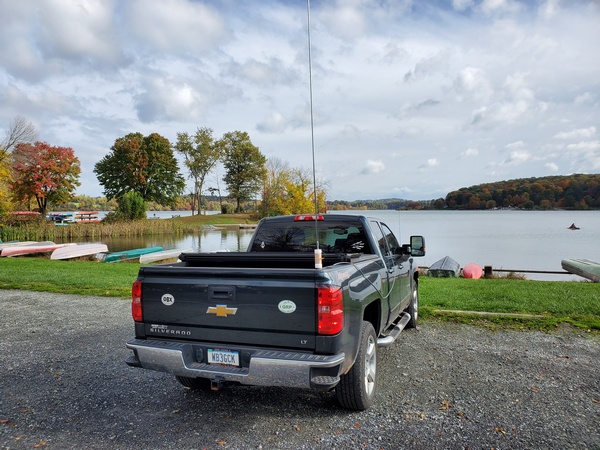
I operated from the parking lot at the West Lauch area of the park. Despite the hilly terrain leading down to the boat launch, I’ve always had good luck there. The beautiful view of the lake is a bonus, too.
My view at Marsh Creek State Park (K-1380, KFF-1380)
For my antenna, I went with my 12-whip and homebrew loading coil combination. I used my TR-35 (5 watts) in the truck.
The bands were in pretty good shape, which made for a busy activation. After operating for 50 minutes, I finished up with 30 contacts. Twenty-two contacts were on 40M, and the rest were on 30M. I had two park-to-park contacts I know of.
It was a short activation but a lot of fun. And now it’s time to hit the road to visit family.
Looking through my POTA stats, I noticed I was one activation away from a Repeat Offender Award for French Creek State Park (K-1355). So, I set out today for my 20th activation for this park. For many POTA activators, this is a trivial milestone. But for a casual activator like me, it takes a while to get to that point.
The Straight Key Century Club (SKCC) Weekend Sprintathon (WES) was going on this weekend. I hadn’t taken part in a WES in a while, so I started off using a straight key and calling “CQ WES.” My first eight contacts were with SKCC members. After that, I spotted myself and started calling “CQ POTA.”
The 40M band was in great shape this morning, with lots of POTA activity. In fact, all of my contacts were on 40M. In about an hour and 15 minutes, I ended up with 23 contacts. Among those were four park-to-park contacts.
My parking spot at French Creek State Park (K-1355, KFF-1355)
I used my 12-foot whip and homebrew loading coil for the second time today. I like that I can set it up in a couple of minutes. Once again, it worked like a champ. I think it will probably my go-to antenna for stationary-mobile operation. Inside the truck, I used my trusty TR-35 (5 watts).
And with that, POTA activation #20 at French Creek State Park is in the books.
It had been a while since my last portable outing, so I was itching to get out today. The weather forecast, however, was calling for periods of heavy rain and gusting wind. Fortunately, I had a plan in mind to deal with the weather.
I made a quick trip up to nearby Evansburg State Park (K-1351, KFF-1351). It was rainy on the drive there, but tapered off by the time I reached the park. According to the weather radar app on my phone, another round of nasty weather was likely.
In order to use my usual truck-mounted antennas, I have to open up the tonneau cover. I had some things back there that I needed to keep dry, so I opted to set up under a large picnic pavilion. It’s no surprise that it was unoccupied. Who wants to hold a picnic on a rainy day in October, anyway?
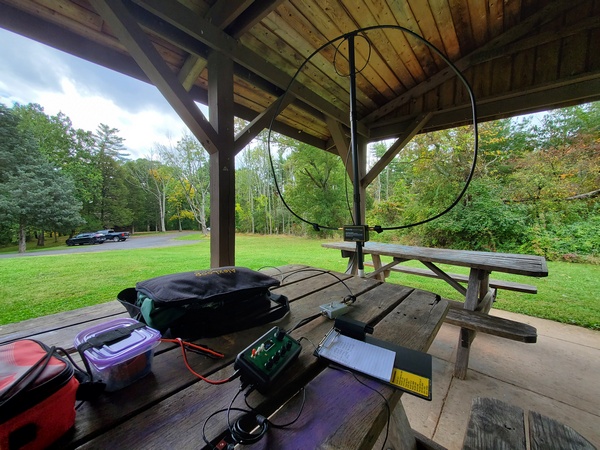
My operating position under a pavilion at Evansburg State Park (K-1351, KFF-1351)
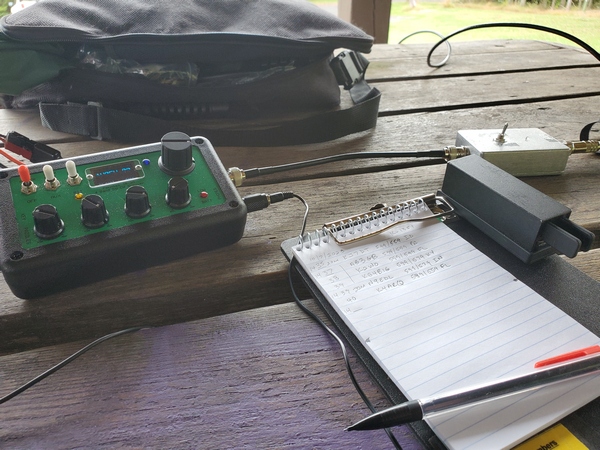
I pressed my Alexloop into service today, so I could keep my whole station under cover. Since my TR-35 doesn’t have an SWR indicator, I used a homebrew resistive SWR bridge. The resistive bridge is a little too sensitive on 40M and 30M, so I have to reduce the TR-35’s output power in order to see the null on the LED indicator.
My rig at Evansburg State Park (K-1351, KFF-1351). My homebrew resistive SWR bridge is the silver box to the right.
I started out on 20M, and things got off to a quick start. I logged seven contacts in the first few minutes. After that, it dried up. I picked up two more on 30M, but I was wondering if I was going to make it to 10 contacts before the next band of storms moved in.
I dropped down to 40M, and the activity picked up again. Even though it’s the least efficient band for the Alexloop, I always have good luck there. It was my most productive band today.
The rain wasn’t the big problem today; it was the wind gusts. I had to stop twice to pick up things that blew off the table. So, after just under an hour, I called it quits. I finished up with 21 contacts in the log. I had one park-to-park contact today (that I know of).
Despite the inclement weather, it wasn’t a bad day.
I was out yesterday with my local ARES-RACES group providing communications support for the Marshalton Triathlon, here in Chester County, Pennsylvania. This popular event combines cycling, canoeing, and fast walking. I always look forward to volunteering for this event each year.
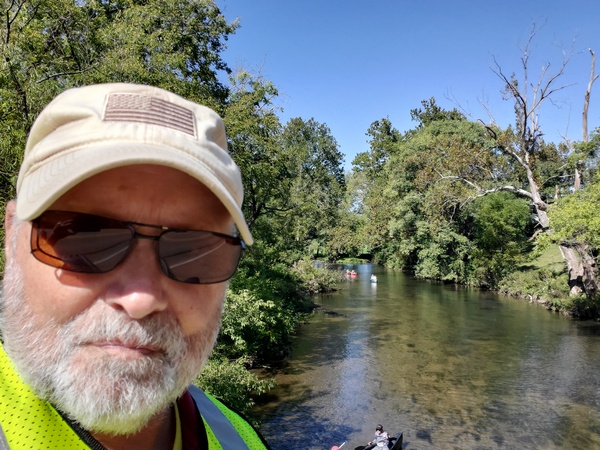
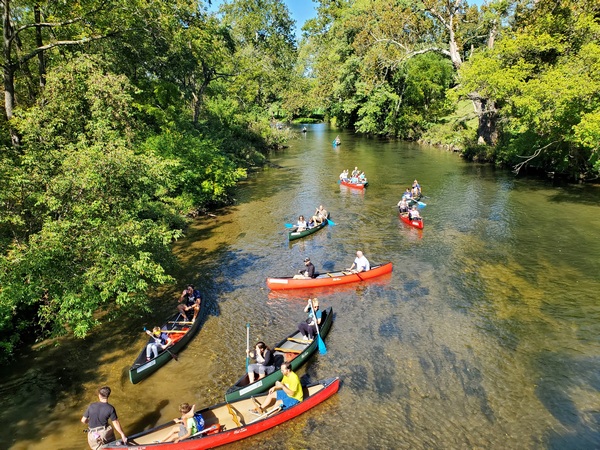
Once again, I was at the end of the 2.3-mile canoeing segment, known as “Canoe Out.” This is my favorite assignment and one that I request each year. The folks working at this location help the participants out of their canoes and retrieve the canoes for transport back to the starting point. I was situated on a bridge with a superb view of the Brandywine River. Compared to the rainy weather we had last year, the weather this year was just about perfect for this time of year.
A selfie taken from my vantage point on the bridge during the Marshalton Triathlon
Canoeists waiting to exit their canoes
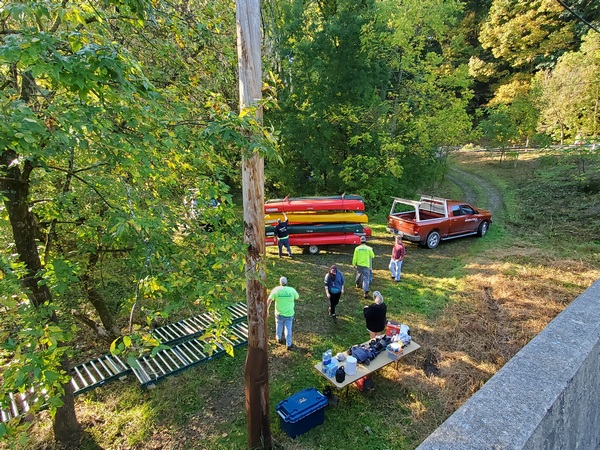
The boat handlers getting a load of canoes ready to go back upriver. They use a system of rollers to help move the canoes up from the river.
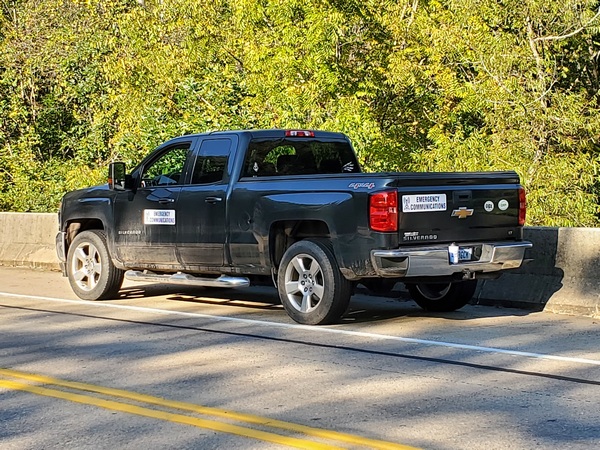
My truck parked on the bridge across the Brandywine River
From a communications standpoint, this event is pretty simple. An HT was the only equipment I needed. Most of my communications involved coordinating with the folks at the “Canoe In” location upriver, letting them know when a load of canoes was headed back to them.
I didn’t hear of any serious incidents on the course, so that’s good news. There was a report of an overturned canoe, but the participants were able to get back in their boat and continue downriver.
This is our group’s last public service event for the year. We’ll be back out on the Brandywine River in the Spring supporting the Northbrook Canoe Challenge.
Whenever I buy parts for a project, I always buy one or two extras. Over the years, I’ve amassed a sizable collection of random parts. Some of it will never be used, but sometimes my collection of parts has just what I need for something I want to build. I like when that happens.
A while back I wrote about an old homebrew coil I resurrected and paired with a 12-foot telescopic antenna. The coil, while effective, was built to use with a much shorter whip and is larger than what I need. I scoured my junk box and came up with most of the parts I needed to build a scaled-down version.
I should note that I built this coil specifically to use with my old MFJ-1956 12-foot telescopic whip. In this configuration, this coil covers 40M through 17M. So, if you have a different whip or want to cover different bands, you’ll need to modify the design accordingly.
Completed loading coil. Used with a 12-foot telescopic whip, it tunes from 40M through 17M.
I used the old coil as a guide to determine the number of turns I needed to cover the bands of interest, adding two turns for good measure. Using an online shortened vertical calculator, I figured I would need about 13.4μH to load the 12-foot whip on the 40M band. Using an online coil inductance calculator, I estimated the total inductance of my coil to be 14.8μH. So, it covers 40M with a turn or two to spare.
The new coil assembly measures 8.25 inches end-to-end, making it 2.25 inches shorter than the old coil. While it’s about 3.3 ounces lighter than the old coil, this new coil still weighs in at a hefty 10.8 ounces.
Parts List
With a few exceptions, my junk box provided the parts I needed to build the coil.
5-3/8 inches of 1.5 inch PVC pipe
(2) PVC end caps for 1.5 inch PVC pipe
(4) pieces of nylon grommet edging, 3.25 inches each. (The material I used has about 8 notches per inch)
16 gauge bare copper wire, approx. 12.5 feet
(1) 3/8-24 coupling nut, 1-1/8 inches long
(1) 3/8-24 x 1-1/4 inch stainless steel bolt (bottom mounting stud)
(1) 3/8-24 x 1 inch stainless steel bolt (top bolt)
3/8 inch flat washers & lock washers
(2) #10 x 3/4-inch self-tapping screws
Approx. 6 inches of RG-174 coax
Small alligator clip
Misc: ring lugs for ⅜-inch & #10 screws
Construction Notes
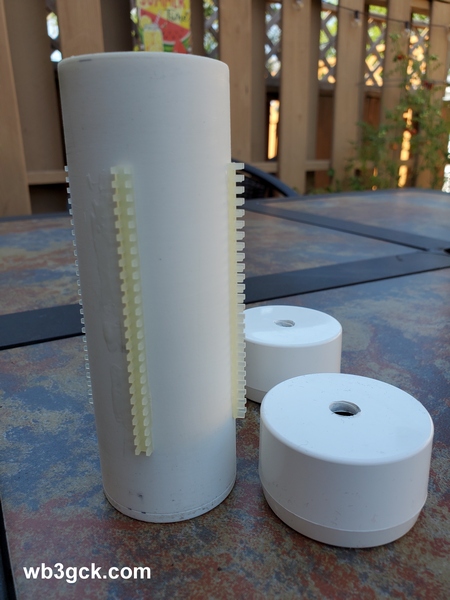
As shown in the accompanying photo, I drilled the end caps to accommodate the ⅜-24 bolts. The 1-1/4 inch bolt was used for the bottom of the coil, along with a flat washer and a lock washer. The 1-inch bolt was used for the top, along with flat washer, lock washer, and the coupling nut.
This is the coil form with the four strips of grommet edging glued on. The ends were drilled to accommodate the 3/8-24 bolts.
The coupling nut was one item I didn’t have in my junk box. My local hardware store is well-stocked, but they didn’t have them with the ⅜-24 thread. I eventually found what I needed on Amazon. It was a little pricey, but I didn’t have any better options at the time.
After cutting the PVC pipe to length, I temporarily installed the end caps. Then, I cut four pieces of the grommet edging to length and glued them on, using Goop® adhesive. Unfortunately, I can’t provide a part number and source for the edging. A local QRPer, Ron Polityka WB3AAL (SK), gave me several pieces many years ago. I’m pretty sure Panduit was the manufacturer. My stash was nearly depleted, but I had enough left for this project.
Before assembling the end caps, I made two short jumpers, each with a ⅜-inch ring lug on one end, and a smaller ring lug on the other. Then I tightened everything up. I left about a ½ inch of thread on the top bolt to go into the coupling nut. I was careful to ensure that my whip antenna would fully thread into the coupling nut.
Before winding the bare wire on the coil form, I installed a ring lug on one end. I drilled a pilot hole in the side of the lower end cap and used a self-tapping screw as a connection point. When you wind the wire on the coil form, try to get the turns as tight as you can. (I didn’t do as good a job winding the coil as I would have liked.) Once I finished winding the coil, I cut the wire to length and installed a ring lug. I used some more Goop adhesive on the grommet edging to hold the turns in place.
The last step was to build the clip lead. For this, I used a piece of RG-174 coax. There’s nothing magical about the RG-174; stranded hookup wire would be fine. I used RG-174 primarily because of its flexibility, plus the shield would be a good RF conductor. (The center conductor was unused.) I crimped and soldered a ring lug to the braid on one end, and soldered an alligator clip to the braid on the other end. Then I used another self-tapping screw on the top end cap to connect everything together.
On the Air
I wrote about my initial tests of the coil in a previous post. Using an antenna analyzer, I determined where to place the tap for each of the four bands. I then used a permanent marker to mark these locations on the coil, so I can quickly change bands without resorting to the antenna analyzer.
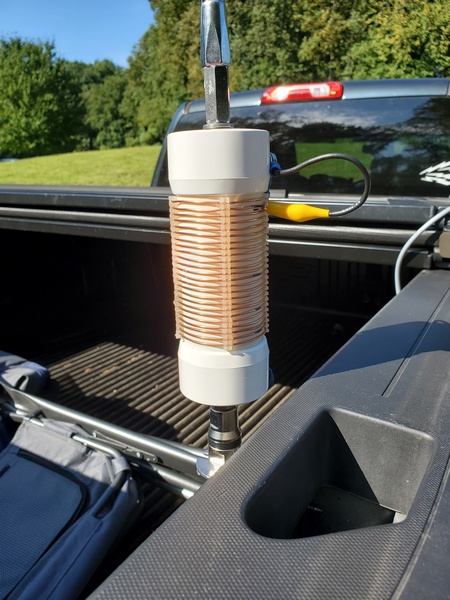
This is the completed loading coil installed on my truck for a POTA activation.
With the antenna mounted on my truck, the SWR is higher than I would like on 40M and 30M. This is not unlike other shortened, base-loaded verticals I’ve used in this configuration. An additional counterpoise wire or two might help. Also, grounding the bottom of the coil and feeding it a couple turns up from the bottom would provide a precise match on the lower bands. I’ve used that technique in the past. That configuration , however, is a bit more complicated to implement, given the way I plan to use this coil. So, I just use a tuner to keep the radio happy, and the antenna seems to work fine.
Wrap-up
My older, larger coil worked fine; so technically, this project was unnecessary. But, since I had most of the parts on hand, what the heck. It was a fun project, and I’m sure it will see a lot of use in the future.
I built a new loading coil to use with my MFJ-1956 12-foot telescopic whip. This is a scaled-down version of the old one I had been using. But, more on that in a separate post. Anyway, I was dying to see how it worked, so I drove down to Ridley Creek State Park (K-1414, KFF-1414) to put it on the air.
When I rolled into the parking lot, I was surprised to see a large military truck there. As I drove around the loop, I saw about a dozen soldiers in a field. Two of them were carrying a stretcher back into the woods. No, the park wasn’t under attack. It appeared to be some reservists going through a training exercise.
I deployed the new antenna configuration in a minute or two. Before I got on the air, I hooked up my antenna analyzer to confirm that I could tune it up on each band from 40M through 17M. Success! I used a Sharpie® pen to mark the coil tap locations for each band.
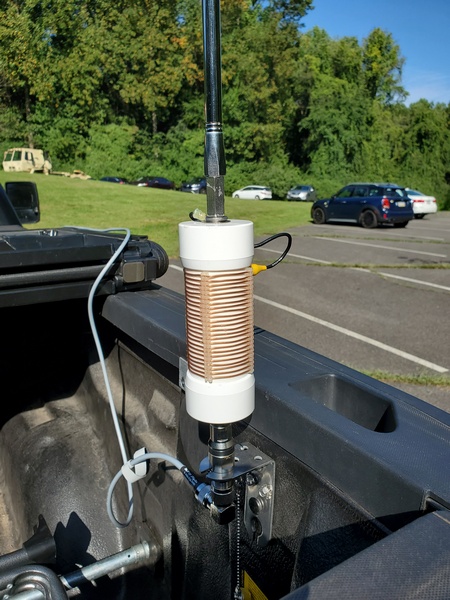
My new homebrew loading coil on its maiden deployment
My rig today was my trusty TR-35 (5 watts). I started out on 40M: and, after spotting myself, the calls started rolling in. I made the requisite 10 contacts in about eight minutes. After making 23 contacts on 40M, I moved up to 20M.
There was also lots of action on 20M. One caller was W6LEN in California. It’s been a while since I worked Jess, so it was good to hear him again. Jess spotted me for the WWFF folks, and I soon started receiving calls from DX stations. I logged contacts with Puerto Rico, Italy, France, and Poland.
After exactly an hour of operating, I had 42 contacts, with four park-to-park contacts I’m aware of. Throwing in the DX contacts, this was one of the better activations I’ve had lately.
I’m hesitant to attribute today’s success to my shortened, base-loaded whip; but this thing seems to have some kind of mojo. I’ll do a separate post on the coil and how I put it together.
I wanted to get out for at least one POTA activation during the Labor Day holiday weekend. Since we have another extended heatwave kicking off today, I opted to go out yesterday. I got an early start at French Creek State Park (K-1355, KFF-1355), figuring that the park would be busy—and it was.
I parked at a trailhead, well away from the busy boat launch and picnic areas. Using my TR-35 (5 watts) and homebrew vertical, my first ten contacts came in about 15 minutes. Most of my contacts were on 40M, while 30M and 20M both yielded a few more.
My rig at French Creek State Park (K-1355, KFF-1355)
After an hour or so, the bands seemed to suddenly dry up; so I packed up. (After I got home, I saw that there was some geomagnetic activity in progress.) In any event, my log had 22 QSOs with four park-to-park contacts.
This activation put me one away from a “Repeat Offender” award for this park. I guess I’ll be back again soon to wrap that up.
I hope everyone has a happy and safe Labor Day holiday.





 WB3GCK QRP Amateur Radio