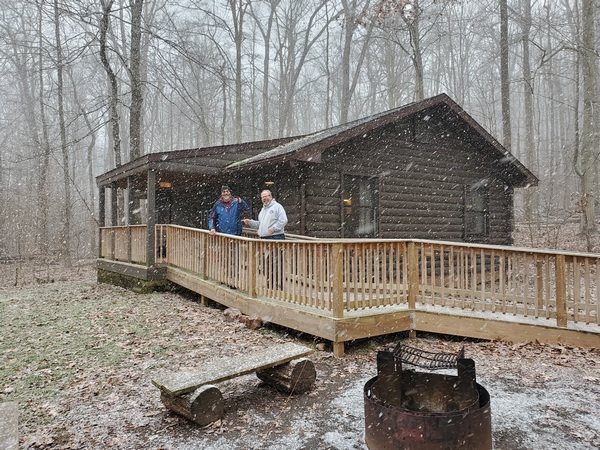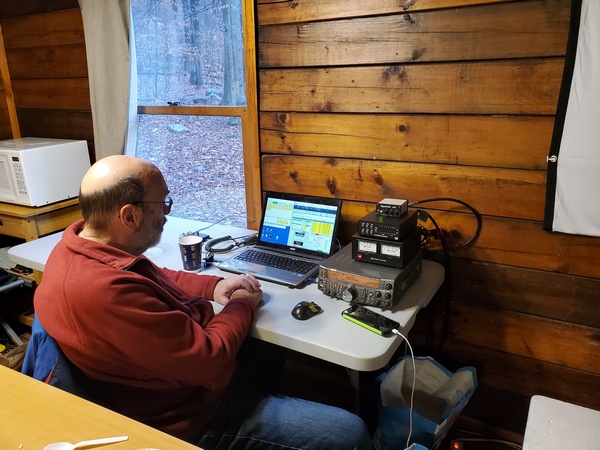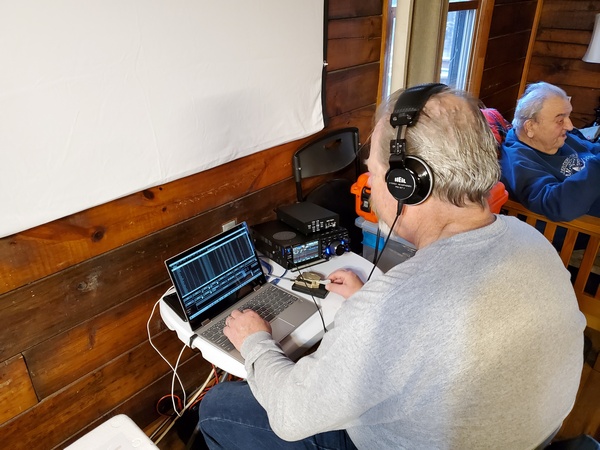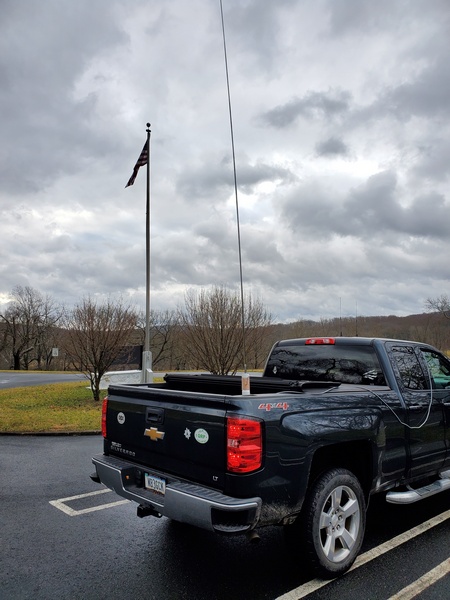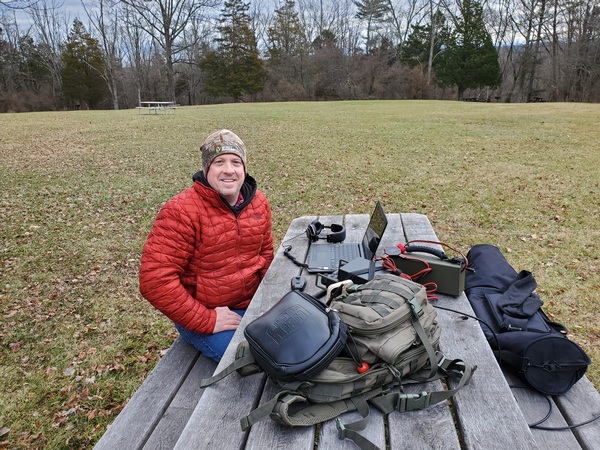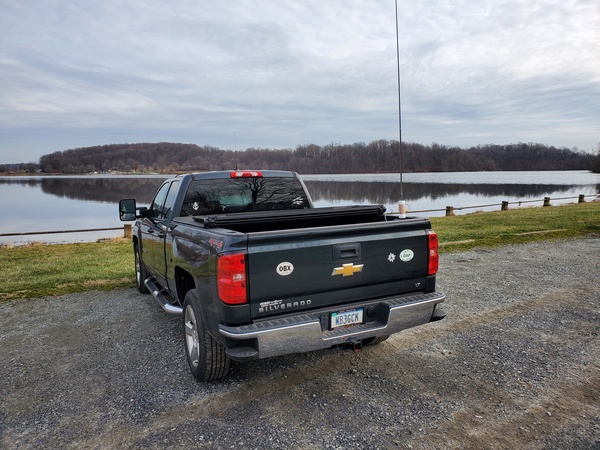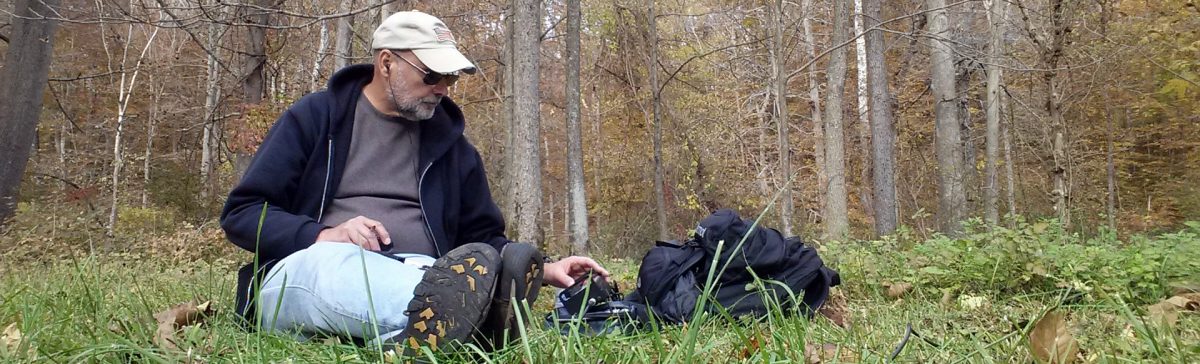
With my Christmas shopping done, I had some free time yesterday. So, I got in a quick POTA activation before the Christmas holiday festivities kicked in. I drove over to Marsh Creek State Park (K-1380, KFF-1380) and operated from my usual spot near the West Boat Launch area.
WB3GCK at Marsh Creek State Park (K-1380, KFF-1380)
I used my usual Penntek TR-35 (5 watts CW) and 12-foot whip, and got on the air within minutes of my arrival. Things got off to a fast start on 40M. I made my first 10 contacts in about 9 minutes. The 30M band was also going strong.
When I switched to 20M, I encountered some intense pile-ups. I was beginning to think someone spotted my callsign incorrectly and people thought I was a rare DX station or something. Although it was tough trying to pull callsigns out of the din, I appreciate all the hunters who were out there yesterday.
After an hour and 10 minutes, I shut down and packed up. I ended up with 55 contacts, including two park-to-park contacts. I also worked 10 European stations: Finland, Sweden (2), Italy (2), France (3), and Germany (2).
So now, I’m looking forward to getting together with my family on Christmas day. I want to wish you and yours the very happiest of holidays.
Back in 2020, I started fooling around with digital voice modes. I don’t really use them a lot, but there are a couple of DMR nets I like to check into each week. I recently started using the WPSD software instead of the Pi-Star software I had been using on my two hotspots. Just for the heck of it, I wanted to try upgrading the old Raspberry Pi Zero board on one of them to something more capable.
According to the documentation, WPSD was never written for single core processors, like the old Pi Zero W board in my hotspot. The developer recommends a Pi Zero 2 W or better. While it will work on a single core Pi, it runs slower—I can attest to that. I also noticed that CPU utilization was well over 100% at times. With its quad core processor, the Raspberry Pi Zero 2 W is supposed to be five times faster than its single core predecessor. So, I was hoping to see some general performance improvements and faster boot-ups after this upgrade.
In the interest of full disclosure, I’m no Raspberry Pi expert—far from it. I had to do some online research before launching into this. It looked simple enough; the Pi Zero 2 W board is a drop-in replacement for the original Pi Zero board, so it seemed simple enough.
I bought a Pi Zero 2 W board on Amazon for about $28 (US). The board didn’t have the header pins installed, so I bought some. I bought a box of 40-pin headers for less than $10 (US). I now have more of them than I’ll use in my lifetime.
I took advantage of a rainy Sunday to do the upgrade. First, I needed to install headers on each end of the Raspberry Pi’s GPIO area. The two headers had two rows of five pins each. With the help of an Xacto knife, I snapped the pieces I needed from one of the (many) 40-pin headers I now own. With my aging eyes, I needed to use a lighted magnifying glass to do the soldering. To avoid melting the plastic, I allowed some cooling time after I soldered each pin.
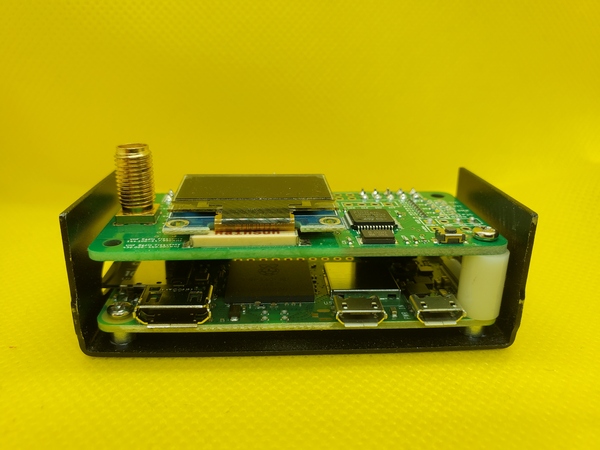
The new Pi Zero 2 W board installed in the hotspot case. The two headers I soldered in are towards the front.
The MMDVM board installed on top of the Raspberry Pi board.
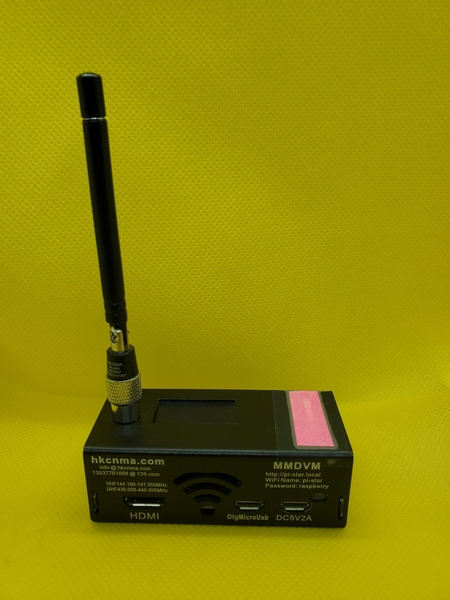
The is the fully-assembled hotspot. This pink section to the right is a piece of paper I used to cover some overly-bright LEDs.
From there, it was a simple task to disassemble the hotspot, swap boards, and put it back together. I estimate that the hardware part of the upgrade took all of about 20 minutes.
I had previously burned the WPSD image on a new Micro SD card, so it was ready to go. When I inserted the card and powered up, the hotspot booted up in a minute or two. After importing a backup WPSD configuration file and doing a couple of tweaks, the hotspot came to life. Success!
The performance improvements were immediately obvious. The dashboard and configuration web pages were much more responsive, and the CPU load typically stays under 20%. It’s been running for a week now, and it’s been rock-solid. Since this upgrade went so smoothly, I went ahead and upgraded my other hotspot. That one was just as easy and is also working great.
For you Raspberry Pi power users out there, this is pretty trivial stuff. Yeah, I guess it is. But it was an easy and fun little project, and I learned a bit about Raspberry Pi boards in the process.
I’ve been a little under the weather this week, but I squeezed in a long overdue POTA activation this morning. Although I had a successful activation, I had to contend with some annoying QRM.
I took a ride down to Ridley Creek State Park (K-1414, KFF-1414), one of my favorite nearby parks. I went with my usual setup: TR-35 (5 watts CW) and 12-foot whip with my homebrew loading coil.
WB3GCK at Ridley Creek State Park (K-1414, KFF-1414)
I had a great start on 40M, logging my first 10 contacts in 12 minutes. Four contacts later, a loud digital signal popped up on my frequency wiping me out. I moved up to 20M and had to tune around for a while until I found an empty spot. Although the band was producing contacts for me, it seemed like I was operating on the “international tune-up frequency” or something. At one point I had to stop for an extended “tuner-upper.” After what seemed like an eternity, he finally unkeyed. After that, I heard someone call him a “lid” (in CW, of course). Fortunately, things were more civilized on the 17M and 30M bands.
When I wrapped up, I had 43 contacts in my log, including Finland, Italy, and two stations in France.
Despite the occasional QRM, it wasn’t a bad morning.
Sometimes I get excited over some of the most trivial things. This is one of those times.
I wrote about my Junk Box Loading Coil in a recent post. I normally keep the loading coil and my 12-foot telescopic whip antenna stashed away under the backseat of my pickup truck, so it’s handy for spur-of-the-moment activations. I also keep a couple of Jackite poles and some other gear under there. While the coil is pretty rugged, I just didn’t feel right about cramming it in there unprotected. By pure dumb luck, however, I stumbled on the perfect storage solution.
While mindlessly browsing the Internet a while back, I stumbled across something on a Chinese seller’s website (Temu.com) that caught my eye. It was a storage case that was probably made for something no longer sold. I’d provide a link, but products quickly come and go on this website. The website listed it as “Simple Portable Storage Zipper Bag, Travel Electronic Tools Organizer, Zipper Container.” Wow. That’s a mouthful.
I had seen similar cases on eBay, but not in this particular size. Given the listed dimensions, I thought it might be a good fit for my homebrew loading coil. At the time I placed my order, it was selling for $7.98 USD.
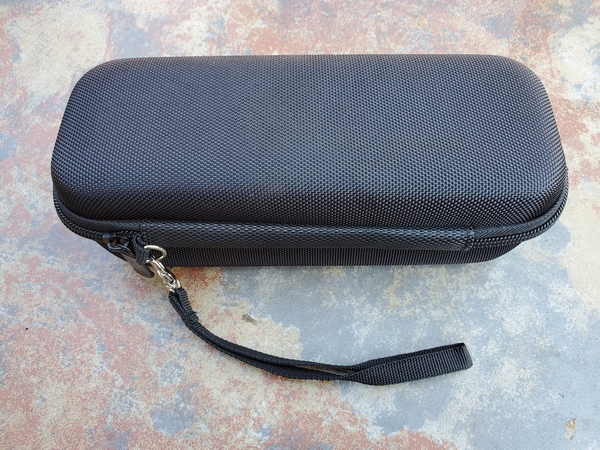
This is the case I bought to use with my Junk Box Loading Coil.
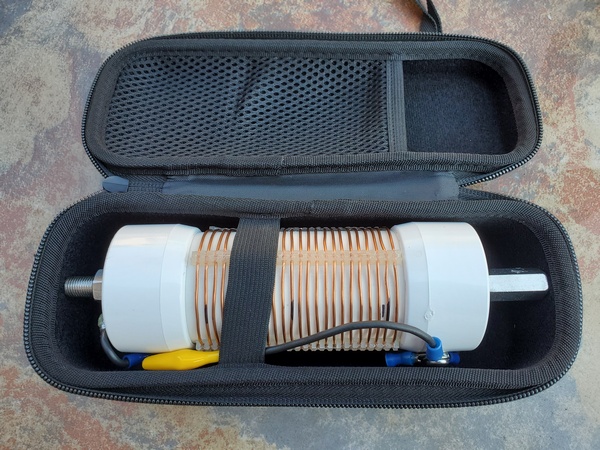
The container, along with a few other things I ordered, arrived on my front porch eight days after I placed my order. Voila! The case was a perfect fit for my loading coil. In fact, it looks like it was custom made for it. It’s semi-rigid, so it affords some degree of protection. It’s definitely not elephant-proof, though. There’s an elastic strap inside that helps hold everything in place.
My Junk Box Loading Coil tucked away in its new storage container
I’m not exactly sure what this case was intended to house, but it’s perfect for my application. So now, my coil will stay clean and protected, while waiting under the backseat of my truck for my next POTA activation.
One of my favorite quotes—attributed to several people and often paraphrased—states: “Predictions are tough, especially about the future.” That famous quote certainly applied to the propagation predictions for today.
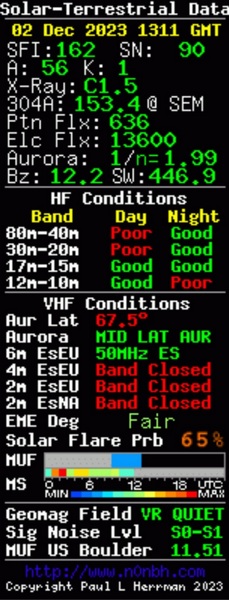
Yesterday, a major geomagnetic storm wreaked havoc with the bands. The propagation widget I have on my phone described it as a “severe storm.” That’s a description I don’t see very often. This morning, the widget showed some improvement, although it predicted poor daytime propagation on the 40M, 30M, and 20M bands.
Poor daytime band conditions were predicted for this morning for 20M and below.
Undeterred by these predictions, I headed out to Evansburg State Park (K-1351, KFF-1351) for an early morning activation. I used my current go-to setup, which includes my Penntek TR-35 (5 watts) and my 12-foot whip combined with my homebrew loading coil.
My location this morning in Evansburg State Park (K-1351, KFF-1351)
Despite the predicted poor conditions, I started out on 40M. I immediately found band conditions to be anything but poor. In fact, it only took nine minutes to make the requisite 10 contacts. I had equally good results on 30M, 20M and 17M. The 17M band was very active, and I had a mini pile-up of DX stations at one point.
After an hour and 20 minutes, I ended up with 58 contacts. I didn’t have any known park-to-park contacts today, but I had 11 European DX contacts including: France (4), Italy (2), Denmark, Belgium, Slovenia, Sweden, Slovak Republic. I ran into a lot of QRM today, so I thank those operators for their perseverance. As an added bonus, my little five-watt signal also made it out to California today.
I’m sure glad I didn’t let the band predictions scare me off this morning!
Our family had to postpone our Thanksgiving get-together until the weekend. So that gave my (far) better half and me a quiet day to ourselves. What better way to celebrate a holiday than a POTA activation?
My destination today was Marsh Creek State Park (K-1380, KFF-1380), one of my favorite local parks. As I was walking out the door, my (far) better half told me, “You shouldn’t expect too many contacts because of the holiday.” Ha! After being married to a ham for 46 years, you would think she would know better. A holiday is just an opportunity to get on the radio instead of working!
My rig today was my old YouKits HB-1B. After I bought it through Ten Tec 10 years ago, it was my go-to portable rig. In recent years, I’ve been taking it along on trips as a backup rig, but it hasn’t seen much air time.
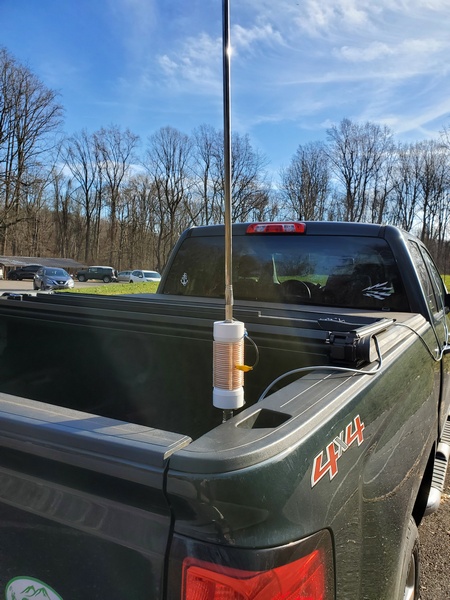
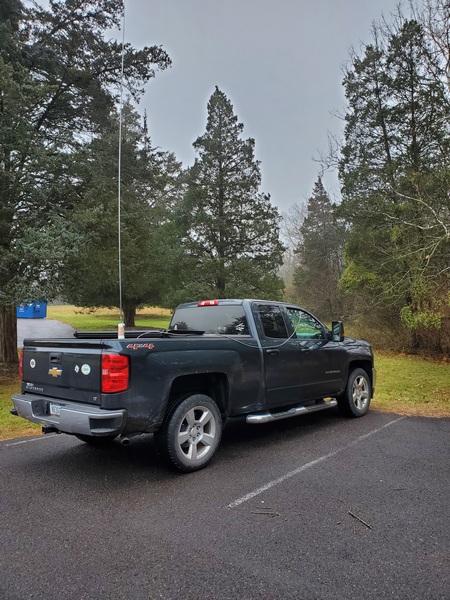
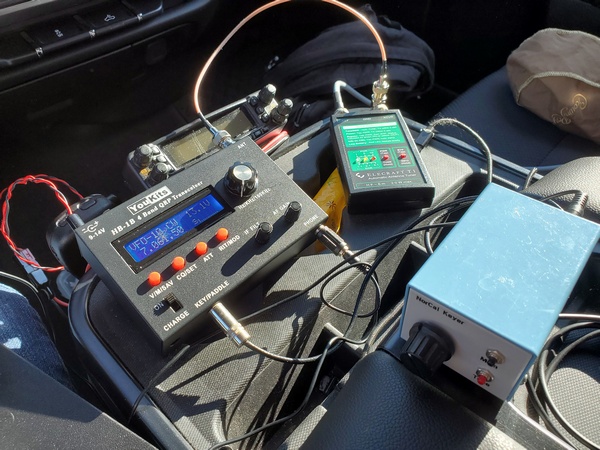
The HB-1B has a canned “CQ” CW message, but no programmable memories. I brought my old NorCal keyer along to take care of that. Since the HB-1B also lacks an internal tuner, I used my Elecraft T1. Actually, this was a portable configuration I have used many times years back. Antenna-wise, I went with my 12-foot whip and homebrew loading coil on the back of my truck.
My old YouKits HB-1B transceiver, along with my Elecraft T1 ATU and NorCal keyer
The HB-1B never had the cleanest sounding sidetone; but using a LiFePO4 battery (around 13V), the sidetone had some loud clicks. Over the years, the display also developed some kind of mark or smudge that is very noticeable at some viewing angles. Neither of these issues were a show-stopper for me.
I started out on 40M and seemed to get out well enough. After the first eight contacts, though, the band seemed to dry up. I moved up to 20M, and things picked up. Although it took 20 minutes to get my first 10 contacts, there was lots of activity on the 20M band. The power output is slightly lower on 20M (approximately four watts), but I still collected 32 contacts there. I picked up a few more on 30M before calling it quits.
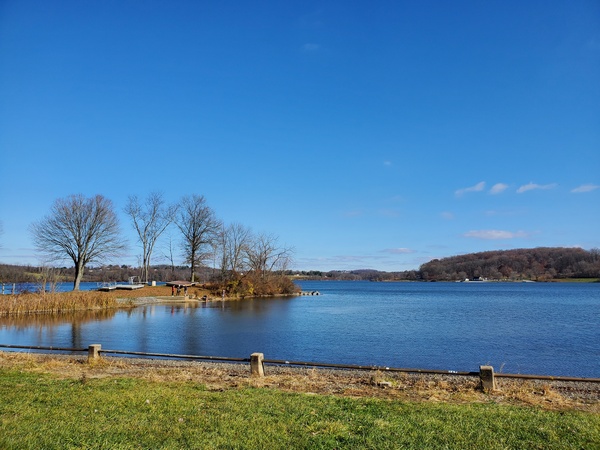
My view of the lake in Marsh Creek State Park (K-1380, KFF-1380)
In less than 90 minutes on the air, I ended up with 50 contacts (with one dupe). There were no park-to-park or DX contacts today. (I neglected to post a spot for the WWFF folks.)
Despite its shortcomings, the little HB-1B gave a good accounting of itself. It’s still a worthy backup rig, and I need to put it on the air more often.
Finally, to all those celebrating, have a happy and safe Thanksgiving.
I made a run down to Ridley Creek State Park (K-1414, KFF-1414) for an early POTA activation. I usually do well at this park, but this morning was something else.
Using my usual Penntek TR-35 (5 watts), along with my 12-foot whip and homebrew coil, I made my first ten contacts on 40M in ten minutes. Among those was VE3WMB, a fellow Polar Bear QRPer. When things slowed down on 40M, I moved up to 20M. That’s when things really got interesting.
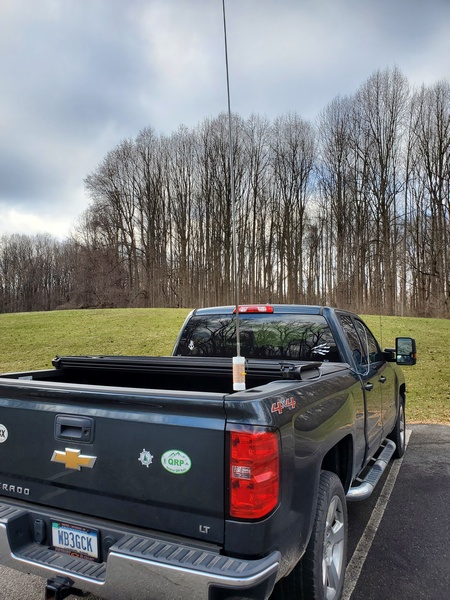
The WB3GCK “QRPmobile” at Ridley Creek State Park (K-1414, KFF-1414)
After I started calling CQ on 20M, I spotted myself on the WWFF spotting page. A minute later, the European stations came out to play. Between the stateside and European hunters, things got pretty busy. Up on 17M, for example, I had a string of six DX stations in a row.
When I wrapped up after 90 minutes, I had 52 QSOs in my log, with five park-to-park contacts. I had a total of 13 European contacts today, including:
Italy: IW2NXI, IK1GPG
Finland: OH1MM
Germany: DL1EBR, DL1HB, DG1KJG
Sweden: SM4BNZ
France: F4ILH, F4HZR, F6EOC
Denmark: OZ1IPP
Latvia (a new one for me): YL2TQ
Poland: SP6GNJ
I think today’s activation was a combination of a site with good elevation, good band conditions, and some DX stations with exceptional ears.
I made a long overdue visit to a nearby park yesterday. Norristown Farm State Park (K-4363, KFF-4363) is only about 30 minutes away, but it has been six years since my last activation. So, I set out to rectify that.
This time around, I parked in the lot near the park office, a few spaces away from where I parked six years ago. Being a working farm, this parking lot is surrounded by cornfields, making it an unusual setting for a state park.
Operating from Norristown Farm Park (K-4363, KFF-4363)
This time around, I used my current go-to setup: Penntek TR-35 (5 watts) and 12-foot loaded whip. I noticed that there was some local noise on the bands. It was most noticeable on portions of the 20M band. Undeterred, I got on the air.
I started on 40M, but that was slow going. After logging three contacts, I moved up to 20M, where I spent most of my time. I also checked 17M, and that band seemed in good shape as well.
After an hour and 20 minutes, I logged 34 contacts, including five park-to-park contacts. Some highlights:
European contacts with Spain, Italy, and Germany. (WWFF spots always seem to bring out the DX stations.)
K4NYM called me on 17M from Florida. Bill was working a “3-fer,” giving me three park-to-park contacts with one QSO. Thanks, Bill!
I’m not sure why it took me so long to get back here, but I’ll definitely visit more often.
I had a rare weekday free from my usual family obligations, so I went out to activate a park. It had been almost a year since I last activated White Clay Creek State Preserve (K-4633), so that was my destination this morning.
Located near the Pennsylvania-Delaware border, the Preserve is about an hour away from home. I parked near the park office and got set up. I used my usual setup: my TR-35 (5 watts) and 12-foot whip with my homebrew loading coil.
My truck at White Clay Creek State Preserve (K-6433)
Starting out on 40M, it took me about 15 minutes to make my first 10 contacts. The 20M band was in pretty good shape, so I spent most of my time there. I also made some contacts on 17M before packing up.
This park doesn’t get activated too often, so I had a steady stream of hunters today. After about 90 minutes, I had 50 contacts in my log. I had one DX contact (F4ILH) but no park-to-park contacts (that I know of).