
Boschveldt QRP Field Day 2023

ARRL.ORG 2023 Field Day Logo

Another Boschveldt QRP Club Field Day is in the books. The weekend started out rainy, but the weather improved for the rest of the weekend. The inclement weather didn’t stop us from having a good time. 

As we’ve done for the past five years, we camped out on private property owned by a local businessman. There were only three of us this year: Ed K3YTR, Glen NK1N, and me. On the air, we operated in category 2A (battery) running QRP. We used our club callsign, W3BQC.

Given the lousy weather, I kept my antenna simple this year. I used a 29.5-foot vertical fed with my homebrew weather-resistant 9:1 unun. NK1N used an 85-foot inverted L, which performed very well for him. Once again, we used a battery operated Wi-Fi access point to network our logging laptops together. 
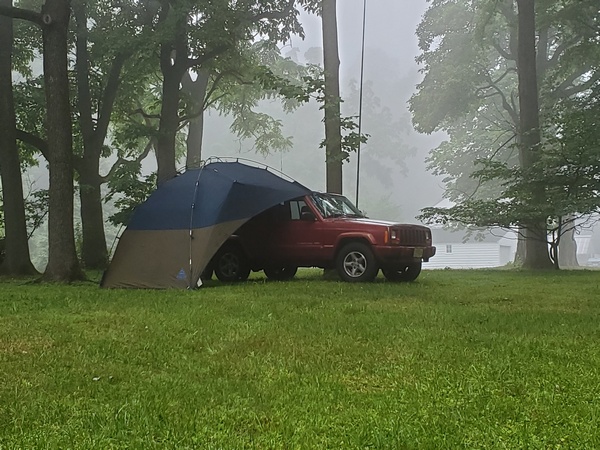
  • This picture of NK1N's set up shows the fog and rain on Friday.
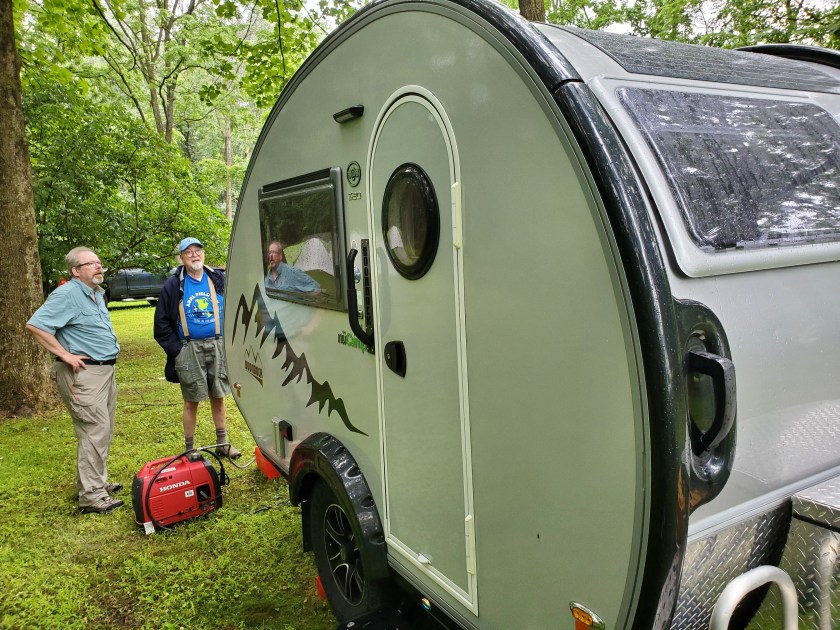
  • NK1N and K3YTR admiring the trailer Ed K3YTR rented for the weekend
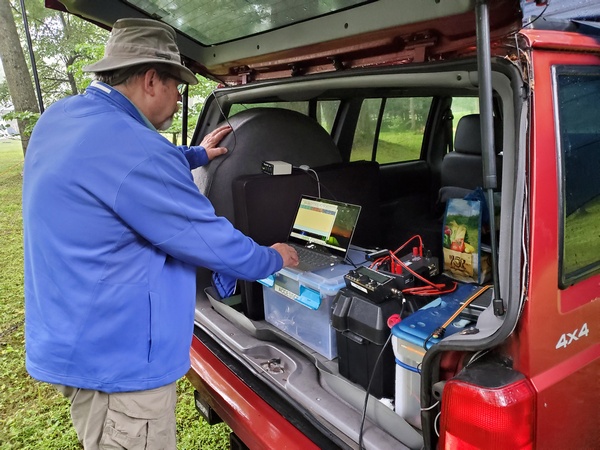
  • Glen NK1N testing out his gear on Friday
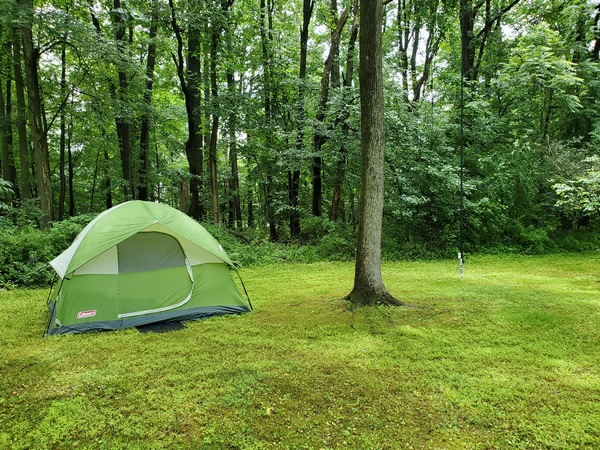
  • WB3GCK's tent with my vertical to the right of the tree
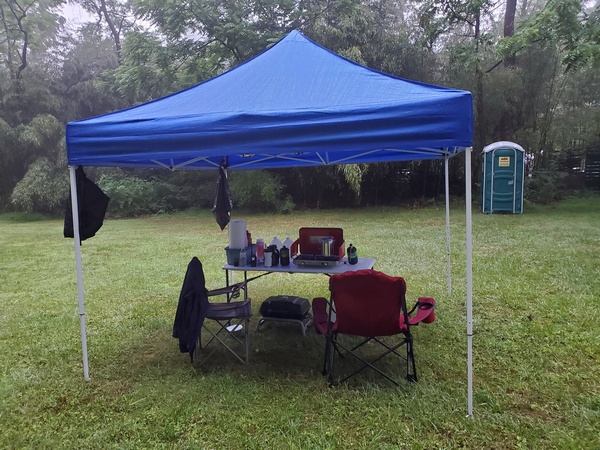
  • Our common food prep area gave us a place to hang out during the rain.
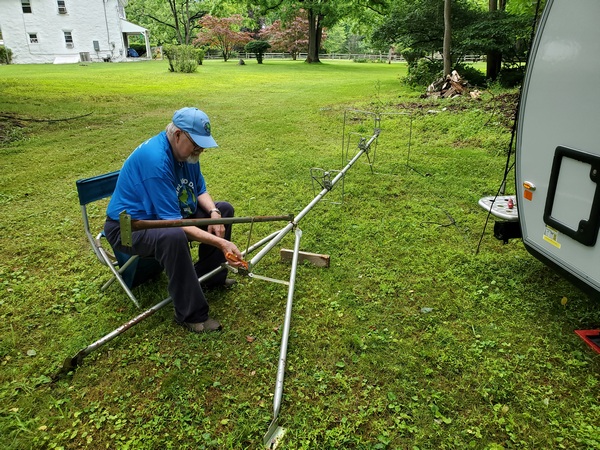
  • Ed K3YTR assembling his VHF antennas
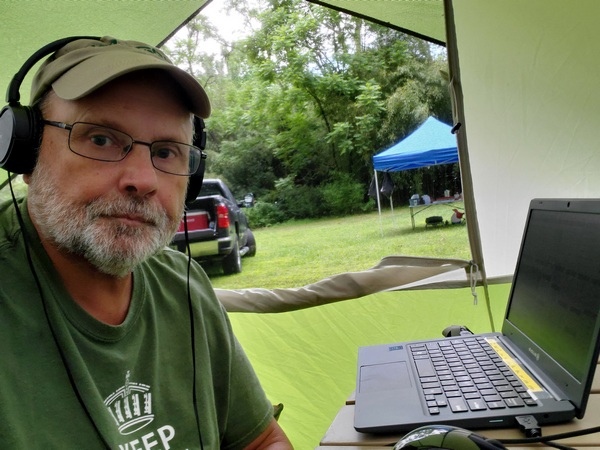
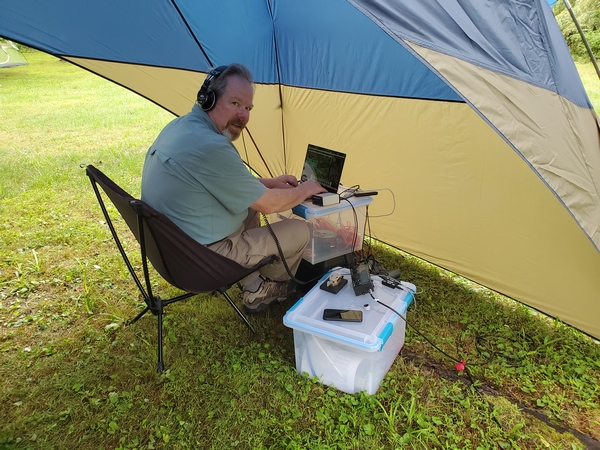
  • WB3GCK operating from the tent
  • Glen NK1N operating under his canopy
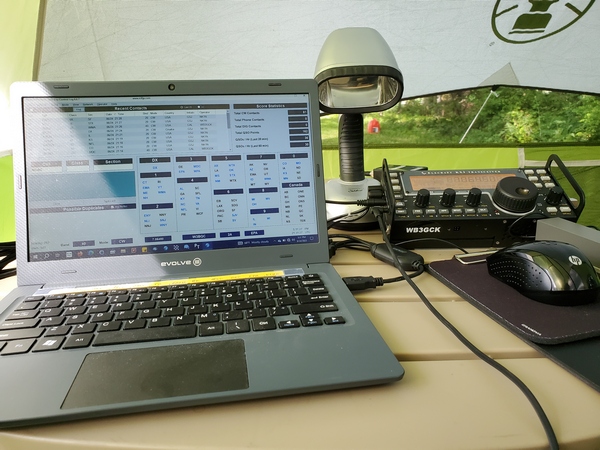
  • The radio equipment in my tent. This was the first Field Day for my little Evolve laptop. I used it for logging, CW keying, and rig control.
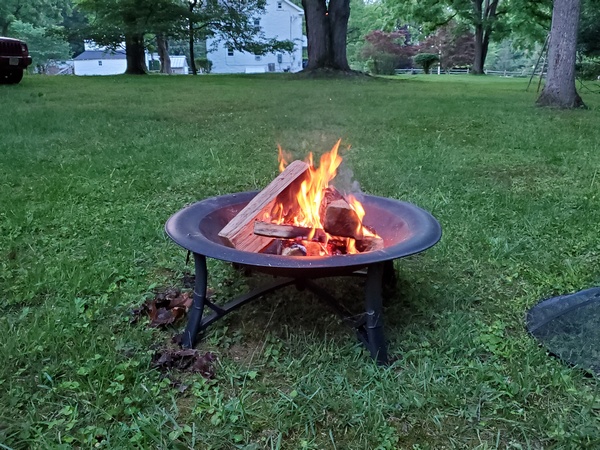
  • It's just not a Boschveldt Field Day without a campfire.

I primarily operated 40M CW, while Glen covered 20M and 80M. We both made contacts on 15M CW. Glen had a contact with a station in Croatia and one in Hawaii. I think the Hawaii contact was a Boschveldt QRP Field Day first. By Saturday night, the weather had improved enough for us to take a break and swap some tall tales around the campfire. 

The weekend was not without some equipment issues. Glen and I both had batteries fail. Fortunately, we had spares on hand, so our operations weren’t affected. K3YTR also had to spend some time troubleshooting his setup. I also had an issue with the Digirig Mobile interface that I planned to use to send a radiogram via Winlink (VARA-FM). However, Glen was able to successfully send the radiogram via HF.

On Sunday morning, we operated for a few hours before shutting down early to pack up. We had some rain and thunderstorms headed our way, so we wanted to pack up while everything was still dry. (The rain started about an hour after we left.) 

We ended up with 233 CW contacts. No records were broken, but the three of us had a great time.

72, Craig WB3GCK
Repurposed Antenna Parts – Round 2

In a recent post, I wrote about a vertical antenna I put together with an old homebrew loading coil and a 12-foot telescopic whip. I intended to add some marks on the coil for each band, so I could eliminate the need for an antenna analyzer during band changes. This time, I actually remembered to bring a permanent marker and got it done.

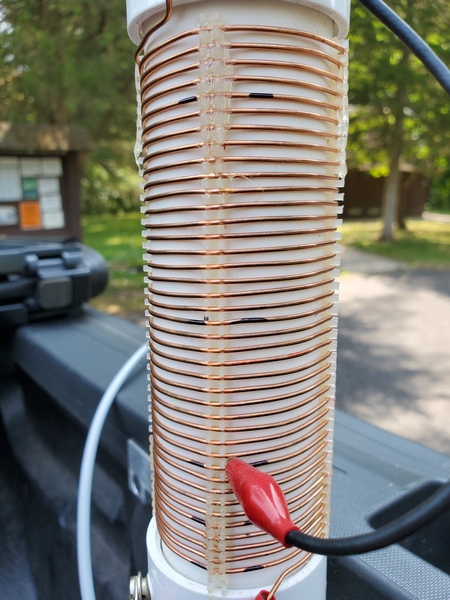
I drove up to Evansburg State Park (K-1351/KFF-1351) this morning for a quick POTA activation. Before I got going, I used my antenna analyzer to determine the tap points for each band. I used a Sharpie® marker to mark the coil for 40M, 30M, 20M, and 17M. Since the coil has sufficient inductance to load the 12-foot whip on 60M, I also marked that band (the top-most mark on the coil). Before I started operating, I went back and checked each tap location to confirm repeatable results. Using a Sharpie marker is a decidedly low-tech approach, but it serves the purpose. 

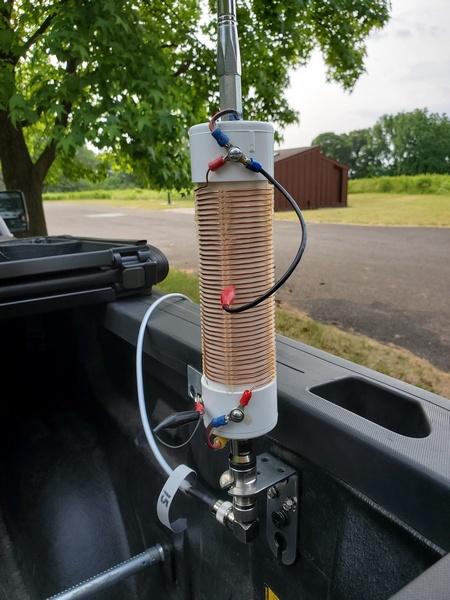
My homebrew loading coil. If you look closely, you can see the marks I added. As shown, the coil is tapped for the 30M band.

To change bands now, I just move the tap to the appropriate mark. I still use an antenna tuner to deal with any minor variations I might encounter. Now I can change bands in the time it takes to move the coil tap and hit the “tune” button on the tuner.

Despite the so-so band conditions this morning, the 12-foot whip performed well. In less than an hour of operating, I made 18 contacts. Most of my contacts were on 40 and 30. There were two park-to-park contacts I’m aware of. 

The 12-foot base-loaded whip in use at K-1351

My operations were interrupted for a chat with a curious park ranger. I gave him my standard Parks on the Air spiel. He had encountered POTA activators in another state park, so he had some familiarity with the activity. After a few minutes, he left to look into a reported issue on one of the hiking trails. 

So, I’m pretty satisfied with this antenna. It has a length advantage over my Gabil GRA-7350TC antenna. Comparing coil dimensions, I suspect it also has an efficiency advantage over the Gabil antenna. 

Regardless, I now have another useful option in my antenna arsenal.

73, Craig WB3GCK

POTA with Repurposed Antenna Parts

While going through my stash of old parts, I came across a coil assembly I built over 20 years ago. Originally, it was part of a homebrew antenna inspired by the MFJ-1622 Apartment Antenna; but I used it over the years with a variety of whip antennas while “stationary-mobile.” As I moved on to other antennas for my portable operations, the coil was relegated to the junk box and forgotten—until now.

I also had an old MFJ-1956 12-foot telescopic whip that I haven’t used in years. It was stashed away in the basement waiting to become part of a new antenna project. Having just installed a ⅜-24 antenna mount in the bed of my pickup truck, I thought the coil and whip might work well with it. 

The coil is a beast. It’s made from 1.5-inch PVC pipes and wound with bare copper wire—16 awg, I think. I used four strips of nylon grommet edging material to keep the turns evenly spaced. (I don’t remember where I got the grommet material, but it’s similar to this Panduit product.) The coil is about 5.4 inches long and 2 inches in diameter with 40 turns. Using an online calculator, I figured the coil is approximately 25.4 μH. 

The homebrew coil I built more than 20 years ago.

The coil assembly weighs in at a hefty 14.1 ounces, and the overall length is 10.5 inches. The whip is 24 inches collapsed and weighs 9.6 ounces, so it wouldn’t be my choice for a backpacking antenna. However, on my truck, it should do fine.

Using another online calculator, I reckoned the coil should be more than enough to resonate the 12-foot whip on the 40M band and possibly the 60M band. Since the whip, coil, and mounting bracket all use ⅜-24 hardware; it was just a matter of slapping it all on the truck to see what how it would perform. 

To test it out, I made a trip to Valley Forge National Historical Park (K-0761, KFF-0761) this morning. With a minor geomagnetic storm underway, the forecasted band conditions looked pretty dismal. I also got an early start, since we were expecting some severe storms around mid-day. So, I wasn’t expecting much, in the way of contacts. 

I mounted the antenna on the back of the truck and broke out the antenna analyzer. It took a bit of fiddling to find resonance on 40M. The lowest SWR was around 3.8:1. That’s not great, but my little Elecraft T1 tuner handled it with no difficulties. On the air, I was getting some decent spots from the Reverse Beacon Network, and I made about 8 contacts before moving to 30M.

My homebrew coil and 12-foot whip mounted on the back of my truck.

The SWR on 30M was down to about 2:1. Again, the T1 made sure my TR-35’s finals stayed happy. I made one park-to-park contact on 30M before moving up to 20M

The SWR on 20M was about 1.3:1 across the band. I made another seven contacts here, before stopping to do some experimenting with the antenna. 

I checked 17M and measured an SWR of about 1.2:1 across the band. I didn’t try to make contacts on 17M. Instead, I went back to 40M to pick up a few more contacts before shutting down. 

I intended to bring a Sharpie® pen along to mark the coil for each band to speed up band changes. Of course, I forgot to bring one along. Oh well, I’ll do that next time. For 15M and above, I’ll need to bypass the entire coil and shorten the length of the whip accordingly. 

The static crashes were getting louder, and I heard thunder off in the distance. So, I called it quits. Just as I shut the rig off, the heavy rains started. I quickly took down the antenna and packed up to leave. 

Despite the lousy band conditions and heavy QRN, I ended up with 18 contacts. I had three park-to-park contacts today. And, as it turns out, this was my 20th POTA activation at Valley Forge, earning me a “Repeat Offender” award for this park. 

It looks like this mash-up of antenna parts works pretty well. I’ll give it another shot in a few days. Hopefully, the weather and band conditions will be better. 

72, Craig WB3GCK

Skeeter Hunt 2023 Announced

NJQRP Skeeter Hunt Logo

Larry W2LJ recently released the details for this year’s running of the NJQRP Skeeter Hunt. Of particular note is a slight change in the date; this year’s Skeeter Hunt has been moved to the 4th Sunday in August.

There’s also a new bonus point challenge for this year. Larry has asked me to be one of the 15 “Palindrome Skeeter” bonus stations (Nr. 66).

Here’s Larry’s announcement with all the details:

The long anticipated announcement for the 2023 NJQRP Skeeter Hunt – the 12th Annual, if you can believe that!

For all the details – please go to www.qsl.net/w2lj or go to the Skeeter Hunt page of this blog (the next to last tab on the right – located under the KX3 photo up at the top).

A few points to remember:

1) Due to a personal commitment, the Hunt has been moved to the 4th weekend of August – the 27th.

2) New Bonus Point Challenge for 2023:

Fifteen Skeeters have graciously consented to act as Bonus Skeeters. They have been issued numbers that are palindromes (numbers that are the same forward and backward) – Skeeters 11, 22, 33, 44 …… right through 151. When you work one, that QSO is worth 100 points – and you can work as many as you can up to 1,000 bonus points. The Bonus Skeeters are highlighted on the roster.

3) Skeeter numbers for the rest of you will be issued in the same way as they have since the beginning of this event. Send an e-mail to either w2lj@arrl.net, or w2ljqrp@gmail.com NO SOONER THAN June 21st, the First Day of Summer. You will receive an e-mail back with your sequential number, or you can check the roster, by clicking here. Please do not apply for a number via the Facebook page, as I may very well miss your request – and we wouldn’t want that to happen, would we? Numbers will be issued right up until the Midnight before the day of the event.

I hope you’ll have fun and enjoy the Hunt this year – good luck and happy QRP’ing!

72 de Larry W2LJ 

Bracket for the GRA-7350TC Antenna

Regular readers of this blog know that my homebrew 19-ft vertical is my go-to antenna for “stationary-mobile” operations. I use a low-tech mounting system in the bed of my truck involving a plastic milk crate, a cargo bar, and some bungees. When we go on our annual vacation to North Carolina, unfortunately, I have to remove the crate to free up storage space. I plan to activate a park or two while on vacation this year, so I wanted to come up with an alternate antenna arrangement.

I bought the GRA-7350TC antenna with this specific scenario in mind. Previously, I tested this antenna with a magnetic mount that I had stashed away in the basement. Although a couple of successful POTA activations proved its viability, I wanted something better than my little mag mount. 

Browsing around on Amazon, I found a stainless steel bracket with an SO-239 to ⅜-24 mount. I was reluctant to drill holes in my truck, but I thought a couple of small holes in the truck’s bed wouldn’t be too bad. So, I placed an order.

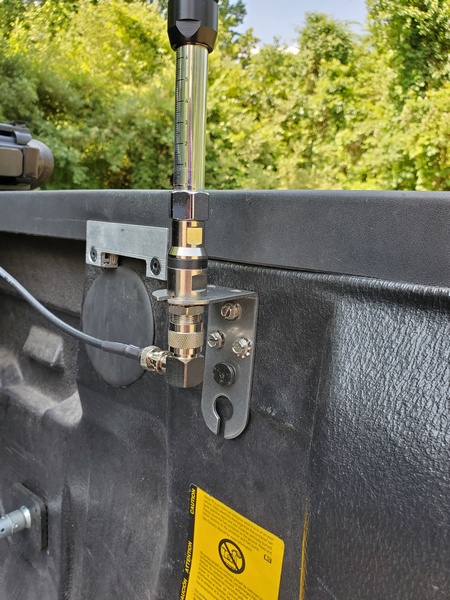
The Sirio stainless steel antenna mounting bracket I found on Amazon
The Sirio M1 stainless steel antenna mounting bracket I found on Amazon

The bracket arrived the next day. It’s really heavy-duty and possibly overkill for my application. My local hardware store had an excellent selection of stainless steel hardware. I bought some #12 x 1-inch sheet metal screws and some star washers. 

The next step was figuring out exactly where to mount it. I had to make sure that I could still close the truck bed cover without hitting it. By dumb luck, I chose a spot where I could use one of the screws that fastens the truck’s bed liner. This placed the mount close to where I wanted it. Then, it was a quick task to drill pilot holes for the three additional screws. Mechanically, it felt solid, and an ohmmeter check confirmed continuity to the truck’s body. 

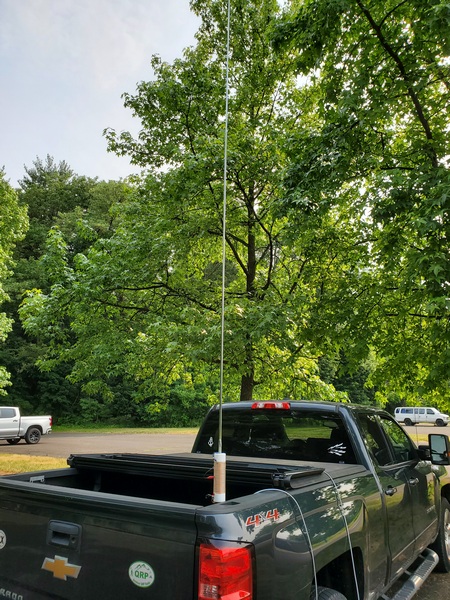
The bracket installed in the bed of my truck with the antenna installed. The black screw is an existing screw I took advantage of.

I gave the new mount a trial run at Ridley Creek State Park (K-1414, KFF-1414). It took me about a minute to get the antenna set up on the mount, and it was a perfect fit. I ran an 18-foot length of RG-8x coax (much longer than I really needed) to the Penntek TR-35 inside my truck.

Using an antenna analyzer, I first tuned it up on the 40M band. I couldn’t get the SWR down below 2:1. This also happened when using the antenna on a magnetic mount, too. I’m guessing a different length of coax or a counterpoise wire might help. In any event, I tuned the antenna to resonance and used a tuner to keep the rig happy. The first QSO was a station in Georgia who gave me a decent signal report. 

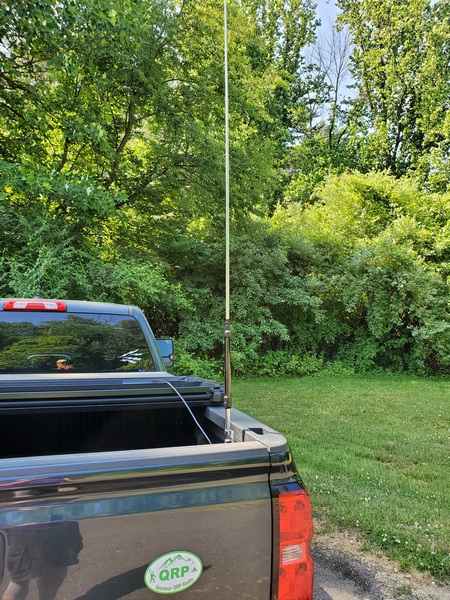
The Gabil GRA-7350TC antenna in use

The SWR on 30M was a bit lower but still above 2:1. Again, I had no problems making contacts with the antenna. On 20M and 17M, the SWR was down to about 1.2:1 or thereabouts. 

Despite the time spent fiddling with the antenna, I logged 13 contacts, with three park-to-park QSOs. I also worked W1HNJ on 40M and 30M. As part of Museum Ship Weekend, they were operating the radio console from the hospital ship, SS Hope. The radio console is now part of the Chatham Marconi-RCA Wireless Museum on Cape Cod, Massachusetts. 

I still have some tinkering to do, but I think the mounting bracket will work just fine. I won’t be retiring my homebrew vertical anytime soon, but the GRA-7350TC gives me another option when the need arises. 

73, Craig WB3GCK