Boschveldt QRP Field Day 2021

Boschveldt QRP Club patch

Once again, our loosely organized group of QRPers got together for Field Day. We only get together a few times each year, so our Field Day tends to be a laid-back social affair.

This year marked our 5th year operating from the property of a local business owner. We certainly appreciate him allowing us to set up camp in his field again this year. We ran as category 4A EPA using the club’s callsign, W3BQC.
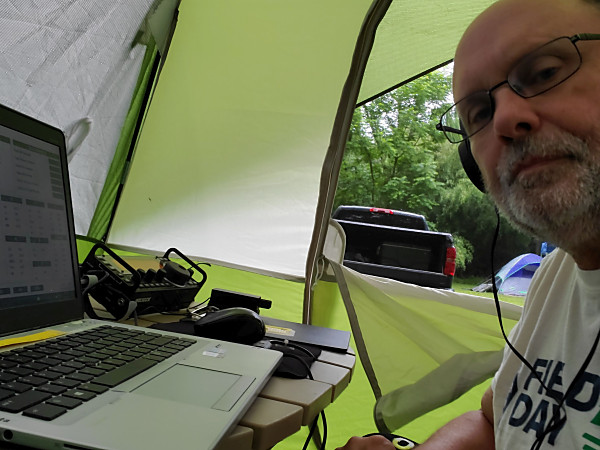
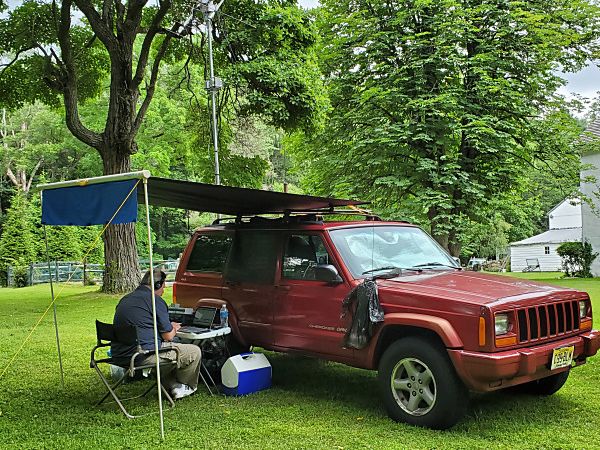
Yours truly, WB3GCK, operating CW from my tent

This year’s Boschveldt crew included: 

Ed WA3WSJ
Ed K3YTR
Glen NK1N
Ron WA8YIH and his son, Cole
John NU3E
Rob KE3TI
Craig WB3GCK
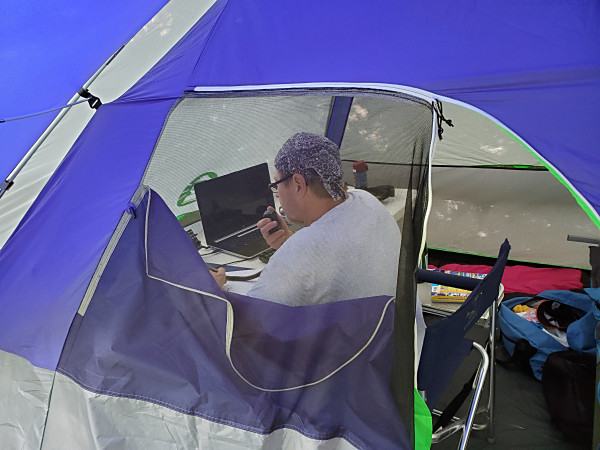
Ron WA8YIH operated phone and ran CW on 80M

I spent most of the weekend hobbling around on a bum knee, so I didn’t get pictures of everyone there. WA3WSJ will likely post more on the Boschveldt QRP Club website

Glen NK1N working the satellites

I operated on 40M only with a 53-ft inverted L. I gave my new K1EL WKmini CW interface its first real workout. I have to say it performed flawlessly for me. One of the highlights for me was working W1AW.
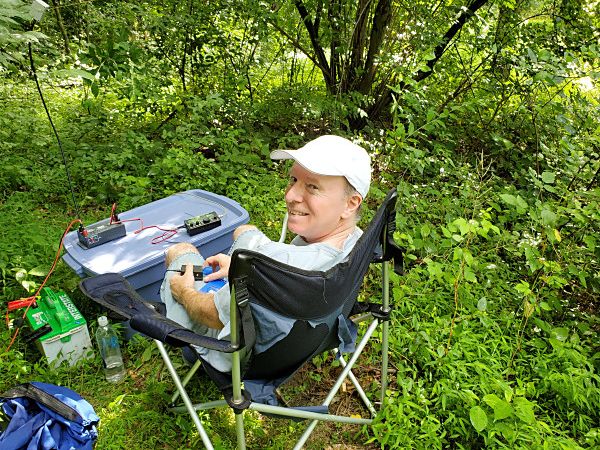
KE3TI operating CW. Rob joined us for the first time this year.

I think it’s safe to say that none of our group are hardcore contesters. We just enjoy camping together and playing some radio. I haven’t received everyone’s logs yet, but I’m sure we won’t be leading our category. Nonetheless, it was a good time. 
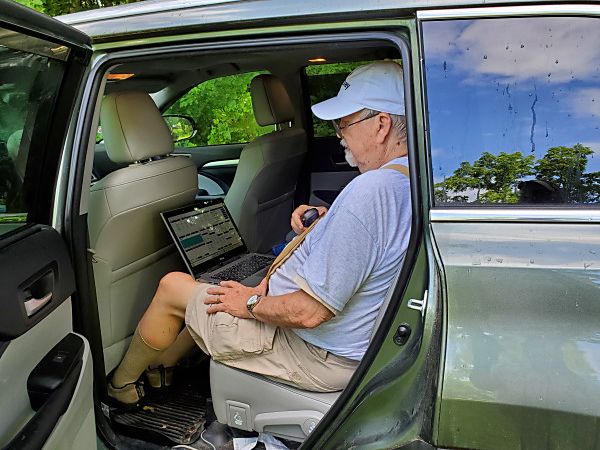
Ed K3YTR operating 2M and 6M SSB and FM

Weather-wise, it has a hot and humid weekend. We had some rain Saturday afternoon; thankfully, it didn’t last long. Overall, it was far from the worst weather we’ve endured for Field Day.
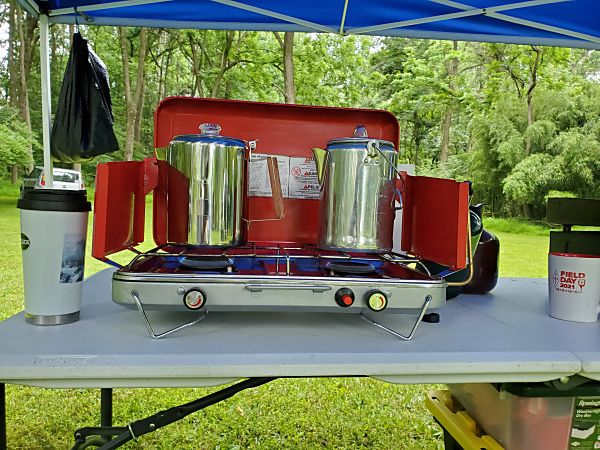
Fueling up for the day at the Boschveldt QRP Club Field Day

Our next major group outing will be in January 2022. We’re planning to have our annual Winter get-together at the Daniel Boone Homestead

I hope everyone had a successful and safe Field Day.

72, Craig WB3GCK
Inside My Old Tuner

In a recent post, I wrote about an old antenna tuner I built about 25 years ago. Although a description of it has been online for decades, I never posted pictures of it. So, here it is. 

I originally posted an article about this tuner on my QSL.net website under the title: A Simple and Flexible Tuner for QRP. Once my go-to transmatch for portable use, it had been on the shelf for quite a while. I hadn’t opened the case in 20 years, so it was a nostalgic walk down Memory Lane for me. 

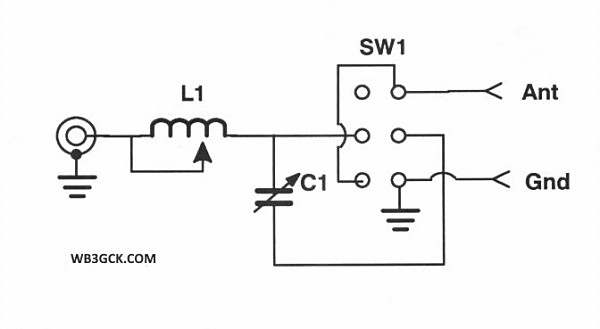
Schematic of the "Simple and Flexible Tuner for QRP."
Schematic of the “Simple and Flexible Tuner for QRP.”

All of the parts used for this project came from my junk box or were re-purposed from other projects. This is the second tuner to inhabit this enclosure, so the variable capacitor and rotary switch were already in place. 

The coil is consists of 40 turns of enameled copper wire on a plastic 35mm canister. The wire appears to be 22 AWG. I wasn’t shooting for any particular inductance value; I just started winding turns. Based on the dimensions of the coil, the total inductance appears to be approximately 31 uH. I tapped it in 8 places and wired it to a rotary switch. I used two-sided foam tape to secure it to the bottom of the enclosure. I left the cap on the film canister so that the lid would press down slightly on it. This helps to securely hold the coil in place.

Inside view of the tuner

The variable capacitor was salvaged from an old radio by a friend of mine. It’s a two-section capacitor, totaling about 365 pf, according to my notes. I added a switch to select between one or both of the sections. Because the capacitor is sometimes in series with the coil, I used some thin fiberglass material to insulate it from the chassis. 

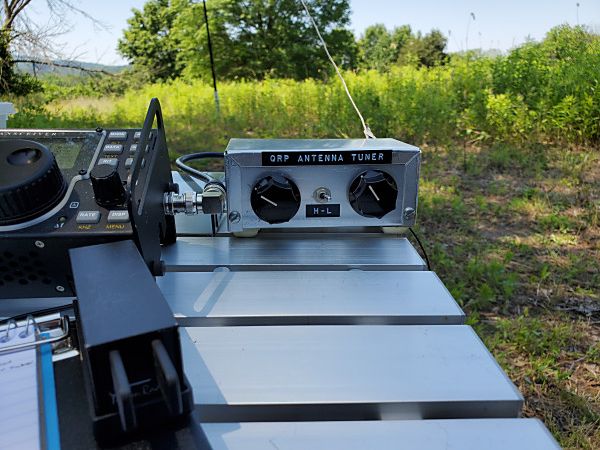
Front panel of my old antenna tuner. The switch selects one or both sections of the variable capacitor.

To the best of my recollection, I purchased the aluminum box at Radio Shack back in the day. I finished off the project with some embossed labels made on an old Dymo label maker. They look tacky, but they’re still holding up after all these years.

Rear view of my old tuner. The slide switch on the left selects the confiuration. In the "LO" position, the coil and capacitor are in series. In the "HI" position, the tuner is configured as an L-match tuner.
Rear view of my old tuner. The slide switch on the left selects the configuration. In the “LO” position, the coil and capacitor are in series. In the “HI” position, the tuner is configured as an L-match tuner.

After spending 15 or more years on the shelf, this funky-looking tuner has been seeing a lot more use lately. I mostly use it as an L-Match for end-fed wires. (I’ve only used the low impedance, series connection a few times over the years.) It’s a great portable tuner for QRP when weight isn’t a consideration. 

I have the parts on hand to build a lighter L-match when I need to carry a tuner in my backpack. Until I find the time to put it together, I’ll keep using this funky old tuner.

73, Craig WB3GCK

Old Tuner to the Rescue

According to the weather prognosticators, today is the start of a 4- or 5-day heatwave here in southeastern Pennsylvania. So, I wanted to get out early for some antenna testing before things heated up too much.

I planned to play around with the speaker wire end-fed halfwave antenna I built recently. To do this, I went back to my favorite antenna test range—my daughter and son-in-law’s property. 

I set up the formerly 66-foot wire (now about 63 feet) in an inverted-V configuration. Since the last time I used this antenna, I trimmed off a couple of feet to see if I could get my little Hendricks SOTA tuner to load it on 20M. 

I started with the SOTA tuner on the 40M band and worked a POTA activator in Indiana. I moved up to 20M, but the SOTA tuner wouldn’t tune below a 2.2:1 SWR. 

Before I left the house today, I had the forethought to pack an old antenna tuner I built about 25 years ago. I used it extensively years ago, but I relegated it to the shelf when fancier equipment came along. I switched to the old tuner, which I configured as an L-match. It loaded up nicely on 40, 20, and 15 meters. As a bonus, the old-school tuner gave a good match on 30 and 17 meters. 

My 25-year-old homebrew antenna tuner. It doesn't look like much, but it did a nice job with my end-fed halfwave antenna cut for 40M.
My 25-year-old homebrew antenna tuner. It doesn’t look like much, but it did a nice job with my end-fed halfwave antenna cut for 40M.

After I finished experimenting with the antenna, I set out to make a few contacts. It was a busy day for Parks-on-the-Air (POTA) activators. I worked 10 of them in 8 states plus Puerto Rico. Three of the QSOs were on 17 meters. It was nice to hear POTA activity up there. 

All in all, I was pleased with how my old homebrew antenna tuner performed. I don’t think it will be spending as much time on the shelf in the future.

73, Craig Wb3GCK