
Some recent Internet discussion got me thinking about the Rybakov 806 Vertical antenna. This easy-to-build antenna has served me well over the years. So, I went back and revisited some of the ways I’ve used it.
What the heck is a Rybakov anyway?
The Rybakov 806 Vertical appears to be the brainchild of Enrico IV3SBE from Italy (now 5Z4ES in Kenya). The term, Rybakov, is Russian for “fisherman.” That’s right… It’s an antenna with a Russian name designed by an Italian who lives in Africa — truly an international creation. From what I could glean from exhaustive Internet searches, this design dates back to the mid to late 2000s. I found numerous references to it from 2009.
The classic Rybakov configuration is a 7.6m or 8m (~25 or 26 feet) wire fed through a 4:1 UNUN. The length isn’t critical, as long as you avoid resonance on the bands of interest. It’s often supported by a telescopic fishing pole (hence, the name, “Rybakov”). Being a non-resonant antenna, you need to use an antenna tuner to make it work. You also need to use radials or some other type of ground.
The antenna can cover 80M through 6M (the “806” part of its name, I suppose). The band coverage depends on the wire length used and the capabilities of your tuner. With a 7.6M wire, you can cover 40M and up without problems. For 80M coverage, plan on using a longer radiator.
The only thing you need to build is the 4:1 UNUN. The IW7EHC website provides detailed instructions for building one. Beyond that, you just need to cut some wire to length for the radiator and radials. Easy peasy!
My experience with the Rybakov
I had been using this type of antenna before I even knew it had a name. Rick KC8AON had a version of this type of antenna he called, “The Untenna.” That’s where I found it.
My first experiment with it was in a “stationary mobile” setup. I rigged up a 26-foot vertical wire and grounded the UNUN to the body of my truck. My Z-817 tuner was able to load it up with no difficulty. I had no problem making contacts and I liked the multi-band coverage.
I next used the Rybakov at a Boschveldt QRP Club Field Day. I set up a 26-foot ground-mounted vertical and used about six 16-foot radials with it. Again, the performance seemed decent and I remember doing well on 10M that year. The only shortcoming was that it wouldn’t load up on 80M.
The next year, I solved the 80M problem by using a 50-foot wire in an inverted L configuration. For the ground, I used six 16-foot radials and two 33-foot radials. This configuration gave me full coverage from 80M to 10M and it worked great. This antenna configuration became my “go to” Field Day for several years. In later years, I used a 53-foot radiator re-purposed from another antenna project.
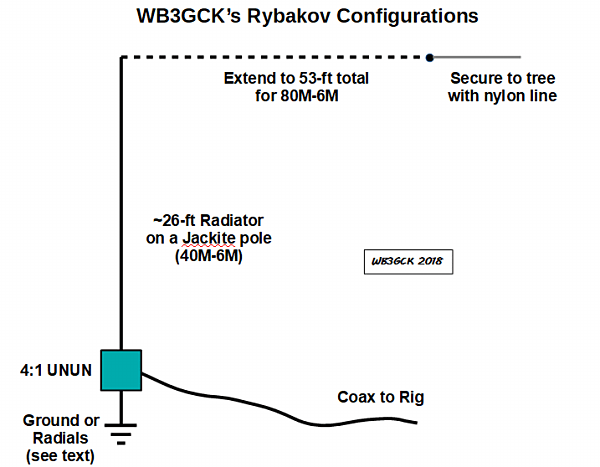
I used another version of the Rybakov with the pop-up camper that I used to own. I strapped a 31-foot Jackite pole to the camper and used it to support a 27-foot wire. I grounded the UNUN to the body of the camper. This antenna worked great on 40M to 6M and, best of all, I didn’t need to go outside at night to change bands. I used this antenna with good results for several years until I sold the camper.
I also built a Rybakov that I use as a backup antenna in the field. I built a small 4:1 UNUN that I use with a 25-foot radiator and a 25-foot radial. The antenna, along with a short length of coax, is easy to carry in my pack.
The bottom line (for me, at least)
I’ve had good luck with the Rybakov Vertical over the years. Is it the best antenna? Nope. Purists will argue about UNUN, ground, and coax mismatch losses. Yep, there are those. Yet, its simplicity and “no gap” band coverage are hard to beat. It’s easy to deploy in the field and it really does work.
If you’re in the market for a simple portable antenna project, the Rybakov 806 is an easy one.
[Update 4/3/2019: I’ve always wondered about the rationale behind the 25-foot radiator often used with the Rybakov antenna. An article in QST [1] by Joe Reisert W1JR shed some light on that for me. Joe’s article discusses the 3/8-wave vertical antenna. According to the article, the 3/8-wave antenna has a low take-off angle and its 200-ohm feedpoint is easily matched with a 4:1 transformer. Its higher radiation impedance provides good performance with just four 1/4-wave radials. For 20M, a 3/8-wave radiator is about 25-ft. Similarly, for 40M, it would be 50-feet. So, my guess is that’s the concept behind the Rybakov design.]
73, Craig WB3GCK
Reference Links:
- IV3SBE Rybakov 806 Vertical
- IW7EHC 4:1 UNUN
- WB3GCK 4:1 UNUN
- WB3GCK Field Day Inverted L
- WB3GCK Pop-Up Vertical
Reference Articles:
- Reisert, Joe W1JR, “The 3/8-Wavelength Vertical — A Hidden Gem,” QST, April 2019, pp. 44-47.
 WB3GCK QRP Amateur Radio
The link for the antenna takes us to a phishing site. You should upadte or remove the link
LikeLike
Thanks for letting me know. The link has been updated. 73, Craig WB3GCK
LikeLike
You are welcome!
As you known already; “That’s what HAMs do.”.
LikeLike
Ran across your post, did some more research and decided to build
the antenna. Built a 4:1 UNUN using a FT-240-K mix toroid. Used 53’ of stealth wire and a 33’ counterpoise that I just run around the perimeter of my vehicle. I run the wire up a 32’ Jackite pole that I put in a flagpole hitch mount with the remaining wire connected to a piece of paracord that I run in a sort of inverted L. I connected my LDG tuner with a 6’ coax right at the UNUN per another discussion on the antenna. Added a 1:1 choke for good measure. Loads perfectly 80-10 and performs excellent.
LikeLiked by 1 person
Sounds like an excellent setup, Chuck. Have fun with it! 73, Craig WB3GCK
LikeLike
Hi, I have recently done some tests, because I found that I had high SWR on 7 and 14 MHz. First tried 5m RG58, 7.6m radiator and 5m counterpoise, tried 8m radiator, 7.6m counterpoise no significant frequency change of the peaks. The next thing was the length of coax. As 5m matches 1/4 on 14MHz and I did not want shorter coax I tried to match with 12MHz with 6.18m coax /1/4 wl*velocityfactor 0.67. It made the trick, moved the SWRmax to 11MHz and 5.5 MHz..
What coaxlength are you using?
LikeLike
Hi Espen: Since the Rybakov is a non-resonant antenna, I never bothered measuring the SWR. A tuner (transmatch) is always required with it. Even though the 25-ft (7.6M) radiator is a 3/8-wavelength on the 20M band, some capacitance is required to obtain a precise match (see the referenced QST article).
I only occasionally use the Rybakov as a portable antenna, typically using either 5.5M or 7.6M of coax. Again, I don’t get concerned with SWR; I just use an antenna tuner and go. (Ignorance is bliss, I suppose.) It’s a compromise antenna for sure, but it always seems to work for me. 73, Craig WB3GCK
LikeLike
Hello Guys,
I’m currently using the “semi-factory” version of Rybakov antenna and I’m quite happy with it. But… our hobby bases on tests and experiments, so… I’m going to allow it to work on 80 m. Anyway, I have the question – has anybody tested 53 feet long version as a “helical” done on the approx. 25 feet long fiber whip? Will it work?
Best Regards and 73,
Piotr SP5TZP
LikeLike
Hi Piotr:
I’m not sure what the effect of helical winding would be. But, by all means, give it a try. I’d love to hear how it works for you.
73, Craig WB3GCK
LikeLike
The Hustler 6BTV uses a helical resonator on top to get 80M. Interestingly it’s wound with Litz wire. The 80M bandwidth is very narrow and tuning of the whip is very touchy. Some have added a capacity hat to increase the b/w. Another alternative to look at is folding the wire back on the mast. That would be similar to the DX Commander design. Also look at the SteppIR CrankIR for some inspiration.
LikeLike
A linguistic remark:
fisherman is rybak (substantive)
rybakov means fisherman’s (technically adjective, in slavic languages we don’t have possessive case but we have possessive adjectives)
but it can be also a surname Rybakov with the meaning “son of fisherman” (similar to scandinavian -sson, not that surprising tradition, because ruling family of Rus’ were originally Rurikids of swedish descent)
originally I thought it was developed by a guy with surname Rybakov, but after diving into history it is pretty clear it really means “fisherman’s antenna” because it is often installed using fishing rod and capital R in “rybakov”, what originally mislead me, was probably taken from some article headline or beginning of the sentence
LikeLike
Thanks, Erik. Interesting stuff! 73, Craig WB3GCK
LikeLike
Hi Folks, I to have been using this design long before I knew it’s proper name. Many years ago Albert M. from Ultimax Antennas asked me to try the configuration of the 25ft radiator, his 4:1 UNUN and looped radials. I have great success with (6) 18FT radials in loops each crossing over each other like the petals of a flower. I use a MFJ 949 series tuner to get a match. I live in a HOA situation and also like to operate portable. This configuration fits the bill to a tee. This was also our main antenna for the DXpedition to the Frying Pan Tower with the exception of using a 33FT. radiating wire. We were extremely successful even down to 80M. With a 25ft wire it sings on 10m thru 20m and will do 40 with out issues but changing to the 33FT really opened 40m and provides ok coverage on 75/80M.
No it’s not the most efficient. We all know the most efficient will be something cut for the frequency desired however a Rybakov even with its draw backs is a sweet multi band antenna especially for portable ops or for a newbie to get on the air quickly and have some great fun!
Cheers to all and 73 KE4IDW
LikeLike
Thanks for sharing
Best Regards and 73, de BH4ESA
LikeLike
There was some suggestion some time ago that the Rybakov was a 3/8 wave antenna that happened to be the length of some fishing pole
I also read that Marconi invented the antenna which was known as the Marconi and his use of an antenna is what showed him the potential of longer range
The fun is trying different antennas to see what works and every now and then cobble up your own idea
So a 4:1 balun and some speaker wire and you are experimenting
John VE3IPS
LikeLike