This is a large event, with distance options ranging from 11 to 100 miles. Because the event covers such a wide area, CCAR needed to provide radio operators at five rest stops and aboard eight support vehicles. The support vehicles are equipped with APRS trackers, allowing the net control operators to track their locations around the course.
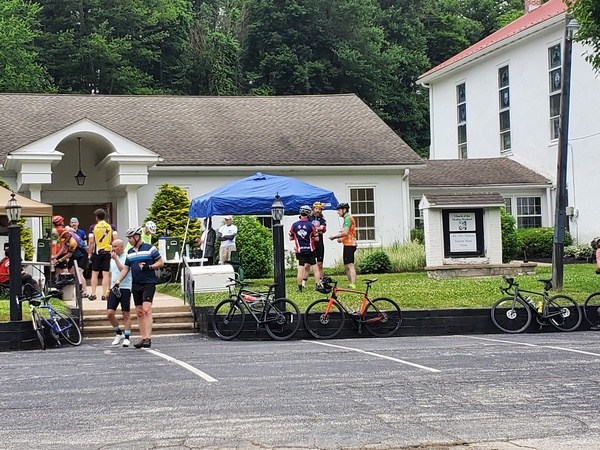
French Creek Iron Tour participants taking a break at the Yellow Springs rest stop
My part in the event was pretty straight-forward. I was once again stationed at a rest stop in historic Yellow Springs, Pennsylvania. Because CCAR has an extensive linked repeater infrastructure, an HT was all I needed for communications.
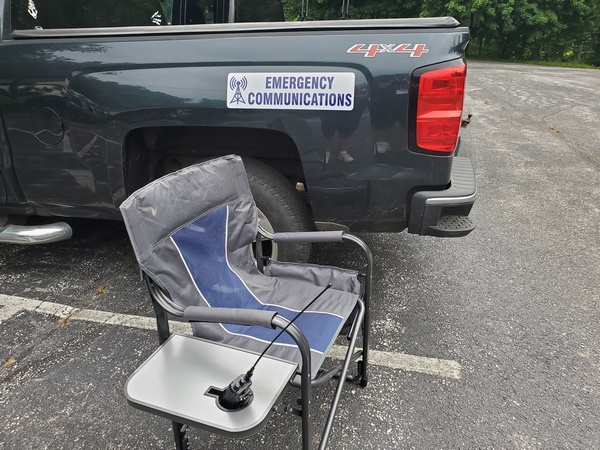
My minimalist setup for the French Creek Iron Tour cycling event
Fortunately, there were no serious issues to handle. A few riders rolled into the rest stop needing bicycle repairs, and some riders required transportation back to the start/finish line at the Kimberton Fairgrounds.
This is always a fun event, and the folks from the sponsoring organization are always a pleasure to work with.
This was another of those weekends that involved different aspects of ham radio. I was involved in a public service event on Saturday, and I got my QRP-portable fix on Sunday morning.
Once again, I served as the net control operator for the event. Chester County ARES-RACES (CCAR) had 13 operators at nine locations along the course. Several local dive teams also took up positions along the course, to ensure the safety of the participants.
This year, I was set up at the Northbrook Canoe Company, which is the end point for the course. The weather was less than stellar, with on and off drizzle throughout the event. The CCAR team, along with a paramedic, hunkered down under a large overhang off of one of the buildings. Communications-wise, this is a straightforward event. CCAR’s repeater system provides excellent coverage in the area, so the entire course can be covered using HTs. I was able to run the net from my camp chair with my AnyTone HT.
I neglected to take pictures of the Canoe Challenge, but I did snap this one of the WB3GCKmobile next to the Brandywine River.
Fortunately, there were no serious issues to be dealt with, and judging by the cheers at the finish line, the participants had a great time, despite the weather.
Evansburg State Park (US-1351, KFF-1351)
On Sunday morning, I wanted to get in a quick POTA activation. The weather was worse than the day before, with chillier temperatures and a more steady rainfall.
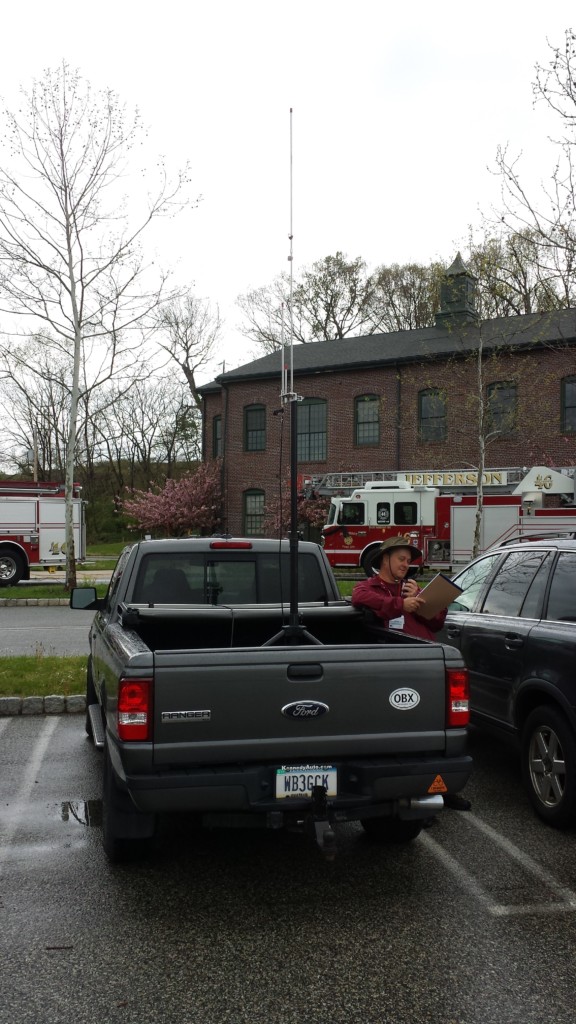
I rolled into Evansburg State Park and found the park completely empty—except for one crazy old ham. After setting up my 12-foot loaded whip, I draped a plastic bag over the loading coil to give it some protection from the elements. I used my trusty TR-35 (5 watts, CW) up in the cab.
My antenna and I sporting our raingear in Evansburg State Park (US-1351, KFF-1351)
For as early as it was (0900 EDT), the number of callers surprised me on 40M. I had my first 10 contacts in about 13 minutes. I operated for exactly an hour and spent most of my time on 40M. Moving up to 30M, I picked up three contacts there before shutting down.
I ended up with 31 contacts, including one park-to-park contact that I’m aware of. No DX today, but the Canadian stations were really booming in.
Towards the end of my activation, I had some rain coming in the passenger-side window where I bring the coax in. Normally, I use a piece of pipe insulation to help seal things up a bit, but I couldn’t find it in the truck. I have some more in the basement, so I’ll have to cut a new piece to fit the window.
Now it’s time to dry off my antenna parts before putting them back in the truck for next time.
I was out yesterday with my local ARES-RACES group providing communications support for the Marshalton Triathlon, here in Chester County, Pennsylvania. This popular event combines cycling, canoeing, and fast walking. I always look forward to volunteering for this event each year.
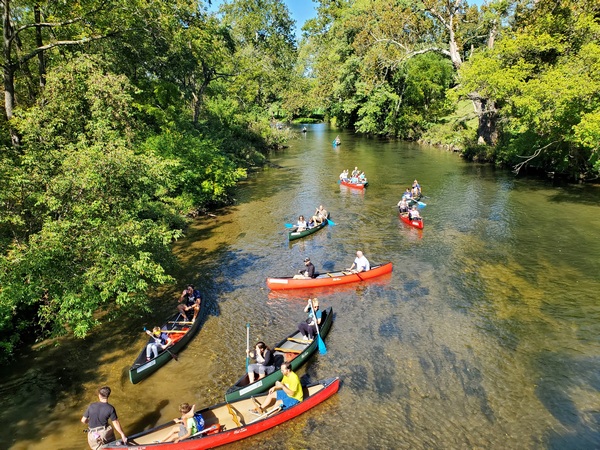
Once again, I was at the end of the 2.3-mile canoeing segment, known as “Canoe Out.” This is my favorite assignment and one that I request each year. The folks working at this location help the participants out of their canoes and retrieve the canoes for transport back to the starting point. I was situated on a bridge with a superb view of the Brandywine River. Compared to the rainy weather we had last year, the weather this year was just about perfect for this time of year.
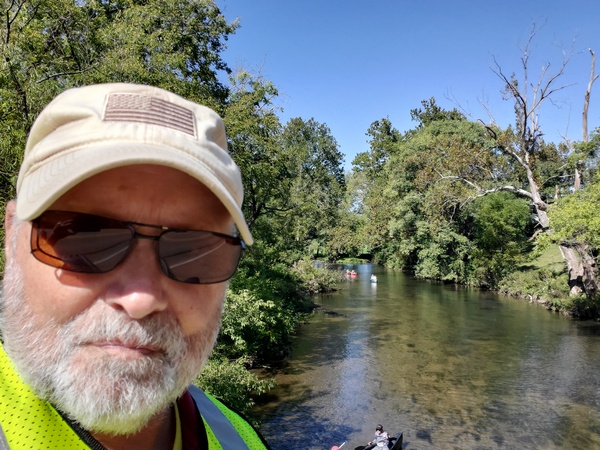
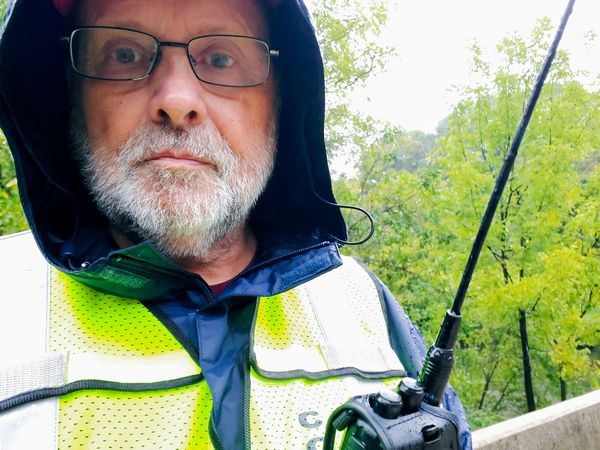
A selfie taken from my vantage point on the bridge during the Marshalton Triathlon
Canoeists waiting to exit their canoes
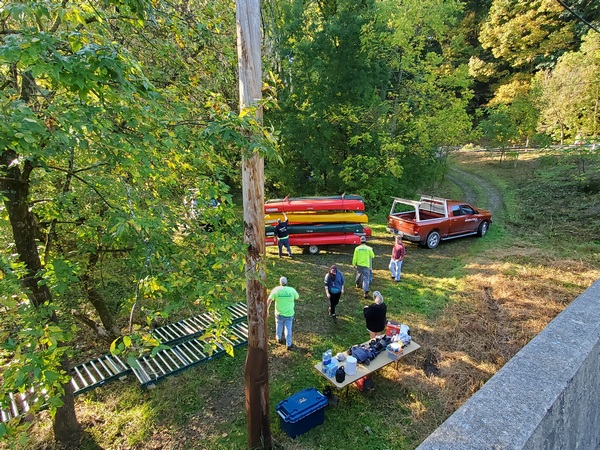
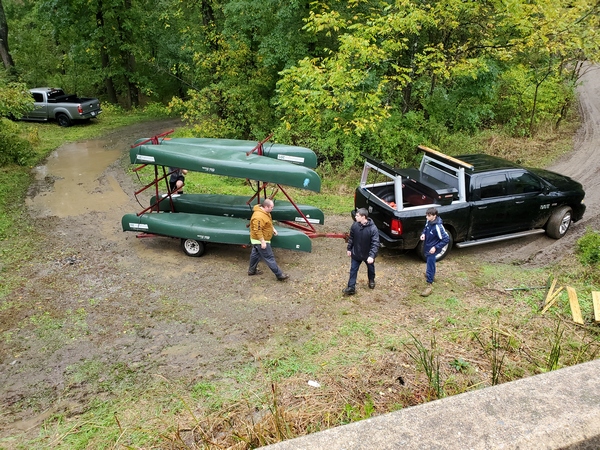
The boat handlers getting a load of canoes ready to go back upriver. They use a system of rollers to help move the canoes up from the river.
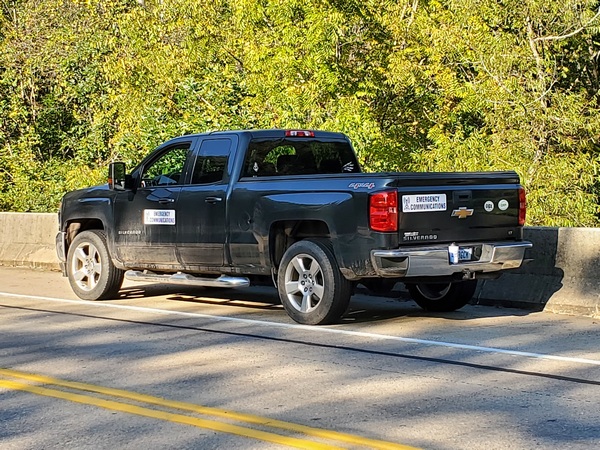
My truck parked on the bridge across the Brandywine River
From a communications standpoint, this event is pretty simple. An HT was the only equipment I needed. Most of my communications involved coordinating with the folks at the “Canoe In” location upriver, letting them know when a load of canoes was headed back to them.
I didn’t hear of any serious incidents on the course, so that’s good news. There was a report of an overturned canoe, but the participants were able to get back in their boat and continue downriver.
This is our group’s last public service event for the year. We’ll be back out on the Brandywine River in the Spring supporting the Northbrook Canoe Challenge.
Yesterday, my local ARES-RACES group provided communications support for the Northbrook Canoe Challenge. This fun event benefits the Cerebral Palsy Association of Chester County (PA). Despite some equipment issues on my part, the event went off without a hitch.
Like last year, I was located near a dam along the Brandywine River with my ARES-RACES colleague, Tim KB3FCJ. I once again served as the net control operator for the event.
I initially set up my trusty old Icom IC-207H dual band mobile rig, and it seemed to work fine. However, I ran into an issue where it wouldn’t un-key when I released the push-to-talk button. Fortunately, Tim had his rig nearby, and we were back on the air in short order. (I have some troubleshooting to do this week.)
My old Icom 207H. It was replaced shortly after taking this picture, due to an issue with the push-to-talk button.
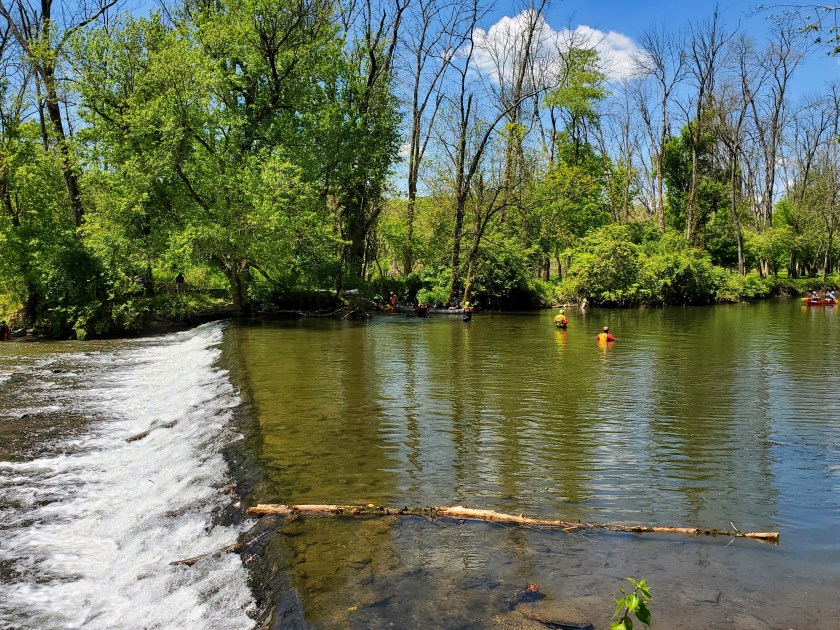
The dam on the Brandywine River. Members of a water rescue team were in the water directing canoeists around the dam.
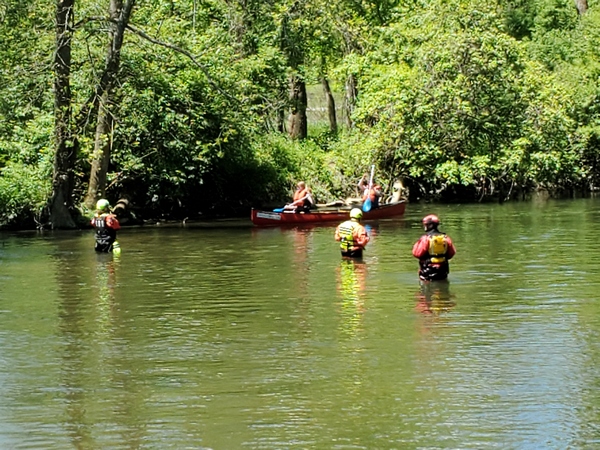
The water rescue team directing a canoeist around the dam
The perfect weather made for a great day to sit along the river, watching the canoes and observing the wildlife in the area. We had a water rescue team on hand in the river to make sure canoeists avoided the dam and portaged safely around it.
After the final “sweep canoe” or “drag boat” passed our location, I packed up and relocated to the finish line at the Northbrook Canoe Company to run the rest of the net. I met up with Rich KE3HG, who served as our liaison with the canoe company. After the drag boat had passed all of our locations along the river, I closed the net. Rich and I stayed on site until the drag boat arrived at the finish line.
There were plenty of emergency personnel on hand, but (thankfully) there weren’t any safety issues. It was just a beautiful day out on the Brandywine River.
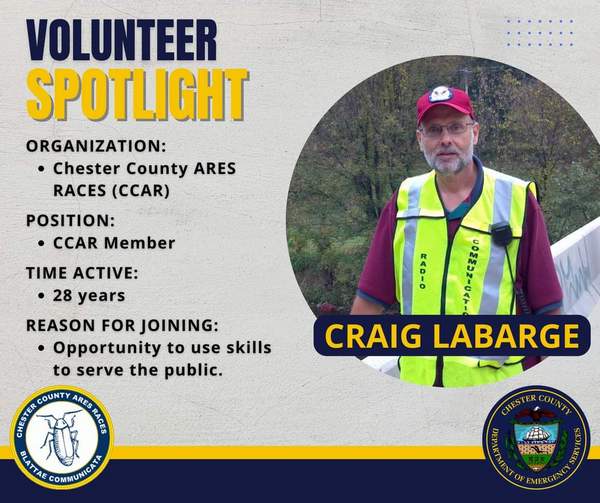
I was honored to have been selected by Chester County ARES-RACES (CCAR) to represent our organization during National Volunteers Week. Our local served agency, Chester County Department of Emergency Services (CCDES) is highlighting volunteer organizations in social media posts this week. The image below, along with a nice write-up, was posted on the CCDES Facebook page yesterday.
My hat goes off to everyone who volunteers their time, especially my CCAR colleagues. Thank you for your service!
I haven’t been very active on the HF bands lately. Family functions and other obligations have been keeping me busy. This weekend, however, I was able to take part in two different ARES–RACES events.
On Saturday morning, our local ARES-RACES group conducted a Simulated Emergency Test (SET). Because of the heavy rains forecasted, most operators participated from home. During the brief exercise, I sent an NBEMS message and a Winlink peer-to-peer message to the county Emergency Operations Center over local 2M simplex frequencies. I used my little Evolve laptop, and it performed great.
On Sunday, our ARES-RACES group provided emergency communications for the Marshalton Triathlon. This annual, family-friendly event combines cycling, canoeing, and speed walking. This year I was once again stationed at “Canoe Out,” which is the terminus of the 2.3 mile canoe run on the Brandywine River.
A water-logged WB3GCK at the Marshalton Triathlon
A crew was on hand to help participants disembark safely
The boat handlers did a great job in some very muddy conditions
This year’s triathlon was a wet one. It rained steadily for most of the five hours I was onsite. Despite the lousy weather, the participants seemed to have a good time. After the last canoe arrived, I was able to head home and dry out.
Hopefully, I’ll get back to doing some QRP-portable operating this week.
Chester County ARES-RACES provides communications support for the event, and it’s one of our larger public service events. Besides providing a crew at the start/finish line, we have operators at five rest stops and in seven roving support vehicles. APRS is used to track the locations of the support vehicles, allowing Net Control to dispatch them efficiently to assist riders experiencing problems.
This year, my assignment was at a rest stop in historic Yellow Springs, Pennsylvania. I’ve been at this location for the past several years, and it’s become my favorite assignment. This rest stop is the first one to open for the event, so after a quick stop for coffee and a breakfast sandwich, I was onsite bright and early.
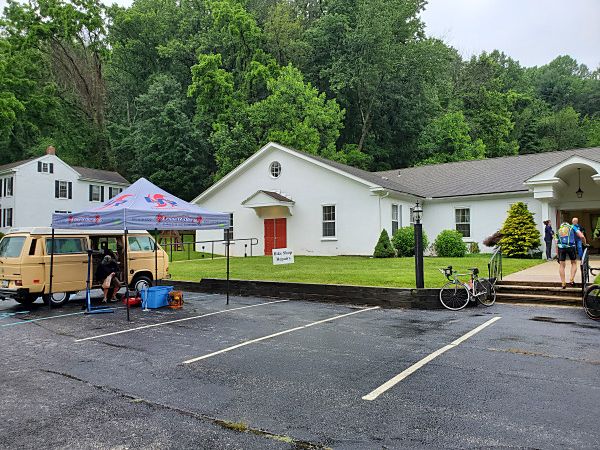
Yellow Springs rest stop for the French Creek Iron Tour. This was taken early in the day as the riders started coming through.
The day started off with some heavy downpours. I hunkered down in my truck, and the rain pounding on the roof made it hard to hear the radio. Fortunately for the riders, the rain stopped by mid-morning. Despite the initial rain and the wet road conditions, I didn’t encounter any downed riders or other major issues during my shift.
Although the weather could have been better, it was nice to work with the friendly volunteers at the Yellow Springs rest stop again this year. Kudos to my ARES-RACES colleagues who put in a long day supporting this event.
Earlier this week, my orthopedic surgeon gave me the OK to drive again. This allowed me to take part in the Northbrook Canoe Challenge, an event to benefit the Cerebral Palsy Association. My local ARES-RACES group has provided communications for this event for many years.
This year I served as Net Control Operator for the event. Tim KB3FCJ set up a canopy for us along the scenic Brandywine River. We were situated near a dam, which the canoeists needed to portage around. A water rescue team was on hand to ensure the safety of the participants.
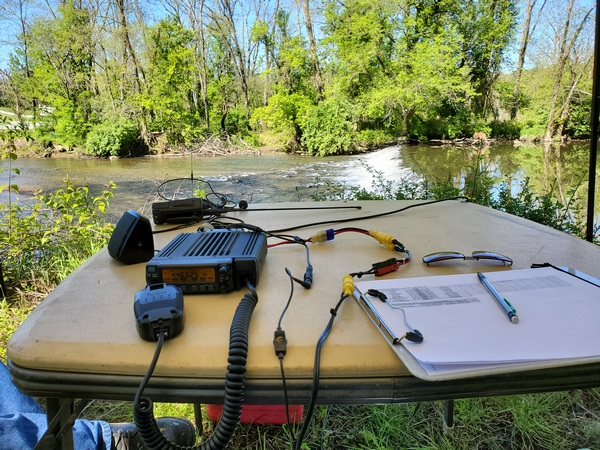
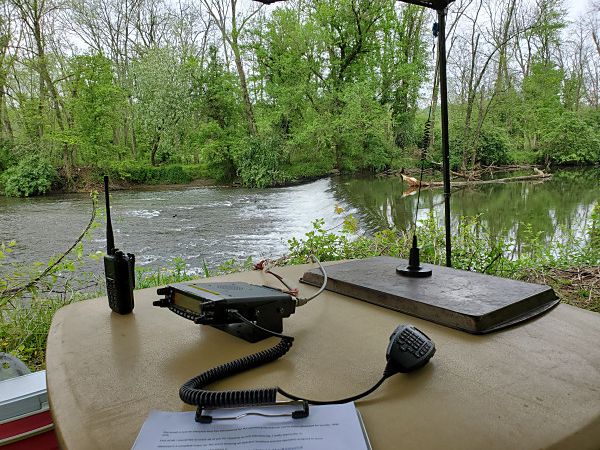
My operating position for the Northbrook Canoe Challenge. This was taken while we waited for the canoes to make their way down the river.
As events go, it was pretty uneventful. There were no medical emergencies or overturned canoes. Just a nice day on the river operating with my Chester County ARES-RACES colleagues.
This week, my ham radio activity was focused on an emergency communications exercise with my local ARES-RACES group. I thought I’d do a post about the simple whip antenna I used with a dual-band radio. I cobbled this set up together a few years back and it has come in handy on several occasions.
During the exercise, I was operating indoors with easy access to our local repeaters. I was copying digital traffic using the Narrowband Emergency Messaging System (NBEMS), so a handheld radio wasn’t a good option. In this situation, a dual-band mobile radio and this little whip antenna hack were able to get the job done.
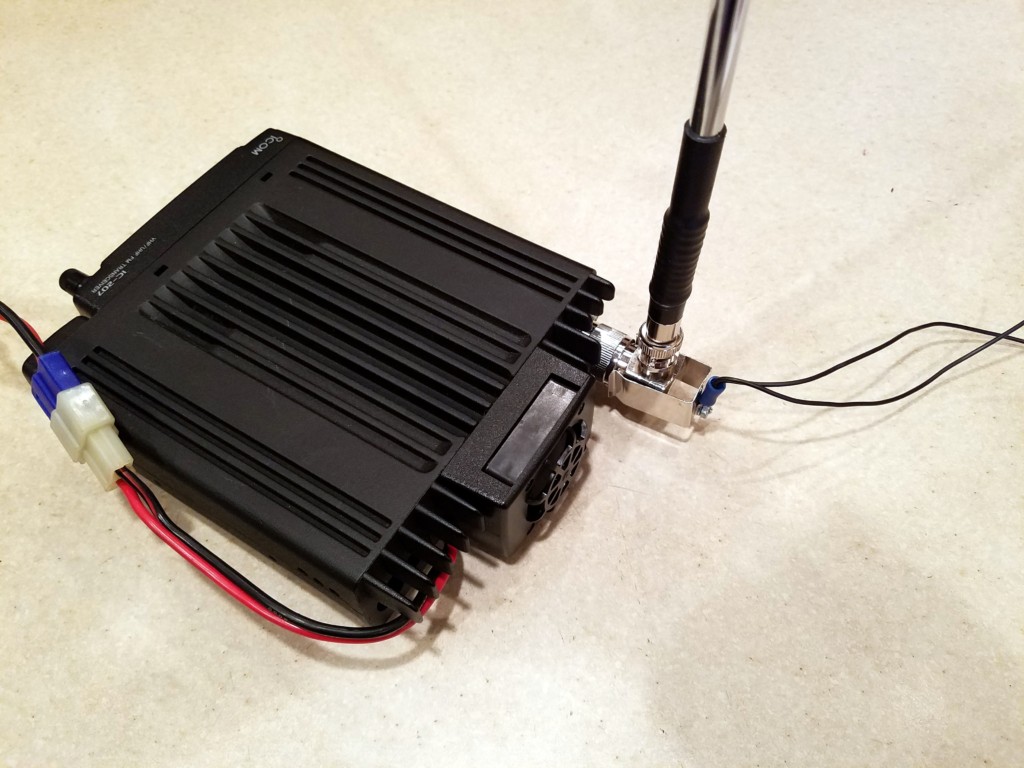
The Quickie Whip attached to my old Icom 207-H dual band radio
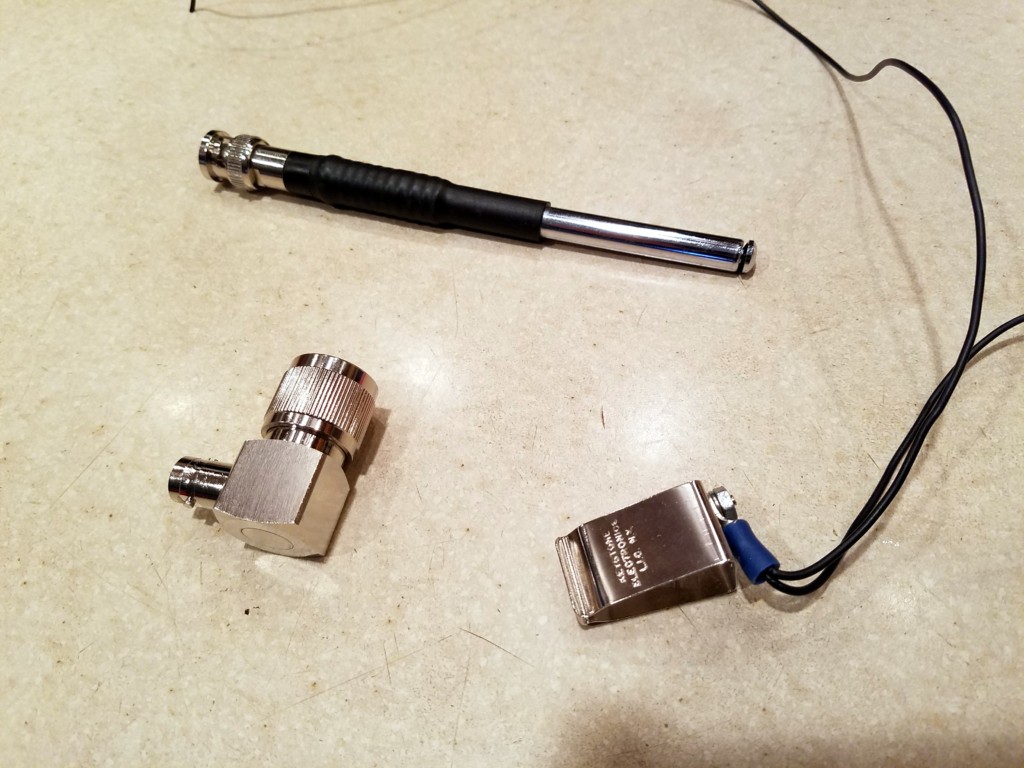
For the whip, I use commercially available, collapsible BNC whip antennas for the 2 meter and 440 bands. To connect the whip to the radio, I use a UHF-Male to BNC-Female right angle adapter I picked up on eBay. To help improve the efficiency, I attach two 1/4-wave counterpoise wires, one for 2 meters (about 19 inches) and one for 440 (about 6.3 inches).
Quickie Whip Antenna components: telescopic whip antenna, PL-259 to BNC-F right-angle adapter, and the modified 9V battery clip for the counterpoise wires.
To attach the counterpoise wires, I re-purposed a 9-volt battery holder. I just drilled out one of the mounting holes and used a small bolt and nut to attach the wires. The clip is just about the perfect size to snap onto the right angle adapter.
The antennas I use came from Smiley Antenna. I have 5/8-wave whips for 2 meters and 440, along with a halfwave whip for 2 meters. Although some of the antennas are specified to handle 50 watts, I generally use them only for 10 watts or less (in the interest of RF safety). If I need to run more power, I’ll go with an antenna placed a safe distance away.
I’ve used this simple antenna arrangement in several situations in recent years. It’s become a permanent part of my emergency communications go-kit.
The QRP to the Field (QTTF) contest is one that I look forward to every year. This year, however, it coincided with a long-standing commitment to take part in a public service event.
For many years, I’ve been coordinating my local ARES-RACES group’s support for the March of Dimes’ annual March for Babies event in Valley Forge, Pennsylvania. In addition to enhancing the safety of the participants, events like this also provide a low-stress environment to hone our emergency communications skills.
The event got off to an unpleasant start. Paul, KB3ZOH, and I arrived early to set up a crossband repeater at the Net Control location. We wound up having to set things up in a steady downpour. Fortunately, the rain let up by the time the walkers set out on the course.
Paul KB3ZOH assuming the Net Control duties
From an ARES-RACES standpoint, it was an uneventful event. We had solid communications around the course and there were no incidents or issues to handle. In addition to KB3ZOH and me, The Chester County ARES-RACES team included Leslie KC3EOR, Joe W3JY, Will K3WIL, and Rob W3OWM.
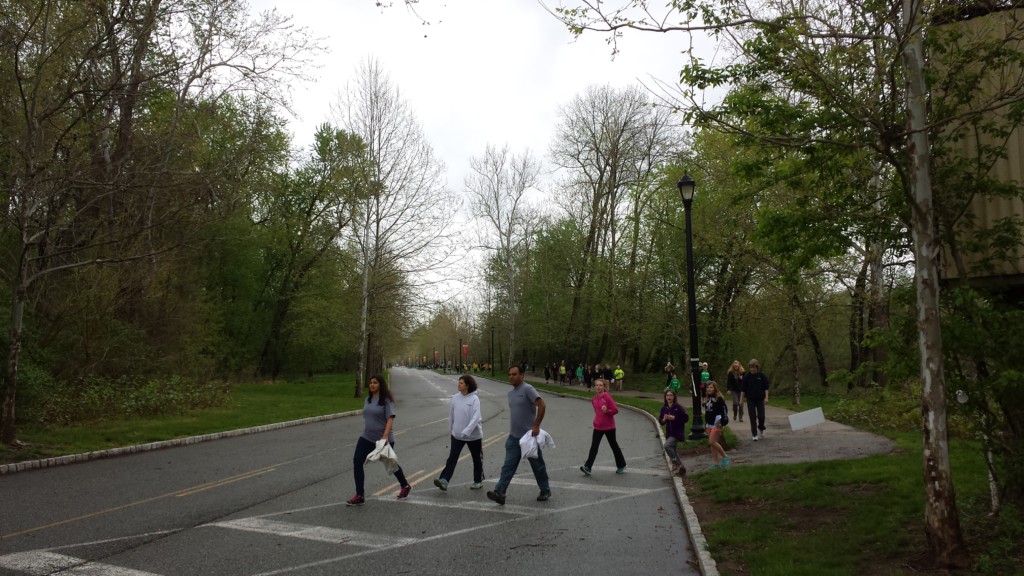
Walkers passing by my position. The weather was dreary but, at least, it was raining.
Since the March for Babies course was located about 100 yards from Valley Forge National Historical Park, my original plan was to head over there after the event for some QTTF action. With another obligation later in the day, however, QTTF was clearly not in the cards for me.
So, I look forward to next year’s contest. At least I was able to do some portable operating for a good cause this morning.



 WB3GCK QRP Amateur Radio