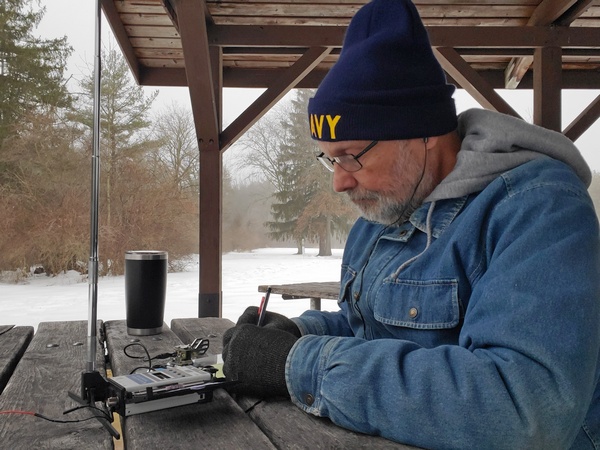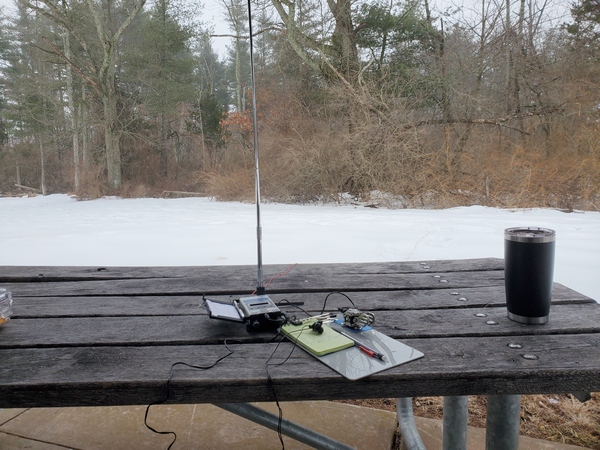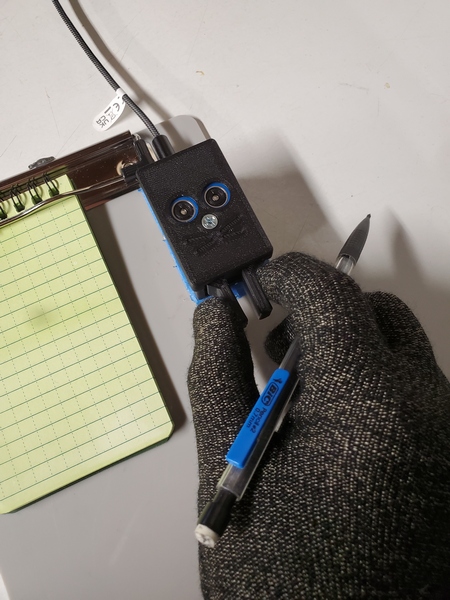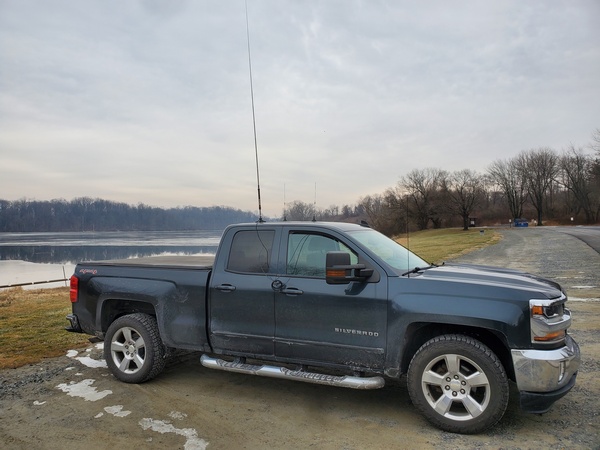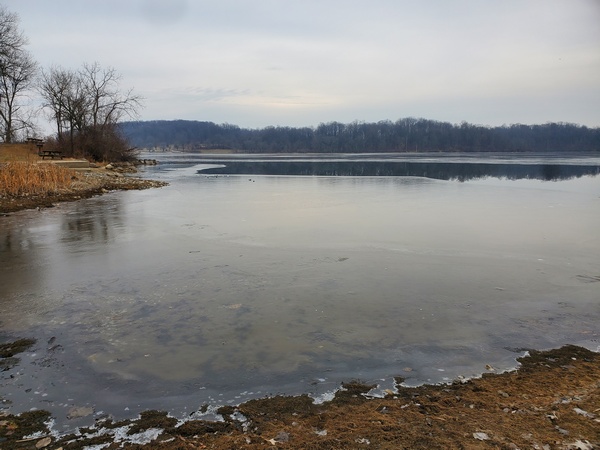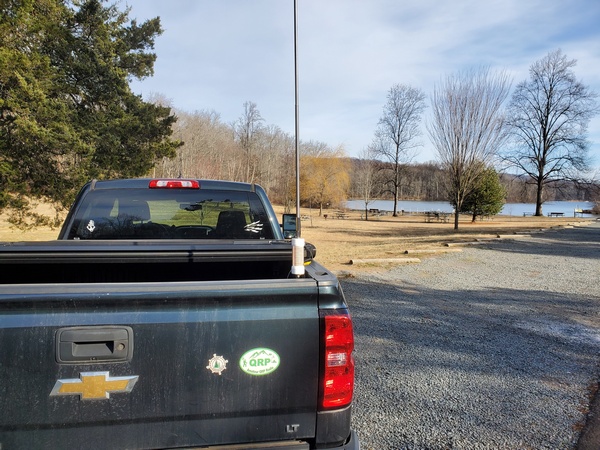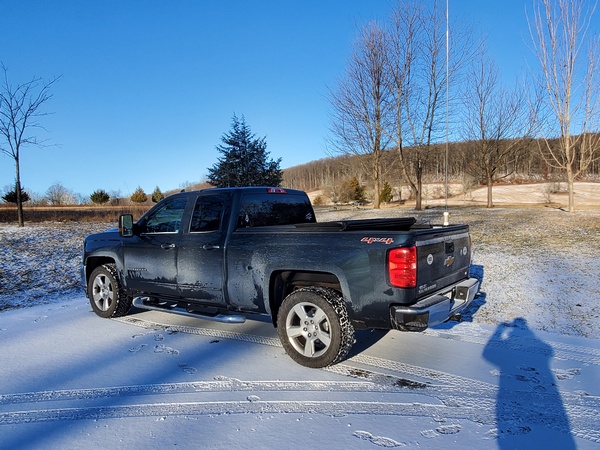
I haven’t had much time for ham radio this week, but I squeezed in a quick activation this morning. Not only did I get in some much-needed radio time, but I finally achieved a POTA Kilo award at one of my favorite local parks.
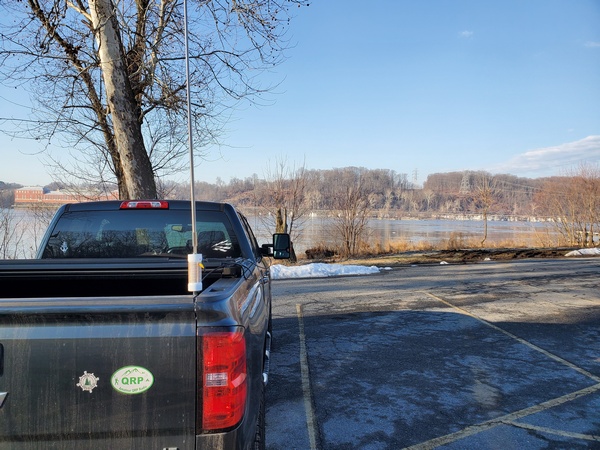
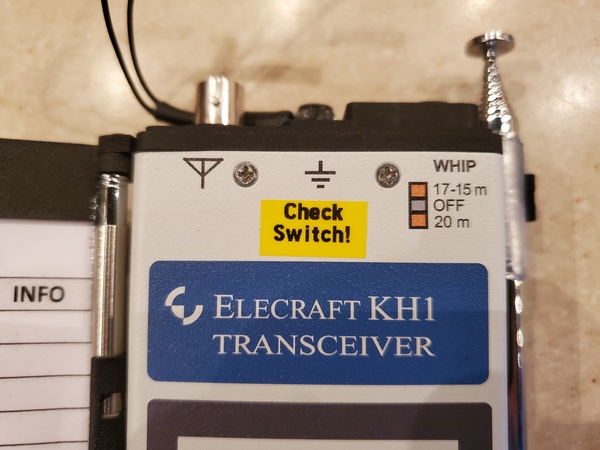
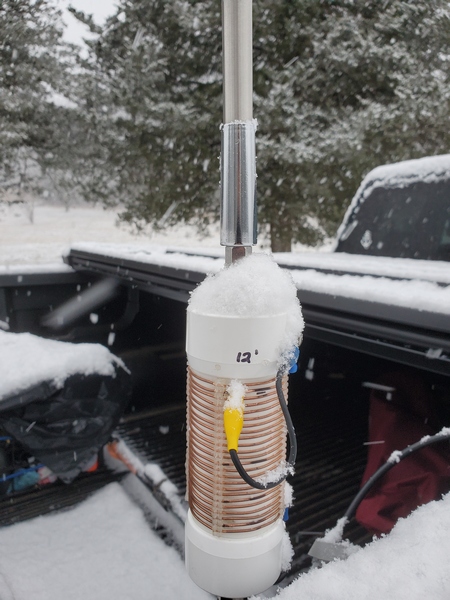
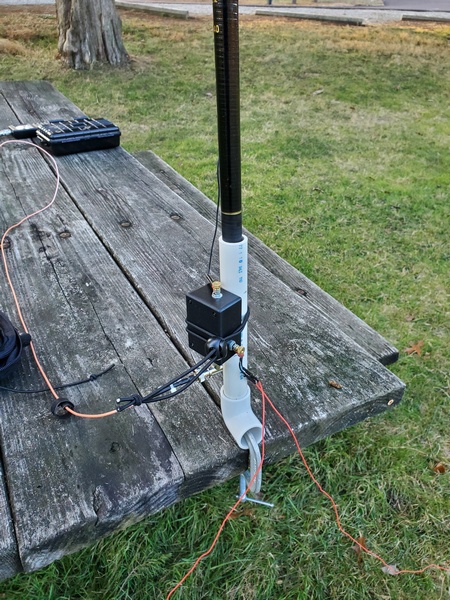
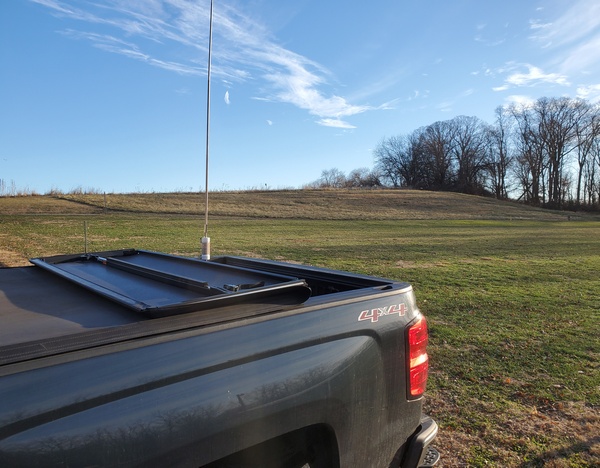
The park in question is Norristown Farm State Park (US-4363, KFF-4363). According to the POTA website, I needed 36 more QSOs for a Kilo award at this park, so I was hoping the bands would be in good enough shape to get there. I set up my Elecraft KH1 and 12-foot base-loaded whip and got busy.
On the air, there was some fading, but overall the bands weren’t too bad. The 40M band was the most productive for me, with 20M a close second. I made some contacts on 17M and 15M, but they were few and far between. I was amazed at the number of hunters out there early on a Friday morning. After an hour and 15 minutes, I had made 40 contacts—enough for the Kilo award with a few to spare.
As I mentioned, I didn’t make too many contacts on 17M and 15M, but I did work some DX. On 17M, I worked Germany, France, and Denmark. Stations in Mexico and France hunted me on 15M. While not DX, a special shout-out goes to N4NR in Florida who worked me on 20M, 17M, and 15M this morning.
While making a thousand contacts at a park isn’t a big deal for most activators, I was happy to finally get there after 32 activations at this park. I’m close to a Kilo award at another of my local parks, so I’m hoping to finish that one off in the next week or so.
Instead of heading out to the stores looking for bargains, I headed up to French Creek State Park (US-1355, KFF-1355) looking for POTA and WWFF hunters. It turned out to be a productive morning—and I didn’t have to spend any money.
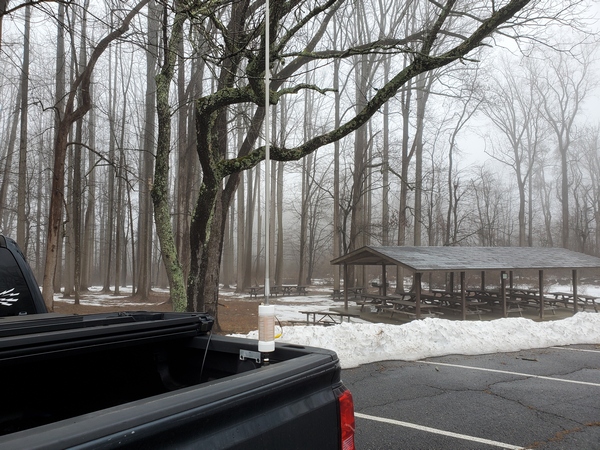
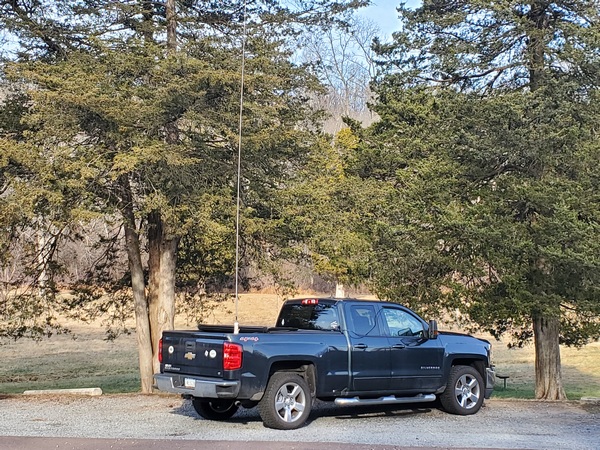
I rolled into a parking lot near Hopewell Lake and started setting up. Old Man Winter is starting to rear his head here in southeastern Pennsylvania, with an air temperature about 32°F (0°C) with a wind chill around 25°F (-3.9°C). I forgot to bring my gloves, so my fingers were becoming numb by the time I got my 12-foot base-loaded whip set up on the truck. I used my Elecraft KH1 up in the truck’s cab.
Hopewell Lake in French Creek State Park
My handy band conditions app showed an active geomagnetic field with “FAIR” conditions for 40M through 15M, my bands of interest. Even under these conditions, however, there are usually contacts to be made.
Despite the predicted band conditions, the band weren’t all that bad.
There was plenty of activity on 40M. It only took about nine minutes to log my first 10 contacts. After logging 18 contacts, I moved up to check 20M, 17M, and 15M. These higher bands weren’t too shabby either, producing 35 contacts across these three bands. I had DX contacts on each of those bands, too. The KH1’s display showed it was putting out about 3.5 watts on 15M, but that was enough to be heard in Europe.
My KH1 showing about 3.5 watts on 15M
Altogether, I had 53 contacts, including the following DX contacts:
20M: F6EOC
17M: DF2PI
15M: DL1SWB, F6DHD, IK3HMB, IK1LBL, DK1RS, EA7ZC
I also had a nice 2xQRP QSO with N8NK on 20M. He was running 1 watt from Michigan and sounded great here in Pennsylvania.
I had to pull the plug after about two hours. I would have stayed longer, but I had an errand I needed to take care of. The windchill temperature was still below freezing, so I hastily took the antenna down and headed on to my next stop.
I headed down to Ridley Creek State Park (US-1414, KFF-1414) this morning for a pre-Thanksgiving POTA/WWFF activation. While I was there, I wanted to field test a couple of paddles, one new and one I slightly modified.
I mentioned in a previous post (or two) that I somehow damaged the paddles that came with my Elecraft KH1. In searching for an alternative, I came across the KH1 Pressure Paddles from K6ARK. The kits were selling for a mere $22 on Amazon, so I fired off an order.
K6ARK Pressure Paddles
I’m not as good at building kits with small parts as I used to be. My close-up vision hasn’t gotten any better with age. However, with the aid of my lighted magnifying glass, I assembled the kit in less than 30 minutes with no major issues. The only issue I ran into was the 3-D printed cover didn’t fit against the KH1 too well and needed a little sanding. Once I took care of that, the paddles worked great. Using pressure-sensitive paddles feels a little different at first, but I quickly adapted.
The other thing I did was glue two more magnets onto the bottom of my CWMouse paddles. The four I glued on initially weren’t quite enough to keep the paddles from moving when attached to my clipboard. Two additional magnets seemed to do the trick.
The magnets on my CWMouse paddles. I recently added the two towards the middle.
When I rolled into my usual spot in the park, the place was deserted. I wasn’t too surprised, since it was a weekday and drizzling to boot. My original plan was to operate the KH1 handheld to give the K6ARK paddles a good workout. Given the lousy weather, I abandoned that plan and set up in the truck. I used my trusty 12-foot loaded vertical on the back of the truck.
KH1with the K6ARK Pressure Paddles attached
I started off trying to use the K6ARK paddles with the KH1 on the center console. After two contacts, I decided that wasn’t the most comfortable way to operate. The pressure paddles worked fine, though. I switched over to the CWMouse paddles attached to my clipboard, and the magnets held nicely. It helps that the CWMouse paddles have a light touch, so I’m not slamming them side to side.
On the air, the bands were as mediocre as the weather this morning. According to my band conditions app, we were experiencing an unsettled geomagnetic field. Starting out on 40M, it took longer than usual to make my first ten contacts. After I had 15 in the log, I switched to 20M and picked up a few more. I spent the rest of my time on 17M and 15M. As predicted, the band conditions up there were fair at best. I worked two domestic stations on 17M, and stations in Germany and Texas on 15M.
My loaded whip at Ridley Creek State Park (US-1414, KFF-1414)
I was getting ready to call it quits, but I wanted to adjust the KH1’s real-time clock before shutting down. It had gained a minute or two over the past couple of months, so it just needed a tweak. As I navigated through the menus to set the clock, I heard a very loud IK1LBL calling me. I quickly exited out of the menu and completed the contact. After that, I set the KH1’s clock and packed everything up.
As activations go, this one was nothing special. However, my new KH1 paddles and my modified CWMouse paddles were a rousing success.
And finally, I’ll leave you to ponder this curious AI-generated image of a turkey operating a radio. It appears the turkey might be keying with his left foot (QLF?).
It’s been a busy week here, with a major ARES-RACES exercise, medical appointments, and some unexpected repairs on my truck. With all that behind me, I was more than ready for a QRP-portable outing.
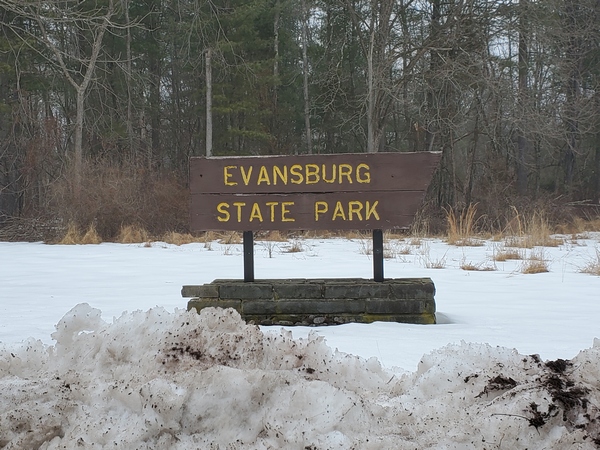
When I drove up to Evansburg State Park (US-1351, KFF-1351) early this morning, the weather was dreary, and everything was wet from the rain we had overnight. I did a quick check of the band conditions app on my phone, which showed only fair conditions on the higher bands. Conditions can sometimes change minute to minute, so I don’t let those band predictions deter me from getting on the air.
I installed my trusty 12-foot loaded whip on the back of the truck and set up my Elecraft KH1 on the center console in the cab. I also used my CWMouse paddles, which are among my favorite paddles these days.
As I was setting up my antenna, a woman with a group of hikers yelled over to me, “What are you going to do with that big antenna?”. I gave her my 30 second explanation of ham radio and Parks on the Air. She told me to have fun and continued on her way. Normally, I just get curious stares, but now and then someone will ask about what I’m doing.
The 40M band was really hot this morning. I made my first 10 contacts in about eight minutes. I logged 24 contacts before the activity thinned out.
Like my last activation, I wanted to focus my attention on 20M through 15M. The 20M band was a little disappointing for me today, producing only two contacts. I spent the rest of my time on 17M and 15M. Even with the “fair” band conditions, these two bands did not disappoint. My 4.5 watts was getting some strong European hits on the Reverse Beacon Network.
The action wasn’t exactly fast and furious on 17M and 15M, but I definitely had fun working the DX stations. Many of them were hunters in the World-Wide Flora & Fauna (WWFF) parks program, who sent the traditional WWFF greeting, “44.”
I shut down after an hour and 50 minutes, which is a little longer than my usual activations. In the end, I had 56 contacts in my log, including two park-to-park contacts.
After more than 50 years in ham radio, I still find it amazing that a little radio running less than 5 watts can be heard thousands of miles away. I think that’s what has kept me interested in QRP all these years.
I have always spent a fair amount of my HF operating time on the 40M and 30M bands, with a little time on 20M. Lately, though, I’ve been making a point of spending more operating time on 20M through 15M (or at least as high as the rig I’m using will go). To that end, I had a little fun on 15M with my KH1 this morning.
I stopped by Norristown Farm State Park (US-4363, KFF-4363) this morning. I broke out my Elecraft KH1, which hadn’t seen much action over the past few weeks. We were under a wind advisory, so I operated from the truck and used my truck-mounted 12-foot loaded whip.
As I was setting up the KH1, I ran into an issue while removing the KH1 paddles from the radio. During an activation about a month ago, the spring between the paddles popped off. I found the spring and re-installed it when I got home. The paddles must have gotten damaged somehow, because the left paddle wasn’t moving as smoothly as it used to. Today, the spring came off the paddles again, but this time it was nowhere to be found. I wasn’t planning to use them today, anyway. For those times when I use the KH1 handheld, I have the N6ARA Tiny Paddles with a KH1 adapter. I also have a K6ARK Pressure Paddle kit on order. But I digress…
Anyway, I started on 40M, because here on the east coast it’s a quick way to make the first 10 contacts for the activation. That’s especially the case early in the morning. There was a lot of atmospheric noise on 40M this morning, but it didn’t take long to log 17 contacts. The 20M band was good for another nine contacts, and 17M produced three contacts.
Being inherently lazy, I left the loading coil tap set for 17M and tried to see if the KH1 would tune it up on 15M. The KH1 easily found a 1.2:1 match. That wasn’t surprising, since the 12 foot whip is only about 11 inches longer than a quarter-wave on 15M, and I only use one turn of the loading coil at the 17M setting.
After making a couple of 15M contacts with the antenna adjusted for 17M, I bypassed the coil completely. Again, the KH1 loaded it right up. I could have shortened the whip by 11 inches to make it a resonant quarter wave on 15M, but I didn’t have my antenna analyzer with me. Honestly, I don’t think it would have made a significant improvement in performance, anyway. Overall, I made 13 contacts on 15M, which included a handful of DX stations.
After 90 minutes on the air, I had made 42 contacts, including nine park-to-park contacts. The DX contacts today included:
20M: Dominican Republic
17M: Ukraine
15M: Czech Republic, Latvia, Spain, Italy (2), England
I was happy with how the 12-foot whip and KH1 performed on 15M. I’ll definitely be spending more time on 15M (and above) in the future.
I also have an idea for an antenna I might try to build. More on that later, if it works.
I was out of town this past week puppy-sitting my grand-dog recovering from surgery. Although I brought my KH1 along, I didn’t have an opportunity to use it. Today was the first day I could get in some radio time. Since I hadn’t been there in a while, Marsh Creek State Park (US-1380, KFF-1380) seemed like an appropriate destination.
My (far) better half and I had plans for the afternoon, so I got an early start. The weather was somewhat dreary with some occasional drizzle, so the park wasn’t very crowded. I hunkered down in the truck with my usual Penntek TR-35 and 12-foot loaded whip.
Marsh Creek Lake on a hazy morning
As is my custom, I started on 40M. Since the Straight Key Century Club’s (SKCC) monthly Weekend Sprintathon (WES) was in progress, I grabbed my straight key and worked a half-dozen SKCCers. One thing I love about the TR-35 is that it has separate inputs for paddles and straight key, and you can switch between the two at will. That’s perfect for mixing SKCC and POTA/WWFF.
I started calling CQ on 40M and worked 13 POTA/WWFF hunters before a digital station started transmitting on top of me. Right about then, it started raining, so I grabbed a plastic bag to protect my loading coil. From that point on, I stayed on the WARC bands, picking up some more contacts on 30M and 17M.
My loading coil protected rom the rain
After an hour and 10 minutes, I had logged 35 contacts. The bands seemed to be in decent shape, although there was some static from storms along the east coast. Despite the occasional noise, I had contacts with both California and Poland on 17M.
Although it was another of my typical short-duration activations, it was great to get back on the air. And I’m happy to report that my grand-dog is recovering nicely and doing great.
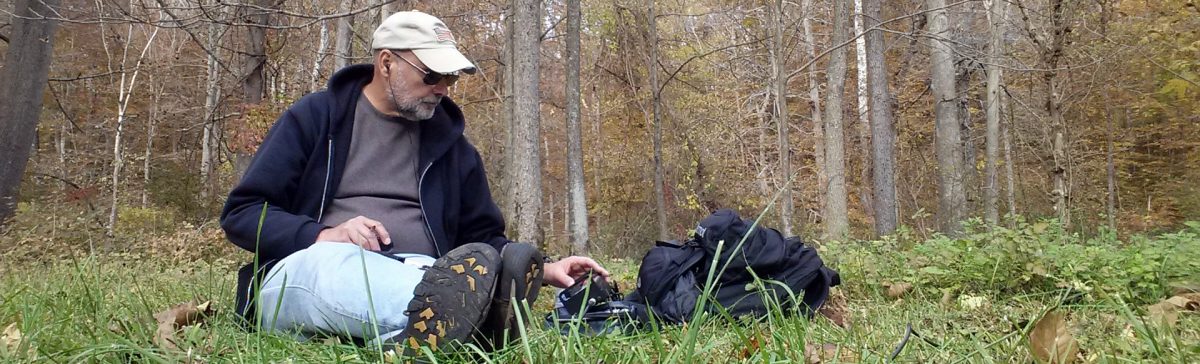
I headed out this morning for an early activation at Norristown Farm State Park (US-4363, KFF-4363). Although it’s Halloween, the only slightly scary thing this morning was a creepy old guy operating a radio in the park. Oh, wait… That was me!
For this visit, I operated from one of the highest points in the park. I used this same location last week with excellent results. Unfortunately, we’re currently under a wind advisory here in southeastern Pennsylvania, so the wind was really whipping around. I was eyeing up a picnic table but opted to stay in the truck (instead of chasing my logbook across the park). I went my usual setup: Penntek TR-35 (5 watts, CW) and my base-loaded 12-foot whip.
I was parked near Shannon Mansion, built in 1764. Apparently, this was yet another place George Washington slept. I don’t know if it’s haunted, but it sure looks like it should be.
Today was another day with some unsettled band conditions. Before I left the house, the K index was 4 and the A index was 38. By the time I got on the air, the K index had dropped to 3. Even with those numbers, the action was hot and heavy on 40M. I had 22 contacts on 40M in no time flat.
The 20M band wasn’t as good as 40M, but it still produced 10 contacts. My band conditions app showed “Fair” conditions on 17M, and I would agree with that. Signals on 17M were weak, and I made only four contacts. However, those contacts included IK3HMB and F4ILH.
My view of the corn field this morning. I could help but think about Stephen King’s “Children of the Corn.”
Having grown tired of fruitless CQing on 17M, I dropped to 30M and picked up nine more contacts there. Right about the time I changed bands, someone with a hybrid vehicle parked next to me. Fortunately, the signals on 30M were strong enough to overcome the noise generator next to me.
I wrapped up my 90-minute activation with 45 contacts in my log and packed up for the drive home. My (far) better half and I have plenty of candy on hand for the neighborhood goblins who will be wandering the neighborhood tonight.
I had some spare time this morning, so I made a trip to Evansburg State Park (US-1351, KFF-1351) for some radio time. Before I left, I took a quick peek at the band conditions and saw that we had some unsettled geomagnetic conditions. Despite the less-than-optimal conditions, I had a pretty good morning.
When I rolled into the parking lot, I was the only one there. That’s not too surprising for early in the day on a Wednesday, I suppose. I kept things simple and operated from the truck with my Penntek TR-35 (5 watts, CW) and a 12-foot base loaded whip. I was also using a set of paddles I purchased recently. (More about those in a future post.)
The new paddles I was trying out. They’ll be the subject of a future post.
As is my usual practice, I started out on 40M. As I was tuning across the band, I heard N1BS in Rhode Island and had a quick park-to-park QSO with him. After that, I found a clear frequency and started calling CQ. Even though the band conditions app showed poor daytime conditions on 40M, I had my first ten contacts in about 15 minutes. Not too bad, actually.
Band conditions this morning. The 40M was pretty good, despite the predicted poor conditions.
After logging 20 contacts on 40M, I gave 20M a go. That band was good for another 22 contacts, including three European hunters. I moved up to 17M and made six more contacts, five of which were European stations. I seemed to have a pipeline into Poland this morning on 17M.
After 90 minutes of operating, I had 48 in the log. The DX stations included:
20M: Sweden, Belgium, and Denmark
17M: Finland, Poland (3), and Switzerland
Even with an unsettled geomagnetic field, I was pleased with my results. Of course, a QRP-portable outing with questionable band conditions is better than not getting out at all.
For several years my homebrew 19-foot vertical was my go-to portable antenna. Over the past two years, I’ve been using a variety of other antennas, relegating my trusty vertical to backup status under the backseat of my truck. I dusted it off recently to see how well the Elecraft KH1 would work with it.
I designed the antenna to be resonant on the 40 and 30 meter bands. On the 20M band and higher, it functions as a random wire, so a tuner is required. I was sure the KH1 would easily find a match on 40M and 30M, but I was curious to see how well it would fare on 20M through 15M.
The matching unit for my 19-foot vertical. The red jumper is used for changing bands.
To test this out, I drove to Ridley Creek State Park (US-1414, KFF-1414). I had been to an ARES-RACES get-together that morning, so I swung into the park for a quick activation on my way home.
I set up at the edge of a field away from other park visitors. Since it was a weekday, the park wasn’t very busy, anyway. I supported the antenna on a cheap telescopic pole using my homebrew ground mount and spread out four 12.5-foot radials. From there, I ran 20-feet of RG-213 over to my camping chair, where I used the KH1 on a Tufteln KH1 knee board.
KH1 and Ashi Paddle 45 on a Tufteln KH1 kneeboard
Before I got started, I tried the KH1’s internal tuner from 40M through 15M. It easily found a decent match on each of the five bands. The SWR on 15M was 2:1, which is certainly usable for the KH1.
The 19-foot vertical on a slightly-leaning pole
Despite some unsettled geomagnetic conditions, I made contacts on each band except 15M. (I didn’t hear any activity there this morning.) The antenna really worked well on 17M, where I had back-to-back contacts with F4ILH and F5MQU. Even with the geomagnetic wackiness afoot, I managed to log 16 QSOs. Five of those were park-to-park contacts.
Spotted by F5MQU
It was good to get the old vertical out in the field again. I’ve been thinking about re-packaging it to reduce the size of the matching unit and eliminate the jumper used for band changes. That might be a good project for over the winter.
I ordered a KH1 kneeboard from Tufteln, and it arrived in the mail earlier this week. I was out of town for most of the week, so today was my first opportunity to try it out.
I drove down to Ridley Creek State Park (US-1414, KFF-1414) and headed up to one of the picnic areas. This area is one of the highest elevations in the park. My original plan was to set up in an out-of-the-way clearing in the woods, but with rain in the forecast I thought it would be smarter to stay close to my truck. (Spoiler alert: It was.)
I backed my truck into a parking space away from everyone else and set up a 12-foot whip and my homebrew loading coil on the back of the truck. Next, I ran 18 feet of RG-8x coax over to my camping chair.
My 12-foot loaded whip mounted on my truck
I ordered the kneeboard version with a metal plate for magnetic mount paddles. Mike KE8PTX, designer of the kneeboard, recommends using a short audio cable with right-angle connectors for connecting your paddles to the KH1. I bought a couple but neglected to bring them along this morning. Instead, I used a 3-foot cable. It was a little awkward, but worked just fine.
The leg strap provided with the kneeboard was easy to adjust and comfortable to use. I used my CWMouse paddles, and the magnets I glued onto them held on to the kneeboard’s metal plate with no issues. For logging, I used a 3” x 5” weatherproof notebook, which I balanced on my leg by the kneeboard.
The KH1 and CWMouse paddles mounted on the Tufteln KH1 Knee Board
Settled comfortably into my chair, I got started on 40M. After logging a quick eight contacts, the hunters thinned out. I eventually made my required 10 contacts plus a few more before moving to 30M. After logging eight contacts on 30M, I moved to 20M for five more.
After an hour on the air, I felt a few raindrops and figured I had better pack up. That was an excellent decision, as it started raining as soon as I put the KH1 in the truck. I quickly took down my antenna and tossed my chair in the back of the truck.
Although the rain interrupted my activation, I ended up with 27 contacts. Some highlights included:
I got a call from F1BLL on 20M. He was an honest 599 into southeastern Pennsylvania this morning.
I worked fellow Polar Bear QRP member VE3DN on 40M and 30M.
W9DP and W9GTA each hunted me on two bands.
I have to say that I really enjoyed using the kneeboard. In fact, this might be my new favorite way to operate with the KH1.