International Field Radio Event Recap

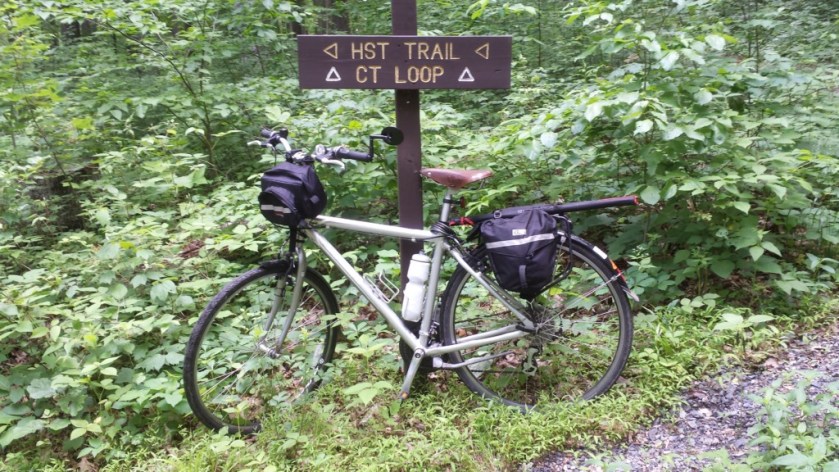
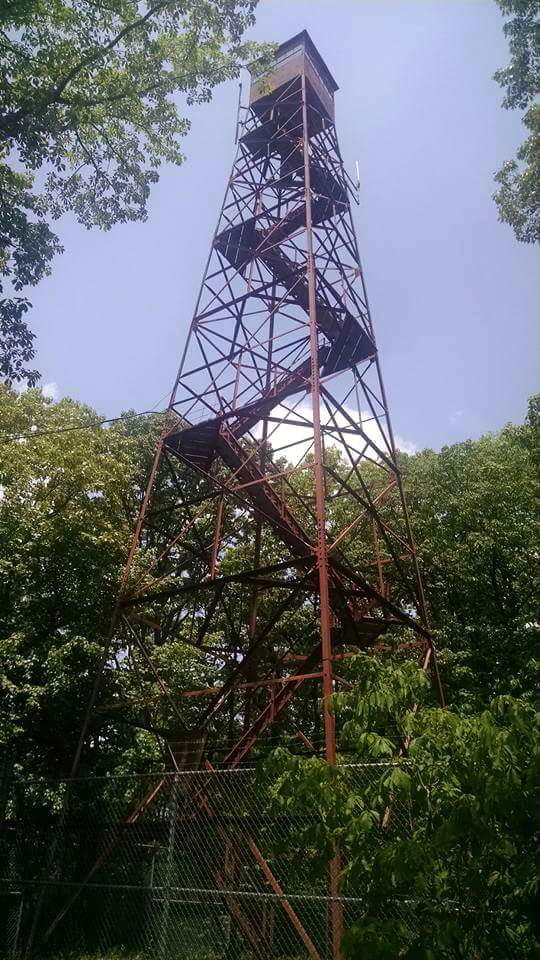
I operated in the first-ever International Field Radio Event on May 28th.  (See my earlier post for information on this event.)  A few days before the event, I decided to operate near the Hopewell Fire Tower in French Creek State Park.  The day before the event, my XYL and two of our grandchildren accompanied me on a hike to scout out operating locations.  I found a small clearing in the woods near the fire tower.  It was off the beaten path and looked like it would work out for me.

Hopewell Fire Tower
Hopewell Fire Tower

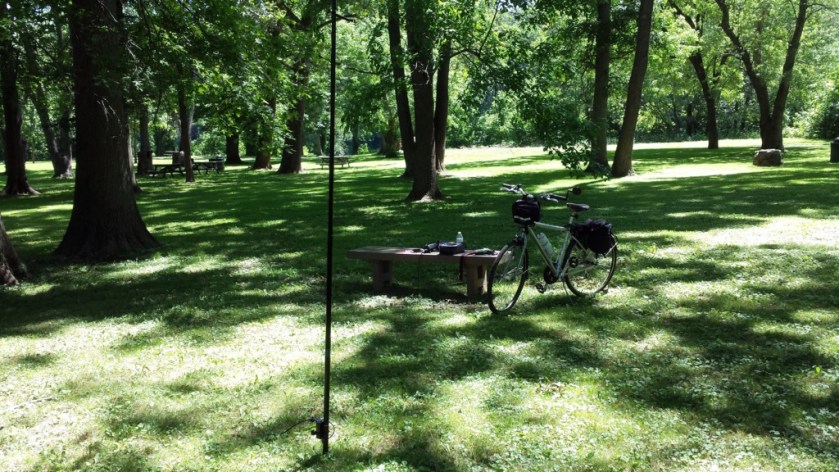
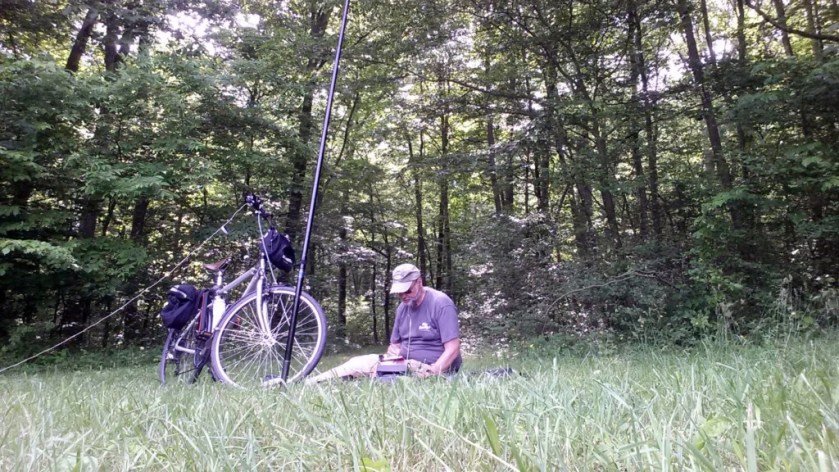
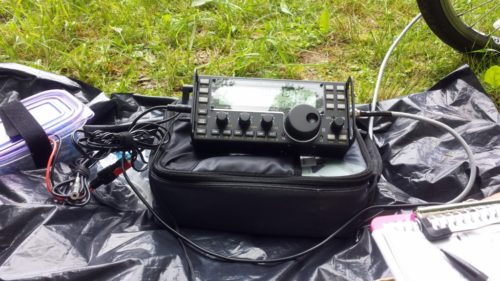
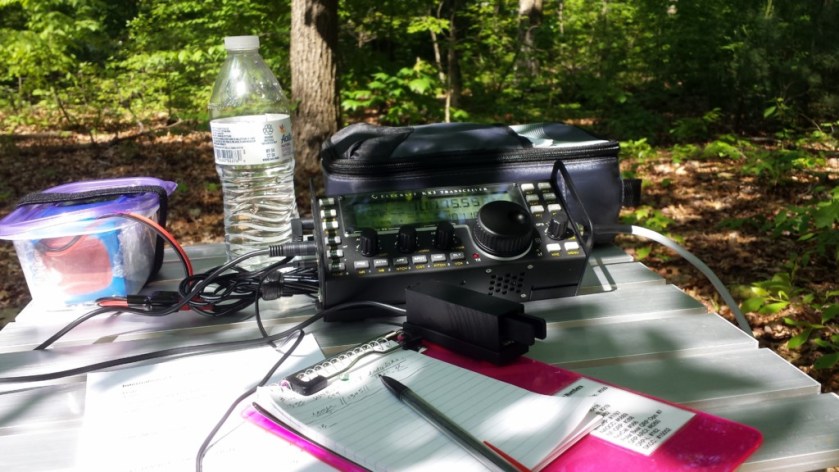
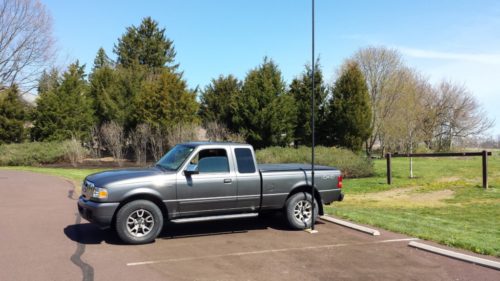
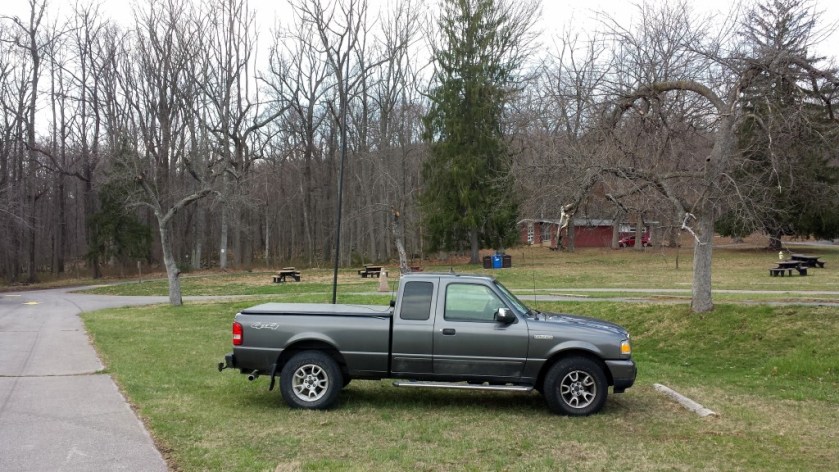
The next day I got off to an early start and headed back to the little clearing.  There wasn’t enough room to toss a line up in a tree, so I used two Velcro® straps to secure my 31-foot Jackite pole to a tree.  I set up a 29.5-foot vertical wire supported by the pole and laid out two radials on the ground.  I fed the antenna through a 4:1 unun and a short length of coax.  I set up my KX3 on a small table near the tree and was soon ready to get started.

My operating position for the International Field Radio Event.

It was tough going for this event.  Band conditions were less than stellar and 20 meters was wall-to-wall with CQ WW WPX CW Contest stations.  I spent my time searching for other Field Radio Event stations, both CW and (gulp) SSB.  After a few hours, I only had 3 CW contacts on 30 meters in my log.  None of them were Field Radio stations.  One was a National Parks on the Air (NPOTA) activation in Kentucky and the other two were rag chews with stations in Florida and Michigan.

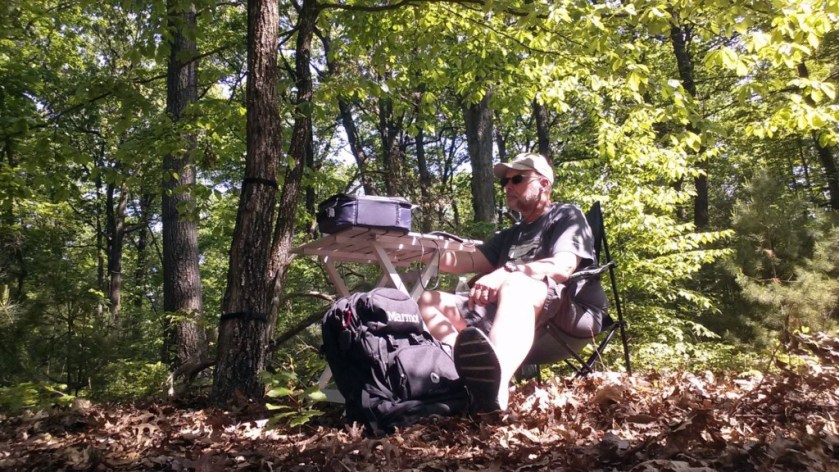
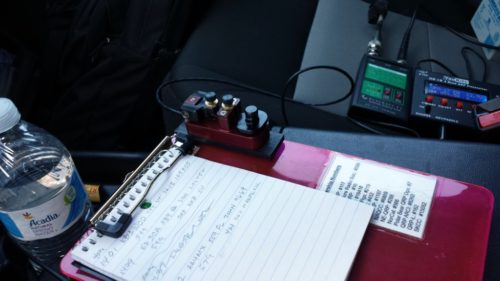
WB3GCK hard at work searching for other Field Radio Event stations

One pleasant surprise was an eyeball QSO with Jerry K3BZ.  Jerry was walking near my location and noticed me back in the woods.  He stopped by to say hello and introduce himself.  After chatting with Jerry for a bit, I packed up and headed home.

I was somewhat disappointed that I didn’t work any other Field Radio Event stations.  On the Field Radio group page on Facebook, many other stations reported similar disappointing results.  There is talk about conducting another International Field Radio Event later this year.  I’ll keep my fingers crossed that band conditions will be better and that there won’t be a major contest going on that weekend.

73/72, Craig WB3GCK

International Field Radio Event

IFR LogoI’m looking forward to participating in the first ever International Field Radio Event this weekend.  The event is sponsored by the Field Radio Facebook group and runs from 0000Z to 2359Z on May 28th, 2016.  Field Radio is an international group of amateur radio operators who practice and enjoy portable operations.
The goal of the event is simple:  Get out in the field and contact other Field Radio members, while letting other hams know about the group.  More than 200 hams from around the world have signed up to take part.  Registered Field Radio members will be exchanging ID numbers assigned for the event.  You don’t need to be a member to join in, though.  Feel free to work any of the portable stations calling, “CQ IFR.”

I haven’t yet decided where I’ll be operating on Saturday but I will likely be out operating from 1300Z to 1800Z.  I will most likely be on 40, 30, 20, and 17 meters CW.

So, if you hear any of the International Field Radio event participants on Saturday, give them a call.  I’m sure many of them will be operating from some interesting locations.

For more information on the Field Radio group, visit www.fieldradio.org.

72, Craig WB3GCK

A Brief Break in the Weather

I was itching to get out for some portable operating but the weather this weekend had been pretty lousy.  I checked the weather radar this morning and saw that there was some clearing coming.  I figured I had a couple of hours before the next band of rain moved in.

I threw my backpack into my truck and headed out to nearby Upper Schuylkill Valley Park.  Given the dreary weather, there was no one in the picnic area.  I headed for a picnic table that I had used once before and set up my equipment.

This was the first outing for my new KX3 and I was using a new LiFePO4 battery for the first time.  I connected a straight key with the hope of making a few Straight Key Century Club (SKCC) contacts.  I strapped my 31-foot Jackite pole to a wooden sign post and strung up a 30-foot vertical wire fed through a 9:1 unun.

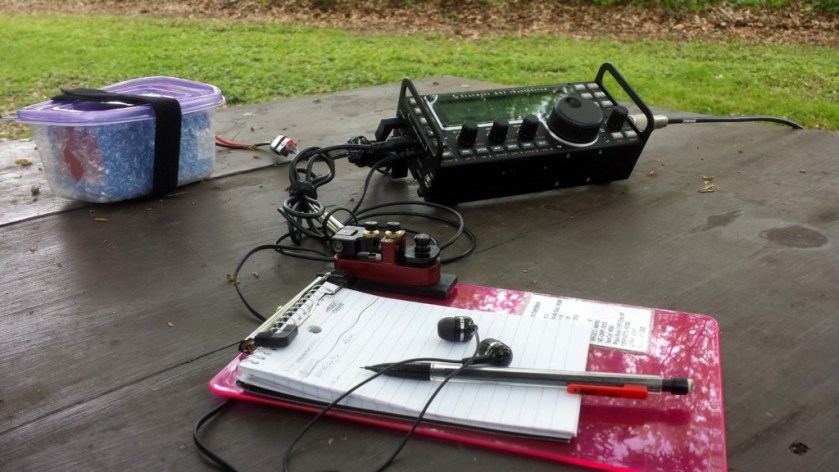
My setup at Upper Schuylkill Valley Park. The food storage container is holding a 6 A-H LiFePO4 battery.

There wasn’t a lot of activity on the bands.  I eventually had a 2-way QRP SKCC QSO on 20 meters with K4ARQ in Florida.  That turned out to be my only QSO today.  I had a couple of “almost” QSOs that were either disrupted by QSB or QRM.  In particular, NP3CW in Puerto Rico heard me calling CQ on 17 meters and gave me a call.  As soon as I answered, a station in Mexico came on frequency and started calling CQ.  A few other SKCC members attempted QSOs with me but propagation just wasn’t working in my favor today.

Dark clouds starting rolling in, so I packed up and headed back to my truck.  My timing was excellent; it started raining on my drive home.

It wasn’t the greatest field trip I’ve had but it was a good practice session with the KX3.

72, Craig WB3GCK

Portable for a Good Cause

The QRP to the Field (QTTF) contest is one that I look forward to every year.  This year, however, it coincided with a long-standing commitment to take part in a public service event.

For many years, I’ve been coordinating my local ARES-RACES group’s support for the March of Dimes’ annual March for Babies event in Valley Forge, Pennsylvania.  In addition to enhancing the safety of the participants, events like this also provide a low-stress environment to hone our emergency communications skills.

The event got off to an unpleasant start.  Paul, KB3ZOH, and I arrived early to set up a crossband repeater at the Net Control location.  We wound up having to set things up in a steady downpour.  Fortunately, the rain let up by the time the walkers set out on the course.

Paul KB3ZOH assuming the Net Control duties

From an ARES-RACES standpoint, it was an uneventful event.  We had solid communications around the course and there were no incidents or issues to handle.  In addition to KB3ZOH and me, The Chester County ARES-RACES team included Leslie KC3EOR, Joe W3JY, Will K3WIL, and Rob W3OWM.

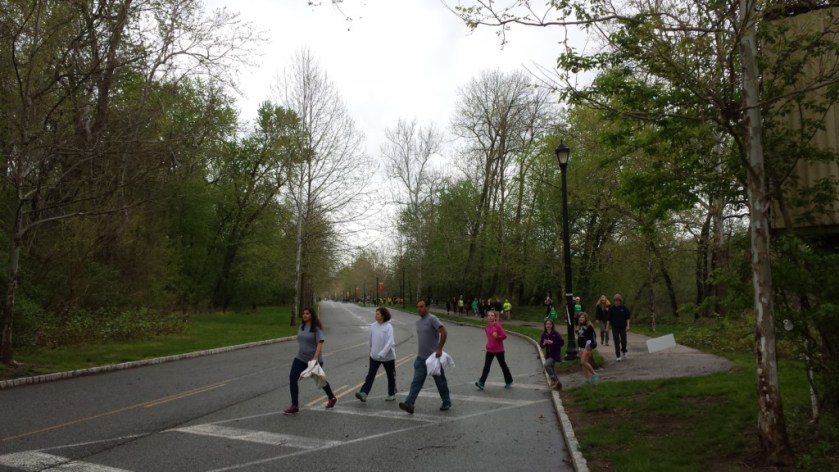
Walkers passing by my position. The weather was dreary but, at least, it was raining.

Since the March for Babies course was located about 100 yards from Valley Forge National Historical Park, my original plan was to head over there after the event for some QTTF action.  With another obligation later in the day, however, QTTF was clearly not in the cards for me.

So, I look forward to next year’s contest.  At least I was able to do some portable operating for a good cause this morning.

72, Craig WB3GCK

Three Birds, One Stone

I was on a mission today and there were three things I wanted to accomplish.  With one trip to a local park, I was able to check them all off of my list.

First, I submitted a write-up on my homebrew, drive-on antenna mount for the Ideas Exchange column in the QRP Quarterly publication.  Mike WA8MCQ, the column’s editor, asked for some more pictures.  So, I needed to get out and set up somewhere to take a few shots.

Next, I wanted to field test my little American Morse MS2 straight key and the homebrew magnetic mount I built for it.  I had used it at home but I was anxious to see how it works out in a portable setting.

Finally, I wanted to get out and make some Straight Key Century Club (SKCC) QSOs using a real antenna (as opposed to using my downspout at home).  I only had an hour, so I needed to move quick.

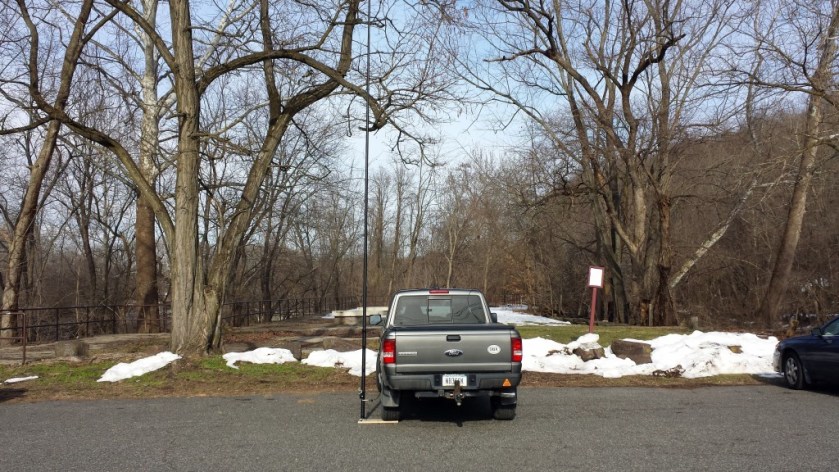
I headed out for Black Rock Sanctuary, which is just outside Phoenixville, PA.  On arrival, I set up the drive-on mount and took some pictures before and after deploying my 31-foot Jackite pole.  I used a 29.5-foot vertical wire with one counterpoise wire fed through a 4:1 unun.  My rig today was my trusty YouKits HB-1B powered from a small gel cell battery.

Drive-on antenna support

I started on 40M and posted my frequency on the SKCC Sked Page.  Almost immediately, I got a call from KB1WOD in Vermont.  He gave me a decent signal report, despite some less-than-optimal band conditions.  A few minutes later, I had a 2-way QRP QSO with KD3CA here in Pennsylvania.  I finished out my brief session with a 2-way QRP QSO on 20 meters with AA4MX in Florida.

As for the MS2 straight key, I have to say it worked pretty well.  My homebrew magnetic mount held the key firmly to my clipboard.   I was pleased with that.  Using a straight key in the confines of my pickup truck’s cab was a little challenging, though.  I also found the feel of the key a little loose, so I’ll need to tighten up the spring tension a bit.

MS2 miniature straight key and magnetic mount in use.

So, in about an hour, I accomplished my mission.  I got the pictures I needed, tested my little straight key/clipboard setup, and made a few SKCC QSOs to boot.

72, Craig WB3GCK

Hopewell Furnace NPOTA Activation

ARRL National Parks on the Air logoOn Good Friday, I found myself with a free afternoon.  I decided to take advantage of the great Spring weather and make a spur-of-the-moment trip to activate the Hopewell Furnace National Historic Site (NS37).  I hastily threw some equipment into my truck and headed out.
About 45 minutes later, I was on site and ready to get started.  But first, I  had to resolve some antenna issues.  For some reason, my SWR was higher than normal and not very stable.  I found a loose BNC connector on my 4:1 unun that I think was the culprit.  I eventually managed to get things stabilized enough to operate.  I was using my FT-817 at 5 watts into a 29.5-foot vertical wire antenna with two counterpoise wires.  I operated all CW.

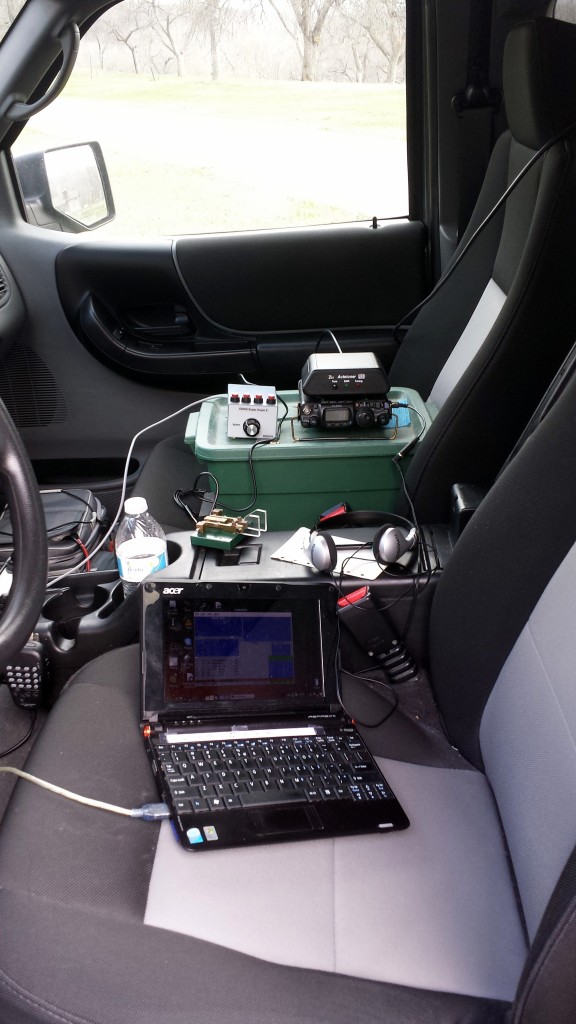
The somewhat cramped operating position in my truck.

I couldn’t spot myself due to lack of a cell signal, so I just started calling, “CQ NPOTA.”  After about 35 minutes with no takers, I was pretty close to packing up and heading home.  Finally, I worked a Wisconsin station on 20 meters.  I tuned down the band a bit and heard N4CD activating a park in Texas.  I got him on the first call.  So, at least, I was getting out to somewhere.

I moved down to 40 meters and worked stations in New York and Michigan.  One of them must have spotted me because things picked up quickly after that.  I spent the rest of my time on 40 meters and wound up with 30 contacts in the log (including 2 park-to-park QSOs) after an hour and forty-five minutes.

My 31-ft Jackite pole supported with a drive-on mount

After I packed up, I stopped by the visitor center and chatted a bit with the park rangers.  They were very welcoming and happy to have their park activated again.  They were curious about how many contacts I made and how far I was able to get out.  As I was leaving they thanked me for putting their park on the air.

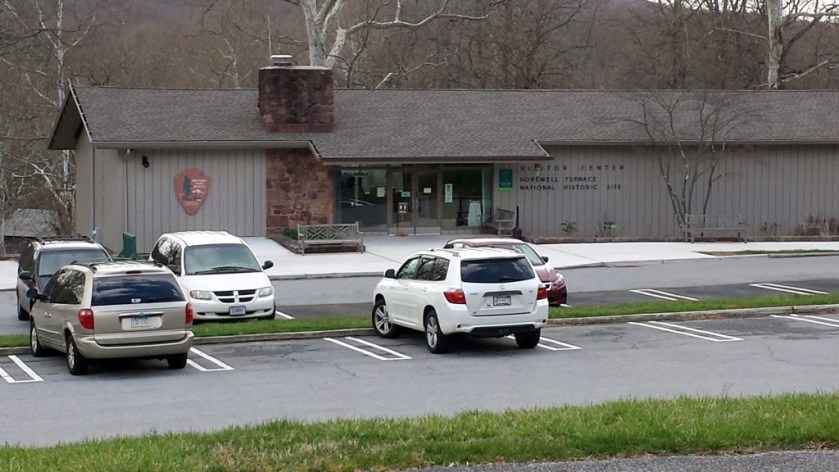
Hopewell Furnace visitor's center
Hopewell Furnace visitor’s center

I have some repair work to do on my antenna but it was a nice afternoon for an NPOTA activation.

72, Craig WB3GCK

American Morse MS2 Straight Key

For many years after I first learned the code in the Navy, I was a die-hard straight key user.  Unfortunately, back in the 90s, I started to experience some wrist pain and switched to using iambic paddles.  Recently, after working one of the Straight Key Century Club (SKCC) K3Y special event stations, I was inspired to sign up with SKCC and dust off my straight keys.  Hopefully, I will be able to get my old straight key fist back in short order.

Since I do most of my operating while portable, I wanted a straight key that was easy to pack and use while sitting on the ground along some trail somewhere.  I was looking for something small that I could add some magnets to for use with my little clipboard.

After doing some research, I decided on the American Morse MS2 miniature straight key.  I built a set of Doug Hauff’s (W6AME) NorCal paddles from a kit many years ago and they are still in regular use.  Doug’s machine shop produces some precision stuff.

The kit arrived a few days after I placed my order.  Following the manual’s precautions, I emptied the parts into a baking pan.  Some of the parts are pretty small and would disappear forever if dropped on the carpet.  Even with my aging eyes, it only took about 45 minutes to assemble the kit.  (A younger person with better eyes and steadier hands could have done it faster, I’m sure.)  You need to supply your own cable and connector, so I dug an old audio patch cable out of my junk box and cut it in half.

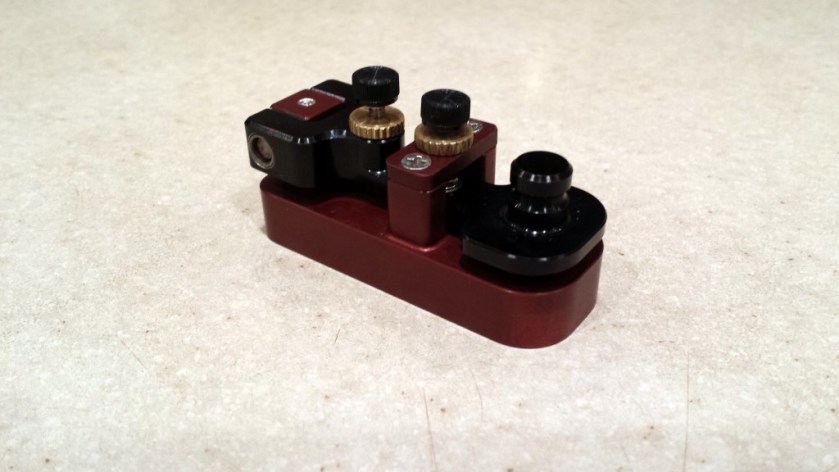
American Morse MS2 straight key after initial assembly

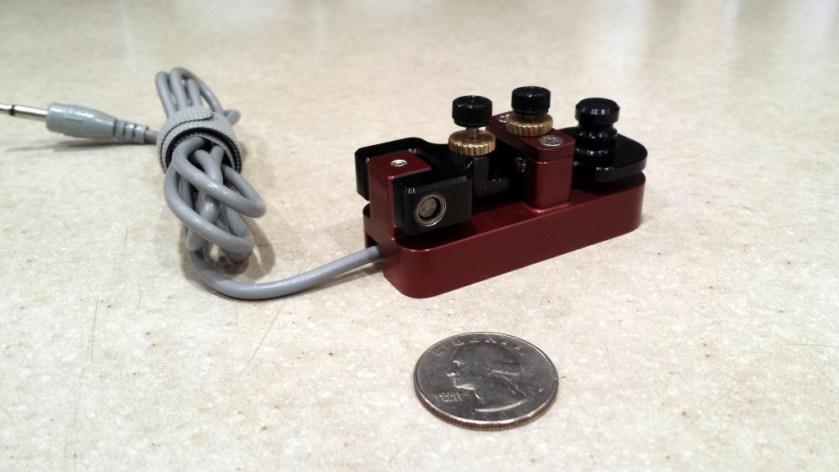
The key is 2 inches long by 1 inch wide and is made from machine aluminum.  The contact gap and spring tension are fully adjustable.  The key (with my cable attached) only weighs about 2.7 ounces (76 grams).

The finished MS2 straight key with cable attached. The cable is one half of an 1/8-inch diameter audio patch I had in the junk box.

After adjusting the contact spacing and the spring tension, I was surprised at how great this little key feels.  The knob is a little different from most keys, but I was able to easily adapt to it.  As expected, the overall quality of the key is outstanding.

My next project will be to attach some sort of base to it with magnets spaced to line up with the washers on the clipboard I use while portable.  More on that in another post.  I’m looking forward to making some SKCC contacts from out in the field.

72, Craig WB3GCK

FYBO 2016

I didn’t have a lot of time today but I wanted to get out for an hour or two for the annual Freeze Your B—- Off (FYBO) contest.  FYBO is sponsored by the Arizona ScQRPions.  I didn’t do a lot of  advanced planning for this event, so I threw my backpack into my truck and headed out with a couple of possible locations in mind.

I ended up in the Schuylkill Canal Park in Mont Clare, Pennsylvania, just a few miles away from home.  I’ve been to this park many times but I had never operated from there.  The spot I had in mind had some high voltage power lines nearby so I headed a little further down the road.  I wound up in a parking lot next to the canal lock.  There was still some snow on the ground and the area looked muddy, so I set up in the truck with the window down.  (It was 36F when I started.)  I used my YouKits HB-1B and a 29.5-foot vertical.

FYBO "Stationary-mobile" set up
FYBO “Stationary-mobile” set up

Now, normally, when people see my antenna, they usually just give some curious stares and move on.  Not so today.  Before I had even made a contact, I noticed a county park ranger drive by.  He circled back around and pulled up next to me.  He was curious about the antenna and I ended up discussing ham radio with him for the next 5 minutes or so.  He wished me well and drove off.

A few minutes later, I looked in my rearview mirror and saw a car with two park rangers behind me.  They were staring at the antenna, so I got out and went over to talk to them.  I gave them my ham radio spiel and a few minutes later they drove off.  I was finally able to get back to the radio and start making some contacts.

In my hour or so of operating, I only managed to work 3 FYBO contesters on 20 meters.  There was very little FYBO activity heard.  In fact, I worked more Minnesota QSO Party stations than FYBO stations.  Before I packed up, I dropped down to 40 meters and picked up a Vermont QSO Party station.

Just before shutting down, a fellow who had been walking his dogs walked up to my truck and asked about what I was doing.  Once more I gave my ham radio spiel.  In all the years I’ve been operating from portable locations, I can’t remember ever getting this much attention.  Maybe I enlightened a couple of folks today.

Lock 60 and the Canal Keeper's House at Schuylkill Canal Park, Mont Clare, Pennsylvania
Lock 60 and the Canal Keeper’s House at Schuylkill Canal Park, Mont Clare, Pennsylvania

Even though it was a short outing and I’m sure I wasn’t a big threat in the FYBO contest, it’s always good to get out and play some radio.

72, Craig WB3GCK

Winter Field Day 2016

My original plan was to get outside or, depending on the weather, operate “stationary-mobile” from my truck for Winter Field Day 2016.  However, my XYL and I had a long-standing obligation to head out of town for a weekend of babysitting our grandson.  So, “Plan B” was put into effect.  I would have to operate in the “Indoor” category and, at least, hand out some points to those braving the elements.

On Saturday morning, I started to set up my portable station at my daughter’s house.  I secured the feed point of my LNR EFT-10/20/40 end-fed antenna and tossed the rest of the antenna out of a second story window.

Antenna support for my LNR EFT-10/20/40 EFHW antenna

The next part was a little tricky since there was still more than a foot of snow in the backyard and I neglected to bring boots.  Anyway, I trudged through the snow to secure my 31-foot Jackite pole to the fence.  I used three velcro cinch straps that I had recently purchased.  I used some twine to hoist up the far end of the antenna.  It turned out to be mostly horizontal but with a little bit of sag in it.  Then, I set up my YouKits HB-1B and my logging computer on the dining room table.

My portable station for Winter Field Day 2016

About 2 hours before the start of Winter Field Day, I fired up my YouKits HB-1B and had a nice 2-way QRP chat with John, W3FSA, up in Maine. So, my slightly sagging antenna wasn’t doing too badly.

In between entertaining my 1-year-old grandson and taking my grand-dog out for walks, I got on the radio.  There didn’t seem to be a large number of stations on, so I bounced back and forth between 40 and 20 meters.  At the end of the first day, I had worked 22 stations and a few stations not in the contest.

I got on for a bit on Sunday morning but things had really thinned out a lot.  I made a few non-contest contacts.  It was a while before I heard any WFD activity.  I only managed to pick up one new one.   Around 10 AM, I packed up and tore down my antenna.

With my 23 contacts, I certainly didn’t set any records.  It was, however, a fun event.  Hopefully, I can get outdoors next year.

72, Craig WB3GCK

Delaware Water Gap Activation

ARRL National Parks on the Air logoEach year, I spend a weekend in January with some QRP friends in the Delaware Water Gap Recreation Area.  We’re all members of a loosely-organized group of QRPers known as the Boschveldt QRP Club.  We stay in a cabin at the Mohican Outdoor Center (MOC) near Blairstown, New Jersey.  We have come to call this annual trip, “Camp Run-a-MOC.”  This year, the Boschveldt crew convened Camp Run-a-MOC over the weekend of January 15-17.  There were four QRPers in attendance:  WA3WSJ, NK1N, KB3SBC and me.  As a bonus, this year’s trip coincided with the National Parks on the Air (NPOTA) event.

Mohican Outdoor Center is run by the Appalachian Mountain Club.  It is located within the Delaware Water Gap National Recreation Area and is popular stop-over point for Appalachian Trail through hikers.

Our home for the weekend at Mohican Outdoor Center

Day 1

I rolled into camp around mid-day on Friday and the others were waiting for me in the parking lot.  I got out of my truck and threw my backpack into WA3WSJ’s truck and we took off for a hike up to the Catfish Fire Tower.  We hiked up the Fire Tower road and connected up with the Appalachian Trail. This location was an NPOTA “twofer.”  It encompasses both the Delaware Water Gap (RC07) and the Appalachian Trail (TR01).

Hiking to Catfish Fire Tower. L-R: KB3SBC, NK1N, WB3GCK. (Photo by WA3WSJ)

While the others were operating pedestrian mobile, I hiked a little further down the trail in search of a good place to hang my EFHW antenna.  There weren’t a lot of good options.  There were a lot of dense woods up on this high ridge and the trees weren’t particularly tall.  I eventually got my antenna up in an inverted vee configuration.  It was NVIS at best.  I set up my YouKits HB-1B on a convenient flat rock and got on the air.

Catfish Fire Tower
Catfish Fire Tower

I worked one station on 20M CW but I didn’t hear much other activity.  I moved down to 40M and started calling CQ.  I fired off a quick text message to my friend, Carter N3AO, down in Virginia.  A few minutes later he answered my CQ.  After he spotted me on the cluster, I was soon met with a hoard of very strong signals calling me.  However, the pile-up was short-lived and the activity quickly slowed down.  About that time, the wind was blowing across the top of the ridge and it started getting cold up there.  I packed up and rejoined the others for the hike back down the hill.  I ended the day with 17 QSOs, most of them on 40M CW.

Operating along the Appalachian Trail near Catfish Fire Tower
Operating along the Appalachian Trail near Catfish Fire Tower (Photo by NK1N)

Day 2

After breakfast, we all packed up and headed out to the Crater Lake area to activate RC07.  While, the others continued on to Crater Lake, I pulled off into the Blue Mountain Lake trailhead parking lot.  It was a bit colder than the day before, so I opted to operate “stationary-mobile” from my truck.  I set up a 30 foot vertical on the back of my truck, using my bike rack mount, and set up my station in the truck.

Stationary-mobile setup at the Blue Mountain Lakes trailhead

I worked several stations on 20M including WA3WSJ who had hiked up to Kittatinny Mountain for a combined SOTA (W2/NJ-003) and NPOTA activation.  I heard a lot of activity on 30 meters, so I moved there next.  That turned out to be a very productive move.  I finished out my session on 20 meters.  I worked NK1N who was with KB3SBC several miles away at Crater Lake.

The Boschveldt QRPers at Crater Lake. L-R: WB3GCK, WA3WSJ, NK1N, KB3SBC. (Photo by WA3WSJ)

The skies were starting to look threatening, so I started packing up.  Over 2m simplex, WA3WSJ told me he had started hiking back down to Crater Lake.  I drove over to Crater Lake to join up with the rest of the crew and we soon headed back to the cabin for lunch.  It was a short session but I ended with 21 QSOs.

Once again, we had a great winter QRP getaway at Mohican Outdoor Center.  The Boschveldt QRPers are already making plans for next year.

72, Craig WB3GCK