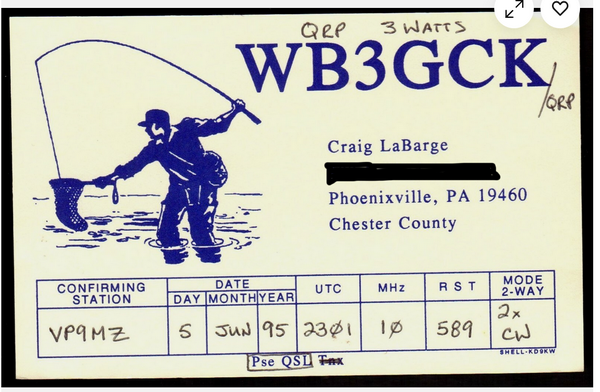
Several years back, a friend of mine said he found one of my old QSL cards for sale on eBay. It was a card I sent to a DX ham almost 31 years ago. While poking around on eBay recently, I saw it was still for sale.
I sent this card to VP9MZ in Bermuda for our 30M CW QSO back in June 1995. The card shows a fisherman, representing one of my other hobbies. The eBay seller, located in Canada, is asking $6.95 Canadian ($5.08 US).
My old QSL card someone is selling on eBay
I went back through my old paper logbooks and found the QSO. I was running my old MFJ-9030 (about 3 watts, CW) into my raingutter antenna. In the remarks column, I made a note that he remembered me. Apparently, we had worked each other previously. My log entry also shows that I received his QSL card via his QSL manager. While I was on that page of the logbook, I saw another QSO with him 5 days later.
One part of me is insulted that my card hasn’t been sold after being up on eBay for years. On the other hand, I’m not really sure why someone would want to buy it.
I have boxes of QSL cards I have received over the past 50+ years. Hmmm…. Maybe I should start selling them on eBay.
Ten years ago today, I published my first post on this blog. Time flies when you’re having fun—and it certainly has been fun.
I started this blog mostly for selfish reasons. It started off as a personal journal of sorts, a way of documenting my ham radio activities and projects. When I receive a QSL card or Logbook of the World confirmation, I often go back through the posts to see where I was, what equipment I was using, and how I was set up during the contact. I thought others might want to read this stuff, and apparently they do.
Some blog posts have been consistently popular over the years. I could only pull up statistics for the last five years, but the most frequently visited posts over that period were:
I don’t make any money from this blog; there are no sponsors, affiliate links, or the like. It’s just something I have enjoyed doing. So, if you are among the hundreds of visitors each day from around the world, thank you for stopping by.
I learned recently that Ed Hare, W1RFI, passed away. Ed was a long-time lab engineer at ARRL. I didn’t really know him, but I had the pleasure of meeting him at a QRP gathering 25 years ago. The post below originally appeared on my old website, but I thought I’d share it over here in Ed’s memory. – WB3GCK
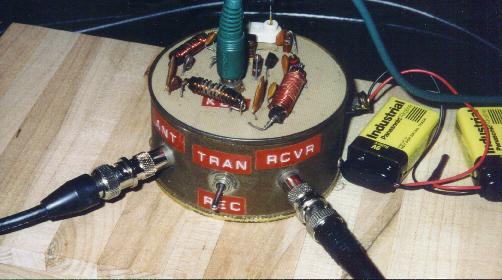
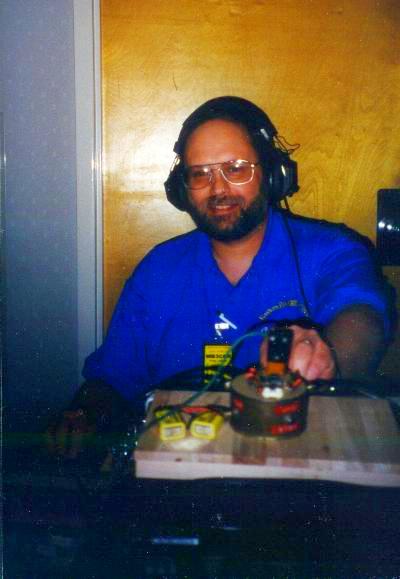
During the 2000 Atlanticon QRP convention at Glen Mills, Pennsylvania, I had the distinct honor of operating a bit of QRP history. Ed Hare, W1RFI, brought the original Tuna Tin 2 transmitter and put it on the air as a special event station operating as W1FB/3.
For those unaware of the significance, the Tuna Tin 2 was built by famed QRPer, Doug DeMaw, W1FB, and featured in QST back in the 70s [1][2]. It was stored at ARRL headquarters for many years until it mysteriously disappeared. It was later discovered by Ed Hare in a hamfest junk box 100 miles away. Ed bought it back for a dollar and has been putting this classic rig on the air on a regular basis. The fact that it still exists at all makes it a very special piece of equipment. The design has been updated over the years and QRPers still continue to build versions of this venerable classic.
Technically speaking, it’s not much of a transmitter. A couple of 2N2222s in a simple, crystal-controlled circuit putting out about a half-watt or so (or about 800mW with the two 9-volt batteries shown). Using a toggle switch to switch from transmit to receive brought back memories of my Novice days. My only QSO was with another QRPer on the 4th floor of the hotel. Still, I was thrilled to be able to briefly operate this famous little transmitter. Especially, under Doug DeMaw’s callsign, W1FB. That really made it special.
[1] DeMaw, Doug. “Build a Tuna Tin 2.” QST, May 1976, pp. 14–16. Available in the QST archives at ARRL.org. [2] Hare, Ed. “The Tuna Tin 2 Today.” QST, Mar. 2000, pp. 37–40. Available in the QST archives at ARRL.org.
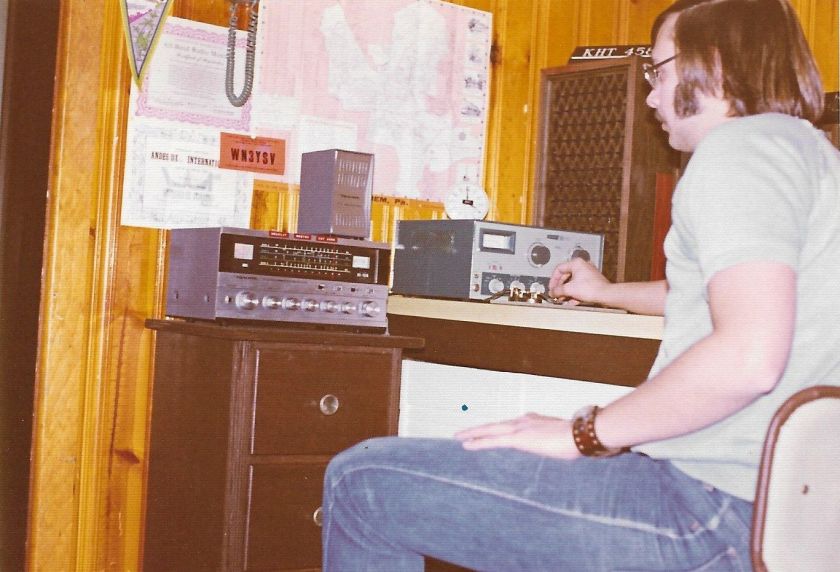
Wow! Where has the time gone? Today marks 50 years of ham radio for me. I was first licensed as WN3YSV on this date in 1974, after finishing a four-year hitch as a Navy Radioman. Over those years, I’ve made a lot of great memories. I also made a lot of great friends, both in-person and on the air.
WN3YSV (pre-WB3GCK). My first station included a Heathkit DX-60 crystal-controlled transmitter and a Realistic DX-160B receiver. This picture was taken in 1975, about 8 months after leaving the Navy.
Thanks to the thousands and thousands of hams I’ve had the pleasure of working over the past 50 years. I look forward to many more contacts over the next 50 years!
I recently learned of the passing of my old friend, Carter Craigie, N3AO. He was an avid QRPer, an excellent CW operator, and one of the nicest people I have ever met.
I first met Carter sometime back in the 90s, when we were members of the now-defunct Eastern Pennsylvania QRP Club (EPA-QRP). Later on, Carter and I were members of Chester County (PA) ARES-RACES. Carter served a two-year stint leading the organization as the Emergency Coordinator (EC).
Eventually, Carter and his wife, Kay N3KN (former ARRL President), moved to Blacksburg, Virginia. Although I rarely saw him in person after that, I had a bunch of QSOs with him over the years. He was a regular participant in QRP field contests, like the NJQRP Skeeter Hunt and Flight of the Bumblebees. He was also an active member of the Straight Key Century Club (SKCC).
In 1999, Carter N3AO and Ed WA3WSJ stopped stopped by my campsite in French Creek State Park (PA) to check out my new camper. L-R: WA3WSJ, WB3GCK, and N3AO.
Looking back through my logs brought back some memories. Carter always tried to work me when I was out camping or traveling. He seemed to know my go-to frequencies and operating habits and would always seem to find me. I remember being on a camping trip to the Thousand Islands in New York back in 1999. I turned on the radio one morning, and without touching the tuning knob, the sound of Carter calling me greeted me. We had some nice rag chews on those trips.
I had the pleasure of running into Carter and Kay during Phillies spring training in Clearwater, Florida, in 2009. L-R: WB3GCK, my (far) better half, Kay N3KN, and Carter N3AO.
During the year-long National Parks on the Air (NPOTA) event in 2016, I used to text Carter whenever I was out activating a park. Within minutes, I would hear Carter calling me for a contact. He would always make sure to spot me on the NPOTA Facebook page.
While it’s sad to know that I won’t hear Carter on the air anymore, I feel truly blessed for having known him. Rest in peace, my friend.
Looking through some files recently, I came across the sales invoice for my old Yaesu FT-817. According to the invoice, my FT-817 was 20 years-old back in May. The ‘817 hasn’t seen much use lately, so I set out to change that.
I first saw the FT-817 at an Atlanticon QRP convention back in 2001. The FT-817 had just come out, and I wanted one the moment I saw it. It wasn’t until two years later that I finally pulled the trigger and bought one. The FT-817 became my main rig for many years, both at home and in the field. After I bought my Elecraft KX3, the FT-817 was only saw infrequent use in the shack.
The early FT-817s were plagued with a tendency to blow the finals. Sadly, mine was no exception. Despite being very careful, my finals went belly-up during a camping trip in 2006. I sent my rig back to Yaesu for repairs, and they installed the newer, more robust finals used in the FT-817ND. It’s been fine ever since—knock on wood.
Initially, I used my homebrew Z-match tuner with the FT-817. In 2009, I bought the LDR Z-817 auto tuner, which was designed specifically for the FT-817. The Z-817 certainly made tuning up a lot faster.
A while back, I tried to program some new repeater frequencies using Chirp on my laptop. Windows informed me that the chip in my old FT-817 CAT cable is no longer supported. I bought a new cable on Amazon, and I was soon back in business.
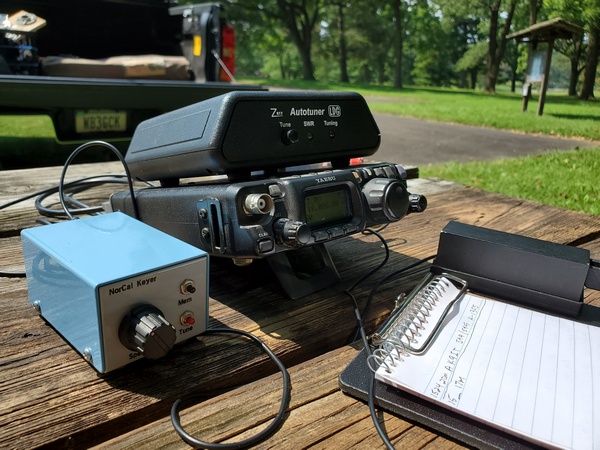
To prepare for today’s outing, I put fresh batteries in the Z-817. Since the FT-817 doesn’t have a memory keyer in it, I dug out my old NorCal Keyer. I built the NorCal Keyer from a kit not long after I purchased the FT-817, so it is also 20 years old. I gave the keyer a set of fresh batteries and programmed one of the three memories with a “CQ POTA” message.
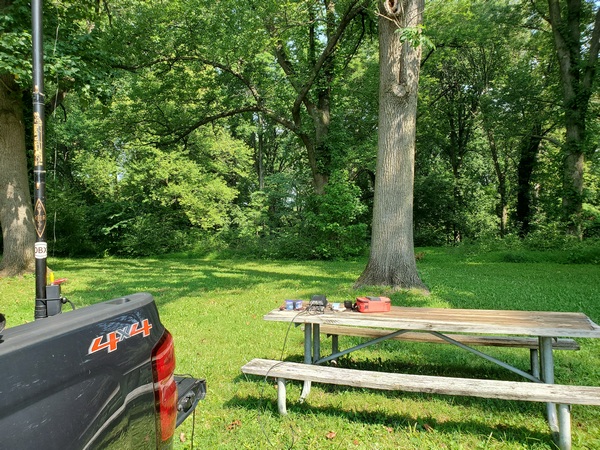
With my trusty FT-817 in tow, I drove over the Valley Forge National Historical Park (K-0761, KFF-0761). I parked my truck in a spot that had a picnic table about 10 feet behind it. That allowed me to set up my homebrew 19-foot vertical on the truck and run an 18-ft length of RG-8x over to the rig.
My 20 year-old Yaesu FT-817 back in the field at Valley Forge National Historical Park (K-0761, KFF-0761). The blue box in the foreground is my NorCal Keyer, which I built from a kit 20 years ago.
Before starting my activation, I did some testing. The FT-817 and Z-817 combo played well with the vertical. I was able to easily get a good match from 40M through 10M. The earbuds I used were more sensitive than the headphones I use at home, so the sidetone was louder than I’m accustomed to. Unfortunately, I couldn’t remember how to adjust the sidetone volume, and I neglected to pack my little FT-817 cheat sheet. So, I just pulled the earbuds out a bit and continued on.
Since the picnic table was only 10 feet from my truck, I was able to use my homebrew 19-foot vertical.
Once I got going, using the FT-817 brought back a lot of memories of portable outings from years ago. Happily, the old rig still works like a charm.
Despite some fading on the bands, contacts came easily. In a little more than an hour, I made 21 contacts with four park-to-park QSOs. Most of my contacts were on 40M and 20M, with one contact on 30M (a P2P). I also had a contact with W1AW/0, but the operator didn’t give his location.
It was a lot of fun getting my trusty FT-817 back out in the field again. The FT-817 isn’t my oldest QRP rig; that honor goes to my 30 year-old MFJ-9030 transceiver. I definitely need to dust off more of my old rigs and give them some QRP-portable love.
Happy Morse Code Day! This annual event honors the inventor of the code, Samuel F. B. Morse, who was born on this day in 1791.
The original Morse telegraph
Nearly 179 years after the famous “What hath God wrought” telegraph message was sent from Washington. DC, to Baltimore, you can still hear plenty of Morse Code on the ham bands. Amazing!
So, in observance of Morse Code Day, get on the air and launch some dots and dashes into the ether.
It saddened me to learn over the weekend of the recent passing of Rich Arland K7SZ. Rich was an avid QRPer and author of several books and many articles on the subject. Years back, he was the author of the QRP Power column in QST Magazine. Rich was a 2002 inductee in the QRP Hall of Fame, a well-deserved honor.
I first met Rich when we were both members of the (now defunct) Eastern Pennsylvania QRP Club. He and his wife, Patty, attended a Field Day or two with the club in French Creek State Park. His keen sense of humor always made for a fun weekend.
Rich Arland K7SZ at the Eastern Pennsylvania QRP Club (EPA-QRP) Field Day in 2005.
During one of our club gatherings, he admired an alkaline battery pack I built into a small military surplus container. I had an extra container, which I mailed to him along with a small circuit breaker/switch. Rich wrote about his completed battery pack in the March 2002 edition of QST (pages 82-83). He gave me a little shout-out, too.
When I bought my Yaesu FT-817, Rich sent me a nice little 12 volt power supply to go with it. That was about 18 years ago, and that power supply is still in regular use today.
Rest in peace, Rich. I’ll think of you every time I power up my old FT-817.
It’s hard to believe, but a half-century has gone by since I graduated from Navy Radioman School. The Navy decided that the 18-year-old kid was ready to do this radio stuff for real.
Following three months of boot camp, the Navy transferred me to the U.S. Navy Training Center in Bainbridge, Maryland. USNTC Bainbridge was not the most glamorous place. The barracks were run-down, World War II-vintage wooden structures with a cockroach problem.
I still remember my first day in Radioman school. The instructor gave us a sheet of paper and told us to memorize it. It was the Morse alphabet with the sound of each character. (A = DID-DAH, B = DAH-DI-DI-DIT, and so on). I also took a typing test. Fortunately, I had a typing course in high school and was able to test out of the typing training. The non-typers had to attend an after-hours crash course in touch typing.
Early on, our training focused on CW. As I recall, the requirement back then was 10 WPM, sending and receiving. The CW training also covered messaging handling, logging, and net procedures. Looking back, I think focusing on CW 8 hours a day for a few weeks was a great way to learn it. Plus, I was getting paid to do it!
We did all of our CW copying on a mill. A mill was a manual typewriter will all caps. After I got out of the Navy, I had to re-train myself to copy with a pencil since I had never done that before.
Over time, we moved on to a variety of other topics. We learned about the radio equipment we would likely be using. Radio-teletype was the primary communications mode for the fleet back then, so we also had to learn that equipment.
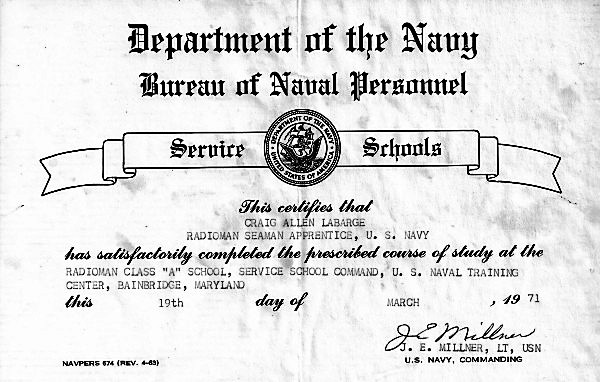
My diploma from Navy Radioman A School in March of 1971.
We spent the last week of school standing radio watches in a simulated shipboard radio room. This part of the course was called the PRAC-DECK. We set up radio circuits and sent and received message traffic. To make things interesting, the instructor would inject some equipment issues for us to troubleshoot.
On my first mid-watch (night shift), the instructor said I had to learn the most important skill I would need out in the fleet. That skill turned out to be making coffee in one in one of those 25-cup percolators. I ran into that instructor a few years later. He laughed when I reminded him about that lesson. I told him he was right about a pot of coffee being necessary for communications.
All in all, it was an interesting four months. Fifty years later, I’m still using the CW I learned back then.
On one of the several ham radio mailing lists I subscribe to, there was some recent discussion about unusual antennas. You know—bed springs, light bulbs, and the like. It brought to mind a memorable QSO I had 27 years ago.
In the July 1993 issue of QST, Rod Newkirk W9BRD (later VA3ZBB, now SK) wrote an article about building small, multi-turn loop antennas[1]. If his name doesn’t ring a bell for you, Rod wrote the “How’s DX?” column in QST from 1947 to 1978 and coined the term, “Elmer.”
Although I never actually built one of Rod’s loops, I found the article fascinating. At the end of the article, Rod noted that he conducted his loop antenna experiments in the partially-underground cellar of his Chicago home. Remarkable!
Fast-forward to September 1993. I went downstairs to my basement shack one evening and fired up my old MFJ-9030 on 30M CW. I had three QSOs that night; one of them was with—you guessed it—W9BRD.
During our QSO, Rod mentioned that he was using one of his experimental mini-loops indoors in his shack. When I told him I was running 5 watts into my rainspout, he sent back, “Hey, if it’s metal, load it up.” According to my log, we chatted for about 12 minutes before signing.
Needless to say, that contact put a smile on my face. It was the kind of QSO I really enjoy—one with a station using an unusual set-up or operating in a unique location. I guess you could say this QSO checked both of those boxes. Not to mention that I had just worked a very well-known figure in Amateur Radio.
QSL card from W9BRD documenting our unusual QSO in 1993.
I fired off a QSL card to Rod to acknowledge our QSO and to let him know that I enjoyed his loop article. Before too long, I received a card back from Rod. His typewritten note on the back of the card continued the theme of our QSO. It read, in part: “Hey, if your XYL uses gold or silver thread for that needlepoint, let’s try loading it up, Craig.” He also wrote about his experiences with rainspout antennas, including his attempt to feed a particularly stubborn one.
Rear of W9BRD’s QSL card
From articles I have read, it’s clear that Rod had a penchant for assembling and experimenting with unusual antennas. His daughter, Amanda, once wrote: “He especially loved discovering how much of a signal he could achieve with his various objects: the coffee cans, cookie tins, piles of wire and boxes and tidbits—out of which he wrung quite magical things.”[2]
When it comes to unusual antennas, Rod was a man after my own heart. Over the past 27 years, his words from our QSO have been my mantra: “If it’s metal, load it up!”
Thanks for the inspiration, Rod.
73, Craig WB3GCK
References: [1] Newkirk (W9BRD), Rod. “Honey, I Shrunk the Antenna.” QST, July 1993, pp. 34-35, 39. [2] Newkirk (WN9PMC), Amanda. “On Being W9BRD’s Daughter.” K9YA Telegraph, Vol 11, Issue 9, September 2014, pp. 2-3. (K9YA Telegraph website)





 WB3GCK QRP Amateur Radio