Lately, I’ve had to squeeze in my ham radio opportunities whenever I can. (That seems to be a common theme for this blog these days.) This past weekend was a perfect example. While spending the weekend with family in central Pennsylvania, I got in a very short activation and still made it back in time for breakfast with the family.
Always the early riser, I was up on Sunday morning before the rest of the family. After grabbing a quick cup of coffee, I threw my backpack in the car and headed out just after sunrise.
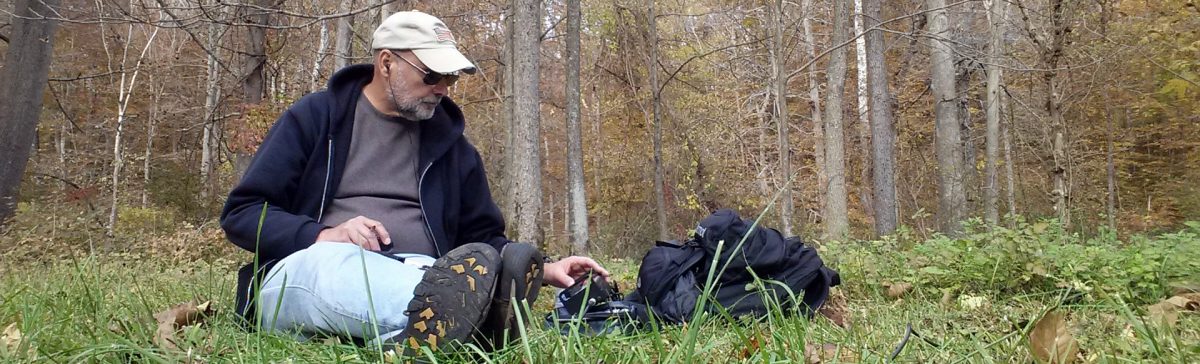
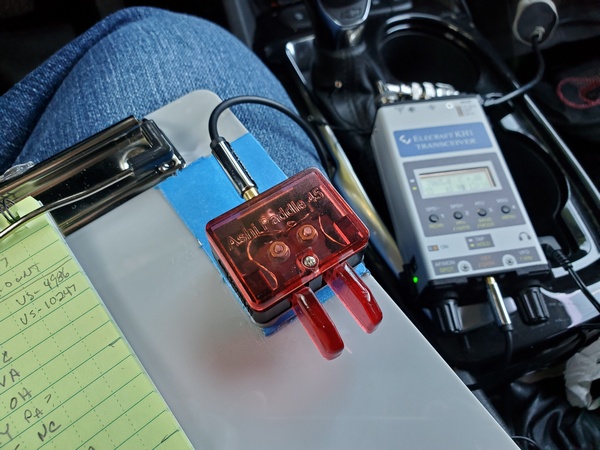
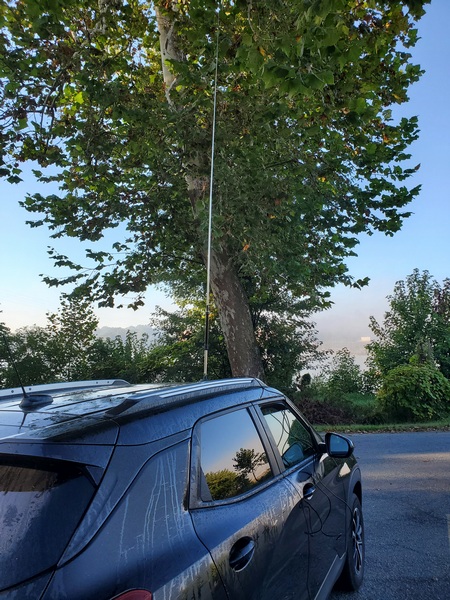
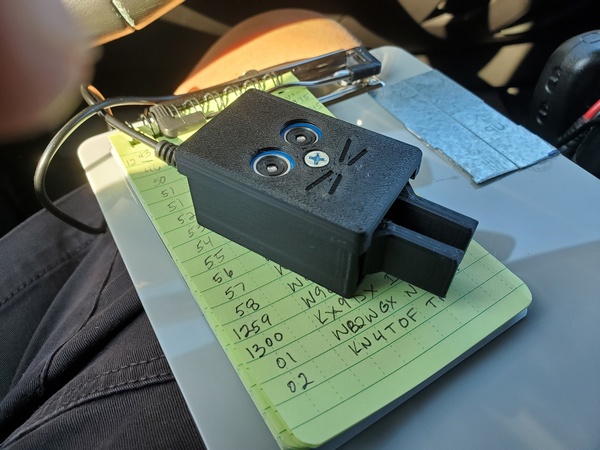
I activated the Captain John Smith Chesapeake National Historic Trail (US-4567) from a boat launch in Lancaster County. Equipment-wise, this activation was a carbon copy of my last visit—minus the paddle issues. I used my Elecraft KH1 in my (far) better half’s compact SUV. Once again, I used my Gabil GRA-7350TC vertical and magnetic mount on the roof of the car. The paddles I used this time out were the Ashi Paddle 45 from N6ARA Electronics. (More on those in a future post.)
Ashi Paddle 45 and Elecraft KH1
After parking in my usual spot, I placed the antenna on the roof of the car and roughly adjusted the coil slider for 40M. I got out my antenna analyzer and conected the coax to fine-tune the antenna. However, when I turned on the antenna analyzer, it showed a 1.26:1 SWR—no adjustment needed! I couldn’t do that again if I tried.
Gabil GRA-7350TC on a mag mount
After hunting for a few park-to-park contacts, I found a vacant frequency and started calling CQ. Like on my last visit, the 40M band was so productive I spent my whole activation there. I operated for about 30 minutes, logging 19 contacts—not too bad for about 4.5 watts into an eight-foot vertical on a mag mount, I guess. Once again, I connected with N4JAW (aka Ham on a Bike). Jim was out doing his usual bike-portable activation at US-7956 in Kentucky.
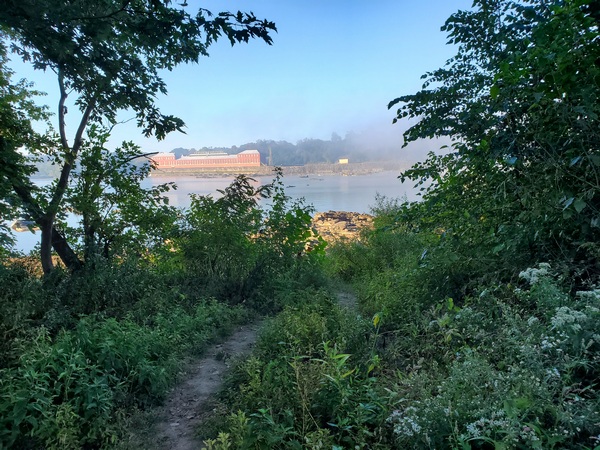
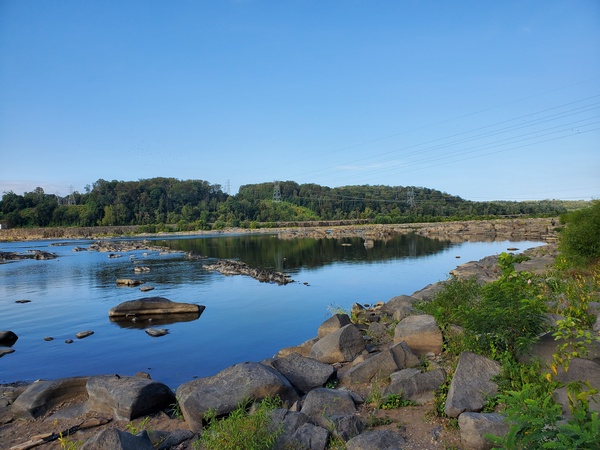
Some morning fog on the Susquehanna River
I packed up in a couple of minutes and was back at the house about 15 minutes later. My time on the air was a little shorter than I would have liked, but at least I had no paddle issues this time.
My (far) better half and I had plans to go watch our grandson’s soccer game yesterday, but I still squeezed in a short, early morning activation. I headed over to nearby Valley Forge National Historical Park (US-0761, KFF-0761) and allotted myself an hour of operating time. While I was there, I tried out a few things with my Elecraft KH1.
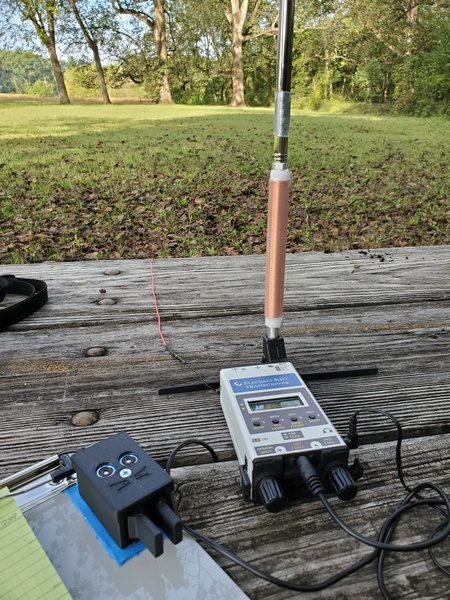
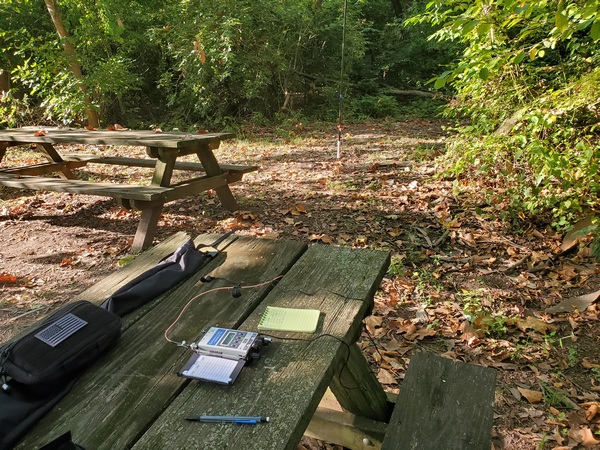
I set up the KH1 at a picnic table and used the whip antenna and AXE1 extender coil. I supported the antenna with a right-angle adapter from Tufteln. This was the first opportunity I had to use the adapter, so I was anxious to try it out. For my counterpoise, I used a homebrew setup with a 13-ft wire and a 20-foot extension for 40M.
The KH1 with the AXE1 loading coil for 40M/30M and the Tufteln right-angle adapter.
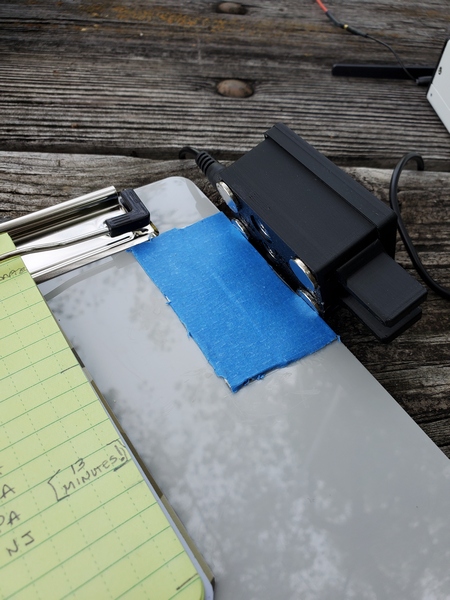
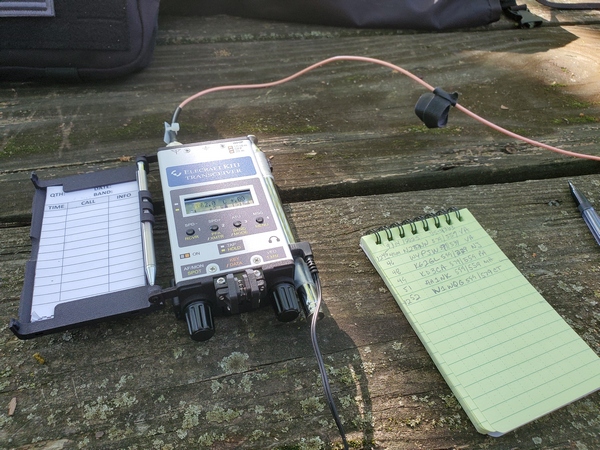
I also gave my CWMouse paddles another go. I glued four small magnets to them the night before, so I wanted to see how they worked with my clipboard. KE8PTX had a Facebook post recently in which he mentioned using painter’s tape on the metal surface of his knee board to give his paddles a little extra traction. As luck would have it, I was doing some painting this week and had some tape handy. I put some on the steel strips on my clipboard right before I left the house.
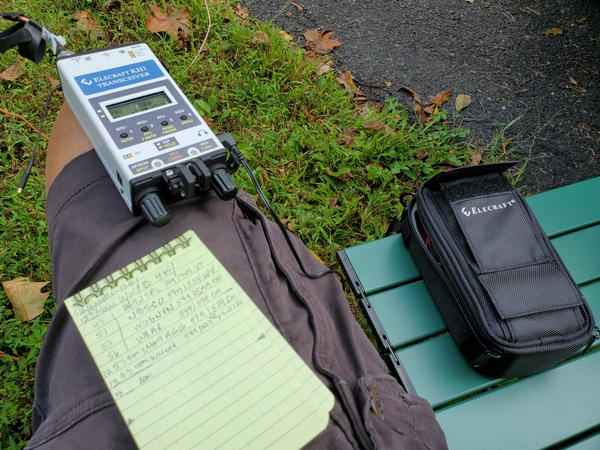
I glued some magnets to my CWMouse paddles. The blue painter’s tape helps the magnets get a better grip on the steel strips glued to the clipboard. You can also see the notation I made in my log for my 10th contact.
With everything set up, I tuned up the KH1 and got started. My results on 40M really surprised me. Although my signal reports were on the low side, I was getting some decent spots on the Reverse Beacon Network. It took only 13 minutes to log my first 10 contacts. I continued making contacts for 30 minutes, while brushing ants off of my log. (I think there was an anthill under the picnic table. Doh!)
I spent the rest of my hour-long activation on 30M and 20M. There was less activity there, but I picked up a few more contacts on each band.
When my hour was up, I packed up and gave the ants exclusive use of the picnic table. I finished up with 25 contacts in my log; I’ve done much worse with much better antennas. The KH1 did an amazing job with just the whip antenna, and my modified CWMouse paddles worked great attached to my clipboard.
As you can probably tell, I’m having fun with my new rig.
I did a POTA/WWFF activation this morning and used it as an opportunity to try out a new set of paddles. During a recent activation, I encountered a recurring problem with the cheap QU-21C paddles I keep in my backpack as a backup. As a result, the finicky paddles have lost out on their role as my backup.
Always a sucker for unusual paddles, I came across an interesting offering I couldn’t resist. I fired off an order for the CWMouse paddles and had them in my hot little hands two days later. Mike KN6FQM designed the CWMouse paddles, which are currently selling on Amazon for $39.00 (US).
The CWMouse paddles are made from 3D-printed parts and include sealed ball bearing races, two sealed microswitches, and an ⅛-inch stereo jack. One thing that drew me to these paddles was the small size: 74mm/2.9in L x 36mm/1.4in W x 28mm/1.1in H. They weigh a mere 1.5oz/45g, making them ideal for portable use. See the CWMouse website for the complete specifications.
The CWMouse paddles. For size reference, they are on a 3″x5″ notepad.
My destination this morning was Marsh Creek State Park (US-1380, KFF-1380). I usually operate near one of the boat launches, which can sometimes get crowded during the summer. Given that it was a weekday in September, there was plenty of room in the parking lot.
My rig today was my Elecraft KH1 into a 12-foot whip and homebrew loading coil. Starting out on 40M, I found lots of strong signals. I made a couple of quick park-to-park contacts before settling on a frequency and calling CQ. I quickly achieved the required 10 contacts and then some.
My KH1 fit nicely on the center console of my truck.
After 20 minutes, the activity on 40M tapered off, so I moved up to 20M. The action wasn’t as busy on 20M, but I made 11 contacts. One of those was with a station in California—I like when that happens. The 17M band produced three more before I called it quits. After a bit more than an hour, I had logged 32 contacts with six park-to-park contacts.
The CWMouse paddles performed flawlessly. Because of the microswitches, there are no adjustments for throw or tension. However, they felt great right out of the box. They have a nice, light touch, which is what I prefer.
One potential issue is the plastic used for the 3D printing. The website is very clear that the paddles should not be stored at temperatures above 100F. This could easily happen in a closed vehicle, so I’ll have to keep that in mind.
I used the “two-handed” technique with the paddles this morning, which is not my preferred way of operating. I’ll probably glue on some magnets, so I can attach the paddles to my clipboard.
Overall, however, I really like these paddles. It was a pleasure operating with them this morning.
My (far) better half and I spent the past weekend with family out in central Pennsylvania. During the weekend, I squeezed in a quick, early morning POTA activation. The great band conditions made for a fun activation, but paddle problems made it challenging at one point.
On Saturday morning, I was up before everyone else. After downing a cup of coffee, I took a short drive to a boat launch on the Susquehanna River to activate the Captain John Smith Chesapeake National Historic Trail (US-4567).
We drove out in my (far) better half’s car, so I used a simple antenna setup that produced decent results in the past. I used my Gabil GRA-7350TC on a small magnetic mount. Like the last time I used it on my (far) better half’s car, I easily adjusted it for a 1.3:1 SWR on 40M. I fed the coax through the passenger side window.
Gabil GRA-7350TC antenna on a magnetic mount
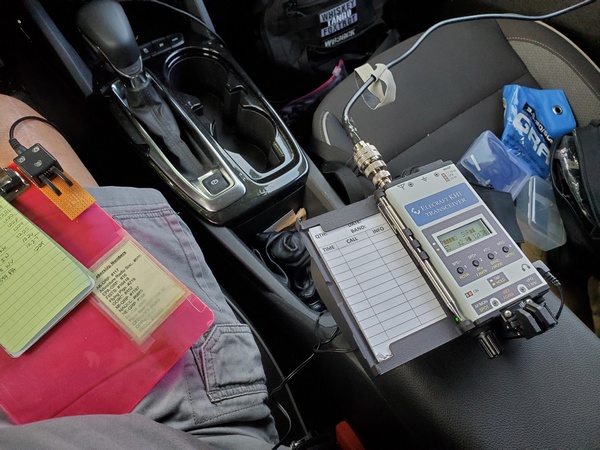
Inside the car, I set my Elecraft KH1 on the center console. I used my cheap QU-21C paddles attached to a clipboard with a homebrew magnetic mount I made for them.
The 40M band was hot with no trace of the QRM I experienced the last time I was there. It only took 14 minutes to log my first 10 contacts, the contacts came in steadily for the next 45 minutes.
I was cruising right along for about 30 minutes until my cheap paddles decided to start dropping “dits” here and there. Based on my crazy sending, I’m sure some folks thought I was experiencing some sort of medical emergency.
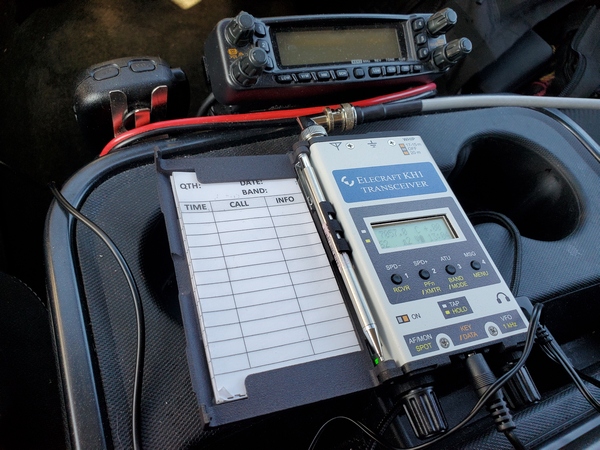
I frantically searched for my N6ARA Tiny Paddle that I always carry as a backup. Of course, they were nowhere to be found. I ended up using the stock KH1 paddles attached to the radio, with the KH1 on the center armrest. This setup was an ergonomic nightmare, with my elbow in the backseat area. Despite the awkward position I was in, I was able to finish up my activation.
My setup after my paddle problems started. On hindsight, I could have arranged things better to make my operating position a little less awkward.
After an hour, I had 39 contacts in my log. I was so occupied on 40M, I never got around to trying the higher bands. My log included 7 park-to-park contacts. One of those was with N4JAW (aka Ham on a Bike). It’s always fun working Jim down in Kentucky.
I also heard from my friend, Greg WA3GM. It had been a while since our last QSO, so it was great to hear him again.
Susquehanna River
The Gabil antenna and mag mount setup once again proved to be a great antenna when using my (far) better half’s car. With about 4.5 watts out on 40M, I worked stations up and down eastern U.S. and Canada and out to several mid-west states.
The QU-21C paddles, however, are a different story. This is the second time I have had issues with them. A squirt or two of contact cleaner will usually fix the problem—for a while, anyway. As they say: You buy cheap, you get cheap.
And, of course, I found my N6ARA paddles as I was packing up. Doh!
I set off this morning to activate Norristown Farm State Park (US-4363, KFF-4363) with a specific plan in mind. We’re talking about me, of course; so things don’t always go as planned. Today was a good example of that.
If a specific parking space was available, I planned to use a loaded whip on my truck and operate from a nearby park bench. Failing that, I figured I would set up at one of the picnic pavilions with a vertical of some sort. When I rolled in, however, the parking lot was crowded and people were setting up for an event under the pavilions. So, I was off to come up with a Plan C.
I drove back up the road a bit and pulled into a mostly empty trailhead parking lot. Off to one side, I found a secluded picnic table tucked away in a wooded area. About five minutes later, I was on the air.
I sometimes think that my 50+ years of ham radio have been an ongoing quest to simplify my operations. My recently acquired KH1 is definitely a giant step in that direction. Everything I need (except for my earbuds) is attached to the radio.
Looking at the propagation forecast, I opted to forego the KH1’s whip antenna and go with something larger. So, I went with the 9:1 end-fed random wire from AD8HK Antenna Systems mounted on a cheap 19-foot telescopic pole. The ground was a little soft, so it took me a few tries with my homebrew ground mount to get the antenna reasonably vertical.
Even with a vertical just under 18 feet, the 40M band was productive today. After eight quick contacts, things slowed down, and I changed bands. The 30M band produced one contact, while 20M was good for a half-dozen more. I went back down to 40M to pick up a few more before calling it quits. After about an hour, I ended up with 18 contacts, five of which were park-to-park.
I have to say I’m really having fun with the KH1. It’s ideal for the short activations I tend to do. The battery life is nothing short of exceptional. This was the second activation since I last charged it, and I could probably do four or five more.
A little over a month ago, the finals in my brand new Elecraft KH1 gave up the ghost during my second outing with it. After a trip back to the factory for some TLC from the Elecraft folks, the rig safely arrived back in Pennsylvania this week. I anxiously took the little rig out to the field this morning to get re-acquainted with it.
My destination today was Evansburg State Park (US-1351, KFF-1351). With an active geomagnetic field, I knew band conditions could make for a tough outing.
Along with my KH1, I used a new antenna I bought from AD8HK Antenna Systems and received just yesterday. This antenna features a 9:1 unun with 17’9.5″ radiator and a 8’10.5″ counterpoise wire. The unun assembly has an integrated wire winder, making for a neat, compact little antenna. I mounted the antenna on a 19-foot pole and ran 20 feet of RG-316 back to the KH1.
The AD8HK 9:1 Random Wire Antenna strapped to a telescoping pole
With the KH1 resting on my knee, I did a quick check of the bands from 40M through 15M. The KH1’s internal tuner easily found a decent match on all five bands. I went back to 40M and got started.
My newly-repaired Elecraft KH1 balanced on my knee
Despite the questionable band conditions, I logged seven contacts in about 15 minutes. I made another five contacts on 20M and 17M before calling it quits. The nice shady spot where I started out was quickly becoming a toaster oven.
I ended my brief outing with twelve contacts, including four park-to-park contacts. My KH1 has been out of commission for the past month, so I spent a good portion of my time refreshing my memory on the KH1’s menus and functions. The KH1 is thoughtfully laid out, so it all came back quickly.
Today wasn’t the best day for evaluating a new antenna, but the AD8HK EFRW did a decent job. Plus, it was great to have the KH1 back on the air. Both will see more use in the field in the future.
[Update 9/9/2025: During this activation, the KH1’s output power seemed low. As it turned out, the KH1 had been inadvertently set for low power. So, I was only running about two watts. Doh! I guess I need some more re-familiarization with this rig!]
Actually, this bumblebee barely got off the ground at all this year. It started off with a heartbreaking rig failure and ended with some horrendous local noise.
I had a late-breaking change of plans this week. I originally planned to operate in the Flight of the Bumblebees (FOBB) contest from a nearby POTA entity. Instead, I ended up in central Pennsylvania helping a family member recovering from a recent surgery.
So, I activated Plan B: take my new KH1 along and make a few contacts from the backyard. What could go wrong with that? A lot, as it turns out.
Using my homebrew ground mount, I set up a new antenna on my lightweight telescopic pole. The antenna comprises a 15-foot radiator and a 7.5-ft counterpoise fed through a 4:1 unun. (More about that antenna in another post.) I ran a 6-foot length of RG-316 coax over to the KH1.
I easily got a 1:1 match on 20M and up, but it wouldn’t load up at all on 40M. Going back to 20M, I started operating. Something on the display didn’t look right. It turned out that I wasn’t getting any power output. When I pressed the ATU button, I heard some relay clicking, but there was no power or SWR displayed after tuning. When I keyed up, the display showed zero bars of power and one bar for SWR.
I checked to make sure I wasn’t in “Test” mode (I wasn’t). Next, I started pouring through the settings to make sure I hadn’t messed something up. Nothing looked out of the ordinary to me. I tried the built-in whip on 20M, but still no power out.
After spending an inordinate amount of time playing around with the KH1, I packed it up and brought out my Penntek TR-35. My trusty Elecraft T1 ATU also refused to load up on 40M.
So, 20M was the only band working for me, given the rig I was using. I could have set up a different antenna, but I didn’t have that much time.
The 20M band had some horrendous local noise, so it was rough going. I worked one bumblebee in Missouri, and that was it. Frustrated with my inability to hear any other FOBB activity through the noise, I called it quits. I needed to get back inside to take care of a few things, anyway.
Having owned my KH1 for less than a week, you can imagine my disappointment. I shot off a message to the support folks at Elecraft, so hopefully, they can help get this issue resolved before I head down to North Carolina on vacation next month. (Fingers crossed)
I’m at the stage in my life when I should be “thinning the herd” when it comes to radios. So, what do I do? Instead of getting rid of some stuff, I fire off an order to Elecraft for a KH1 Edgewood package. I need another QRP rig like a hole in the head, but after considering it for the past year, I gave in and ordered one.
I have a couple of use cases in mind for the KH1. This rig should be ideal for bicycle-portable outings and hopefully get me out on some hiking trails—within the limits of my arthritic knee, of course.
I have to admit that after I placed the rig in my online shopping cart, it took me several minutes to convince myself to press the “Submit” button. Less than 24 hours later, I received a shipping notice from Elecraft.
While waiting for the KH1 to arrive, I watched a bunch of YouTube videosread serveral blogs, and downloaded the manual. With those resources, I was thoroughly prepared when the Post Office delivered it.
What I wasn’t prepared for was exactly how tiny this thing is. Even with the research I had done, I didn’t fully appreciate its diminutive size until I had it in my hand. It’s amazing how much functionality Elecraft was able to cram into this little rig.
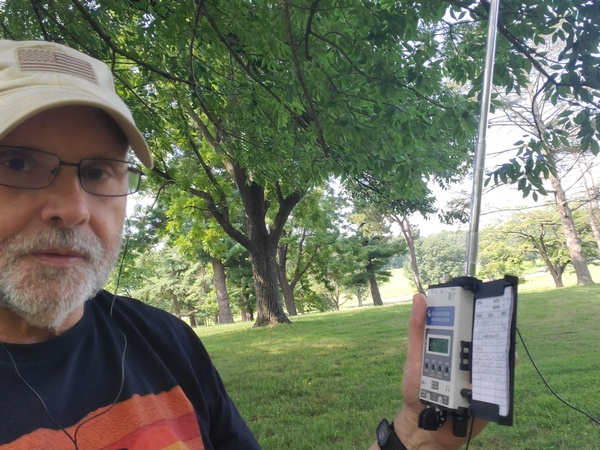
My new rig at US-0761/KFF-0761
Some Initial Impressions
Menus. I prefer radios that are simple to operate without a bunch of complicated menus. That’s one reason I love my Penntek TR-35 so much. There are a lot of menu options provided through the four pushbuttons on the KH1’s front panel. Elecraft, however, has come up with a scheme that makes navigating the menus very intuitive.
Paddles. The Elecraft KHPD1 paddles included with the Edgewood package will take some getting used to. I typically prefer paddles with a light touch, like my trusty Palm Mini paddles. I played around with the Elecraft paddles with the rig in the “Test” mode. It didn’t take too long before I could send coherent code with them. We’ll see how I do in the field. Fortunately, there are several after-market paddles for the KH1 if I decide to go that route.
Overall Ergonomics. It’s clear that a lot of thought has gone into the clever design of the KH1. Everything from the logging tray to the self-contained pen is nothing short of genius. I’ve never used a handheld HF rig before, so using the logging tray will take some getting used to.
Maiden Outing
The day after I received the KH1, my (far) better half suggested I go out and give the new radio a try. Of course, I took her suggestion, but I had some reservations. There was some geomagnetic craziness going on, plus the higher bands could be tough early in the morning. Nevertheless, I packed up the KH1 and headed off to Valley Forge National Historical Park (US-0761, KFF-0761).
I started off using the KH1 handheld with the telescopic whip while sitting on top of a picnic table. Using the stock counterpoise wire on the ground, the KH1’s internal ATU easily found a 1:1 match. The bands were really rough, but I made seven contacts that way. It took the better part of an hour to make those contacts, however. Six were on 20M and one was on 17M.
A Boy and His Toy
I wanted to try the lower bands—and my rear end was sore from sitting on the table—so I walked back to the parking lot and set up a 12-foot loaded whip on my truck. Sitting on a camp chair next to the truck, I bounced around the bands. I ended up with one contact on 40M and three more on 20M. Out of my 11 contacts, four were park-to-park.
Using the logging tray was a challenge. Writing while holding the rig in my hand was tough. Sitting in a chair with the radio resting on my knee was a little easier. My handwriting was pretty sloppy but still readable.
With enough contacts for the activation, I declared victory and went home.
Wrap-Up
I’m definitely not an early adopter with new gear. The KH1 is no exception. Elecraft announced the KH1 in the fall of 2023. Since that time, they have made improvements to the paddle and added new features via the firmware. Plus, by waiting to buy one, I got to learn from the users who jumped on the KH1 bandwagon early on. Thanks to the legions of YouTubers and bloggers for sharing their experiences with this rig. You made it easy for me to get up and running with it.
After the intial outing, I am thoroughly impressed with the KH1. With earbuds, the receiver sounds great, and the rig was super easy to use.
This little rig is going to see a lot of future use in the field.




 WB3GCK QRP Amateur Radio