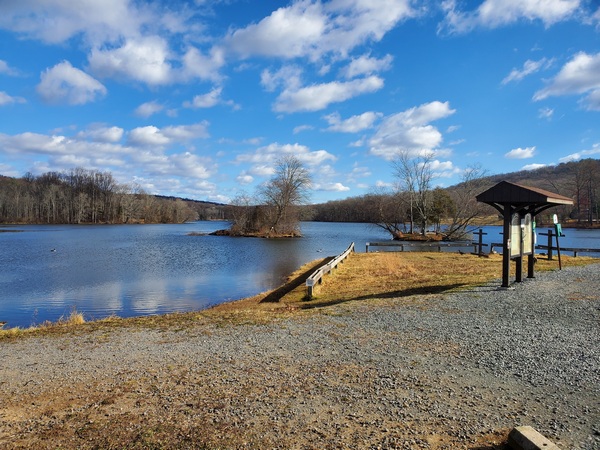
I haven’t had much time for ham radio this week, but I squeezed in a quick activation this morning. Not only did I get in some much-needed radio time, but I finally achieved a POTA Kilo award at one of my favorite local parks.
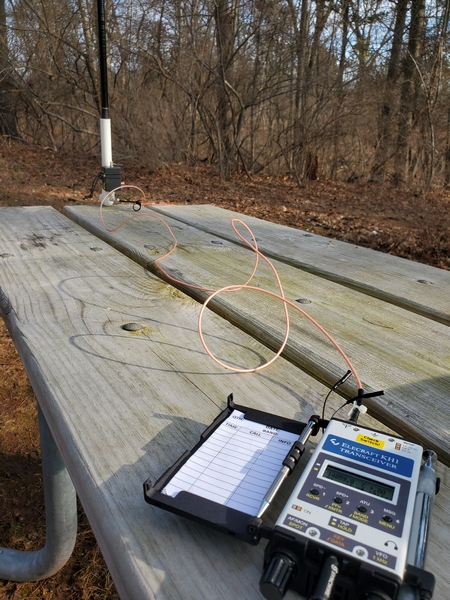
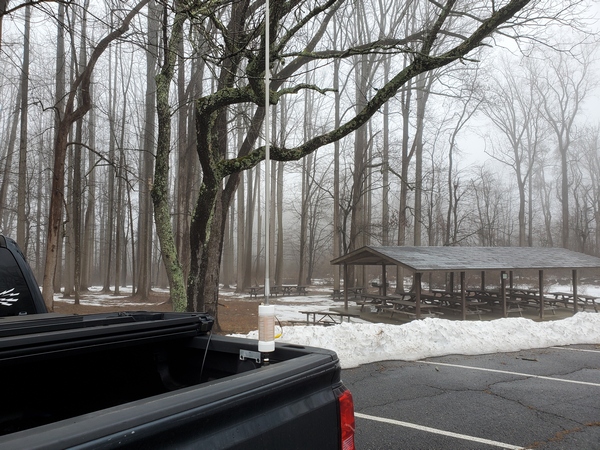
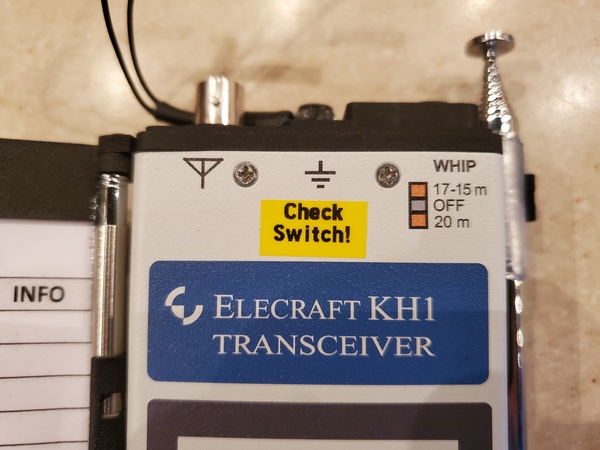
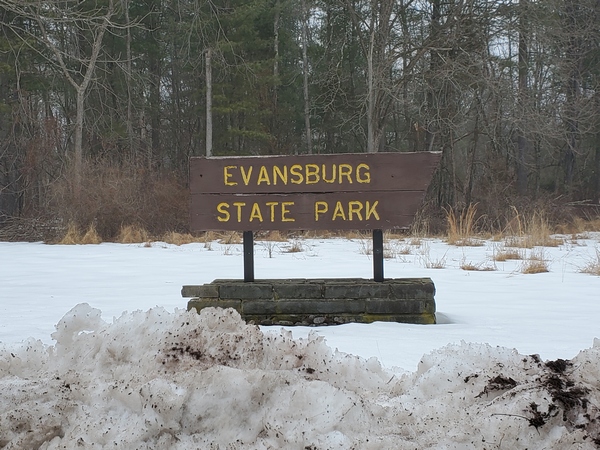
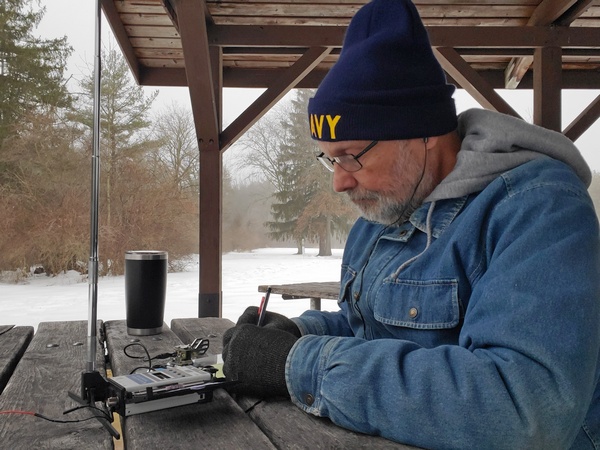
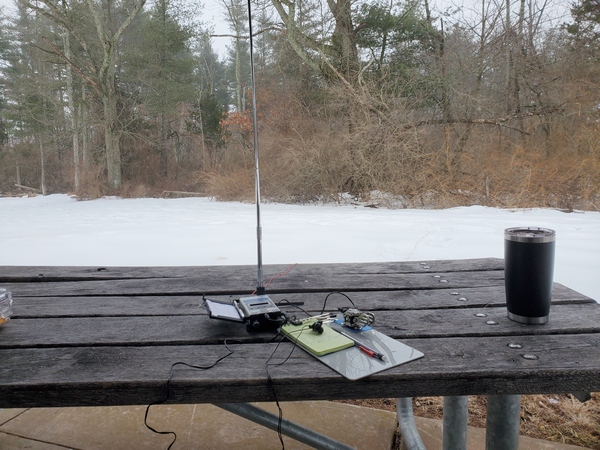
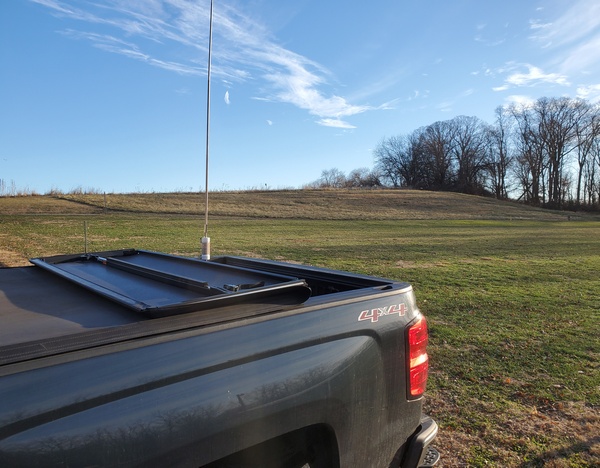
The park in question is Norristown Farm State Park (US-4363, KFF-4363). According to the POTA website, I needed 36 more QSOs for a Kilo award at this park, so I was hoping the bands would be in good enough shape to get there. I set up my Elecraft KH1 and 12-foot base-loaded whip and got busy.
On the air, there was some fading, but overall the bands weren’t too bad. The 40M band was the most productive for me, with 20M a close second. I made some contacts on 17M and 15M, but they were few and far between. I was amazed at the number of hunters out there early on a Friday morning. After an hour and 15 minutes, I had made 40 contacts—enough for the Kilo award with a few to spare.
As I mentioned, I didn’t make too many contacts on 17M and 15M, but I did work some DX. On 17M, I worked Germany, France, and Denmark. Stations in Mexico and France hunted me on 15M. While not DX, a special shout-out goes to N4NR in Florida who worked me on 20M, 17M, and 15M this morning.
While making a thousand contacts at a park isn’t a big deal for most activators, I was happy to finally get there after 32 activations at this park. I’m close to a Kilo award at another of my local parks, so I’m hoping to finish that one off in the next week or so.
Instead of heading out to the stores looking for bargains, I headed up to French Creek State Park (US-1355, KFF-1355) looking for POTA and WWFF hunters. It turned out to be a productive morning—and I didn’t have to spend any money.
I rolled into a parking lot near Hopewell Lake and started setting up. Old Man Winter is starting to rear his head here in southeastern Pennsylvania, with an air temperature about 32°F (0°C) with a wind chill around 25°F (-3.9°C). I forgot to bring my gloves, so my fingers were becoming numb by the time I got my 12-foot base-loaded whip set up on the truck. I used my Elecraft KH1 up in the truck’s cab.
Hopewell Lake in French Creek State Park
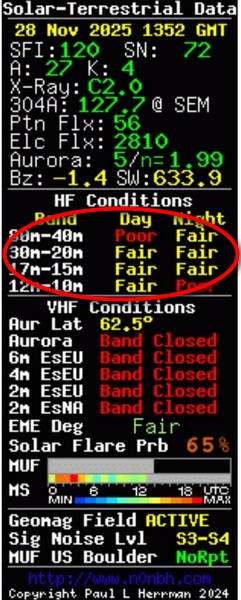
My handy band conditions app showed an active geomagnetic field with “FAIR” conditions for 40M through 15M, my bands of interest. Even under these conditions, however, there are usually contacts to be made.
Despite the predicted band conditions, the band weren’t all that bad.
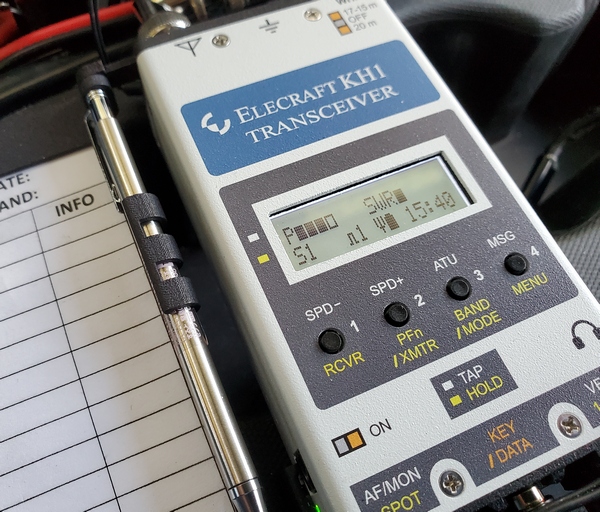
There was plenty of activity on 40M. It only took about nine minutes to log my first 10 contacts. After logging 18 contacts, I moved up to check 20M, 17M, and 15M. These higher bands weren’t too shabby either, producing 35 contacts across these three bands. I had DX contacts on each of those bands, too. The KH1’s display showed it was putting out about 3.5 watts on 15M, but that was enough to be heard in Europe.
My KH1 showing about 3.5 watts on 15M
Altogether, I had 53 contacts, including the following DX contacts:
20M: F6EOC
17M: DF2PI
15M: DL1SWB, F6DHD, IK3HMB, IK1LBL, DK1RS, EA7ZC
I also had a nice 2xQRP QSO with N8NK on 20M. He was running 1 watt from Michigan and sounded great here in Pennsylvania.
I had to pull the plug after about two hours. I would have stayed longer, but I had an errand I needed to take care of. The windchill temperature was still below freezing, so I hastily took the antenna down and headed on to my next stop.
I headed down to Ridley Creek State Park (US-1414, KFF-1414) this morning for a pre-Thanksgiving POTA/WWFF activation. While I was there, I wanted to field test a couple of paddles, one new and one I slightly modified.
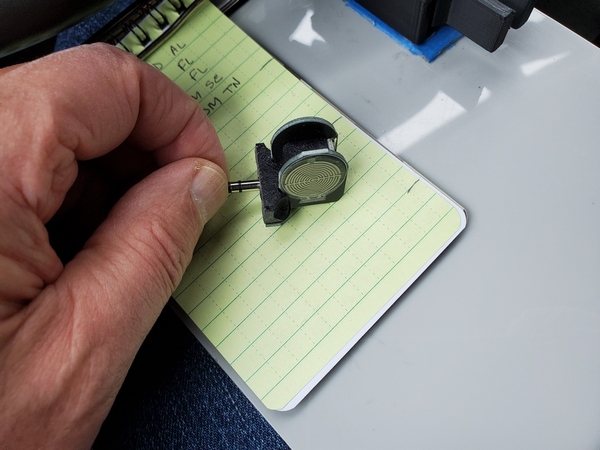
I mentioned in a previous post (or two) that I somehow damaged the paddles that came with my Elecraft KH1. In searching for an alternative, I came across the KH1 Pressure Paddles from K6ARK. The kits were selling for a mere $22 on Amazon, so I fired off an order.
K6ARK Pressure Paddles
I’m not as good at building kits with small parts as I used to be. My close-up vision hasn’t gotten any better with age. However, with the aid of my lighted magnifying glass, I assembled the kit in less than 30 minutes with no major issues. The only issue I ran into was the 3-D printed cover didn’t fit against the KH1 too well and needed a little sanding. Once I took care of that, the paddles worked great. Using pressure-sensitive paddles feels a little different at first, but I quickly adapted.
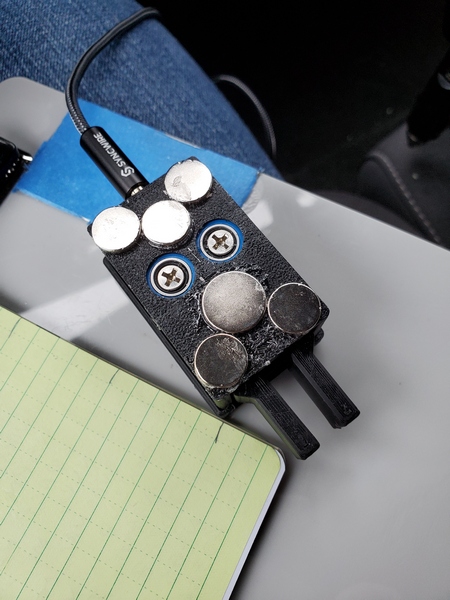
The other thing I did was glue two more magnets onto the bottom of my CWMouse paddles. The four I glued on initially weren’t quite enough to keep the paddles from moving when attached to my clipboard. Two additional magnets seemed to do the trick.
The magnets on my CWMouse paddles. I recently added the two towards the middle.
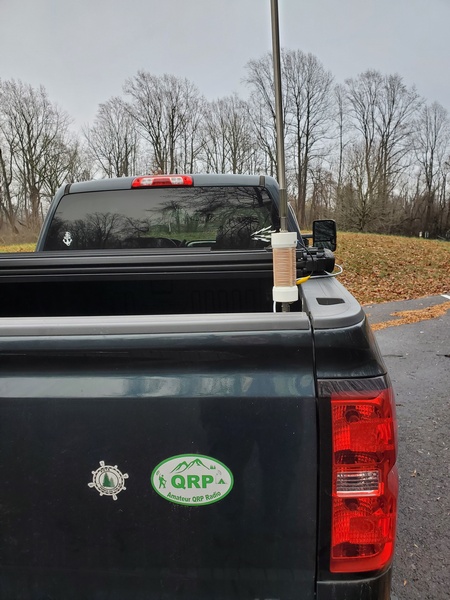
When I rolled into my usual spot in the park, the place was deserted. I wasn’t too surprised, since it was a weekday and drizzling to boot. My original plan was to operate the KH1 handheld to give the K6ARK paddles a good workout. Given the lousy weather, I abandoned that plan and set up in the truck. I used my trusty 12-foot loaded vertical on the back of the truck.
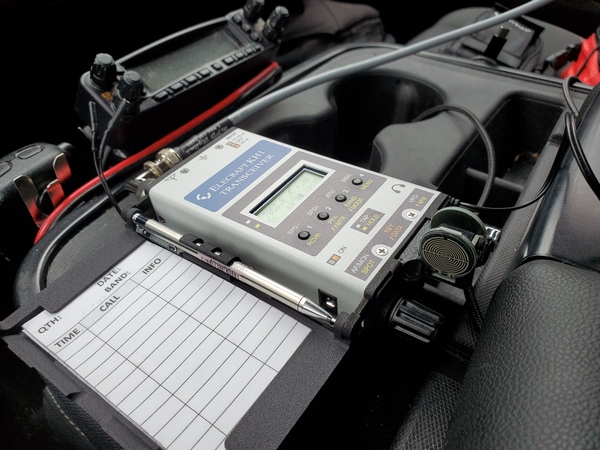
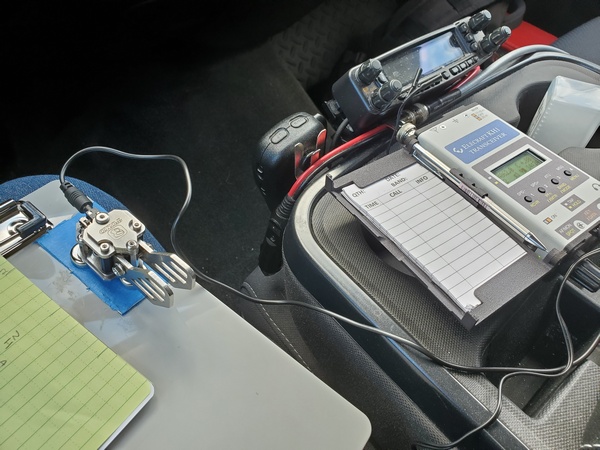
KH1with the K6ARK Pressure Paddles attached
I started off trying to use the K6ARK paddles with the KH1 on the center console. After two contacts, I decided that wasn’t the most comfortable way to operate. The pressure paddles worked fine, though. I switched over to the CWMouse paddles attached to my clipboard, and the magnets held nicely. It helps that the CWMouse paddles have a light touch, so I’m not slamming them side to side.
On the air, the bands were as mediocre as the weather this morning. According to my band conditions app, we were experiencing an unsettled geomagnetic field. Starting out on 40M, it took longer than usual to make my first ten contacts. After I had 15 in the log, I switched to 20M and picked up a few more. I spent the rest of my time on 17M and 15M. As predicted, the band conditions up there were fair at best. I worked two domestic stations on 17M, and stations in Germany and Texas on 15M.
My loaded whip at Ridley Creek State Park (US-1414, KFF-1414)
I was getting ready to call it quits, but I wanted to adjust the KH1’s real-time clock before shutting down. It had gained a minute or two over the past couple of months, so it just needed a tweak. As I navigated through the menus to set the clock, I heard a very loud IK1LBL calling me. I quickly exited out of the menu and completed the contact. After that, I set the KH1’s clock and packed everything up.
As activations go, this one was nothing special. However, my new KH1 paddles and my modified CWMouse paddles were a rousing success.
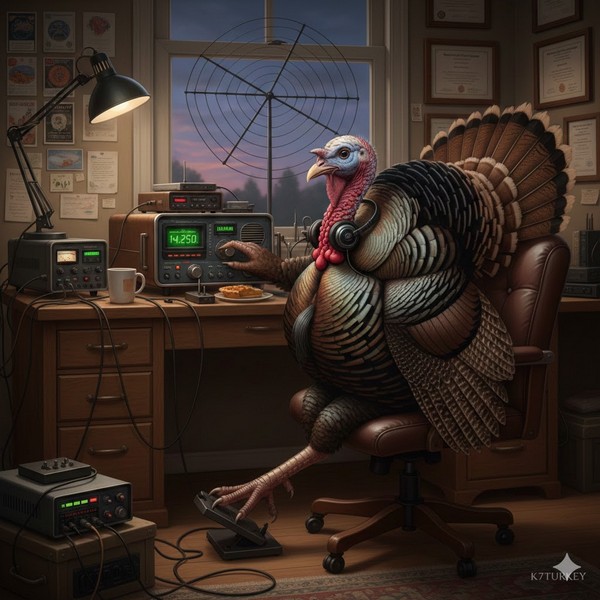
And finally, I’ll leave you to ponder this curious AI-generated image of a turkey operating a radio. It appears the turkey might be keying with his left foot (QLF?).
I have always spent a fair amount of my HF operating time on the 40M and 30M bands, with a little time on 20M. Lately, though, I’ve been making a point of spending more operating time on 20M through 15M (or at least as high as the rig I’m using will go). To that end, I had a little fun on 15M with my KH1 this morning.
I stopped by Norristown Farm State Park (US-4363, KFF-4363) this morning. I broke out my Elecraft KH1, which hadn’t seen much action over the past few weeks. We were under a wind advisory, so I operated from the truck and used my truck-mounted 12-foot loaded whip.
As I was setting up the KH1, I ran into an issue while removing the KH1 paddles from the radio. During an activation about a month ago, the spring between the paddles popped off. I found the spring and re-installed it when I got home. The paddles must have gotten damaged somehow, because the left paddle wasn’t moving as smoothly as it used to. Today, the spring came off the paddles again, but this time it was nowhere to be found. I wasn’t planning to use them today, anyway. For those times when I use the KH1 handheld, I have the N6ARA Tiny Paddles with a KH1 adapter. I also have a K6ARK Pressure Paddle kit on order. But I digress…
Anyway, I started on 40M, because here on the east coast it’s a quick way to make the first 10 contacts for the activation. That’s especially the case early in the morning. There was a lot of atmospheric noise on 40M this morning, but it didn’t take long to log 17 contacts. The 20M band was good for another nine contacts, and 17M produced three contacts.
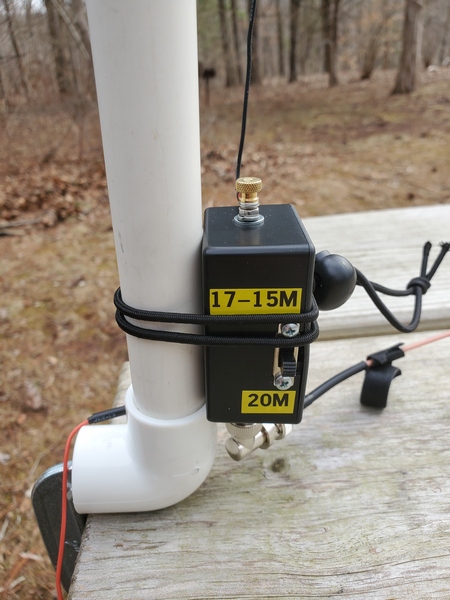
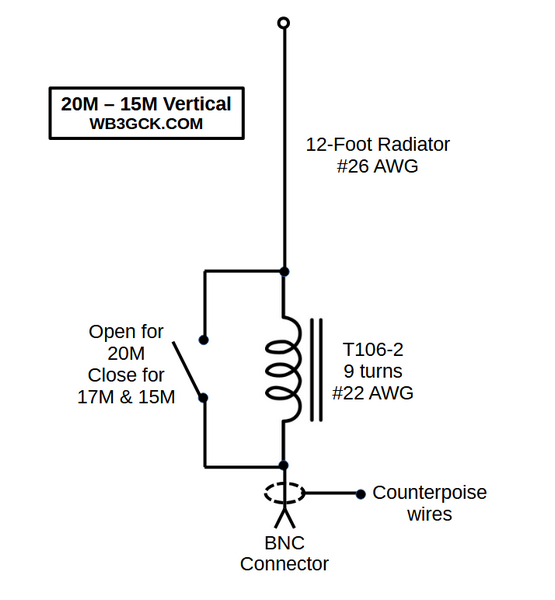
Being inherently lazy, I left the loading coil tap set for 17M and tried to see if the KH1 would tune it up on 15M. The KH1 easily found a 1.2:1 match. That wasn’t surprising, since the 12 foot whip is only about 11 inches longer than a quarter-wave on 15M, and I only use one turn of the loading coil at the 17M setting.
After making a couple of 15M contacts with the antenna adjusted for 17M, I bypassed the coil completely. Again, the KH1 loaded it right up. I could have shortened the whip by 11 inches to make it a resonant quarter wave on 15M, but I didn’t have my antenna analyzer with me. Honestly, I don’t think it would have made a significant improvement in performance, anyway. Overall, I made 13 contacts on 15M, which included a handful of DX stations.
After 90 minutes on the air, I had made 42 contacts, including nine park-to-park contacts. The DX contacts today included:
20M: Dominican Republic
17M: Ukraine
15M: Czech Republic, Latvia, Spain, Italy (2), England
I was happy with how the 12-foot whip and KH1 performed on 15M. I’ll definitely be spending more time on 15M (and above) in the future.
I also have an idea for an antenna I might try to build. More on that later, if it works.
For several years my homebrew 19-foot vertical was my go-to portable antenna. Over the past two years, I’ve been using a variety of other antennas, relegating my trusty vertical to backup status under the backseat of my truck. I dusted it off recently to see how well the Elecraft KH1 would work with it.
I designed the antenna to be resonant on the 40 and 30 meter bands. On the 20M band and higher, it functions as a random wire, so a tuner is required. I was sure the KH1 would easily find a match on 40M and 30M, but I was curious to see how well it would fare on 20M through 15M.
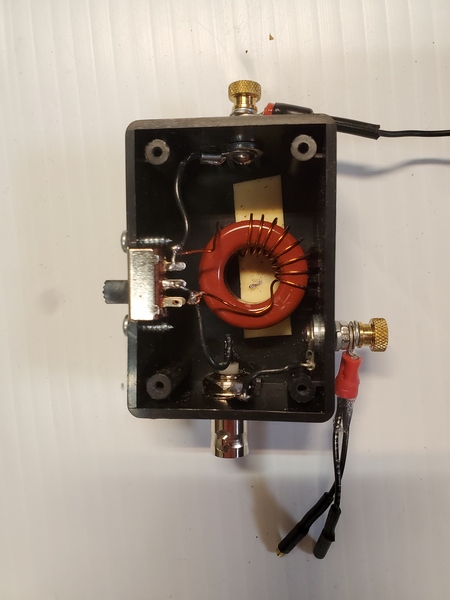
The matching unit for my 19-foot vertical. The red jumper is used for changing bands.
To test this out, I drove to Ridley Creek State Park (US-1414, KFF-1414). I had been to an ARES-RACES get-together that morning, so I swung into the park for a quick activation on my way home.
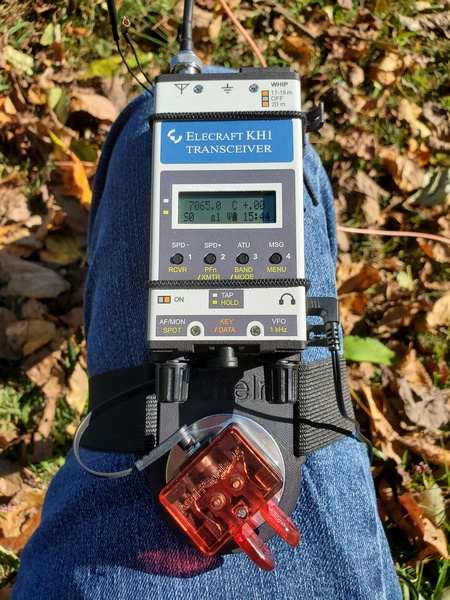
I set up at the edge of a field away from other park visitors. Since it was a weekday, the park wasn’t very busy, anyway. I supported the antenna on a cheap telescopic pole using my homebrew ground mount and spread out four 12.5-foot radials. From there, I ran 20-feet of RG-213 over to my camping chair, where I used the KH1 on a Tufteln KH1 knee board.
KH1 and Ashi Paddle 45 on a Tufteln KH1 kneeboard
Before I got started, I tried the KH1’s internal tuner from 40M through 15M. It easily found a decent match on each of the five bands. The SWR on 15M was 2:1, which is certainly usable for the KH1.
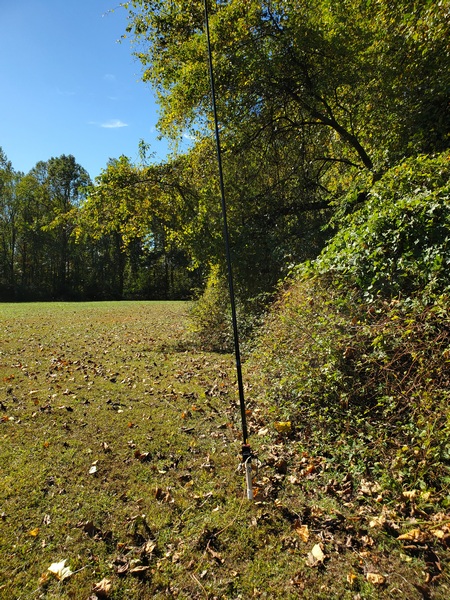
The 19-foot vertical on a slightly-leaning pole
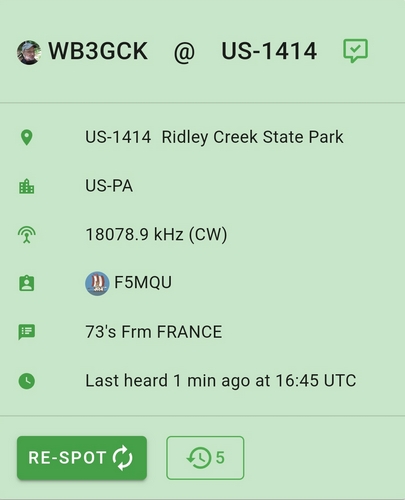
Despite some unsettled geomagnetic conditions, I made contacts on each band except 15M. (I didn’t hear any activity there this morning.) The antenna really worked well on 17M, where I had back-to-back contacts with F4ILH and F5MQU. Even with the geomagnetic wackiness afoot, I managed to log 16 QSOs. Five of those were park-to-park contacts.
Spotted by F5MQU
It was good to get the old vertical out in the field again. I’ve been thinking about re-packaging it to reduce the size of the matching unit and eliminate the jumper used for band changes. That might be a good project for over the winter.
I ordered a KH1 kneeboard from Tufteln, and it arrived in the mail earlier this week. I was out of town for most of the week, so today was my first opportunity to try it out.
I drove down to Ridley Creek State Park (US-1414, KFF-1414) and headed up to one of the picnic areas. This area is one of the highest elevations in the park. My original plan was to set up in an out-of-the-way clearing in the woods, but with rain in the forecast I thought it would be smarter to stay close to my truck. (Spoiler alert: It was.)
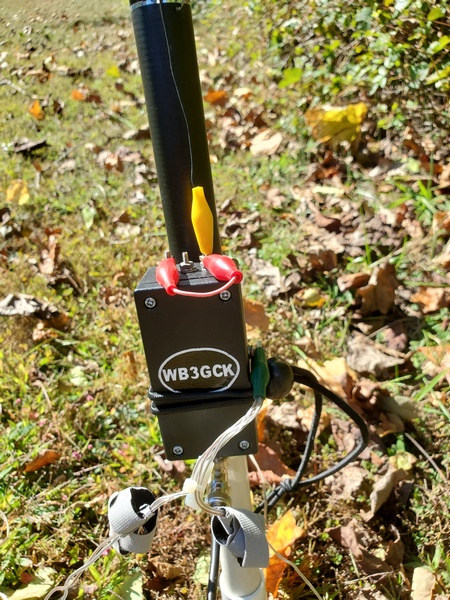
I backed my truck into a parking space away from everyone else and set up a 12-foot whip and my homebrew loading coil on the back of the truck. Next, I ran 18 feet of RG-8x coax over to my camping chair.
My 12-foot loaded whip mounted on my truck
I ordered the kneeboard version with a metal plate for magnetic mount paddles. Mike KE8PTX, designer of the kneeboard, recommends using a short audio cable with right-angle connectors for connecting your paddles to the KH1. I bought a couple but neglected to bring them along this morning. Instead, I used a 3-foot cable. It was a little awkward, but worked just fine.
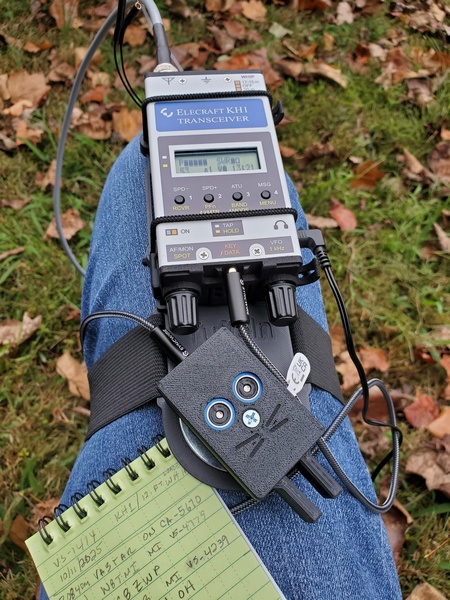
The leg strap provided with the kneeboard was easy to adjust and comfortable to use. I used my CWMouse paddles, and the magnets I glued onto them held on to the kneeboard’s metal plate with no issues. For logging, I used a 3” x 5” weatherproof notebook, which I balanced on my leg by the kneeboard.
The KH1 and CWMouse paddles mounted on the Tufteln KH1 Knee Board
Settled comfortably into my chair, I got started on 40M. After logging a quick eight contacts, the hunters thinned out. I eventually made my required 10 contacts plus a few more before moving to 30M. After logging eight contacts on 30M, I moved to 20M for five more.
After an hour on the air, I felt a few raindrops and figured I had better pack up. That was an excellent decision, as it started raining as soon as I put the KH1 in the truck. I quickly took down my antenna and tossed my chair in the back of the truck.
Although the rain interrupted my activation, I ended up with 27 contacts. Some highlights included:
I got a call from F1BLL on 20M. He was an honest 599 into southeastern Pennsylvania this morning.
I worked fellow Polar Bear QRP member VE3DN on 40M and 30M.
W9DP and W9GTA each hunted me on two bands.
I have to say that I really enjoyed using the kneeboard. In fact, this might be my new favorite way to operate with the KH1.
Lately, I’ve had to squeeze in my ham radio opportunities whenever I can. (That seems to be a common theme for this blog these days.) This past weekend was a perfect example. While spending the weekend with family in central Pennsylvania, I got in a very short activation and still made it back in time for breakfast with the family.
Always the early riser, I was up on Sunday morning before the rest of the family. After grabbing a quick cup of coffee, I threw my backpack in the car and headed out just after sunrise.
I activated the Captain John Smith Chesapeake National Historic Trail (US-4567) from a boat launch in Lancaster County. Equipment-wise, this activation was a carbon copy of my last visit—minus the paddle issues. I used my Elecraft KH1 in my (far) better half’s compact SUV. Once again, I used my Gabil GRA-7350TC vertical and magnetic mount on the roof of the car. The paddles I used this time out were the Ashi Paddle 45 from N6ARA Electronics. (More on those in a future post.)
Ashi Paddle 45 and Elecraft KH1
After parking in my usual spot, I placed the antenna on the roof of the car and roughly adjusted the coil slider for 40M. I got out my antenna analyzer and conected the coax to fine-tune the antenna. However, when I turned on the antenna analyzer, it showed a 1.26:1 SWR—no adjustment needed! I couldn’t do that again if I tried.
Gabil GRA-7350TC on a mag mount
After hunting for a few park-to-park contacts, I found a vacant frequency and started calling CQ. Like on my last visit, the 40M band was so productive I spent my whole activation there. I operated for about 30 minutes, logging 19 contacts—not too bad for about 4.5 watts into an eight-foot vertical on a mag mount, I guess. Once again, I connected with N4JAW (aka Ham on a Bike). Jim was out doing his usual bike-portable activation at US-7956 in Kentucky.
Some morning fog on the Susquehanna River
I packed up in a couple of minutes and was back at the house about 15 minutes later. My time on the air was a little shorter than I would have liked, but at least I had no paddle issues this time.
My (far) better half and I had plans to go watch our grandson’s soccer game yesterday, but I still squeezed in a short, early morning activation. I headed over to nearby Valley Forge National Historical Park (US-0761, KFF-0761) and allotted myself an hour of operating time. While I was there, I tried out a few things with my Elecraft KH1.
I set up the KH1 at a picnic table and used the whip antenna and AXE1 extender coil. I supported the antenna with a right-angle adapter from Tufteln. This was the first opportunity I had to use the adapter, so I was anxious to try it out. For my counterpoise, I used a homebrew setup with a 13-ft wire and a 20-foot extension for 40M.
The KH1 with the AXE1 loading coil for 40M/30M and the Tufteln right-angle adapter.
I also gave my CWMouse paddles another go. I glued four small magnets to them the night before, so I wanted to see how they worked with my clipboard. KE8PTX had a Facebook post recently in which he mentioned using painter’s tape on the metal surface of his knee board to give his paddles a little extra traction. As luck would have it, I was doing some painting this week and had some tape handy. I put some on the steel strips on my clipboard right before I left the house.
I glued some magnets to my CWMouse paddles. The blue painter’s tape helps the magnets get a better grip on the steel strips glued to the clipboard. You can also see the notation I made in my log for my 10th contact.
With everything set up, I tuned up the KH1 and got started. My results on 40M really surprised me. Although my signal reports were on the low side, I was getting some decent spots on the Reverse Beacon Network. It took only 13 minutes to log my first 10 contacts. I continued making contacts for 30 minutes, while brushing ants off of my log. (I think there was an anthill under the picnic table. Doh!)
I spent the rest of my hour-long activation on 30M and 20M. There was less activity there, but I picked up a few more contacts on each band.
When my hour was up, I packed up and gave the ants exclusive use of the picnic table. I finished up with 25 contacts in my log; I’ve done much worse with much better antennas. The KH1 did an amazing job with just the whip antenna, and my modified CWMouse paddles worked great attached to my clipboard.
As you can probably tell, I’m having fun with my new rig.
I did a POTA/WWFF activation this morning and used it as an opportunity to try out a new set of paddles. During a recent activation, I encountered a recurring problem with the cheap QU-21C paddles I keep in my backpack as a backup. As a result, the finicky paddles have lost out on their role as my backup.
Always a sucker for unusual paddles, I came across an interesting offering I couldn’t resist. I fired off an order for the CWMouse paddles and had them in my hot little hands two days later. Mike KN6FQM designed the CWMouse paddles, which are currently selling on Amazon for $39.00 (US).
The CWMouse paddles are made from 3D-printed parts and include sealed ball bearing races, two sealed microswitches, and an ⅛-inch stereo jack. One thing that drew me to these paddles was the small size: 74mm/2.9in L x 36mm/1.4in W x 28mm/1.1in H. They weigh a mere 1.5oz/45g, making them ideal for portable use. See the CWMouse website for the complete specifications.
The CWMouse paddles. For size reference, they are on a 3″x5″ notepad.
My destination this morning was Marsh Creek State Park (US-1380, KFF-1380). I usually operate near one of the boat launches, which can sometimes get crowded during the summer. Given that it was a weekday in September, there was plenty of room in the parking lot.
My rig today was my Elecraft KH1 into a 12-foot whip and homebrew loading coil. Starting out on 40M, I found lots of strong signals. I made a couple of quick park-to-park contacts before settling on a frequency and calling CQ. I quickly achieved the required 10 contacts and then some.
My KH1 fit nicely on the center console of my truck.
After 20 minutes, the activity on 40M tapered off, so I moved up to 20M. The action wasn’t as busy on 20M, but I made 11 contacts. One of those was with a station in California—I like when that happens. The 17M band produced three more before I called it quits. After a bit more than an hour, I had logged 32 contacts with six park-to-park contacts.
The CWMouse paddles performed flawlessly. Because of the microswitches, there are no adjustments for throw or tension. However, they felt great right out of the box. They have a nice, light touch, which is what I prefer.
One potential issue is the plastic used for the 3D printing. The website is very clear that the paddles should not be stored at temperatures above 100F. This could easily happen in a closed vehicle, so I’ll have to keep that in mind.
I used the “two-handed” technique with the paddles this morning, which is not my preferred way of operating. I’ll probably glue on some magnets, so I can attach the paddles to my clipboard.
Overall, however, I really like these paddles. It was a pleasure operating with them this morning.
My (far) better half and I spent the past weekend with family out in central Pennsylvania. During the weekend, I squeezed in a quick, early morning POTA activation. The great band conditions made for a fun activation, but paddle problems made it challenging at one point.
On Saturday morning, I was up before everyone else. After downing a cup of coffee, I took a short drive to a boat launch on the Susquehanna River to activate the Captain John Smith Chesapeake National Historic Trail (US-4567).
We drove out in my (far) better half’s car, so I used a simple antenna setup that produced decent results in the past. I used my Gabil GRA-7350TC on a small magnetic mount. Like the last time I used it on my (far) better half’s car, I easily adjusted it for a 1.3:1 SWR on 40M. I fed the coax through the passenger side window.
Gabil GRA-7350TC antenna on a magnetic mount
Inside the car, I set my Elecraft KH1 on the center console. I used my cheap QU-21C paddles attached to a clipboard with a homebrew magnetic mount I made for them.
The 40M band was hot with no trace of the QRM I experienced the last time I was there. It only took 14 minutes to log my first 10 contacts, the contacts came in steadily for the next 45 minutes.
I was cruising right along for about 30 minutes until my cheap paddles decided to start dropping “dits” here and there. Based on my crazy sending, I’m sure some folks thought I was experiencing some sort of medical emergency.
I frantically searched for my N6ARA Tiny Paddle that I always carry as a backup. Of course, they were nowhere to be found. I ended up using the stock KH1 paddles attached to the radio, with the KH1 on the center armrest. This setup was an ergonomic nightmare, with my elbow in the backseat area. Despite the awkward position I was in, I was able to finish up my activation.
My setup after my paddle problems started. On hindsight, I could have arranged things better to make my operating position a little less awkward.
After an hour, I had 39 contacts in my log. I was so occupied on 40M, I never got around to trying the higher bands. My log included 7 park-to-park contacts. One of those was with N4JAW (aka Ham on a Bike). It’s always fun working Jim down in Kentucky.
I also heard from my friend, Greg WA3GM. It had been a while since our last QSO, so it was great to hear him again.
Susquehanna River
The Gabil antenna and mag mount setup once again proved to be a great antenna when using my (far) better half’s car. With about 4.5 watts out on 40M, I worked stations up and down eastern U.S. and Canada and out to several mid-west states.
The QU-21C paddles, however, are a different story. This is the second time I have had issues with them. A squirt or two of contact cleaner will usually fix the problem—for a while, anyway. As they say: You buy cheap, you get cheap.
And, of course, I found my N6ARA paddles as I was packing up. Doh!