I normally have my old YouKits HB-1B nearby as a backup radio. In that role, it spends a fair amount of time tucked away under the backseat of my truck. I hadn’t used it in a few months, so I fired it up for a POTA/WWFF activation at Marsh Creek State Park (US-1380, KFF-1380).
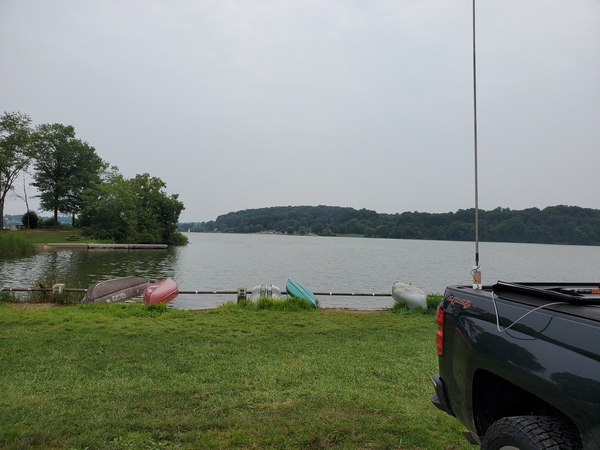
I rolled into one of my favorite spots on the western shore of Marsh Creek Lake. Being a weekday, the boat launch parking lot wasn’t nearly as crowded as it gets on weekends during the summer months. It was very hazy this morning from the smoke from Canadian wildfires.
Hazy morning at Marsh Creek Lake
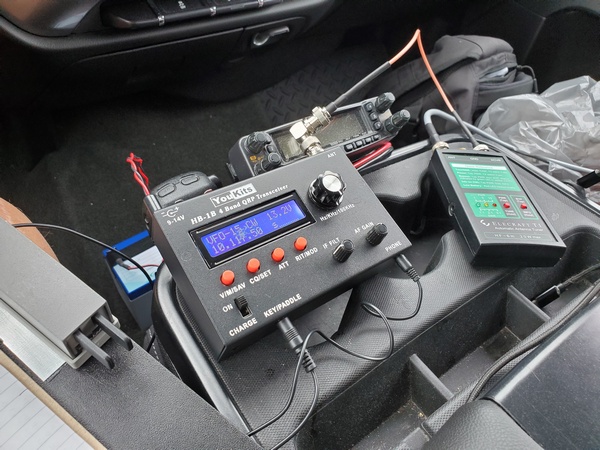
Besides the HB-1B, I used my Elecraft T1 tuner, a 17-foot whip, and my homebrew loading coil. I started out on 40M, and that band did not disappoint. It only took about 10 minutes to make my first 10 contacts. I stayed on 40M for about 30 minutes until the activity dwindled.
My trusty HB-1B getting some air time
I set the loading coil tap for 20M, but things were much slower there. I logged just two contacts on 20M, but one of them was F1BLL in France. After that, I switched to 30M and picked up three final contacts.
After a little more than an hour, I had logged 28 contacts. Among those contacts, I had three (known) park-to-parks and one DX contact.
The HB-1B really doesn’t like my cell phone. To prevent getting noise in the receiver, I had to keep my phone several feet away. Despite its quirks, the HB-1B still got the job done.
Whenever I go operate portable, I usually take my old YouKits HB-1B transceiver along as a backup. One thing I learned from back in my working days, is you need to test your backup equipment periodically to make sure it will actually work when you need it. It had been quite a while since I last used the HB-1B, so I put it to use today.
My destination today was Ridley Creek State Park (US-1414, KFF-1414). I rolled into one of my favorite spots and set up my homebrew loading coil paired with a 17-foot telescopic whip. This combination covers the 40M, 30M, and 20M bands, perfect for the HB-1B. Along with the HB-1B, I used my Elecraft T1 tuner and my old NorCal keyer.
My YouKits HB-1B in use at Ridley Creek State Park (US-1414, KFF-1414)
The A Index was 32 when I started out on 40M. Despite the active geomagnetic field, my four-watt HB-1B still managed 10 contacts in about 16 minutes. The 30M band was a little better, but I made most of my contacts on 20M. The HB-1B only puts out a little over 3 watts on 20M, so I was pleased with that.
The (far) better half and I are puppy sitting one of our grand-dogs this weekend, and I received a text message that he was at the house waiting for me. He knows I’m the designated dog walker at our house, so I packed up to go spend some quality time with a furry buddy.
After operating for an hour, I logged 34 contacts. I didn’t have any DX contacts today, but four of my contacts were park-to-park.
I bought the HB-1B from Ten-Tec almost twelve years ago, and it has seen a lot of use in the field. Although it doesn’t see as much action as it used to, it proved once again it’s a capable little rig.
Our family had to postpone our Thanksgiving get-together until the weekend. So that gave my (far) better half and me a quiet day to ourselves. What better way to celebrate a holiday than a POTA activation?
My destination today was Marsh Creek State Park (K-1380, KFF-1380), one of my favorite local parks. As I was walking out the door, my (far) better half told me, “You shouldn’t expect too many contacts because of the holiday.” Ha! After being married to a ham for 46 years, you would think she would know better. A holiday is just an opportunity to get on the radio instead of working!
My rig today was my old YouKits HB-1B. After I bought it through Ten Tec 10 years ago, it was my go-to portable rig. In recent years, I’ve been taking it along on trips as a backup rig, but it hasn’t seen much air time.
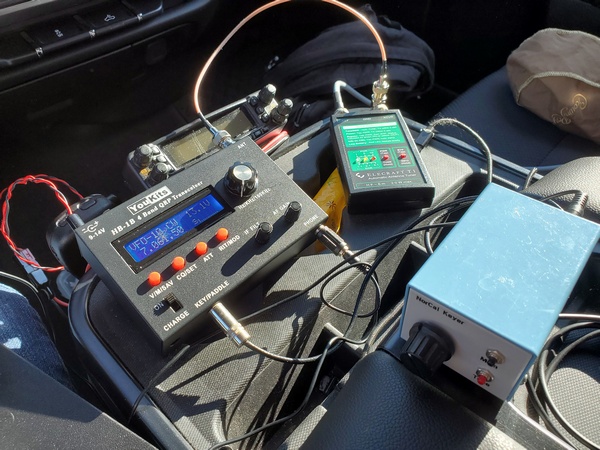
The HB-1B has a canned “CQ” CW message, but no programmable memories. I brought my old NorCal keyer along to take care of that. Since the HB-1B also lacks an internal tuner, I used my Elecraft T1. Actually, this was a portable configuration I have used many times years back. Antenna-wise, I went with my 12-foot whip and homebrew loading coil on the back of my truck.
My old YouKits HB-1B transceiver, along with my Elecraft T1 ATU and NorCal keyer
The HB-1B never had the cleanest sounding sidetone; but using a LiFePO4 battery (around 13V), the sidetone had some loud clicks. Over the years, the display also developed some kind of mark or smudge that is very noticeable at some viewing angles. Neither of these issues were a show-stopper for me.
I started out on 40M and seemed to get out well enough. After the first eight contacts, though, the band seemed to dry up. I moved up to 20M, and things picked up. Although it took 20 minutes to get my first 10 contacts, there was lots of activity on the 20M band. The power output is slightly lower on 20M (approximately four watts), but I still collected 32 contacts there. I picked up a few more on 30M before calling it quits.
My view of the lake in Marsh Creek State Park (K-1380, KFF-1380)
In less than 90 minutes on the air, I ended up with 50 contacts (with one dupe). There were no park-to-park or DX contacts today. (I neglected to post a spot for the WWFF folks.)
Despite its shortcomings, the little HB-1B gave a good accounting of itself. It’s still a worthy backup rig, and I need to put it on the air more often.
Finally, to all those celebrating, have a happy and safe Thanksgiving.
Given my epic fail the other day, I needed a win. I went on the same bike ride this morning, but this time I was more careful while packing my radio gear.
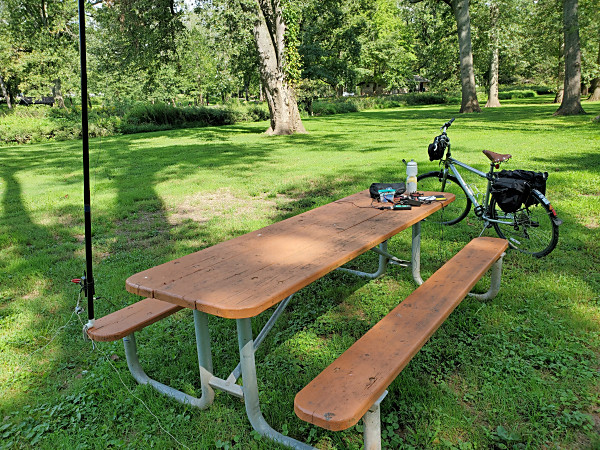
I rode on the Schuylkill River and Perkiomen trails, stopping off again at Lower Perkiomen Valley Park in Montgomery County, Pennsylvania. I set up my 19-ft vertical by mounting it to the picnic table bench. For the rig, I used my little YouKits HB-1B, which puts out somewhere between 4 and 5 watts.
My set-up in Lower Perkiomen Valley Park. I even remembered to bring the antenna this time!
I heard WB8JAY in Ohio calling CQ on 40M. I gave him a call, and we exchanged SKCC numbers. As we were signing off, a couple rode up on their bikes. They spotted my antenna from the trail and came by to say hello. Craig KC3MVF is a relatively new ham and is interested in doing some portable operating. It was nice chatting with Craig and his wife, Erin.
After they rode off, I tuned around for another contact. Despite getting some decent RBN spots, it just wasn’t happening. I needed to get back home anyway, so I loaded up the bike and headed back down the trail. I only had one QSO today, but at least I got on the air this time!
It was a beautiful Labor Day weekend here in southeastern Pennsylvania. I hope you all had a great weekend as well.
When I was in need of a container to transport my QRP rig, my XYL came up with an inexpensive solution. The answer was as close as the nearby grocery store.
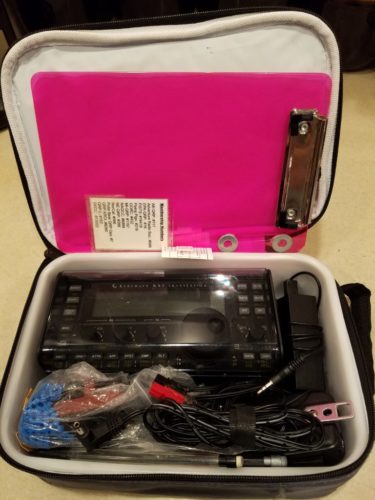
A few years ago, I was using a plastic food container to keep my little YouKits HB-1B and accessories organized and protected in transit. It had enough room for the radio, a Li-Ion battery, keyer, paddles, K1 tuner, earphones, my clipboard/paddle mount, and assorted cables and connectors. Life was good until I cracked the plastic box while out in the field for a QRP Skeeter Hunt contest. I started searching for a replacement.
I mentioned my dilemma to my XYL. She came back into the room carrying a nifty insulated lunch box that she was using for a first-aid kit. I emptied out the first aid stuff and found that it could hold all of my radio stuff. I was particularly happy that my clipboard/paddle mount fit in there perfectly. I made a trip to the grocery store where she found the container and bought one for myself.
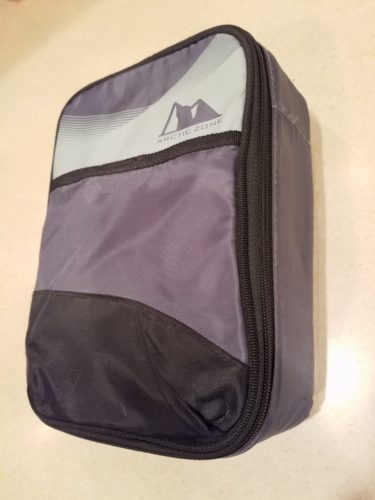
Arctic Zone Upright HardBody® Lunch Box. This one has seen years of use and now holds my KX3 and accessories.
The box my XYL found was the Upright HardBody® Lunch Box made by Arctic Zone. The outer material is padded for insulation and it has a rigid plastic liner that provides some extra protection. It also comes with an adjustable divider, which might be useful in some cases. There’s an outside pocket that I use to hold a notebook and pencil for logging. At the time, I paid less than $10 USD for it.
Last year, when I bought my KX3, I went through the same trial and error with the lunch box. I was able to get the KX3, Palm Mini paddles, MS2 straight key, microphone, earphones, clipboard and assorted cables and adapters in there. It holds everything but my LiFePO4 battery and antenna. (These items can vary from trip to trip, so this isn’t much of an inconvenience for me.) So, off to our local KMart store I went. I bought two of the lunch boxes this time — one for the KX3 and one for a first-aid kit for in my truck.
This is the lunch box with the KX3 and accessories packed up. Out of sheer paranoia, I normally wrap the KX3 in a layer of bubble wrap for extra protection. When placed on top of everything, the clipboard provides another rigid surface for even more protection.
When I load up the KX3 box, the other items keep the radio for shifting around while in transit. Out of sheer paranoia, I put a layer of bubble wrap around the KX3. I’m not really sure that’s necessary though. When I’m ready to head out to the field, I just grab the KX3 box, my battery, and antenna of choice for the day and I’m all set.
There are certainly better, more expensive containers available. For the price, it’s hard to beat these lunch boxes. Maybe I should buy another one to hold my lunch and a couple of cold ones when I go into the field. Hmmm…
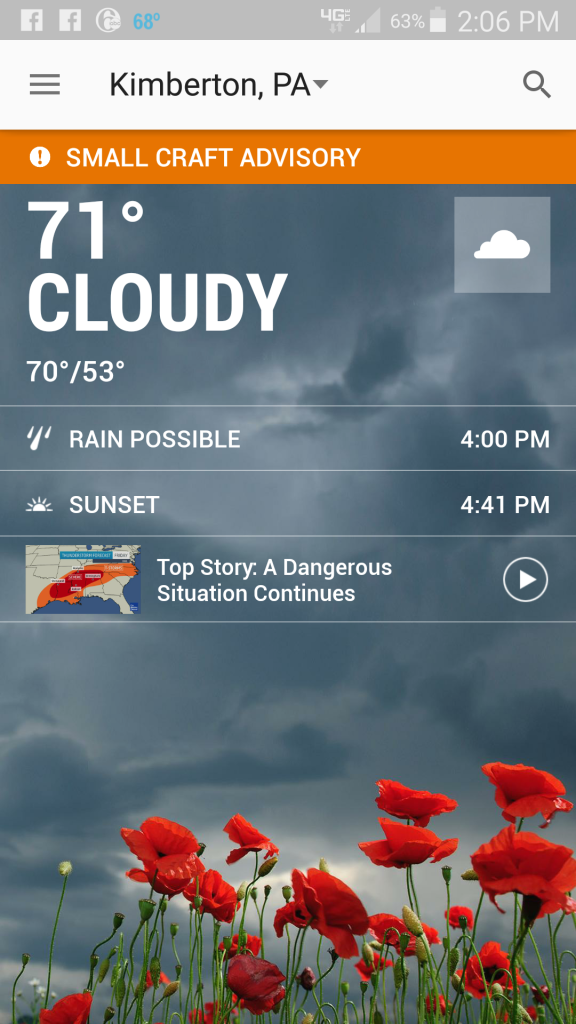
Or was it? You certainly couldn’t tell by the weather. It reached a balmy 71 degrees F today here in southeastern Pennsylvania. It just doesn’t seem right being outside in late December wearing a T-shirt.
Christmas Eve 2015 Weather
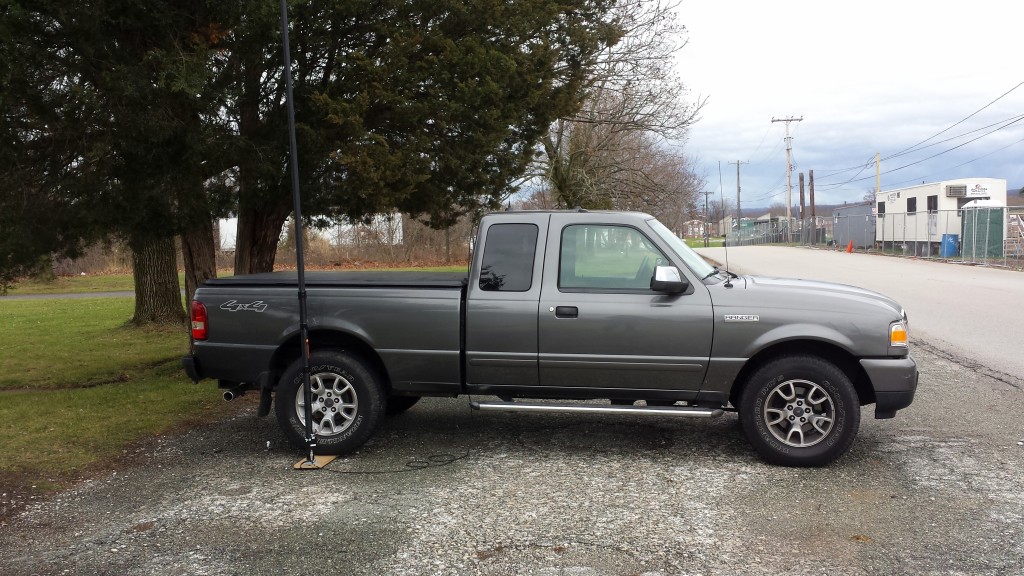
Anyway, the shopping was done and the presents were wrapped, so I decided to sneak out to a local park for a little QRP-portable. I drove a couple of miles down the road to Charlestown Township Park and set up in my truck. The forecasters were predicting possible storms, so I operated in the truck today. I used my roll-on support to put my 31-foot Jackite pole up. I used one 30-foot wire as a vertical and another on the ground for a counterpoise. I fed it through a homebrew 4:1 unun. I used my YouKits HB-1B running 4 watts.
Stationary-mobile set up
I started out on 20 meters but had no luck there. Moving down to 30 meters, I got a call from Walt WB8E near Detroit. Walt had a nice signal in Pennsylvania, despite some fading on the band. Next, I went to 40 meters and had a nice, long chat with Lou WA3MIX in Williamsport, PA. Lou grew up in my area and has some relatives in nearby towns. Finally, I went back to 20 meters and called CQ on 14.060MHz a few times. As I reached over to shut off the radio, I heard Dave KB8XG calling me from Michigan. This was Dave’s second CW contact. After wrapping up with Dave, I packed up and headed home.
Whatever your weather is like, I hope you have a very Merry Christmas!
I can’t believe it– three decent weekends in a row. Thanks to El Niño, we’re headed for record temperatures this weekend. I definitely needed to take advantage of these mild temperatures. So, I drove down to Valley Forge National Historic Park to do some portable operating. I had planned to operate from Mount Misery (aka Valley Forge Mountain) for a while but never got around to it.
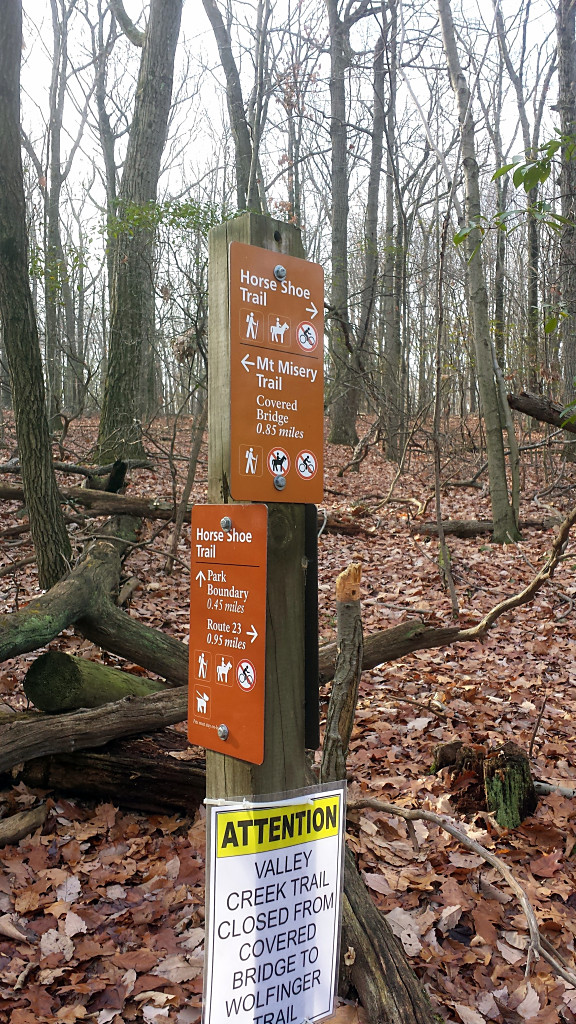
Following some directions that my friend, Carter N3AO, gave me, I hiked up the Mount Misery Trail. Carter operated a QRP field contest there years ago and said it was a nice spot. I hiked in about a mile and branched off onto the Horse-Shoe Trail for another half-mile or so. Most of the other hikers seemed to be staying on the Mount Misery Trail. I figured the Horse-Shoe Trail would be more secluded. I was right. The only other person I saw was a Park Watch volunteer. She came by as I was trying to figure out where to hang my antenna. I’m sure she was wondering why I was standing there staring up into the trees.
The intersection of the Mount Misery and Horseshoe trails.
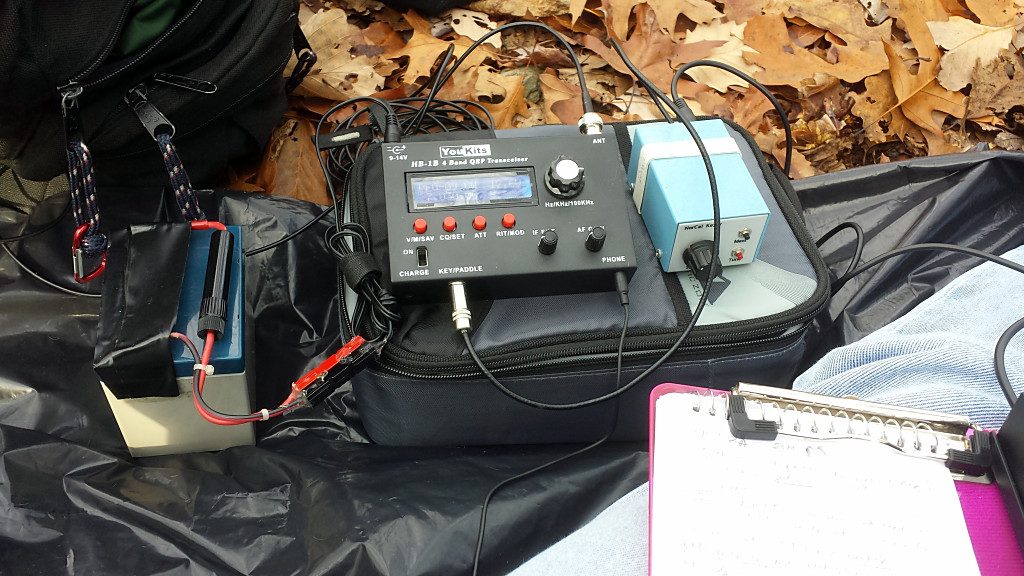
My biggest challenge of the day was getting my antenna up in the trees. I continued to hike looking for something that resembled a clearing. The woods up there are dense and there is a lot of brush just waiting to snag my antenna wire. After about 20 minutes, I managed to get my LNR EFT-10/20/40 EFHW antenna up. I set up my trusty YouKits HB-1B and got on the air.
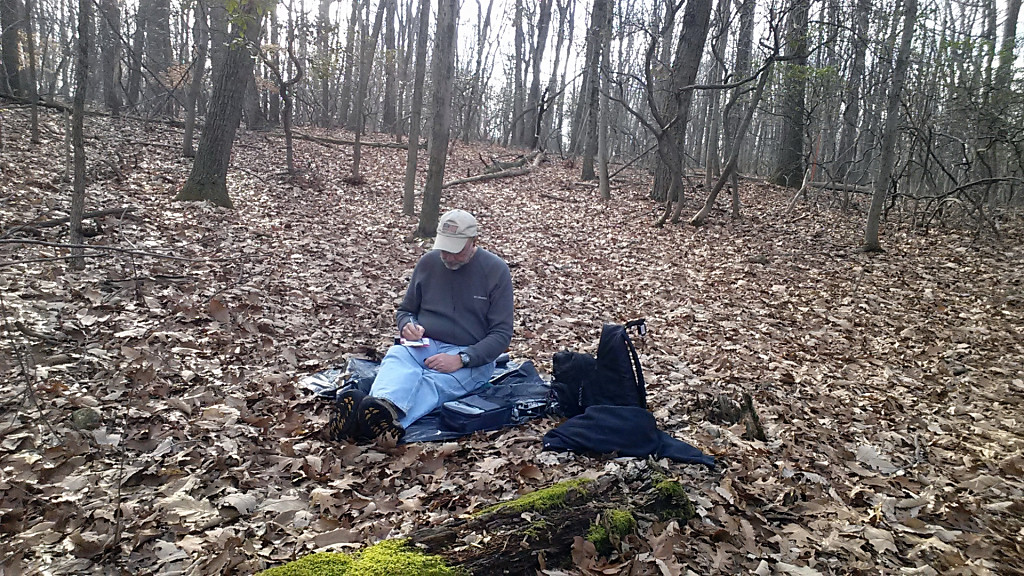
My operating position on Mount Misery.
I called CQ on 20 meters and AF5BA answered from Arkansas. After that, I got a call from fellow QRP Polar Bear, WA8REI. Ken was also QRP portable, operating from his trailer in a deer camp in Michigan. Next up was VE1BA in Nova Scotia. John’s 5-watt signal was booming into Pennsylvania.
I moved down to 40 meters, but I didn’t hear a lot of activity. I tuned around and heard NM1I calling CQ from Massachusetts. I gave him a call and we had a nice chat.
I took a break to stretch my legs and take a few pictures before heading back to 20 meters. I worked the VE9CRM club station in New Brunswick. The operator was VE9BEL. Their club station was putting out a very strong signal.
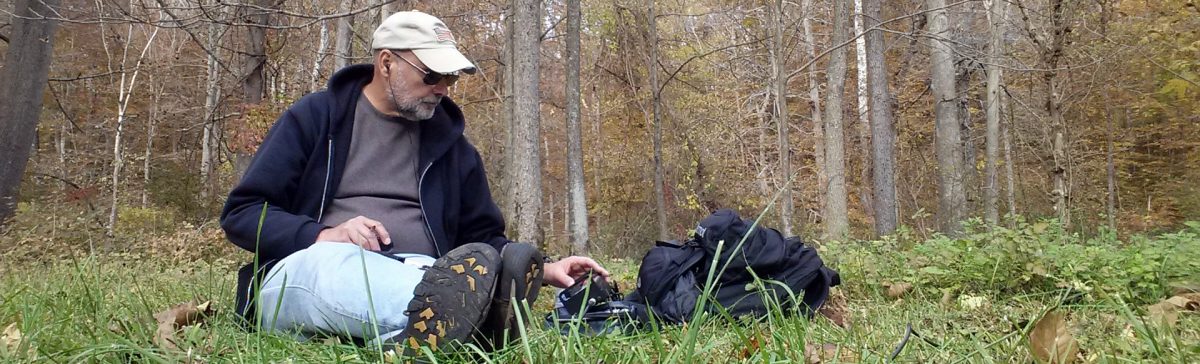
WB3GCK operating on Mount Misery in Valley Forge, PA
I was getting ready to shut down when I heard KG0YR calling me from Missouri. Dave was running 1 watt and had a nice signal. On his heels was K4AKC from Alabama. Tom was running 5 watts. I hated to cut our QSO short, but I needed to pack up and hike back down the hill.
All in all, it was a productive 2 hours.
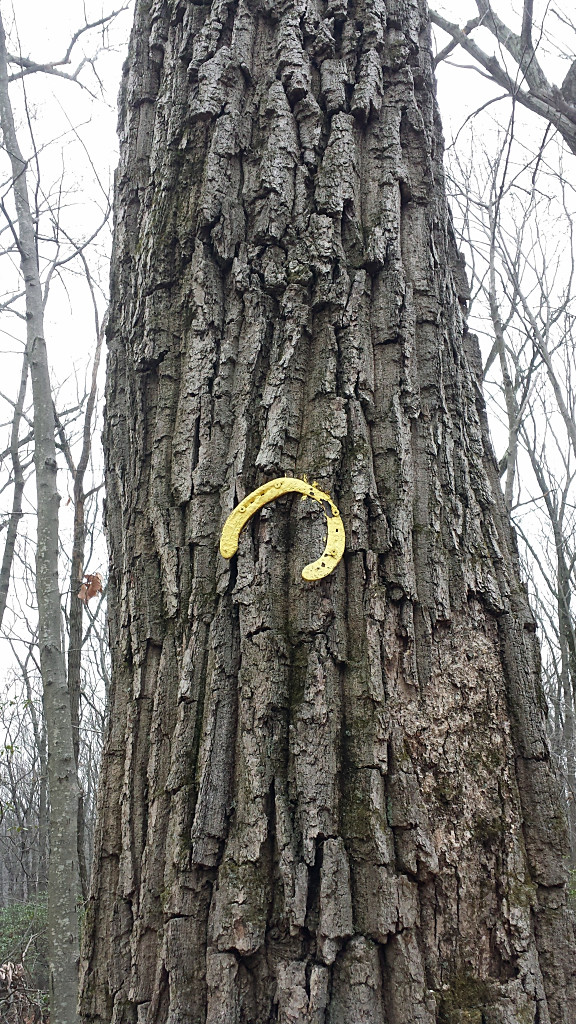
Trail marker on the Horseshoe Trail
I did have one take away from today’s outing. I have been using 20 lb. test monofilament line with a 2-ounce lead sinker to get my antenna up. It works great, but the line becomes completely invisible in the woods. I need to get some high-visibility line and paint the sinker.
Across from Mount Misery is another mount named… Wait for it… Mount Joy! That’s on my list for a future outing.
This is another one of those projects that took longer to write up than to build.
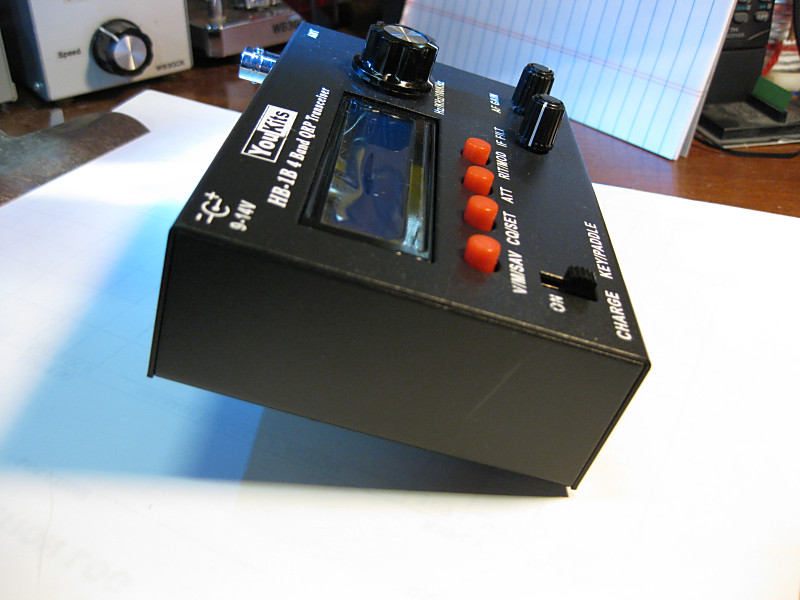
The top facing controls on “trail-friendly” radios like the YouKits HB-1B and others are very convenient when you’re sitting on the ground out in the middle of nowhere. When operating “picnic-table-portable,” however, the display can sometimes be a little hard to read. For those situations, I came up with a little tilt stand using some stuff I had on hand.
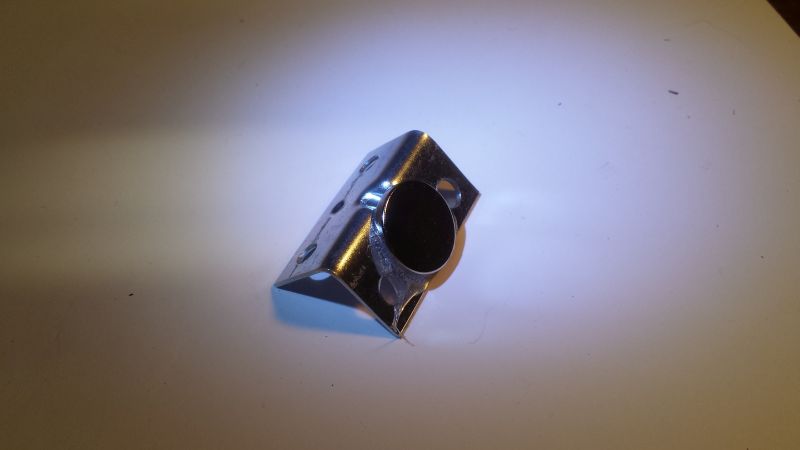
Magnet applied to the corner brace.
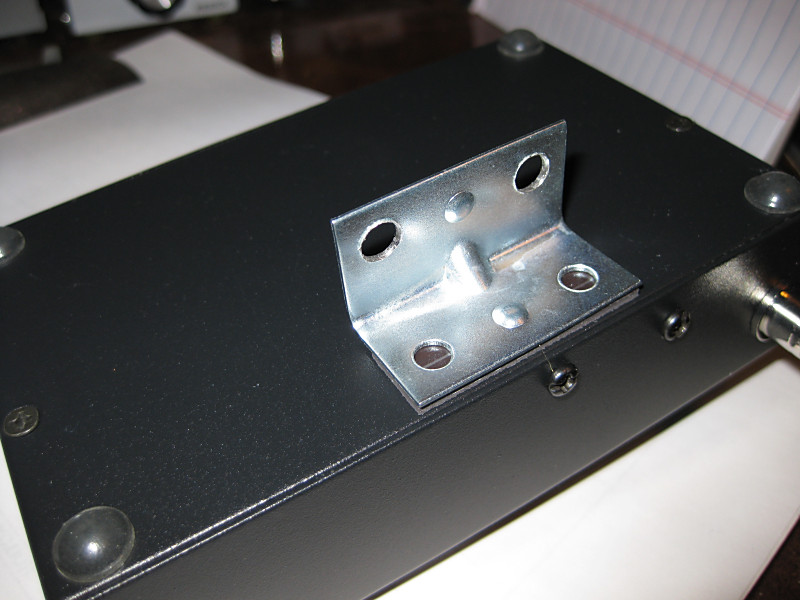
The tilt stand I came up with has a grand total of two parts. First is a steel inside corner brace. You can find these at any hardware store. The one I used is 3/4-inch on each side and 1.5 inches long. You can use whatever size gives you the amount of tilt you’re looking for. The other item is a small but powerful magnet. The one I used is about the size of a nickel. I secured it to the corner brace using some Goop adhesive. To use the tilt stand, just use the magnet to put it on the bottom of the HB-1B, as shown in the pictures.
Tilt stand attached to the radio
This tilt stand works best when you have rubber feet on the bottom of the radio, as I have on mine. In fact, I added those the first time I used the radio, to keep it from sliding around on my desk.
Tilt stand in use
This little gizmo will a permanent part of my HB-1B portable station for those “picnic-table-portable” operations.



 WB3GCK QRP Amateur Radio