Taking My FT-817 Back to the Field

Looking through some files recently, I came across the sales invoice for my old Yaesu FT-817. According to the invoice, my FT-817 was 20 years-old back in May. The ‘817 hasn’t seen much use lately, so I set out to change that.

I first saw the FT-817 at an Atlanticon QRP convention back in 2001. The FT-817 had just come out, and I wanted one the moment I saw it. It wasn’t until two years later that I finally pulled the trigger and bought one. The FT-817 became my main rig for many years, both at home and in the field. After I bought my Elecraft KX3, the FT-817 was only saw infrequent use in the shack.

The early FT-817s were plagued with a tendency to blow the finals. Sadly, mine was no exception. Despite being very careful, my finals went belly-up during a camping trip in 2006. I sent my rig back to Yaesu for repairs, and they installed the newer, more robust finals used in the FT-817ND. It’s been fine ever since—knock on wood. 

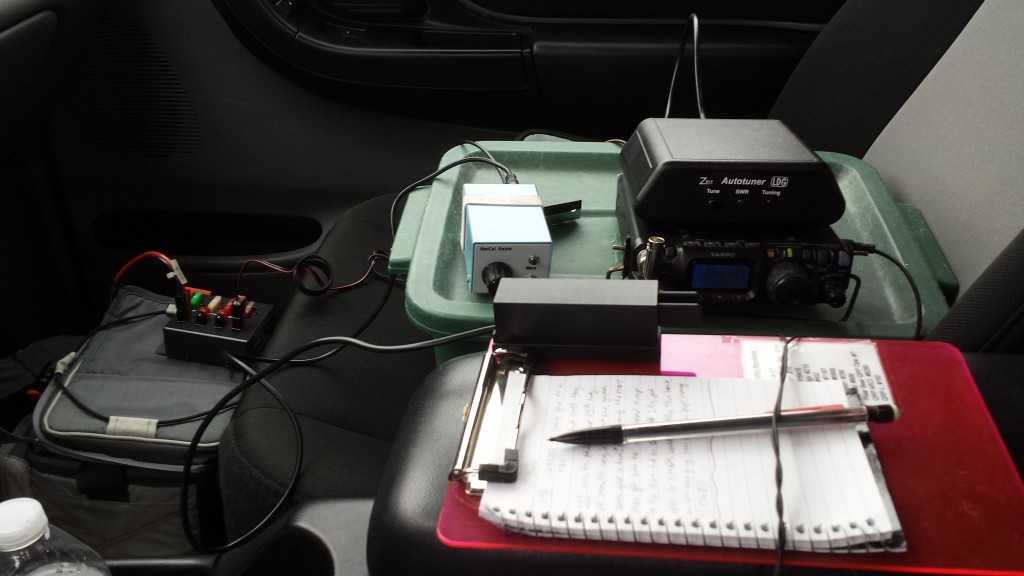
Initially, I used my homebrew Z-match tuner with the FT-817. In 2009, I bought the LDR Z-817 auto tuner, which was designed specifically for the FT-817. The Z-817 certainly made tuning up a lot faster.

A while back, I tried to program some new repeater frequencies using Chirp on my laptop. Windows informed me that the chip in my old FT-817 CAT cable is no longer supported. I bought a new cable on Amazon, and I was soon back in business. 

To prepare for today’s outing, I put fresh batteries in the Z-817. Since the FT-817 doesn’t have a memory keyer in it, I dug out my old NorCal Keyer. I built the NorCal Keyer from a kit not long after I purchased the FT-817, so it is also 20 years old. I gave the keyer a set of fresh batteries and programmed one of the three memories with a “CQ POTA” message.

With my trusty FT-817 in tow, I drove over the Valley Forge National Historical Park (K-0761, KFF-0761). I parked my truck in a spot that had a picnic table about 10 feet behind it. That allowed me to set up my homebrew 19-foot vertical on the truck and run an 18-ft length of RG-8x over to the rig. 
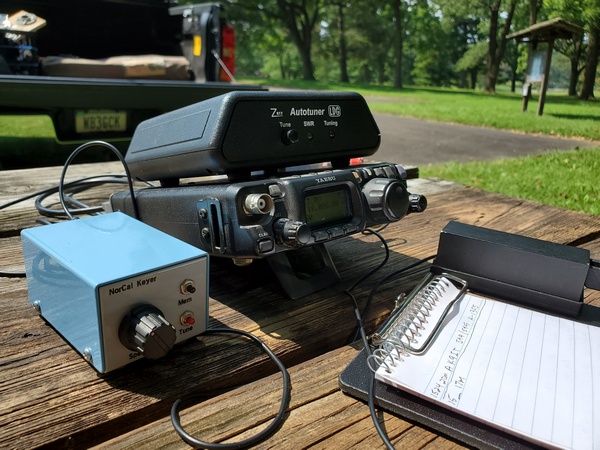
My 20 year-old Yaesu FT-817 back in the field at Valley Forge National Historical Park (K-0761, KFF-0761). The blue box in the foreground is my NorCal Keyer, which I built from a kit 20 years ago.

Before starting my activation, I did some testing. The FT-817 and Z-817 combo played well with the vertical. I was able to easily get a good match from 40M through 10M. The earbuds I used were more sensitive than the headphones I use at home, so the sidetone was louder than I’m accustomed to. Unfortunately, I couldn’t remember how to adjust the sidetone volume, and I neglected to pack my little FT-817 cheat sheet. So, I just pulled the earbuds out a bit and continued on. 
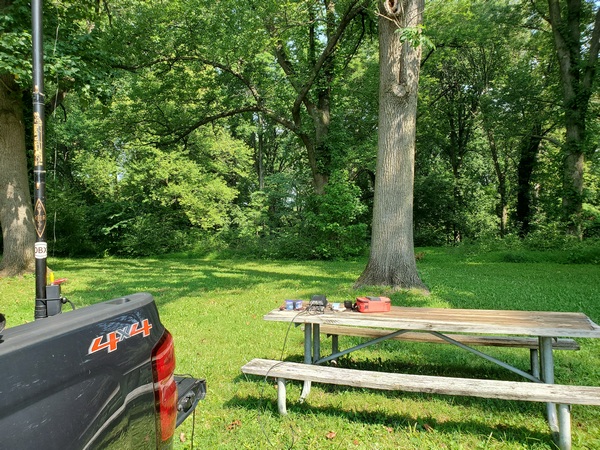
Since the picnic table was only 10 feet from my truck, I was able to use my homebrew 19-foot vertical.

Once I got going, using the FT-817 brought back a lot of memories of portable outings from years ago. Happily, the old rig still works like a charm. 

Despite some fading on the bands, contacts came easily. In a little more than an hour, I made 21 contacts with four park-to-park QSOs. Most of my contacts were on 40M and 20M, with one contact on 30M (a P2P). I also had a contact with W1AW/0, but the operator didn’t give his location. 

It was a lot of fun getting my trusty FT-817 back out in the field again. The FT-817 isn’t my oldest QRP rig; that honor goes to my 30 year-old MFJ-9030 transceiver. I definitely need to dust off more of my old rigs and give them some QRP-portable love. 

72, Craig WB3GCK
FT-817 Power Connection

I’ve seen a lot of discussion on the Internet lately about the FT-817’s less-than-robust DC power connector. Its miniature coaxial power connector has long been recognized as a failure waiting to happen. I thought I’d chime in with my crude, little hack.

Over the years, users have come up with a variety of ways of dealing with the FT-817’s power connector. If you’re brave enough, you can just hard-wire the power cord directly to the FT-817’s main circuit board and eliminate the connector altogether. You can also buy a really slick adapter that gives you an Anderson Powerpole connector on your FT-817.

When I bought my FT-817 almost 15 years ago, I was immediately leary of the little 4.0 x 1.7 mm power connector; there was no way it was going to hold up in the field. I didn’t know of any commercial options at the time, so I raided my junk box to come up with a solution, albeit a crude one.

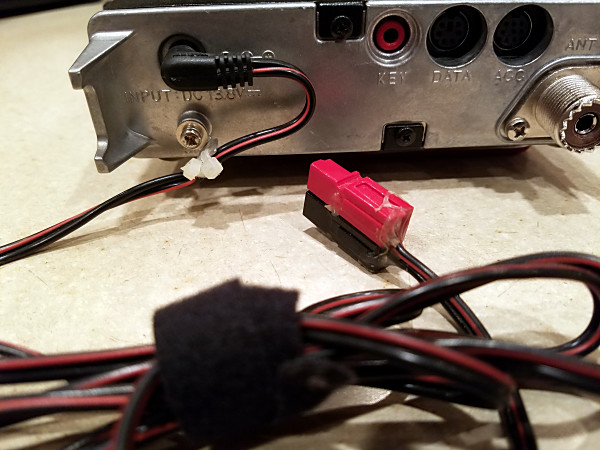
The power cord with an Anderson Powerpole connector attached to my FT-817

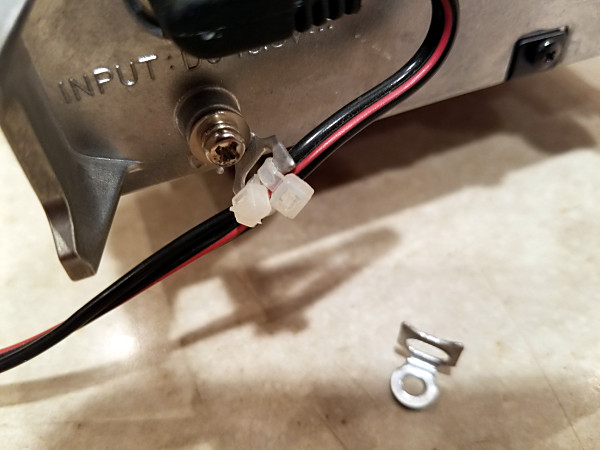
I merely attached a small right angle lug to the FT-817’s ground screw. Then, I used a couple of small nylon cable ties to secure the power cable to the lug and provide some strain relief. I installed Powerpole connectors on the other end of the cable. It’s not pretty but it served the purpose.

Close-up of the right-angle lug attached to the ground stud. Two small nylon tie-wraps secure the power cord to the lug. An unused lug is shown in the bottom of the picture.

Although my FT-817 doesn’t see as much field use as it used to, my stupid-simple hack is still going strong after 15 years. While this approach doesn’t eliminate the FT-817’s little DC connector, it has (so far) survived many years of portable use in the field.

72, Craig WB3GCK

Measuring Audio Frequencies with a Guitar Tuner

Here’s a little hack that serves no real purpose.  I’ll tell you about it anyway.

I recently built the T-Tone Code Practice Oscillator (CPO) kit from Morse Express.   It’s a handy little addition to the shack for adjusting straight keys or testing keyers.  After building it, I just adjusted the audio frequency for a pleasing tone.  Most people would have just left it alone at that point.  I’m not most people.

I started to do some thinking, which is a dangerous practice that can sometimes lead to unexpected consequences.  I wondered how the frequency of CPO compared to the sidetone of my FT-817.  There was no particular point to this mental exercise other than idle curiosity.

Now, I certainly could have keyed both the CPO and the FT-817 and done a comparison by ear.  I could have just adjusted the CPO by ear to match the FT-817.  But what fun would that be?  I was curious about the exact audio frequency of the FT-817’s sidetone, so I opted to do some experimenting.

Having been playing guitar for more than 50 years, I have acquired a gadget or two over the years.  One of those gadgets is a clip-on guitar tuner.  I can clip this clever device on the headstock of my guitar and, by sensing vibrations, it will tell me what note I’m playing and whether the pitch is sharp or flat.  I figured I could use this thing as an audio frequency meter of sorts.

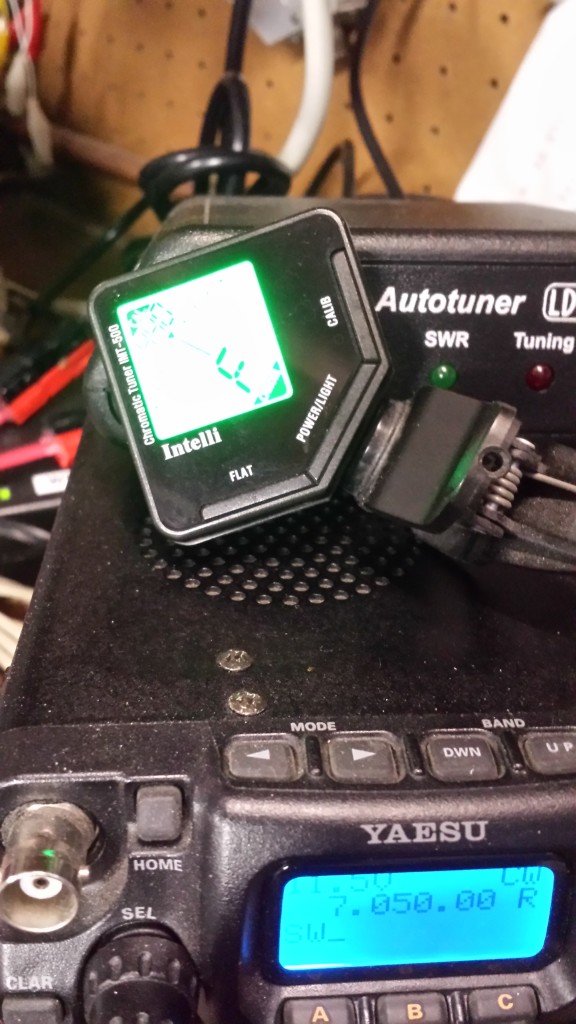
First, I laid the guitar tuner on top of the FT-817’s speaker and keyed up.  That indicated that the pitch of the sidetone was an F note.  Consulting a conversion chart I found on the Internet, that equates to 699Hz.  I seemed to recall that the FT-817’s sidetone was somewhere around 700Hz, so that seemed about right.  I was sure I was in the right octave.

Guitar tuner on top of the FT-817

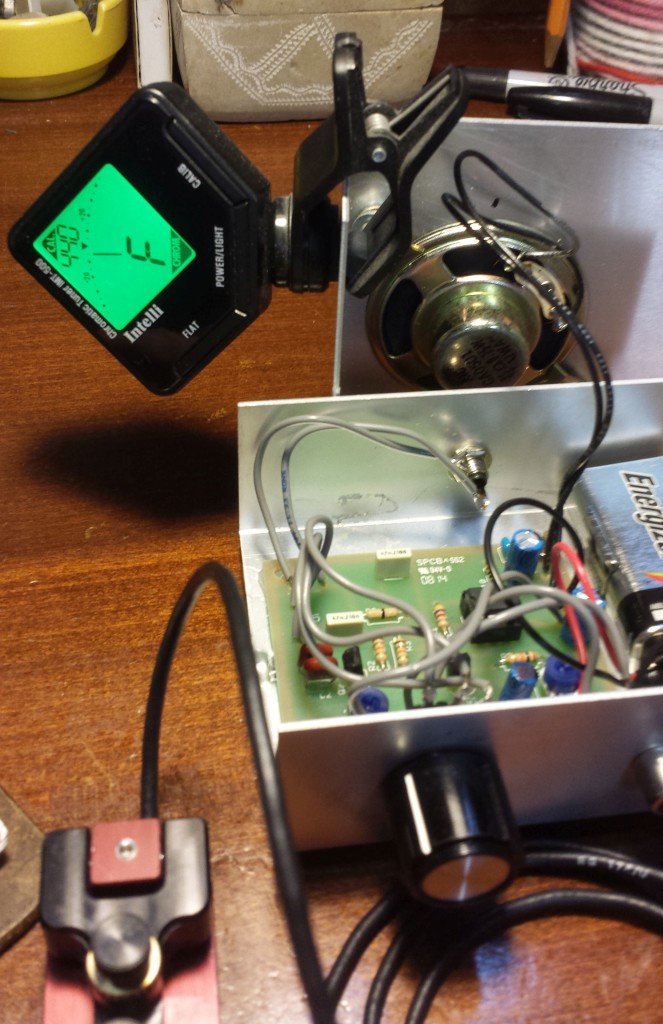
Next I took the lid off of the CPO and clipped the guitar tuner on it.  It initially indicated that the CPO was tuned to F#.  That equates to a frequency of 740Hz.  I tweaked the CPO’s frequency adjustment pot to F, matching the FT-817.  A side-by-side comparison of the CPO and the FT-817 showed that I was successful.

Guitar tuner clamped onto the lid of the code practice oscillator

So, what’s the point of all this?  None really.  Is there a practical use for this?  Probably not.  Does it really matter that my CPO matches the sidetone of my radio?  Nope.  I just had one of those “I wonder what would happen if…” moments.  Now I know.

72, Craig WB3GCK

Antenna Testing at Black Rock Sanctuary

I almost talked myself out of going out today.  My grandkids got together and gave me one heck of a cold for Christmas.  Thanks a lot, kids.  🙂  Despite being a little under the weather, I packed up and headed out.  I’m glad I did.

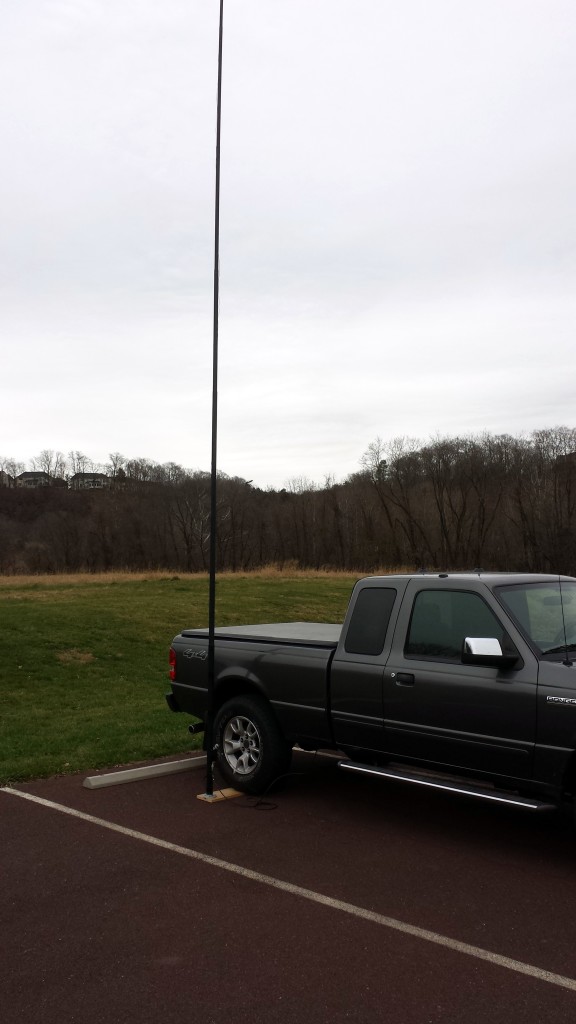
I drove to nearby Black Rock Sanctuary to test the equipment I plan to use for a National Parks on the Air (NPOTA) activation on New Year’s Day.  My antenna today was a 29.5-foot vertical wire with two similar wires on the ground for a counterpoise.  I ran one of the wires around the tires of my truck.  I ran the other wire into a grassy area directly behind the truck.  I figured I was in an area that wouldn’t see any pedestrians.  (More on that faulty assumption later.)  My rig was my old Yaesu FT-817 and Z-817 tuner.

My vertical antenna. 29.5-foot radiator fed through a 4:1 unun with two 29.5-foot radials.
My vertical antenna. 29.5-foot radiator fed through a 4:1 unun with two 29.5-foot radials. It loaded up great 40M through 10M.

I had last used the FT-817 on 14.060.  So, when I powered up the radio, I immediately heard my QRP buddy, Ed WA3WSJ, and gave him a call.  Ed was operating pedestrian mobile on Monocacy Hill about 20 miles away from me.  He had a great signal.  Right after I signed with WA3WSJ, Ed W1GUE gave me a call from New Hampshire.

A view of the "cockpit" of my truck.
A view of the “cockpit” of my truck.

On 15 meters, I called CQ on 21.060 and got a quick response from WA8IWK/8.  Allen was portable in Michigan.  While I was working Allen, a woman walked her dog directly behind my truck.  I noticed her child looking down at the ground.  After they left, I went back to check.  They apparently had gotten caught up in my counterpoise wire.  I re-routed the wire around the truck.  Fortunately, I didn’t notice any difference in the antenna tuning.

I moved down to 17 meters and heard Jim W1PID working HK1MW.  Jim was hiking in New Hampshire with W3ATB.  I moved down a little bit and called CQ.  I was hoping that I would catch Jim’s attention.  It worked!  Conditions were great on 17 meters and Jim said I was very strong into New Hampshire.

On 30 meters, I got a call from a familiar callsign.  Wink WA8KOQ from Tennessee is a regular on 30 meters.  I’ve worked Wink many times over the years and it was good to hear him again.

I went back to 20 meters to see if I could find Tim W3ATB.  No luck today.

Finally, I went back to 17 meters and had a quick QSO with John, YV5IUA in Venezuela.

I’m glad I went out today.  The bands were in good shape and my antenna seems to be working great.  I should be ready for my NPOTA activation next week.

72, Craig WB3GCK