I set off this morning to activate Norristown Farm State Park (US-4363, KFF-4363) with a specific plan in mind. We’re talking about me, of course; so things don’t always go as planned. Today was a good example of that.
If a specific parking space was available, I planned to use a loaded whip on my truck and operate from a nearby park bench. Failing that, I figured I would set up at one of the picnic pavilions with a vertical of some sort. When I rolled in, however, the parking lot was crowded and people were setting up for an event under the pavilions. So, I was off to come up with a Plan C.
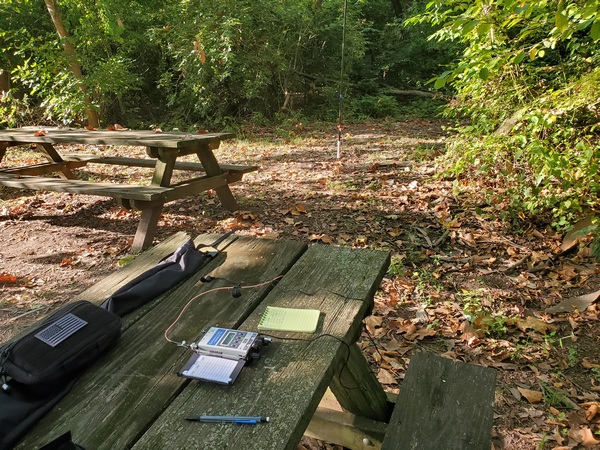
I drove back up the road a bit and pulled into a mostly empty trailhead parking lot. Off to one side, I found a secluded picnic table tucked away in a wooded area. About five minutes later, I was on the air.
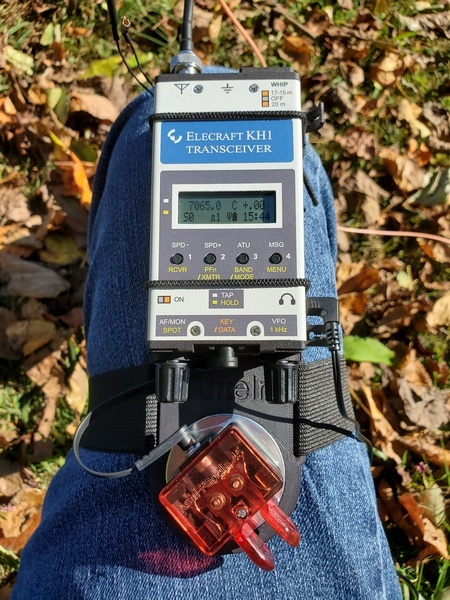
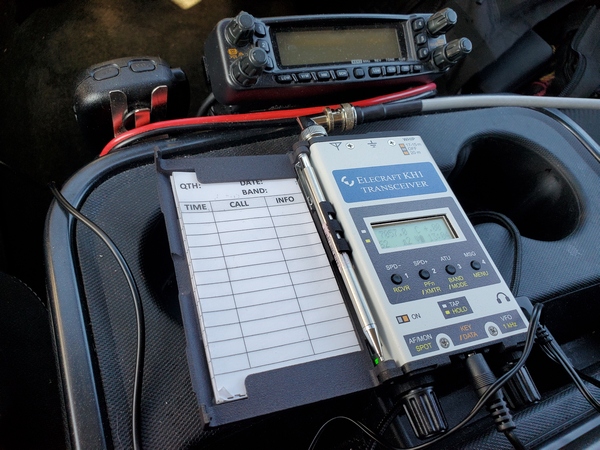
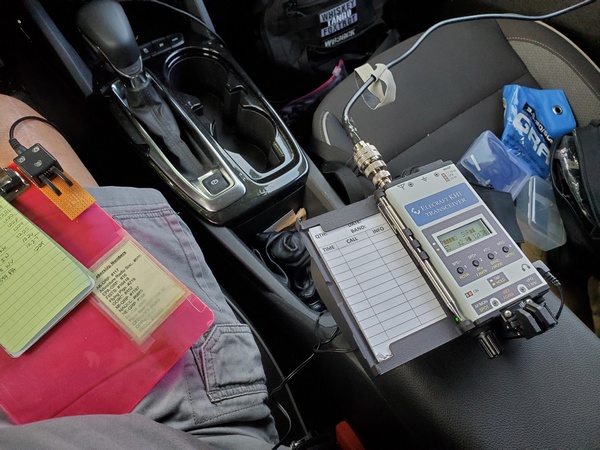
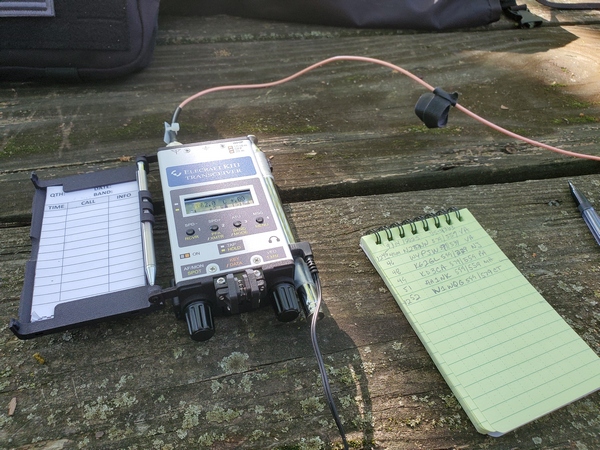
I sometimes think that my 50+ years of ham radio have been an ongoing quest to simplify my operations. My recently acquired KH1 is definitely a giant step in that direction. Everything I need (except for my earbuds) is attached to the radio.
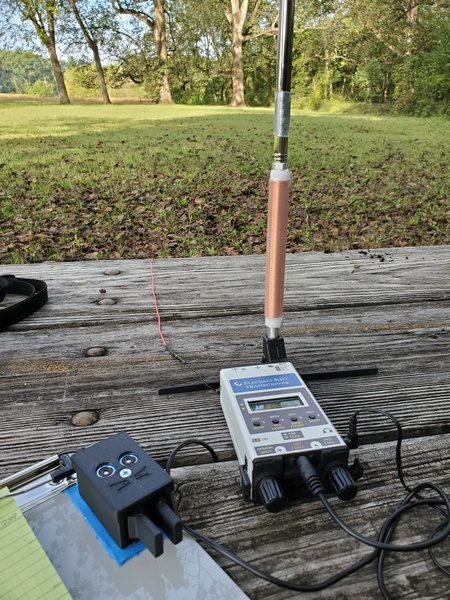
Looking at the propagation forecast, I opted to forego the KH1’s whip antenna and go with something larger. So, I went with the 9:1 end-fed random wire from AD8HK Antenna Systems mounted on a cheap 19-foot telescopic pole. The ground was a little soft, so it took me a few tries with my homebrew ground mount to get the antenna reasonably vertical.
Even with a vertical just under 18 feet, the 40M band was productive today. After eight quick contacts, things slowed down, and I changed bands. The 30M band produced one contact, while 20M was good for a half-dozen more. I went back down to 40M to pick up a few more before calling it quits. After about an hour, I ended up with 18 contacts, five of which were park-to-park.
I have to say I’m really having fun with the KH1. It’s ideal for the short activations I tend to do. The battery life is nothing short of exceptional. This was the second activation since I last charged it, and I could probably do four or five more.
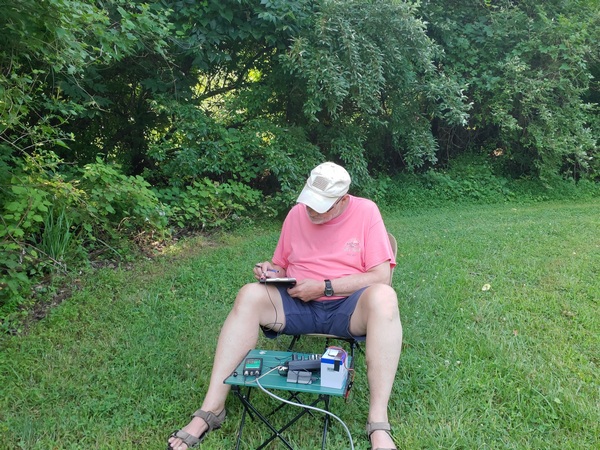
I rolled into one of my favorite spots and set up my table and chair in the grass behind my truck. From previous activations, I knew this spot always has lots of shade. Of course, with the heavily overcast skies this morning, sun exposure wasn’t much of an issue.
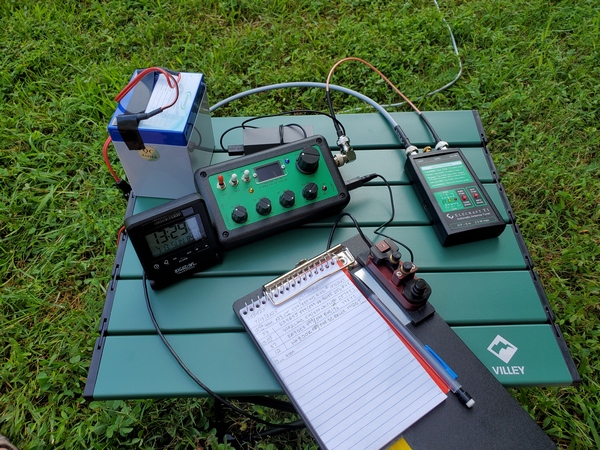
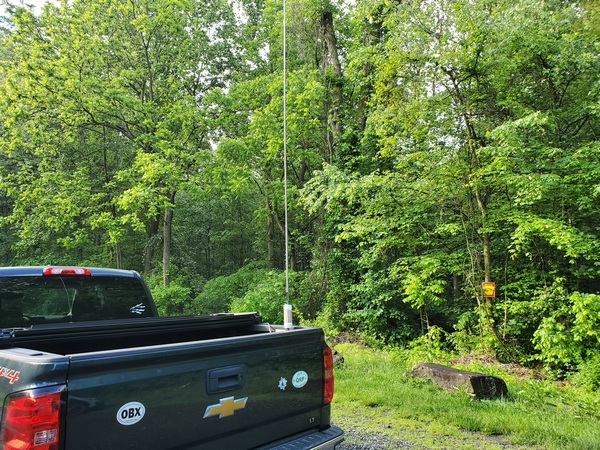
I mounted a 17-foot whip and my homebrew loading coil on my truck and ran some coax back to my operating position. Rig-wise, I used my Penntek TR-35 (5 watts, CW), Elecraft T1 tuner and my little American Morse MS2 straight key.
My strategy today was to operate in the WES for an hour. If I hadn’t reached 10 contacts by then, I planned to break out the paddles and finish up as a POTA activator.
It was a good thing I had a “Plan B.” After an hour, I had only scratched together six WES contacts. I don’t know if it was the unsettled geomagnetic conditions or just a lack of early morning participants, but I didn’t hear much WES activity on 40M and 20M.
After spotting myself on the POTA and WWFF websites, I easily made the requisite 10 contacts on 20M plus three more for good measure. One of those contacts was a park-to-park.
It wasn’t my best outing, but far from my worst. Even with the humid weather and the occasional mosquito, it was nice to do a little outdoor operating and log some familiar SKCC and POTA callsigns.
I recently spent six days out in Central Pennsylvania on house- & puppy sitting duty again. I got to spend some quality time with my grand-dog, Belle, and got in some radio time, too.
Grand-dog, Belle
PA State Game Land 246 (US-8941, KFF-5862)
My first radio outing was early on a Friday morning. Pennsylvania State Game Lands 246 is only about 10 minutes away, so it’s perfect for a quick activation. With an active geomagnetic field, the propagation didn’t look at all promising. I ignored all that and headed out the door. As I was leaving, Belle thought we were going for another walk. Needless to say, I had a very disappointed German shepherd at the window watching me leave.
The parking lot at SGL246 was empty when I got there. I set up my 12-foot whip and homebrew loading coil, along with my trusty Penntek TR-35 (5 watts, CW). I spent the whole activation—and it was a short one—on 40M.
State Game Lands 246 (US-8941, KFF-5862)
Given the band conditions and the early hour (around 0745 local) on a weekday, I got off to a slow start. My big issue was the local power line noise. Before I started, I tuned around 40M to find a frequency where the noise was lower. Despite the band conditions and noise, I seemed to be getting out well enough, and the received signals were fairly strong.
After 30 minutes on the air, I finished up with 14 contacts. I packed up my gear and headed back to take Belle for that walk. After that, I think she forgave me for leaving without her.
And Then the Rains Came
Bright and early Saturday morning, I took Belle through the basement to let her out in the backyard. I found myself splashing through puddles of water in the rec room, and the sump pump was running like crazy.
We had some severe thunderstorms the previous night, and according to the local news, we received close to two inches of rain overnight. So, much of the day was spent cleaning up and drying out instead of playing radio. Fortunately, my (far) better half drove out for the weekend and helped with the cleanup effort.
Capt. John Smith Chesapeake National Historic Trail (US-4567)
When I woke up Sunday morning, I saw we were in the midst of a severe geomagnetic storm. Some hams on a local repeater were complaining about the poor conditions on the HF bands. So, what did I do? I headed out for an early morning QRP POTA activation.
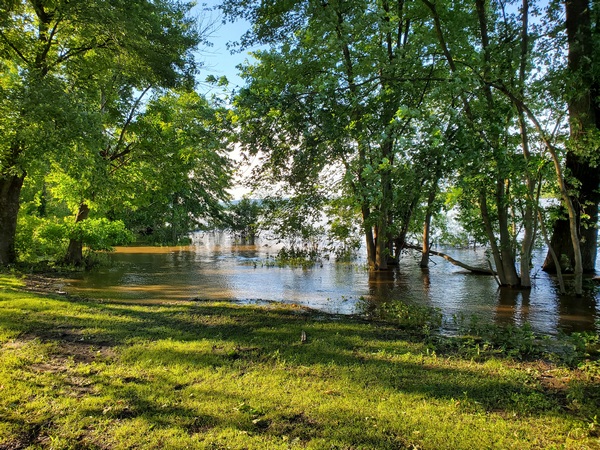
For this water trail, I went to a public boat launch on the Susquehanna River. The river was still slightly flooded from the recent rainstorms, but the water hadn’t reached the parking lot.
Some minor flooding on the Susquehanna River
Given the poor band conditions, I used my homebrew loading coil and a 17-foot whip instead of my usual 12-foot whip. I was hoping the additional five feet would help my 5 watt signal punch through the geomagnetic storm.
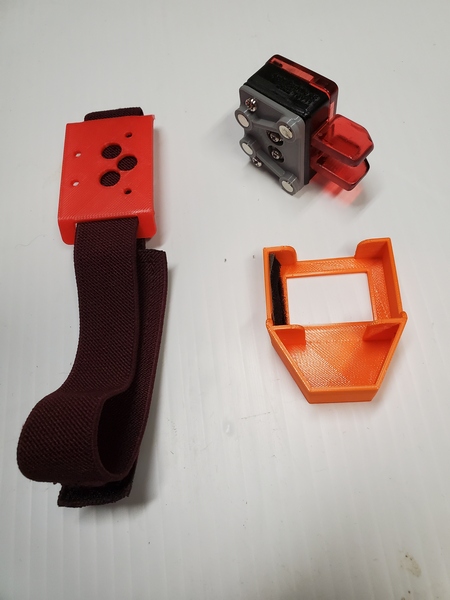
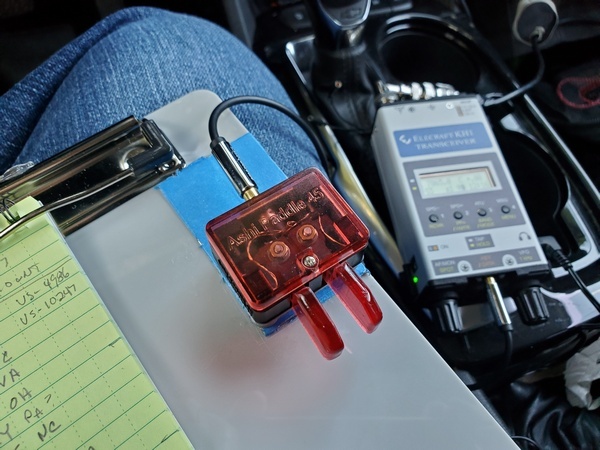
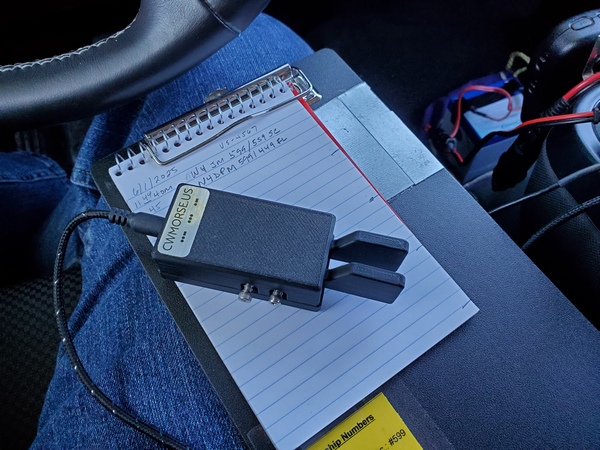
I also used my brand new Pocket Paddles from CWMorse. I neglected to order one with magnets, so I couldn’t attach it to my clipboard. However, I think I have a plan to address that as a future project. On the air, the Pocket Paddles performed flawlessly, and I’m looking forward to using them a lot more in the future.
CWMorse Pocket Paddles
After my third CQ call on 40M, I quickly logged my first two contacts. The contacts kept coming, but at a slow pace. After nine contacts, I thought that the tenth one might never come. Fortunately, it did. After 45 minutes, I ended up with 12 contacts, including one park-to-park. Not bad for a severe geomagnetic storm. I packed up and headed to a grocery store to pick up a few things for breakfast back at the house.
And Back to PA SGL246
On Monday morning I made another trip over to PA State Game Lands 246. There was a major geomagnetic storm in progress, so I knew this would be another challenging activation.
The parking lot was empty the whole time I was there. No big surprise, given that it was early on a weekday. I went with the same set-up as yesterday, opting for the 17-ft whip.
With a K Index of six and the usual power line noise, it was slow going on 40M. It took a few minutes of continuous CQing to log my first contact. It took almost 45 minutes to get seven in the log. At that point, things stalled for a bit. Around that time, I received a NOAA email alert saying the K Index had increased to seven.
I had allotted an hour for this activation, and I was getting close to the end. Then, out of nowhere, I had three callers in rapid succession that got me to 10 contacts. For good measure, there were three more after that.
I finished up with 13 in the log, with one known park-to-park contact. So, my little five-watt station managed to pull it off again. Take that, Mr. Sun!
And with that, I wrapped up my activations out here. Radio-wise, the band conditions were challenging, but it was still fun. I might be back in central Pennsylvania for another round of puppy sitting next month—with better band conditions, I hope!
I needed another mini straight key like a hole in the head. With my fascination for these things, however, I just couldn’t help myself.
The key in question came from AliExpress and cost me about $18 USD. Although it has no markings on it, it appears to be from the same manufacturer as the QU-21C paddles I bought a while back. The basic design is the same as the QU-21C, and it came with identical packaging and accessories. After modifying the magnetic base, the paddles have served me well. So I took a chance on the look-alike straight key.
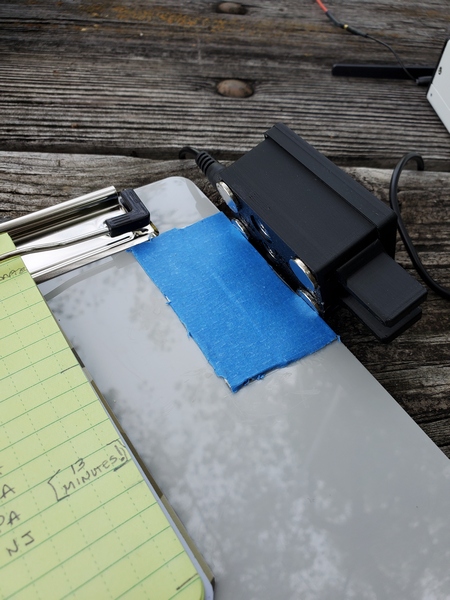
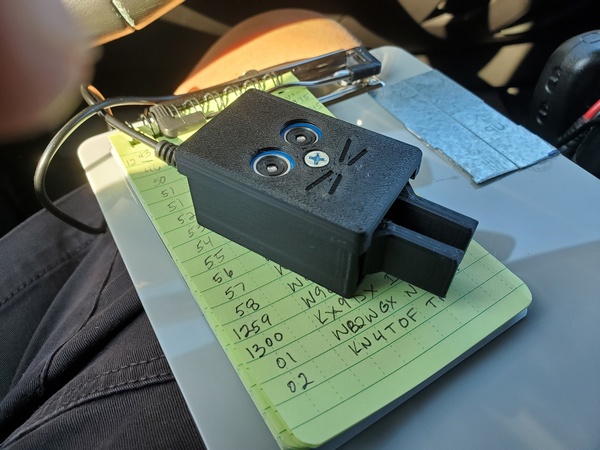
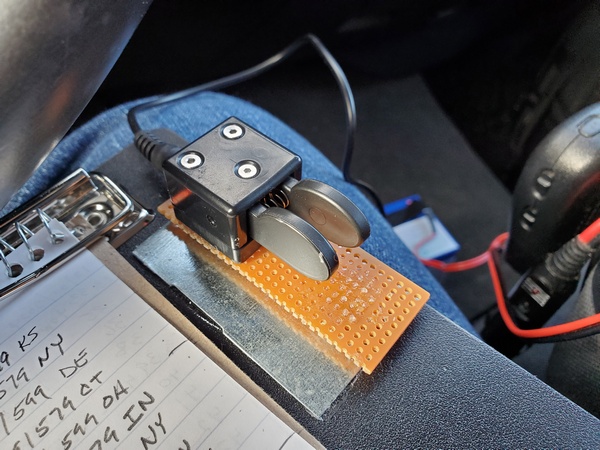
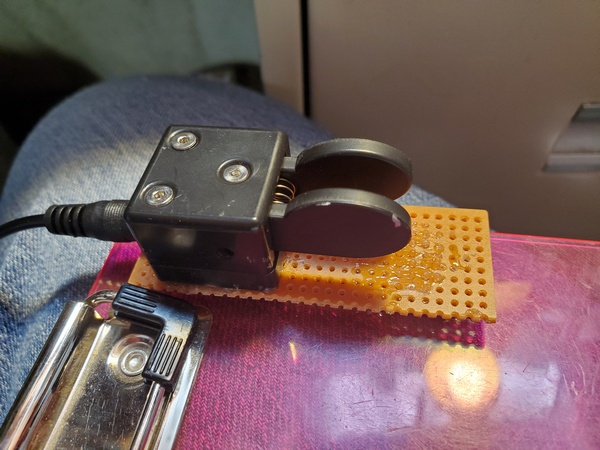
My no-name mini straight key from AliExpress during a recent portable outing. The key is magnetically attached to steel strips I glued to my clipboard.
Out of the box, the straight key’s contact spacing was a little wide for my taste. Using the included Allen wrench, I adjusted the key more to my liking. For a cheap key, it has a pretty good feel to it, and it keys cleanly.
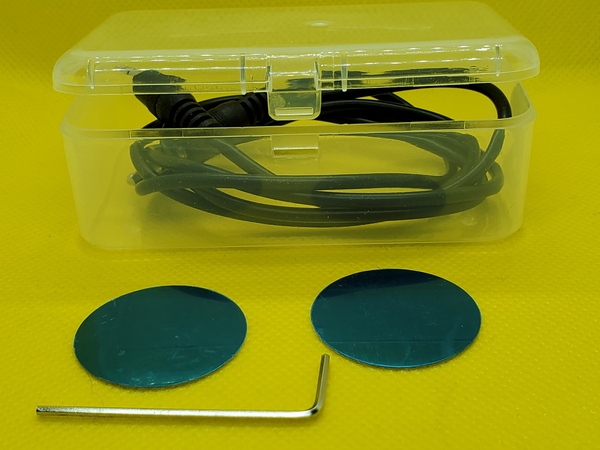
The accessories that came with the mini straight key. (Not shown is an adhesive rubber square that I attached to the bottom of the key.)
Based on my experience with the QU-21C paddles, I had some reservations about the highly polished square magnet on the bottom. However, since the motion of the straight key is the vertical plane instead of side-to-side, the magnet is less of an issue.
I used the key during a recent outing, and I had no major issues with it. I have some a couple of steel strips glued to my clipboard, and I stuck the key there. There was a little movement, but nowhere near as bad as the paddles. I just needed to make sure I didn’t get too vigorous with my keying. After I use them some more, I’ll decide if I want to modify them like I did with the paddles.
Most of the time I get what I pay for, but in this case, I think I got a decent product for the price. I let you know if my opinion changes with time.
I was out in central Pennsylvania over the past weekend for our family’s belated Thanksgiving get-together. Before we left for home on Sunday, I squeezed in a quick early-morning POTA activation. This time, I drove down to Falmouth Boat Launch to activate the Captain John Smith Chesapeake National Historic Trail (US-4567).
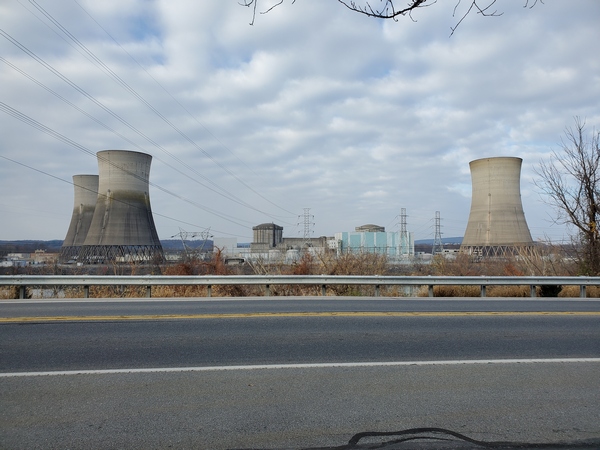
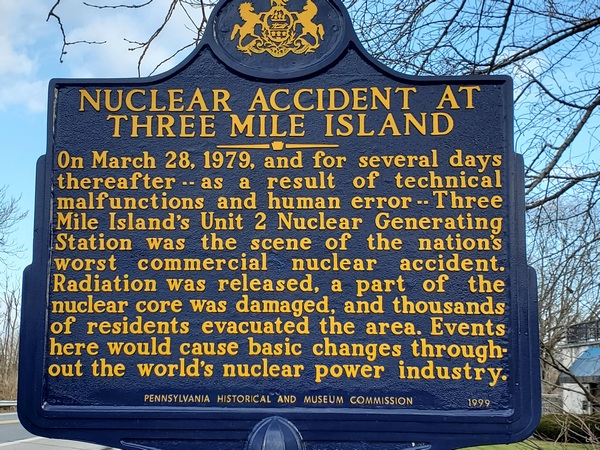
The Falmouth launch is about two miles downstream from the infamous Three Mile Island Nuclear Generating Station. I was here once before back in 2018. However, I had forgotten that this water trail includes the entire length of the Susquehanna River. (I have since uploaded that log to the POTA website.)
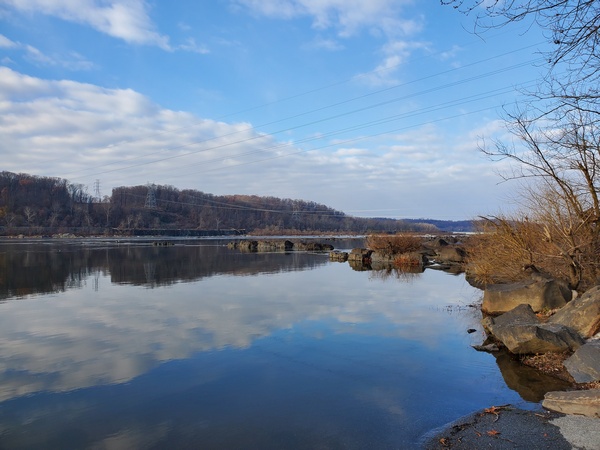
Susquehanna River
It was about 20F (-7C) when I headed out for the 15-minute drive to the site. The parking lot was nearly empty, so I was able to park in a spot that fell within the 100 feet guideline. I had previously used Google Earth to measure the distance to the river.
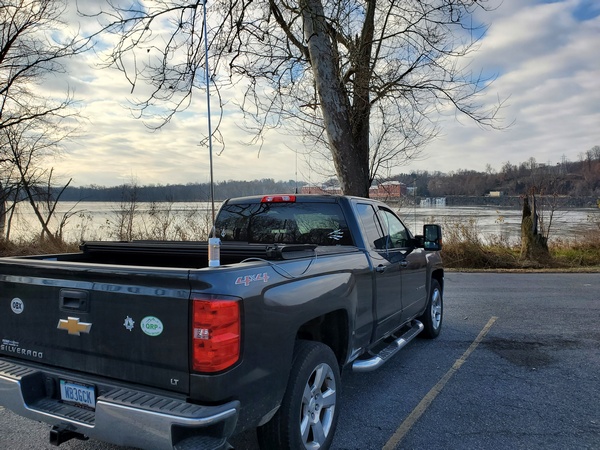
WB3GCK along the Susquehanna River on a sub-freezing morning
I quickly put up my 12-foot loaded whip (before my fingers got numb) and set up my Penntek TR-35 (5 watts CW). Thankfully, the sun and my body heat brought the cab of the truck up to 40F (4C) in short order.
The conditions on 40M were amazing. The first two stations answered my CQs before I had even spotted myself. When I finally posted my spot, I had a huge pile-up. There were a lot of early risers out there, so Craig was a very busy boy for the first 15 minutes or so.
I gave the cheap QU-21C paddles a real workout this morning. My quick and dirty magnetic mount held perfectly, and the paddles worked great. They’ll be seeing a lot more use in the future.
QU-21C Mini Paddles with my quick & dirty magnetic mount. This clipboard has some thin, steel strips, instead of the steel washers I had been using.
After 33 minutes on the air, I had worked 32 stations, all of them on 40M. I had one known park-to-park.
Then, it was time to head back to my daughter’s house for breakfast. On the way, I pulled over to take some pictures of Three Mile Island. I also saw another boat launch that I’ll have to check out further.
When I bought the QU-21C Mini Paddles a while back, I wasn’t crazy about the small square magnet attached to the base. It didn’t seem to hold very well. When subjected to vigorous keying, the paddles would sometimes move side-to-side. I came up with a quick and dirty hack that resolved the issue for me.
A little backstory is in order. I’ve never been a big fan of “two-handed” keying; that is, holding the paddles in one hand while sending with the other. I modified a small clipboard by gluing two steel washers to it, such that they lined up with the two magnets in my Palm Mini paddles. The clipboard securely holds the paddles and gives me a nice writing surface for logging in the field. I’ve been using clipboards like this for about 10 years now.
In just a few minutes, I modified my QU-21C paddles to adapt them to my clipboards and make them more suitable for “single-handed” keying. The first order of business was to remove the square magnet from the bottom of the paddles. That was almost too easy. I wedged a knife blade between the base and the magnet, and the magnet popped right off.
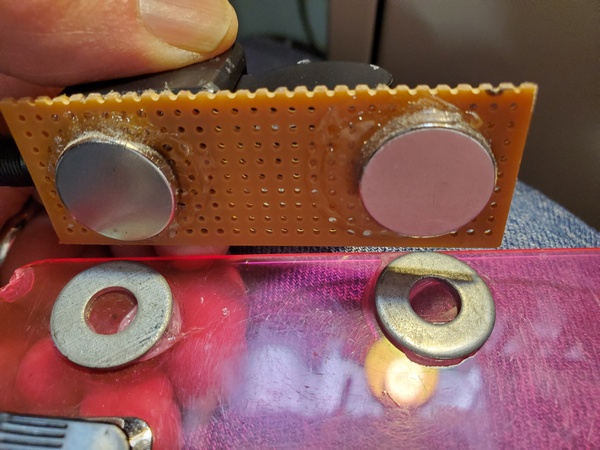
Magnets glued to the underside of the perf board to line up with the steel washers on my clipboard
Next, I took some perf board from my junk box and cut off a 3.5 x 1 inch piece. I used some Goop® adhesive to attach two magnets on one side of the board. I placed them so they had the same spacing as the magnets on my Palm paddles. Then I glued the QU-21C paddles to the other side of the perf board. Except for the drying time for the adhesive, I completed the project in about 10 minutes.
The QU-21 paddles glued to the perf board and ready for use
The magnets I used are really strong and probably overkill for this application. But, I had a bunch of them on hand, so I put them to use.
Admittedly, this cheesy little hack doesn’t look like much. If I feel ambitious sometime, I might come up with something more elaborate. Maybe something like the base I made for my little MS2 straight key. For now, though, this will suffice.
I’ve been toying with the idea of putting together a small radio kit based on my (tr)SDX or something similar, so I’ve been looking at small paddles to go with it. Browsing through eBay recently, I came across several listings for the QU-21C paddles. They were inexpensive, so I thought I’d order them and give them a shot.
These paddles are nothing new; they’ve been around for a few years. (I’m definitely no early adopter.) The QU-21C paddles are made in China and mine are marked with the brand name, Magic Rabbit. From other reviews I have seen, there may be other manufacturers. So, the quality and packaging may vary. I paid about $24 USD from a seller (iDrone) that ships from the U.S., but you can find them listed for less than $20, if you don’t mind waiting for a shipment from China.
Opening the package, I found the paddles are even smaller than I expected. The base is approximately .98 inch by .98 inch (25mm x 25mm) and 1 inch (26mm) tall. The overall length, including the paddles, is 1.9 inches (48.5mm). On my kitchen scale, the paddles weighed in at 1.25 ounces (34 grams). The paddles appear to be 3-D printed, but the quality is pretty good. The base of the paddles is magnetic, which is one feature that first drew my attention.
Magic Rabbit QU-21C paddles with the rubber pad attached to the magnet. The pad looks a little ragged around the edges, because I applied it, removed it, and then decided to put it back on. I messed it up a little in the process.
The package I received included:
Paddles with a magnet attached to the bottom
3-ft cable with 3.5mm stereo plugs on each end
Hex wrench for adjusting contact spacing
Two adhesive metal discs
Adhesive rubber pad
Plastic storage case that holds everything
Some of the accessories that came with it. The cable is inside the clear plastic storage box. The adhesive discs can be applied anywhere, so you can use the attach the paddles magnetically.
My first impression was that the contact spacing seemed a little wider than I like. I used the supplied hex wrench and adjusted the spacing until the contacts were completely closed. Then, I backed off a little.
I prefer a light spring tension on my paddles, but the spring in these paddles seems stiffer than I’m used to. Unfortunately, there’s no adjustment for that. So, I’ll just have to get used to using a little more force than my other paddles.
I’m not sold on the magnetic base, though. The square magnet is fairly strong, but it’s highly polished. So, the paddles sometimes have a tendency to slide when I’m sending. I applied the rubber pad that comes with it, but that seemed to offer only minimal improvement. For now, I just hold them in one hand while sending with the other.
I’ve actually thought about trying to remove the magnet altogether, since it appears to be glued on. At least, it wouldn’t be attracting every ferrous object that comes near it. But, for now, I’m just thinking about it.
The QU-21C paddles during a recent activation, along with my trusty Palm Mini paddles.
I had a chance to use the QU-21C paddles on a recent park activation. It didn’t take long to get used to them, and I had no issues with them at all. The paddles keyed reliably, without missing a single dit or dah.
Even with my spring tension and magnet gripes, I’m pretty happy with these paddles. These cheap paddles look like worthy candidates for field use. We’ll see how well they hold up over time.
During a POTA activation a few days ago, I was in the middle of a QSO when my Palm Mini paddles started behaving erratically. I knew right where to look for the cause of the problem.
The Palm Mini paddles have been my go-to paddles in the field for many years. Although the German manufacturer, Palm Radio, is no longer in business, they are still the only paddles I take along for portable work. They are compact, have a great feel, and work perfectly with the clipboard arrangement I use in the field. I loved the first set I bought and later acquired a second set.
These great little paddles have one weakness: the cable connection. The three-pin connector is similar to standard header pins with a two-piece plastic backshell held together with a tiny screw. Once inserted into the paddles, there’s no locking mechanism to hold it in place. It’s definitely not the most rugged arrangement. After my first encounter with cable issues, I ordered a couple of replacement cables. Sadly, that’s no longer an option.
During my most recent episode of cable problems, the connector backshell had fallen apart, leaving the tiny wires exposed. I grabbed a spare cable and was back in business in short order.
Fortunately, after some searching, I found the two backshell pieces on the floor of my truck. The screw that holds the backshell together goes into a threaded boss, which had broken. I encountered an identical failure on another cable a couple of years ago, so I knew how to deal with it.
After I got home, I carefully checked the wire connections and confirmed that they were still intact. So this time, the fix was just to reassemble the backshell. Since I could no longer screw the two halves back together, I had to resort to drastic measures. I call this the “final fix.” Once implemented, it can’t be undone.
This photo shows the rear of the Palm Mini Paddles (left). On the right is the connector I repaired by gluing it back together. In my haste to repair the cable, I neglected to take pictures of the inside of the connector.
I positioned the connector in the bottom half of the backshell and re-checked the connections. Then, I applied a dollop of Goop™ adhesive inside the backshell and put the top half on. The Goop™ filled the inside of the backshell, holding it all together and providing some additional strain relief for the tiny wires. After cleaning off the adhesive that squeezed out during assembly, I clamped the backshell overnight. The next morning, I gave it a test and confirmed that everything was still working.
I’ve seen webpages describing ways of replacing the fragile connector with something more robust. I’m not quite ready to perform major surgery on my beloved Palm Mini paddles. Someday, I suppose, I’ll have no choice.
Happy Morse Code Day! This annual event honors the inventor of the code, Samuel F. B. Morse, who was born on this day in 1791.
The original Morse telegraph
Nearly 179 years after the famous “What hath God wrought” telegraph message was sent from Washington. DC, to Baltimore, you can still hear plenty of Morse Code on the ham bands. Amazing!
So, in observance of Morse Code Day, get on the air and launch some dots and dashes into the ether.
Along with the usual junk mail yesterday, the mailman brought a couple of envelopes from the Straight Key Century Club (SKCC) QSL Bureau. Among the QSL cards I received, were two special ones.
First was a QSL card confirming contacts I made with K3Y stations during the annual Straight Key Month (SKM) event. SKM is held each January with event stations operating around the world. I didn’t have my best year in the event, but I worked K3Y stations in eight of the ten call areas in the continental U. S. I also worked SKM stations in Puerto Rico and Portugal this year.
K3Y Straight Key Month QSL card for 2023
Each year SKCC members submit designs for the K3Y QSL card, and members vote to select the final design. I always try to work some of the K3Y stations each year to ensure I receive a QSL card.
Another card I received was for the VC3Y Canadian Operating Event. Taking place during the month of September, this is an annual SKCC event that promotes the club’s many Canadian members. This year, I worked VC3Y/VY2 (Prince Edward Island) on 40M and 20M. I remember those particular QSOs because I was out bicycle-portable in a local park at the time.
VC3Y QSL card for the 2022 Canadian Operating Event
Sadly, when the mailman came by today, it was back to the usual junk mail.